Bob “The Nailer” Swagger is back in Stephen Hunter’s new novel, I, Sniper. Released at the end of 2009, Hunter’s new Bob Lee Swagger story has earned praise as “the best Stephen Hunter book in years.”
In I, Sniper, four Vietnam-era peaceniks are shot dead and retired military sniper Carl Hitchcock is framed for their murders. (The Hitchcock character is based, as you’ve guessed, on famed USMC sniper Carlos Hathcock). Swagger soon realizes that Hitchcock, a fellow ex-Marine and Vietnam vet, is innocent, while the real killer, who’s using high-tech, electronic sniper gear, is still at large. Swagger sets out to find the actual shooter.
If you liked Hunter’s Point of Impact, you’ll probably love the new book. The plot is compelling and Bob Lee Swagger remains the ultimate marksman/crime solver. Hunter, an avid shooter and Pulitzer-prize-winning journalist, knows his firearms, so the gunfights and other action scenes are believable, and the discussions of long-range shooting and ballistics are correct.
One of the best things about I, Sniper is that Hunter takes on the liberal media. One character is a New York Times reporter, who is used as a foil to show the ignorance of the mainstream media about gun matters. In an interview with American Rifleman magazine, Hunter explains: “One of the themes in I, Sniper is how an extremely sophisticated news organization can make a really stupid gun error and have no idea that they’re doing it. How can you be so certain of your politics if you have such an infirm grasp of the reality of the instrument (firearms). You know, maybe if your grasp of the reality of the instrument is ludicrously incorrect, maybe your grasp of the politics of the instrument is ludicrously incorrect [also], and you want to re-examine both issues.”
Below is Michael Bane’s DownrangeTV VIDEO Interview with Stephen Hunter:
If you’re thinking about buying this book, read some of the 50+ reviews on Amazon.com. Most reviews are four-star or five-star, but some folks feel Hunter’s writing is sloppy in places and the book should have been more tightly edited. Other critics say Hunter gets “too political” in this book. This Editor believes the jabs at the liberal media are one of the book’s better features. I suspect Hunter’s viewpoints will be welcomed by most of his readers. Here are representative reader reviews from Amazon.com:
This book is classic Bob Lee Swagger. Great read. Also, as a gun owner and 2nd Amendment supporter, I love the not-so-subtle-jabs at the liberal media and their woeful understanding of the south, gun culture, law abiding citizens who own guns legally. [Hunter] picks on the New York Times, which is hilarious and accurate. Great job Mr. Hunter.
Hunter is at his best in I, Sniper. Dialogue? Crisp, real, down to earth, and sometimes hysterically funny. Action? Have a box of Depends at the ready. Technical support? Pay attention. Reading Hunter is like taking a Master’s course in armament.
On Media Day, just prior to SHOT Show 2010, our Assistant Editor Jason Baney headed straight to the biggest, baddest rifles he could find — a pair of serious-looking tactical rigs from Barrett Rifles. First off was the mighty semi-auto Barrett 82A1, chambered in .416 Barrett. a “beast of a cartridge” according to Jason. The .416 is a very powerful chambering, and you can see the recoil pushed Jason pretty hard. That’s serious energy — Jason’s a big boy, and the Barrett 82A1 weighs nearly 31 pounds. Want one? You may have to liquidate some investments. MSRP on the Barrett 82A1 is a whopping $9345.00.
Ninety-Eight Bravo in .338 Lapua Magnum
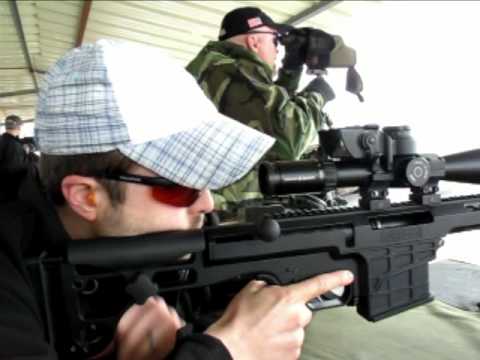
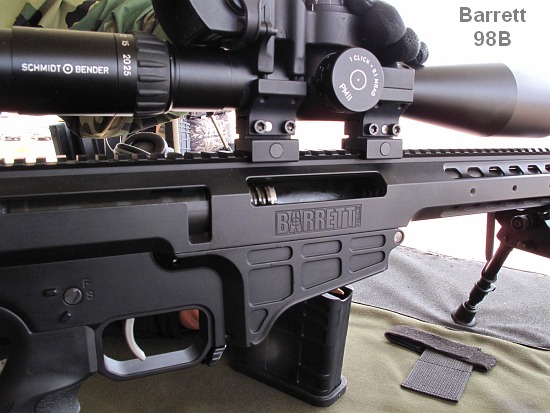
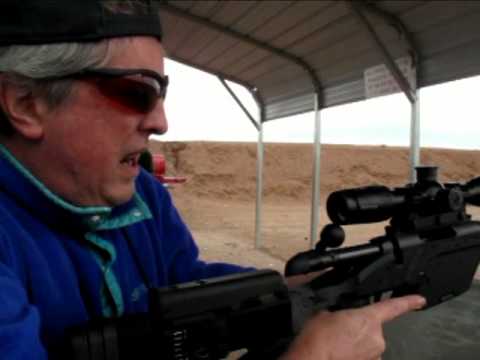
Next up was Barrett’s bolt-action model 98B (“Ninety-Eight Bravo”), chambered in .338 Lapua Magnum. At less than half the weight of the Barrett 82A1, the 98B was much easier to steer on the bench and the ergonomics were generally better according to Jason.
While recoil from the .338 Lapua Mag was stout, you can see in the video that the .338 LM kicked much less than the .416 Barrett, even in a gun with less than half the mass. The 98B gives you a good solid thump to the shoulder when firing. By contrast, the .416 Barrett in the 82A1 shakes your whole body. The 98B weighs 12.4-13.5 pounds (depending on configuration) and starts at $5039.99 without optics. Speaking of optics, the hooded display on top of the 98B is a Barrett Optical Ranging System (BORS). This $1500.00 gadget provides a digital read-out of your actual ballistics settings. It doesn’t control windage and elevation — that is still done manually with the scope knobs. BORS is an integrated electronic ballistic computer that mounts directly on the riflescope and couples to the elevation knob. Just turn the elevation knob until the LCD displays the target’s actual range (which must be pre-determined). The BORS’ three internal sensors automatically calculate a ballistic solution, compensating for up/down angle, temperature, and barometric pressure changes. It even tells you if the rifle is canted. It’s a handy device that eliminates the possibility that you loose track of your turret settings.
At the Media Day rifle venues, “Tactical” rifles were definitely the featured attraction. There were, of course, many AR-based black rifle offerings, but the purpose-built, precision bolt guns really were the stars of Media Day this year. Savage has a new .338 Lapua Magnum, its first ever. SAKO unveiled an impressive new .338 TRG with front rails and a very sophisticated folding stock (more on that later). Barrett had some thundering big boomers on display. You could feel the compression from the muzzle blast on the new .416 Barrett a dozen feet away. JP Enterprises had its handsome new MOR-07 on display. This features an aluminum chassis with either tubular or square 2×4-style fore-arm, plus a buttstock that looks like the Magpul AR stock. JP’s new MOR (Manually Operated Rifle) is offered either as a chassis to fit Rem footprint receivers, or as a $4499.00 complete rifle.
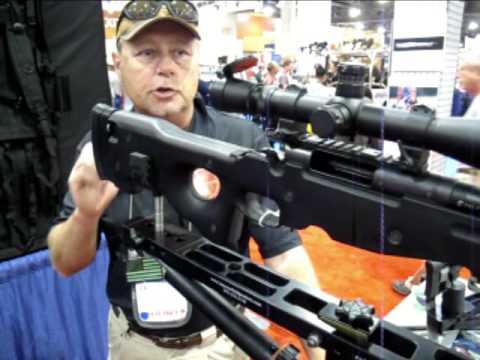
Though there were many impressive domestic tactical bolt guns, one of the nicest overall designs, in this Editor’s opinion, came from Austria’s Steyr Arms. The new Steyr SSG 08, shown below, features an advanced folding stock that is solid in the locked position while offering full adjustability of comb height and length of pull. The pistol grip was one of the most comfortable I’ve tried. The SSG 08 features a unique, 3-position triggersafety. In the “full safe” position, a positive pop-up selector locks the safety in place and actually blocks the firing pin. The detachable box magazine can be secured in two positions. In the first, the magazine is fully retained in the gun but you can cycle the bolt without picking up or extracting a round.
While the SSG 08 had all the tactical bells and whistles (such as forearm rails and 10-round magazine), it was the overall execution and competence of the weapon that impressed me. The design was well thought out — there were no “rough edges”, and everything, from the buttstock hinge to the mag release, functioned smoothly (and quietly). What separated the SSG 08 from most of the competition was the quality of the trigger. Many of the tactical rifles had very, very heavy trigger pulls with lots of over-travel. The Steyr SSG 08’s trigger was crisp and light. Shooting this gun was a pleasure. One noticed the attention to detail in every element of the rifle. We are told that Steyr received input from Austria’s Special Forces on this rifle. We aren’t surprised. With the SSG 08, one can see that real marksmen were involved in the design.
Our “master fabricator” and silhouette guru Mark LaFevers recently attended the SoCal Precision Rifle Competition, Mark’s first-ever tactical match. Competition was fierce at this year’s SCPRC. The match winner, and “top gun” among the 50+ competitors was Sgt. Dan Gilland, (USMC), a scout-sniper from a nearby Marine base. This was only Dan’s second civilian match and yes, the young Marine was shooting a .308 Win (7.62×51 to be precise). Jason Boak took second place while Gordon Campfield finished third. Jason was the top shooter among the NorCal guys, who did well, capturing 6 of the top 10 places, earning California intra-club bragging rights.
Mark told us that the match was a humbling yet very fun experience. In these kind of matches very few, if any, sighters are allowed, and you’re often shooting at unknown distances. Accordingly, it is imperative that you have rock-solid come-ups at all distances, before you arrive at the match. In addition, the SCPRC offered the challenges of angled shooting (requiring ballistic compensation), and lowlight shooting. Log on to the CalGuns.net Forum for a complete match report by NorCal shooter Vu Pham, with lots of photos, plus stage descriptions (match directors take note).
A wide variety of calibers were shot at the match, and Mark observed that no one chambering seemed to have the edge (though a .308 finished on top). However, most of the top shooters were running detachable magazines, and had barrels fitted with muzzle brakes. You can see the dust kicked up from the muzzle brakes in the video below. The first part of the video shows a stage where competitors had to start with standing (off-hand) shots, then transition to a stepped barricade, moving lower and lower as the timer ticked off the seconds. For the standing stages, Mark noted, you wanted a rifle that balanced well and was not too heavy. Some of these beefy tactical rifles, optimized for prone work, are tough to hold offhand.
We had a chance to check out the SPEC-REST from Lone Star Field Products at the NRA Meeting in Phoenix. This is one solid, well-built piece of kit, we can assure you. The SPEC-REST is finely engineered, and very smooth in operation (both elevating and traversing). To be honest, the spec-rest makes some other stamped metal portable shooting platforms look like kids’ toys. The main beam is solid metal and all the adjustment controls are well-placed and sturdy. A SPEC-REST is not going to bend or break under hard use. This rig was designed from the ground up to work with even the heaviest-recoiling calibers, such as 338 Lapua Magnum and 50 BMG. The unique design of the SPEC-REST even helps it dissipate recoil when shooting the “big boomers”.
Our Assistant Editor, Jason Baney, currently has a SPEC-REST plus low-profile Lone Star Quad base for testing and evaluation. The photo above shows the SPEC-REST on the Quad base which can be adjusted low enough to allow use on a bench. To view Lone-Star’s SPEC-REST in action, watch the video below. Lone Star President Robert Black puts a tripod-mounted SPEC-REST through its paces. I think you’ll be impressed… this Editor was.
Our own Asst. Editor, Jason Baney, runs a popular “postal match” called “Smack the Smiley”. Four times a year (Spring/Summer/Fall/Winter) you can shoot an official target at your own range, and then submit it for judging. Over $2000.00 in prizes will be awarded for each 2009 seasonal match. You can compete with shooters from across the continent.
Jason started the Smiley matches in 2004. Since 2006, a share of monies collected from entry fees have been donated to American military marksmen via AmericanSnipers.org. These donations have totaled over $5000.00.
Jason is accepting entries for the current Spring Match. Order your targets now. The Spring Match officially starts April 13, 2009. Your finished Spring targets must be returned (postmarked) by May 26, 2009. Targets will be scored and ranked on shooting forums including SnipersHide.com, West Coast Tactical, SnipersParadise, and the main contest site, SmackTheSmiley.com
Smack the Smiley Prizes
Prizes donated by manufacturers are raffled off, lottery-style, after each match. This means that every participant has a chance at winning a valuable prize. The prize list totals over $2000.00 in value for each Smack the Smiley match. You’re smart to shoot all four seasonal matches (Spring/Summer/Fall/Winter). A four-match Aggregate will be tallied this year with a possible prize for the Aggregate winner.
● There are two classes, rimfire and centerfire, with no other rifle restrictions. Rimfire guns shoot at 50 yards, while centerfire rifles shoot at 100 yards.
● All rifles must be shot from the ground, either sitting or prone position, with NO tripod rests allowed. Only bipods or other field expedient rests are allowed.
● You must shoot official targets only, ordered from SmackTheSmiley.com. These cost $3.50 each with a max of 4 targets per class. One dollar ($1) from each target goes to Americansnipers.org.
At the U.S. Army’s Aberdeen Proving Ground, a team of ballistics technicians, supported by some of the U.S. Army’s top sniper instructors, has been quietly developing a radical new “dimpled” bullet. The exterior of the bullet resembles the dimpled surface of a golf ball. The function of the special dimpled skin is to reduce projectile drag, providing a flatter long-range trajectory, and greater retained energy at the target.
.338 Projectile with MIM Exo-Jacket (3D-CAD Artist’s Rendering)
In their pursuit of a lower-drag bullet, the Army tried a variety of designs, including bullets with circumferential drive bands, dual-radius ogives, and rebated boat-tails. The dimpled “golf-ball” design was considered a “long shot” according to the design team, but it has performed beyond all expectations. The nominal drag coefficient (Cd) has improved by about +.040, while cartridge muzzle velocity has increased by nearly 80+ fps because the bullet’s dimpled skin reduces in-barrel friction. What’s more — the terminal performance of the dimpled bullet has been “spectacular”. The Aberdeen team set out to produce a slightly more slippery bullet for U.S. Army snipers. What they ended up with is a bullet with dramatically enhanced long-range ballistics and superior killing power on “soft targets”.
Lt. Col. Ben Eldrick, Long-Range Projectile Project (LRPP) team leader, told AccurateShooter.com how the radical bullet was conceived: “During our initial design work, we wanted the benefits of a high-BC, pointed bullet, but in a design that could be mass-produced and could work as a tracer. We consulted some of the top civilian bullet experts, including ballistician Bryan Litz of Berger Bullets. Mr. Litz really got the ball rolling. He suggested that the ‘next big step’ in bullet design would involve the turbulent boundary layer over the body of the bullet. Litz told us that ‘pointing bullet tips will take you only so far… think about optimizing the airflow over the entire bullet’. That made a lot of sense to us. When you design a race car to be aerodynamic, you sculpt the whole body, not just the front bumper.”
Lt. Col. Eldrick continued: “It turns out Litz was right on the money. By employing a golf-ball type dimpled surface, we were able to optimize the turbulent boundary layer on the bullet body. This reduced the low-pressure wake zone behind the bullet significantly, resulting in reduced base drag. As a result the bullet experiences much less overall drag, effectively raising the BC.” The Army team had discovered that what works for golf balls also works for bullets.
After testing a series of prototypes, the Aberdeen bullet design team settled on a copper-jacketed bullet with dimples about 0.5 mm in diameter. The first-generation bullets were formed in special binary impact swages that press-form the dimples after the bullets were pointed up in conventional dies. Future production bullets will be made with an advanced metal-injection-molding (MIM) process that forms the dimples directly into the surface of the bullets. Rather than simply wrap the core material (which is classified), the MIM is molecularly bonded to the core. The Aberdeen LRPP team calls this “Exo-Jacket” construction, as in “Exo-Skeleton”.
Higher Velocities Achieved
There was a surprise benefit of the dimpled bullet design — higher muzzle velocities. Given the same powder charge, dimpled bullets exit the muzzle faster because they produce less in-barrel friction than do conventional bullets. This is because the recessed dimples effectively reduce the metal-on-metal bearing surface. Lt. Col. Eldrick revealed: “the added velocity was an unexpected bonus. With equal-pressure loads, dimpled .308 bullets will fly about 80 fps faster than normal .308 bullets. With the large .338-caliber projectiles, the difference is even greater… we can pick up nearly 150 fps.” Given the observed velocity gains achieved with dimpled bullets, Aberdeen designers are now working on dimpled shell casings for larger artillery projectiles.
Dimpled Jacket Delivers ‘Explosive’ Fragmentation
While the internal design and core materials of the new dimpled bullet remain classified, the design team revealed that the terminal performance of the new bullet has been “spectacular”. The bullet penetrates like a FMJ but then explosively fragments, resulting in a devastating energy release in the target. According to Capt. Jack Sarazen, an Aberdeen engineer, “the enhanced terminal performance of the dimpled bullet was unanticipated. This was a serendipitous effect of the slight thinning of the jacket material where the dimples are pressed.” Sarazen explained: “Most FMJ bullets break along the cannelure and then fragment into two or three large pieces. With the dimpled bullets, you have multiple fragmentation points so the bullet literally blows up like a grenade in the target.”
Nightforce Optics has just released a new first focal plane (FFP) scope, the 3.5-15x50mm F1. This scope, developed with input from the U.S. Military, should be ideal for tactical applications. The scope is available with Zero-Stop windage and elevation knobs calibrated in 0.10 Mil-Radian increments. When combined with Mildot or MLR reticles in the first focal plane, the Milrad knobs permit easy and precise ranging and holdovers. (Turrets with 1/4-MOA clicks are also available.)
The big news is the first focal plane engineering — something new for Nightforce. The advantage of the first focal plane design (also called “front focal plane”) is that the reticle size remains constant relative to the target’s dimensions at ALL magnifications. With a first-focal-plane reticle, the ranging marks, such as mildots, stay in synch with the target image at any zoom level. This allows the shooter to range targets and judge hold-offs at any magnification. As Zak Smith explains: “In variable power scopes, a first focal plane (FFP) reticle configuration means that the angular measure of the reticle features stays constant. No matter what magnification [the scope] is set at, 1 MOA will be 1 MOA and 1 MIL will demarcate 1 MIL.”
This scope is made in the USA. It is in short supply right now but Mike at CSGunworks.com has two units in stock, priced at $2290.00 including MLR reticle, Milrad turrets, and Nightforce UltraLite Rings. Those two scopes will sell quickly but Mike should have more inventory before Christmas. Call Mike at (916) 670-1103 for availability (price subject to change).
Ken from Nightforce Optics has announced that supplies of the new 3.5-15×50 F1 will be very limited for the next 4 to 6 months because Nightforce is fulfilling U.S. Army contracts. Ken notes that: “this new model riflescope, in the Mil-Spec version, is currently in use by several U.S. Army Special Forces groups.” Ken provided these details about the new Nightforce F1:
Product Information for the NXS 3.5-15x50mm F1
Manufacturer’s Suggested Retail Price is $2,410.00
Standard Features Include:
1) ZeroStop
2) Illuminated reticle
3) Side parallax adjustment
4) Set of Nightforce Ultralite 30mm medium rings, (limited time only)
Reticle Options:
1) Two mil-radian reticles are currently available: The Mil-Dot and MLR
a. Thin-line subtended measurement equals .250 MOA
2) Proprietary MOA type reticles will be available in the future. (Within the next four to six months)
Adjustment Options:
1) .250 MOA elevation and windage adjustments, ZeroStop
2) 1.0 MOA elevation and 1/2 MOA windage adjustments, ZeroStop
3) .10 Mil-Radian elevation and windage adjustments, ZeroStop
Ken adds: “Considering the fact that we will only offer the Mil-Dot and MLR reticle options in the short term, we believe the Mil-Radian adjustment option will be the most popular of the models listed above for the short term.”
First Focal Plane vs. Second Focal Plane Optics
If first focal plane design is better for ranging, one might ask “why aren’t all scopes made this way?” Well, there are tradeoffs. When shooting at known distances, if you’re trying to aim with extreme precision on a tiny X-Ring, you don’t want the cross-hairs to appear thicker as you turn up the magnification. With first focal plane reticle configuration, the reticle increases in thickness, as viewed by the shooter, as magnification increases. This means that, at higher powers, the reticle lines and mildots/hashmarks may obscure very small targets at long range. For a more complete discussion of the pros and cons of first focal plane vs. second focal plane designs, read Optics for Practical Long Range Rifle Shooting by Zak Smith.


 Bob “The Nailer” Swagger is back in Stephen Hunter’s new novel, I, Sniper. Released at the end of 2009, Hunter’s new Bob Lee Swagger story has earned praise as “the best Stephen Hunter book in years.”
 One of the best things about I, Sniper is that Hunter takes on the liberal media. One character is a New York Times reporter, who is used as a foil to show the ignorance of the mainstream media about gun matters. In an interview with American Rifleman magazine, Hunter explains: “One of the themes in I, Sniper is how an extremely sophisticated news organization can make a really stupid gun error and have no idea that they’re doing it. How can you be so certain of your politics if you have such an infirm grasp of the reality of the instrument (firearms). You know, maybe if your grasp of the reality of the instrument is ludicrously incorrect, maybe your grasp of the politics of the instrument is ludicrously incorrect [also], and you want to re-examine both issues.”






 Our own Asst. Editor, Jason Baney, runs a popular “postal match” called


 Lt. Col. Ben Eldrick, Long-Range Projectile Project (LRPP) team leader, told AccurateShooter.com how the radical bullet was conceived: “During our initial design work, we wanted the benefits of a high-BC, pointed bullet, but in a design that could be mass-produced and could work as a tracer. We consulted some of the top civilian bullet experts, including ballistician Bryan Litz of Berger Bullets. Mr. Litz really got the ball rolling. He suggested that the ‘next big step’ in bullet design would involve the turbulent boundary layer over the body of the bullet. Litz told us that ‘pointing bullet tips will take you only so far… think about optimizing the airflow over the entire bullet’. That made a lot of sense to us. When you design a race car to be aerodynamic, you sculpt the whole body, not just the front bumper.”
 After testing a series of prototypes, the Aberdeen bullet design team settled on a copper-jacketed bullet with dimples about 0.5 mm in diameter. The first-generation bullets were formed in special binary impact swages that press-form the dimples after the bullets were pointed up in conventional dies. Future production bullets will be made with an advanced metal-injection-molding (MIM) process that forms the dimples directly into the surface of the bullets. Rather than simply wrap the core material (which is classified), the MIM is molecularly bonded to the core. The Aberdeen LRPP team calls this “Exo-Jacket” construction, as in “Exo-Skeleton”.
 Higher Velocities Achieved


