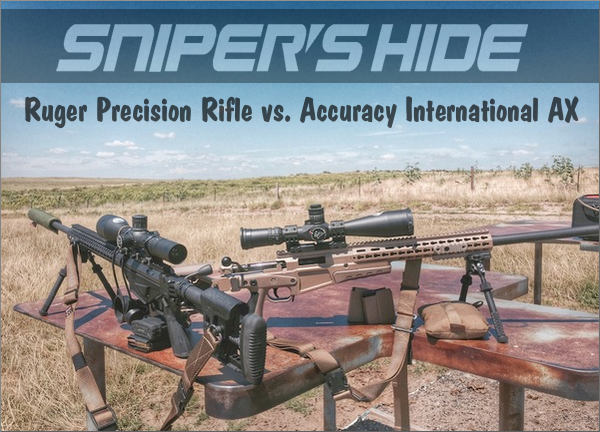
Can a $1300 Ruger compete with a $7000 high-end sniper rifle from the UK? That was the question posed a few years back by Frank Galli, Head Honcho of Sniper’s Hide. Galli, aka “Lowlight”, conducted an interesting comparison test, running the $1300 Ruger Precision Rifle (RPR) vs. a $7000 Accuracy International AX in a 450-yard “mad minute” drill. The goal was to see how many shots could be put on a 12″ steel target in one minute. Both rifles were chambered for the 6.5 Creedmoor and were fed with Hornady 140gr Amax ammo. The much cheaper Ruger did surprisingly well, though the AI AX did come out on top. Galli got 19 rounds on target in one minute with the AI AX compared to 14 rounds with the Ruger.
Watch the “Mad Minute” face-off in this video:
Galli notes: “The target is 450 yards away, and, as noted in the video, we have winds gusting anywhere from 10 to 18 mph out on the Front Range of Colorado today. So my job is to not only hit the target as fast as possible, but to also manage the conditions.”
In Summary
Frank Galli says the Ruger offers a lot of bang for the buck:
“For those looking to get into competitive tactical shooting, like a PRS Event, there is absolutely no excuse. This rifle will allow you to be competitive, the only thing that would hold a person back is themselves. The more this rifle is shot, the more impressive it is. Would I trade my Accuracy International for one? Well, odd question, but no. However for those on a budget I would recommend the Ruger in a heartbeat.”
Upgrades for Ruger Precision Rifle — RPR Enhancements
After conducting this test, Galli added some upgrades to his first-generation RPR, with bolt-on parts. Improvements included new barrel, stock, grip, and handguards. The first video below runs through the selection and installation of parts, while the second video shows the upgraded RPR being tested in the field. These two videos have been watched over half-a-million times combined. Note, the current-generation RPR has different handguards than shown in the photos.
Magpul MOE Grip
Magpul PRS Stock
Seekins Precision “Triangle” Handguards
LongRifles Inc. (LRI) Aluminum Bolt Shroud
Custom K&P “Pre-Fit” Barrel from LRI (chambered in 6.5 Creedmoor)
Sniper’s Hide offers a training class for novice shooters getting started in the PRS/NRL precision rifle game. This Precision Rifle Fundamentals course covers equipment selection, using shooting supports, rifle handling, SFP scope basics, and much more. The Precision Rifle Network video below covers a Sniper’s Hide class offered at the Sure Shot Range, near Vinton, Iowa. This video covers the class both in the field and in the classroom, and has interviews with participants.
One participant praised the course: “As a novice shooter, this [Sniper’s Hide Class] was probably the best money I have spent. It helped me learn all my equipment, how to use rear bags, how to figure out dope… and for the dollar, it’s the best money I’ve spent so far.”
Another student concurred: “I’ve been through all kinds of training, including the military and law enforcement, and I have to say the is one of the best, if not THE best class I’ve ever been in.”
Joel from the Precision Rifle Network stated: “At the end of four days, from two back-to-back precision rifle courses, we sent approximately 4500 rounds down-range. All in all, I would say this is some of the finest precision rifle training you can find ANYwhere.”
Another Video from Frank Galli of Sniper’s Hide
Frank Galli, aka “Lowlight”, is the head honcho of Sniper’s Hide. In the video below, Galli offers a series of shooting tips he calls the “Long Range Shooting W.T.F”. No that’s not what you think it is — no cuss words are involved. “W.T.F.” stands for Wind, Trajectory, and Fundamentals of Marksmanship. To shoot well, Frank says, you first must gauge the wind correctly. Second, you must know the trajectory of your load in your rifle — i.e. know your ballistics. If you want to hit a target at long range, you must start with a rock-solid zero, determine an accurate muzzle velocity, and know the Ballistic Coefficient of the bullet. Plug all that into a good ballistic program (along with elevation, temp, and air pressure) and you should have your point of impact (within a click or two) out to 1000 yards.
Watch Video for Tips about Wind-Reading, Ballistics, and Shooting Fundamentals:
The third element of “W.T.F” is “F” for “Fundamentals of Marksmanship”. This actually involves multiple factors — body position (relative to the rifle), finding your natural point of aim, proper head alignment behind the scope, pre-loading the bipod, breathing modulation, trigger control, follow through, recoil management and more. Frank addresses all these “fundamentals” in the second half of the video, starting at the 3:40 time-mark.
Books for Precision Rifle Training
Along with the Videos above, here are two recommended print publications. These both offer a wealth of useful information for PRS competitors and those interested in tactical/practical style shooting. In addition these books will also benefit hunters. They provide good tips on shooting positions, ranging, supports (bipod, tripod, bags) and more.
Practical Shooter’s Guide
Thinking of getting started in the Practical/Tactical shooting game? Looking for ways to be more stable when shooting from unconventional positions? Then you may want to read Marcus Blanchard’s Practical Shooter’s Guide (A How-To Approach for Unconventional Firing Positions and Training). Unlike almost every “how to shoot” book on the market, Blanchard’s work focuses on the shooting skills and positions you need to succeed in PRS matches and similar tactical competitions. Blanchard provides clear advice on shooting from barricades, from roof-tops, from steep angles. Blanchard says you need to train for these types of challenges: “I believe the largest factor in the improvement of the average shooter isn’t necessarily the gear; it’s the way the shooter approaches obstacles and how they properly train for them.”
Long Range Shooting Handbook
Ryan Cleckner’s Long Range Shooting Handbook is the best-selling modern book on practical rifle skills. A former U.S. Army sniper instructor, Cleckner is knowledgeable, and his text is well-organized and chock full of good information. You can view Sample Chapters on Amazon.com.
Ryan Cleckner’s highly-regarded Long Range Shooting Handbook is designed as an intro to important fundamental concepts such as MOA vs. Mils, External Ballistics, and Environmental Effects. Included are personal tips and advice based on Cleckner’s years of experience as a sniper instructor and special operations sniper.
The Long Range Shooting Handbook is divided into three main categories: What It Is/How It Works, Fundamentals, and How to Use It. “What It Is/How It Works” covers equipment, terminology, and basic principles. “Fundamentals” covers the theory of long range shooting. “How to Use It” gives practical advice on implementing what you’ve learned, so you can progress as a skilled, long range shooter. This book will benefit any long-range shooter, not just PRS/NRL competitors.
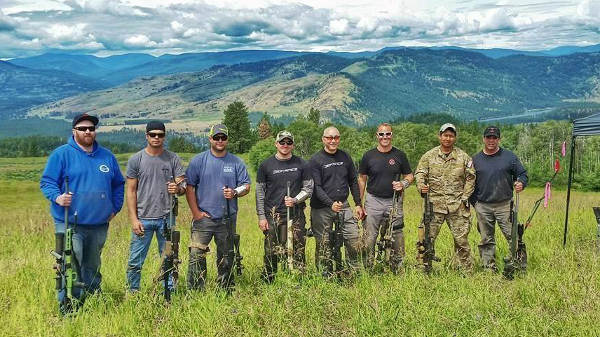
The Sniper’s Hide Cup competition went forward this year, despite challenges presented by the COVID-19 pandemic. The event took place June 20-21, 2020 in Colville, WA. This was a backcountry match, set in beautiful green mountain scenery. Here are images from the 2020 SH Cup as posted on the Sniper’s Hide Facebook Page. Congrats to Frank Galli (aka “Lowlight”), founder of Sniper’s Hide, and all the participants in the event. Looks like a great two days of shooting.
The Everyday Sniper Episode 260: Sniper’s Hide Cup 2020
After the 2020 SH Cup event, Frank Galli hosted an informative podcast:
Topics include: Stages, Targets, Equipment, Mindset, First-Time Competitors
Frank: “I’m back from the Sniper’s Hide Cup in Colville, Washington. I’ll be breaking down some lessons learned and give you my observations from the field and competitors with whom I spoke. [We cover] the experience of attending a match and helping new shooters — the juniors, the first time competitors, and how you work with them. Thanks for listening, sharing, and commenting on the Everyday Sniper Podcast.”
For many riflemen, reading the wind is the toughest challenge in long-range shooting. Wind speeds and directions can change rapidly, mirage can be misleading, and terrain features can cause hard-to-predict effects. To become a competent wind reader, you need range-time and expert mentoring. In the latter department, Frank Galli, founder of Sniper’s Hide, offers a detailed digital resource: Wind Reading Basics for the Tactical Shooter.
Wind Reading Basics is much more than a 47-page eBook — it has charts, instructions for ballistic calculators, and even embedded videos. Galli explains: “We break down the formulas, walk you through using a ballistic computer, and give you all the information in one place. From videos, to useful charts, we make it simple to get started. It’s all about having a plan, and we give you that plan.”
Galli’s Wind Reading Basics, priced at $7.99, can be downloaded from iTunes for iPads, iPhones and iOS compatible devices. Here are sample sections from the eBook (which includes videos):
Are you looking to get started in PRS and NRL practical precision rifle competition? Or perhaps you’d like to advance your skill set so you can place higher in big matches (and get your hands on some of those prize table items)? Of course there is no substitute for trigger time in the field, but there ARE some great print resources. These four books can help you select the right equipment, improve your shooting skills, make better wind calls, increase your fitness level, and develop a more efficient between-match training program.
1. IMPACT! — Training and Preparing for Precision Rifle Matches
Rodney Maze, $19.99 Paperback, $4.99 Kindle
Impact!, by PRS competitor Rodney Maze, is an entry/intermediate level guide to preparing yourself and your equipment to compete in precision rifle type matches. It will also benefit anyone looking to learn about practical-style long range and precision shooting. We recommend you check it out for yourself — there are 20 Pages of free sample content on Amazon. Topics covered include:
— Rifle, optic, and equipment selection
— Setting up your rifle, bags, tripods for PRS/NRL matches
— Understanding ballistics and how to record and use ballistic data
— Techniques for using holdovers for multi-target stages
— Gun skills, rapid fire techniques, clearing malfunctions
— Shooting off of barricades, and specialty stages
— Effects of wind and how to improve your wind calls
— Tips for live fire and dry fire practice
— Preparing yourself and your equipment for a match
— Mental strategies and techniques
Impact! is illustrated with plenty of photographs. Topics are divided logically, and concepts are explained in clear language. Also included is an extensive glossary of terms used in precision shooting and a list of additional resources you can use to further pursue your precision shooting knowledge. This book also includes a handy Appendix with formatted pages for recording data about your rifle, scope, and ammunition. There is also a Wind table for recording your rifle “dope” and wind hold-offs. Lastly, Impact! has a useful table of unit conversions.
2. Practical Shooter’s Guide
Marcus Blanchard, $19.99 Paperback, $9.99 Kindle
Thinking of getting started in the Practical/Tactical shooting game? Looking for ways to be more stable when shooting from unconventional positions? Then you may want to read Marcus Blanchard’s Practical Shooter’s Guide (A How-To Approach for Unconventional Firing Positions and Training). Unlike almost every “how to shoot” book on the market, Blanchard’s work focuses on the shooting skills and positions you need to succeed in PRS matches and similar tactical competitions. Blanchard provides clear advice on shooting from barricades, from roof-tops, from steep angles. Blanchard says you need to train for these types of challenges: “I believe the largest factor in the improvement of the average shooter isn’t necessarily the gear; it’s the way the shooter approaches obstacles and how they properly train for them.”
3. Long Range Shooting Handbook
Ryan Cleckner, $19.85 Paperback, $9.99 Kindle
Ryan Cleckner’s Long Range Shooting Handbook is the best-selling modern book on practical rifle skills. A former U.S. Army sniper instructor, Cleckner is knowledgeable, and his text is well-organized and chock full of good information. You can view Sample Chapters on Amazon.com.
Ryan Cleckner’s highly-regarded Long Range Shooting Handbook is designed as an intro to important fundamental concepts such as MOA vs. Mils, External Ballistics, and Environmental Effects. Included are personal tips and advice based on Cleckner’s years of experience as a sniper instructor and special operations sniper.
The Long Range Shooting Handbook is divided into three main categories: What It Is/How It Works, Fundamentals, and How to Use It. “What It Is/How It Works” covers equipment, terminology, and basic principles. “Fundamentals” covers the theory of long range shooting. “How to Use It” gives practical advice on implementing what you’ve learned, so you can progress as a skilled, long range shooter. This book will benefit any long-range shooter, not just PRS/NRL competitors.
4. Official U.S. Army Sniper Training and Operations Manual
From U.S. Army Sources, $17.59 paperback.
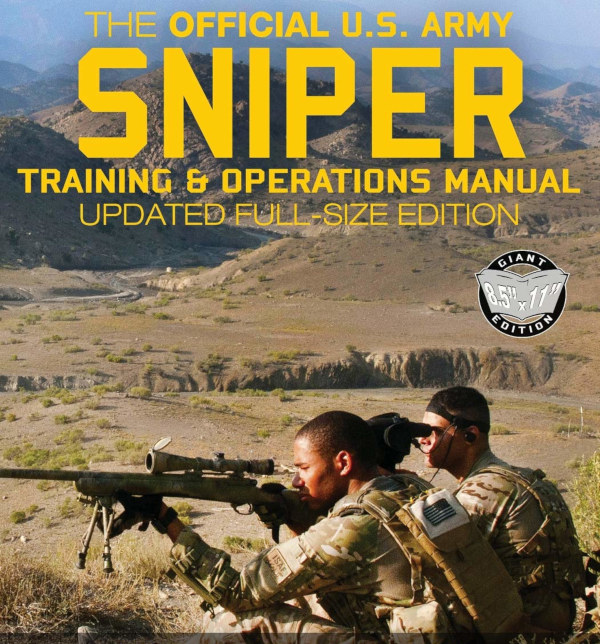
This U.S. Army Sniper Training Manual is a very comprehensive resource, with over 450 pages of information in a large 8.5″x11″ format. NOTE: Unlike other editions on Amazon, this is NOT the basic, outdated FM 23-10. This is the completely-overhauled 450+ page edition (FM 3-22.10). Heavily illustrated, this is a very useful resource for tactical/practical precision shooter. Employed as the “textbook” for the U.S. Army Sniper School at Fort Benning, GA, this big manual explains ranging methods, rifle handling, optics selection and operation, and rifle maintenance.
There is also extensive discussion of ballistics, wind reading, and weather effects. Practical competitors will appreciate the discussions of moving targets, range estimation, and range safety procedures. One reviewer explains: “This book contains the distilled wisdom of the Sniper School’s instructors and expert marksmen, giving you over 450 pages of unique insight into the long range combat shooter’s art.”
Serious riflemen know that Krieger makes outstanding centerfire barrels that hold world records and have won many National Championships. But did you know that Krieger makes great rimfire barrels too? Well, Krieger does make outstanding .22 LR rimfire match barrels that can deliver impressive accuracy.
Sniper’s Hide moderator “Padom” recently tested a variety of rimfire ammo types, employing five different barrels: Krieger, Bartlein, Benchmark, Lilja, and Green Mountain. He tested at both 50 yards and 100 yards. FULL Rimfire TEST REPORT HERE.
Reporting on the 50-yard test, Padom posted: “Had a virtually dead calm day today for 50-yard RimX testing (Keystone Accuracy RimX barreled action with 1:16″ Krieger 20″ barrel). A few infrequent 3 mph gusts but pretty dead [calm] and the target showed. This Krieger just barely edged out the Bartlein by 0.003″ with a 0.177″ 6×5 with SK Rifle Match. The 10×5 was 0.198″. The best lots of Center-X weren’t far behind either. This is the first Krieger rimfire [barrel] I’ve shot and it didn’t disappoint.”
Padom noted: “Winds were much calmer tonight than this morning so the 100-yard Krieger test was a success. Winds were pretty consistent [at] 3-5 mph.”
Test Results at 100 Yards
Padom then tested ammo at 100 yards, again using his Krieger rimfire barrel: “To recap, the Krieger shot the best 50-yard results of the barrels tested so far, just barely beating the Bartlein but it was so close you can call the 50-yard results equal (.005). Well the Krieger beat all the barrels tested to date at 100 yards by a pretty good margin with Center-X. The 10×5 was incredible as well at just barely over 0.6″ showing the results were very consistent. A second lot of Center-X was right there with the previous 100-yard 6×5 best results just barely over 0.6. The third lot of Center-X shot a respectable 0.75″ 6×5. This Krieger sure is shooting very nicely. I’m really looking forward to shooting it at 300 and 400 yards[.]”
Components Tested: 20″ Krieger M24 barrel, .22 LR Match Eachus chamber 0.046 headspace, Zermatt RimX Action, Bix’N Andy TacSport Pro 2-Stage Trigger, RimX 10rd magazine, XLR Envy Pro Folding Chassis, Athlon Cronus BTR 4.5-29x56mm MIL scope.
Shooting Set-up: 100 Yards Prone with Bipod and Rear Bag.
Berger Ballistics Experts in 10-Part Podcast Series
Berger Bullets is presenting a 10-part Podcast series on bullet design and ballistics. Bryan Litz and Emil Praslick III are the featured guests for a 10-part Sniper’s Hide Podcast series about Ballistics. These 10 Podcasts aredelivered through The Everyday Sniper podcast platform. The series will help listeners learn more about Ballistic Coefficients (BCs), why BC consistency is important, and how BC effects both accuracy and precision.
In this 10-part series, Bryan Litz of Applied Ballistics and Wind Wizard Emil Praslick talk with Sniper’s Hide head honcho Frank Galli. Along with Ballistics, the 10 podcasts will cover a variety of shooting-related topics including: long range shooting, precision rifle builds, training, wind effects, industry updates, and more. The key features of the podcasts are also explain in print articles by Bryan Litz found at BergerBullets.com/NoBSBC.
How and Why Bullet BC Varies with Velocity
Podcast Episode 2 focuses on how Ballistics Coefficients Vary with Velocity and why that matters. Listen to Berger Chief Ballistician Bryan Litz and Mil/LE Tactical Expert, Emil Praslick, talk shop about bullet design, modern BC measurement techniques, and the importance of BC consistency for long-range precision and minimal vertical dispersion. READ Bryan Litz BC Variation Analysis HERE.
The 10-part podcast series kicked off May 1, 2020. Each podcast is an in-depth discussion of Berger’s bi-weekly “No-BS BCs” ballistics articles, authored by Bryan Litz, Berger’s Chief Ballistician. In Episode One, linked below, Litz defined BC and its purpose. As the series continues, the experts explain why BC consistency is the most important factor in long-range bullet performance. Learn more about “The Everyday Sniper” BC podcast series at NoBSBC.com.
“This is a great opportunity to open up our platform to Berger with Bryan and Emil. Giving people this kind of access through the partnership is a Masterclass opportunity for anyone interested in long range shooting”, stated Frank Galli.
Podcast Schedule and Topics
To learn more about Berger’s No-BS BCs and to read Bryan Litz’s bi-weekly articles, visit NoBSBC.com and Bergerbullets.com.
For many riflemen, reading the wind is the toughest challenge in long-range shooting. Wind speeds and directions can change rapidly, mirage can be misleading, and terrain features can cause hard-to-predict effects. To become a competent wind reader, you need range-time and expert mentoring. In the latter department, Frank Galli, founder of Sniper’s Hide, offers a detailed digital resource: Wind Reading Basics for the Tactical Shooter.
Wind Reading Basics is much more than a 47-page eBook — it has charts, instructions for ballistic calculators, and even embedded videos. Galli explains: “We break down the formulas, walk you through using a ballistic computer, and give you all the information in one place. From videos, to useful charts, we make it simple to get started. It’s all about having a plan, and we give you that plan.”
Galli’s Wind Reading Basics, priced at $7.99, can be downloaded from iTunes for iPads, iPhones and iOS compatible devices. Here are sample sections from the eBook (which includes videos):
Location: Overlooking Columbia River in Colville, Washington area, (North of Spokane, WA)
The annual precision tactical rifle event known as the Sniper’s Hide Cup (SHC) wrapped up on Sunday and it was quite an adventure this year. The match, held in a stunningly beautiful corner of Washington State, offered plenty of challenge for the competitors, along with memorable scenery. On the podium this year were: Nick Gadarzi (1st), 2nd Jesse Redell (2nd), and 3rd Brent Webley (3rd). Congrats guys!
These photos come from Frank Galli, Sniper’s Hide Founder, and our friend Steve Lawrence from 6.5Guys.com. Steve competed in Squad 8 with other members of the Northwest precision shooting community. Three members of the squad placed in the top 20. Steve placed 34th out of 148 shooters registered for the event.
Credit goes to Frank Galli of Sniper’s Hide, LLC, Mile High Shooting Accessories, and Carl Taylor of In Motion Targets for organizing, sponsoring, and hosting this event, as well as the dozens of Range Officers, volunteers, and companies who donated to the prize table which made this such a memorable match. The ‘Hide Cup will be featured on the Long Range Reality TV series.
Match Director’s Report — Sniper’s Hide Cup 2016
The 2016 Sniper’s Hide Cup was held in Colville, Washington in one of the most picturesque settings I have ever attended. We had 24 stages, 50 Range Officers, and 148 competitors at this year’s 2.5-day event. Starting off with heavy rain and fog, we quickly rolled in cool temps and partly sunny skies. It made for a great weekend of shooting.
Because Carl Taylor owns and operates In Motion Targets, we had 5 mover (moving target) stages. So every segment included a moving target stage, which was anywhere from 400 to 800 yards. This was a more traditional Field Course-type event, but the SHC was part of the PRS Series. Targets averaged from 300 to 1100 yards during the match, under challenging and unpredictable conditions thanks to the varied terrain. Competitors shot 360 degrees so they were subject to wind from every direction.
Congratulations to the Top 3, Nick Gadarzi, Jesse Redell, and Brent Webley. We thank key Sponsors Sig Optics, Swarovski, and Proof Research, along with Falkor, Prime Ammo, GA Precision, and Kasey Beltz with B&T Industries. They were Segment Sponsors.
We look forward to doing more in the Colville area next year. It was a laid back fun event.
— Frank Galli, Sniper’s Hide Cup Match Director
Steve Lawrence takes aim on a down-angle shot amidst the pines.
Steve (shown above) gave a shout-out to his sponsors: “We want to acknowledge the 6.5 Guys partners/sponsors who make it possible for us to bring viewers along with us on our precision rifle marksmanship quest. Travis Redell of R Bros Rifles who built me a superbly accurate, ultra-dependable match rifle, Jake Vibbert of JC Steel Targets, Glen Harrison and Mike Lee of Defiance Machine, Michael Ryan of Midsouth Shooters Supply, and Kevin Thomas and Adam Braverman of Lapua.
We first ran this eye-opening story two years ago. We’re republishing it today as a reminder that safety should always be a shooter’s #1 concern at the range. Avoid distractions and always check your barrel for obstructions before you chamber a round or pull the trigger. A moment of inattention can result in a catastrophic kaboom …
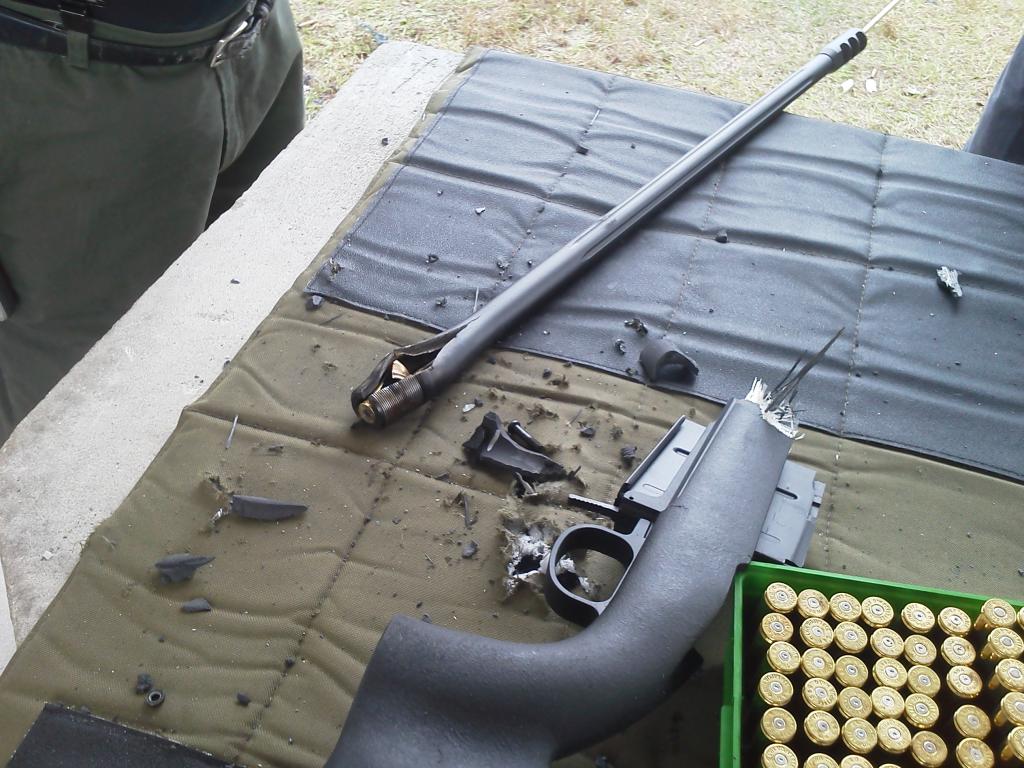
Discharging a .338 Lapua Magnum round with a cleaning rod in the barrel — that’s a recipe for disaster. What happens when a fired .338 caliber bullet and a cleaning rod try to occupy the same place at the same time? Well you get a catastrophic kaboom, with metal pieces flying all over the place, and a shooter very lucky to escape without serious injury. This incident occurred recently in Manatee, Florida, as reported by Sniper’s Hide member Queequeg. We thank SnipersHide.com for granting permission to publish these revealing images in the Daily Bulletin.
This story should serve as a chilling reminder to follow proper safety practices whenever you are at the range. Always check to make sure there is no obstruction in the bore BEFORE loading a live round.
.338 Lapua Magnum + Cleaning Rod + Inattention = Kaboom!
Kaboom at Manatee!
A while back, Sniper’s Hide member Queequeg published shocking photos of a catastrophic kaboom involving a .338 Lapua Magnum (Savage action). The action was blown off the rifle, shrapnel went through the roof, and the barrel split at the tenon before taking an excursion downrange. The action did crack in the front but the lugs remained engaged so the bolt did not slam to the rear (luckily for the shooter).
Here’s the report: “This happened [January 20, 2014] at the Manatee Gun and Archery Club. Al, Ren and myself were there with a couple other folks. Ren was at bench 12, I was at 13. The fellow at 11 was running a Savage .338 Lapua. He had a very bad day! He damn sure could have killed himself and quite likely Ren as well.”
Queeqeg added: “After the boom, I heard Ren ask ‘Are you alright’ and then turned to look in time to see the fellow reacting in total shock — literally stunned. Ren and I went over to him and could not see any major injuries. Ren was uninjured as well but had a lot of fiberglass splinters on him. The barrel nut is what I presume punched the two holes in the roof. The shooter is a regular there[.] He had been having a problem with sticky cases though he said he was certain the loads were mild. That’s why he was content to knock the sticky ones out with the rod. He simply forgot to remove the rod after knocking out the last stuck case. You can see what happened next.”
The Important Lesson Here
What did the .338 LM shooter do wrong here? You will say — “Well that’s obvious, he left a cleaning rod in the barrel and then shot a round.” Yes, that was a potentially fatal error. But that was his second mistake — one that occurred only because he made a more fundamental judgment error first.
The FIRST mistake was not acknowledging the problem with his ammo. Had he heeded the warning signs, he would still have a rifle (and an unsoiled pair of trousers). When he first observed that he was having problems with extracting cases, a warning light should have gone off in his head. Presuming his extractor was not broken (and that the chamber was cut properly) he should have been able to extract his brass if he was running safe loads. The lesson here we all need to learn is that if you observe a serious ammo-related issue, it is time to stop shooting. Don’t try to invent work-arounds just to extend your range session, when there are clear signs that something is wrong, very wrong.






 Test Results at 100 Yards