|
|
February 7th, 2011
When conditions are absolutely perfect, you can see 6mm bullet holes (in the white) at 600 yards with a premium spotting scope (with at least 45x magnification). But add some haze and mirage into the mix and all bets are off. This weekend, we tested three top-of-the-line “big name” spotting scopes. All three had at least 60X magnification, all had HD glass, and the average price of the three units was over $2500.00 with eyepiece. Even with all those pricey, state-of-the-art optics, on Saturday we couldn’t see bullet holes at 400 yards because of thick mirage and dust in the air.
Quality Target Cams Can Provide Reliable Viewing from 50 yards to 1000+ yards
What can you do if you want to practice at long ranges, and see your bullet impacts — reliably, every time? There are electronic target systems that plot shot locations with sonic sensors or accelerometers, but these are large, complex, semi-permanent installations costing many thousands of dollars. For most shooters, the only practical, field-deployable solution is a quality, wireless target cam system. You can source the necessary components — video camera, transceivers, antennas, batteries, display screen — or you can purchase a turn-key system. There are a handful of target cam systems now marketed for shooters. We’ve tried a couple that did not perform as claimed. But one system that we can endorse without reservation is the Target Cam System from Pro Security Warehouse (PSW). We purchased PSW’s Long-Range Wireless Target Observation System and have tested it outdoors extensively. With a well-illuminated target, this system will reliably display even .22 caliber bullet holes in the black, at distances out to 1000 yards. In order to see bullet holes in the black you may have to increase the contrast or adjust the brightness — but that’s a simple matter of clicking a couple control buttons. During daylight hours, we could easily see all bullet holes, with the camera displaying an area about two feet by two feet square. When shooting at night, you need to illuminate the target with lights.

 PSW Wireless Video Viewing System Components PSW Wireless Video Viewing System Components
The PSW Target Cam System costs $1499.00 but that includes everything you need, even tripod and batteries. The target image is captured by a high-resolution, auto-focus color camera with 22X max magnification and motorized zoom. This can be set as far as 30 feet from the target, but we got the best results with the camera positioned about 10 feet from the target, on one side of the target frame. The camera connects to a digital wireless multi-channel transceiver (with high-gain antenna) clamped to the same tripod that holds the camera. A sealed, rechargeable 12V gel cell battery will run the camera for a full day’s worth of shooting.
Pro Security Warehouse Target Cam System Brochure (PDF).
For the shooter’s station, PSW provides a compact transceiver (the size of a smart-phone), plus a rugged color monitor in a padded carry pack. These are likewise powered by a rechargeable 12V battery. Initially, we suspected the 5.6″ monitor was a little on the small size, but it proved more than adequate in use. With the monitor positioned a couple feet from your rifle (either on the bench or on the ground when shooting prone), you can easily see scoring rings, score numbers, and, of course, bullet holes. You may want to fiddle with the color and contrast controls to create the best definition for viewing bullet holes in the black. The resolution is good enough that we could easily make out “doubles” where two 6mm shots landed virtually on top of one another.

One smart feature is that the target display is set for a short time delay. This allows you to turn your head from sights or scope to the display screen and see the bullet hole “arrive” on paper a few seconds after the actual hit. Being able to actually see the bullet hole appear on the target helps you quickly locate the latest shot even if there is a cluster of bullet holes close together. That’s smart engineering.
The PSW system works really well. We have no negatives to report — everything performed as advertised. Are there any improvements/enhancements we would like? Yes — it would be nice if the receiver could output to a laptop computer, so you’d have the option of a larger display screen and so you could capture video of shot strings. We would like PSW to offer an optional, small solar panel that could trickle-charge the unit during use. Lastly, we would like to see PSW offer a lower-cost system that could be used with a user-supplied video camera. We know many shooters already own small video cameras, and this could reduce the overall “buy-in” cost of the system.
 Certainly, $1499.00 for the complete PSW system is not cheap. However, when you consider that the PSW wireless viewing system reliably displays bullet holes at long range in all daylight viewing conditions — something not even a $3500.00 spotting scope can do — the system is worth the money for shooters who practice at long ranges. Interestingly, all four testers who looked through the top-end spotting scopes agreed that they would rather have this $1500.00 target cam AND a $1000.00 spotting scope rather than a $2500.00+ spotting scope alone. To learn more about the PSW Target Cam system visit www.ProSecurityWarehouse.com or call (407) 447-1637. Certainly, $1499.00 for the complete PSW system is not cheap. However, when you consider that the PSW wireless viewing system reliably displays bullet holes at long range in all daylight viewing conditions — something not even a $3500.00 spotting scope can do — the system is worth the money for shooters who practice at long ranges. Interestingly, all four testers who looked through the top-end spotting scopes agreed that they would rather have this $1500.00 target cam AND a $1000.00 spotting scope rather than a $2500.00+ spotting scope alone. To learn more about the PSW Target Cam system visit www.ProSecurityWarehouse.com or call (407) 447-1637.
January 21st, 2011
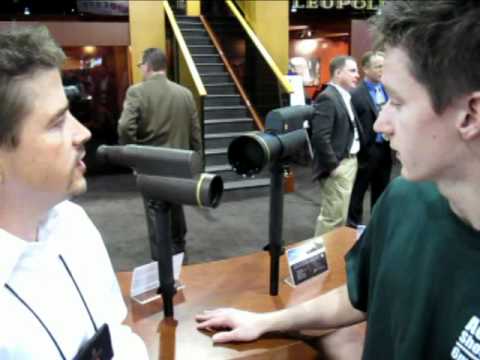
Yes, bigger is better. Leupold has upgraded its popular “folded-light-path” compact spotting scope, by adding an HD-glass, 80mm front objective and boosting the magnification up to 60-power. That will give this NEW scope better low-light performance and higher magnification while retaining a usable exit pupil (if you increase magnification without increasing the front lens diameter, the exit pupil shrinks). The unit costs $1800, not bad considering the price of other 80mm spotters, and the Leupold is much easier to carry, given its compact design.
Bigger Objective, Better HD Glass, More Useful Magnification Range
We’ve always liked the Leupold compact spotter because it is light weight and it’s Newtonian (folded light path) design makes it much more compact than most spotters of comparable magnification. The U.S. Military currently uses the Mark 4 “tactical” version of the Leupold 12-40x60mm spotter. However, we felt that the glass in the 12-40 spotter was not on a par with the latest generation HD spotters from Kowa, Zeiss, and Leica, or even Nikon and Pentax for that matter. Leupold has taken a huge step forward by gracing its new spotter with a big, HD (low dispersion) front objective. This should give the scope better perceived sharpness with much less color fringing (chromatic aberration) when viewing targets at long range. Upsizing the objective to 80mm makes the scope brighter, improving low-light performance. That’s important, particularly for tactical guys and hunters. The bigger objective also allows Leupold to increase magnification all the way from 40X to 60X. Do you always want a 60-power view? No, but it is great have 50% more magnification on tap when you need it.

60X is a Good Thing for Target Shooters
Most 40-power spotting scopes struggle to resolve 6mm and 6.5mm bullet holes at 600 yards. With HD glass and 60X magnification, you’ll have a much better chance to see small bullet holes at long range (though you’ll also need good viewing conditions). That’s a huge advantage for the long-range target shooter. Overall, we were very pleased that Leupold engineered this much-enhanced 80mm spotter. We predict it will be a big hit with anyone who needs serious magnification in an easy-to-carry optic.
January 15th, 2011
Zeiss has just introduced its latest spotting scope, the Dialyt 18-45x65mm Compact Field Spotter. We like the design and we think there’s a place in the spotting scope market for a simple straight-tube spotter with razor-sharp, ultra-premium glass. High-end spotting scopes have become increasingly large and heavy over the years as the optics-makers have chased ever-greater levels of brightness and magnification. But a hunter or tactical shooter doesn’t want to hump 8 pounds of glass up and down mountains. The Dialyt (“Die-Ah-Lite”) weighs a mere 2.6 lbs. (1.2 kg) and is just 15.5 inches long.

Easy to Use, Easy to Carry
The Dialyt is easy to use — twist the eyepiece to zoom and rotate the front objective to focus. Originally designed for European Alpine hunters, the new rubber-armored ZEISS Dialyt 18-45×65 Field Spotter is built tough for field use. This should appeal to hunters and tactical shooters. And unlike older-style draw-tube scopes, the straight-tube Dialyt is dustproof and fully waterproof (rated to 400 mbar).
About the size of a thermos bottle, the 2.6-pound Dialyt 18-45×65 fits easily into a backpack and, if necessary, can be rested on a pack for stabilization at higher magnification. This spotter also has threads for a tripod or monopod.
The Dialyt 18-45×65’s variable eyepiece provides a wide field of view at low magnification and plenty of magnification up top. This compact spotter also features multilayer coatings and high light transmission for good performance at dawn and dusk — something important for hunters.

December 1st, 2010
We’re often asked: “What’s the best way to set up a spotting scope for shooting from a bench?” Some guys have spotting scopes set on big full-size tripods positioned to the side of the bench. That will work, but it normally requires you to move way out of position to look through your scope. Also, if you place the tripod as close to the bench as possible, one of the tripod legs will extend down close to your foot. It is all too easy to jostle the tripod with your foot or knee and move the scope off your target. We’ve also seen folks with spotting scopes mounted on compact camera tripods set directly on the bench. Again, this is not a very good solution. These small tripods position the spotting scope too high. Small camera tripods are also really too light and flimsy to hold a big, heavy spotter, with a 65mm or larger front objective. You really need a better set-up. You want to mount the spotting scope so, when you are in shooting positino, the eyepiece is close to your head — allowing easy viewing without moving your whole body away from the rifle.
Scope Stands for Bench Use
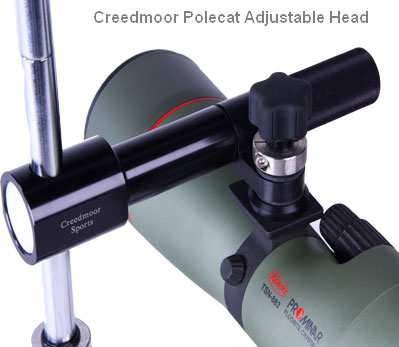
The best system for mounting a spotting scope to a bench was the Ray-Vin Ultimate Benchrest Stand. This clamped securely to the side of the bench and was a very high-quality piece of gear. Unfortunately, Ray Brandes of Ray-Vin has retired and his clamping benchrest scope stand is currently out of production. If you can find one for sale second-hand — snag it. If you can’t locate a Ray-Vin clamping stand, don’t despair, Creedmoor Sports has come out with a clamping-type Spotting Scope Bench-mount that is only $79.95 without head. This features 1″-diam vertical shaft so it can be used with most scope-holding heads that can adapt to a 1″ tube, such as a Ray-Vin head, Big Blue head, or Creedmoor’s new Polecat head. The clamp mount secures the rig anywhere you want along the side of the bench. You can easily adjust the scope height and fore/aft position relative to the shooter. The Ray-Vin head, now sold by Creedmoor, features a twist handle with a ball joint on the end. This then lets you set the scope (and angled eyepiece) to any angle you want. It’s a very slick system.
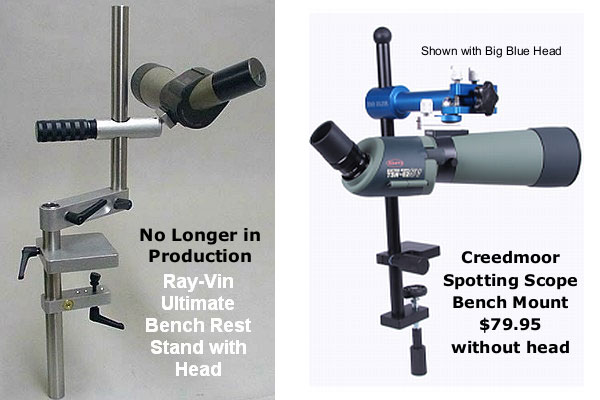
The Creedmoor Bench-mount is currently back-ordered, but Creedmoor expects to receive product before the end of the year. The Polecat head is available now for $139.95. Creedmoor, which has taken over production of the Ray-Vin scope stand head, is taking orders for the Ray-Vin head currently. No release date is offered. However, there should be some 1″ Ray-Vin heads on the used market.
September 8th, 2010
The new Zeiss Victory DiaScope 85mm spotting scope from Carl Zeiss has won Field & Stream magazine’s prestigious Best of the Best Award for 2010. This annual awards program recognizes the most innovative and best-designed products in the hunting industry. In the September issue of Field & Stream, the magazine’s reviewer wrote: “The DiaScope is superior in sharpness, focus, zoom and armored construction. When I tested for waterproofness, it floated. I could judge buck antelope miles away with it on a cloudy day. The cost can be made up in saved boot leather. – T.M.”

Zeiss 85mm Diascope Also Earned Outdoor Life and Hunting Magazine Honors
This marks the third major industry award for the ZEISS DiaScope this year. The 85mm DiaScope also won the 2010 Outdoor Life Editor’s Choice Award and Petersen’s Hunting magazine’s Editor’s Choice Award. The DiaScope is available in 65mm or 85mm models, straight or angled, and newly-designed eyepieces include the Vario D 20-75X, one of the most powerful and versatile eyepieces on the market today. All DiaScope eyepieces boast Zeiss’ LotuTec® water-repellant coating and a new bayonet locking system that securely locks the eyepieces yet still allows quick eyepiece changing.
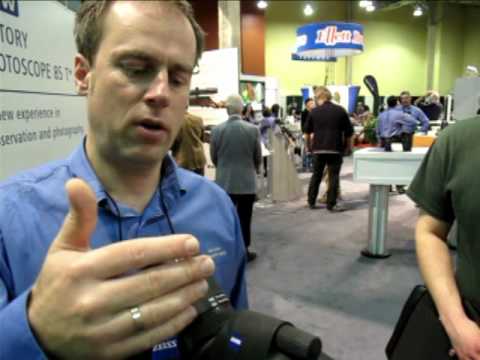
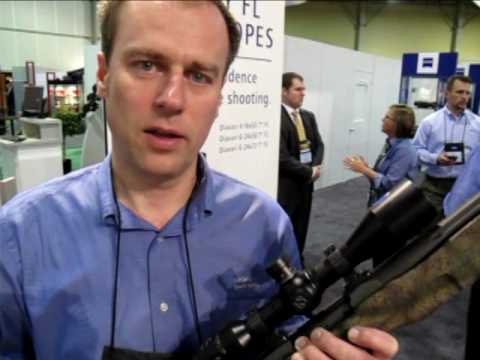
At the 2010 SHOT Show, this Editor had a chance to interview Stephan Albrecht, Project Engineer for the impressive new 85mm Diascope. In the video below, Stephan explains the important new features of the award-winning spotting scope, including the dual-speed focus system and the new, high-power 20-75X eyepiece.
September 4th, 2010
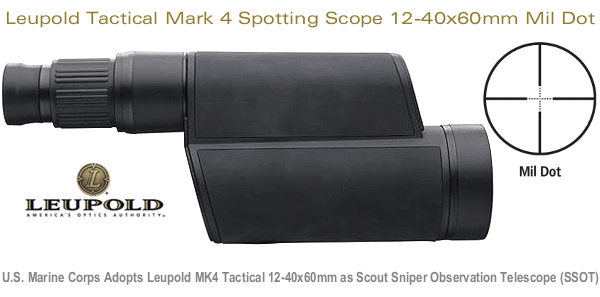
 Leupold’s Mark 4 Tactical Spotting Scope is now the standard Scout Sniper Observation Telescope (SSOT) of the U.S. Marine Corps, the first new spotting scope the Corps has used in decades. Leupold’s compact MK4 variable-power spotter replaces the fixed 20X M49 spotting scope fielded by the Marines since World War II. The Mark 4 Tactical spotter was also selected by the U.S. Army for use with its XM110 Semi-Auto Sniper System (SASS). This same Mark 4 spotting scope, with either Mil-dot or Horus reticles, is available for civilian purchase. Leupold’s Mark 4 Tactical Spotting Scope is now the standard Scout Sniper Observation Telescope (SSOT) of the U.S. Marine Corps, the first new spotting scope the Corps has used in decades. Leupold’s compact MK4 variable-power spotter replaces the fixed 20X M49 spotting scope fielded by the Marines since World War II. The Mark 4 Tactical spotter was also selected by the U.S. Army for use with its XM110 Semi-Auto Sniper System (SASS). This same Mark 4 spotting scope, with either Mil-dot or Horus reticles, is available for civilian purchase.
Only 12.4 inches long, the MK4 spotting scope is extremely compact for its magnification level. Though it weighs just 37 ounces, it boasts a rugged, armored magnesium body that is nitrogen charged and 100% waterproof. Other good features of the MK4 include generous eye relief, multi-coated lenses, and rubber fold-down eyecups. A front focal plane (FFP) reticle magnifies the reticle along with the image, so users can estimate range at any power setting using the Mil Dot or Tactical Milling Reticle. CLICK HERE for full MK4 Spotting Scope Specs.
Folded Light Path Design Yields High Power in Small Package
By “folding” the entering light in a ‘Z’-path, the Newtonian-reflector design achieves high magnification in a very compact optic that is easy to pack and carry. Leupold’s efficient Folded Light Path (FLP) lens and mirror optical system allow the Mark 4 to deliver the effective optical path of a scope twice its length. We have also found that, compared to conventional spotting scopes, the Leupold spotter is more stable in windy conditions because it has much less overhang and a smaller cross-section than conventional designs. The folded-path Newtonian design makes perfect sense for spotting scopes that need to be carried in the field. A similar folded-light-path design is used in the superb, $5000.00 Zeiss Optronics 20-60x72mm Tactical Spotting Scope.
Leupold Now Offers Horus Reticle Options in MK4 Spotting Scopes
While the Marines use the MK4 Spotting scope with a conventional Mil Dot reticle, Leupold now offers Horus H32 and H36 ranging reticles as options. The H32 has a mil line for target measurement and speed estimation, while the H36 features an inverted “L” in Inch Of Angle (IOA) for easy ranging. The Mil Dot reticle matches those found in military riflescopes, allowing a spotter to quickly range a target, while viewing the same sight picture as the shooter. The Horus H32 and H36 provide a more complex grid that allows range estimation, target speed calculation, and 2nd-shot-correction.
 
To learn about more about the sophisticated Horus reticles, visit HorusVision.com.
August 9th, 2010
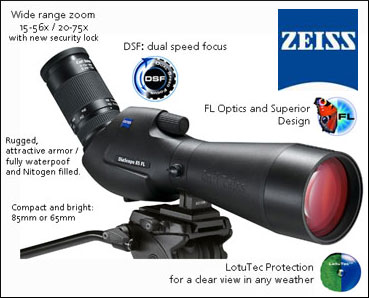
The new Zeiss Victory DiaScope 85mm T* FL spotting scope from Carl Zeiss has been named Editor’s Choice by Petersen’s Hunting magazine. The 2010 Spotting Scope Review, featured in the magazine’s September issue, compared spotting scopes from many manufacturers and the new ZEISS DiaScope, with its revolutionary Dual Speed Focus (DSF) system, came out on top. Petersen’s editors wrote: “The innovative Dual Speed Focus (DSF) system is something you almost have to try to believe. It automatically transfers from macro-adjustment to fine-tuning like no other scope. This is our pick of the litter, price be damned. $2,999.00.”
straight or angled bodies both boasting a rubber-armored exterior for protection. Eyepieces are available as variable 20-60x, 20-75x, or fixed 40x. A 65mm version of the new Diascope is also available, but we feel that, if you’re going to spend this kind of money ($3000.00 for 85mm with 20-60X eyepiece), you should go with the 85mm. The 20-75X eyepiece only delivers 15-56X when used with the smaller 65mm Diascope.
 New DiaScope Wins Other Awards New DiaScope Wins Other Awards
The new Zeiss Victory DiaScope 85 T* FL Spotting Scope has earned two other prestigious awards. First the new 85mm DiaScope won the coveted Red Dot Design Award. “All products honored with the red dot design award had to impress an international jury. These products [must] demonstrate their quality in one of the toughest design competitions in the world,” says Professor Dr. Peter Zec, speaking on behalf of Design Zentrum Nordrhein Westfalen which issues the Red Dot Design Awards.
At the NRA Annual Meeting on May 14, the Zeiss 85mm DiaScope was named an “Editor’s Choice” by Outdoor Life Magazine. Outdoor Life’s editors praised its “optically superior [flourite] glass in a surprisingly lightweight chassis”. The ZEISS DiaScope won the low-light test, had a top resolution score and “the two-speed focus and wide-angle eyepiece sparkled”, according to the test team.
June 6th, 2010
The new Zeiss Victory DiaScope 85 T* FL Spotting Scope has earned two prestigious awards. First the new 85mm DiaScope won the coveted Red Dot Design Award. “All products honored with the red dot design award had to impress an international jury. These products [must] demonstrate their quality in one of the toughest design competitions in the world,” says Professor Dr. Peter Zec, speaking on behalf of Design Zentrum Nordrhein Westfalen which issues the Red Dot Design Awards.
Outdoor Life Magazine. Outdoor Life’s editors praised its “optically superior [flourite] glass in a surprisingly lightweight chassis”. The ZEISS DiaScope won the low-light test, had a top resolution score and “the two-speed focus and wide-angle eyepiece sparkled”, according to the test team.
We checked out the new 85mm DiaScope at SHOT Show and reviewed its new features with Zeiss project engineer Stephan Albrecht. Make no mistake about it. This is an outstanding spotting scope. We loved the dual-rate focus system. You can do the gross focus really fast, but still achieve the ultra-precise focus needed to resolve bullet holes at long ranges. We were very impressed with the new higher-magnification 20-75X zoom eyepiece. This is one of the best variable-power eyepieces ever made, and long-range shooters can definitely use the extra magnification (75x vs. 60x). Overall the Zeiss system is surprisingly compact, yet it offers excellent low-light performance, plus higher magnification than most other spotting scopes in the 80mm category.
The new 85mm Diascope is available in straight or angled bodies both boasting a rubber-armored exterior for protection. Eyepieces are available as variable 20-60x, 20-75x, or fixed 40x. A 65mm version of the new Diascope is also available, but we feel that, if you’re going to spend this kind of money ($3000.00 for 85mm with 20-60X eyepiece), you should go with the 85mm. The 20-75X eyepiece only delivers 15-56X when used with the smaller 65mm Diascope.
January 24th, 2010
At SHOT Show 2010, Zeiss Sport Optics displayed its impressive new series of Diavari scopes with FL (flourite) glass. The new scopes are extremely clear and bright (on a par with Schmidt & Bender), and the flourite lens elements allow very high light transmission with super-low fringing (chromatic aberration). Controls are very positive and the Zeiss eyepieces feature a +2 to -3 diopter. With that broad diopter range, you can use the scopes without corrective lenses even if you normally wear eyeglasses or contacts. A variety of reticles are offered, including ballistic compensating reticles calibrated for four popular cartridge types. Three scopes will initially be available in the new Zeiss FL lineup: 4-16x50mm, 6-24x56mm, and 6-24x72mm, shown below. This extra-large 72mm objective provides superior low-light performance plus a large exit pupil, even at full 24X magnification.

Higher Magnification and Dual-Rate Focus for New FL Diascope
In addition to the new FL Scopes, Zeiss displayed its new 65mm and 85mm Diascope FL spotting scopes. These look very similar to last year’s models, but there are internal lens upgrades, a new focus system, and a superb new eyepiece that raises the max magnification to 75X on the 85mm model.
We really like the new “dual-rate” focus system. Focusing a high-magnification spotting scope can be frustrating with a single control knob. The dual-rate system is an intelligent solution. When you spin the knob more than 270°, it automatically goes into fast focus mode, which is five times faster. Then as you “dial in” your subject, it reverts to fine focus mode. This is a smart system that works very intuitively. Kudos to Zeiss for this innovation. Zeiss engineer Stephan Albrecht, Diascope project manager, explains the new features.
October 1st, 2009
The 2009 F-Class Nationals are underway right now at Camp Butner, NC. While riflescopes are allowed in both F-Open and F-TR classes, many competitors use a spotting scope as well. With a low-mounted spotting scope placed near the shooter, you can keep your riflescope trained on the target, then quickly check wind flags or mirage by looking through the spotter.
Here’s a smart product from Ray-Vin.com that lets F-Class and prone shooters mount their spotting scopes in the ideal viewing position. Ray-Vin’s patented MKII F-Stand is solid and sturdy, and “floats” the scope close to the shooter’s head without interfering with the placement of a front pedestal rest or ultra-wide bipod. The base can sit off the shooter’s mat.

How much? The entire F-Stand package costs $310.00, including 8″ bottom for prone, two 24″ extensions, Ray-Vin 360 Head, and Take-Off Knob. But if you don’t need the extensions, you can purchase components separately.
 The F-Stand is shown with Ray-Vin’s $85.00 Scope Head. This head allows the shooter to adjust scope height, rotation (around the stand shaft), scope angular elevation, and eyepiece orientation, all with one control. Some other scope heads, though more expensive, require you to use multiple knobs or friction adjusters. Conveniently, most of the adjustments can be done easily with one hand, using the black adjusting handle. Smart engineering we’d say. The F-Stand is shown with Ray-Vin’s $85.00 Scope Head. This head allows the shooter to adjust scope height, rotation (around the stand shaft), scope angular elevation, and eyepiece orientation, all with one control. Some other scope heads, though more expensive, require you to use multiple knobs or friction adjusters. Conveniently, most of the adjustments can be done easily with one hand, using the black adjusting handle. Smart engineering we’d say.
You can see that the F-Stand places the spotting scope right where the shooter wants it, yet the legs do not interfere with the shooting position. A heavy-duty milled metal bracket clamps the base stud and scope rod securely. The F-stand will hold even heavy 80mm spotting scopes without flexing.

CLICK HERE to Read Reports from F-Stand Owners.
|


