Following shoulder surgery, our Contributing Editor German Salazar moved to F-TR shooting, replacing his sling and iron sights with bipod and scope. German has done remarkably well for an F-TR newbie, winning his first two 500-yard matches (in F-TR class) at Phoenix-area ranges. German has been shooting his “old Palma rifle with a scope and bipod attached”. This rig features a Gilkes-Ross action in a Robertson/Sitman Highpower Prone stock with an Anschütz 5020 trigger and 30″ 1:11″-twist Krieger barrel. The rifle is fitted with a Canadian-made Rempel “Ski” bipod and a Leupold BR 24X scope.
On his Riflemans’ Journal website, German has crafted a helpful article with advice for “sling shooters contemplating a busman’s holiday into F-Class.” Even seasoned F-Class shooters can learn something from German’s observations in his F-TR: Scoping it Out article. Here are some highlights from the article:
Carpet Under the Bipod
“I quickly learned that a piece of carpet was an essential component under the bipod. Without the carpet, [on dirt surfaces] the bipod tends to dig into the dirt with every shot, resulting in odd elevation shots. On the concrete it isn’t quite as essential, but it smooths the recoil movement appreciably and is worthwhile. [I used] a short-nap carpet remnant for this, but my car floor mat also worked well.”
Clicking vs. Holding Off
“I’ve been shooting iron sights and clicking sight knobs for most of my life; trying to hold off made me very uncomfortable and the reflex pull of the trigger just wasn’t there. Once I returned to holding center and clicking, I was more comfortable and was able to execute my shots more quickly and cleanly. By zeroing the windage knob I can also easily return to a previous setting when conditions warrant.”
Reading Mirage with Spotting Scope
“In conversations with other F-Class shooters in our club, I found that few were using a spotting scope to see mirage; they were largely relying on the rifle scope. However, the rifle scope is focused on the target, as it must be to eliminate parallax, and thus cannot show mirage with the same clarity as a spotting scope that is focused roughly halfway down the range.”
Positioning Your Spotting Scope
“I position the spotting scope in the same manner as I did when shooting from the sling. It is very close to me and can be used without moving the head from the cheekpiece. The object, as always, is to minimize movement in order to maintain a consistent position and to minimize the time lost between the last glance at the mirage and breaking the shot.”
Carl Zeiss Sports Optics has some very attractive promotions in place right now — with rebates from $50 to $500.00. With Zeiss Field Days mail-in rebates you can save money on premium rifle scopes, spotting scopes, laser rangefinders, and rangefinding binoculars. But time’s running out. The 2012 Carl Zeiss Field Days Promotion runs out on December 31, 2012. CLICK HERE for Field Days Rebate Coupon.
Save $500.00 on Zeiss Diascope Spotting Scopes
Zeiss produces a very high-quality spotting scope. We did a three-way test with a Pentax PF-100ED, 2010-model (one piece) Swarovski 80mm, and 2012 Zeiss 85mm Diascope. Compared to the big Pentax, the Zeiss could resolve very fine lines better and the Zeiss had less chromatic aberration. The Diascope was very, very close to the Swaro in resolution, but it had a slight edge in low light given its larger front objective. Most of our testers gave a slight edge to the Swaro for contrast. The dual-rate focus system on the Zeiss does take a while to master, but it allows faster focusing than either the Pentax (which uses two separate knobs for course and fine focus), or the Swaro (which has one large full-diameter focusing ring). If you’re choosing between the Swaro and the Zeiss, the $500.00 rebate can easily settle the argument. Street price for the Zeiss Angled 85mm Diascope (before rebate) is $2999.99 including Vario 20-60x Eyepiece. Do note, however, that anyone considering a high-end spotting scope should also look at the Kowa 88mm TSN-88X Prominar HD series ($2310.00 street price for TSN-883 Angled, BODY ONLY).
How to Get Your Discounts
All purchases must be made from a Carl Zeiss Authorized Dealer in the United States and rebate request forms must be completed and postmarked within 30 days of purchase. Payment will be made by a ZEISS Prepaid Reward Card by American Express. For promotion details, visit the Field Days Promo Page. For faster payment and real-time tracking, register on-line at Zeiss.4myrebate.com. After submitting your rebate forms, check the status of your rebate with the Zeiss Online Rebate Tracker.
$500 rebate on the 65mm and 85mm VICTORY DiaScope (plus free tripod).
$300 rebate on the award-winning VICTORY RF rangefinding binoculars.
$50 rebate on the award-winning VICTORY 8×26 PRF laser rangefinding monocular.
$100 rebate on the NEW Conquest HD 42mm binoculars.
$100 rebate on the NEW Conquest 30mm Duralyt Riflescopes.
$100 rebate on all riflescopes that have any Rapid-Z reticle.
by Steven Blair, 2012 California State Long Range F-Open Champion
Assess the Terrain and How the Wind Will Interact with It
Before you begin a match, take a few minutes to look around the range at the terrain, any obstructions, range topography (berms and backstop), and trees, buildings or structures that could affect wind flow over the range. Imagine what might happen if the wind was from the left or right, headwind or tailwind. Depending upon the direction, significant effects may be seen on range. A head or tail wind may ripple across the berms, causing elevation changes, both high and low. A tall side berm, like the east side berm at Ben Avery, may cause turbulence when the wind comes from that direction. Blocking features might shield most of the wind but a break along the range can funnel strong gusts through the gap with no other indications. Take a few notes about the effects of different wind directions and refer to them if the prevailing direction changes. (Tip courtesy Tony Robertson.)
Use a Spotting Scope, Even When Shooting a Scoped Rifle
A good spotting scope can “see” mirage much more clearly than even an expensive rifle scope. Take your spotting scope to the line and position it as sling shooters do, close enough to use without much movement. Focus the scope approximately 1/3 of the way down range or where the most significant wind effects are likely to occur. Take a quick look while waiting for pit service, glance at the flags and compare to your scope sight picture. I often see ambiguous indications at the target through the rifle scope, but see a clear indication of wind direction and speed through the spotting scope at the shorter distance. When shooting the Arizona Palma Championship at Ben Avery last weekend, I was scoring while the wind was coming from the east. Shooters up and down the line were out to the left, losing points. Mirage at the target looked moderate and the flags weren’t indicating strong wind. As I focused the spotting scope back, the mirage suddenly looked like it was flowing twice as fast around 500 yards than it was closer or farther. It wasn’t until I realized that the access road cut through the berm there that I understood what was happening. (Tip courtesy Gary Eliseo.)
Don’t Over-React to Something That May Be an Anomaly
On ranges with sizable berms, a headwind or tailwind can cause significant elevation problems. It is generally not possible to see or predict when this will occur. When the conditions exist that cause elevation changes and other competitors are experiencing the same problem, the best strategy is to ignore it. Certainly, avoid shooting when the head or tail wind is gusting, the same as you would in a crosswind. But, if you react to random, range-induced elevation changes, the only likely result is to make it worse. Whether the problem is caused by range or ammunition, maintain your waterline hold until you have evidence that something has fundamentally changed.
My .284 Shehane will usually require a click or two down during a string as the barrel warms. That is normal and manageable. But, if your shots are just bouncing up and down in the 10 ring, leave it alone. The same is also true of an occasional gust pushing a shot into the 9 ring. If the conditions have not changed and one shot just went out, it may be the result of a random occurrence that was not predictable. (Tip courtesy “School of Hard Knocks”.)
Adjust Spotting Scope Focus and Magnification as Needed to View Mirage vs. Target Details
In F-Class we only need to see mirage, spotters, and scoring disks. That does not take a lot of magnification. My scope is a Nikon 25-75x82mm ED. It is a superb scope for the money and makes it trivial to see minor variations in mirage. It is good to have the high magnification available, and it can always be reduced if necessary. I use different power settings for different situations.
Setting Magnification Levels
During a match, in very good viewing conditions, I set my spotting scope at 75X, full power. The mirage is more subtle in the morning and greater magnification is needed.
During a match with heavy mirage I set my spotting scope at about 40X. I have no problem seeing mirage, even at this magnification.
When practicing at 300 yards or closer I set my spotting scope at max power (75X) so I can see the little 6mm holes from my 6BR rifle. I usually need to focus back and forth between shots to see both bullet holes and mirage.
Steven Blair, 2012 California State Long Range F-Open Champion, has been shooting since childhood and competing for over 30 years. Before retiring, Steve spent 16 years in Engineering and IT with General Atomics. He has held Engineering and Marketing positions with several firearms companies and worked on projects from pistols to 155mm howitzers.
Meopta USA now offers additional versions of its award-winning MeoPix® iScoping Adapter to fit Swarovski, Leica and Zeiss spotting scopes and binoculars, as well as most popular mid-level optics brands. With this iScoping Adapter, you can use your iPhone to record still images or video of the view through your spotting scope. This is great for capturing views of your target, or to record mirage conditions and flag positions for later study.
Available in several eyecup diameters, the MeoPix® iScoping adapter correctly positions an iPhone® 4/4S to a spotting scope or binocular eyepiece. Proprietary technology provides a secure fit to the iPhone and precise alignment to the spotting scope or binocular eyepiece. Priced at $59.99, the iScoping Adapter is sold by Cabelas.com and major optics dealers. “The overwhelming responses and feedback about the MeoPix iScoping Adapter convinced us to make versions to fit most popular brands of optics” said Meopta USA GM Reinhard Seipp.
Bushnell is now offering rebates on popular rifle scopes and spotting scope. Through this “Bushnell Bonanza” promo, you can save up to $75.00 on Elite, Legend Ultra HD, or Trophy XLT Riflescopes and Spotting Scopes. An Elite would be a choice for an affordable optic for your hunting or varminting rifle. Bushnell’s Elite series of scopes are pretty darn good for the price, and Bushnell offers a ‘Bullet-Proof’ money-back gaurantee — if you don’t like the scope, send it back, and Bushnell will refund 100% of the purchase price. Can’t argue with that.
To get your rebate, you must purchase a qualifying product before the end of October. Then you must complete a REBATE FORM and mail it (along with Sales Receipt, and Package Barcode tag) back to Bushnell before 11/15/2012.
Promo Tip from EdLongrange. We welcome reader submissions.
Swarovski has just announced a truly revolutionary spotting scope system. Imagine a “normal” spotting scope sliced in half, with separate objective (front) units and separate eyepiece (rear) units. This way you can have both straight and angled viewing options, and you can select from three (3) different objectives (65mm, 85mm, 95mm), depending on the light-gathering and max magnification you need for the job (and the weight you’re willing to carry).
The new Swarovski Optik ATX/STX Modular Spotting Scope combines a straight (#49902) or angled (#49901) rear eyepiece module with any one of three front objective sections, the largest of which is a whopping 95mm. All three available objectives have coated HD lenses for high contrast, low chromatic aberration, and optimal light transmission. These lenses are bright, with excellent color fidelity.
Both eyepiece modules have extended-eye-relief ocular lenses, with a “field-flattener” lens design that provides high contrast and correct geometry all the way out to the edge of the image. The eyepiece modules deliver either 25-60X or 30-70X power depending on front module. NOTE: The eyepieces are built into the rear modules — they are non-removable and you can’t swap in a third-party eyepiece. However, digiscoping adapter can also be fitted in the rear.
Watch Video to See Product Features and Lens Modules Changed in Field
With front and rear modules joined, the zooming and focusing rings are located right next to each other. This allows you to zoom quickly, and then easily fine-tune the focus without moving your hand. Centralizing both controls is smart because you don’t have to take your head away from the eyepiece to look for one control or the other. Your hand can stay in one position. We’ve always liked the large-diameter focus rings on Swarovski spotting scopes. Now, with the new modular Swarovski system, you get the advantage of a large-diameter, centralized zoom control as well.
Big Money for Complete System
As you might expect, the Swarovski ATX/STX system commands a premium price. Either angled or straight eyepiece module is $2179.00 at EuroOptic.com. The 65mm front objective module is $879.00, but you’ll pay $1599.00 for the 85mm objective module. The biggest 95mm objective module costs $1899.00. So, for an angled rear module plus the jumbo 95mm objective, you’re looking at $4078.00 total. If you want BOTH rear modules AND the 95mm objective, you’ll need to pony up $6257.00! That’s got to be some kind of record for consumer spotting scopes. The minimum you can spend (for one rear module and 65mm objective), will be $3058.00, which is still pretty pricey. There are some significant advantages to this modular system though. For example, transport and storage is simplified, and we like the ability to choose the objective size based on the “mission”. You don’t need a 95mm objective to see bullet holes at 100 yards. But at long range, a bigger objective can be very useful.
Carl Zeiss Sports Optics has made its top-end spotting scopes much more affordable. From August 1, 2012 through the end of the year, Zeiss is offering a whopping $500 rebate on its 65mm and 85mm Victory DiaScope spotting scopes. Those who purchase a DiaScope during this time will also receive a free portable tripod to enhance their viewing pleasure. This rebate offer is part of the Carl Zeiss 2012 Field Days Promotion. Visit Zeiss.com on August 1st for full details of the DiaScope promotion and other Field Days special offers.
The current Zeiss DiaScope models were launched in 2010 and won Field & Stream’s Best of the Best award, Outdoor Life’s Editor’s Choice award, Petersen’s Hunting’s Editor’s Choice award and the prestigious international Red Dot Design Award. It has many impressive features, including one-piece construction, full armor, and an innovative Dual Speed Focus System (DSF). For those seeking extreme magnification, the DiaScope has an edge over other premium spotting scopes — MORE POWER. The DiaScope’s 20-75x eyepiece remains the most powerful on the market today.
AccurateShooter.com Field Tests: Zeiss vs. Other Premium Spotting Scopes
We have tested the latest Zeiss 85mm DiaScope against high-end scopes from Swarovski, Nikon, and Pentax. Viewed at equivalent 60 power, the Zeiss glass was sharper, brighter, and clearer than both the Nikon and Pentax (showing less chromatic aberration). Contrast and sharpness was very, very close to the Swarovski, with possibly a tiny edge to the Swaro in contrast. Some of our testers prefered the DiaScope’s Dual Speed Focus. It is definitely fast. Others preferred the simplicity of the big, full-diameter ring on the Swarovski. But when we wanted max magnification, the DiaScope offered significantly more power than the Swaro: 75X for the Zeiss vs. 60X for the Swaro. Advantage Zeiss.
How about price? A Swarovski ATM-80 HD (Angled) with 20-60X eyepiece currently costs about $3059.00. The Zeiss Victory DiaScope 85T FL (Angled) with 20-75x eyepiece retails for about $3150.00 before rebate. If you knock $500.00 off the Zeiss with the rebate, you can get the 85mm Zeiss DiaScope for $409.00 less than the 80mm Swarovski. That should secure more buyers for the Zeiss. But anyone looking at ultra-premium spotting scopes should also consider the 88mm Kowa TSN-883/884 Prominar with Fluorite Glass. The Kowa is superb — perhaps the new benchmark for 80+ mm class spotters. The 88mm Angled version is $2450.00 for body only. CLICK HERE for Kowa TSN-880 Series Gear Review.
Camera Land’s One-Penny Tripod Promo Camera Land is offering a Vortex $129.99 Ball-head Tripod for just one penny ($0.01) if you purchase a Vortex spotting scope from the product list below. Cameraland’s marketing team states: “We thought it would be a nice thing to offer a special deal to all those forum members who support us so we came up with a wonderful offer. If you buy any new Vortex Viper Spotter from the list below, for an extra $.01 we’ll include a Vortex Dakota Tripod (PN#-DKA) with a Ball Head.”
Get a Tripod for a Penny More
If you purchase a Vortex Viper or Vortex Razor Spotting scope from the about list, Camera Land will include a Vortex Dakota Tripod (PN#-DKA) with a Ball Head for just one penny more. The Dakota ball-head tripod currently sells for $129.99.
Sale tip from EdLongrange. We welcome reader submissions.
Nikon has raised the bar in Spotting Scope technology. It has introduced the first-ever spotters with built-in Vibration Reduction. This may be a significant breakthrough. Image stabilization has revolutionized hand-held photography, and it could definitely improve the practical functioning of spotting scopes. If you have ever used a big, heavy spotting scope, you know that it is easy to induce vibration and shaking — merely with a heavy hand on the focus knob. And when the wind blows, a big scope acts like a sail, so it can wobble and vibrate in gusts. Just a small amount of shake or vibration can make it difficult to see your target, slowing down your target acquisition time considerably.
Nikon’s new 85mm EDG Fieldscopes are the first spotting scopes on the planet with lens-adjusting image stabilization. The EDGs employ a lens-shift type VR (Vibration Reduction) system that counters vibration and shaking. According to Nikon, the EDG VR system greatly reduces external vibrations caused by wind and the operational vibrations occurring during focusing, panning and tilting. Nikon claims its VR system reduces vibration to 1/8th the level of a conventional spotting scope.
HOW IT WORKS — This system uses two independent Angular Velocity sensors to detect pitching (vertical movement) and yawing (horizontal movement). Both sensors then detect diagonal movements. Upon the detection of movement, the sensors provide instructions to the two Voice Coil Motors (VCM) that command and control the Vibration Reduction-optical system to eliminate the shake or blurring. These sensors can detect movement every 1/1000 second. The system can effectively reduce vibrations by roughly 88% (compared to a conventional spotting scope), providing the equivalent of a shutter speed approximately two stops faster.
So how much does this new VR technology cost? Hold on to your hat — MSRP for the 85mm EDG VRs (either body style) is a shocking $5,499.95! At least that includes eyepiece and protective case. We can only hope that, as this technology matures, it will be implemented at much lower cost. Consider that $200.00 point-and-shoot cameras now offer image stabilization. Given time, we can expect the vibration reduction systems to go down in price, and to become commonplace in premium spotting scopes.
Available in a straight or angled body, the all-new EDG VR Fieldscopes come standard with a 20-60x Zoom Eyepiece, ED (Low-Dispersion) glass, and multi-coated lenses. The 85mm EDGs feature a five-meter close focus distance and waterproof, fogproof construction. Weighing in at just over 84 ounces (w/o batteries), the straight-body EDG is 14.9″ long, while the angled version is 15.7″ long. Nikon’s VR system takes four AA batteries which provide roughly 17 hours of battery life with alkaline batteries and up to 32 hours with lithium. While the VR function can be manually activated, an auto power-off function helps conserve battery life. Seven optional EDG eyepieces are available. Three tripod mount screw holes permit flexible mounting.
Amazon.com just listed 15 more Pentax PF-80ED Angled spotting scopes at $684.95 with FREE Shipping. While this price does NOT include eyepiece (20-60X zoom costs another $320.00 or so), this is a great deal on a high-quality 80mm spotting scope with great glass. You need to spend $2000.00 or more for a spotting scope that will significantly out-perform the Pentax PF-80ED. Also the Pentax eyepieces (purchase separately) are outstanding. READ MORE here.
Disclosure: AccurateShooter.com has an affiliate relationship with Amazon.com.


 Setting Magnification Levels


 With front and rear modules joined, the zooming and focusing rings are located right next to each other. This allows you to zoom quickly, and then easily fine-tune the focus without moving your hand. Centralizing both controls is smart because you don’t have to take your head away from the eyepiece to look for one control or the other. Your hand can stay in one position. We’ve always liked the large-diameter focus rings on Swarovski spotting scopes. Now, with the new modular Swarovski system, you get the advantage of a large-diameter, centralized zoom control as well.
 Big Money for Complete System
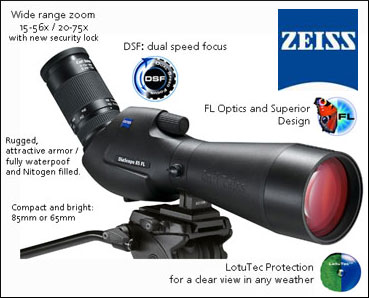 The current Zeiss DiaScope models were launched in 2010 and won Field & Stream’s Best of the Best award, Outdoor Life’s Editor’s Choice award, Petersen’s Hunting’s Editor’s Choice award and the prestigious international Red Dot Design Award. It has many impressive features, including one-piece construction, full armor, and an innovative Dual Speed Focus System (DSF). For those seeking extreme magnification, the DiaScope has an edge over other premium spotting scopes — MORE POWER. The DiaScope’s 20-75x eyepiece remains the most powerful on the market today.
 Camera Land’s One-Penny Tripod Promo


