|
|
August 6th, 2014
Berger Bullets has improved its online stability calculator. Tests have shown that bullets can suffer from reduced BC if the bullet rpm (spin rate) is less than optimal, even if barrel twist rate is otherwise fast enough to stabilize bullets in flight. Now, the improved, free Stability Calculator can determine if you need a faster-twist barrel to enjoy the best BC from your bullets.
CLICK HERE for FREE Berger Twist Rate Stability Calculator
By Bryan Litz, Chief Ballistician for Berger Bullets
We’re happy to announce a major upgrade to our Twist Rate Stability Calculator which is free to use on the Berger Bullets webpage. The old stability calculator was pretty basic, and would simply return a gyroscopic stability number based on your bullet, twist rate, and atmospheric conditions. This was used to determine if your barrels twist rate was fast enough to stabilize a particular bullet or not, based on the Gyroscopic Stability Factor (SG) being greater than 1.4.

Stability and BC — How Bullet RPM Affects Ballistic Coefficients
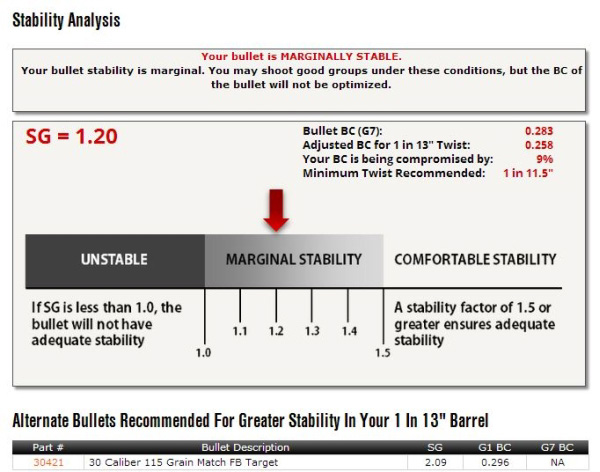
The new calculator still calculates SG, but also goes much further. In addition to calculating stability, the upgraded calculator can also tell you if your stability level is harming the effective BC of your bullets or not. Extensive testing has proven that bullets fired with stability levels between 1.2 and 1.5 can fly with excellent precision (good groups), but suffer from a depressed BC, sometimes as much as 10%. Shooting the bullets from faster twist rate barrels allows for the bullets to fly better and realize their full BC potential.
May 4th, 2014
 Berger Twist-Rate Stability Calculator Berger Twist-Rate Stability Calculator
On the Berger Bullets website you’ll find a handy Twist-Rate Stability Calculator that predicts your gyroscopic stability factor (SG) based on mulitiple variables: velocity, bullet length, bullet weight, barrel twist rate, ambient temperature, and altitude. This very cool tool tells you if your chosen bullet will really stabilize in your barrel.
LIVE DEMO BELOW — Just enter values in the data boxes and click “Calculate SG”.
How to Use Berger’s Twist Rate Calculator
Using the Twist Rate Calculater is simple. Just enter the bullet DIAMETER (e.g. .264), bullet WEIGHT (in grains), and bullet overall LENGTH (in inches). On its website, Berger conveniently provides this info for all its bullet types. For other brands, we suggest you weigh three examples of your chosen bullet, and also measure the length on three samples. Then use the average weight and length of the three. To calculate bullet stability, simply enter your bullet data (along with observed Muzzle Velocity, outside Temperature, and Altitude) and click “Calculate SG”. Try different twist rate numbers (and recalculate) until you get an SG value of 1.4 (or higher).
Gyroscopic Stability (SG) and Twist Rate
Berger’s Twist Rate Calculator provides a predicted stability value called “SG” (for “Gyroscopic Stability”). This indicates the Gyroscopic Stability applied to the bullet by spin. This number is derived from the basic equation: SG = (rigidity of the spinning mass)/(overturning aerodynamic torque).
 If you have an SG under 1.0, your bullet is predicted not to stabilize. If you have between 1.0 and 1.1 SG, your bullet may or may not stabilize. If you have an SG greater than 1.1, your bullet should stabilize under optimal conditions, but stabilization might not be adequate when temperature, altitude, or other variables are less-than-optimal. That’s why Berger normally recommends at least 1.5 SG to get out of the “Marginal Stability” zone. If you have an SG under 1.0, your bullet is predicted not to stabilize. If you have between 1.0 and 1.1 SG, your bullet may or may not stabilize. If you have an SG greater than 1.1, your bullet should stabilize under optimal conditions, but stabilization might not be adequate when temperature, altitude, or other variables are less-than-optimal. That’s why Berger normally recommends at least 1.5 SG to get out of the “Marginal Stability” zone.
In his book Applied Ballistics For Long-Range Shooting, Bryan Litz (Berger Ballistician) recommends at least a 1.4 SG rating when selecting a barrel twist for a particular bullet. This gives you a safety margin for shooting under various conditions, such as higher or lower altitudes or temperatures. Try changing the altitude and temperature in the calculator and you will see that the SG can increase or decrease when these environmental factors change. Under optimal circumstances you should aim for a 1.4, that way if you change circumstances you are still over 1.1.
Erik Dahlberg rifling illustration courtesy FireArmsID.com.
Story idea from EdLongrange. We welcome reader submissions.
February 7th, 2010
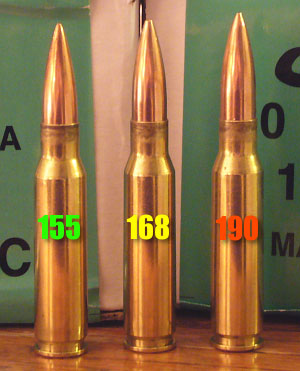 In December, we published the rules controlling choice of caliber and bullet weight for Palma competition. (CLICK HERE to Read.) In the USA, some events are still limited to 156gr or lighter bullets for .308-caliber shooters. But where such restrictions don’t exist, many shooters are using heavy 175-190gr bullets in their .308s. Is the heavier bullet always better? What considerations favor the lighter 155gr-class bullets in Palma competition? Top Palma shooter Kelly Bachand addresses these questions in today’s commentary. In December, we published the rules controlling choice of caliber and bullet weight for Palma competition. (CLICK HERE to Read.) In the USA, some events are still limited to 156gr or lighter bullets for .308-caliber shooters. But where such restrictions don’t exist, many shooters are using heavy 175-190gr bullets in their .308s. Is the heavier bullet always better? What considerations favor the lighter 155gr-class bullets in Palma competition? Top Palma shooter Kelly Bachand addresses these questions in today’s commentary.
Factors That Favor the 155s
by Kelly Bachand
It is clear that 155gr bullets are adequate. In the Palma game, more matches have been won and more 450 scores have been shot with 155gr bullets than with any other weight projectile. With the NRA allowing heavier bullets in Palma matches, many shooters prefer to shoot the longer, heavier bullets when possible. With their higher BCs, the longer bullets would seem to offer a ballistic advantage. There may be an edge, but in my opinion, it comes at a high cost.
Shooting a heavier bullet adds complications. You’ll probably need a different powder and new load development will have to be done. New zeroes must be calculated and confirmed on the range. An expensive new barrel with a faster twist rate may be needed to stabilize the heavier bullets. And unless you’re lucky, there’s a chance that the new barrel is less accurate than your existing barrel. (If you’ve got a “hummer” barrel for the 155s, what are the odds of getting another one as good for the 190s?) For a shooter who only competes domestically and who has plenty of time and money, this does not pose much of a problem, as he can work up multiple loads and acquire multiple barrels, or even build up a second complete rifle. But shooting BOTH the 155s and the heavy bullets (which may require a new barrel) certainly adds to the cost of competing, and the time required to work up loads. One who also competes internationally has much more to worry about, since you’ll likely be switching between the heavy bullets for most domestic matches and the 155s for most international matches.

Consider the challenges you’ll encounter switching between a heavy-bullet domestic load and a 155gr international load. Will changing between two different loads (with very different recoil levels) alter your gun-handling and follow-through? Will having two loads (with different ballistics) create confusion when making wind calls? And if you DO shoot both 155s and 190s, should you have two different barrels, or should you stick to one barrel which is adequate for both bullet weights, but perhaps not optimal for either? The heavier bullets typically have a better BC which means they should be less bothered by the wind. At the same time the heavier bullets travel at a much slower velocity. Does this negate the ballistic advantage? You need to check the ballistic tables carefully, looking at BOTH BC and velocity.
As a person who prefers to keep things simple and stick with what works, it’s no surprise I continue to shoot 155gr bullets exclusively in Palma competitions. But I understand this is just one viewpoint. A Palma shooter reading this should survey competitors who are consistently putting themselves in the winner’s circle. Talk to top shooters and then make your own rational, informed decision about which bullets to use. Good luck and keep them in the center.
April 25th, 2009
 Ever wondered what twist rate is required to stabilize a particular bullet? Or would you like to see how changes in spin rates (rpm) affect bullet stability? Well thanks to our friends from Canada, you’ll find helpful formulas online that answer many questions about external ballistics. Ever wondered what twist rate is required to stabilize a particular bullet? Or would you like to see how changes in spin rates (rpm) affect bullet stability? Well thanks to our friends from Canada, you’ll find helpful formulas online that answer many questions about external ballistics.
The Ballistics Page for the Canadian National Firearms Association (NFA) website offers a variety of useful programs and data charts created by Peter Cronhelm. These include:
Caliber Twist Rate Chart
Greenhill Formula Twist Calculator
Bullet Stability Calculator (requires MS Excel)
Ballistic Coefficients Chart (MS Word), (Or DOWNLOAD HERE.)
Ranging Ballistics Computer (Scroll to bottom of page.)
This exterior ballistics computer works in conjunction with range data as well as computing a conventional drop and windage chart. Using an FFP (Final Firing Point) and multiple TRP’s (Target Reference Points) the system will simultaneously calculate Drop and Windage data for up to 30 TRP’s 360 degrees around the FFP. Windage is corrected for the TRP direction compared to the primary wind direction. The spreadsheet consists of six individual pages. Each page performs a distinct function and contains all the information required to complete a shot at a target or targets. The entire system can be used in any laptop or handheld computer capable of running MS Excel or Excel CE.
CLICK HERE to download Ranging Ballistics Computer (requires MS Excel)
Rimfire Ammo Comparison Table
Canada’s NFA even provides a detailed table with bullet weights and velocities for over 100 varieties of 22LR Rimfire ammunition from Aguila, CCI, Eley, Federal, Fiocchi, Lapua, PMC, Remington, RWS, and Winchester. This Rimfire Ammo Table is a “must-have” resource for any smallbore shooter. Shown below is the section for Lapua:

|


