On its YouTube Channel, the USAMU offers “Pro Tips” videos providing expert instruction on rifle marksmanship. One helpful video covers up/down angle shooting. In the video, SFC Emil Praslick III, one of America’s best long-range shooting coaches, explains how to determine up/down angle, and how to compensate for the angle using scope clicks. Praslick explains how gravity always works as a constant relative to the flat-ground distance to the target (which is distinct from the actual straight-line distance to target.)
The flat-ground distance is the actual distance over which the bullet will be affected by gravity. Use this as the basis for your elevation corrections. As Praslick explains, “this [flat-ground] distance will get less and less as the angle to the target increases [either up or down].” Once you know the straight-line distance to the target AND the exact angle of your shot, simple math lets you calculate the flat-ground distance to the target. Basically, to determine your flat-ground distance to target, you multiply the cosine of the shot angle by the measured straight-line distance to the target.
Application to Long-Range Hunting Since the effects of angles increase with distance, Praslick explains that: “Unless the angle is extremely severe, [a hunter] really won’t notice these effects at ranges of 200 yards or less.” However, for long shots, hunters definitely need to compensate when taking angled shots. Praslick recommends that hunters print out a small chart with the cosines of common angles (20°, 25°, 30° etc.). In addition, hunters need an accurate ballistic table for their rifle and particular ammo. This should show the elevation corrections (in MOA or clicks), for 200 yards to the maximum range at which you may take a shot.
SFC Emil Praslick III is an instructor/coach with the USAMU. He also has served as a coach and “wind guru” with numerous U.S. Teams in international competition, including the U.S. Palma Team, which recently participated in the World Long-Range Fullbore Rifle Championship in Australia. Praslick has also coached the U.S. F-Open Class Team.
Each Wednesday, the U.S. Army Marksmanship Unit publishes a reloading “how-to” article on the USAMU Facebook page. This week’s “Handloading Hump Day” post covers an important safety issue — why you should never assume that a stated “book” load for a particular bullet will be safe with an equal-weight bullet of different shape/design. The shape and bearing surface of the bullet will affect the pressure generated inside the barrel. Visit the USAMU Facebook page next Wednesday for the next installment.
Beginning Handloading, Part 13:
Extrapolating Beyond Your Data, or … “I Don’t Know, What I Don’t Know!”
Last week, we addressed several key facets of Service Rifle reloading. Today, we continue our Handloading Safety theme, focusing on not inadvertently exceeding the boundaries of known, safe data. Bullet manufacturers’ loading manuals often display three, four, or more similar-weight bullets grouped together with one set of load recipes. The manufacturer has tested these bullets and developed safe data for that group. However, seeing data in this format can tempt loaders — especially new ones — to think that ALL bullets of a given weight and caliber can interchangeably use the same load data. Actually, not so much.
The researchers ensure their data is safe with the bullet yielding the highest pressure. Thus, all others in that group should produce equal or less pressure, and they are safe using this data.
However, bullet designs include many variables such as different bearing surface lengths, hardness, and even slight variations in diameter. These can occasionally range up to 0.001” by design. Thus, choosing untested bullets of the same weight and caliber, and using them with data not developed for them can yield excess pressures.
This is only one of the countless reasons not to begin at or very near the highest pressure loads during load development. Always begin at the starting load and look for pressure signs as one increases powder charges.
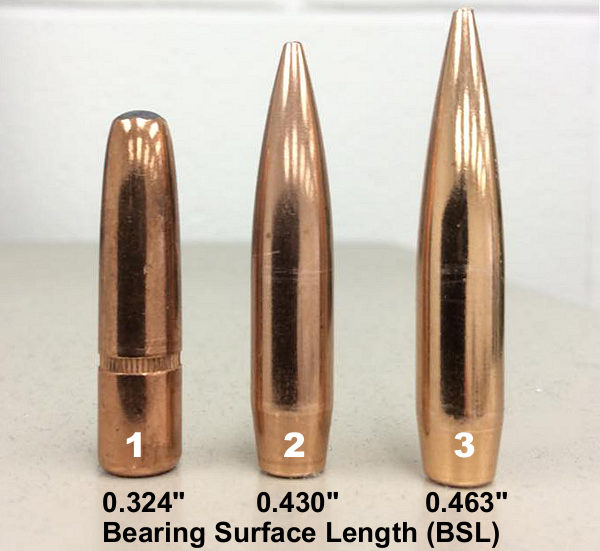
Bullet bearing surface length (BSL) is often overlooked when considering maximum safe powder charges and pressures. In photo 1 (below), note the differences in the bullets’ appearance. All three are 7mm, and their maximum weight difference is just five grains. Yet, the traditional round nose, flat base design on the left appears to have much more BSL than the sleeker match bullets. All things being equal, based on appearance, the RN/FB bullet seems likely to reach maximum pressure with significantly less powder than the other two designs.
Photo 1: Three Near-Equal-Weight 7mm Bullets with Different Shapes
Due to time constraints, the writer used an approximate, direct measurement approach to assess the bullets’ different BSLs. While fairly repeatable, the results were far from ballistics engineer-grade. Still, they are adequate for this example.
Bullet 1 (L-R), the RN/FB, has a very slight taper and only reaches its full diameter (0.284”) very near the cannelure. This taper is often seen on similar bullets — it helps reduce pressures with good accuracy. The calculated BSL of Bullet 1 was ~0.324”. The BSL of Bullet 2, in the center, was ~0.430”, and Bullet 3’s was ~ 0.463”. Obviously, bullets can be visually deceiving as to BSL!
Some might be tempted to use a bullet ogive comparator (or two) to measure bullets’ true BSL for comparison’s sake. Unfortunately, comparators don’t typically measure maximum bullet diameter and this approach can be deceiving.
Photo 2: The Perils of Measuring Bearing Surface Length with Comparators
In Photo 2, two 7mm comparators have been installed on a dial caliper in an attempt to measure BSL. Using this approach, the BSLs differed sharply from the original [measurements]. The comparator-measured Bullet 1 BSL was 0.694” vs. 0.324” (original), Bullet 2 was 0.601” (comparator) vs. 0.430” (original), and Bullet 3 (shown in Photo 2) was 0.602” (comparator) vs. 0.463” (original). [Editor’s comment — Note the very large difference for Bullet 1, masking the fact that the true full diameter on this bullet starts very far back.]
Please join us again next week as we examine other lesser-discussed variables that affect pressure and velocity during handload development. In the meantime, stay safe, and favor center!
Congratulations to SFC Brandon Green on winning the 2015 NRA National High Power Championship. Green shot an impressive 2387-140X to earn his second High Power title, finishing ahead of past Champion Norman Houle (2380-126X) and USAMU team-mate SFC Shane Barnhart (2379-127X). Brandon told AccurateShooter.com: “It’s a great honor and privilege to shoot and compete with such great people here at camp Perry. We had a great match this year and I already look forward to seeing everyone next year.”
Over 260 shooters competed in this year’s High Power Championship events. CLICK HERE to view complete match results, with overall rankings, as well as category-specific results.
It was a well-deserved win for Green, who had to over-come the effects of a nasty spider bite on his right arm (see photo). Joe Caley observed: “Our man Brandon Green and his new-found Spiderman powers pulled off another great Championship. Years from now, no one will remember the 2015 Championship [scores], but they will remember Brandon Green’s Spider Bite!”
SFC Green expressed gratitude to all those who assisted his efforts: “I just want to say thank you to all of my friends and family who support and help us do what we love to do. Thank you for all of the hard work, congratulations, and encouraging words. From the USAMU support team to the friends on the range and back home, I feel blessed to be surrounded by such wonderful people. THANK YOU!”
Here are the Top Ten Finishers, ranked by score for all Classifications:
Bernosky Forced to Withdraw Due to Medical Issues Report by NRABlog.com
This is the second championship for SFC Green, whose first win came two years ago in 2013 after a tie with legendary shooter Carl Bernosky at 2384-126X each. Although both possessed the same point total and X-Count, Green was ultimately awarded the championship after a rulebook-mandated comparison of Xs at each distance gave him the advantage.
Bernosky, a ten-time NRA High Power Rifle champion, withdrew from this year’s competition after the first day (while in sole possession of first place) due to medical complications.
“This win is kind of bittersweet because Carl wasn’t able to be out here. We are pretty good friends and we’re both super competitive people so I wanted to shoot against him,” Green said. “Carl is one of the best competitors I’ve ever seen in this sport, Norm too, and it’s nice to be able to shoot with these guys every year.”
Range photos from 2015 HP Nat’l Championships courtesy NRABlog.com.
This week, the U.S. Army Marksmanship Unit is pleased to host pistol teams from the various U.S. Armed Services in the 56th Annual Interservice Pistol Championship. Our Handloading Shop members have enjoyed discussing pistol accuracy and enjoying the camaraderie of competitive shooters from all over. In that spirit, this week’s topic will focus on handloading for best pistol accuracy, rather than our usual rifle-oriented information.
Optimize the Taper Crimp
One often-overlooked aspect of handloading highly-accurate pistol ammunition is the amount of crimp and its effect on accuracy. Different amounts of taper crimp are used with various handloads to obtain best accuracy. The amount is based on bullet weight, powder burn rate and charge, plus other factors. It is not unusual for our Shop to vary a load’s crimp in degrees of 0.001″ and re-test for finest accuracy.
In the just-released June 2015 issue of Shooting Sports USA, you’ll find an excellent profile of SFC Emil Praslick III, a legendary figure in American shooting. As a marksmanship instructor and coach for the USAMU, Praslick has been a mentor for many of America’s greatest marksmen. Praslick has also served as a wind coach for many civilian teams over the years, guiding them to victory in high-level championship events. SFC Praslick plans to retire later this year, when SFC Shane Barnhart will take over as coach of the USAMU Service Rifle Team.
In a wide-ranging Shooting Sports USA interview with writer John Parker, SFC Praslick offers many interesting insights. Here are some highlights (after the jump):
SGT Tyler Payne of the USAMU gets rounds downrange quickly. Check out the spent brass.
The Sniper’s Hide Cup, one of the premier events on the tactical match circuit, has been underway this weekend in Colorado at the 6000-acre T3 Ranch. This year’s match got off to great start despite the bad weather. The 236 shooters completed all eight stages on time, a significant accomplishment in a field-type match of this scale. Here’s a video report from Day 2 of the event:
Just a week after securing a third straight NCAA Rifle Championship, the West Virginia University (WVU) Rifle team has notched another impressive team victory. At the 2015 NRA Intercollegiate Rifle Club Championships, the Mountaineers just won the Smallbore Rifle competition, compiling an aggregate 2116 team score (out of a possible 2400). Now WVU hopes to win the combined Smallbore and Air Rifle events to secure the overall Championship.
After clenching the Smallbore Championship, the Mountaineers carry a 17-point lead into today’s Air Rifle competition at the USAMU’s facility at Fort Benning, Georgia. In second, with their eyes still on the Championship trophy, is Clemson University at 2099. Penn State rounds out the top three with 2084.
It’s rare when Soldiers and Marines agree on anything. But in this case, both Army shooters and Marine marksmen endorsed the electronic target system at Talladega. Members of the U.S. Army Marksmanship Unit (USAMU) and the U.S. Marine Corps Service Rifle Team traveled to Alabama to test the Kongsberg electronic target system at the CMP’s new Talladega Marksmanship Park. Despite wet weather, the system worked well, allowing shooters to see their shot locations (and scores) instantly. At each shooting station a monitor displays the shooter’s target. Shots are plotted as contrasting white dots with shot values automatically calculated. Watch the video below to hear what the Soldiers and Marines thought of this high-tech system.
Video Shows Electronic Target System in Action
SGT Joseph Hall of the USAMU said the target system was “Super-smooth, super-quick. So far everything has been fantastic. We are saving a tremendous amount of time. There are no pit changes because everything is electronic. We are able to concentrate more on the shooting aspect… and less on … taking care of the targets and pit changes and relay changes. The relay changes here are just as simple as moving your equipment and the next guy getting on the line. The amount of time you’re saving is just incredible.”
Each Wednesday, the U.S. Army Marksmanship Unit publishes a reloading “how-to” article on the USAMU Facebook page. Yesterday’s “Handloading Hump Day” post covered preparation of once-fired 5.56x45mm brass. This article, the first in a 3-part series, has many useful tips. If you shoot a rifle chambered in .223 Rem or 5.56x45mm, this article is worth reading. And visit the USAMU Facebook page next Wednesday for the next installment.
This week, Handloading Hump-Day will answer a special request from several competitive shooters in Alaska. They asked about procedures for morphing once-fired GI 5.56mm brass into accurate match brass for NRA High Power Rifle use. The USAMU has used virgin Lake City (LC) 5.56 brass to win National Championships and set National Records for many years. In this 3-part series, we’ll share techniques proven to wring match-winning accuracy from combat-grade brass.
Preparing Once-Fired GI 5.56 Brass for Reloading (Part 1 of 3)
Assuming our readers will be getting brass once-fired as received from surplus dealers, the following steps can help process the low-cost raw material into reliably accurate components.
1. Clean the Brass
First, clean the brass of any dirt/mud/debris, if applicable. Depending on the brass’s condition, washing it in a soap solution followed by a thorough rinsing may help. [This step also extends the life of the tumbling media.] Approaches range from low-tech, using gallon jugs 1/2 full of water/dish soap plus brass and shaking vigorously, to more high-tech, expensive and time-consuming methods.
2. Wet-Tumbling Options (Be Sure to Dry the Brass)
When applying the final cleaning/polish, some use tumblers with liquid cleaning media and stainless steel pins for a brilliant shine inside and out, while others take the traditional vibratory tumbler/ground media approach. Degree of case shine is purely personal preference, but the key issue is simple cleanliness to avoid scratching ones’ dies.
If a liquid cleaner is used, be SURE to dry the cases thoroughly to preclude corrosion inside. One method is to dump the wet brass into an old pillow case, then tilt it left/right so the cases re-orient themselves while shifting from corner to corner. Several repetitions, pausing at each corner until water stops draining, will remove most water. They can then be left to air-dry on a towel, or can be dried in a warm (150° F-200° F max) oven for a few minutes to speed evaporation.
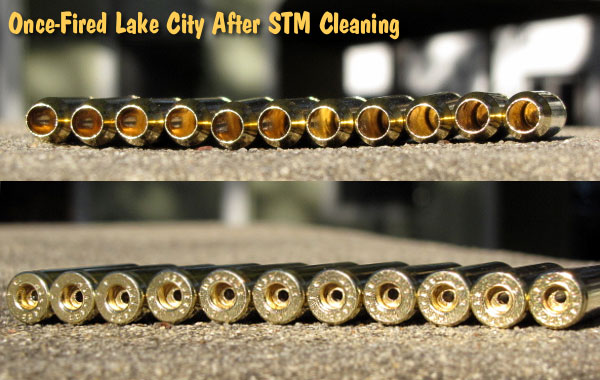
Shown below are Lake City cases after cleaning with Stainless Media (STM). Note: STM Case cleaning was done by a third party, not the USAMU, which does not endorse any particular cleaning method.
3. Inspect Every Case
Once dry, inspect each case for significant deformation (i.e., someone stepped on it), damaged mouths/necks and case head/rim damage. Some rifles’ ejectors actually dig small chunks of brass out of the case head — obviously, not ideal for precision shooting. Similarly, some extractors can bend the case rims so badly that distortion is visible when spinning them in one’s fingers. These can be used for plinking, but our match brass should have straight, undamaged rims.
Dented case mouths are common, and these can easily be rounded using a conical, tapered tool, [such as a .223 expander mandrel. A dummy 7.62 or .30-06 cartridge with a FMJ spitzer can also work.] If most of your brass is of one headstamp, this is a good time to cull out any odd cases.
4. Check the Primers Before Decapping
Your clean, dry and inspected brass is now ready for full-length sizing, decapping and re-priming. Historically, primer crimps on GI brass have caused some head-scratching (and vile language) among handloaders. Our next installment will detail efficient, easy and practical methods to remove primer crimp, plus other useful handloading tips. Until next week, Good Shooting!
NOTE: The USAMU Handloading (HL) Shop does not RE-load fired 5.56 brass. We use virgin LC brass with our chosen primer already staked in place. However, our staff has extensive personal experience reloading GI brass for competition, which will supplement the Shop’s customary steps. In handloading, as in life, there are many ways to accomplish any given task. Our suggestions are note presented as the “only way,” by any means. Time for loading/practicing is always at a premium. Readers who have more efficient, alternative methods that maintain top accuracy are invited to share them here.
Can a human being, hand-holding a rifle, out-shoot a mechanical test rest? Who would win in this battle between man and machine? You might just be surprised. At 600 yards, with an AR-platform rifle, the results can be remarkably close, based on targets provided by the USAMU. When clamped in a test rig, a USAMU M16A2 produced a 200-18X group with handloads. The USAMU says this was “one of our better 20-shot groups at 600 yards, testing ammo from a machine rest”. Can a human do better?
Remarkably, a human soldier came very close to matching the group shot from the machine rest. The photo below shows a 20-shot group shot by a USAMU marksman with sling and iron sights, using USAMU-loaded ammunition. The score, 200-16X, was nearly the same. As you can see, the USAMU rifleman didn’t give up much to the machine rest, even at 600 yards!
In fairness, this was no ordinary human performance. The 200-16X score was a new National Record set in December, 1994. This was fired by PFC Coleman in an Interservice Match at Okeechobee, Florida. Nice shootin’ soldier!


 On its YouTube Channel, the USAMU offers “Pro Tips” videos providing expert instruction on rifle marksmanship. One helpful video covers up/down angle shooting. In the video, SFC Emil Praslick III, one of America’s best long-range shooting coaches, explains how to determine up/down angle, and how to compensate for the angle using scope clicks. Praslick explains how gravity always works as a constant relative to the flat-ground distance to the target (which is distinct from the actual straight-line distance to target.)
 Since the effects of angles increase with distance, Praslick explains that: “Unless the angle is extremely severe, [a hunter] really won’t notice these effects at ranges of 200 yards or less.” However, for long shots, hunters definitely need to compensate when taking angled shots. Praslick recommends that hunters print out a small chart with the cosines of common angles (20°, 25°, 30° etc.). In addition, hunters need an accurate ballistic table for their rifle and particular ammo. This should show the elevation corrections (in MOA or clicks), for 200 yards to the maximum range at which you may take a shot.


 Preparing Once-Fired GI 5.56 Brass for Reloading (Part 1 of 3)