Today we are highlighting Olympic shooter SPC Alison Weisz, a marksmanship instructor/competitive shooter with the U.S. Army Marksmanship Unit International Rifle Team. Weisz competes internationally in both 10m Air Rifle and 50m Smallbore. Just recently, Allison earned the Bronze Medal in Women’s 10m Air Rifle and 4th place in Mixed Team 10m Air Rifle, along with USAMU teammate SGT Tim Sherry, at the ISSF World Cup in Cairo, Egypt.
Alison, who hails from Belgrade, Montana, joined the USAMU to advance her marksmanship skills. She is now a U.S. Army soldier and also a Team USA member. She represented the USA at the 2020 Olympics in Women’s 10m Air Rifle.
In the video below, SPC Alison Weisz, a marksmanship instructor/competitive shooter with the USAMU International Rifle Team, explains the mental focus she achieves during her training sessions at the range.
“The range is absolutely my ‘home away from home’. I spend all of my time on it. While I am up there it’s just peace, tranquility. Of course there are triumphs and trials and errors as well … but for me, it’s my space. I get to be with just myself and my thoughts.”
This year, Alison has already won a Bronze Medal at the ISSF World Cup in Cairo. Her competition goals are now set on the 2024 Olympics. We commend Alison for her dedication to her sport and her service to her country as a U.S. Army soldier.
The U.S. Army Marksmanship Unit regularly publishes reloading “how-to” articles on the USAMU Facebook page. One very good article, part 5 of a 6-part series, focused on Progressive Presses. This article explains proper procedures for Auto-Indexing Progressives, which advance the shell-plate with every pull of the handle. Auto Progressives are very efficient, but they also require special attention and focus, because so many things are happening at once. You need to train yourself to watch every station. If you run a progressive press now, or are considering getting a progressive, we recommend you read this article. Visit the USAMU Facebook page for other helpful handloading guidance.
Progressive Loading Presses — Self-Advancing Shellplate Type
Recently, we addressed manually-operated progressive presses for the beginning handloader. This type press requires one to manually advance the shellplate after each handle stroke. An advantage for beginners is that nothing happens at any station until the loader wants it to. This helps users avoid problems from clearing malfunctions without noticing that the shellplate has advanced itself. (Read Previous USAMU Article on Manual Progressives.)
The next, more luxurious type progressive press advances the shellplate automatically whenever the handle is cycled. [Editor: This is also called an “Auto-Indexing” Progressive Press.] Typically, each stroke automatically sizes and primes a case, operates the powder measure (if used) and seats a bullet. Some also have case feeders that automatically put a new case in the shellplate with every cycle. Others require the loader to insert a case each cycle. With both types, the loader usually puts a bullet on each sized/primed/charged case.
[CAVEAT: While our Handloading Shop has several progressive presses, ALL of our powder charges are thrown/weighed by hand. We do not use powder measures on our presses. Our progressives are used for brass preparation, priming, seating, etc., but not for fully-progressive loading.]
The manually-advanced press can be a boon to beginners, but as one gains experience it can be a mixed blessing, depending on one’s style. If one pays close attention to every operation and loads without distractions, the manual press is very reliable and allows full scrutiny of each round as it is loaded. However, if one easily drifts into day-dreaming, or isn’t focused on paying careful attention at all times, the manual progressive can be a bit of a liability. The opportunity for forgetting a powder charge, leading to a squib load, is ever-present. [Editor: A lock-out die can help reduce the risk of a squib load, or a double-charge. See below.]
The automatically-advancing progressives help prevent this by ensuring a powder charge will be dropped each time the handle is operated. Experienced handloaders often appreciate this feature due to the savings of time and effort. Individual preferences between the two press styles are influenced by several factors. These include one’s comfort with more- vs. less-complicated mechanisms, how often one changes calibers (case feeders often must be converted, in addition to dies and shellplates), how many rounds one loads annually, relative ease of changing primer mechanisms from small to large, etc. Automatic progressives and their caliber conversion kits tend to be significantly more expensive than manual progressives and caliber conversions from the same maker.
One USAMU handloader, who likes simple, bullet-proof machines and maximum efficiency when converting presses, owns two manually-advanced progressives. One is set up for large primers, and the other for small primers. He can change calibers in the twinkling of an eye. As he loads for many different calibers, this fits his style. Another handloader here is just the opposite. He loads for a few calibers, but in larger quantities. He much prefers his self-advancing press with case-feeder for its speed. He makes large lots of ammo in a given caliber before switching, to improve overall efficiency. His caliber conversion kits are more expensive than those for the manually-advanced progressive, but he uses fewer of them.
Whichever type one chooses, it is VERY important to buy quality gear from a manufacturer with a long, well-established track record for quality, durability and good customer support. Avoid jumping on the “latest, greatest” model until it has a proven track record. For example, this writer knows a loader who got a brand-new, expensive, self-advancing model press some years back, shortly after its introduction. As is too often the case these days, the manufacturer released it before all the “bugs” were worked out.
Better Safe Than Sorry — the RCBS Lock-Out Die
RCBS Makes a “Lock-Out Die” that senses the powder charge. This will halt the Progressive press if you have a double charge, or an undercharge. Your Editor has the Lock-Out Die on his RCBS Pro 2000. It has “saved his bacon” a half-dozen times over the years. It can be used on Dillon and Hornady progressives as well as RCBS machines.
It would not fully seat primers to the correct depth. No amount of adjustment, extra force, or fiddling would do better than to seat primers barely flush with the case head. Any inattention could result in a slightly “high” primer, protruding above the case head. It created a risk for slam-fires, particularly in semi-autos without spring-retracted firing pins, such as the M1 or M1A. In desperation, he had a machinist buddy study the problem and machine a new part to correct it. No dice. Its engineering didn’t permit full primer seating, even with extended parts. He now wishes he’d heeded his shooting buddies’ advice to stick with the “tried and true,” reliable performer they all used.
Whichever press one selects, see if the maker has a kit or list of commonly-replaced parts. Having needed springs, pins, etc. on hand in the rare event that one breaks or “goes missing” can save the day when one is busy loading for a match! Another tip for improving one’s overall loading efficiency (rounds loaded with minimal set-up/tear-down time) is to plan one’s handloading by primer size. For example, if your machine is set to use small primers, load all the calibers that you intend to that take small primers, before converting the press to load large-primer calibers.
In our next chapter, we’ll discuss peculiarities of progressive loading for rifle cartridges, with remedies for problems such as excessive cartridge-case headspace variation when sizing, tips for ensuring best powder charge consistency, and so on. Until then, be safe, and good shooting!
The U.S. Army Marksmanship Unit (USAMU) has produced an excellent series of videos, which collectively cover the Basic Rifleman’s Course. If you are getting started in High Power shooting, or want to improve your position shooting skills, this series is well worth watching. And these videos are not just for service rifle shooters — even bench shooters can benefit from these videos, particularly Part 5, which explains how to estimate wind speed and direction. The lead instructor for these videos is SFC Brandon Green, a three-time National High Power Champion. When SFC Green talks, you should listen.
SFC Brandon Green is a shooting superstar. Green won his third NRA National High Power Rifle Championship in 2018 at Camp Atterbury, Indiana. He dominated the HP Championship cycle, finishing eight points and ten Xs ahead of his nearest competitor. Brandon also won High Power National Championships in 2015 and 2013. And in 2017 he set new records at the CMP’s National Trophy Matches at Camp Perry. One of the greatest marksmen in the nation’s history, SFC Green has no weaknesses, excelling at all positions, both rapid-fire and slow-fire.
Part 5 — Wind and Weather Estimation (Very Useful for All Shooters)
Note: This video includes a hit location “target analysis” in the first 6 minutes.
Part 4 — Minute of Angle Explained
Part 3 — Ballistics and Zeroing
Part 2 — Positions, Sight Alignment, and Natural Point of Aim (Very Useful)
Part 1 — Aiming and Sight Picture
Three-time National High Power Champion SFC Brandon Green (left above) set four new National Records at Camp Perry in 2017.
About SFC Brandon Green — One of America’s Greatest Marksmen
A three-time National High Power Champion, SFC Green has had a distinguished shooting career while at the USAMU. In 2018 Green set 4 Individual National Records and capturing his first President’s 100 match win while setting a new national record for the match. 2018 also saw SFC Green winning his third National Trophy Individual championship while setting a new national record for this championship. In 2017 Green won his fourth Interservice Individual Championship, setting a new record for this match in the process. He was also a member of several first-place winning teams, including the Nation Team Trophy and the National Infantry Trophy team match at the National Championships.
SFC Green has won the Interservice Long Range championships five times and is the current record holder for this match. In 2007 and 2008 Green captured the coveted Wimbledon Cup trophy during the NRA National Long Range Championships. He earned his third overall NRA National High Power Championship title in 2018. Green is also a lead instructor for the USAMU’s marksmanship courses and teaches the Small Arms Firing School every summer at Camp Perry, Ohio.
Now here is an example of truly impressive marksmanship skills and amazing aiming from a USAMU soldier. From a standing position, SPC Ivan Roe shoots a tiny aspirin pill off the top of a balloon — without breaking the balloon. In fact, he does this twice … with iron sights no less.
Watch Video to See Aspirin Pill Shot Twice off Balloon:
The first time the pill sits on a small piece of tape just millimeters above the upper edge of the balloon (Time mark 00:40-45). But the second time, the aspirin pill lies flat on the top on the balloon — an even tougher challenge. Watch Ivan nail that flat pill again without hitting the balloon at 00:59. No that is truly impressive — and remember it was done from standing with Iron sights!
SPC Ivan Roe was using a German Feinwerkbau, an elite precision air rifle favored by Olympic and World Cup competitors. Originally from Montana, SPC Roe is a member of the USAMU International Rifle Team.
Did you like this demonstration of Trick-Shot marksmanship? Then visit the USAMU’s Facebook Page. The USAMU often releases shooting skills/marksmanship videos on Facebook and YouTube, with the Trickshot examples featured on Tuesday. CLICK HERE for another USAMU trick-shot video — hitting a poker chip on a fast-moving target frame with a pistol. Very impressive.
Photo 1: Three Near-Equal-Weight 7mm Bullets with Different Shapes
TECH TIP: Bullets of the same weight (and caliber) can generate very different pressure levels due to variances in Bearing Surface Length (BSL).
Bullet 1 (L-R), the RN/FB, has a very slight taper and only reaches its full diameter (0.284″) very near the cannelure. This taper is often seen on similar bullets — it helps reduce pressures with good accuracy. The calculated BSL of Bullet 1 was ~0.324″. The BSL of Bullet 2, in the center, was ~0.430”, and Bullet 3’s was ~ 0.463″. Obviously, bullets can be visually deceiving as to BSL!
This article from the USAMU covers an important safety issue — why you should never assume that a “book” load for a particular bullet will be safe with an equal-weight bullet of different shape/design. The shape and bearing surface of the bullet will affect the pressure generated inside the barrel. This is part of the USAMU’s Handloading Hump Day series, published on the USAMU Facebook page.
Beginning Handloading, Part 13:
Extrapolating Beyond Your Data, or … “I Don’t Know, What I Don’t Know!”
We continue our Handloading Safety theme, focusing on not inadvertently exceeding the boundaries of known, safe data. Bullet manufacturers’ loading manuals often display three, four, or more similar-weight bullets grouped together with one set of load recipes. The manufacturer has tested these bullets and developed safe data for that group. However, seeing data in this format can tempt loaders — especially new ones — to think that ALL bullets of a given weight and caliber can interchangeably use the same load data. Actually, not so much.
The researchers ensure their data is safe with the bullet yielding the highest pressure. Thus, all others in that group should produce equal or less pressure, and they are safe using this data.
However, bullet designs include many variables such as different bearing surface lengths, hardness, and even slight variations in diameter. These can occasionally range up to 0.001″ by design. Thus, choosing untested bullets of the same weight and caliber, and using them with data not developed for them can yield excess pressures.
This is only one of the countless reasons not to begin at or very near the highest pressure loads during load development. Always begin at the starting load and look for pressure signs as one increases powder charges.
Bullet bearing surface length (BSL) is often overlooked when considering maximum safe powder charges and pressures. In photo 1 (at top), note the differences in the bullets’ appearance. All three are 7mm, and their maximum weight difference is just five grains. Yet, the traditional round nose, flat base design on the left appears to have much more BSL than the sleeker match bullets. All things being equal, based on appearance, the RN/FB bullet seems likely to reach maximum pressure with significantly less powder than the other two designs.
Bearing Surface Measurement Considerations
Some might be tempted to use a bullet ogive comparator (or two) to measure bullets’ true BSL for comparison’s sake. Unfortunately, comparators don’t typically measure maximum bullet diameter and this approach can be deceiving.
Photo 2: The Perils of Measuring Bearing Surface Length with Comparators
In Photo 2, two 7mm comparators have been installed on a dial caliper in an attempt to measure BSL. Using this approach, the BSLs differed sharply from the original [measurements]. The comparator-measured Bullet 1 BSL was 0.694” vs. 0.324” (original), Bullet 2 was 0.601” (comparator) vs. 0.430” (original), and Bullet 3 (shown in Photo 2) was 0.602” (comparator) vs. 0.463” (original). [Editor’s comment — Note the very large difference for Bullet 1, masking the fact that the true full diameter on this bullet starts very far back.]
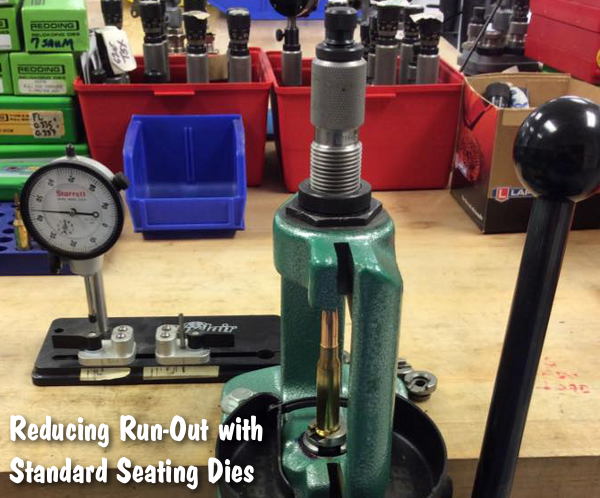
The U.S. Army Marksmanship Unit (USAMU) regularly publishes reloading “how-to” articles on the USAMU Facebook page. This USAMU article, the second in a series on improving concentricity, has many useful tips. If you use standard (non-micrometer) seating dies when loading some cartridge types, this article is worth reading. And visit the USAMU Facebook page for other tips on handloading and marksmanship.
Once again, it’s time for USAMU’s “Handloading Hump-Day!” Last week, we addressed achieving very good loaded-cartridge concentricity (AKA “TIR”, or Total Indicator Runout) using standard, “hunting grade” reloading dies.
We explained how to set up the Full-Length Size die to float slightly when correctly adjusted for desired case headspace. We also cited a study in which this method loaded ammunition straighter than a set of [higher grade] match dies from the same maker. [One of the keys to reducing TIR with both sets of dies was using a rubber O-ring below the locking ring to allow the die to float slightly. READ Full-Length Sizing Die TIP HERE.]
Now, we’ll set up a standard seating die to minimize TIR — the other half of the two-die equation. As before, we’ll use a single-stage press since most new handloaders will have one. A high-quality runout gauge is essential for obtaining consistent, accurate results.
Having sized, primed and charged our brass, the next step is bullet seating. Many approaches are possible; one that works well follows. When setting up a standard seating die, insert a sized, trimmed case into the shell-holder and fully raise the press ram. Next, back the seating stem out and screw the die down until the internal crimping shoulder touches the case mouth.
Back the die out one-quarter turn from this setting to prevent cartridge crimping. Next, lower the press ram and remove the case. Place a piece of flat steel on the shellholder and carefully raise the ram. Place tension on the die bottom with the flat steel on the shellholder. This helps center the die in the press threads. Check this by gently moving the die until it is well-centered. Keeping light tension on the die via the press ram, secure the die lock ring.
If one were using a micrometer-type seating die, the next step would be simple: run a charged case with bullet on top into the die and screw the seating stem down to obtain correct cartridge OAL.
However, with standard dies, an additional step can be helpful. When the die has a loosely-threaded seating stem, set the correct seating depth but don’t tighten the stem’s lock nut. Leave a loaded cartridge fully raised into the die to center the seating stem. Then, secure the stem’s lock nut. Next, load sample cartridges and check them to verify good concentricity.
One can also experiment with variations such as letting the seating stem float slightly in the die to self-center, while keeping correct OAL. The runout gauge will show any effects of changes upon concentricity. However, the first method has produced excellent, practical results as evidenced by the experiment cited previously. These results (TIR Study 2) will reproduced below for the reader’s convenience.
TIR Study 2: Standard vs. Match Seating Dies
50 rds of .308 Match Ammo loaded using carefully-adjusted standard dies, vs. 50 using expensive “Match” dies from the same maker.
Standard dies, TIR:
0.000” — 0.001” = 52%;
0.001”– 0.002” = 40%;
0.002”– 0.003” = 8%. None greater than 0.003”.
AccurateShooter Comment: This shows that, with careful adjustment, the cheaper, standard dies achieved results that were as good (or better) than the more expensive “Match” Dies.
These tips are intended to help shooters obtain the best results from inexpensive, standard loading dies. Especially when using cases previously fired in a concentric chamber, as was done above, top-quality match dies and brass can easily yield ammo with virtually *no* runout, given careful handloading.
The 2021 Rifle Small Arms Firing School helped train over 250 individuals on the range.
This article recognizes the efforts of military men and women who teach others shooting skills and preserve the proud traditions of American marksmanship.
The National Matches at Camp Perry, a staple in the marksmanship world for over 100 years, include many excellent training clinics taught by military teams as well as CMP instructors. The CMP offers an entire lineup of educational courses for those new to the sport and those eager to develop their skills. The types of rifle and pistol courses span from junior to adult, competitive to maintenance and everything in between. Along with classes taught by CMP staffers, other courses are taught by military personnel, including many past and current National Champions and record-holders.
Small Arms Firing School Led by 3-Time Nat’l HP Champion SSG Brandon Green
This year, the Small Arms Firing School was directed by many top-flight marksmen from a number of military teams. The rifle classroom portion was led by the USAMU’s SFC Brandon Green (shown below), a 3-Time National High Power Champion who holds multiple national records including a perfect score in the President’s Rifle event.
Out on the line, world-class shooters such as SSG Amanda Elsenboss and MAJ Samuel Freeman, the 2021 winner of the President’s Rifle Match, brought their knowledge and experience into one-on-one training with participants. Elsenboss is one of America’s greatest shooters. She recently won the 2021 National High Power Championship at Camp Atterbury, after winning the National Long-Range Championship in 2019.
“Having those world-class shooters serve as instructors is an honor and one the students should remember always”, Cooper added.
U.S. Marine Corps Junior Clinic
The Marine Corps junior clinic, guided by MAJ Martinez (USMC Shooting Team Officer), is always a big hit with up-and-coming young rifle shooters. CMP Training Manager Steve Cooper noted: “It was great to see so many enthusiastic young people, who revere the Marine Corps Shooting Team, come out and take advantage of the instruction at this year’s clinic.”
The 3-day clinic includes more advanced training beyond fundamentals, including weather conditions, how to read wind, equipment use, shooting positions, and rulebook standards. Juniors in the clinic spend one day in the classroom, followed by two days of live-fire on the range at 200, 300, and 600 yards.
“We talk to them and try to understand them, what they struggle with as individuals and their process,” Cooper said of the USMC’s training technique. “We try to give them tiny, little fixes to what they already have going on.”
GySgt Daniel Rhodes, the staff non-commissioned officer in charge of the Marine Corps Rifle Team, helped lead instruction on the firing line in 2021. Rhodes was pleased with the turnout of around 80 juniors. Rhodes explained that around 25 percent of the juniors in the clinic were first-timers.
Team CMP Advanced High Power Clinic:
Led by members of Team CMP (the organization’s own competitive High Power squad) the Advanced High Power Clinic offers more complex instruction in service rifle competition techniques using classroom and range discussion. Though the class traditionally only utilizes dry-fire training on the range, in 2021, a 600-yard live-fire portion was added.
The Advanced High Power Clinic, led by Team CMP members including Bob Gil (above), provides advanced training on wind reading, mental management and more.
With 65 individuals signed up, the course was broken into groups headed by Sara Rozanski, James Fox, Nick Till, Danny Arnold, Robert Taylor and Bob Gil — all experienced and award-winning marksmen. Each focused on a specific area, such as wind reading, mental management and positioning.
Hail the new Champion — SSG Amanda Elsenboss is the 2021 NRA High Power Rifle National Champion. Amanda secured the High Power title with a Grand Aggregate score of 2386-133X. This is a major achievement for Amanda. In winning the coveted High Power title, Amanda is now just the third female to earn this honor, along with Nancy Tompkins and Nancy’s daughter Sherri Gallagher. And we believe this is the first time a woman won the High Power title shooting a Service Rifle in all matches.
Elsenboss, formerly with the U.S. Army Marksmanship Unit, now competes with the Pennsylvania Army National Guard Team. She is classified as a High Master in NRA High Power. Finishing second overall was SSG John Coggshall of the Army National Guard with a score of 2380-125X. Coggshall, like Amanda, shot a Service Rifle. Kenneth Lankford, shooting a Match Rifle, finished third with 2379-104X.
The match was held August 22–28 at Camp Atterbury, Indiana. On her Facebook Page, Amanda posted:
“Today was a great day. After four long, hot days on the range I won the 2021 NRA [High Power] Rifle Championships. Thank you to everyone for the support and encouragement along the way. Congratulations to John Coggshall for coming in second overall and second Service Rifle, and to Kirk Freeman for being third Service Rifle. It was some great shooting by the Guard… and everyone really making the last day count.”
Amanda added: “I have to thank my biggest supporter — Perry Sabertooth X Mayfly” (shown above in Amanda’s shooting cart at Camp Atterbury).
Before Her High Power Victory, Amanda Took 2nd in Long Range
Before winning the 2021 High Power National Championship, Amanda took second in the 2021 NRA Long Range National Championship, also held at Camp Atterbury.
This has been a great summer for Amanda at Camp Atterbury. She finished second overall at the 2021 NRA Long-Range Nationals, behind Oliver Milanovic, and she also won the Canadian Cup at Atterbury. Prior to that, competing at Camp Perry with the National Guard All Guard Marksmanship Team, Amanda shot perfect individual scores in both the National Trophy and Hearst Doubles team events. Her 500-34X in the National Trophy Team (NTT) event set a National Record.
Amanda, then shooting with the USAMU team, previously won the NRA Long Range National Championship in 2019. Now that she has won BOTH High Power and Long Range National Championships, Amanda can truly be ranked among the most notable shooters in U.S. history.
Amanda Elsenboss — America’s New Leading Lady of Shooting
Before his retirement from the U.S. Army, Emil Praslick III coached Amanda as a shooter with the U.S. Army Markmanship (USAMU) team. Emil, considered one of the greatest shooting coaches in the nation, was impressed with Amanda’s skill and dedication. Emil posted: “[Amanda is] by far the easiest shooter to coach I’ve ever worked with. A machine.”
Video Interview with SSG Amanda Elsenboss
This video, featuring SSG Amanda Elsenboss, was created by the USAMU to mark Women’s History Month. Amanda talks about her career in the military, and her love of competitive shooting. This is a great video, well worth watching. There are images from many shooting ranges around the nation.
SSG Amanda Elsenboss. CLICK Speaker Icon to Hear Sound!
When serving with the USAMU, Amanda shot the sling division at the Berger SW Nationals:
SSG Greg Markowski of the USAMU at Camp Perry, Ohio.
Today is the final day of pistol competition for the National Matches at Camp Perry. Many of the best pistol shooters in the country will be on the firing line, including members of the U.S. Army Marksmanship Unit Service Pistol team. Today, July 18th, the handgun phase of the CMP National Matches concludes with the Oliver Hazard Perry Pop-Up Pistol Match, Military & Police Pistol Match, 1911 As-Issued Pistol Match, and Glock Match. After the last match, trophies and awards will be presented to the top shooters.
If you want to compete in top competitions like this, you’ll need good ammo. The following USAMU article provides rock-solid reloading advice, explaining how to load accurate, reliable handgun ammo.
Camp Perry NM pistol firing line from CMP Photo Archives.
The U.S. Army Marksmanship Unit (USAMU) fields pistol teams as well as rifle and shotgun competition squads. Consequently the USAMU’s Reloading Shop loads tens of thousands of pistol rounds every year. In this article, the USAMU’s handgun experts talk about reloading for handguns — with smart tips on how to achieve superior accuracy with 100% reliability. This article, which offers important insights on COAL, primers, crimps and more.
Precision Pistol Reloading — Recommended Methods
Optimize the Taper Crimp
One often-overlooked aspect of handloading highly-accurate pistol ammunition is the amount of crimp and its effect on accuracy. Different amounts of taper crimp are used with various handloads to obtain best accuracy. The amount is based on bullet weight, powder burn rate and charge, plus other factors. It is not unusual for our Shop to vary a load’s crimp in degrees of 0.001″ and re-test for finest accuracy.
Use Consistent Brass
Brass is also important to pistol accuracy. While accurate ammunition can be loaded using brass of mixed parentage, that is not conducive to finest results, particularly at 50 yards. It is important for the serious competitor/handloader to use brass of the same headstamp and ideally one lot number, to maximize uniformity. Given the volumes of ammunition consumed by active pistol competitors, using inexpensive, mixed surplus brass for practice, particularly at the “short line” (25 yards), is understandable. However, for the “long line” (50 yards), purchasing and segregating a lot of high-quality brass to be used strictly for slow-fire is a wise idea.
Importance of Uniform COAL
Uniformity of the Case Overall Length (COAL) as it comes from the factory is also important to achieving utmost accuracy. More uniform case lengths (best measured after sizing) contribute to greater consistency of crimp, neck tension, ignition/burn of powder charge, and so on. Cartridge case-length consistency varies from lot to lot, as well as by maker. Some manufacturers are more consistent in this dimension than others. [Editor’s note: It is easy to trim pistol brass to uniform length. Doing this will make your taper crimps much more consistent.]
Primers and Powders — Comparison Test for Accuracy
Pay attention to primer brands, powder types and charges. Evaluating accuracy with a Ransom or other machine rest at 50 yards can quickly reveal the effect of changes made to handload recipes.
Bullet Selection — FMJ vs. JHP
Bullets are another vital issue. First, there is the question of FMJ vs. JHP. A friend of this writer spent decades making and accuracy-testing rifle and pistol bullets during QC for a major bullet manufacturer. In his experience, making highly-accurate FMJ bullets is much more difficult than making highly-accurate JHPs, in large part due to the way the jackets are formed. Small die changes could affect accuracy of FMJ lots dramatically.
The CMP now allows “safe, jacketed ammunition” in Excellence-in-Competition (EIC) Service Pistol matches, although wadcutter ammunition is prohibited. Thus, the option to use very accurate JHP designs simplifies the life of CMP Service Pistol shooters in pursuit of the prestigious Distinguished Pistol Shot badge.
Hopefully, these tips will be helpful to any pistol shooters interested in accurate handloads, not just “Bullseye” shooters. Small tweaks to one’s normal routine can pay big dividends in improved accuracy and make practice and competition more rewarding.
Stay safe, and good shooting!
TOP IMAGE: SSG Greg Markowski, a shooter/instructor with the U.S. Army Marksmanship Unit and native of Poland, fires his pistol during the 2018 Civilian Marksmanship Program’s National Pistol Matches at Camp Perry, Ohio July 13, 2018. At that event, Markowski claimed the General Mellon Trophy, General Patton Trophy and the General Custer Trophy. U.S. Army photo by Maj. Michelle Lunato/released by Defense Visual Information Distribution Service.
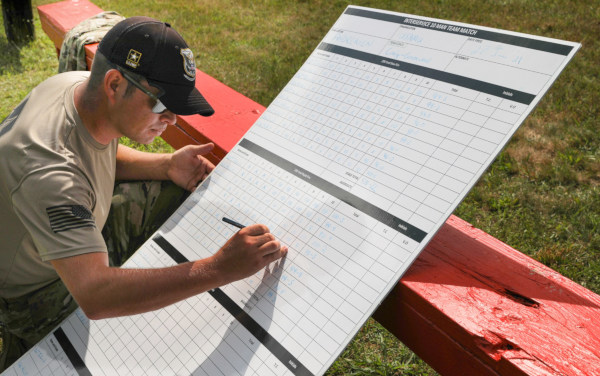
This past weekend, the U.S. Army Marksmanship Unit (USAMU) Service Rifle Team won the 2021 Interservice Rifle Team Championship Match held in Quantico, Virginia. The USAMU squad finished with an impressive score of 4918-185X! This competition features 10-person teams. All the shooters have to perform well to secure the team victory.
This is a tough match, shot with multiple positions at 200, 300, and 600 yards. In this course of fire, all members of a 10-person team complete the following stages:
Stage 1 at 200 yards — 10 standing, slow fire shots with a total time of 66 minutes.
Stage 2 at 200 yards — 10 sitting from standing, rapid fire shots within 60 seconds per shooter.
Stage 3 at 300 yards — 10 prone from standing, rapid fire shots within 70 seconds per shooter.
Stage 4 at 600 yards — 20 prone, slow fire shots with a total time of 126 minutes.
Team members were: Sgt. 1st Class Walter Craig (coach), Lt. Col. Erik Andreasen (captain), Staff Sgt. Erin McNeil (497-21X), Sgt. Brandon Muske (495-22X), Sgt. Jarrod McGaffic (495-18X), Sgt. 1st Class Brandon Green (494-20X), Sgt. Jared Desrosiers (494-15x), Staff Sgt. David Bahten (492-19X), Spc. Kade Jackovich (492-17X), Spc. Luke Rettmer (489-16X) Staff Sgt. Verne Conant (487-13X) and Sgt. Lane Ichord (483-24x).
By earning the top score in this match, SSG Erin McNeil (shown above) also earned the Lt. Col. Reynolds Trophy. SGT Muske placed second in this category. The 2021 Interservice Match at Quantico concludes today with the well-known Infantry Trophy Team Match. See more Interservice match photos at: USAMU Flickr Archive (742 images).










 Use Consistent Brass