Want to see a bullet hit a target in ultra-ultra-slow motion? Watch this video to witness some amazing things — such as a bullet jacket peeling back like a banana-skin (at time-mark 7:30). A while back, Werner Mehl of Kurzzeit.com produced a 10-minute video for the SHOT Show. This video has has been watched over 10.6 million times, making it one of the most popular shooting-related videos in history. Employing cameras recording at up to 1,000,000 (one million) frames per second, Mehl’s bullet flight video has been called “astounding” and “mesmerizing”. If you haven’t seen it yet, sit back and enjoy!
Watch This Video! It’s Really Something Special…
LINK: Kurzzeit.com Video System and PVM-21 Chronograph
Click the link above to learn more about Werner Mehl and his super-sophisticated camera systems that can record at 1,000,000 frames per second. On the same linked page you can learn about the advanced PVM-21 chronograph (now sold as the BMC-19) designed by Werner. Operating “all-infrared, all the time”, the PVM-21/BMC-19 is the best optical chronograph we have tested for very low light conditions, or very tricky light conditions.
How well can the little 6mm Dasher perform at 1000 yards when the conditions are good, and the shooter is riding a hot streak? Well here’s a shot-by-shot record of Scott Nix’s 4.554″ ten-shot group shot at Missoula, Montana at the Northwest 1000-yard Championship a few years back. All 10 shots were centered for a 100-6X score. That’s about as good as it gets. If Scott had stopped after 5 shots, his group would have been under three inches.
Video Demonstrates Amazing 1000-Yard Accuracy
Watch the video. You can see the group form up, shot by shot. It’s pretty amazing. Scott’s first shot (at the 45-second mark of the video) was right in the X-Ring, and four of Scott’s first five shots were Xs. That’s drilling them! This video was recorded from the pits at the 1000-yard line, during record fire.
How is a modern, metal-chassis rifle built? This very cool video from Masterpiece Arms answers that question. The nicely-edited video shows the creation of a Masterpiece Arms tactical rifle from start to finish. All aspects of the manufacturing process are illustrated: 3D CAD modeling, CNC milling of the chassis, barrel threading/contouring, chamber-reaming, barrel lapping, laser engraving, and stock coating. If you love to see machines at work, you will enjoy this video…
As part of the NRA’s Tips & Tactics video series, Kristy Titus explains how to prepare for a hunt. Titus, co-host of the Team Elk TV show, is a certified instructor has hunted around the globe. She grew up in the outdoors, running pack mules in Oregon with her father. In this video, Kristy discusses fitness training and demonstrates field positions that can be employed during a hunt.
Kristy explains: “Hunting can lead you into some steep, rough country. It’s really important that you train both your body and your mind to handle the elements and the rigors of hunting. With no two hunting situations being the same, we must train to be adaptable and make the most of every opportunity. The most important aspect of hunting success, ultimately, is the person behind the rifle. So, if you plan on going on a mountain hunt, get out and train your body. Train with your firearm. Get off the bench and have some fun with this. Do some positional shooting or, if you want to add a stress dynamic… have someone put you under a time parameter.”
“When it comes to bolt-action rifle fit, there is no ‘one size fits all’,” says Titus. “When picking out your rifle [consider options] after the purchase to ensure you are as comfortable as possible.”
Story Tip from EdLongrange. We welcome reader submissions.
Here is a video every shooter should watch. It reminds us that our sport demands 100% attention. Lose track of individuals down-range and the results could be tragic. This video will give you chills (starting at about the 0:25 mark). We need to remember to follow all the firearms safety rules, and apply them all the time. At the range, all it takes is one brief moment of inattention to create a life-threatening situation. Never assume the downrange area is safe. Use your own eyes and ears.
This video shows a competitor shooting a stage at an action pistol match. He starts when instructed by the Range Safety Officer (RSO). But unbeknownst to both RS0 and competitor, a volunteer is downrange working on targets. Watch carefully. At 0:27 the shooter sweeps left to right, engaging a paper silhouette target to his right. Then, at 0:30, as he begins a mag change, his head turns downrange. A few yards away is a white-shirted range worker! The shooter yells “Hey what’s going on?!”
What’s going on indeed… The RSO should have ensured that nobody was downrange before the shooter even stepped up to the firing line. If other competitors standing to the side had been alert, they might have seen the worker changing targets and called for a halt. And the target-worker himself — even if he was wearing earmuffs, he should have noticed that live fire had commenced just yards away…
We also have to wonder about the stage design. This set-up made it very difficult to see downrange. The white panels (see 0:10-0:20) definitely hid the target worker from view. In hindsight, given the way the stage was laid out, this was truly an “accident waiting to happen”. It’s fortunate that no one got injured in this incident. But this chilling video provides a lesson to all shooters — “Safety First”.
How could this “near-fatality” have been averted? Post your comments below.
Nightforce scopes are built tough. This was demonstrated in the latest Nightforce Torture Test. In this remarkable experiment, a Nightforce NXS 5-22x50mm scope was subjected to some truly brutal treatment — freezing, blasting, and pounding. During the course of the test, the NXS was:
— Encased in a block of ice for 24 hours.
— Blasted with a 12-gauge shotgun (while in the ice).
— Pounded on a block of wood to clear the ice.
— Used as a hammer to drive a spike into wood.
The test had two phases. After the ice-encased scope was blasted with a 12 gauge shotgun, the scope was mounted on a Barrett MRAD rifle (1:00 time-mark) and used to successfully hit a steel swinger target at 100 yards. Then the scope was removed from the Barrett and used to hammer a long steel spike into a block of wood (1:55 time-mark). Then, after the pounding, the NXS scope was reattached to the rifle, and used to hit a binary explosive target (2:25 time-mark).
WATCH Nightforce Torture Test Video:
The entire torture test process was filmed in a continuous shoot (with no “time-outs”) so there is no trickery. Watch the video to see the continuous time-line in the lower right.
Want to learn more about Long Range Shooting? Check out the “Elements of Long Range Shooting” videos from the National Shooting Sport Foundation (NSSF). In this multi-part series, Bryan Litz of Applied Ballistics covers a variety of topics of interest to precision shooters. Today we feature three of these videos. There are five other videos in this series. Watch the entire 8-video “Elements of Long Range Shooting” series on the NSSF YouTube Channel.
Atmospherics and Density Altitude
Bryan Litz explains: “An important element in calculating an accurate firing solution for long-range shooting is understanding the effects of atmospherics on a projectile.” Atmospherics include air pressure, air temperature, and humidity. Bryan notes: “Temperature, pressure, and humidity all affect the air density… that the bullet is flying through. You can combine all those factors into one variable called ‘Density Altitude’.” Density Altitude is used by the ballistic solver to account for air density variables that affect bullet flight.
Bullet Ballistic Coefficients
A bullet’s ballistic coefficient (BC) basically expresses how well the bullet flies through the air. Higher BC bullets have less aerodynamic drag than lower BC projectiles. You will see BCs listed as either G1 and G7 numbers. These correspond to different bullet shape models. Generally speaking, the G7 model works better for the long, boat-tail bullets used for long-range shooting. Notably, a bullet’s drag is NOT constant in flight. The true BC can vary over the course of the trajectory as the bullet velocity degrades. In other words, “BC is dynamic”. That said, you can make very accurate drop charts using the BCs provided by major bullet-makers, as plugged into solvers. However, long-range competitors may want to record “real world” drop numbers at various distances. For example, we’ve seen trajectories be higher than predicted at 500 yards, yet lower than predicted at 1000.
Ballistics Solvers — Many Options
Bryan Litz observes: “When we talk about the elements of long range shooting, obviously a very important element is a getting a fire solution, using a ballistic solver. There are a lot of ballistic solvers out there… Applied Ballistics has smartphone Apps. Applied Ballistics has integrated the ballistic solver directly into a Kestral, and the same solver runs (manually) on the Accuracy Solutions Wiz-Wheel. The point is, if it is an Applied Ballistics device it is running the same solutions across the board.”
About Bryan Litz
Bryan began his career as a rocket scientist, quite literally. He then started Applied Ballistics, the leading company focusing on ballistics science for rifle shooting. A past F-TR Long-Range National Champion and Chief Ballistician for Berger Bullets, knows his stuff. His Applied Ballistics squad was the winning team at the 2017 King of 2 Miles event, and Applied Ballistics recently received a major U.S. defense contract to to execute Phase 1 of the Extreme Sniper Strike Operations (ESSO) project.
Montana-based PROOF Research has released a revealing new video showcasing carbon fiber firearms technology and the company’s barrel-making process. Viewers will find the 8-minute film an intriguing introduction to composite barrel-making, which employs aerospace carbon fiber wrapped around a steel barrel core. The video showcases the high-tech machines used at PROOF’s production facilities.
PROOF’s CEO Larry Murphy explains that PROOF’s barrel technology is state-of-the-art: “What PROOF Research is doing is bringing disruption into our industry. We’re doing things that have never been done here before. That’s going to help the warfighter, and it’s going to help the average hunter … it’s going to do a lot of things.” The video shows how the company employs aerospace-grade, high-temperature composite materials to build match-grade carbon fiber-wrapped barrels, and composite rifle systems.
Dr. David Curliss, General Manager of PROOF Research’s Advanced Composite Division, and former head of the U.S. Air Force High Temperature Composites Laboratory, explains how aerospace expertise helps in the development of PROOF’s firearms-related products: “We are able to provide premier materials for PROOF Research for firearms barrels applications as well as the aerospace market. We’re probably the only firearms technology company that has composite materials in orbit around the earth.”
OK, admit it — you’ve always wondered how they get those color swirls and camo patterns in McMillan stocks. (You’ll be surprised at the answer). And how does McMillan manage to inlet stocks so precisely for so many different action types?
McMillan Stocks is one of the leading fiberglass stock producers, cranking out 8,000-10,000 stocks every year for hunters, target shooters, and members of the military. McMillan employs state-of-the-art, high-tech machinery. At the same time, many processes are still done by hand — such as applying colors to the stocks.
In the videos below, Kelly McMillan hosts Bob Beck of Extreme Outer Limits TV in a tour of the McMillan stock-making facility. We think all avid “gun guys” will be fascinated by these high-quality videos.
McMillan Custom Stock Production
The first video shows the stock-building operation from start to finish — You’ll see the lay-up, color application, molding, and “stuffing”. Watch carefully at 0:16 to see colors being applied.
Sinclair International has created a series of instructional videos illustrating the basics of metallic cartridge reloading. The 8-part series starts with reloading basics and provides step-by-step, how-to instructions that will help new reloaders get started. Detailed, animated illustrations show you what happens inside the chamber when shooting, and inside the dies during each step of reloading. The videos can be viewed on Sinclair Int’l’s YouTube page. Shown below is the first video in the series:
Each of the eight videos is hosted by Sinclair Int’l President Bill Gravatt. Bill doesn’t just show you “how”, he tells you “why”. The how-to segments cover case inspection, proper die set up, case sizing, primer installation, powder measuring, bullet seating, crimping, and even goes into the record keeping needed for the handloader. “We wanted to give shooters who haven’t reloaded a look at all the advantages of creating your own ammo and how easy it is to get started,” said Gravatt, “without telling them they had to have any certain brand or type of equipment to do the job.” The eight videos are:
Part 1 — Intro to Video Series
Part 2 — Intro to Reloading Safety
Part 3 — Metallic Cartridge Components
Part 4 — The Firing Sequence
Part 5 — Tools for Reloading
Part 6 — Loading Bottle-Neck Cartridges
Part 7 — Loading Straight Wall Cartridges
Part 8 — Reloading Series Conclusion
Reloading Tools
Shown below is Part 5 of the video series, covering the tools used for precision reloading.


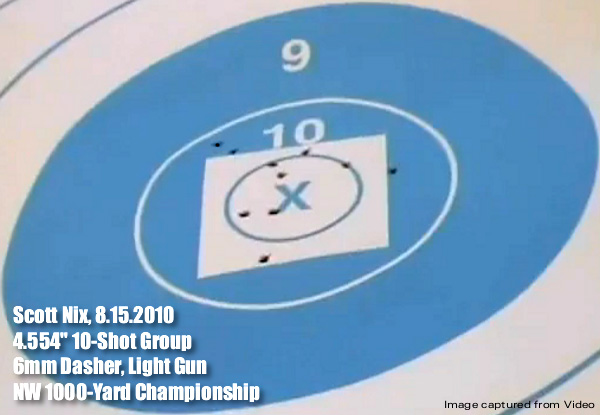
 How well can the little 6mm Dasher perform at 1000 yards when the conditions are good, and the shooter is riding a hot streak? Well here’s a shot-by-shot record of Scott Nix’s 4.554″ ten-shot group shot at Missoula, Montana at the Northwest 1000-yard Championship a few years back. All 10 shots were centered for a 100-6X score. That’s about as good as it gets. If Scott had stopped after 5 shots, his group would have been under three inches.




 OK, admit it — you’ve always wondered how they get those color swirls and camo patterns in McMillan stocks. (You’ll be surprised at the answer). And how does McMillan manage to inlet stocks so precisely for so many different action types?


