Looking for a very high-quality hunting scope that won’t break the bank? The German-crafted Zeiss Conquest DL has won many awards, yet it’s half the cost of super-premium European brands. For general performance, durability, and glass quality, many experts say the Conquest DL sets the “benchmark” for the “upper middle” end of riflescopes. Here is a very revealing review of the Conquest DL by British lady hunter Ginny Langton.
Ginny explains: “Even when the visibility has been bad, early in the morning, very cloudy and a bit foggy, the image is really clear and really bright… which has made for a much easier and clearer shot for me. I have found that using the [ASV bullet drop compensator] even when it’s bitterly cold is really straight-forward. Even when you’re fumbling around with gloves on, it’s very easy to find the buttons and the functionality of the scope is very, very good. The great thing about the DL scope is its versatility — I could use this scope all over the world.”
In a recent comparison review, gunwriter L.P. Brezny rated the 3-12x50mm Zeiss Conquest DL one of the best hunting scopes under $1000. Brezny states: “As a second option on my list of five top hunting scopes for big game that are under a grand stands the Zeiss Conquest DL Hunting Scope in 3x12x50mm. Here you have an illuminated reticle [extra cost], ultra-refined German glass, and a side focus knob with the Z-Plex reticle. In most cases what is in this optic, in terms of quality, is often found at a much higher price.” This German-made Conquest DL retails for $999.99 on Amazon.com (non-illuminated) or $1299.95 with illuminated reticle.
The entire Zeiss riflescope line is available from Europtic.com. Call (570) 368-3920 and ask for Jason Baney and request the best price. Tell Jason that AccurateShooter.com sent you.
We recently showed a video of an incident at a pistol match that easily could have resulted in the death of a range worker. If you watched that video, you’ll understand that one momentary oversight is all it takes to put someone in the hospital (or the morgue). That’s why shooters should be prepared for the worst. Get first-aid training, and carry a basic first-aid kit whenever you go to the range.
Carry a Basic First-Aid Kit Shinnosuke Tanaka, reporter for RECOIL Magazine, offers some good advice: “OK, most of us have seen the [pistol match incident] video. YES, it is RSO’s fault not checking down range enough. BUT it’s your bullet that could hurt someone when it happen. So don’t let someone take care of safety for you, look around one more time after the command ‘Make ready’.”
Four basic firearms safety rules always apply. The Fourth Rule is: “Always be sure of your target and what is beyond it”. Shinnosuke adds: “My own fifth rule is ‘If there is doubt, don’t pull the trigger’.”
Shinnosuke cautions: “If you play with firearms you should know how to deal with gunshot wounds… Carry a simple medical kit. Here is my first aid kid, always carried on top of my shooting pack. Seek professional training and know how to use it. It’s your responsibility to stop the loss of your blood when an accident happens.”
Watch Gun Shot First Aid Video
If someone at a range is seriously injured by a gunshot, you should immediately summon emergency medical professionals. In addition, basic first aid can help stabilize the injured individual. This 55-minute video explains Basic First Aid for Gunshot Wounds:
We met with our friend Erik Cortina at the Berger Southwest Nationals this week. Erik (shown above), had a beautiful new F-Open rifle to show us. This features a new, large-diameter Borden action and a Shurley Brothers fancy maple stock. Erik loves great hardware — whether it comes to actions, stocks, or reloading equipment. One of Erik’s favorite reloading tools is his Forster Co-Ax press.
Cortina has produced a series of YouTube videos about reloading hardware and precision hand-loading. Here is Erik’s video review of the Forster Co-Ax® reloading press. The Co-Ax is unique in both design and operation. It features dual guide rods and a central handle. You don’t screw in dies — you slide the die lock ring into a slot. This allows dies to float during operation.
Erik does a good job of demonstrating the Co-Ax’s unique features. At 1:00 he shows how to slide the dies into the press. It’s slick and easy. At the two-minute mark, Erik shows how sliding jaws clasp the case rim (rather than a conventional shell-holder). The jaws close as the ram is raised, then open as it is lowered. This makes it easy to place and remove your cases.
At the 5:20 mark, Erik shows how spent primers run straight down into a capture cup. This smart system helps keep your press and bench area clean of primer debris and residues.
While many Co-Ax users prime their cases by hand, the Co-Ax can prime cases very reliably. The priming station is on top of the press. Erik demonstrates the priming operation starting at 4:20.
Smart Accessories for the Co-Ax from Inline Fabrications
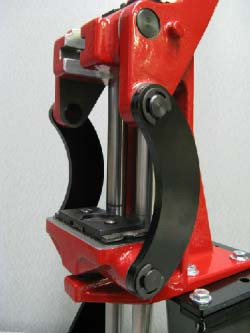
Lapua’s Kevin Thomas also owns a Co-Ax press, which he has hot-rodded with accessories from Inline Fabrications. Kevin tells us: “Check out the add-ons available from Inline Fabrications for the Co-Ax. I recently picked up a riser mount and a set of linkages for mine and love the results. The linkages are curved. When you replace the original straight links with these, the work area opens up substantially and the the press becomes much easier to feed.” CLICK HERE for Co-Ax Accessories.
Inline Fabrications Forster Co-Ax Accessories
Forster Co-Ax Curved Side Linkage (For Better Access)
We had a chance to meet with Jerry Miculek and his wife Kay at SHOT Show. These are very nice people who also happen to be superb shooters. They are great ambassadors for the shooting sports. We talked about Jerry’s many titles and match wins over recent decades. He explained: “It didn’t come easy… the winning comes after years of hard work”. Jerry’s name is synonymous with revolvers. But Jerry is also one heck of a rifleman, as he demonstrates in this video.
Three Shots Standing at 400 Yards in 4.37 Seconds
For those of use who usually shoot from the bench, hitting a silhouette target at 400 yards from an standing position (unsupported) would be a big challenge. Here Jerry Miculek makes it look easy.
In this video, Jerry hits not one but THREE c-zone targets at 400 yards. And — get this — he does this in under 4.4 seconds starting with his rifle laying on a support. It took Jerry two tries (on his first run he hit 2 out of 3 in 4.65 seconds). On the second attempt (see video starting at 2:19), it takes Jerry just 4.37 seconds to shoulder his rifle, aim, and fire three shots, each hitting a separate steel target. Wow. That’s truly remarkable. Most of us would need ten seconds (or more) just to get the scope on the first target.
Trust us folks, this ain’t easy. It takes remarkable marksmanship skills to shoot with this kind of precision at this kind of pace. As Jerry would say himself, “Not bad for an old guy who needs glasses”.
At SHOT Show 2016 we visited the Sellier & Bellot pavilion. You may not have heard of this company, but it is one of Europe’s older ammunition manufacturers. The video below shows ammunition being made from start to finish, starting with raw materials. This is a fascinating video that is well worth watching. It shows some amazing machines in operation:
Based in in Vlašim, Czech Republic, Sellier & Bellot was founded in August 5, 1825 by a German businessman of French origins called Louis Sellier. His family were royalists who fled France during the French Revolution. Louis Sellier began manufacturing percussion caps for infantry firearms in a factory in Prague, Bohemia on the request of Francis I, the Emperor of Austria. Sellier was joined by his countryman Jean Maria Nicolaus Bellot.
At the S&B booth, we also saw an interesting CGI video that shows what happens inside a rifle chamber and barrel when a cartridge fires can’t be seen by the naked eye (unless you are a Super-Hero with X-Ray vision). But now, with the help of 3D-style computer animation, you can see every stage in the process of a rifle round being fired.
In this X-Ray-style 3D animation illustrates the primer igniting, the propellant burning, and the bullet moving through the barrel. The video then shows how the bullet spins as it flies along its trajectory. Finally, this animation shows the bullet impacting ballistic gelatin. Watch the bullet mushroom and deform as it creates a “wound channel” in the gelatin.
Watch Video – Cartridge Ignition Sequence Starts at 1:45 Time-Mark
This important video shows what really happens when loaded ammunition burns. You will probably be surprised. Contrary to Hollywood notions, the ammo doesn’t ignite in a massive explosion. Far from it… basically the rounds “cook off” one by one, and the bullets release at relatively low velocity. We’ve featured this SAAMI research project before, but it is worth reprising for those who have not yet seen the burn tests.
A couple years back, SAAMI released an important video concerning ammo and fire. With professional fire-fighters standing by, over 400,000 rounds of ammo were incinerated in a series of eye-opening tests. If you haven’t had the chance to view this video yet, you should take the time to watch it now
The Sporting Arms and Ammunition Manufacturers’ Institute (SAAMI) has produced an amazing 25-minute video that shows what actually happens to sporting ammunition involved in a fire. This video shows the results of serious tests conducted with the assistance of professional fire crews. We strongly recommend you watch this video, all the way through. It dispels many myths, while demonstrating what really happens when ammunition is burned, dropped, or crushed.
Watch SAAMI Ammunition Testing Video
Video Timeline
2:10 Impact Test (ignited outside firearm)
3:40 65-foot Drop Test
5:08 Bullet Impact (.308 Win firing)
7:55 Blasting Cap Attacks
9:55 Bulldozer and Forklift Tests
12:20 Boxed Ammo Bonfire
15:37 Bonfire without Packaging
17:21 Retail Store Simulation Burn
20:55 Truck Trailer Burn
Over 400,000 rounds of ammunition were used in the tests. Some of the footage is quite remarkable. Testers built a bonfire with 28,000 rounds of boxed ammo soaked in diesel fuel. Then the testers loaded five pallets of ammo (250,000 rounds) in the back of a semi-truck, and torched it all using wood and paper fire-starting materials doused with diesel fuel.
The video shows that, when ammo boxes are set on fire, and ammunition does discharge, the bullet normally exits at low speed and low pressure. SAAMI states: “Smokeless powders must be confined to propel a projectile at high velocity. When not in a firearm, projectile velocities are extremely low.” At distances of 10 meters, bullets launched from “cooked-off” ammo would not penetrate the normal “turn-out gear” worn by fire-fighters.
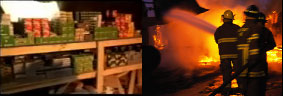
We are not suggesting you disregard the risks of ammo “cooking off” in a fire, but you will learn the realities of the situation by watching the video. There are some amazing demonstrations — including a simulated retail store fire with 115,000 rounds of ammo in boxes. As cartridges cook off, it sounds like a battery of machine-guns, but projectiles did not penetrate the “store” walls, or even two layers of sheet-rock. The fire crew puts out the “store fire” easily in under 20 seconds, just using water.
Additional Testing: Drop Test, Projectile Test, Crush Test, Blasting Cap Test
Drop Test
The video also offers interesting ammo-handling tests. Boxes of ammo were dropped from a height of 65 feet. Only a tiny fraction of the cartridges discharged, and there was no chain-fire. SAAMI concludes: “When dropped from extreme heights (65 feet), sporting ammunition is unlikely to ignite. If a cartridge ignites, it does not propagate.”
Rifle Fire Test
SAAMI’s testers even tried to blow up boxes of ammunition with rifle fire. Boxes of loaded ammo were shot with .308 Win rounds from 65 yards. The video includes fascinating slow-motion footage showing rounds penetrating boxes of rifle cartridges, pistol ammo, and shotgun shells. Individual cartridges that were penetrated were destroyed, but adjacent cartridges suffered little damage, other than some powder leakage. SAAMI observed: “Most of the ammunition did not ignite. When a cartridge did ignite, there was no chain reaction.”
Bulldozer Crush Test
The test team also did an amazing “crush-test” using a Bulldozer. First boxes of loaded ammo, then loose piles of ammo, were crushed under the treads of a Bulldozer. A handful of rounds fired off, but again there was no chain-fire, and no large explosion. SAAMI observed: “Even in the most extreme conditions of compression and friction, sporting ammunition is unlikely to ignite. [If it does ignite when crushed] it does not propagate.”
Blasting Cap Test
Perhaps most amazingly, the testers were not able to get ammunition to chain-fire (detonate all at once), even when using blasting caps affixed directly to live primers. In the SAAMI test, a blasting cap was placed on the primer of a round housed in a large box of ammo. One cartridge ignited but the rest of the boxed ammo was relatively undamaged and there was no propagation.
There’s a chap in Poland named Łukasz Pietruszka, who is a bonafide “Wizard of Wood”. Lukasz handcrafts unique custom stocks, selling them through his LP Gunstocks company. Many of his most eye-catching stocks are for airguns (particularly Field Target rifles), but he also produces fine stocks for rimfire and centerfire hunting rifles. Lukasz is a master carver who includes exquisite details on many of his stocks. Some of these designs, crafted from exotic hardwoods, raise stock-crafting to an art form.
Check out the figure on this Turkish Walnut stock by Łukasz Pietruszka.
You can see a variety of Lukasz’s stocks in a video sampler. If you’re a fan of fine wood, you’ll love this video. So pull up a chair, grab your favorite beverage, and enjoy this 16-minute video interlude.
Watch Video in High Definition
NOTE: We recommend you view this video in high definition, in wide screen format. To do this, start the video, then click on the gear-shaped icon at the lower right-hand corner of the video frame (it’s located just to the right of the clock icon). If you have a fast internet connection, select 720P or 1080P from the pop-up menu. (1080P is the highest resolution.) Now select theater mode or full-screen mode using the small icons on the lower right of the frame.
Radical ‘Shockwave’ from LP Gunstocks
Here is a truly amazing bit of craftmanship. The images below show a one-of-a-kind Shockwave stock created by Łukasz for a Steyr Field Target air rifle. Over the top? Perhaps… but you have to admire the imaginative design and exquisite worksmanship.
Video find by Boyd Allen. We welcome reader submissions.
Here’s an early Christmas present to our readers from Beretta — a really great video about gun-making. This movie, entitled “Human Technology”, is one of the best videos we’ve ever featured on this site. It’s that good. You’ll see an amazing blend of ultra-modern manufacturing technology along with old-world artisanship — “a mesmerizing meld of the high-tech and the traditional”. (Daniel Xu, Outdoor Hub.)
“Human Technology is a singular and symbolic movie, its cast entirely made up of Beretta workmen, thus illustrating the perfect synthesis between craftsmanship and technology,” Beretta writes. This artistic movie by Ancarani Studio illustrates all the aspects of the manufacturing of a high-end Beretta shotgun. This video is a study in contrast. The movements of robotic assembly machines are juxtaposed with the centuries-old craftsmanship of stock carvers. Beautifully filmed and edited, this video should amaze and entertain anyone who loves fine firearms. (Full-screen HD Recommended.)
The R-F Cam Cradle is a smart new product that lets you securely mount a Laser Rangefinder (LRF), digital camera, and spotting scope all on a single tripod. The “game-changing” feature of the R-F Cam Cradle is that it allows you to colimmate (i.e. precisely align) all your optics on the same spot. This way you can simultaneously aim all three devices at a long range target by simply moving the tripod head. A tactical shooter can easily range his target while watching the wind though his spotting scope. And the long-range hunter can range and film his prey as he watches it through the spotter. This unit costs $179.95 from DefensiveEdge.net.
You’ll find a detailed product evaluation of the R-F Cam Cradle on the LongRangeOnly.com website. Reviewer Sam Millard uses the R-F Cam Cradle in the field with a variety of optics and rangefinders. Millard explains how the R-F Cam Cradle conveniently allows combined use of spotting scope, LRF, and compact video camera.
Millard was very impressed with the system: “I field-tested the R-F Cam Cradle in the mountains of northern Idaho and the wide open spaces of eastern Wyoming. I believe the most effective way to use the cradle is in a long range ambush; get the spotting scope, camera, and LRF aligned on a landmark, then lock it down. The LRF and spotter won’t be aligned perfectly, but they’ll be well within the field of view of each other, requiring only a gentle tilt of the tripod to center the beam of the LRF on the target. At ELR distances, a well-supported LRF is crucial to obtaining an accurate range. This mount makes it easy, and doesn’t require displacing your spotting scope to get it done.”
See R-F Cam Cradle Demonstrated in the Field:
Having a video camera mounted in alignment with spotting scope is great for Long Range applications notes Millard: “The camera mount is my favorite feature of the R-F Cam Cradle. It allows co-witnessing the video camera to the spotting scope, then aiming the field of view of both with one movement of the tripod head. This is a great improvement to the normal way of recording the shot and spotting at the same time, which previously required two tripods or a clamp-on head for the camera, both of which required separate aiming of the camera and spotting scope.”
R-F Cam-Cradle Product Details
Manufacturer: RLC Customs
Vendor: Defensive Edge, Inc.
Rathdrum, ID DefensiveEdge.net
Order Phone: (208) 687-2659
Material: 3/16” 53 Series aluminum
Finish: Powder-coated Matte Black
Total Weight: 16.5 ounces
Mount: ¼-20 Threaded Standard Camera Mount
Retail price: $179.95
Shawn Carlock of Defensive Edge explains: “The R-F Cam Cradle is a way for one person to run everything. Otherwise it’s really difficult to run the spotting scope, run the video camera, run the rangefinder, get dope — do all those different things. So RLC Customs has come up with the idea to put everything together in one platform, where you can sync it together and use it effectively, as a cluster.”
Product Find by Boyd Allen. We welcome reader submissions
The prestigious GAP Grind tactical match took place 16-18 October, at the K&M Shooting Complex in Finger, Tennessee. Here’s a “sizzle reel” video showing highlights from this year’s match, which drew talented competitors from across the nation. Held in association with the Precision Rifle Series (PRS), this year’s Grind features a Pro/Am format with professional and amateur competitors aiming for individual and team honors.
Watch GAP Grind 2015 Video (Loud Soundtrack):
Lots of Action, with 20+ Stages
The GAP Grind is a challenging, “high tempo” match with minimal down-time between stages. This year, over the course of 20+ stages, competitors each fired 200+ shots at a variety of steel, paper, moving, and reactive targets out to 1,200 yards. Targets varied in size and difficulty based on distance and time allotted. Most stages included “stressors” — i.e. time limits or required movement(s).




 The Sporting Arms and Ammunition Manufacturers’ Institute (
 We are not suggesting you disregard the risks of ammo “cooking off” in a fire, but you will learn the realities of the situation by watching the video. There are some amazing demonstrations — including a simulated retail store fire with 115,000 rounds of ammo in boxes. As cartridges cook off, it sounds like a battery of machine-guns, but projectiles did not penetrate the “store” walls, or even two layers of sheet-rock. The fire crew puts out the “store fire” easily in under 20 seconds, just using water.

 Watch Video in High Definition


