|
|
April 3rd, 2022

This past Friday was April Fool’s Day, and there were some clever spoofs. One notable April First item came from Vihtavuori, maker of premium propellants. On April 1st, Vihtavuori (VV) announced a new men’s cologne — a “New scent for the avid reloader: Vihtavuori Eau de Gunpowder.”
Here is the product description:
“Our composition opens with an aromatic smokiness and lingers on the dark, addictive scent of graphite and nitrocellulose. A powerful and refined composition for the serious reloader who wants to feel connected to his powder every day. Try the essence of accuracy with Vihtavuori Eau de Gunpowder — you won’t be disappointed.”
Comments from Readers:
One Facebook poster observed: “I love the smell of gunpowder in the morning…” *
While another FB fan joked cleverly, “Will it be available in different burning rates?”
Finally, one astute poster said this Vihtavuori product actually has serious commercial potential: “I know today is April 1st … but I want this! It would market well I think!”

For April 2023 — Will Vihtavuori Offer a Fragrance for Females?
Recognizing that there are many very talented lady shooters in the world, we think Vihtavuori should also introduce a special scent for ladies, i.e. a Female Fragrance. Perhaps it could be called Parfume de Pistol, Fragrance de Firearms, or VV N°5.56? What do you think ladies, would such products sell?

Kirsten Weiss would be a great representative for a Ladies firearms fragrance.
* In the 1979 Hollywood movie Apocalypse Now, actor Robert Duvall famously stated “I love the smell of Napalm in the morning.”
February 20th, 2022

The 300 Meter .22 PPC — Smaller Caliber for Less Recoil
By GS Arizona
[This article originally appeared in Precision Shooting Magazine many years ago, but we are reprising it because the .22 PPC remains a notable cartridge for many disciplines, from benchrest to silhouette.]
I’ve spent the past few years pursuing the largely solitary pastime of 300 Meter shooting in the US. While it is a hugely popular sport in Europe, with thousands of competitors in each of various countries and overflowing national championships, in the U.S., 300 Meter shooting is simply a forgotten discipline. As an example, consider that the entry at the USA Shooting 300 Meter National Championships held at Fort Benning did not reach 20 competitors in [years past]. For those not familiar with the discipline, the 300 Meter ISSF target has a 100 mm ten ring, 200 mm 9 ring and so forth. That’s a 3.9″ ten ring at 328 yards for those of you who may object to the metric system, electricity and other intrusions upon a well settled universe (which ends at the dragons). [Editor’s Note: GS Arizona was a championship-class prone shooter, in both rimfire and centerfire disciplines, who had a popular online Blog, which has been closed.]
300 Meter Basics
300 Meter matches can be either three-position (prone, standing, kneeling) or all prone. Being of that age at which limbs aren’t limber and the mid-section obscures one’s view of the toes, I shoot prone matches only and leave the 3P to those for whom the term “shooting athlete” doesn’t produce an automatic smirk from the better half.

Like most 300 Meter shooters, I shoot a 6BR as my main rifle. As used in 300 Meter shooting, the 6BR is loaded with a 105-108gr bullet, with a velocity in the 2850 fps range. There is simply no cartridge out there at this time that delivers the accuracy, low recoil and ease of loading that can be had from the 6BR. That doesn’t mean we shouldn’t embark on a quixotic adventure now and then to find something better. This article is about one such search. So, if you don’t mind spending some time learning about an uphill struggle in a forgotten corner of the shooting world, pour a hot cup of coffee, get a plate of chocolate chip cookies and read on.
Getting Started–The Concept Behind the Project
The premise for building a .22 PPC was simple — less is more. Less recoil, that is, while retaining good ballistics and accuracy, should allow for higher scores. The hard part is meeting the ballistic and accuracy standards set by the 6BR. If pressed I might also admit to a desire to do something different. I made a decision early on in the project to stick to 80-grain bullets. I believe the 80 is pushing the envelope for safe and sane pressure in a case the size of the PPC; additionally, there are a number of manufacturers of 80-grain .224″ bullets so selection and testing can be more meaningful. Barrels are another consideration and all of the better barrel makers offer a 1:8″ twist .224 barrel (unlike the limited selection of 1:6.5″ twist required for 90 grain .224″ bullets).
With the basic parameters of a full-length .22 PPC case (reformed Lapua .220 Russian to be exact) and an 80-grain bullet established, a few other details needed attention. The first of these was specifying certain dimensions for the reamer maker. I chose not to change any of the essential dimensions of the .22 PPC such as headspace, shoulder angle or body taper, but there were a couple of areas that I felt needed to be different from the typical Benchrest PPC. These were neck diameter and throat length. With the outstanding quality of the Lapua brass, I elected to go with a 0.255″ neck diameter which would allow the use of unturned brass and still leave 0.002″ clearance around the neck of a loaded cartridge. The throat was specified longer than a standard PPC to allow for the length of the 80-grain bullets and avoid having the bullet go past the neck/shoulder junction.
|
 300 Meter .22 PPC — Equipment List 300 Meter .22 PPC — Equipment List
Hardware
Action: RPA Quadlite, RPADefense.com.
Stock: Master Class Highpower Prone MasterClassStocks.com
Barrel: Broughton .224″ bore, 1:8″ twist, 30″ Palma contour
Rear Sight: Warner #1, Anschutz Iris, Warner-Tool.com
Front Sight: Gehmann Iris from Scott Riles
Trigger: Jewell 4 oz. one-stage
Bolt Knob: Keychain from 7-11 ($2.00)
Gunsmithing
Barrel fitting, sight, scope bases: Warner Tool Company.
Stock inletting, pillar bedding, and hardware: Alex Sitman,
Master Class Stocks. |
Detours Along the Way
Like Quixote stumbling his way to his dreams, I’ve made a few mistakes. That 0.255″ neck diameter turned out to be the first. Turning brass isn’t a problem, but I was so captivated by the quality of the .220 Russian brass that I planned to skip turning or just take a light (0.001″) clean-up cut. Well, that’s fine, but as it turns out, PPC die makers assume you have turned necks and using unturned brass causes problems. The Redding Competition Seater, for instance, wanted to crimp the entire length of the neck onto the bullet. Turns out it was 0.250″ in the neck diameter of the sliding sleeve. This required reaming the sleeve which wasn’t too hard as the sleeve is made of relatively soft steel. Hand turning the chambering reamer with lots of care and oil took care of that problem. This opened up the neck to 0.255″ which might be 0.001″ more than ideal but I’ll live with it.
 Sizing dies were another problem altogether. Forget using a non-bushing die with unturned brass–you’ll just overwork the neck to death. The Redding bushing dies worked well, though. Fired brass ends up at 0.254″ and is sized to 0.250″ in two steps (0.252″ and 0.250″) to maintain better concentricity. Sizing dies were another problem altogether. Forget using a non-bushing die with unturned brass–you’ll just overwork the neck to death. The Redding bushing dies worked well, though. Fired brass ends up at 0.254″ and is sized to 0.250″ in two steps (0.252″ and 0.250″) to maintain better concentricity.
I also got the throat length wrong as the base of the bullet (above the boat tail) is halfway up the neck and I want it just above the shoulder. I don’t know how I missed on that spec, but that’s what happened. As it turns out, the extra throat length hasn’t caused any problems with the Nosler 80, but it might with shorter or pointier bullets. Powder and primer choices became additional areas for demonstrating my inability to make good choices. You might think that adding a heavier bullet to an existing cartridge would be simple but it really turned into a full scale adventure.
Choice of Components and Smiths — Only the Best
Based on my previous favorable experience and that of a few friends, I ordered a Broughton barrel for the PPC, a .224″ bore 1:8″ twist, long enough to finish at 30 inches in what is generally referred to as a medium Palma taper. I haven’t been disappointed by the barrel: like all of those made by Tim North of Broughton Barrels, it is top notch. With the barrel and reamer in hand, they and the RPA Quadlite action were sent to Al Warner for barreling and then on to Alex Sitman for the stock. I can’t say enough good things about Alan’s metal work and Alex’s stock work. They have barreled and stocked many rifles for me over the years, all flawless. Alex’s Highpower Prone stock fits me like a comfortable moccasin. The trigger is a Jewell set at 4 oz., the rear sight is a Warner #1 and the front sight is a Scott Riles with a Centra aperture.
Eventually, the UPS man — purveyor of all things worth having — arrived with a long package and the real work began. Load testing and shooting can be a lot more frustrating than planning and talking to gunsmiths, but hopefully the eventual results make it worthwhile. I had a good supply of Nosler 80-grain bullets and some preconceived notions about powder and primers. Off to the loading bench.
Load Development + Accuracy Testing
 Fire-forming the .220 Russian cases to the PPC chamber was a breeze: run an expander into the neck to get them to .224″, bump the shoulder 0.002″, load a caseful of IMR 4895 (about 23 grains) and insert a Nosler 77 (leftover from another project) and fire. I shot these at 100 yards while zeroing the rifle and was very impressed with the accuracy. Fouling was minimal, off to a promising start. Fire-forming the .220 Russian cases to the PPC chamber was a breeze: run an expander into the neck to get them to .224″, bump the shoulder 0.002″, load a caseful of IMR 4895 (about 23 grains) and insert a Nosler 77 (leftover from another project) and fire. I shot these at 100 yards while zeroing the rifle and was very impressed with the accuracy. Fouling was minimal, off to a promising start.
Once formed, I loaded the brass with Varget and the 80-grain bullets. Since Varget has given such good results in the 6BR, it was a natural starting point for this project. However, it quickly became evident that it might be too slow. While accuracy was excellent, powder fouling in the barrel was very heavy even at the highest charge tried (28.5 grains) and there was soot all the way down the shoulders of the cases. Cleaning the bore felt like patching a rusty water pipe after just 20 shots. I knew I’d never make it through a 60-shot match (about 70 shots with sighters) without cleaning[.]
Putting the .22 PPC to the Test in Competition
At this point, I took the PPC to a 300 Meter match with the Varget load. While it might not look perfect, I needed to try it. The first string was a 198 and I was able to clean the rifle immediately after firing. The second string was also a 198 but I had to fire the third string without cleaning. The effects of the fouling were evident in the last score, a 194.
 While a 590 total isn’t bad for 300M, it was a bit below my average with the 6BR at this range – my home range that I knew well. More importantly, the score dropped as the group opened up in the third string when I wasn’t able to clean. At the Nationals all 60 shots are fired without a break for cleaning or additional sighters; therefore, Varget, while promising, wouldn’t work in the long run. While a 590 total isn’t bad for 300M, it was a bit below my average with the 6BR at this range – my home range that I knew well. More importantly, the score dropped as the group opened up in the third string when I wasn’t able to clean. At the Nationals all 60 shots are fired without a break for cleaning or additional sighters; therefore, Varget, while promising, wouldn’t work in the long run.
The next faster powder on my shelf was IMR 4895. I’d used it in the fire forming loads and if I had a lick of sense I would have tried it right away since the fire forming loads shot so well. However, stubbornly clinging to the preconceived notion that Varget was going to be a great powder for this combo cost me a month or so fooling with it. I then worked up loads with 4895 from 26.8 to 28.6 and saw that while 4895 was better suited to the case than Varget, it was still slow. The powder fouling was still occurring, though to a lesser degree. The shoulders still showed some soot, but less. I settled on 27.8 grains as a useful load and loaded 70 cases.
 New Load for a New Home New Load for a New Home
At this point, I moved from Florida to Arizona causing a delay of several months in testing. The move also had an effect on the load as the hotter and drier climate in Arizona turned out to be much more suitable for 4895. Of course, I still had those 70 rounds loaded with 27.8 so I shot them in practice. Everything seemed OK but one primer (Federal 205M) pierced at the edge. I didn’t pay much attention to that as there were no other pressure signs and it was the first primer failure of any sort so far in this project. Extraction was fine, primer edges were nicely radiused and base growth was under two tenths. There was an opportunity to shoot a 500-yard prone match the following day so I reloaded the cases with the same load. At the match I pierced two more primers, this time right at the edge of the firing pin, causing two craters running into the firing pin hole. As you might imagine, all subsequent shots cratered into that area, although no more pierced.
I was contemplating a switch to Hodgdon Benchmark (slightly faster than H4895) until this point. Now, repairing the bolt face and switching to a tougher primer took priority. I loaded 25 rounds with CCI BR4 primers and 25 with Remington 7.5 primers. Both of these are well known for their tougher cups which I hoped would eliminate the piercing. I like the mild flash from the Federal 205 and believe it contributes to good accuracy, but I needed a primer that holds together more than I need to cut another tenth MOA. Bearing in mind that the powder charge itself might need reworking, I took those 50 rounds to the range to test them with the 27.8 gr. IMR 4895 load as it remains best to only change one thing at a time. Temperatures were in the 100 to 110 degree range during testing as they are for a good portion of the year here in Phoenix. If the load won’t work in hot temperatures, it just won’t work at all for me.
The primer testing at 200 yards showed the CCI BR4 primers to be better suited to this load than the Remington 7.5 primers. While no primer failed out of the 50 fired, the CCI BR4 primers gave distinctly better accuracy. I fired two ten-shot groups prone (scoped) with each, the Remington-primed groups averaged just over 1 MOA and the CCI-primed groups averaged 1/2 MOA. The difference between the two was principally in the amount of elevation in the groups. Given that result, as well as previous good experience with the CCI primers in the 6BR, I settled on the CCI BR4 primers for the PPC.
Final Testing at 500 Yards–It all Comes Together
While the purpose of the 80-grain PPC is 300 Meter shooting, those matches are somewhat hard to find so I’ve done most of my testing at 200 yards on the local public range (Ben Avery Shooting Facility in Phoenix) and at 500 yards in some of the local prone matches. With the primer issue potentially resolved, I went back to the 500-yard range to make sure the load held good elevation at that distance.
 Final testing at 500 yards was a complete success. I fired one group of 24 shots from the prone position. Elevation for the bulk of the group was right at 3″ (0.6 MOA), the horizontal spread was somewhat larger as the group was fired in gusty, fast-switching conditions. The CCI BR4 primers functioned flawlessly, with no sign of pressure despite ambient temperatures over 100° F. None of this should be taken as a general statement of inadequacy of Federal primers. I have used (and continue to use) the very same lot of Federal 205M primers in my 6BR and have not experienced any problems at all. Simply stated, the 80-grain .22 PPC is an odd duck and has special requirements when fired under the conditions that prevail in my area. Final testing at 500 yards was a complete success. I fired one group of 24 shots from the prone position. Elevation for the bulk of the group was right at 3″ (0.6 MOA), the horizontal spread was somewhat larger as the group was fired in gusty, fast-switching conditions. The CCI BR4 primers functioned flawlessly, with no sign of pressure despite ambient temperatures over 100° F. None of this should be taken as a general statement of inadequacy of Federal primers. I have used (and continue to use) the very same lot of Federal 205M primers in my 6BR and have not experienced any problems at all. Simply stated, the 80-grain .22 PPC is an odd duck and has special requirements when fired under the conditions that prevail in my area.
At this point, I’ve determined that the basic premise of a .22 PPC for 300 Meter matches is perfectly viable, even if it is quite a bit more complex an undertaking than the 6BR. Recoil reduction over the 6BR was minimal, bordering on unnoticeable, but accuracy is on a par with the 6BR, perhaps slightly better. As a nice bonus, the PPC has proven to be quite useful for the 500-yard prone matches that are a regular part of the Phoenix shooting scene and it never fails to spark a good conversation with a new friend when I’m practicing or testing at the range. Future plans include testing Berger and Hornady 75 and 80-grain bullets and Hodgdon Benchmark powder. And, after conferring with your moderator, who ran some simulations in QuickLOAD, I’ll be trying Reloder 15 soon (QuickLOAD predicts RL15 allows 100% load density with good velocity). At some point I’ll also have the reamer reground for a shorter throat and tighter neck, but probably not until time comes to rebarrel.
6mmBR Norma versus .22 PPC

For the shooter who wants a superbly accurate, easy to load cartridge for 300 Meters to 600 yards, you simply can’t beat the 6BR. Everything you need, including brass, dies, reamers and knowledge are just a phone call away. The .22 PPC, by contrast, is an uphill struggle. The chambering reamer was custom ground to my specifications to allow unturned brass, as well as a longer freebore for the 75- and 80-grain bullets that are the heart of the project. The no-turn necks also meant that the Redding Competition Seater (an excellent unit) had to be reworked to allow for the thicker neck diameter. Once those hurdles were overcome I struggled to find the best powder for this combination–and I’m still searching. Unlike the 6BR where any of a half dozen or more powders will do the job (Varget, Reloder 15, N140, N540, IMR 4895, Norma 203B, etc.) the .22 PPC with heavy bullets has proven finicky with even the most accurate powders leaving fairly heavy carbon fouling.
Despite the problems, the .22 PPC offers a bit more pure accuracy than the 6BR and also a tiny bit less recoil. Both of these things can contribute to slightly higher scores in prone matches. However, to get the most out of the PPC, one must find the time to clean between 20 shot strings–a not inconsiderable effort sometimes in the mad rush of pit changes, scoring, shooting and just plain being tired.
This rifle was initially a .223 and when that cartridge proved unsatisfactory for my purposes, I had it rebuilt as the .22 PPC you see here. I like it and I enjoy the challenge, but I would not recommend this combination as someone’s primary rifle; it can get a bit frustrating. To put it into another context, the 6BR is like a 350 Chevy, it’ll just keep on doing the job forever, no matter what. The .22 PPC is like a Ferrari, it’ll scream when you do everything right, but it takes more attention to detail and a lot more maintenance. You wouldn’t want a Ferrari as your only car and likewise, you would be better off making the .22 PPC a second rifle.
|
Parting Shots — The .22 PPC vs. 6mm BR
If you’re looking for a simple, accurate and reliable cartridge for 200 to 600 yards, you probably can’t improve on the 6BR. However, if you’re someone who finds the journey as rewarding as reaching the destination, then you may very well enjoy a .22 PPC for prone shooting. While I received a great deal of help in this project from friends, gunsmiths, suppliers and parts makers far and wide, I really must acknowledge the huge debt we all owe to Ferris Pindell and Dr. Lou Palmisano. Without them there would be no PPC. We truly stand on the shoulders of giants.
Copyright © Precision Shooting Magazine and GS Arizona. Reprinted by permission.
February 5th, 2022

Capstone is a respected company that represents world-class ammunition, powder, and component manufacturers Berger, Lapua, Vihtavuori, and SK. At SHOT Show 2022, Capstone showcased new products from all these brands. Here are summaries of new products from Lapua and SK. We will follow with new Berger offerings next week.
New Lapua Centerfire Match Ammunition for 2022
Lapua produces some of the finest, most accurate factory-loaded centerfire ammunition in the world. We have shot Lapua 90gr 6mmBR ammo that produced verified groups well under quarter-MOA. For 2022, Lapua has added three new match loads that promise great consistency and accuracy. For 2022, Lapua has added 6.5 Creedmoor 136 Grain Scenar-L, .260 Remington 136 Grain Scenar-L, and .300 Winchester Magnum 185 Grain Scenar OTM, to Lapua’s highly successful Scenar Match Target ammunition line.

New Lapua Hunting Ammunition for 2022
Lapua’s ammo gurus in Finland definitely know how to build hunting rounds that are ultra-effective on game. Lapua has been crafting hunting ammo for nearly 100 years! New hunting ammo offerings include .223 Remington 50 Grain Naturalis, 6.5 Creedmoor 156 Grain MEGA, .300 Win Mag 170 Grain Naturalis (lead-free), and .300 Win Mag 185 Grain MEGA. All these hunting ammo types are available now.

 New Lapua Cartridge Brass — 6.5 PRC, .284 Win, .300 PRC, .300 Win Mag New Lapua Cartridge Brass — 6.5 PRC, .284 Win, .300 PRC, .300 Win Mag
Lapua cartridge brass sets the standard by which quality brass is measured. You will see Lapua brass used by top competitors for all accuracy-oriented disciplines: Benchrest for Score, Benchrest for Group, 1000-Yard Benchrest, F-Class (Open and F-TR), Palma, Service Rifle, Silhouette. And Lapua brass is also favored by varmint hunters who load their own ammo. In 2021 and 2022 Lapua has rolled out new types of top-grade cartrige barss. New offerings available now for 6.5 PRC, .284 Winchester, .300 PRC, and .300 Winchester Magnum. All are available and shipping now.
SK High-Velocity Match Rimfire Ammunitions
SK now offers an extremely accurate, High-Velocity round. For 2022 SK will offer High-Velocity Match .22 LR ammunition. This new SK ammo pushes a 40gr round-nose projectile at a very fast 1,263 FPS muzzle velocity. This high-velocity SK ammunition should work well for PRS/NRL22 matches and long-range rimfire events, some of which have targets out to 300 meters. The new SK High-Velocity Match ammo employs a proprietary clean-burning and high-energy propellant for reliable function in all platforms — shot after shot.

Coming Soon — New Berger Ammo and Bullets for 2022
Berger, another Capstone company, is offering new bullets and loaded ammunition for 2022. The new Berger offerings include Elite Hunter loaded ammunition for the 6.5 PRC and .300 PRC, plus new Berger .30 Caliber 245 Grain Long Range Hybrid Target (LRHT) Bullets. We’ll have a feature on these Berger products soon.
August 24th, 2021
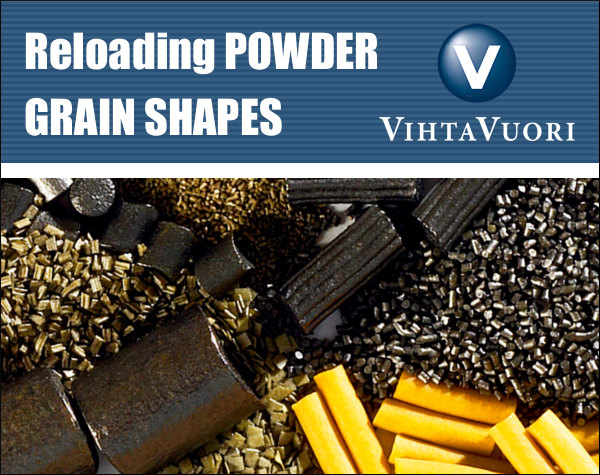
POWDER GRAIN SHAPES — What You Need to Know
The shape of powder grains has a profound effect on the performance of the powder charge, as it concerns both pressure and velocity. There are multiple powder shapes including flake, ball, and extruded or “stick” (both solid and perforated).
So how does powder grain shape affect pressure and muzzle velocity?
In general, it can be said that powder that burns progressively achieves a desired muzzle velocity at lower maximum pressure than a powder that burns neutrally, not to mention a degressive powder. As grain size increases, the maximum pressure moves towards the muzzle, also increasing muzzle blast. Muzzle velocity and pressure can be adjusted by means of the amount of powder or loading density, i.e. the relationship between the powder mass and the volume available to it. As the loading density increases, maximum pressure grows.
All Vihtavuori reloading powders are of the cylindrical, single-perforated extruded stick type. The differences in burning rate between the powders depend on the size of the grain, the wall thickness of the cylinder, the surface coating and the composition. Cylindrical extruded powders can also have multi-perforated grains. The most common types are the 7- and 19-perforated varieties. A multi-perforated powder grain is naturally of a much larger size than one with a single perforation, and is typically used for large caliber ammunition.
Other types of powder grain shapes include sphere or ball, and flake. The ball grains are typically used in automatic firearms but also in rifles and handguns. The ball grain is less costly to produce, as it is not pressed into shape like cylindrical grains. Flake shaped grains are typically used in shotgun loadings.
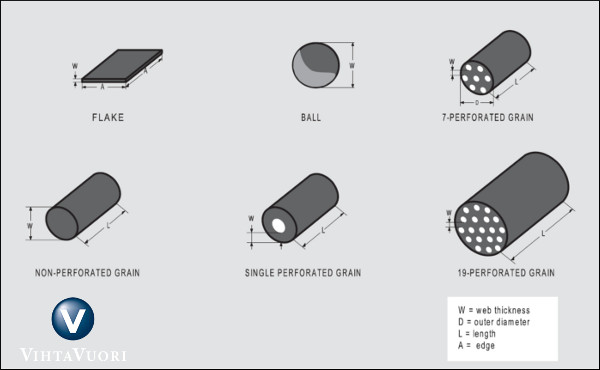
Web thickness in gunpowder terminology means the minimum distance that the combustion zones can travel within the powder grain without encountering each other. In spherical powders, this distance is the diameter of the “ball”; in flake powder it is the thickness of the flake; and in multi-perforated extruded powders it is the minimum distance (i.e. wall thickness) between the perforations.
The burning rate of powder composed of grains without any perforations or surface treatment is related to the surface area of the grain available for burning at any given pressure level. The change in the surface area that is burning during combustion is described by a so-called form function. If the surface area increases, the form function does likewise and its behavior is termed progressive. If the form function decreases, its behavior is said to be degressive. If the flame area remains constant throughout the combustion process, we describe it as “neutral” behavior.
The cylindrical, perforated powders are progressive; the burning rate increases as the surface area increases, and the pressure builds up slower, increasing until it reaches its peak and then collapses. Flake and ball grains are degressive; the total powder surface area and pressure are at their peak at ignition, decreasing as the combustion progresses.
This article originally appeared on the Vihtavuori Website.
July 18th, 2021

Many years ago, when we decided to do a story about SAKO’s TRG series of rifles, we remembered our friend Terje Fjørtoft in Norway. Terje has owned, and hunted with, both the TRG-22 (in .308 Win), and its big brother, the TRG-42 (chambered in .338 Lapua Magnum). Unlike many TRG owners in the USA, Terje has carried his “tactical hunters” into the field, and tested their effectiveness on large game in both coastal and mountain environments, in warm weather and cold. Terje tells us the TRGs have proven to be rugged and reliable. And they are accurate. The .308 Win TRG-22 delivers about 0.45 MOA groups at 420 yards shot from bipod. The .338 LM TRG-42 shoots about 0.55 – 0.7 MOA at that distance.
| A Tale of Two TRGs by Terje Fjørtoft

I live in Brattvåg, along the coast of Norway, but I hunt and shoot at the nearby island “Fjørtoft” (same as my last name) and a small island outside Fjørtoft. I grew up on Fjørtoft as a child, and we hunt seals there in the spring and fall. The large, top photo shows me with my black TRG-42 338 Lapua Mag (“LM”) during a seal hunt a couple years ago. Click on the thumbnail at right to watch a video that shows me shooting the .338 LM. Most of the photos in this story are from that hunt. Because the .338 LM was really “overkill” on the seals (and expensive to reload), I replaced that rifle with a TRG-22 in .308 Winchester.
 We hunt seals primarily for wildlife control. This is because the seals carry an internal parasite, called “Kveis”, a small worm that breeds inside the seals (after eating contaminated fish). When the seals expel the Kveis into the water, the Kveis larvae are consumed by the fish and then the fish become unfit to eat. The parasite literally eats the fish from the inside out. It’s not very pretty and it has hurt our Norwegian fishing industry. So there is an important purpose for our seal hunting. We hunt mostly from islands, targeting the seals in the water, and retrieving them with a small boat. We hunt seals primarily for wildlife control. This is because the seals carry an internal parasite, called “Kveis”, a small worm that breeds inside the seals (after eating contaminated fish). When the seals expel the Kveis into the water, the Kveis larvae are consumed by the fish and then the fish become unfit to eat. The parasite literally eats the fish from the inside out. It’s not very pretty and it has hurt our Norwegian fishing industry. So there is an important purpose for our seal hunting. We hunt mostly from islands, targeting the seals in the water, and retrieving them with a small boat.
 Because the seals spend most of their time in the water, a seal-hunter needs a very accurate rifle [to take head shots at distance]. I like the TRG-22 because it is very accurate out of the box, with a very nice bipod that works well in the field. The stock is comfortable with good adjustment range. The TRG features a 10-rd magazine and the barrel is pre-threaded for a muzzle brake or suppressor. Because the seals spend most of their time in the water, a seal-hunter needs a very accurate rifle [to take head shots at distance]. I like the TRG-22 because it is very accurate out of the box, with a very nice bipod that works well in the field. The stock is comfortable with good adjustment range. The TRG features a 10-rd magazine and the barrel is pre-threaded for a muzzle brake or suppressor.
I have also used my TRGs for hunting big game, deer and what Americans call “Elk”. You can see, further down on this page, a picture from a hunting stand taken late in the evening, in the fading light. Yes I successfully bagged a nice buck during that trip with my TRG-42. When hunting, I use a Leica 900 rangefinder, Swarovski 7×42 Habicht binoculars, and a Silva windwatch. For Optics on the TRG-22, I have a Zeiss 6-24×56 scope, in Tikka Optilock rings. To get more scope adjustment I milled 0.9 mm off the front scope base mount. The Zeiss is great for viewing small targets past 400 meters. It was very difficult to find a longer shooting place than 575 meters on this Island (Uksnøy) but I found a place where I can shoot out to 930 meters, and I’ve made an 80-cm steel gong for a target. At this range, the bullet must fly nearly all the distance over the water.

Terje Shooting the TRG-42 without suppressor. Big recoil, big flash.
 Both the TRG-22 and TRG-42 are very accurate right out of the box. The only thing I did before I first shot the TRGs was to clean the barrels very thoroughly. This is because the SAKO factory test shoots the gun without cleaning the barrel. I also adjust the cheek piece upward when shooting the rifles with a big scope. However, if you raise the cheek piece too high you can’t get the bolt out without removing the whole cheek piece. The only real modification I’ve made to my TRGs was to put rubber foot pads on the feet of the SAKO factory bipod. This gives the bipod better grip on slick surfaces such as concrete, or the rocks on the offshore islands. Both the TRG-22 and TRG-42 are very accurate right out of the box. The only thing I did before I first shot the TRGs was to clean the barrels very thoroughly. This is because the SAKO factory test shoots the gun without cleaning the barrel. I also adjust the cheek piece upward when shooting the rifles with a big scope. However, if you raise the cheek piece too high you can’t get the bolt out without removing the whole cheek piece. The only real modification I’ve made to my TRGs was to put rubber foot pads on the feet of the SAKO factory bipod. This gives the bipod better grip on slick surfaces such as concrete, or the rocks on the offshore islands.
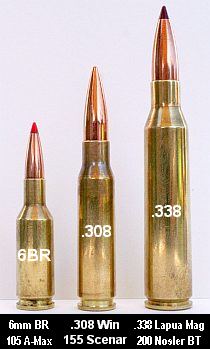 .338 LM vs. .308 Win — Smaller Can Be Better .338 LM vs. .308 Win — Smaller Can Be Better
A few years ago I had a black TRG-42 (338 LM), but after a year, I sold it, and ordered a TRG-22 from the SAKO factory. After a one-year wait, I got the new green TRG-22 in February this year. One main reason I changed to .308 Win was the cost of ammo. I can reload .308 Win ammo for about one-third the price that it costs to reload .338 LM. One other reason is that my usual shooting distance is about 390 meters–at that distance the .308 is more than effective enough. Also, with the .338 LM, the barrel and the suppressor heated up after only a few shots, but with my new .308, I can shoot at my own pace without this problem. After my most recent shooting trip I once again confirmed how accurate, and fun-to-shoot, the TRG-22 is. I think now the TRG-22 has become my favorite plinking gun.
Though it is fun to experience the big boom and flash of the .338 LM, I’ll admit that it is just too much rifle for most applications. The .338 LM is REAL overkill for seal hunting. Here in Norway we have a rule that the smallest caliber we can use is 6.5×55 with a 140gr (or heavier) bullet, but everyone who hunts seals knows that the seals stay mostly in the water, and therefore you must take a headshot at distance up to about 200 meters. Making the headshot with a smaller caliber is advised for two reasons. First, when a big .338 bullet hits the water, there is a danger it will skip and ricochet quite some distance. Second, if you use too powerful a load/gun/caliber and take a headshot on a swimming seal, the seal sinks like a rock.

|
 Reloading for the TRG-22 (.308 Win) Reloading for the TRG-22 (.308 Win)
With the TRG-22, I found it was easy to get an accurate load. My groups with 155gr Scenars are consistently good with a variety of different powders. I’ve tried both light and heavy bullets, but I favor the 155gr Scenars over the 185gr Scenars because the 155s fly a lot faster and drop less.
Three loads (all with Fed 210m primers) that have worked well are: 155gr Scenar with VV N150, 885m/sec; 155gr Scenar with Norma N-11, 890m/sec, and 185gr Scenar, VV N150, 770m/sec. Norma N-11 is a low-cost powder for target shooting. N-11 is similar to Norma 203B or Norma 202 but it varies quite a bit from lot to lot.
I use a RCBS Rock Chucker press, and currently use a standard RCBS full-length die kit to reload my .308 rounds. However, I recently ordered a Redding Competition 3-die set with a .335 bushing. I look forward to trying the Reddings. I have just started to test different seating depths. The 155s just “kiss” the lands at 74.10 mm. I’ve tried 74.00 mm, 74.10 mm and 73.55 mm, but so far saw no significant differences.
 Reloading for the TRG-42 (.338 LM) Reloading for the TRG-42 (.338 LM)
For the .338 LM, I started with a 250gr Scenar and 95 grains of Vihtavuori N-170. That load was very accurate at about 850 m/sec, but it produced excessive muzzle flash. And, in the winter, the muzzle velocity was inconsistent, and there was too much unburned powder. Next I tried Norma N-15, which proved very accurate at about 880 m/sec. With that load I shot my best TRG-42 group at 380 meters. I set the 250gr Scenar to touch the rifling with 93.2 mm COAL, and I used Federal 215m primers in Lapua-brand brass. Norma MPR2 and VV N-560 (860 m/sec) also were very accurate with the 250 Scenar.
My seal hunting bullet was the 200gr Nosler BT. This bullet grouped very well with 90-94 grains Norma N-15. Velocity was about 970m/sec if I remember correctly. I also tried the 300gr Sierra MK, and got 1/2″ 3-shot groups at 100 meters with 93.5 grains of VV N-170, but this combination produced terrible groups at longer range.
Loading for the .338 LM was not difficult — about the same as loading for .308 Win, except that you use nearly twice the amount of powder. I didn’t crimp the bullets in the neck, didn’t use any special tricks or neck lube. I used RCBS .338 LM full-length die. That functioned, but it would not be my first choice today. Overall, my better loads in the .338 shot in the 0.5-0.7 MOA range. My best group was four shots in 25mm (1″) at 380 meters (416 yards).

 Hunting in Norway Hunting in Norway

I’m not a competitive sport-shooter. Normally, the only time I go to a “commercial” rifle range is to take the test for my hunting license. Every year, I must re-qualify for a shooting license to hunt big game and seals.
Hunters Tested Annually
In Norway, you must pass an actual shooting test before you can hunt big game. This test requires five shots at a deer silhouette target at 100 meters. No rests are allowed–you must shoot off-hand or with a sling only. You have to place five shots inside a 30 cm circle over the front leg.
Every big game hunter that passes this test is authorized to hunt at “dusk and dawn” and in moonlight. So, we do a lot of our hunting in the twilight hours. However, no night-vision or artificial illumination (spotlights) are allowed. We usually hunt deer at dusk and dawn. In the evening, we go on post two to three hours before it is dark, and sit there waiting for the deer to show up–hopefully before it is too dark. In the morning we go to the post one hour before you see any light of the sun, and wait for the deer to show up until the daylight. But when it is full moon we sometime have enough light to hunt in the middle of the night. In the photo, you can see a deer through the scope of my TRG-42. This was very late in the evening. CLICK HERE for BIG Photo.

|
| Sound Suppressors for Hunting Rifles
Suppressors are legal to use for hunting in Norway. I have suppressors on all my rifles, even my little CZ 452 in 17 HMR. To me, shooting a rifle without a suppressor is like driving a car without an exhaust system. The suppressor reduces both noise AND recoil significantly. With a good suppressor, there is no loss of accuracy. The only “negative” in using a suppressor is extra weight on the end of the barrel.
I crafted my own home-made suppressor. It’s similar to my commercially-made TRG-22 suppressor, but the core is made from titanium to be lighter in weight and more corrosion-resistant. I used a lathe at work to craft the inside of the new suppressor. The core of the unit is built from a 27.5 cm X 40mm round bar of titanium while the outer cylinder is made from a 42mm stainless steel tube. I wanted to use titanium for the exterior cylinder as well, but I couldn’t source the right size titanium tube.

|

Commercial Suppressor on TRG-42 |
Comparing .308 Win vs. 6mmBR
 I also have a 6BR hunting rifle (compensated of course). I have a lot of field time with the 6BR rifle, and feel very confident with that gun. When I got the Krieger 6mmBR barrel on the SAKO Varminter, I fell in love with that rifle from day one, and that rifle is my first choice for small game hunting. I also have a 6BR hunting rifle (compensated of course). I have a lot of field time with the 6BR rifle, and feel very confident with that gun. When I got the Krieger 6mmBR barrel on the SAKO Varminter, I fell in love with that rifle from day one, and that rifle is my first choice for small game hunting.
I also like the TRG-22 gun very much and enjoy it more and more with each new field trip. That .308 is my big game rifle and my long-range target rifle.
I recently tested my TRG-22 rifle at 387 meters. This was just “fun shooting” at steel plates, and I didn’t measure groups. But I was happy with the results. Once I corrected for the 5 m/sec crosswind, I was able to put five successive shots on a 10 cm (4″) diameter steel target at 387 meters (423 yards).
My SAKO Varminter in 6mm BR and my TRG-22 are two very different rifles. The TRG-22 is much heavier. I guess the TRG-22 is about 6.5-7 kg while my SAKO 6BR is about 4.5-5 kg, both with suppressor, scope, and bipod. The 6BR with suppressor is much quieter than the TRG-22 with suppressor. The recoil of the 6BR is a lot softer than the TRG-22. So far my 6BR is more accurate. A typical three-shot group with the 6BR is 25-40 mm at 387 meter (423 yards), and that is with just 10X magnification from a Zeiss scope. With my TRG-22, my 3-shot groups run about 50-60 mm, shooting with bipod and beanbag. But I think with a better .308 Win reloading die and more practice, I can improve my groupings with the TRG-22.


|
SPEC SHEET
The SAKO TRG-22 and TRG-42 are built in Finland by SAKO, a subsidiary of Beretta. In America, the guns are distributed by Beretta USA. Both TRGs (22/42) are available in forest green or a matte black textured finish. A two-stage match trigger is standard.
The stock is somewhat unconventional. It is an external shell, bolted to an internal metal chassis. The action bolts directly to the chassis, without bedding. The injection-molded stock is adjustable for comb height, length of pull (with spacers), vertical butt-pad height and cast-off.
Weight TRG-22
4.7 kg (black)
4.9 kg (green)
Barrel TRG-22
660 mm (26″), hammer-forged, optional stainless or phosphate finish
Capacity
10-round Mag (TRG-22)
7-round Mag (TRG-42)
Calibers
.308 Win (TRG-22)
300WM, .338 LM (TRG-42) |
December 16th, 2020

DATE of this REPORT is DECEMBER 16, 2020.
Times are tough right now for hand-loaders. It is hard to find reloading components, particularly powder and primers. Thankfully, Brownells has made it easier for folks to find available powders without going through hundreds of searches resulting in “0ut of Stock” results. Just visit Brownell’s IN-STOCK Powder Page to see all reloading propellants currently available. This can save you much time and effort.
Brownells has two dozen major-brand powders IN STOCK today, including excellent, popular propellants from Vihtavuori, Hodgdon, and Winchester. Vihtavuori propellants such as N140 and N550 have a proven track record in competition and are popular with benchrest and F-Class shooter. As of today, 12/16/2020, here are 16 powders IN STOCK and available at Brownells.com. There are at least eight more powders in stock. But act quickly — these may sell out very soon. CLICK HERE for ALL in-stock powders.
CLICK PHOTOs to go to Brownells.com IN STOCK Powder Sales Page

June 9th, 2020
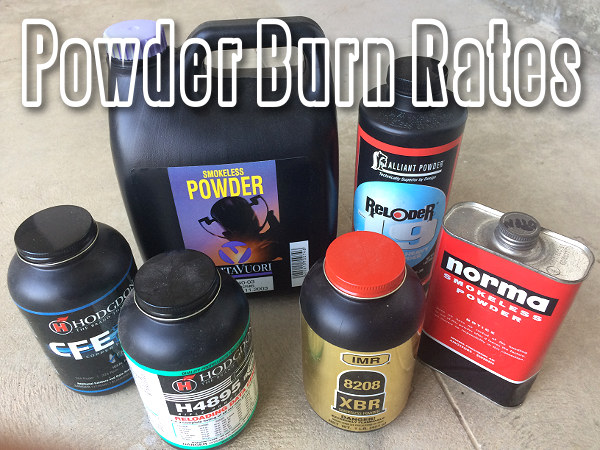
Day after day, one of AccurateShooter’s most-visited web pages is a reference guide featuring a comparative burn rate chart, ranking powders from fastest to slowest. Compiled by Hodgdon Powder Co., this Burn Rate Chart displays the relative burn rates of 163 different powders. Here is the latest table, released by Hodgdon in November of 2019.
You’ll want to download this Powder Burn Rate Table. This table shows the latest IMR powders including the Enduron series (IMR 4166, 4451, 4955, 7977), highlighted in green. This 163-entry comparison table provides vital information for hand-loaders. Note — this invaluable chart is not limited to Hodgdon and IMR propellants. This burn rate chart ranks powders from eight major powder-makers: Accurate, Alliant, Hodgdon, IMR, Norma, Ramshot (Western), Vihtavuori, and Winchester.
This chart provides useful information for all hand-loaders. When doing load development, and testing one powder versus another, it’s generally wise to choose propellants that share the same relative burn rate, as least for starters.
NOTE: Hodgdon powders are blue, IMR Enduron powders are green, IMR standard powders are yellow, and Winchester powders are red. DOWNLOAD Chart HERE.

CLICK HERE to Download Chart as PDF File
Story find by EdLongrange. We welcome reader submissions.
April 28th, 2020
POWDER GRAIN SHAPES — What You Need to Know
The shape of powder grains has a profound effect on the performance of the powder charge, as it concerns both pressure and velocity. There are multiple powder shapes including flake, ball, and extruded or “stick” (both solid and perforated).
All Vihtavuori reloading powders are of the cylindrical, single-perforated extruded stick type. The differences in burning rate between the powders depend on the size of the grain, the wall thickness of the cylinder, the surface coating and the composition. Cylindrical extruded powders can also have multi-perforated grains. The most common types are the 7- and 19-perforated varieties. A multi-perforated powder grain is naturally of a much larger size than one with a single perforation, and is typically used for large caliber ammunition.
Other types of powder grain shapes include sphere or ball, and flake. The ball grains are typically used in automatic firearms but also in rifles and handguns. The ball grain is less costly to produce, as it is not pressed into shape like cylindrical grains. Flake shaped grains are typically used in shotgun loadings.
Web thickness in gunpowder terminology means the minimum distance that the combustion zones can travel within the powder grain without encountering each other. In spherical powders, this distance is the diameter of the “ball”; in flake powder it is the thickness of the flake; and in multi-perforated extruded powders it is the minimum distance (i.e. wall thickness) between the perforations.
The burning rate of powder composed of grains without any perforations or surface treatment is related to the surface area of the grain available for burning at any given pressure level. The change in the surface area that is burning during combustion is described by a so-called form function. If the surface area increases, the form function does likewise and its behavior is termed progressive. If the form function decreases, its behavior is said to be degressive. If the flame area remains constant throughout the combustion process, we describe it as “neutral” behavior.
The cylindrical, perforated powders are progressive; the burning rate increases as the surface area increases, and the pressure builds up slower, increasing until it reaches its peak and then collapses. Flake and ball grains are degressive; the total powder surface area and pressure are at their peak at ignition, decreasing as the combustion progresses.
So how does the shape affect pressure and muzzle velocity? In general, it can be said that powder that burns progressively achieves a desired muzzle velocity at lower maximum pressure than a powder that burns neutrally, not to mention a degressive powder. As grain size increases, the maximum pressure moves towards the muzzle, also increasing muzzle blast. Muzzle velocity and pressure can be adjusted by means of the amount of powder or loading density, i.e. the relationship between the powder mass and the volume available to it. As the loading density increases, maximum pressure grows.
This article originally appeared on the Vihtavuori Website.
February 2nd, 2020

This Technical Report Comes from the Vihtavuori website.
Powder Moisture Content — Did You Know?
Variations in moisture content change the burning rate of a powder and thereby chamber pressures and muzzle velocity. The moisture content of the Vihtavuori N100 and N300 series powders is usually around 1%, while the N500-series’ normal moisture content is 0.6% because of the added nitroglycerine.
So what difference does moisture content make? Here’s an example. In a test, a [Vihtavuori] powder sample was dried by heating it, losing about 0.5 % of its weight. Cartridges were then loaded with the dried powder and fired using a pressure gun. Chamber pressures and muzzle velocities produced by these special cartridges were compared to those produced by cartridges loaded with untreated powder. (The powder charge and bullet were of course the same in both sets of cartridges.)
After Powder Drying:
Pressure Increased 11% from 320 MPa to 355 MPa
Velocity Increased 2.6% from 2526 to 2592 FPS
Comparing results showed chamber pressures increased from 320 MPa to 355 MPa with the dried powder, and the muzzle velocity increased accordingly from 770 m/s to 790 m/s (2526 to 2592 FPS). And note, this is only one example, of one caliber and loading. The difference might be much higher depending on the cartridge and loading combinations.
Recommendation: Store powder below 68°F in 55-65% humidity.
What does this tell us? Well, it seems we need to forget the old saying “Keep your powder dry”! Instead, focus on proper powder storage, at a temperature below 20°C/68°F and humidity between 55 and 65%. Safe reloading everybody!
 Tech Tip sourced by EdLongrange. We welcome reader submissions.
November 5th, 2019

We’re approaching winter — the perfect time to stock up on your propellants for next season. And now you can earn up to $5.00 per pound on your favorite Vihtavuori powders. Vihtavuori makes some great powders that have been used to set many records. With Vihtavuori’s Keep Your Cash Rebate, you can get up to $100 cash back on qualifying Vihtavuori powder purchases.

Vihtavuori $100 CONSUMER REBATE
This offer is valid on qualifying purchases made between November 1, 2019 and January 1, 2020. This applies to all sizes, 1-lb, 4-lb, and 8-lb. You can also mix and match powders to maximize your rebate. Pick up a Rebate Form from your favorite Vihtavuori retailer or download the PDF Form linked below. Then submit the form with your proof of purchase no later than January 31, 2020.
The 2019 Vihtavuori Rebate program is currently under way. For a limited time, earn $5.00 back per one-pound bottle, $10.00 per four-pound bottle, and $20.00 back per eight-pound bottle when you purchase Vihtavuori powders (maximum $100 rebate). Offer is valid on qualifying purchases made between November 1, 2019 and January 1, 2020. All rebate coupons must be received by January 31, 2020.
|


