|
|
June 22nd, 2015

AccurateShooter.com has released the most complete discussion of the 6.5×47 Lapua cartridge ever published. Our new 6.5×47 Cartridge Guide is packed with information. If you own a 6.5×47 rifle, or are thinking of building a rifle with this chambering, definitely read this Cartridge Guide from start to finish. Our comprehensive, 5000-word article was researched and written by the 6.5 Guys, Ed Mobley and Steve Lawrence. Both Ed and Steve shoot the 6.5×47 Lapua in competition and they are experts on this accurate and efficient mid-sized cartridge.
You’ll find everything you need to know about the 6.5×47 Lapua in our new Cartridge Guide. We cover ballistics, reloading, die selection, and we provide an extensive list of recommended loads, for bullets from 120 to 140 grains. You can read interviews with respected experts who’ve built and tested many 6.5×47 rifles. The Guide includes helpful tech tips such as how to maximize the powder fill in your cases. This Cartridge Guide can put you on the “fast track” — helping you develop accurate, reliable loads with minimal development time.
 6.5×47 Lapua Cartridge Guide Highlights: 6.5×47 Lapua Cartridge Guide Highlights:
- Cartridge Specifications
- Comprehensive Load Data
- Best Bullets and Primers for 6.5×47
- Ballistics Comparison Charts
- Sizing and Seating Die Options
- 6mm-6.5×47 (Necked-Down) Options
- Ask the Experts Section
- Tips for Accurate Reloading
- Brass Life and Annealing
- Chambering and Gunsmithing Tips
- 6.5×47 Lapua for Hunting
- 6.5×47 Lapua for Tactical Competition
- 6.5×47 Factory-Loaded Ammo

Here is a sample from the 6.5×47 Cartridge Guide’s Ask the Experts Section. This is an interview with Rich Emmons, one of the founders of the Precision Rifle Series:


March 29th, 2012
Three-gun match competitor Zak Smith employs a simple, handy means to store his elevation and wind dift data — a laminated data card. To make one, first generate a come-up table, using one of the free online ballistics programs such as JBM Ballistics. You can also put the information in an Excel spreadsheet or MS Word table and print it out. You want to keep it pretty small.
Below is a sample of a data card. For each distance, the card includes drop in inches, drop in MOA, drop in mils. It also shows drift for a 10-mph cross wind, expressed three ways–inches, MOA, and mils. Zak explained that “to save space… I printed data every 50 yards. For an actual data-card, I recommend printing data every 20 or 25 yards.” But Zak also advised that you’ll want to customize the card format to keep things simple: “The sample card has multiple sets of data to be more universal. But if you make your own data card, you can reduce the chance of a mistake by keeping it simple. Because I use scopes with MILS, my own card (photo below left) just has three items: range, wind, drop in MILS only.”
 
Once you have the card you can fold it in half and then have it laminated at a local office store or Kinko’s. You can keep this in your pocket, tape it to your stock, or tie the laminated card to your rifle. If you regularly shoot at both low and high elevations, you may want to create multiple cards (since your ballistics change with altitude). To learn more about ballistic tables and data cards, check out the excellent “Practical Long-Range Rifle Shooting–Part 1″ article on Zak’s website. This article offers many other insights as well–including valuable tips on caliber and rifle selection.
Scope-Cover Mounted Ballistics Table
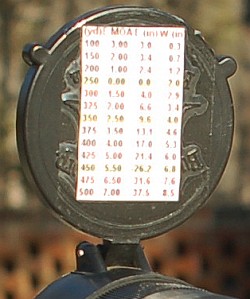 Another option is to place your ballistics card on the back of the front flip-up scope cover. This set-up is used by Forum member Greg C. (aka “Rem40X”). With your ‘come-up’ table on the flip-up cover you can check your windage and elevation drops easily without having to move out of shooting position. Greg tells us: “Placing my trajectory table on the front scope cover has worked well for me for a couple of years and thought I’d share. It’s in plain view and not under my armpit. And the table is far enough away that my aging eyes can read it easily. To apply, just use clear tape on the front objective cover.” Another option is to place your ballistics card on the back of the front flip-up scope cover. This set-up is used by Forum member Greg C. (aka “Rem40X”). With your ‘come-up’ table on the flip-up cover you can check your windage and elevation drops easily without having to move out of shooting position. Greg tells us: “Placing my trajectory table on the front scope cover has worked well for me for a couple of years and thought I’d share. It’s in plain view and not under my armpit. And the table is far enough away that my aging eyes can read it easily. To apply, just use clear tape on the front objective cover.”
Updated Links for JBM Ballistics Program
With the release of version 5.1 of the JBM program, some URLs for the calculations pages have changed. You may want to update your bookmarks with the following web addresses:
May 26th, 2011
The kickoff of the 2011 Steel Safari is just a week away, and things are heating up! Temperatures at this long-range field match are always right around 100-degrees, but this year there will be more competitors than ever (38) and a better prize table than ever before. Match organizers expect strong competition this year, as there will be many seasoned Steel Safari “alumni” competing, including recent Steel Safari Top-5 finishers. The Steel Safari takes place this year on June 3rd, 4th, and 5th at the Blue Steel Ranch located near Logan, NM. Zak Smith is the match director. You can learn more about match details and courses of fire at www.SteelSafari.com.

A true field match with no “square-range” in sight, competitors may need to use improvised and non-standard shoot positions to make shots.
The match showcases practical rifle shooting in the field. Competitors locate small and medium-sized steel targets (often hidden), range them, and engage with one shot only, under a challenging time limit. Some movement on the clock is required, and shoot positions are always improvised, the best you can do while on a reverse incline, over a rock face, shooting down a gully, or leaning out the side of a truck. To add to the challenge, these shooting stations are distributed over two different 3-mile courses in rugged desert terrain. Despite this simple general description, there are a host of individual skills that a competitor must master to place well at this match.
Besides being a test of rifle shooting skill, it also stresses rifle and gear setup and reliability, and individual concentration and mettle. After hiking around in the desert for six hours, it takes talent, determination, and good field skills to find six targets out in the terrain, range them accurately, and then quickly make the shot from sometimes very difficult shooting positions.

Rugged precision bolt rifles such as this Accuracy International are typical at the Steel Safari. The .260 Remington is one of the most common cartridges in the Winner’s Circle.
A variety of rifles, calibers, and scopes will be used at the match, but most competitors employ more or less similar gear. First, an accurate rifle is critical. Bench-rest accuracy is not required; one MOA is sufficient, but one-half-MOA is preferred. Almost everyone shoots their own hand-loads with premium bullets from Sierra, Berger, or Lapua. Ballistic data, or “dope,” completes the triad with the rifle and ammunition. Most shooters laminate a small card and tie it to their rifle or scope, or use a retractable “pathfinder” available from Allison Machine Tool or Leupold. Long-range ballistic data isn’t useful unless the target distances can be determined, and the best tool for that is a laser range-finder. Since many laser range-finders are monocular units with limited field of view, a good set of binoculars can be a life-saver when trying to find that hidden target.
May 20th, 2011
In our recent story on the 2010 Steel Safari in New Mexico we included photos of tactical rifles fitted with suppressors (sound moderators). Whenever we show photos of suppressor-equipped rifles, some readers ask: “Why did you show silencers in that article — aren’t they illegal?”

J. Holdsworth ranges a target at the 2010 Steel Safari. Holdsworth finished 3rd overall in the main match.
In fact, sound moderators, also known as “suppressors”, “silencers”, or “cans”, are legal to own in most of the fifty U.S. States. You have to pay a special tax, fill out some official paperwork, and submit fingerprints. And the suppressor must be transferred through a Class III SOT Federal Firearms License-holder (FFL). In this article, tactical shooter Zak Smith explains the basic regulations concerning suppressors. Zak, whose company Thunder Beast Arms Corp., makes a line of advanced sound moderators, also explains the many benefits of modern suppressors.
 What You Need to Know about Suppressors What You Need to Know about Suppressors
by Zak Smith
Despite common perceptions, silencers are not illegal in the United States. That is, unless you live in CA, DE, HI, MA, MI, MN, MO*, NJ, NY, RI, or VT. If you live in one of those states you’re out of luck. Sorry! Try to elect better politicians.
For the rest of us in the Free United States, sound suppressors — also called silencers — can be owned legally by private citizens provided a little extra paperwork is filled out and approved by the ATF. Silencers (and other NFA items) are transferred to individuals on an ATF Form 4, which requires a $200 stamp tax, a chief law enforcement sign-off, and a set of fingerprints to be submitted to the ATF. In some cases a “corporate” transfer can be done that bypasses the requirements for fingerprints and the local chief law-enforcement sign-off. It usually takes between 3 and 6 months for a Form 4 to be approved by the ATF. At that point you can take possession of your shiny new suppressor. The suppressor itself is the NFA item; you can place it on any firearm (that is otherwise legal to own in your jurisdiction).
 Silencers, along with other National Firearms Act (NFA) items, must be transferred only by Class 3 SOT (Special Occupation Tax) license holders, which is an additional license on top of a regular FFL. To buy a suppressor, you can choose one your local Class 3 dealer has in stock, or you can have him order it for you from the manufacturer. A manufacturer-to-dealer transfer is done on an ATF Form 3, and typically takes 10 days to 3 weeks. Silencers, along with other National Firearms Act (NFA) items, must be transferred only by Class 3 SOT (Special Occupation Tax) license holders, which is an additional license on top of a regular FFL. To buy a suppressor, you can choose one your local Class 3 dealer has in stock, or you can have him order it for you from the manufacturer. A manufacturer-to-dealer transfer is done on an ATF Form 3, and typically takes 10 days to 3 weeks.
“But I don’t plan to be a sniper so why would I want a silencer anyway?” If you hear a shooter say that, you can bet your beer money that they haven’t shot a modern suppressor. Modern suppressors allow the use of full-power ammunition, do not reduce the muzzle velocity, do not contact the bullet during flight, and often aid accuracy. On high-power rifles, a suppressor acts like a muzzle brake and reduces recoil, and of course, the “ka-BOOM” report of the shot is reduced 25-30 dB, yielding a sound not unlike high-pressure gas escaping from an air hose being disconnected.
I have been shooting high-power, bolt-action rifles at long range in competition since 2004. The same year, I had the opportunity to try a modern suppressor on a long-range rifle and there was no going back. Since 2005, my long-range shooting is done almost exclusively suppressed — the only exceptions being F-class (which prohibits their use) and for comparative testing with brakes or bare muzzles.

If you take an accurate bolt-action rifle in .260 Remington or .308 Winchester and fit a suppressor, the recoil will be noticeably reduced and the report will be more similar to a .22 WMR. Most premium .30 caliber suppressors will reduce the report by 25-30 dB — a very substantial sound attenuation. While I do recommend wearing ear protection when using suppressors because hearing damage is subtle but cumulative, the entire experience is more pleasant with a suppressed rifle.
Modern Suppressors Are Superior to Older Designs — And May IMPROVE Your Accuracy
Historically, suppressors had rubber baffles that slowed down the bullets and ruined accuracy. Modern suppressors don’t have any of these drawbacks. While you’ll find competing viewpoints as to whether a suppressor-equipped rifle is more inherently accurate than a rifle with a bare muzzle (or muzzle brake), in practice many shooters shoot better with a suppressed rifle due to psychological and physiological factors — call it “shootability”. With less noise, less barrel hop, and less felt recoil — thanks to the suppressor — many shooters can achieve greater accuracy, shot after shot.
In the last few years, the use of suppressors by competitors has gone from an oddity to being commonplace. At recent matches such as the 2010 Steel Safari, as many as half of the top ten competitors used suppressors.

Suppressors from Thunder Beast Arms Corp.
Several years ago two fellow long-range shooters and I had the opportunity to start a suppressor manufacturing company. We all shared a passion for long-range shooting, had a history of competition, and were convinced that shooting suppressed was the way to go. Thunder Beast Arms Corp., based in Cheyenne, Wyoming, was formed to produce the best suppressors for practical long-range rifle shooting. Our “cans”, as they are sometimes called informally, are designed for accuracy, durability, and light weight, while maintaining best-in-class sound suppression levels. Many of our suppressors are made from Titanium for ultra-light weight and superior corrosion resistance.
Although I am proud of our products, there are many good brands of suppressors on the market right now. A suppressor buyer can dial in the performance, application, and amount he wants to pay very precisely — there will almost certainly be a suppressor on the market that meets his requirements. If you have a chance, see if you can get a suppressor demo lined up — I guarantee you’ll be impressed.
*In Missouri, suppressors may be legally acquired, but only by the military, by law enforcement personnel (acting officially), and by certain Federal Firearms License Holders (including C&R). See: http://www.moga.mo.gov/statutes/C500-599/5710000020.HTM .
May 13th, 2011
 While the venerable .308 Winchester is still the chambering of choice for most tactical shooters, a growing number of tac competitors are switching to the 6.5 Creedmoor (as well as other 6.5mm chamberings such as the 6.5×47 Lapua and .260 Remington). Among the 6.5mm options, the 6.5 Creedmoor offers the advantage of high quality, relatively affordable factory ammo. While the venerable .308 Winchester is still the chambering of choice for most tactical shooters, a growing number of tac competitors are switching to the 6.5 Creedmoor (as well as other 6.5mm chamberings such as the 6.5×47 Lapua and .260 Remington). Among the 6.5mm options, the 6.5 Creedmoor offers the advantage of high quality, relatively affordable factory ammo.
Can the 6.5 Creedmoor win tactical matches with factory ammo? Absolutely. Team Hornady’s Tony Gimmellie used Hornady 6.5 Creedmoor 120gr Match ammo to win the Oregon Sniper Challenge, held May 22-23, at the Douglas Ridge Rifle Club in Eagle Creek, Oregon. Tony said, “Hornady’s 6.5 Creedmoor ammo delivered ½ MOA accuracy from [my] POF gas piston rifle, allowing me to stay well ahead of the competition.”
To learn more about the 6.5 Creedmoor, along with the other popular 6.5mm cartridges used for tac comps, we recommend three articles by Accurateshooter.com contributor Zak Smith:
6.5 Creedmoor vs. the .308 Winchester
In the first article above, Zak explains: “Why 6.5 mm instead of .30 caliber? Put simply, they sling the long, slim, high-BC 6.5 mm bullets at respectable velocity. It duplicates or beats the .300 Win Mag’s trajectory with less recoil than a .308 Win. Compared to the 175 Sierra MK fired from a .308 Win, the 6.5 mm will have 27% less wind drift and about 10 MOA less drop at 1000 yards. Despite a 35-grain deficit in bullet mass, the 6.5 Creedmoor will retain 18% more energy and hit the target 260 fps faster.”

6.5mm Cartridges — Comparative Ballistics Performance by Zak Smith
Put in order of ballistic performance, the 6.5 Creedmoor and the .260 Remington are almost neck-and-neck, pushing the same weight bullets at about the same velocities from almost identical case capacities. The 6.5×47 Lapua in factory form lags by 100 to 200 fps due to less powder capacity; however, it has already gained a reputation for having a strong case that puts up with the high pressures some reloaders push in their custom rifles. The .260 Remington’s main problem for the reloader is lack of high-quality and affordable brass and to date there has only been one factory load produced which was appropriate for serious long-range competition for the non-reloader. The 6.5×47 was designed for intermediate-range competition and very accurate ammunition is available from Lapua; however, these factory loads are at a ballistic disadvantage at long range compared to the .260 Remington and the 6.5 Creedmoor.
There will always be those who bash new cartridges, claiming that they don’t do anything better than their favorite cartridge. By this logic, we’d all be shooting .30-06. Put simply, the 6.5 Creedmoor is what the .260 Remington should have been. It looks like Hornady has the right mind-set to make its new cartridge a success in the competitive and practical market, unlike Remington who basically let the .260 languish in a few hunting rifles. The 6.5 Creedmoor enjoys additional case capacity over the 6.5×47 Lapua, which allows better ballistics at a lower peak chamber pressure.
June 23rd, 2010
 One of the best hike-and-shoot, field-style long-range rifle challenges is the Steel Safari match — a 3-day event conducted in New Mexico’s high desert. The Steel Safari is a contest that examines “practical hunting skills, including target recognition, range estimation, wind doping, trail skills, and marksmanship”, according to the match entry form. Competitors locate small and medium-sized steel targets, range them, and engage with one shot only, under a challenging time limit. Some movement on the clock is required, and shoot positions are always improvised. Shooters may have to go prone on a rock slab, shoot a steep angle down a gully, or lean out the side of a truck. Both the North course and the South course are approximately 3.3 miles in length starting and ending at the “front range”, and looping around the rim of different parts of elevated terrain features. One of the best hike-and-shoot, field-style long-range rifle challenges is the Steel Safari match — a 3-day event conducted in New Mexico’s high desert. The Steel Safari is a contest that examines “practical hunting skills, including target recognition, range estimation, wind doping, trail skills, and marksmanship”, according to the match entry form. Competitors locate small and medium-sized steel targets, range them, and engage with one shot only, under a challenging time limit. Some movement on the clock is required, and shoot positions are always improvised. Shooters may have to go prone on a rock slab, shoot a steep angle down a gully, or lean out the side of a truck. Both the North course and the South course are approximately 3.3 miles in length starting and ending at the “front range”, and looping around the rim of different parts of elevated terrain features.
 The 2010 Steel Safari, held June 4-6, can be characterized by one word: HOT. Temperatures started ramping up on Friday for the Long-Range Side Match, reaching about 100 degrees Fahrenheit, and peaked on Saturday with a high of 109. The shooting was hot too, with winning scores higher than ever before. Among the 36 competitors, Steve Mann finished first with an impressive 95 score. Close behind, with a 93, was B.J. Bailey. Jimmy Holdsworth and Tom Freeman, both scored 88s, but Holdsworth prevailed on the tie-breaker for third place. In the Long-Range Side Match, Jon Beanland took first with a 111 score, followed by Jim Jensen (109) and Brian Whalen (99). The 2010 Steel Safari, held June 4-6, can be characterized by one word: HOT. Temperatures started ramping up on Friday for the Long-Range Side Match, reaching about 100 degrees Fahrenheit, and peaked on Saturday with a high of 109. The shooting was hot too, with winning scores higher than ever before. Among the 36 competitors, Steve Mann finished first with an impressive 95 score. Close behind, with a 93, was B.J. Bailey. Jimmy Holdsworth and Tom Freeman, both scored 88s, but Holdsworth prevailed on the tie-breaker for third place. In the Long-Range Side Match, Jon Beanland took first with a 111 score, followed by Jim Jensen (109) and Brian Whalen (99).

Equipment List — Two-Thirds of Competitors Use 6.5s or 6mms
The most popular rifle/action make was Surgeon (28%), followed by Remington (22%), then Accuracy International and Stiller (11% each), then Savage (8%), Big Horn Arms (6%), and one each of Barrett, Borden, DTA, GAP Templar, and Howa. The 6.5mm caliber totally dominated with 39% of all rifles; 6mm was next with 28%, then .30 (22%), and then 7mm (11%). Chamberings of choice were: .260 Remington (25%), .308 Winchester (17%), 6.5×47 Lapua (11%), 6% for each of 6XC, 7mm WSM, 7mm RSAUM, .260AI, and then 3% each for .300 WM, 6mm-250, .30-06, 6.5-284, 6 Dasher, .243 Winchester, and 6CM/243.

Scopes: Nightforce (28%), U.S. Optics (25%), Schmidt & Bender (17%), followed by Leupold (14%), Vortex (6%), and 3% each for Hensoldt, Burris, Pentax, and Premier. Laser range-finders were dominated by Leica (50%), followed by Swarovski (19%), Zeiss (17%), Vector (8%), and 3% each Leupold and Newcon. Bipods were mostly Harris (78%), followed by Atlas, AI, Caldwell, and Sinclair.
Propellants: Hodgdon powders totally dominated (80%) with Alliant second (20%). Of the Hodgdon powders, H4350, H4831SC, and Varget were the most popular, while RL17 was the most popular Alliant powder by far. The most notable trend in powder choice is that RL17 has replaced H4350 and H4831SC for many shooters.
Bullets, Brass, Ammo: Sierra (31%), Berger (25%), Lapua (25%), and DTAC 6mm (11%). Winchester and Lapua cases dominated with 33% each, followed by Remington (16%), and then Black Hills, Norma, and Lake City (3%). Only 2 shooters used factory ammo: one was Federal GMM (.308) and the other was M118LR (7.62×51 NATO).
CLICK HERE for full, 6-page report on 2010 Steel Safari
October 12th, 2009
 This week’s episode of ShootingUSA television features a recent Three-Gun Challenge Match at Fort Benning, Georgia. In this event, hosted by the U.S. Army Marksmanship Unit (USAMU), both Army and civilian shooters compete with pistol, rifle, and shotguns in a multi-stage, timed course of fire. ShootingUSA airs Wednesdays on the Outdoor Channel at 4:30 pm, 8:30 pm, and 12:30 am, Eastern Time. Check local listings for show times in your area. This week’s episode of ShootingUSA television features a recent Three-Gun Challenge Match at Fort Benning, Georgia. In this event, hosted by the U.S. Army Marksmanship Unit (USAMU), both Army and civilian shooters compete with pistol, rifle, and shotguns in a multi-stage, timed course of fire. ShootingUSA airs Wednesdays on the Outdoor Channel at 4:30 pm, 8:30 pm, and 12:30 am, Eastern Time. Check local listings for show times in your area.
Stages Re-Create Medal of Honor Scenarios
Each of the 8 stages in the Three-Gun Match recalls the actions of a Medal of Honor recipient. Portions of each medal citation are read to competitors while explaining the course of fire.
 This annual three-gun match helps advance the Army Marksmanship Unit’s mission of improving skills throughout the Army, according to AMU Commander, LTC Frank Muggio, “This type of competition is exactly what we want our soldiers to be able to do in the field. They identify a target, they choose the right weapon system to engage the target, and they take out the target, and not anything around the target.” This annual three-gun match helps advance the Army Marksmanship Unit’s mission of improving skills throughout the Army, according to AMU Commander, LTC Frank Muggio, “This type of competition is exactly what we want our soldiers to be able to do in the field. They identify a target, they choose the right weapon system to engage the target, and they take out the target, and not anything around the target.”
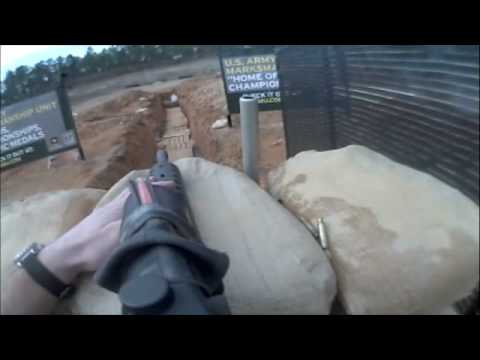
The helmet-cam video clip below (not from ShootingUSA), shows Zak Smith shooting Stage 7 at the 2008 Fort Benning Three-Gun Match. This is a shotgun, rifle, and pistol stage with rifle targets at about 140 yards. Wearing a helmet-mounted camera, Zak starts in the back of a Bradley Fighting Vehicle and proceeds into a trench system to engage pistol targets. Zak has written feature articles and Bulletin reports for AccurateShooter.com. CLICK HERE to read about Zak’s 6.5×47 Lapua tactical rifle.
|


