Here’s a smart tip from Bryan Litz, explaining how damage to a bullet jacket can harm the projectile’s Ballistic Coefficient (BC). This tip is posted on Bryan’s new Bryan Litz Ballistics Facebook page. We recommend you subscribe to that page to access Bryan’s latest informative posts.
Bryan notes: “If the case mouth scratches the bullet when you seat it, the damage can cause the BC to be inconsistent, which shows up as vertical dispersion at long range.”
We see this sometimes when running Doppler Radar for competitors at Applied Ballistics Mobile Lab events. If someone is shooting a bullet that typically has a very consistent BC (1% or less) but they’re seeing a higher BC variation, it can be due to the bullets being damaged in the loading process.”
The lead photo above shows the badly-scratched jacket of a bullet seated in a rough-mouthed case. To prevent such jacket damage, one should chamfer, deburr, and smooth case mouths after trimming.
Below is a recorded Doppler radar result showing excessive BC variation. Such variation can increase vertical dispersion at long range. This can result in larger group sizes and lower scores.
Share the post "Bullet Jacket Scratches Can Affect BC and Long Range Accuracy"
At the request of our readers, we provide select “Deals of the Week”. Every Sunday afternoon or Monday morning we offer our Best Bargain selections. Here are some of the best deals on firearms, hardware, reloading components, optics, and shooting accessories. Be aware that sale prices are subject to change, and once clearance inventory is sold, it’s gone for good. You snooze you lose.
NOTE: All listed products are for sale to persons 18 years of age or older. No products are intended for use by minors.
1. Palmetto State Armory — AR15 Lower Receiver, $49.99
⏺ Amazing Deal on quality AR lower receiver
Do you need a quality, affordable lower for your next black gun build? Here’s a great deal. Palmetto State Armory (PSA) now has stripped AR15 lowers for just $49.99. With this lower as the core, you can build up your AR for any discipline you choose: 3-Gun rifle, competition service rifle competition, varmint rifle, or even “race gun” for the PRS Gas Gun Series. These PSA lowers are forged using 7075-T6 Aluminum and have a durable, mil-spec anodized hardcoat finish.
2. Sportsman’s WH — Rangefinders on Sale, Save up to 34%
⏺ Major discounts on Leupold, SIG Sauer, and Vortex Rangefinders
3. Stocky’s Stocks — Quality Carbon Fiber Stocks on Sale
⏺ Excellent stocks for varmint and hunting rifles — strong and light
Would you like a modern, high-tech carbon fiber stock for your next hunting or varmint rifle project? Stocky’s Stocks is running a major sale on UltraLite Carbon Fiber VG2 Rem 700 Stocks, UltraLite Carbon Fiber Hunter Rem 700 Stocks and UltraLite Carbon Fiber M50 Rem 700 Stocks. With a selection this big you’re bound to find one that fits your needs. These stocks are strong, light, and durable.
4. Palmetto SA — SIG 3-9x50mm Scope + Laser RF, $179.99
⏺ Scope and rangefinder for hunting — combo for under $200
Here’s a good, ultra-affordable scope/LRF combo for a hunter on a tight budget. The Buckmasters Scope and Rangefinder Combo offers advanced SIG Sauer electro-optics for just $179.99. The 3-9x50mm scope has a Bullet Drop Compensation (BDC) reticle with holdover dots. The SIG Sauer LRF 1500 Laser Rangefinder offers fast-ranging performance with red illuminated display for low light hunting. If you don’t need a scope, you can get the Buckmasters 1500 Laser Rangefinder for just $119.99, an amazing deal.
5. Walmart — Fingerprint Access Gun Safe, $149.99
⏺ 50% Off price on Rapid Access Gun Safe (fingerprint, keypad, key)
Need to store a few rifles or shotguns with secure yet rapid access? Consider this 5-Gun Safe with Fingerprint Access. With a $299.99 MSRP, it is now just $149.99 on sale. It has five locking bolts on the door sides plus an internal locking compartment. Sized 13.8″W x 11.8″D x 57″T, this 74-lb safe can hold multiple long guns and pistols, along with other valuables. The main door can be opened instantly with fingerprint recognition, or use the digital keypad (there is also an emergency keyhole). The interior has foam barrel holder and carpeted floor, plus three pistol pouches on the door. NOTE: We do NOT recommend this as a primary gun safe, but it can be a good secondary safe.
6. Palmetto SA, Blackhawk Shooting Mat/Rifle Case, $49.99
⏺ Multi-Function Shooting Mat/Rifle Case now $100 Off
Here’s a great deal on a multi-function Mat/carry case. The Blackhawk Stalker Drag Mat Carry Case functions as a nice padded shooting mat, AND it serves as a rifle carry case and drag bag. Length is 50.5″ and width (in rifle case mode) is 9″. This mat/case is made from durable 1000 denier nylon and closed-cell foam. It has carry straps plus a shoulder strap.
7. Powder Valley — 2500 RUAG SmR Primers, $177.99
⏺ Great price on high-quality primers
If you shoot benchrest rigs, varmint rifles, or ARs, you need small rifle (SR) primers. Now you can get some very high-quality German-made RUAG SR Primers for a mere $177.99 for 2500. That’s the equivalent of $71.20 per thousand. These RUAG #4033 primers have earned positive user reviews: “Excellent quality… they performed very well… would recommend these to anyone”. NOTE: These are mil-spec primers with a fairly hard cup.
8. Midsouth — Poly-Tipped Bullet Sale, 17 to 23 Cents Each
⏺ Good, budget-priced bullets for varminters, AR15 Shooters, and hunters
If you need good bullets for your .223 Rem, 22 BR, or 22-250 varmint rig, here is a great opportunity. Get 55gr or 75gr polymer-tipped bullets at super-low prices, starting at just $41.99 for 250 — just 17 cents each. There are also 110gr .30 caliber bullets at $56.99/250 that can work for small game, or even local club matches. These deals are all on 250-count lots. CLICK HERE for Poly-tip Bullet Sale at Midsouth.
9. Amazon — Dragon AR500 Steel Targets, $16.99 and Up
⏺ Good prices on strong versatile AR500 steel gongs, 4″, 6″, 8″, 10″, 12″.
Shooting steel is fun — you get instant gratification from hearing the “clang” and seeing the gong swing. Shooting steel is also good practice for PRS/NRL events and ground-hog matches. Right now, you can get some great deals on quality AR500 steel targets. These Dragon Target Gongs (#ad) start at just $16.99 for a 4″-diameter, 3/8″-thick gong. Larger 6″, 8″, 10″, and 12″ gongs are offered in 3/8″ and 1/2″ thicknesses, and a 3-pack of 8″ gongs is available. A 6″-diameter gong is $26.99 (3/8″ thick) or $32.99 (1/2″ thick). The largest 12″-diameter gong in the heavy 1/2″ thickness is $76.99. NOTE: All these Dragon gongs have a center hole allowing more hanging options.
⏺ Sophisticated wind speed meter at a super-affordable price
Knowing wind speed is critical to making accurate ballistic adjustments both on the line or in the field. If you need a reliable yet affordable wind speed meter, consider the BTMETER BT-100 Handheld Anemometer (#ad). The BT-100’s multi-function capabilities include Wind Speed, Wind Temperature, and Wind Chill factor. The BT-100 portable wind speed gauge can accurately measure wind velocity in 5 units: m/s, km/h, ft/min, knots, mph. The unit also records air temperatures in degrees Celsius and Fahrenheit.
As an Amazon affiliate, this site can earn revenues through sales commissions.
Share the post "BargainFinder 450: AccurateShooter’s Deals of the Week"
If you hand-load pistol ammunition, you should definitely have a case gauge (aka “gage”) for each cartridge type you reload. Caliber-specific, precision-machined cylindrical gauges perform many important functions. They will instantly reveal if your rounds are too long or have excessive headspace. They will also show if your case is bulged or otherwise too fat to chamber easily. You can use the gauge with sized brass as well as loaded rounds.
Case gauges are a “must-have” for anyone loading handgun ammunition, particularly if you crank out large quantities of pistol ammo with a progressive press. An oversize round can cause a misfeed, jam, or other problem. That can ruin your day if you are in the middle of a shooting match. If you are relying on your handgun for self-defense, the last thing you want is a malfunction of any kind. This Editor personally runs every pistol round through a gauge before it goes into the ammo box.
UltimateReloader.com Video Shows How to Use Pistol Case Gauges:
Our friend Gavin Gear of UltimateReloader.com has prepared an excellent video that explains the benefits of pistol case gauges and shows how to use them. Gavin uses the quality gages produced by L.E. Wilson. These are available for the most popular handgun cartridges, both autoloader cartridges, and rimmed revolver cartridges. Gavin demonstrates gage use with .40 SW and .44 magnum cases.
Gavin states: “Using a case gage is very simple, and I would recommend that you add one of these gages to your reloader’s tool chest for each of the pistol cartridge types you reload. It may just save you a lot of time and hassle. Peace of mind is hard to put a price on!”
Coating bullets with a friction-reducing compound such as Molybdenum Disulfide (Moly) offers potential benefits, including reduced barrel heat, and being able to shoot longer strings of fire between bore cleanings. One of the effects of reduced friction can be the lessening of internal barrel pressures. This, in turn, means that coated bullets MAY run slower than naked bullets (with charges held equal).
To restore velocities, shooters running coated bullets are inclined to “bump up” the load — but you need to be cautious.
Be Careful When Increasing Loads for Coated Bullets
We caution shooters that when your start out with coated bullets in a “fresh barrel” you should NOT immediately raise the charge weight. It may take a couple dozen coated rounds before the anti-friction coating is distributed through the bore, and you really start to see the reduced pressures. Some guys will automatically add a grain or so to recommended “naked” bullet charge weights when they shoot coated bullets. That’s a risky undertaking.
We recommend that you use “naked” bullet loads for the first dozen coated rounds through a new barrel. Use a chronograph and monitor velocities. It may take up to 30 rounds before you see a reduction in velocity of 30-50 fps that indicates that your anti-friction coating is fully effective.
We have a friend who was recently testing moly-coated 6mm bullets in a 6-6.5×47. Moly had not been used in the barrel before. Our friend had added a grain to his “naked” bullet load, thinking that would compensate for the predicted lower pressures. What he found instead was that his loads were WAY too hot initially. It took 30+ moly-coated rounds through the bore before he saw his velocities drop — a sign that the pressure had lowered due to the moly. For the rounds fired before that point his pressures were too high, and he ended up tossing some expensive Lapua brass into the trash because the primer pockets had expanded excessively.
LESSON: Start low, even with coated bullets. Don’t increase your charge weights (over naked bullet loads) until you have clear evidence of lower pressure and reduced velocity.
Procedure After Barrel Cleaning
If you shoot Moly, and clean the barrel aggressively after a match, you may want to shoot a dozen coated “foulers” before starting your record string. Robert Whitley, who has used Moly in some of his rifles, tells us he liked to have 10-15 coated rounds through the bore before commencing record fire. In a “squeaky-clean” bore, you won’t get the full “benefits” of moly immediately.
To learn more about the properties of dry lubricants for bullets, read our Guide to Coating Bullets. This covers the three most popular bullet coatings: Molybdenum Disulfide (Moly), Tungsten Disulfide (WS2 or ‘Danzac’), and Hexagonal Boron Nitride (HBN). The article discusses the pros and cons of the different bullet coatings and offers step-by-step, illustrated instructions on how to coat your bullets using a tumbler.
Share the post "Safety Tip: Adjust Loads Conservatively with Coated Bullets"
Here is big news for reloaders. RCBS, one of the leading producers of dies, reloading gear, case prep tools, powder dispensers, and reloading presses, has been acquired by Hodgdon Powder Company. RCBS has been operated by Revelyst, a division of of Vista Outdoor (VSTO). (SEE Revelyst Report on Yahoo Finance.) Here is the text from the official press release announcing the acquisition:
Hodgdon Powder Company Acquires RCBS Reloading
May 02, 2024
Hodgdon Powder Company is pleased to announce the acquisition of RCBS Reloading from Revelyst, a segment of Vista Outdoor (NYSE: VSTO). This acquisition is effective May 2, 2024, with Hodgdon prepared to immediately continue shipping RCBS products to wholesale and retail customers.
“This acquisition of RCBS, the leading brand in metallic reloading tools, is a perfect complement to our portfolio of smokeless powder brands for our handloading customers,” said Steve Kehrwald, president and CEO of Hodgdon Powder Company. With our world-class ballistics labs, we look forward to providing even more load data to our new RCBS customers.”
Hodgdon is thrilled to add the RCBS facility in Oroville, CA to our company-owned facilities in Shawnee, KS, Herington, KS and Miles City, MT. The addition of the RCBS team will more than double the headcount at the Hodgdon Powder Company and greatly expands the company’s manufacturing capabilities.
“For years, our friends have referred to the Hodgdon family and company as ‘The Gunpowder People’ and this acquisition further demonstrates our dedication to the handloader,” said J.B. Hodgdon, co-owner with his late brother Bob, of the Hodgdon Powder Company. “Our dad Bruce partnered with Fred Huntington from RCBS to conduct Reloading Roadshow events in the 1950s and 1960s. I believe they both are looking down today, proud to have our two great brands together in 2024.”
Comment from Vista Outdoor/Revelyst
“For more than 80 years, RCBS has demonstrated their manufacturing, innovation and operational excellence,” Said Eric Nyman, Co-CEO of Vista Outdoor and CEO of Revelyst. “We are thrilled for RCBS and their new ownership with Hodgdon Powder. This transaction joins two iconic brands, and it ensures that RCBS is positioned for success in the next chapter of its history.”
Hodgdon sent a letter today to its customers. In the letter, Hodgdon Sales V.P. Shawn Kelley states: “Hodgon Powder Company announced earlier this morning that we acquired RCBS from Vista Outdoor, effective immediately.” Shown above is the letter sent to customers.
Share the post "Major News — Hodgdon Acquires RCBS from Vista Outdoor"
Serious riflemen know that Krieger makes outstanding centerfire barrels that hold world records and have won many National Championships. But did you know that Krieger makes great rimfire barrels too? Well, Krieger does make outstanding .22 LR rimfire match barrels that can deliver impressive accuracy.
Sniper’s Hide moderator “Padom” recently tested a variety of rimfire ammo types, employing five different barrels: Krieger, Bartlein, Benchmark, Lilja, and Green Mountain. He tested at both 50 yards and 100 yards. FULL Rimfire TEST REPORT HERE.
Reporting on the 50-yard test, Padom posted: “Had a virtually dead calm day today for 50-yard RimX testing (Keystone Accuracy RimX barreled action with 1:16″ Krieger 20″ barrel). A few infrequent 3 mph gusts but pretty dead [calm] and the target showed. This Krieger just barely edged out the Bartlein by 0.003″ with a 0.177″ 6×5 with SK Rifle Match. The 10×5 was 0.198″. The best lots of Center-X weren’t far behind either. This is the first Krieger rimfire [barrel] I’ve shot and it didn’t disappoint.”
Padom noted: “Winds were much calmer tonight than this morning so the 100-yard Krieger test was a success. Winds were pretty consistent [at] 3-5 mph.”
Test Results at 100 Yards
Padom then tested ammo at 100 yards, again using his Krieger rimfire barrel: “To recap, the Krieger shot the best 50-yard results of the barrels tested so far, just barely beating the Bartlein but it was so close you can call the 50-yard results equal (.005). Well the Krieger beat all the barrels tested to date at 100 yards by a pretty good margin with Center-X. The 10×5 was incredible as well at just barely over 0.6″ showing the results were very consistent. A second lot of Center-X was right there with the previous 100-yard 6×5 best results just barely over 0.6. The third lot of Center-X shot a respectable 0.75″ 6×5. This Krieger sure is shooting very nicely. I’m really looking forward to shooting it at 300 and 400 yards[.]”
Components Tested: 20″ Krieger M24 barrel, .22 LR Match Eachus chamber 0.046 headspace, Zermatt RimX Action, Bix’N Andy TacSport Pro 2-Stage Trigger, RimX 10rd magazine, XLR Envy Pro Folding Chassis, Athlon Cronus BTR 4.5-29x56mm MIL scope.
Shooting Set-up: 100 Yards Prone with Bipod and Rear Bag.
Share the post "Rimfire Ammo Comparison Testing with Multiple Barrel Brands"
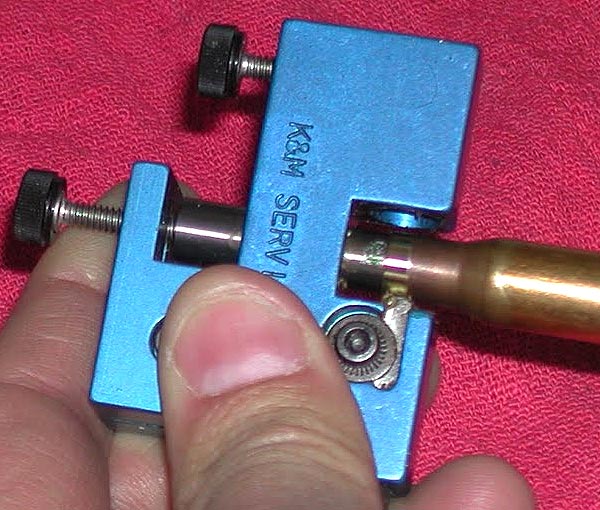
When neck-turning cases, it’s a good idea to extend the cut slightly below the neck-shoulder junction. This helps keep neck tension more uniform after repeated firings, by preventing a build-up of brass where the neck meets the shoulder. One of our Forum members, Craig from Ireland, a self-declared “neck-turning novice”, was having some problems turning brass for his 20 Tactical cases. He was correctly attempting to continue the cut slightly past the neck-shoulder junction, but he was concerned that brass was being removed too far down the shoulder.
Craig writes: “Everywhere I have read about neck turning, [it says] you need to cut slightly into the neck/shoulder junction to stop doughnutting. I completely understand this but I cant seem to get my neck-turning tool set-up to just touch the neck/shoulder junction. It either just doesn’t touch [the shoulder] or cuts nearly the whole shoulder and that just looks very messy. No matter how I adjust the mandrel to set how far down the neck it cuts, it either doesn’t touch it or it cuts far too much. I think it may relate to the bevel on the cutter in my neck-turning tool…”
Looking at Craig’s pictures, we’d agree that he didn’t need to cut so far down into the shoulder. There is a simple solution for this situation. Craig is using a neck-turning tool with a rather shallow cutter bevel angle. This 20-degree angle is set up as “universal geometry” that will work with any shoulder angle. Unfortunately, as you work the cutter down the neck, a shallow angled-cutter tip such as this will remove brass fairly far down. You only want to extend the cut about 1/32 of an inch past the neck-shoulder junction. This is enough to eliminate brass build-up at the base of the neck that can cause doughnuts to form.
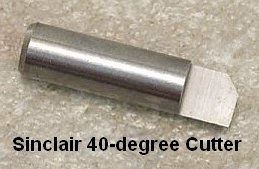
The answer here is simply to use a cutter tip with a wider angle — 30 to 40 degrees. The cutter for the K&M neck-turning tool (above) has a shorter bevel that better matches a 30° shoulder. There is also a 40° tip available. PMA Tool and 21st Century Shooting also offer carbide cutters with a variety of bevel angles to exactly match your case shoulder angle*. WalkerTexasRanger reports: “I went to a 40-degree cutter head just to address this same issue, and I have been much happier with the results. The 40-degree heads are available from Sinclair Int’l for $15 or so.” Forum Member CBonner concurs: “I had the same problem with my 7WSM… The 40-degree cutter was the answer.” Below is Sinclair’s 40° Cutter for its NT-series neck-turning tools. Item NT3140, this 40° Cutter sells for $14.99. For the same price, Sinclair also sells the conventional 30° Cutter, item NT3100.
Al Nyhus has another clever solution: “The best way I’ve found to get around this problem is to get an extra shell holder and face it off .020-.025 and then run the cases into the sizing die. This will push the shoulder back .020-.025. Then you neck turn down to the ‘new’ neck/shoulder junction and simply stop there. Fireforming the cases by seating the bullets hard into the lands will blow the shoulder forward and the extra neck length you turned by having the shoulder set back will now be blended perfectly into the shoulder. The results are a case that perfectly fits the chamber and zero donuts.”
There is an excellent article about primers on the Shooting Times website. We strongly recommend you read Mysteries And Misconceptions Of The All-Important Primer, written by Allan Jones. Mr. Jones is a bona fide expert — he served as the manager of technical publications for CCI Ammunition and Speer Bullets and Jones authored three editions of the Speer Reloading Manual.
This authoritative Shooting Times article explains the fine points of primer design and construction. Jones also reveals some little-known facts about primers and he corrects common misconceptions. Here are some highlights from the article:
Size Matters
Useful Trivia — even though Small Rifle and Small Pistol primer pockets share the same depth specification, Large Rifle and Large Pistol primers do not. The standard pocket for a Large Pistol primer is somewhat shallower than its Large Rifle counterpart, specifically, 0.008 to 0.009 inch less.
Magnum Primers
There are two ways to make a Magnum primer — either use more of the standard chemical mix to provide a longer-burning flame or change the mix to one with more aggressive burn characteristics. Prior to 1989, CCI used the first option in Magnum Rifle primers. After that, we switched to a mix optimized for spherical propellants that produced a 24% increase in flame temperature and a 16% boost in gas volume.
Foiled Again
Most component primers have a little disk of paper between the anvil and the priming mix. It is called “foil paper” not because it’s made of foil but because it replaces the true metal foil used to seal early percussion caps. The reason this little disk exists is strictly a manufacturing convenience. Wet primer pellets are smaller than the inside diameter of the cup when inserted and must be compacted to achieve their proper diameter and height. Without the foil paper, the wet mix would stick to the compaction pins and jam up the assembly process.
Primer Functionality and Primer Types Compared
This video looks at a variety of primer types from multiple manufacturers, foreign and domestic. The video explains the basics of how primers function, and then explains the key characteristics of standard primers, magnum primers, and mil-spec primers (designed for semi-auto rifles).
Share the post "How Primers Work — What You Need to Know"
At the request of our readers, we provide select “Deals of the Week”. Every Sunday afternoon or Monday morning we offer our Best Bargain selections. Here are some of the best deals on firearms, hardware, reloading components, optics, and shooting accessories. Be aware that sale prices are subject to change, and once clearance inventory is sold, it’s gone for good. You snooze you lose.
NOTE: All listed products are for sale to persons 18 years of age or older. No products are intended for use by minors.
1. Midsouth — Lyman Press Kit and Reloading Gear Sale
⏺ Save $100 on turret press combo kits; save $40 on Powder Dispenser
Midsouth is running a sale on Lyman Reloading Press Combo Kits, turret presses, powder dispensers and more. Lyman makes quality products and the All-American 8-station turret press is quite impressive. With this sale you save $50 on the turret press and $100 on the Ultimate Reloading System Kit.
2. Natchez — Burris Optics Blem Sale
⏺ Significant discounts on scopes, spotters, binocs and more
Do you need a good scope, binoculars, or spotting scope? Then check out the Burris Blemished Optics Sale at Natchez. If you don’t mind a minor cosmetic flaw or small scratch you can save up to 50%. Among the bargains are competition FFP zoom scopes, LRF scopes, spotting scopes, thermal monoculars, and compact binoculars. Save $900 on the impressive XTR Pro for PRS/NRL. This features a Quick Detach Race Dial and Zero Click Stop Elevation Knob. Or save $650 on the Burris Eliminator IV Laser Rangefinder scope.
3. Smith & Wesson, Wheelgun Wonderland Rebate, $50 or $75
⏺ Act soon for $50 or $75 rebate on high-quality revolvers
Right now you can get a significant S&W Rebate on both compact carry revolvers and full-size wheelguns. For the smaller J-Frame (with $50 rebate), we like the Model 638 with alloy frame and shielded hammer. You can also get a big $75 rebate on the bigger K-, L-, or N-frame revolvers. In .357 Magnum, we like the modern L-Frame Model 686. NOTE: To get the rebates, purchases must be made before midnight on 4/30/2024 — so don’t delay.
4. Palmetto SA — RUGER-5.7® 5.7×28 Pistol, $549.99
⏺ Save $350 Off MSRP for high-velocity, low recoil 5.7×28 handgun
The 5.7×28 cartridge is a modern defense round with much less perceived recoil than pistol cartridges shooting larger-diameter, 120-250gr bullets. With a 20+1 round capacity, the 5.7×28 Ruger-5.7 is a well-designed pistol with good sights. Owners report the Ruger 57 has good ergonomics, and is accurate and fun to shoot with low muzzle flip. With this sale you save $350.00 off Ruger’s $899.99 MSRP.
5. Graf & Sons — Hornady Ammunition Sale
⏺ Major savings on Hornady brand Rimfire, Centerfire Rifle, and pistol ammo
If you need ammo for a variety of cartridges check out the Hornady Ammo Sale over at Graf’s. There’s a good selection of both rifle and pistol ammunition with good deals on .204 Ruger, .243 Win, 6.5 PRC, .270 Win, and .308 Win. Plus rimfire varmint ammo is deeply discounted — e.g. Hornady 17 Mach 2 is discounted 18%, with 20 rounds just $9.65.
6. Amazon — Walker’s Razor Slim Muffs, $41.75
⏺ Very good customer reports for these NRR23 Slim Muffs
Good hearing protection is vital for preventing hearing loss over the years. A great choice is the Walker’s Digital Razor PRO Electronic Earmuffs, an Amazon Best Seller. Omnidirectional Microphones capture sounds from all directions, and Walkers quick-activated compression dampens sudden, loud noises to protect your hearing. NOTE: These $41.75 muffs require two AAA replaceable batteries. For $69.99 you can get rechargeable Walker’s Razor Slim Muffs.
7. Amazon — RCBS M1000 Balance Scale, $149.52
⏺ Good beam scale serves multiple reloading/sorting tasks
Electronic scale/dispensers are efficient. But many loading room tasks, such as bullet weight sorting, can be performed more quickly and easily with a good beam scale. In addition, a beam scale won’t experience the drift shown by some electronic scales. We think all hand-loaders should have a good mechanical scale. The RCBS M1000 mechanical scale is reliable and well-designed, offering excellent, accurate performance for the price.
8. Locked&Loaded — CCI Blazer 9mm Ammo, $219.99 1000 rds
⏺ Quality 9mm brass-cased ammo at a super-low price — $0.22/round
CCI makes very reliable pistol ammo with reloadable brass cases. Right now you can get 1000 rounds of CCI Blazer 9mm FMJ ammo for just $219.99 at LockedLoaded.com. That price works out to just $11.00 per 50-round box — a fantastic price. This very affordable 115gr Blazer 9mm ammo is excellent for practice/training, and it is more reliable than commercial reloads.
9. Amazon — KingHardCase 200rd Rifle Ammo Case, $49.99
⏺ Great high-capacity waterproof ammo transport case — three versions
Keep 200 rounds of ammo securely stored in this Waterproof Ammo Case, now $49.99 on sale. Made of high-strength ABS plastic, this 11.5″ x 9.5″ x 4.5″ ammo transport case can withstand harsh environments, resist impact, and protect against scratches. Shown above is the version that holds 200 .308 Win-sized rounds. Another model holds 200 .223 Rem rounds in the same-size case priced $39.99 on Amazon. There is also a $39.99 double-decker KingHardCase that holds 350 rounds of pistol ammo.
10. Amazon — PLANO Rifle Hard Case, $47.36
⏺ Versatile TSA-approved rifle case that can hold two rifles or shotguns
Here’s a good basic long gun transport case that will hold two rifles (without scopes) or one large scoped rifle. This 15″L x 5.15″W x 4″H Plano Double Rifle Hard Case features good foam padding and heavy duty latches. Interior dimensions are: 50.5″L x 3.75″W x 12″H. This case has padlock tabs for security and is TSA-approved for airline travel. This is a good case for the price.
As an Amazon affiliate, this site can earn revenues through sales commissions.
Share the post "BargainFinder 449: AccurateShooter’s Deals of the Week"
When you’re on a varmint expedition in the Western states you can bet, sooner or later, you’ll encounter serious winds. Here’s some advice on how to minimize the effects of cross-winds on your shooting, and easily improve your percentage of hits. In essence, you want to use your ability to change shooting positions and angles to put the wind behind you.
A benchrest or High Power shooter must operate from a designated shooting position. He must stay put and deal with the wind as it moves across the course, from whatever direction it blows.
Put the Wind at Your Back
By contrast, a varmint hunter can move around and choose the spot that provides the most favorable wind direction. In most cases you’ll get the best results by moving your shooting position so the wind is at your back. This will minimize horizontal wind drift. Once you’re in position, use wind flags to direct your fire in line with the prevailing winds. A varminter who calls himself “Catshooter” explains:
The String of Death
I remember the first time I was on a dog town in the Conata Basin, in the Badlands area of southwestern South Dakota. Along with two other guys, I drove out for 21 days of shooting, and I never saw wind like that before. If all four tires of our vehicle were on the ground, the weather man said these were “mild wind conditions”.
After the first four or five days, we got smart. We would park the truck on the up-wind side of the town so the wind was at our back. Then we took a piece of string on a 3-foot stick, and set it in front of the shooters, and let the string point at the mounds that we were going to shoot.
For the rest of the trip, we didn’t have to deal with wind drift at all. We just shot the dogs that the string pointed to. We started calling our simple wind pointer the “String of Death”.
We were hitting dogs at distances that I would not repeat here (with benchrest grade rifles). After the first time out, I always took a wind rig like that.
Benefits of Swivel Benches
In a large varmint field, you’ll want to orient your shooting position to put the wind at your back if possible. If you have a rotating bench such as this, you can further adjust your shooting orientation to work with the wind, not against it. You may also want to position simple flags (posts with colored tape) downrange to alert you to wind changes you may not notice from your shooting positions. If you can’t get a “wind at back” orientation, the next best set-up is with the wind coming straight at you — that also minimizes the wind drift on your shots.
The Hornady Handbook of Cartridge Reloading is now available in App form. Like the print and eBook versions of the Reloading Handbook, the new Hornady Reloading Guide App provides comprehensive reloading information. It covers rifle cartridges from the 17 Hornet to the 50 BMG and handgun cartridges from the 22 Hornet to the 500 S&W. This is a convenient mobile App, that works with both iOS (Apple) and Android devices. There are versions for both smartphones and tablets (iPads and Android). With this App you can access load data at the range, making it easier to do efficient load development at the range.
Hornady Reloading App Features:
Velocity and powder charts
An impressive lineup of powders
Find reliable loads by cartridge and bullet weight
Information on bullet design and shooting application
Very comprehensive load data from .17 Cal up to .50 Cal
Download FREE APP — Apple and Android compatible
The Hornady Reloading App is FREE to download. The App includes more than 200 calibers with a variety of loads featuring Hornady bullets, such as the A-Tip Match, ELD-X, and ELD® Match line.
Subscription Options
The iOS and Android download pages explain that fees may be required for detailed information: “Derived from extensive testing by Hornady Manufacturing Company, this App includes reloading data for over 200 cartridges and 300 bullets. [Hornady reports] only data that proved safe in our research. Users have the ability to purchase data for individual cartridges, purchase the whole current edition of the handbook, or subscribe and receive the entire handbook plus more. Subscription provides access to all handbook data on your mobile device and real updates for all new data without waiting for the new handbook publication to be produced.”
Share the post "Download FREE Hornady Reloading Apps for iOS and Android"
Every Tuesday an interesting technical feature is posted on the Applied Ballistics Facebook Page. For today’s 4/23/24 “Tech Tuesday”, a fascinating video of a bullet in flight was posted. This Schlieren video illustrates a 6mm 109gr Berger LRHT bullet traveling at 3163 FPS. The stunning video reveals the bullet shockwave and the turbulent wake. Check it out:
About the Schlieren Imaging Process — What It Shows
Schlieren Imaging is a way of making airflow features visible. You can clearly see the compression (shock) wave at the front of the bullet. A compression wave is formed when the air has to move faster than the speed of sound to get out of the way, which is certainly the case for this bullet which is moving about 2.5 times the speed of sound (Mach 2.5). That shock wave is the ‘snap’ you hear when bullets fly past you if/when you’re downrange. Also, compressing the air into a shockwave takes energy, and that energy comes directly out of the forward velocity of your bullet and gets converted into heat and noise as the shock wave forms and dissipates. The turbulent wake at the base of the bullet shows where/how base drag applies. The third and smallest component of drag for a supersonic bullet is skin friction drag, which is a viscous boundary layer effect, and is the least visible in this image.
Above is a second Schlieren imaging video. This shows a 6mm 109gr Berger LRHT bullet at ~2800 fps as fired from a PRS rifle at the Applied Ballistics Lab. Bryan Litz notes: “You can clearly see the compression (shock) wave at the front of the bullet. A compression wave is formed when the air has to move faster than the speed of sound to get out of the way, which is certainly the case for this bullet which is moving about 2.5 times the speed of sound (Mach 2.5).”
Science of Accuracy Exclusive Content for Subscribers
Applied Ballistics has a huge archive of shooting-related ballistics and technical information plus exclusive videos. You can access all this information plus great members-only podcasts by subscribing to the Science of Accuracy Academy for $9.95/month.




 Test Results at 100 Yards

 When neck-turning cases, it’s a good idea to extend the cut slightly below the neck-shoulder junction. This helps keep neck tension more uniform after repeated firings, by preventing a build-up of brass where the neck meets the shoulder. One of our Forum members, Craig from Ireland, a self-declared “neck-turning novice”, was having some problems turning brass for his 20 Tactical cases. He was correctly attempting to continue the cut slightly past the neck-shoulder junction, but he was concerned that brass was being removed too far down the shoulder.



 A benchrest or High Power shooter must operate from a designated shooting position. He must stay put and deal with the wind as it moves across the course, from whatever direction it blows.
 Benefits of Swivel Benches
 Velocity and powder charts


