With rising crime rates in the USA, many Americans are taking a much more serious look at armed self-defense. We understand why citizens in large cities are more concerned than ever with the need to protect themselves, their families, and their homes and businesses.
Shotgun vs. Handgun — which is better for home defense? That question inspires strong opinions on both sides. We think the best answer may be “both”. There are some situations where a pistol is most handy, while there are other situations where the power (and lethality) of the shotgun clearly wins out. Some would argue that the shotgun offers an “intimidation” factor that may better resolve a threat without a shot being fired.
The NSSF, in cooperation with Thunder Ranch Training Center, has created an interesting video that examines the Shotgun vs. Handgun debate. As the Cheaper Than Dirt Blog notes: “The primary argument against the shotgun is a longer length leading to less maneuverability. On the other hand, the pistol offers better maneuverability, but lacks the stopping power of a shotgun”. Moreover, the pistol may be less accurate, according to some critics. This NSSF video looks at the question from a logical standpoint — making some surprising points.
As you can see in this still frame (above) from the video, the shooting stance of the pistol shooter (Clint) is NOT much more compact than that of the two shotgunners (compare actual muzzle positions). So a shotgun may actually be more handy inside a home than some people realize. Clint concludes that the gun selection debate “is all very easily solved by only one question: ‘If someone was going to run across a bedroom at you and they had a big knife, would you rather shoot him one time with a pistol or one time with a shotgun?’ When you answer the question you figure out why this [shotgun length] doesn’t really bother us. We simply take these [shotguns] and use them in a slightly different manner…”
In this video, Thunder Ranch Director Clint Smith explains why the overall length of a shotgun, as held in firing position against the shoulder, is not really that much greater than the “shooting stance length” of a handgun held in a proper firing position (with arms extended). Accordingly gun length/size should not be the deciding factor when choosing a firearm for home defense.
Whatever Weapon You Choose — Train with It
Fundamentally, you should use the firearm that is 100% reliable, and with which you have trained regularly. Mastery of a defensive firearm — whether shotgun or handgun — needs to be second-nature. You should be able to operate all the controls (safety, pump, decocker, slide, bolt handle etc.) by “instinct” based on hours of training. Likewise you should know how to operate the light/laser if your defensive firearm is so equipped. Importantly, you should be able to reload in darkness, and clear malfunctions without panicking.
Share the post "Shotgun vs. Handgun for Home Defense — What’s Best?"
AccurateShooter.com offers a dozens of free, printable targets in our Target Collection. However, we know that sometimes shooters may prefer a commercially-printed specialty target. These may offer unique designs, hi-viz colors, splatter effect, or special functions (such as scope checking). Here are a variety of excellent commercial grid targets you can buy via Amazon or the target-maker’s website.
EZ-AIM 12″x12″ Grid with Orange Bullseyes — $7.75 for 13-pack
We like this EZ-Aim Sight-in Grid Target for sighting-in, load development. and general practice. The full 12″x12″ target is covered with a precise black-lined grid on white background. There is a large center orange bullseye, plus four additional bulls, one in each corner. Right now this target is a bargain. You can get a 13-pack of targets for just $7.75 (#ad) on Amazon.
Freedom Targets — Bullseye Sight-In Grid Target, 25 for $12.89
Here’s a great Bullseye Sight-in Grid Target. This target provides a central bull on a 1″ grid pattern. There 8 additional small orange dot aim points, plus helpful numbers on the central vertical and horizontal lines. The outer four orange aim points are set inside heavier black lines to help align your scope crosshairs. This target is nicely printed, with sharp lines and bright orange circles. You get a pack of 25 targets for $12.89 — that’s $0.52 per target.
Birchwood Casey Grid — Black on White Splatter, 5 for $4.38
We’ve all seen conventional splatter targets with a black bullseye or grid. When a shot hits the target, a halo (usually neon yellow) appears around the bullet hole. Here is another kind of splatter target that creates a black circle on a white background. This can be very effective for spotting your hits at long range. This Birchwood-Casey White Grid Target is $4.38 for a 5-pack (#ad) on Amazon. These Shoot-N-C Sight-In Targets have a self-adhesive backing, making for easy put up and take down. In addition, the target pack comes with corner pasters to cover holes or use as additional aim points.
High-Viz Option — Yellow on Black Grid with Yellow Halos
If you prefer seeing ultra-high-contrast yellow/green “halos” for your hits, Birchwood Casey also makes adhesive grid targets with five yellow-edged diamonds. Red circles provide precise aiming points in the middle of each box. You can quickly estimate group size or dial-in your zero using the hi-viz yellow 1″ grid lines. These yellow-on-black targets are available in three sizes: 8″ square, 12″ square, and 17.5″ square. These yellow-on-black grid targets start at $4.99 for an 8″ six-pack (#ad) on Amazon.
As an Amazon affiliate, this site can earn revenues through sales commissions.
This content Copyright 2024. Any republication on any other site is a violation of Federal Copyright laws and gives rise to penalties and damages.
Share the post "Great GRID Targets For Load Development and Accuracy Testing"
Do you know someone who recently purchased his/her first handgun and is getting started in the shooting sports? Or do you need to brush up your own pistol skills? Then check out a new FREE video training series from the SIG Sauer Academy: Shooter’s Edge — Learning to Shoot.
Here is the Second Video from the Shooter’ Edge series, covering Basic Rules of Firearms Safety:
This video series features foundational handgun classes at the SIG Sauer Academy in New Hampshire. The ten-episode series takes viewers into the classroom and onto the range as the instructors walk through the fundamentals of handgun safety, shooting techniques, practice and training exercises, along with instruction in equipment options and handgun selection. The series was shot on location during several of the Academy’s introductory classes.
Click Below to Access Full Video Series on SigSauer.com:
The Shooter’ Edge Series includes the following episodes: Learn to Shoot at SIG Sauer Academy; Basic Rules of Safety; Types of Handguns and Ammunition; Foundational Shooting Techniques; How to Practice and Train Effectively; Choosing the Right Gun; Equipment and Its Purpose; Holsters — Presentation and Recovery; Magazines — Loading and Unloading; and What Happens After Learning to Shoot.
Want to show off some groups you’ve shot? Or keep a handy pack of mini-targets in your range kit? Then check out this unique product from stockmaker Bell & Carlson. Shoot’n Aces cards feature a 1-inch black square aiming box with a 1/2-inch inner square. These cards are normal poker-playing-card size, 3.5″ high x 2.5″ wide (89 × 64 mm). Shoot’n Aces cards come 56 to a pack. Carry a few extras in your wallet or a pack in your vehicle glove compartment and you’ll always have a precision target to shoot at the range. Cards can be stapled or taped to target stands.
Sniper Central says these cards work well as targets: “The bold square is easy to pick up with the inner white portion making a nice aiming point. The material of the cards is the same as normal playing cards and the bullets make a very nice hole when passing through.” The sharp edges of the bullet holes makes it easy to measure group sizes with precision.
Each pack of Shoot’n Aces contains 56 premium-quality target cards. If you want some, order Bell & Carlson item SA-2006. This is a set of four (4) card-packs with 56 cards per pack (224 cards total) priced at $20.00 (i.e. $5.00 per pack).
Product Tip from EdLongrange.
Share the post "Cool Deck of Target Cards — Showcase your “Wallet Groups”"
When you’re on a varmint expedition in the Western states you can bet, sooner or later, you’ll encounter serious winds. Here’s some advice on how to minimize the effects of cross-winds on your shooting, and easily improve your percentage of hits. In essence, you want to use your ability to change shooting positions and angles to put the wind behind you.
A benchrest or High Power shooter must operate from a designated shooting position. He must stay put and deal with the wind as it moves across the course, from whatever direction it blows.
Put the Wind at Your Back
By contrast, a varmint hunter can move around and choose the spot that provides the most favorable wind direction. In most cases you’ll get the best results by moving your shooting position so the wind is at your back. This will minimize horizontal wind drift. Once you’re in position, use wind flags to direct your fire in line with the prevailing winds. A varminter who calls himself “Catshooter” explains:
The String of Death
I remember the first time I was on a dog town in the Conata Basin, in the Badlands area of southwestern South Dakota. Along with two other guys, I drove out for 21 days of shooting, and I never saw wind like that before. If all four tires of our vehicle were on the ground, the weather man said these were “mild wind conditions”.
After the first four or five days, we got smart. We would park the truck on the up-wind side of the town so the wind was at our back. Then we took a piece of string on a 3-foot stick, and set it in front of the shooters, and let the string point at the mounds that we were going to shoot.
For the rest of the trip, we didn’t have to deal with wind drift at all. We just shot the dogs that the string pointed to. We started calling our simple wind pointer the “String of Death”.
We were hitting dogs at distances that I would not repeat here (with benchrest grade rifles). After the first time out, I always took a wind rig like that.
Benefits of Swivel Benches
In a large varmint field, you’ll want to orient your shooting position to put the wind at your back if possible. If you have a rotating bench such as this, you can further adjust your shooting orientation to work with the wind, not against it. You may also want to position simple flags (posts with colored tape) downrange to alert you to wind changes you may not notice from your shooting positions. If you can’t get a “wind at back” orientation, the next best set-up is with the wind coming straight at you — that also minimizes the wind drift on your shots.
For many riflemen, reading the wind is the toughest challenge in long-range shooting. Wind speeds and directions can change rapidly, mirage can be misleading, and terrain features can cause hard-to-predict effects. To become a competent wind reader, you need range-time and expert mentoring. In the latter department, Frank Galli, founder of Sniper’s Hide, offers a detailed digital resource: Wind Reading Basics for the Tactical Shooter.
Wind Reading Basics is much more than a 47-page eBook — it has charts, instructions for ballistic calculators, and even embedded videos. Galli explains: “We break down the formulas, walk you through using a ballistic computer, and give you all the information in one place. From videos, to useful charts, we make it simple to get started. It’s all about having a plan, and we give you that plan.”
Galli’s Wind Reading Basics, priced at $7.99, can be downloaded from iTunes for iPads, iPhones and iOS compatible devices. Here are sample sections from the eBook (which includes videos):
Share the post "Wind Reading Basics for PRS and NRL Competitors"
Erik Cortina of Team Lapua has won the 2024 Texas State Long Range Championship for an unprecedented fifth time. Loading Berger 7mm 180 Gr Hybrid Target bullets in his own 7mm PRCW cartridge (formed from Lapua 6.5 PRC cases) Cortina outshot all F-Open competitors and scored a 993-51X. Erik has his own company, Cortina Precision, which produces barrel tuners, tuner/brakes, dies, and other products.
The Texas State Long Range Championship hosted by Bayou Rifles, took place April 12-14 at the Juliff Rifle and Pistol Range in Rosharon, Texas. The Texas Long Range Championship hosted the top shooters from around the USA, competing in both F-Open and F-TR disciplines.
“This year, the Texas State Long Range Championship adopted the Bisley pair fire format. This format requires shooters to alternate shots rather than string fire. Time limit is 45 seconds per shot. Reading the wind and staying focused is essential, so I decided I was going to ignore my partner’s shots and shoot my own match the entire weekend”, commented Cortina. “It worked out and I secured my 5th Texas State Championship with a five point margin. It’s one of the most fun matches I have ever attended.”
The F-Open category requires a rifle weighing no more than 22 pounds and chambered in any caliber .35 and under. Rifles are fired from the prone position with rear sandbag and adjustable front rest.
This F-Class John video shows the Texas match and includes an interview with Erik Cortina.
One of the world’s best F-Class competitors, Erik has won many other major F-Open titles in recent years, including the 2023 Southwest Nationals (see below), and the 2023 South African Championships held right before the F-Class World Championships last year. Below is a photo of Erik at the Southwest Nationals in 2023 with his winning rifle:
Great Shooter Interviews on Erik Cortina’s YouTube Channel
Erik also has a popular YouTube Channel with gear reviews and excellent long-format interviews with talented competitive shooters. CLICK HERE to see the videos on Erik’s Believe the Target Channel.
Lapua is a part of the Capstone Precision Group, exclusive U.S. distributor for Berger, Lapua, Vihtavuori and SK-Rimfire products. For more information, visit Lapua.com.
Share the post "Erik Cortina Wins Texas State Long Range Championship"
What’s a “Wallet Group”? It’s a singularly spectacular proof target that entitles its bearer to bragging rights. The wallet group may or may not have been shot in competition, and, by definition, it may not be repeatable. But it exists as incontrovertible proof that, at least once, the stars aligned, and the wind gods smiled on the shooter.
Five Shots in 0.178 MOA at 1000 Yards
A few years ago, Forum member and F-Class shooter Gary Wood was testing his 6.5-284 rifle at the 1000-yard range in Coalinga, California, getting ready for an upcoming long range match. In practice, Gary nailed a witnessed 1.859″ five-shot group, with four of the five shots well under an inch. Use this as proof to win those club-house arguments about whether it is possible to shoot “in the ones” at 1000 yards. Gary’s group worked out to 0.178 MOA!
Gary reports: “I was load testing with 5-shot groups. Each group was shot on a new F-Class center and pulled by Ret. Master Chief Jerry Pullens and spotted by an other long-range shooter. The second 5-shot load group looked really small … by our reckoning four out of five shots measured under an inch. I was amazed. What’s more, when I shot the group, the 4th shot blew the spindle out of the 3rd shot. My spotter saw that in his scope and Jerry Pullens told me about it afterwards”.
As measured with the OnTarget Software, using a scan of the target, Gary plotted the group size at 1.859″ total for five shots, or 0.178 MOA. Gary noted: “I had everyone sign the target which I saved and photographed.” Yes, Gary, this may be the wallet group to end all wallet groups. You should have that target framed.
Gary’s Load and 6.5-284 Rifle Specs
Gary was running a stout load of Hodgdon H4350 and CCI BR-2 primers, pushing moly-coated 142gr Sierra MKs, in Lapua 6.5-284 brass. The rifle features an F-Class, single-shot Surgeon action with a Bartlein 5R barrel chambered with a no-turn neck. Gary says “The barrel only has 70 rounds through it… yep, I think it will shoot.” Gary did all of the gunsmithing and barrel work himself.
Did Gary have any special reloading tricks? Apparently not: “Other than weighing the cases and the powder very carefully, there really were no magical reloading secrets used. The Sierra 142s were moly-coated straight from the box of 500, but they were not weighed or checked for bearing surface. The powder was dropped with a RCBS ChargeMaster then checked with an Acculab scale (to under a tenth). The Lapua cases were not neck-turned, but I did weight-sort them. The five cases for the small group weighed: 195.05, 195.03, 195.03, 195.03, 195.01.”
Share the post "Best Wallet Group Ever? Five Shots in 1.859″ at 1000 Yards"
Dennis DeMille shows a young competitor at the CMP Western Games how to adjust his leather sling.
If you want to learn more about setting up your sling properly for position shooting, here are some tips from Dennis DeMille, a past Service Rifle Champion. Dennis explains how to choose a sling, and how to adjust it to fit properly.
The Benefits of Dry-Fire Training
Once you know how to set up your sling properly, you’ll want to practice. Dennis DeMille stresses the importance of dry-fire practice with sling and shooting coat. Dry-Fire training is essential to the sling disciplines. Dennis DeMille, a national Service Rifle Champion, told us that, for every minute he spent in actual competition, he would spend hours practicing without ammunition. While in the USMC, Dennis would practice in the barracks, working on his hold and dry-firing:
“The most important thing is to spend time off the range practicing. Most of what I learned as a High Power shooter I learned without ammunition — just spending time dry firing and doing holding exercises. Holding exercises will really identify the weak parts of your position. The primary purpose of dry firing is to get you used to shooting an empty rifle. If you can shoot a loaded rifle the same way you shoot an empty rifle then eventually you will become a High Master.”
SFC Brandon Green, 2018 Nat’l High Power Champion. Brandon, one of the nation’s best “hard-holders”, demonstrates proper use of sling in prone position.
Setting-Up a Leather Service Rifle Sling for Competition
So you made the mistake of disassembling your leather service rifle sling, or are intimidated about how to use one? In this Creedmoor Sports InfoZone video, former Creedmoor G.M. Dennis DeMille explains how to set up and use a sling. The covers the basics — Dennis starts with a totally disassembled leather service rifle sling and shows you how to set it up properly.
Tip: “Many shooters shy away from using a leather sling because they have never been taught how to use one. That’s unfortunate. In my opinion a leather sling offers more support than a web sling, which is important when competiting with the heavier than normal rifles.”
Configuring the Sling for the Standing (Offhand) Position
In this second in a series of Creedmoor InfoZone videos on the setup and use of the leather service rifle sling, Dennis DeMille details how to configure and best utilize the leather service rifle sling while shooting from the standing position.
Tip: “Putting the Frogs in different hole will change the amount of added elevation a sling provides.”
Looking at Sling Types — Comparing the Features
In this video Dennis showcases a large variety of shooting slings. He explains the strong points of each type so you can choose the sling best suited to your discipline and shooting style.
Share the post "Expert Advice on How to Set Up Slings for Competition"
Here’s a rifle that earned a Presidential medal and a visit to the White House. This rifle has a unique heritage, having been used to shoot 3000 consecutive bulleyes in a single day. The year was 1926 and a high school shooter named Sam Moore hoped to set a record. With his trusty Winchester Model 52 rifle in hand, Moore fired 3,000 rounds downrange, only stopping when his rifle became too hot to hold and daylight was fading fast. But he had fired 3,000 consecutive bullseyes in NRA Junior Rifle competition (target at 50 feet). The event, which set a world record, received national attention.
Moore was summoned to Washington, DC on April 26, 1926 to meet President Calvin Coolidge. At the White House, President Coolidge met the young marksman and presented Moore with a gold medal. The engraving on the back reads: “Presented to L.S. Moore by the President of the United States [on] behalf of the National Rifle Association. Junior Rifle Corps World Record — 3000 — consecutive bullseyes.”
Editor: Consider how times have changed. In 1931 the U.S. President was proud to honor a junior marksman for a great achievement. Today the White House condemns everything gun related. And the State of California has passed legislation imposing $25,000.00 fines for promoting youth marksmanship (AB 2571).
Marksman Moore Went to the U.S. Naval Academy and Served in WW II
After high school, Sam Moore earned admission to the U.S. Naval Academy, and graduated in 1931. Later, Moore helped develop the Fairbairn-Sykes fighting knife, served in WW II as a USMC aviator, and maintained his interest in shooting until his passing in 1982. Moore’s rifle and engraved gold medal were donated to the National Firearms Museum by his son David.
The NRA World Shooting Championship was held April 3-6, 2024 at Camp Atterbury, Edinburgh, Indiana. Presented by Walther, this challenging event involved rifle, pistol, and shotgun shooting with a dozen disciplines — from short-range action pistol to long-range rifle. Topping the field among lady shooters was the talented Lanny Barnes, a 3-Time Olympic biathlete and professional 3-Gun competitor. We congratulate Lanny for her great 2024 performance at the NRA Championship, which earned Lanny the title of NRA World Shooting Lady Champion!
Lanny provided this report on the NRA World Shooting Championship event:
“This match definitely is challenging. I was fortunate to shoot with the greatest shooters on the planet and we battled challenging weather, tough stages, foreign to us firearms while shooting 12 different disciplines that tested your skills in picking up a firearm and making the most of it. We shot rifles, pistols, and shotguns and anything from short range to long range to speed to accuracy to shooting on the move to moving targets and everything in-between.
If you want to see how well rounded a shooter you are, come out and give this match a shot. Congrats to all who competed and survived this tough event. I want to especially give a shout out to my squad. I learned so much from your guys. My shooting sisters Dianna Muller, Becky Yackley, and Gabby Franco who despite working their tails off with life’s challenges, they are out there pushing themselves hard. Awesome to shoot with Tristin Burris who is just a beast and is really improving her shooting and then there is the guys, Jerry Miculek and Bruce Piatt among many legends who are not only great guys and incredibly humble, they are a rare breed of champions that has set themselves apart and will go down in the history books as the greatest shooters in the world.
I also don’t think I’ve laughed as much in the last year as I did the last few days with my squad. Thank you guys. Thank you to the NRA for bringing this match back and focusing on shooting sports and to all those you volunteered and put those into this match. Huge shout out to Walther Arms for putting so much effort and great guns into this match.”
Above Lanny (aka “Lanny Oakley”) is shooting a stage at the NRA World Shooting Championships. Lanny notes: “It was a PRS Stage using a Ruger Precision .308 shooting 8 targets at 411 yards. You were allowed 3 sighted shots but couldn’t touch the scope. I ended up using all 10 shots but was happy to get the hits. Thanks to Ruger for sponsoring the match. I actually won one of their precision rifles from this match[.]”
Share the post "Lanny Barnes Wins Lady Division at NRA World Championships"
AccurateShooter’s Target Page provides over 50 FREE downloadable targets. You’ll find all types of targets — sight-in targets, varmint targets, rimfire targets, bullseye targets, tactical targets, load development targets and more. CLICK HERE for all our free targets, including our popular LOAD DEV target.
On this load development target, all your load data fits neatly in the boxes under each target. The diamonds have 1/2″ sides and you can align your cross-hairs on the horizontal and vertical lines. When we test, we crank in a little elevation, setting the point-of-impact higher. That way our shots fall in the gray circles, leaving the red diamonds intact for precise aiming.
Storm Tactical Targets — Hundreds of FREE, Printable Targets
If you want an even greater selection of targets, specialized for PRS and NRL shooters, Storm Tactical offers a vast collection of tactical targets, available in three different versions: MOA, MIL Yards, and MIL Meters. These target sets were created with input from Sniper’s Hide. Storm Tactical also created a great rimfire target set. This includes side-by-side target blocks for fun, one-on-one competition. If you shoot NRL22 or just enjoy shooting with a buddy, we highly recommend the rimfire target set.
Overall there are 299 Storm Tactical Targets in four sets.
CLICK links to launch each Storm Tactical target collection. Then you can click the download icon to save to your hard drive. OR, you can scroll up and down to select the target(s) you like which you can tell your printer to print. We do recommend downloading the complete archives. File sizes are listed.
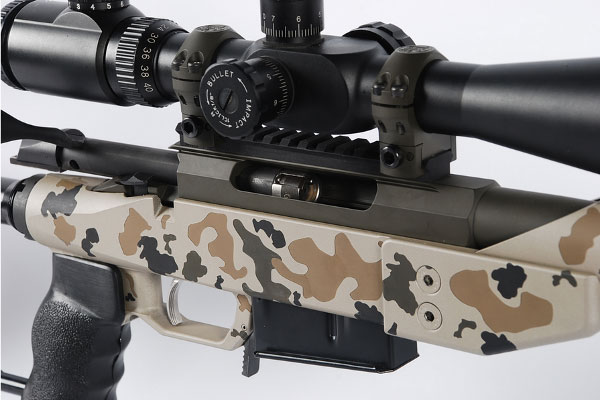
Here’s a Tikka T3 in Third Eye Tactical cerakoted chassis.
Rimfire Twin Target, for One-on-One Shooter Challenges
You’ll find this fun target on the third page of the Rimfire Target Pack. Just download the PDF file and instruct your printer to deliver page three. Or print out all six (6) rimfire targets if you like.
Share the post "GET FREE MIL or MOA Precision Targets Plus Rimfire Fun Targets"


 A benchrest or High Power shooter must operate from a designated shooting position. He must stay put and deal with the wind as it moves across the course, from whatever direction it blows.
 Benefits of Swivel Benches


 Five Shots in 0.178 MOA at 1000 Yards

 The Benefits of Dry-Fire Training

 Moore was summoned to Washington, DC on April 26, 1926 to meet President Calvin Coolidge. At the White House, President Coolidge met the young marksman and presented Moore with a gold medal. The engraving on the back reads: “Presented to L.S. Moore by the President of the United States [on] behalf of the National Rifle Association. Junior Rifle Corps World Record — 3000 — consecutive bullseyes.”


 If you want an even greater selection of targets, specialized for PRS and NRL shooters,