What’s the next best thing to a stockpile of gleaming, freshly-loaded ammo? How about a movie showing gleaming, freshly-loaded ammo being made — from start to finish? The five-minute video below shows the ammunition production process at the Lake City Army Ammunition Plant in Independence, Missouri. Lake City is the largest producer of small arms ammunition for the U.S. military, producing roughly four MILLION small-caliber rounds every day.
This promotional video does go overboard at times (too many smiling employees gushing about quality control). Still, it is fascinating to watch the process of creating cartridges — from the drawing (or extrusion) of raw brass into casings to the placement of projectiles and primers.
Quick History of Lake City Ammunition Plant Lake City Army Ammunition Plant (LCAAP) is a 3,935-acre government-owned, contractor-operated facility in Independence, Missouri that was established by Remington Arms in 1941 to manufacture and test small caliber ammunition for the U.S. Army. The facility has remained in continuous operation except for one 5-year period following World War II. Remington Arms operated the plant from its inception until 1985. Then Winchester took over the facility from 1985-2000.
Prior to its acquisition by Northrup Grumman in 2018, Orbital-ATK ran the plant since late 2000, initially as Alliant Techsystems (ATK). Recently Olin Corporation announced that its ammunition division, Olin Winchester, LLC, has been selected by the U.S. Army to operate and manage the Lake City Army Ammunition Plant for the next seven years — Winchester will assume full operational control of the Lake City plant on October 1, 2020.
The ammunition and reloading component producing divisions of Vista Outdoor will become a new separate company under the name “The Kenetic Group” with NYSE ticker symbol “HUNT”. The Kinetic Group enterprise will make and sell CCI, Federal, Remington (ammunition), Speer, and Hevi-Shot products. The establishment of The Kinetic Group will follow the planned spin-off of Vista Outdoor’s Outdoor Products operations. The Kinetic Group will continue Vista Outdoor’s Sporting Products sales and manufacturing.
Vista Outdoor Inc. (NYSE: VSTO), the parent company of 41 brands that design, manufacture and market sporting and outdoor lifestyle products worldwide, has announced its new name and identity that will be effective following the planned spinoff of Vista Outdoor’s Outdoor Products business.
“The Kinetic Group will be our name moving forward after the separation…” stated Sporting Products President and CEO Jason Vanderbrink. “To hunters and shooters, their favorite brand of ammunition will take center stage as it always has — they’ll look for CCI, Federal, HEVI-Shot, Remington, and Speer on the shelf, at events and online.”
Vista Outdoor will become The Kinetic Group, a name that represents the energy behind the company and its leading ammunition brands. The Kinetic Group will trade on the New York Stock Exchange (NYSO) under the stock ticker “HUNT”, and the brand will feature a North American ram logo. Sporting Products leaders unveiled The Kinetic Group’s branding this week at the CCI-Speer ammunition factory in Lewiston, Idaho.
“The performance of our products is so often measured in energy on target. Kinetic energy is the force behind our world-class brands and exhibits the spirit of the 4,500 American workers who represent our company,” said Vanderbrink, who will be a director on The Kinetic Group’s board of directors post-spin. Joining Vanderbrink on The Kinetic Group’s leadership team are Andy Keegan (CFO) and Jeff Ehrich (General Counsel and Corporate Secretary). Gary McArthur will continue as interim CEO of Vista Outdoor until the completion of the spinoff.
On the new TheKineticGroup.com website, the company explained its company mission:
“Energy is what propels us and inspires us. It defines our products, drives our purpose, and champions our freedoms. Our brands and products give us the ability to unlock freedom, harvest game, protect us, and unite us. Our thirst and our passion to capture and build upon this energy is never extinguished. We are America’s ammunition. We are The Kinetic Group.”
Share the post "Vista Outdoor Sporting Products Will Become The Kinetic Group"
Wouldn’t it be nice to have a print resource that has hundreds of true-size cartridge illustrations, plus technical descriptions of thousands of popular cartridge types? That could be a real time-saver. It’s no wonder this Ammo Encyclopedia book is an Amazon category best-seller.
If you’re a serious shooter, the latest 7th Edition of the Ammo Encyclopedia belongs in your library. This 928-page book by Charles Priore Jr. and Lisa Buening is probably the most comprehensive and up-to-date book in print covering current and classic cartridges and shotshells. The Ammo Encyclopedia is a massive resource work. The 7th Edition, released in October 2022, now boasts 100+ chapters, covering thousands of handgun, rifle, and shotgun cartridges. This 928-page softcover book sells for $44.42 on Amazon.
One of the best features is a full-color section depicting actual size drawings of over 300 current rimfire/centerfire cartridges and shotshells. You won’t find that many “life-size” cartridge drawings in one place even on the internet. Cartridge profiles and ballistic charts have been expanded to include many new factory cartridges. An expanded Trademark Index lists contact information for all current ammunition manufacturers.
For the 7th Edition, over 150 cartridge types have been added. And dozens of previously proprietary cartridges now have individual profiles. An expanded color section shows current centerfire, rimfire, and shotshell cartridges in full color. Plus updated Ballistic Tables provide muzzle velocity, dimensions, and page numbers for the corresponding cartridge profile pages.
Comments from guys who bought the book:
“[The Ammo Encyclopedia is] better than Cartridges of the World. Much better editing and more accurate.” — John Guibert
“The amount and depth of detail provided is beyond impressive. An enormous amount of time and thought went into this latest version of the Ammo Encyclopedia.” — BW Kreisler
“I have many books on firearms and ammunition acculmulated over a few decades. This is by far the best and most comprehensive book on ammunition that I have ever seen. It is a must have reference source for everthing ammunition whether for current or obsolete and the history behind them.” – Eric
Share the post "Ammo Encyclopedia 7th Ed. — Over 300 Cartridge Illustrations"
Wouldn’t it be nice to have a print resource at your fingertips that has hundreds of true-size cartridge illustrations, plus technical descriptions of thousands of popular cartridge types? That could be a real time-saver. It’s no wonder this book is an Amazon category best-seller.
If you’re a serious shooter, the latest 7th Edition of the Ammo Encyclopedia belongs in your library. Released in late 2022, this 928-page book is probably the most comprehensive and up-to-date book in print covering current and obsolete cartridge and shotshell types. The Ammo Encyclopedia is a massive resource work with 100+ chapters, covering thousands of handgun, rifle, and shotgun cartridges from the past century and a half. This 928-page edition includes over 150 new cartridge profiles. An expanded Trademark Index lists contact information for all current ammunition manufacturers.
One of the best features is a full-color section with actual size drawings of over 320 current rimfire/centerfire cartridges and shotshells. You won’t find that many “life-size” cartridge drawings in one place even on the internet. Cartridge profiles and ballistic charts have been expanded to include many new factory cartridges. An updated Cartridge Index lists both the standard and alternate names for each cartridge in chronological order. The authors have even included air rifle pellets and historical images and charts. This 928-page softcover book is now $44.93 on Amazon.
Comments from guys who bought the book:
“This book contains a vast array of information on many modern and even obsolete ammunition. Definitely recommend for any modern reloader novice or experienced.” – Duggaboy460
“It’s a great reference book for individuals who reload their own ammunition. There is a lot more info in this Edition. Everyone who likes this information should have it in their library.” – Reloader
“I like the general and technical comments that are available for each and every cartridge. Information that predicts if a cartridge will stay in production for many more years or rapidly become obsolete.” – RSL1
Share the post "Ammo Encyclopedia 7th Edition — Great Resource for Shooters"
The shooting season is now in full swing. When you head to the range you’ll want to be prepared. That means collecting all the gear you’ll need at the range. It’s easy to forget small, critical items, so we’ve provided a checklist of the small “extras” you should pack before you head out to the range. In addition to rifle, rests, ammo, targets, and cleaning gear, here are a dozen essentials you should include in your range bag.
• Shell-Holder — If you don’t have calipers, you can use a shell-holder to check for excessive case expansion from hot loads. If a fired case doesn’t slip into the shell-holder easily, your load is definitely TOO HOT.
• Extra Earplugs — Always use ear protection when shooting. We bring a 35mm film canister with extra sets of foam earplugs.
• Hex Wrench or Screwdriver for action screws — Action screws can work loose with time. Always bring the appropriate hex wrench or screwdriver whenever you go to the range.
• Small Wrench for Scope Rings — Check the tension of your scope base and ring fasteners before you go. Bring along a small Torx wrench for the ring screws (or other tool that fits your fasteners).
• Normal and Under-sized Jags — It is often wise to use one-caliber undersize jags when applying solvent with cotton patches. You should have a couple sizes in your range kit.
• Extra Batteries — Bring extra batteries for all your electronic gear — which can include chronograph, windmeter, digital camera, GPS etc.
• Small Notebook and Pen or Pencil — Use the notebook to record chron data, log group sizes, and make notes about wind and weather conditions.
• Adhesive dots — Bring a few sheets of adhesive dots (sold at office supply stores). Use small white or black dots as target pasters. Use larger red or orange dots as aiming points (target centers).
• Folding Chair or Camp Stool — This comes in handy if you’re spotting for another shooter, or if you reload away from the firing line.
• Water Bottle — You can’t shoot well if you’re dehydrated. Bring at least two quarts of water with you and keep a bottle at the bench.
• Surveyors’ Tape and Wood Stakes — You can make inexpensive wind indicators using surveyors’ tape attached to the top of wood stakes.
• Small Plastic Ruler — Use this to measure your group sizes. A transparent (see-through) ruler works best. Rulers are also useful for drawing lines on targets.
This list is not intended to be exclusive. There are many other items you may wish to include. Obviously bring safety glasses, and Sharpie-type pens are always handy to mark targets. We invite our readers to add other “essentials” to the list. The important thing is to plan ahead, packing your key items before you drive to the range.
Share the post "A Dozen Very Useful Items to Include in Your Range Kit"
SSG Greg Markowski of the USAMU at Camp Perry, Ohio.*
The U.S. Army Marksmanship Unit (USAMU) fields pistol teams as well as rifle and shotgun competition squads. Consequently the USAMU’s Reloading Shop loads tens of thousands of pistol rounds every year. In this article, the USAMU’s handgun experts talk about reloading for handguns — with smart tips on how to achieve superior accuracy with 100% reliability. This article, which offers important insights on COAL, primers, crimps and more.
This video shows .45 ACP centerfire pistol competitors at Camp Perry
Precision Pistol Reloading — Recommended Methods
Optimize the Taper Crimp
One often-overlooked aspect of handloading highly-accurate pistol ammunition is the amount of crimp and its effect on accuracy. Different amounts of taper crimp are used with various handloads to obtain best accuracy. The amount is based on bullet weight, powder burn rate and charge, plus other factors. It is not unusual for our Shop to vary a load’s crimp in degrees of 0.001″ and re-test for finest accuracy.
Use Consistent Brass
Brass is also important to pistol accuracy. While accurate ammunition can be loaded using brass of mixed parentage, that is not conducive to finest results, particularly at 50 yards. It is important for the serious competitor/handloader to use brass of the same headstamp and ideally one lot number, to maximize uniformity. Given the volumes of ammunition consumed by active pistol competitors, using inexpensive, mixed surplus brass for practice, particularly at the “short line” (25 yards), is understandable. However [at 50 yards], purchasing and segregating a lot of high-quality brass to be used strictly for slow-fire is a wise idea.
Importance of Uniform COAL
Uniformity of the Case Overall Length (COAL) as it comes from the factory is also important to achieving utmost accuracy. More uniform case lengths (best measured after sizing) contribute to greater consistency of crimp, neck tension, ignition/burn of powder charge, and so on. Cartridge case-length consistency varies from lot to lot, as well as by maker. Some manufacturers are more consistent in this dimension than others. [Editor’s note: It is easy to trim pistol brass to uniform length. Doing this will make your taper crimps much more consistent.]
Primers and Powders — Comparison Test for Accuracy
Pay attention to primer brands, powder types and charges. Evaluating accuracy with a Ransom or other machine rest at 50 yards can quickly reveal the effect of changes made to handload recipes.
Bullet Selection — FMJ vs. JHP
Bullets are another vital issue. First, there is the question of FMJ vs. JHP. A friend of this writer spent decades making and accuracy-testing rifle and pistol bullets during QC for a major bullet manufacturer. In his experience, making highly-accurate FMJ bullets is much more difficult than making highly-accurate JHPs, in large part due to the way the jackets are formed. Small die changes could affect accuracy of FMJ lots dramatically. The CMP now allows “safe, jacketed ammunition” in Excellence-in-Competition (EIC) Service Pistol matches, although wadcutter ammunition is prohibited. Thus, the option to use very accurate JHP designs simplifies the life of CMP Service Pistol shooters in pursuit of the prestigious Distinguished Pistol Shot badge.
Hopefully, these tips will be helpful to any pistol shooters interested in accurate handloads, not just “Bullseye” shooters. Small tweaks to one’s normal routine can pay big dividends in improved accuracy and make practice and competition more rewarding. Stay safe, and good shooting!
TOP IMAGE: SSG Greg Markowski, a shooter/instructor with the USAMU, fires his pistol during the 2018 Civilian Marksmanship Program’s National Pistol Matches at Camp Perry, Ohio. At that event, Markowski claimed the General Mellon Trophy, General Patton Trophy and the General Custer Trophy. U.S. Army photo by Maj. Michelle Lunato/released by Defense Visual Information Distribution Service.
Share the post "Precision Reloading for Competition Pistols — Tips from USAMU"
What’s the next best thing to a stockpile of gleaming, freshly-loaded ammo? How about a movie showing gleaming, freshly-loaded ammo being made — from start to finish? The five-minute video below shows the ammunition production process at the Lake City Army Ammunition Plant in Independence, Missouri. Lake City is the largest producer of small arms ammunition for the U.S. military, producing roughly four MILLION small-caliber rounds every day.
This promotional video does go overboard at times (too many smiling employees gushing about quality control). Still, it is fascinating to watch the process of creating cartridges — from the drawing (or extrusion) of raw brass into casings to the placement of projectiles and primers.
Quick History of Lake City Ammunition Plant Lake City Army Ammunition Plant (LCAAP) is a 3,935-acre government-owned, contractor-operated facility in Independence, Missouri that was established by Remington Arms in 1941 to manufacture and test small caliber ammunition for the U.S. Army. The facility has remained in continuous operation except for one 5-year period following World War II. Remington Arms operated the plant from its inception until 1985. Then Winchester took over the facility from 1985-2000.
Prior to its acquisition by Northrup Grumman in 2018, Orbital-ATK ran the plant since late 2000, initially as Alliant Techsystems (ATK). Recently Olin Corporation announced that its ammunition division, Olin Winchester, LLC, has been selected by the U.S. Army to operate and manage the Lake City Army Ammunition Plant for the next seven years — Winchester will assume full operational control of the Lake City plant on October 1, 2020.
Guys — honestly, if you do anything today on this site, watch this video. You won’t be disappointed. Guaranteed. This is a very informative (and surprisingly entertaining) video. Every serious hand-loader should watch this video to see how cartridge cases are made. Your Editor has watched the video 5 times now and I still find it fascinating. The camera work and editing are excellent — there are many close-ups revealing key processes such as annealing and head-stamping.
VERY Informative Video Show Cartridge Brass and Ammunition Production:
Norma has released a fascinating video showing how bullet, brass, and ammunition are produced at the Norma Precision AB factory which first opened in 1902. You can see how cartridges are made starting with brass disks, then formed into shape through a series of processes, including “hitting [the cup] with a 30-ton hammer”. After annealing (shown at 0:08″), samples from every batch of brass are analyzed (at multiple points along the case length) to check metal grain structure and hardness. Before packing, each case is visually inspected by a human being (3:27″ time-mark).
The video also shows how bullets are made from jackets and lead cores. Finally, you can watch the loading machines that fill cases with powder, seat the bullets, and then transport the loaded rounds to the packing system. In his enthusiasm, the reporter/narrator does sometimes confuse the term “bullets” and “rounds” (5:00″), but you can figure out what he means. We definitely recommend watching this video. It’s fascinating to see 110-year-old sorting devices on the assembly line right next to state-of-the art, digitally-controlled production machinery.
Video tip by EdLongrange. We welcome reader submissions.
Share the post "How Cartridge Brass (and Bullets) Are Made — Great Norma Video"
With ammunition in short supply these days, we know ammo production is on people’s minds. Top industry leaders have said the USA will face ammo shortages well into 2021. So ammo-makers big and small are ramping up production to meet demand. If you’re curious how ammunition is created on the assembly by a relatively small, speciality manufacturer, watch the video below to see the entire process, start to finish.
This video from Fog Ammunition reveals how .223 Rem ammo is made. Starting with boxes of bullets and bags of cartridge brass, this video shows how components are bulk-sorted, then .223 Rem ammunition is produced on a modern, linear multi-stage loading machine. In assembly-line fashion, cases are primed, powder is added, bullets are placed, final seating depth is set, and then the case is crimped.
If you’ve never seen an automated loader in action you should definitely watch this video. With this kind of machine, a new round is produced every second or so (see video 1:15 to 1:55). The .223 Remington ammunition featured in this video is loaded with Sierra BlitzKing bullets. Fog offers both rifle and pistol ammo loaded with quality components.
Video Shows Automated Loading Process Start to Finish (Worth Watching):
Remember when primers were plentiful and priced affordably?
Share the post "How .223 Remington Ammunition Is Made — Production Video"
Here’s the good news — loaded ammunition is starting to appear at gun stores again, where shelves were once bare. Here’s the bad news — prices are still WAY higher than they were a couple years ago. High demand and production issues related to the Pandemic continue to create shortages so prices are high. Plus the cost of components, copper in particular is up. That means ammo costs are definitely high. And demand is also driven by new gun owners: “NSSF estimates that 8.4 million people bought a firearm for the first time in 2020. That’s 40 percent of all purchases.” (Source: NSSF.org)
Given the continuing ammo supply shortage, you need to be a smart shopper (particularly when looking for 9mm, .40 SW, .45 ACP and .22 LR ammo). That’s where this article should help. We explain how to use the AmmoSeek website to find the best current prices at dozens of vendors. With AmmoSeek, you can quickly search for dozens of different ammo types, including .22 LR, 9mm, .40 SW, .223 Rem, 6.5 Creedmoor, and other popular cartridges. However prices remain considerably higher than in 2019.
Find All Types of Ammunition Fast with AmmoSeek.com
AmmoSeek.com monitors dozens of online vendors — checking current pricing and available inventory, for pistol, rifle, and shotgun ammunition. Looking for .22 LR ammo for your rimfire trainer or .45 ACP ammo for your 1911? Just select the cartridge type from AmmoSeek’s “Quick Seek” menu. Likewise you can find .223 Rem and .308 Win Rifle ammo with just one click.
9mm Ammo in Stock Now
And here are the 7/1/2021 search results for 9mm Luger (9x19mm) ammunition, the #1 most desired pistol ammo right now. Shown below are the first 8 of the 400+ entries, starting with the least expensive (click image to get latest update):
LAMENT: These prices are depressingly high. Not that long ago, you could get a 50-round box of CCI Blazer or Sellier & Bellot 9mm ammo for under $10.00/box. Now a “good deal” is over three times that price — and some places are now charging $50.00 for 50 rounds — FIVE times the price.
.223 Rem Ammo in Stock Now
And here are this morning’s results for .223 Rem ammunition. You can get significant savings by buying in bulk, that’s for sure. CLICK HERE for latest update.
.22 LR Rimfire Ammo in Stock Now
And here are recent results for .22 LR rimfire ammunition. There are often supplies of .22 LR at major vendors such as Brownells and Midsouth, but it sells out quickly so you need to check often. Brownells does have .22 LR Winchester Super-X in 100rd boxes in stock right now. The price, $13.99/100rds, is pretty good (these days), and you get $30 Off $300 and free shipping with Code FJ3.
These results are from 7/1/2021 in the morning. CLICK HERE to get the latest updates.
Share the post "Find Best Deals on Loaded Ammo with AmmoSeek"
For the past three weeks, the most-read article on the Daily Bulletin has been a discussion of how ammo/reloading component shortages will persist well into 2021. So we know you guys are concerned about finding ammunition. With demand pushed by widespread worries over social unrest and the prospects of radical gun control laws, Ammo is definitely in short supply. The high demand is also driven by new gun owners: “NSSF estimates that 8.4 million people bought a firearm for the first time in 2020. That’s 40 percent of all purchases.” (Source: NSSF.org)
Certain types of ammunition are in short supply — particularly 9mm pistol ammo, .40 SW, and 12-gauge shotshells. And even .22 LR ammo is becoming harder to find, so you may want to stock up. Thankfully, if you shop around a bit, you can still find most types of defensive ammunition and .22 LR rimfire ammo, though prices are considerably higher than in 2019.
Find All Types of Ammunition Fast with AmmoSeek.com
Here’s a great search service that can help you locate hard-to-find ammunition and reloading components — while saving money in the process. AmmoSeek.com monitors dozens of online vendors — checking current pricing and available inventory, for pistol, rifle, and shotgun ammunition. Looking for .22 LR ammo for your rimfire trainer or .45 acp ammo for your 1911? Just select the cartridge type from AmmoSeek’s “Quick Seek” menu. Likewise you can find .223 Rem and .308 Win Rifle ammo with just one click.
9mm Ammo in Stock Now
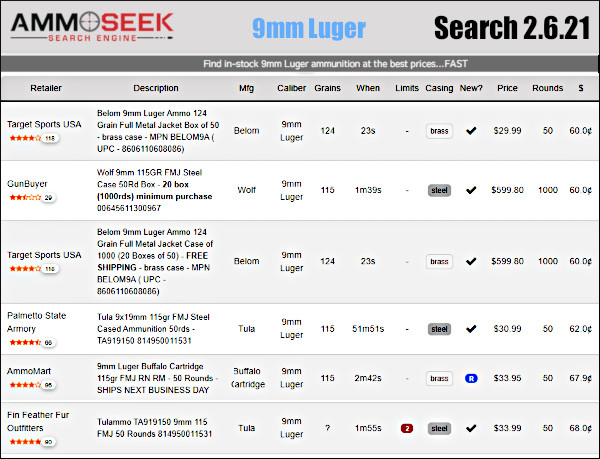
And here are the 2/6/2021 search results for 9mm Luger (9x19mm) ammunition, the #1 most desired pistol ammo right now. These are five of the 406 entries, starting with the least expensive (click image to get latest update):
LAMENT: These prices are depressingly high. Not that long ago, you could get a 50-round box of CCI Blazer or Sellier & Bellot 9mm ammo for under $10.00/box. Now a “good deal” is three times that price — and some places are charging $60.00 for 50 rounds — SIX times the price.
.223 Rem Ammo in Stock Now
And here are this morning’s results for .223 Rem ammunition. You can get significant savings by buying in bulk, that’s for sure. CLICK HERE for latest update.
.22 LR Rimfire Ammo in Stock Now
And here are recent results for .22 LR rimfire ammunition. There are often supplies of .22 LR at major vendors such as MidwayUSA and Midsouth, but it sells out quickly so you need to check often.
These results are from 2/6/2021 in the morning. CLICK HERE to get the latest updates.
Share the post "How to Find Ammunition Supplies Using AmmoSeek.com"
With ammunition in short supply these days, we know ammo production is on people’s minds. Top industry leaders have said the USA will face ammo shortages well into 2021. So ammo-makers big and small are ramping up production to meet demand. If you’re curious how ammunition is created on the assembly by a relatively small, speciality manufacturer, watch the video below to see the entire process, start to finish.
This video from Fog Ammunition reveals how .223 Rem ammo is made. Starting with boxes of bullets and bags of cartridge brass, this video shows how components are bulk-sorted, then .223 Rem ammunition is produced on a modern, linear multi-stage loading machine. In assembly-line fashion, cases are primed, powder is added, bullets are placed, final seating depth is set, and then the case is crimped.
If you’ve never seen an automated loader in action you should definitely watch this video. With this kind of machine, a new round is produced every second or so (see video 1:15 to 1:55). The .223 Remington ammunition featured in this video is loaded with Sierra BlitzKing bullets. Fog offers both rifle and pistol ammo loaded with quality components.
Video Shows Automated Loading Process Start to Finish (Worth Watching):
Remember when primers were plentiful and priced affordably?
Share the post "Watch .223 Rem Ammo Being Made on Multi-Stage Machine"


 What’s the next best thing to a stockpile of gleaming, freshly-loaded ammo? How about a movie showing gleaming, freshly-loaded ammo being made — from start to finish? The five-minute video below shows the ammunition production process at the Lake City Army Ammunition Plant in Independence, Missouri. Lake City is the largest producer of small arms ammunition for the U.S. military, producing roughly four MILLION small-caliber rounds every day.


 The shooting season is now in full swing. When you head to the range you’ll want to be prepared. That means collecting all the gear you’ll need at the range. It’s easy to forget small, critical items, so we’ve provided a checklist of the small “extras” you should pack before you head out to the range. In addition to rifle, rests, ammo, targets, and cleaning gear, here are a dozen essentials you should include in your range bag.
 • Shell-Holder — If you don’t have calipers, you can use a shell-holder to check for excessive case expansion from hot loads. If a fired case doesn’t slip into the shell-holder easily, your load is definitely TOO HOT.
 • Hex Wrench or Screwdriver for action screws — Action screws can work loose with time. Always bring the appropriate hex wrench or screwdriver whenever you go to the range.
 • Extra Batteries — Bring extra batteries for all your electronic gear — which can include chronograph, windmeter, digital camera, GPS etc.
 • Folding Chair or Camp Stool — This comes in handy if you’re spotting for another shooter, or if you reload away from the firing line.
 • Small Plastic Ruler — Use this to measure your group sizes. A transparent (see-through) ruler works best. Rulers are also useful for drawing lines on targets.


 Use Consistent Brass
 Norma has released a fascinating video showing how bullet, brass, and ammunition are produced at the