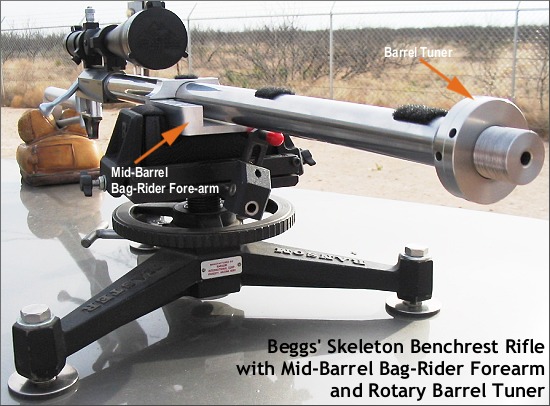
Gene Beggs is a Texas shooter and gunsmith known for “out of the box” thinking. He has successfully pioneered the 220 Beggs and 6mm Beggs cartridges in BR competition, and has developed radical new rifle designs and tuners at his West Texas research facility (with a 100-yard indoor shooting tunnel). Recently Beggs has tackled the challenge of indexing centerfire barrels. It looks like he has engineered a workable solution that will allow shooters to index their barrels without altering the critical headspace dimension. If this really works, Gene has come up with an important new gunsmithing procedure with the potential to enhance accuracy for a wide variety of firearms.
Barrel Indexing Basics
Barrel Indexing is a procedure for optimizing the rotational position of a barrel relative to the action. With a conventional barrel installation, if you were to put a mark on the outside of a barrel and then screw the barrel into the action, that mark might end up at at 12 o’clock, or 6 o’clock or pretty much any position on the “clock-face”, depending on where the shoulder is cut on the barrel. When the shoulder butts up against the face of the action (or recoil lug), you can’t screw the barrel in any farther. At that point, the barrel’s rotational position is fixed and can’t be changed without altering headspace.
Tests with rimfire barrels suggest that careful barrel indexing can produce accuracy gains. We’re not quite sure why — there are different theories — but it has been clearly demonstrated that by rotating the barrel relative to TDC (top dead center) on the action, you can move bullet point of impact quite dramatically. On rimfire barrels machined with a cone breech and secured with a barrel block system (as on an Anschutz 2000-series action), gunsmiths such as Mike Ross have been able to easily experiment with index positions. CLICK HERE for Mike Ross Indexing Tests.
But indexing centerfire barrels has been a challenge. You can use shims to adjust the barrel’s index position relative to action TDC, but this moves the shoulder in and out, effectively altering headspace by the width of the shims used.
Is there a way to index a centerfire barrel without changing the headspace? Texas Benchrest shooter and gunsmith Gene Beggs thinks he has the answer.
The Beggs Barrel Indexing Solution
With a conventional barrel installation, the action/receiver has an internal female thread. The threaded breech end of the barrel, or tenon, has a male thread. The barrel simply screws in until its rotation is stopped (and index position fixed) when the shoulder hits the action face or recoil lug.
Beggs has come up with an ingenious solution using an intermediary threaded bushing that fits between the action thread and the tenon threads. The barrel tenon is reduced in diameter slightly and re-threaded to mate with the inner bushing. This inner bushing is shorter than the receiver threads so it can be adjusted inwards and outwards. Its position is fixed with a set-screw. The effect of moving the inner sleeve inwards and outwards is to change the index position at which the barrel tenon threads start to “grab” as they are spun inwards. Set the inner sleeve at one position, and the tenon threads may start contact at 6 o’clock for example. Rotate the inner sleeve a half-turn and the threads will start at 12 o’clock.
Now, as you continue to screw the barrel inwards, it will still stop when the shoulder hits metal — so headspace is always the same. But…and this is the key point, the barrel’s rotational index position will vary depending on the position of the inner bushing. By adjusting the bushing position, you control where the barrel’s threads start to “connect”. The result is that the rotational orientation of the barrel can be indexed at any point on the dial.
Boyd Allen has given this example which may help readers visualize things: “Think of a slot-head machine screw being tightened till it bottoms. The final orientation of the slot after tightening depends on where it picks up the first thread of the threaded hole. If the hole itself is rotated then the final position of the slot, relative to the viewer, will be rotated by a similar amount. Screw a slot-head machine screw all the way into a nut. Now turn the nut. The slot rotates with it.”
System Slated for Production
Gene Beggs is excited about the new indexing system and plans to create a kit that can be used by gunsmiths. Gene writes:
“Inserted in between the action threads and the barrel tenon is a bushing that can be adjusted fore and aft in the action. This makes it possible for the barrel tenon shoulder to contact the receiver face at any position of the clock. Of course, the barrel tenon must be turned down and threaded to match the inside threads of the bushing. A small stainless steel set screw now holds the bushing securely in place. Adjustments are quick, easy and secure.
I spent two days in the tunnel testing the system. The test rifle is a Cobra sporter chambered in 6mm Beggs stocked with one of my Ultralite aluminum stocks. Barrel torque was rechecked each time the barrel was re-indexed and never seemed to loosen up. The sweet spot was found on the second adjustment at the six o’clock position. After a couple of days of testing, I now have complete confidence in the rifle and indexing system. Unless problems arise, we will soon be tooling up and producing kits which will require gunsmith installation.”
For more information on the Beggs Indexing system, email Gene at genebeggs [at] cableone.net, or call (432) 631-5124, or (432) 367-0329.
Czech arms-maker CZ produces a popular range of accurate, yet affordable rimfire and centerfire rifles. The CZ 452, in various versions, is one of the best rimfire bolt-actions under $400.00 retail. The 22LR version is favored by many club-level silhouette shooters, and is an excellent youth rifle. Model 452s chambered in 17 Mach 2 or 17 HMR also make excellent varminters. Typical model 452 “Street Price” is about $375.00.
Model 527 — Mini-Mauser Action Ideal for .223-sized Cartridges
For centerfire shooters, CZ’s Model 527 has won more awards in the “light rifle” category in Europe than any other rifle…ever. Designed to fit small-base calibers perfectly, the CZ 527 is a true micro-length Mauser style action, with detachable magazine, hammer forged barrel and single set trigger. CZ offers various versions of the 527 chambered in .17 Remington, .221 Fireball, .22 Hornet, .222 Remington, .223 Remington, and .204 Ruger.
New Chambering for Model 527? Vote for Your Choice!
CZ-USA is now conducting a poll, asking website visitors to help choose a new chambering for the Model 527. It looks like CZ has done its homework. We were surprised to see that the “candidates” include popular wildcat cartridges like the 20 VarTarg and 20 Tactical, plus the excellent 6.5 Grendel. Most large manufacturers don’t even know these chamberings exist, much less consider offering them. We wish CZ-USA would also consider the .223 Rem necked down to 20 caliber (aka the “20 Practical”). It does everything the 20 Tactical does, with no special dies needed.
Is an FFL required to ship a long gun out of state? Can you use the U.S. Mail to ship firearms? Can you ship guns directly to a manufacturer for repairs?
Answers to these and many other questions are provided in the Firearms Shipping Guide created by Gunbroker.com, the leading online firearms auction site. The article does a decent job summarizing applicable Federal law and includes handy links to the statutes themselves so you can read them word for word.
We find that folks are often confused between the rules for handguns and long guns. Handguns may NEVER be shipped through the U.S. Mails unless you are an FFL holder. By contrast, a “civilian” (i.e. non license-holder) CAN ship a rifle or shotgun via the U.S. Postal Service. In fact the USPS may be the most economical and reliable shipping choice for long guns these days.
Another common misconception is that you need the services of an FFL for outbound shipping of a firearm. While placing your outbound shipment in the hands of an FFL-holder can have some benefits, if the recipient is a valid Federal FFL, and you have received a copy of his license for verification, you CAN ship a long gun yourself to the address on the license. You can also ship a handgun directly to an FFL holder (or the manufacture for repair), but you must use a common carrier such as FEDEX or UPS. (Only a licensed manufacturer, dealer, or importer can legally ship a handgun via the US Post Office.)
48″ MidwayUSA ‘Quick Ship’ Box, #897166, $15.99. A foam-lined double-cardboard box offers some protection for your firearm. But we recommend you put valuable pistols and long guns in a sturdy plastic or metal hard case, INSIDE a cardboard shipping container. Make sure the contents can’t move around inside the box. Always insure for full replacement value (including tax and transfer fees). Photograph the gun BEFORE it’s shipped so you can document its original condition should it arrived damaged.
Tony Boyer dominated the recent NBRSA Nationals, winning the 4-Gun, 3-Gun, and 2-Gun (LV/Sporter) Overalls, and finishing first in other events. While Boyer’s win was proof of his superior wind-reading and trigger-pulling skills, his equipment didn’t hurt. Boyer was shooting Bartlein gain twist, cut-rifled barrels. These barrels featured a twist rate that increased from 1:15″ to 1:14.25″. Notably, Wayne Campbell and Mike Ratigan, the second-place and third-place finishers in the 4-Gun, were also using Bartlein cut-rifled barrels (twist rate unknown). This was an impressive showing for Bartlein. It also shows that cut-rifled barrels are becoming the “go-to” choice in short-range benchrest, with both Bartlein and Krieger barrels displaying match-winning performance.
Frank Green of Bartlein Barrels told us: “Wayne Campbell did all the barrel fittings for Tony Boyer before Phoenix (NBRSA Nationals) and Kelbly’s (IBS 100/200 Nationals). I know Dwight Scott does work for Tony but not all of it. At Phoenix, Tony Boyer shot all gain-twist-type barrels (in every class). His barrels went from a 15 to a 14.25 twist. At Kelbly’s (the IBS 100/200 Nationals) right before Labor Day, Tony only had gain-twist barrels for his Heavy Varmint, and he proceeded to cream the HV class. At Kelbly’s, Boyer won HV 100 yards, HV 200 and HV Grand Aggregate with a .169 combined Agg.
At Phoenix, Boyer won the Unlimited 100, Unlimited Grand, LV grand, LV/sporter 2 gun, LV/sporter/HV 3 gun, and the Unlimited, LV, Sporter, HV 4 gun. This added up to 11 Hall of Fame points for Tony. In 4-Gun, Wayne Campbell came in second, and Ratigan came in third. In the 3-gun results it was Boyer and Campbell, first and second (both using Bartleins). In 2-Gun it was Boyer, Ratigan, Rodney Brown, and Campbell in that order. All of these we know for sure shot our barrels.”
Here’s an cool new product from Jack Snyder, maker of Edgewood Shooting Bags. The new Grab-Handle Rear Bag (available in both “original” and Mini-Gator sizes from Sinclair Int’l), is unique — the super-thick leather base of the sandbag is extended, forming a grab handle. This has two big benefits. First, of course, the bag is easier to carry. Second the extended leather bottom also helps the bag stay in place. Edgewood first made a few of these grab-handle bags at the request of F-Class shooters. The smart design works well — the handle makes the bag easier to carry to the firing line, and the larger footprint makes the bag more stable when shooting off the ground. These would be excellent bags for varmint hunters who move to new firing points frequently. Sinclair Int’l prices Grab-Handle Bags at $119.95 for standard, and $145.00 for the larger, Mini-Gator size.
Elbow Pad and Brick Bag
In addition to the Grab Handle rear bags, Sinclair has added two useful, leather bench accessories from Edgewood: an Elbow Pad and a 7.5″x5″ Hand rest. The $49.70 Edgewood Elbow Pad (item 04-7550) features a sand-filled, U-shaped outer leather collar, non-skid bottom, and stitched nylon center insert. These pads not only cushion your elbow on rough concrete benches, but they help you maintain the same exact body position for each shot. That, in turn, helps you shoot more accurately.
Edgewood’s hand rest (also called a brick bag) is excellent for resting your hand or wrist. It can also work as an elbow bag. The hand rest ($46.95, item 04-7590) is made from high-quality grained leather with a stiff, double-layer bottom so it sits flat. It has the new bottom-pocket tabbed fill tube. This bag is 7.5″ long, 5” wide, and 2.75” tall — but you can adjust height by the amount of sand fill. If you use it as an elbow pad, you may want to try it about 70% full so it “form-fits” to your elbow.
Taran Butler, Bruce Piatt and Jerry Miculek claimed national titles at the U.S. Practical Shooting Association (USPSA) Multi-Gun Championships held October 3-5 at the Shootout Range in Princeton, Louisiana. The match drew nearly 120 competitors from 28 states. In Multi-Gun matches, shooters tackle multiple, timed stages, using pistol, rifle and shotgun to engage a variety of paper, steel and moving targets. Matches often require competitors to use all three types of firearms on a single stage. Showcasing remarkable shooter skills (and fast reflexes), Multi-Gun (i.e. “3-Gun”) matches are exciting to watch. Below is a video of USAMU team members at the 2007 USPSA Multi-Gun Nationals:
Nat’l Championship Results
In the Tactical Division, Taran Butler of Simi Valley, California dominated the match, winning five of the 12 stages and leading in overall points on eight. In the end his overall score of 1279.9417 outpaced second place shooter and fellow Golden State resident Keith Garcia of San Ramon by almost 77 points. Butler previously won the Tactical Division in 2006.
Team Smith & Wesson member Jerry Miculek, shooting on his home range, defended his 2007 win by again taking the Open Division title, this time by more than 24 points with a final score of 1278.0090. Miculek won five of the 12 stages and led the field over nine of them. Great Shooting Jerry! Chris Tilley finished second in the Open Division with a score of 1253.6155 edging out the 2006 champion Michael Voigt of Chino, California by just over two points. The Limited Division title went to Bruce Piatt of Montvale, New Jersey, who won by more than 41 points with a final score of 1302.0291. Piatt held the lead on eight stages winning three of them.
About USPSA: The United States Practical Shooting Association is a non-profit membership association and the governing body for the sport of Practical Shooting in America. USPSA has over 17,000 members and more than 350 affiliated clubs. Visit www.uspsa.org.
Sierra has a new 155gr Palma bullet, and it’s a winner. The new 155gr MatchKing bullet, featuring a longer ogive and factory-pointed meplats, was used by Team USA at the recent Spirit of America match. According to many team shooters and coach Emil Praslick III, the new bullet helped the American team achieve an impressive victory over arch-rival England and other national squads.
Matt Reams of Sierra Bullets confirmed that the new bullet, Sierra part # 2156, will shortly enter full-scale production. Sierra is planning a late-December 2008 release date, but Matt says “first week of 2009 should be a safe bet.” The bullets will be priced “roughly 5% higher than current Sierra 155gr MatchKings”, according to Matt.
Sierra worked closely with Team USA on the design of the new bullet. Dennis Flaharty, USA Palma Captain, tells us: “We worked very closely with the people at Sierra and they really came up with a winner. We tested several prototypes before we settled on this one. Each one better than the next. This bullet has a lot going for it. I honestly believe that we managed many 10s that would have been 9s. This bullet gave the consistent and high degree of accuracy you have come to expect from Sierra. As compared to other bullets Sierra has a reputation for being ‘forgiving’. By this I mean you can shoot them in the lands or off. We tested this bullet from +0.010 into the lands to -0.100 off.”
Bullet Design Features and Factory Meplat Pointing
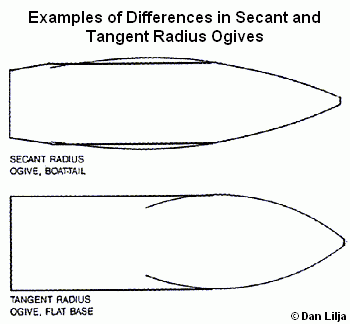
The new bullet is a conventional tangent ogive design, not a secant ogive VLD-style. However, the new bullet has a longer ogive (curved section) than Sierra’s current 155gr MatchKing. It also has a somewhat shorter bearing surface. Most importantly, the meplats on the new 155s will be pointed up on a special extra die used for the final stage of bullet manufacturing. Currently, many reloaders are using the Whidden Pointing Die System to point up their bullets. (Photo at left shows a 107gr MatchKing pointed with the Whidden Die.) Many tests, including our own research done by Jason Baney, prove that bullet-pointing has real benefits. First, pointing the meplats reduces bullet-to-bullet BC variation. This can help tighten vertical spread at long range. Second, bullet-pointing can also reduce drag, effectively increasing average bullet BC. The result is a bullet with less drop at long range, and less wind drift (all other factors being constant). In Jason’s tests, pointed Clinch River 106gr bullets impacted 18″ higher at 1000 yards than non-pointed bullets from the same lot. That’s dramatic evidence that meplat-pointing enhances BC.
Higher BC Predicted by Actual Match Results
Sierra has not yet completed field-testing to determine the ballistics of the new 155gr MatchKing, so no official BC has been released. Matt Reams noted: “We will not release a BC until comprehensive field tests are complete. At Sierra we don’t ‘guesstimate’. Our BC numbers are based on real-world testing.” Nonetheless, Sierra’s bullet testers and USA Palma team members are telling us that the new bullet definitely impacts higher than the old Sierra Palma bullet when driven at the same velocity. This was observed during the Spirit of America match, and is a sure sign that the new bullet has less drag and a higher effective BC. Team members also believe that the new bullet exhibits less wind drift than the previous 155gr MatchKing:
“As one of the line coaches on the American teams at SOA, I witnessed first-hand the difference between the old and new green box 155s. On practice/warm-up day before the team matches we tested the new bullet against the old bullet at 1K to get elevation zeroes on the new bullet. What we saw was the new 155 printed two (2) MOA higher at 1000 yards than the old bullet with the only difference being the bullet…. In my opinion, the new bullet was at least a minute inside of the old bullet at 1K.” — Steve Hardin
Palma Shooters Praise New ‘Top-Secret’ 155gr MatchKing
In the wake of Team USA’s big win at Spirit of America, many members of the USA Palma Team have commented on the impressive performance of the new bullet. You can read their testimonials in THIS THREAD on the Long-Range.com Forum (registration required to access Forum). Team Coach Emil Praslick III had this to say:
“Sierra was very responsive to the US Team’s request that [Sierra] come up with a new design for a 155 grain projectile. After testing a few prototypes designed by the smart guys at Sierra (mainly Pat Daly) we settled on one that seemed to be a good compromise between an efficient design, and a bullet that would shoot well out of a variety of barrels and chambers. Through testing and practice, we have found that the bullet shoots well into the lands, as well as off. One rifle tested jumped them .050″ with good results!
The bullet QC is excellent, and it definitely does shoot. During the team matches at SOA, I felt that the bullet was well inside the other bullets being shot on the line, but as a coach, I am much more concerned with accuracy over chasing a BC ‘magic number’…. The inherent accuracy of the new bullet is what has sold me on it.
The ogive is well back on this bullet, and will probably jump quite a bit at max length in longer than a ‘standard’ Palma 95/WTC 95 chamber. Some, notably Warner Tool and Wayne Forshee, are working on reamer designs. For now, an existing, ‘short throat’, Palma 95 chamber that seats the old Sierra at approx. 2.780″ to touch the lands should work fine.”
Here’s generous promotion designed to boost membership in the National Rifle Association. Readers who subscribe to either American Handgunner ($17.76/year) or GUNS Magazine ($19.55/year) through special online offers will receive a free one-year NRA membership. The offers are available at AmericanHandgunner.com and GunsMagazine.com. Click the graphic at left to go directly to the Guns Magazine NRA Offer Page.
Gun enthusiasts who order American Handgunner will get a one-year subscription plus a one-year NRA membership for $17.76. A GUNS Magazine order includes 12 monthly issues plus the NRA membership for only $19.55. Current NRA members are given a new NRA membership gift certificate for a family member or friend when they complete the subscription order.
“This will help to build the NRA membership during this critical time period,” said Roy Huntington, publisher of American Handgunner and GUNS magazines. “Now’s the time to sign up a spouse, son, daughter, scout or even a good friend and help us build NRA membership — to help all of us keep our right to own firearms alive.”
FMG Publications, headquartered in San Diego, publishes American Handgunner and GUNS magazines, plus American COP and the trade publication, Shooting Industry.
Late this year or early in 2009, Browning will release a new A-Bolt Target rifle. The new A-Bolt Target rifle represents a whole new direction for Browning — no doubt spurred by the success of Savage’s F-TR and F-Class Target rifles. The A-Bolt Target will be offered in both matte blued and stainless versions, in three calibers: .223 Rem, .308 Win, and 300 WSM.
Featuring a laminated wood stock (with adjustable comb), heavy-contour 28″ button-rifled barrel, and single set-trigger, the new Browning should be effective in F-TR (target rifle) class. (Sorry, Browning hasn’t released the set-trigger’s end pull-weight.) With detachable box magazines, and a quick 60° bolt lift, these rifles may also proove popular with tactical shooters (though tac guys may want to shorten the barrels). The .223 version also would make a nice varminter. The .223 has a 1:9″ twist while the .30-caliber guns come with a 1:10″ twist rate.
The Browning A-Bolt Target rifles have some nice features normally found on custom rifles. The action comes glass-bedded in the stock. According to press releases, the buttoned barrels will all be hand-chambered for improved accuracy. The stocks features a satin finish with nice checkering on the grip. The varmint-style forearm looks rigid enough to work well with a bipod, but we think the forearm should be longer for better weight distribution (longer “wheelbase”). The stock is not 3″ wide, so you’d probably want to mount a 3″-wide sled if you shoot this gun from the bench or in F-Open class. What’s all this cost? MSRP for the stainless .223 and .308 rifles is $1489, while the matted blued guns in the same calibers are $1269. 300 WSM versions cost $30.00 on top of those prices for stainless and blued respectively.
Confused about the meaning of a term such as “meplat”, “magnaflux” or “obturate”? Need to know the OAL of an unusual Wildcat such as the .218 Donaldson Wasp? Well CCI and MidwayUSA offer handy answers on the web. CCI’s Shooters’ Glossary is a very complete collection of gun-related and reloading terms. MidwayUSA’s GunTEC Dictionary contains short descriptions of hundreds of cartridges, plus definitions of thousands of shooting-related words and phrases. How many of you knew that “Maggie’s Drawers” is “a colloquial term used for the red flag once used by pit workers to signal a missed shot at high-power rifle competitions”?
Consulting the dictionary, we learned that “Magnus Force” was not a Tom Selleck TV show. Rather, “Magnus Force is the movement of a bullet in the direction it is rotating (and downward) due to the lower air pressure surrounding it. The low pressure pocket is caused by the effect of the bullet’s fast rotation on the surrounding air.” MidwayUSA’s GunTEC dictionary even includes short “bios” of notable firearms inventors and marksmen, including J.M. Browning, Fredrich von Martini, and Peter Paul Mauser. A serious shooting buff could spend hours browsing the GunTEC dictionary, learning new facts (and a ton of obscure trivia.)




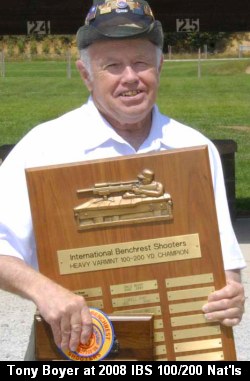 Tony Boyer dominated the recent NBRSA Nationals, winning the 4-Gun, 3-Gun, and 2-Gun (LV/Sporter) Overalls, and finishing first in other events. While Boyer’s win was proof of his superior wind-reading and trigger-pulling skills, his equipment didn’t hurt. Boyer was shooting Bartlein gain twist, cut-rifled barrels. These barrels featured a twist rate that increased from 1:15″ to 1:14.25″. Notably, Wayne Campbell and Mike Ratigan, the second-place and third-place finishers in the 4-Gun, were also using Bartlein cut-rifled barrels (twist rate unknown). This was an impressive showing for Bartlein. It also shows that cut-rifled barrels are becoming the “go-to” choice in short-range benchrest, with both Bartlein and Krieger barrels displaying match-winning performance.
 Frank Green of Bartlein Barrels told us: “Wayne Campbell did all the barrel fittings for Tony Boyer before Phoenix (NBRSA Nationals) and Kelbly’s (IBS 100/200 Nationals). I know Dwight Scott does work for Tony but not all of it. At Phoenix, Tony Boyer shot all gain-twist-type barrels (in every class). His barrels went from a 15 to a 14.25 twist. At Kelbly’s (the IBS 100/200 Nationals) right before Labor Day, Tony only had gain-twist barrels for his Heavy Varmint, and he proceeded to cream the HV class. At Kelbly’s, Boyer won HV 100 yards, HV 200 and HV Grand Aggregate with a .169 combined Agg.



 Nat’l Championship Results
 Sierra has a new 155gr Palma bullet, and it’s a winner. The new 155gr MatchKing bullet, featuring a longer ogive and factory-pointed meplats, was used by Team USA at the recent Spirit of America match. According to many team shooters and coach Emil Praslick III, the new bullet helped the American team achieve an impressive victory over arch-rival England and other national squads.
 Bullet Design Features and Factory Meplat Pointing