|
|
October 2nd, 2008
Up in the woods of Wisconsin, the “Guns of October” are cutting loose. Many of America’s (and Europe’s) top F-Class shooters are competing in the Fifth Annual F-Class Championship in Lodi, WI. The 5-day event at the Winnequah Gun Club continues through October 4th. The event kicked off with a practice match (won by Forum member Charles Ballard), followed by team competition. (The individual championship will be contested last.)

Hard-Fought Team Matches and Record-Breaking Performances
Team match results are available, with complete results posted on Long-Range.com. In the US Nationals Open Class Team Match, Team Spindle Shooters prevailed with a 1590-81X score, followed by Team Berger (1569-62X), and Team 4 Aces (1565-60X). Spindle Shooters’ Coach Praslik praised his shooters: “These guys shot very straight and fast. I believe we broke two national records today. The 600-yard team score of 797-42x is a new record. The 1000-yard team score of 793-39x is a new record. The aggregate of the two scores, 1590-81x, is a National Championship record. Well done, Spindle Shooters. It was a privilege to coach you.”
| Open Class Teams |
F-TR (Target Rifle) Teams |
Spindle Shooters 1590-81X
Captain: Jeff Cochran / Coach: Emil Praslik III
Shawn Ahrens
Jeff Cochran
Jeff Traylor
Brett Solomon
Team Berger 1569-62X
Captain: Larry Bartholome / Coach: Jim Murphy
Bob Bock
John Brewer
Jim Murphy
Larry Bartholome
Team 4 Aces 1565-60X
Captain: David Bailey / Coach: Emil Praslik (older)
David Gosnell
David Bailey
Rick Jensen
Emil Praslik |
Team Sinclair 1544-47X
Captain: Dan Phillips / Coach: Raymond Gross/Paul Phillips
Brad Sauve
Paul Phillips
John Droelle
Raymond Gross
Team USA F-T/R 1535-50X
Captain: Darrell Buell / Coach: Mike Miller/Dale Carpenter
Mike Miller
Warren Dean
Dale Carpenter
Jeff Rorer
Team Savage 1509-26X
Captain: Stan Pate / Coach: Darrell Buell
Monte Milanuk
John Weil
Darrell Buell
Stan Pate |
USA Wins Challenge Match
In addition to the regular Team Competition, International honors were at stake in a USA vs. Europe challenge match. Facing the combined forces of multiple European nations, the American shooters prevailed in both F-Open and F-TR Classes. Team USA-Open posted a 3117-121X score to best the Europeans, who totaled 3073-73. That was a great performance by Team USA-Open members Eric Bair, Shiraz Balolia, Robert Bock Jr., Mike Downey, Dagbs McIntosh, Dean Morris, Bryan Otey, and Larry Taite. In the F-TR division, the American team of Dale Carpenter, Warren Dean, Mike Miller, and Jeff Rorer outscored their European counterparts 1535-5X to 1447-16X to notch another victory for the Red, White, and Blue.
New Records Set Last Weekend
Preceding the Nationals, during last weekend, Wisconsin long-range team matches were held. Larry Bartholome reports: “The weather was near perfect with light, but tricky winds and sun shine some of the time. Six F-Class and Five Sling teams competed. I only have F-Class scores. USFCT1 (Team Berger/Norma) won Saturday’s Palma match with a new US record of 1781-94x. Two points back was USFCT2 (Spindle Shooters). The new record is 54 points and 45Xs ahead of the old one. Four of the five F-Class teams broke the old record.”
October 2nd, 2008
Tom Manners of Manners Composite Stocks has a new F-Class stock that’s long, low, and very stiff. The first three examples get their “trial by fire” this week at the F-Class Nationals in Lodi, Wisconsin. The stock is derivative of some other familiar designs, particularly in the grip area, but the underside of the stock is radically new, and the stock promises to be very rigid in all planes, without the fore-arm lift or flex found in some other F-Class stocks.

Tom says: “The shell is 100% carbon fiber with a molded-in action and barrel area. This design features a very long, stiff fore-end. From the back of the action to the tip of the fore-end the stock measures 27″ long which is around 7 1/2″ longer than our T4 stock.” The idea is to provide a “longer wheelbase” to better balance the long, 30-32″ barrels favored by many F-Class competitors.

The front half of the fore-end is very thin (from top to bottom) to achieve a low profile on the bags. The McMillan F-Class stock uses such a design, and a thin fore-end can definitely lower the center of gravity. However, some other thin-forearm designs have suffered from a springboard effect. This should not be the case with the new Manners stock. Much thought has gone into controlling fore-end flex. Manners’ design achieves greater vertical rigidity (less deflection under load) through an innovative “fish belly” design. The rounded undersection, like a canoe hull, strengthens the fore-end considerably. Carbon fiber construction also adds stiffness.

Another nice feature of the fore-end are the molded-in “rails”. On the underside of the forearm, an area is relieved for a few inches in the center. This allows the stock to contact the front bag on the two outer edges or rails. The relieved center area can ride above the “hump” typically found in the middle of the front sand-bag. Other stock designs have proven the merits of this “twin rail” feature. It works. Eliminating contact with the “hump” reduces rock and wobble, and the twin rails allow smooth tracking.
  Overall, we like the stock design very much except for one thing. The stock has a pronounced corner or knuckle at the top rear of the pistol grip. This creates a sharp transition from the tang to the area relieved for your thumb. A similar (though less extreme) knuckle is found on the McMillan A-series designs. Our testers have shot stocks with grips like this and the reaction was mixed. IF you have big hands and can wrap your thumb all the way around the grip, this design can work well with a hard hold. The vertical section right below the knuckle can help distribute some of the recoil into the web of the hand. However, for people with smaller hands, your thumb is forced into an awkward position. Additionally, many shooters use a lighter hold, or prefer to place the thumb parallel to the bore axis, resting on the stock, just behind the tang. This allows you to apply some down-pressure, WITHOUT side force (a shooting style that some rifles prefer). You can do this easily with a Tooley MBR-style stock, or a Franklin low-rider. With a hard knuckle like you find on the Manners stock, resting your thumb behind the tang doesn’t work well at all. Looking at the photos, we also think the pistol grip is quite fat, further causing problems with shooters with small to medium hands. That said, we know many shooters, particularly “tactical” competitors, who like this kind of grip. Tom Manners wants to “get feedback” on the new stock at the Nationals. It will be interesting to learn if some shooters ask for a different style grip. Overall, we like the stock design very much except for one thing. The stock has a pronounced corner or knuckle at the top rear of the pistol grip. This creates a sharp transition from the tang to the area relieved for your thumb. A similar (though less extreme) knuckle is found on the McMillan A-series designs. Our testers have shot stocks with grips like this and the reaction was mixed. IF you have big hands and can wrap your thumb all the way around the grip, this design can work well with a hard hold. The vertical section right below the knuckle can help distribute some of the recoil into the web of the hand. However, for people with smaller hands, your thumb is forced into an awkward position. Additionally, many shooters use a lighter hold, or prefer to place the thumb parallel to the bore axis, resting on the stock, just behind the tang. This allows you to apply some down-pressure, WITHOUT side force (a shooting style that some rifles prefer). You can do this easily with a Tooley MBR-style stock, or a Franklin low-rider. With a hard knuckle like you find on the Manners stock, resting your thumb behind the tang doesn’t work well at all. Looking at the photos, we also think the pistol grip is quite fat, further causing problems with shooters with small to medium hands. That said, we know many shooters, particularly “tactical” competitors, who like this kind of grip. Tom Manners wants to “get feedback” on the new stock at the Nationals. It will be interesting to learn if some shooters ask for a different style grip.
October 1st, 2008
Natchez Shooters Supplies has the Leatherman Skeletool CX on sale for $53.49, marked down from $96.00. Light-weight (just 5 oz.), compact (4″ closed), and versatile, the Skeletool CX features pliers, wirecutter, screwdriver (with changeable bits), and a very nice semi-serrated cutting blade. The handle is tungsten-coated steel and carbon fiber. We’ve checked around the web, and the next lowest price for the versatile Skeletool CX is $62.99 at Toolup.com. If you do order from Natchez, please mention that you saw this deal on AccurateShooter.com.
Buyer Reviews of the Skeletool CX have been extremely positive. One owner declared: “I’ve owned practically every Leatherman and SOG multi-tool produced over the past 15 years; a few Gerbers and Swiss Army brands thrown in there as well. And I’ve got to just jump in and say, this is arguably the best Leatherman ever.” Another Skeletool user wrote: “I’ve owned this product for about 4 months now and really do love it. I appreciate that this Leatherman has done away with all the extraneous tools that add bulk and weight but are rarely used. Instead of needing a holster, I can wear it in my pocket like I would any other knife.”

Better Than a Blade Alone
 For years, this Editor’s favorite, carry-around cutting instrument has been a semi-serrated Spyderco Delica. I may finally retire the Delica and replace it with the Skeletool CX. For not much more money than a Delica costs today, the Skeletool provides a semi-serrated stainless cutting blade, plus pliers and a bit-driver. The overall package isn’t much larger than my Delica, and it’s just as easy to carry. The Skeletool CX has a removeable pocket clip PLUS a handy, carabiner type carry loop (see photo at right). For years, this Editor’s favorite, carry-around cutting instrument has been a semi-serrated Spyderco Delica. I may finally retire the Delica and replace it with the Skeletool CX. For not much more money than a Delica costs today, the Skeletool provides a semi-serrated stainless cutting blade, plus pliers and a bit-driver. The overall package isn’t much larger than my Delica, and it’s just as easy to carry. The Skeletool CX has a removeable pocket clip PLUS a handy, carabiner type carry loop (see photo at right).
Specs:
• Length: 4 in. / 10 cm closed
• Weight: 5 ounces / 142 grams
• Features: Combination Straight/Serrated Cutting Blade (154CM stainless steel), Pliers, Wire Cutters, Screwdriver with bits, Bit Storage in handle, Bottle Opener, Lanyard Ring, Carabiner snap-loop, Removable Pocket Clip
• Materials: Stainless Steel, Tungsten DLC Coating, 154CM, Carbon Fiber (handle)
Included Bits:
• Phillips #1 and #2
• Screwdriver 3/16″ and 1/4″

October 1st, 2008
 The National Shooting Sports Foundation (NSSF) lists current firearms-related job offerings in its Industry Career Connection webpage. There are a number of interesting positions offered currently by major players in the gun industry. The National Shooting Sports Foundation (NSSF) lists current firearms-related job offerings in its Industry Career Connection webpage. There are a number of interesting positions offered currently by major players in the gun industry.
1. Hornady Manufacturing (Grand Island, NE)
Hornady is seeking a skilled Product Engineer to work on bullets and ammunition. Salary is listed as “negotiable”.
Job Description: This position will be responsible for design of products and the associated tooling, manufacturing processes and quality testing for the product. Must possess strong demonstrated project management skills and be proficient in CAD. Prefer a Bachelor’s degree in Engineering, Science or Mathematics or 10 years experience in the Ammunition or Bullet industry. Some traveling to trade shows will be required.
Contact: Carolyn Weidner, HR Adminstrator, (308) 382-1390.
2. MidwayUSA (Columbia, MO)
MidwayUSA seeks a Gunsmithing Technical Services Specialist. The listed salary is $30-45K per annum.
Job Description: Responsible for providing technical information specifically for our Gunsmithing product line. This position will be responsible for writing technical product descriptions for both our website and catalog production, managing customer comments from our website and staying up to date with the latest product information. The ideal candidate will have excellent reloading experience and be versed on the best products and methods in regards to reloading, optics and ammunition in today’s market.
Other Positions: MidwayUSA also has web-related job openings for Web Marketing Manager ($60-100K), Graphic Designer ($30-$55K), and SEO Analyst (Search Engine Optimization).
Contact: For more information on all these positions, contact Jake Dablemont in Human Resources, (573) 447-5135.
3. Remington Arms Company Inc. (Madison, NC)
Remington is looking for a new Brand Manager for the Marlin Firearms line of guns. (Remington acquired Marlin in January, 2008). Salary is not specified, but this should be a six-figure position, based on comparable jobs in the industry.
Job Description: Position is responsible for managing core product categories to insure products are positioned competitively in the marketplace and are appropriately configured and featured to compete in current market conditions. Job involves updating existing products as well as introducing new products into the market, positioning these products and monitoring product life cycles. Brand Manager has key responsibility for the profitability of the product line — this requires understanding target market and keeping the product line competitive on both price and features. Candidate must develop and produce Strategic Planning documents.
Contact: Angela Holden, HR Recruiter, (336) 548-8602.
September 30th, 2008
Sinclair International has just introduced a new Neck-Turning Tool. Part of a complete system with carbide mandrels, this product promises to be one of the best neck-turners on the market. The new tool has many improved features we really like:
▪ The cutter body is big, and curved to fit the hand. So, it is easier to hold than the old Sinclair tool or the K&M tool.
▪ The cutter-depth adjustment works really well. A large, knurled rotary knob on the back of the cutter body connects to an eccentric mechanism. This moves the mandrel shaft (and case) in and out relative to the cutter tip. You start by setting the cutter with feeler gauges, then fine-tune with the knob. Adjustments are very positive and precise, with laser-engraved index marks. This is a very good adjustment system, we think.
▪ The end of the tool is open so you can easily eyeball the caseneck as you’re cutting.
▪ High-grade carbide mandrels in 17 through 338 calibers will be offered with the new cutter system. At about $45 per caliber, they’re expensive, but the carbide mandrels DO work better — you’ll notice smoother case rotation and less heat build-up than with conventional (non-carbide) mandrels. If you already have mandrels, don’t worry. Sinclair says: “Our single-ended stainless mandrels will work fine with the new Neck-Turning Tool.”

Precise Adjustments Possible
With the eccentric adjustment system, you can make quick cut-depth changes with great precision. The cutter adjustment knob is click-adjustable in .0002″-.00025″ per click increments. The cut depth can be adjusted through a range of .004″-.005″ using the adjustment dial. A mandrel adjustment screw is included to make mandrel set-up and adjustment easier.
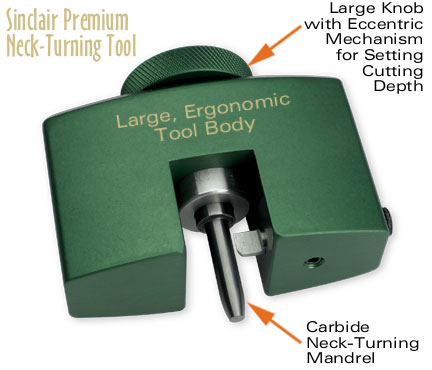
Sinclair’s new Premium Neck-Turning Tool includes three (3) feeler gauges for quickly setting cutter depth in the approximate range of the cut desired. With the cutter in range using the feeler gauge, the eccentric adjustment knob can make final adjustment for the exact neckwall thickness you desire. Sinclair claims: “Cutter adjustment is very fast and sure with none of the usual trial and error experienced with other tools.”
The $145.95 Premium Neck Turning Tool Kit (item NT-4000) includes three feeler gauges and a case-holder Turning Handle. Or you can save ten bucks and get the Tool and gauges without handle for $135.95 (item NT-4100). All popular Sinclair neck-turning tool accessories, including expander mandrels, will work with the Premium Tool. Order caliber-specific carbide turning mandrels separately for $44.75 per mandrel (items 95-0XX).

September 30th, 2008

Effective October 1, 2008, the Federal Firearms Licensing Center (FFLC) will move most of its operations from Atlanta, Georgia to Martinsburg, West Virginia. This transfer of function was mandated by Congress in ATF’s FY2005 appropriations legislation. The notice of change states: “As with previous workload redistributions, we anticipate an initial adjustment period and appreciate your patience in advance.” Please contact the FFLC toll free at 1-866-662-2750 with any questions about this change.
FEDERAL FIREARMS LICENSING CENTER
244 Needy Road
Martinsburg, WV 25405
1-866-662-2750 (phone)
1-866-257-2749 (fax)
Complete contact information for the FFLC, with names and phone numbers for all regional field officers, can be downloaded in a .pdf file linked below.
Federal Firearms Licensing Center Office Roster
New Assignments Starting 10/1/2008
All applications received by the FFLC with a postmark date of October 1, 2008 or later will be assigned for processing based on the new list of State assignments (see .pdf file). Applications postmarked before October 1, 2008 will continue to be assigned to their current examiner for completion.
September 29th, 2008
The United States Practical Shooting Association (USPSA) hosts its 2008 Multi-Gun Nationals Oct. 3-5 at the Clark Range, in Princeton, Louisiana. This USPSA event requires shooters to engage multiple targets, on the clock, with pistol, rifle, and shotgun. The USPSA Nationals will draw ace action shooters from around the country. Shown below is Chris Tilley, competing at the 2007 USPSA Multi-Gun Nationals. The video shows how smoothly Chris transitions from gun to gun and how well he engages targets while on the move. If you’ve ever tried that, you know how difficult it is to aim (and hit) while running sideways. That’s why Chris, the 2006 USPSA National Open-Class Champion, is one of America’s “top guns”.

 Though there are multiple classes for rifles, pistols, and shotguns (based on equipment), most competitors will be using semi-automatic firearms. The rifles will typically be AR15-style carbines with red dot sights. Most shooters use .223-caliber carbines but there is also a “Heavy Metal” division for .308 or larger caliber rifles. Open-class pistols will be 1911-based race guns with red dot or holographic sights, compensators, and high-capacity magazines carrying 20 rounds or more. Though there are multiple classes for rifles, pistols, and shotguns (based on equipment), most competitors will be using semi-automatic firearms. The rifles will typically be AR15-style carbines with red dot sights. Most shooters use .223-caliber carbines but there is also a “Heavy Metal” division for .308 or larger caliber rifles. Open-class pistols will be 1911-based race guns with red dot or holographic sights, compensators, and high-capacity magazines carrying 20 rounds or more.
Speed, accuracy, and firepower all count in this game. Stages require anywhere from 6 to 30+ shots. The scoring system measures points scored per second, then weights the score to compensate for the number of shots fired. If they miss a target, or shoot inaccurately, points are deducted, lowering that all-important points-per-second score. Scoring is based on hits and time, plus the “Power Factor” is calculated into the equations. It can get pretty complicated, so USPSA Multi-Gun matches are scored with computer software called EZWinScore. To learn more about Multi-Gun competition, visit USPSA.org or you can download the Multi-Gun Rulebook.
STAGES: CLICK HERE for Stage Diagrams showing target sequence/placement.
September 29th, 2008
Sophisticated electronic scoring systems (with acoustic targets) are used in Olympic and ISSF competition. Many such advanced systems have been installed at shooting ranges in Europe. The U.S. Army has also installed electronic targets at Ft. Benning, Georgia, but that range is restricted to military use except for a few special matches. Right now there’s just one facility with a full electronic target system that offers regular access to civilians, 12 months a year: AREA 52. In West Central Texas, southwest of Abilene, Spindler Arms LLC operates the modern AREA 52 Long Range Shooting facility. AREA 52 offers high-tech acoustic targets at four distances: 300m, 600m, 800m, and 1000 meters. Every shooter has his/her own target monitor for scoring. All target bays are on separate lines of sight, and shooters are spaced on a single line, so there is no conflict between 300m shooters and those shooting the longer distances.
 
Area 52 has scheduled three major, multi-distance competitions this fall. On October 11, AREA 52 will host a multi-distance Long Range Competition using electronic targets. The Course of Fire consists of 3 sighters and 15 record shots at each of the four metric distances (300m, 600m, 800m, 1000m). The cost is $70 per class. Max caliber is .338 Lapua Magnum. On October 25, the 3-6-8 SniperCup Challenge will be held. Limited to 50 participants, this match involves timed fire at 300, 600, and 800 meters. Thirty (30) record rounds total. There will be separate classes for semi-auto and bolt-action rifles, and the fee is $35 per class. Lastly, on November 1, Area 52 hosts a 4-distance Benchrest event with targets at 300, 600, 800, and 1000 meters. It is unusual for benchresters to be challenged at four distances this far apart, and it will be interesting to see the choice of calibers. Maybe a 6 PPC at 300 and a 300 WSM at 1000? Course of fire includes 3 sighters and 2 x 10 record rounds within 30 minutes at each distance. This is a “group-shooting” match with Score as the tie-breaker. Match fee is $ 79.00 per shooter/class/gun.

To learn more about Area 52 and the upcoming matches, visit SpindlerArms.com, or contact Wilhelm Spindler, AREA 52, 6555 N. State Hwy. 208, Robert Lee, TX 76945, phone: (325) 453-9166, email: info [at] spindlerarms.com.

September 28th, 2008
The 2008 Spirit of America (SOA) Match was a huge success. With International Team Competition on the menu this year, the SOA drew scores of top Palma shooters from around the world. Over 160 competitors came to the Whittington Range in Raton, New Mexico to compete for honors in both Full-bore Target Rifle and F-Class matches. Spc. Tyrel Cooper of the USAMU won the Target Rifle Overall Aggregate. Ty Cooper has “been on a roll lately, and has been shooting great”, according to Veteran Team member Jerry Tierney. On the F-Class side, Larry Bartholome shot consistently to top a very competitive field. Congrats to both Ty and Larry!

Team competition was a major highlight of the SOA. In the America Match* for national teams, The U.S.A. Team finished first, beating Australia (second place) and England (third place). Individual USA Team member scores are posted below. We’re pleased to see forum member Bryan Litz shooting well, and we salute Sherri Hurd. Not only was Sherri the top female shooter in the America Match, but her 597-36X score was the third best in the entire field, after England’s David Luckman (599-35X) and Team USA teammate Tyrel Cooper (597-40x).


The U.S.A. Veterans’ Team performed extremely well, actually posting the second highest team total overall. That’s right — the American veterans out-scored the National teams of Australia and the UK. “Not bad for a bunch of old guys, wouldn’t you say”, Tierney observed. For complete Match Results, visit the Bald Eagles Club website, BaldEaglesRC.org.

For the English perspective on the match, visit the Team England Website. It offers match results, tech info about the sport, and a Photo Gallery with dozens of images.
*The America Match is a major international Palma competition first hosted in 2002. Matches are held every two years. Each team is composed of eight shooters, two sub-coaches, a main coach, an adjutant, a captain and two reserves. It is a multi-distance event. Course of fire is: 2 sighters and 15 shots for record at 300, 600, 900 and 1000 yards (or 300, 600 yards and 800 and 900 meters as appropriate to the venue).
September 28th, 2008
For two years, Forum member John Skowron (John708) has been campaigning a 6BRX, built by Nat Lambeth (RustyStud). You’ll find the full history of John’s 6BRX project in this Forum Thread. With this rifle, John was the overall 1000-yard winner at Butner in February 2007.
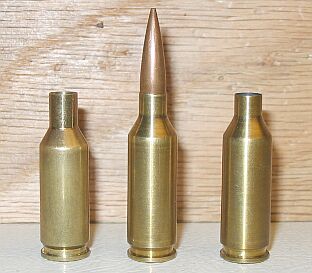
The 6mm BRX is based on the 6mm BR cartridge. The shoulder is moved forward, but the shoulder angle and case taper is the same as the parent cartridge. This way you can use standard dies for most purposes (although it is a good idea to have a custom full-length die so you can size the entire case body). Many of our readers have been interested in the 6mm Improved (BRX, Dasher etc.), but they’ve wondered about case durability and barrel life. John has answers for those questions:
6BRX Case Life
Case life running the Berger 105s at 3000+ fps is 14-15 reloads. Brass was discarded when the primer pockets became too loose. The 6BRX brass OAL after fireforming is 1.56″. Max OAL for the 6BRX is 1.58″. The brass never stretched enough to require trimming before discard. Another plus for the 6BRX and Lapua brass. By the way don’t even bother with Remington-brand 6BR brass. The primer pockets were so loose after my standard fire-forming load I had to trash all the cases. Stick with the good stuff, Lapua.
6BRX Barrel Life
Here are Skowron’s comments as his round count increased:
2750 Rounds: I now have 2570 rounds through my 6mm BRX. I was just at the range today doing an accuracy test. I shot two 10-shot groups at 100 yards, one with 105gr Bergers, and the other with 107gr Sierras. Both were identical 0.44″ 10-shot groups. Not bad for a rifle with 2500+ rounds through it.
2900 Rounds: I now have 2900 rounds through my 6mm BRX. I was doing some load testing with the new 6mm Berger bullets. I compared them with my existing comp. load in my 6mm BRX. The 105gr Bergers, jammed .015″ into the lands, with 31.5 grains of Varget and Fed 205s are still shooting .45″ 10-shot groups at 100 yards. Velocity is 3060 fps. I don’t know how long this Broughton barrel will last, but I’m amazed that it’s lasted this long.
2950-3044 Rounds: I had virtually no throat erosion until I reached 2900 rounds. After 2900 rounds throat became noticeably rougher on cleaning and groups opened up. 10-shot groups with match ammo were now .53″ (compared to low fours before). At 2950 rounds the groups ran .58″. At 3044 rounds, the groups opened up to .7″. That’s not enough accuracy for LR work.
CONCLUSION: Barrel life with competitive accuracy was 2900 rounds with this gun.
Achieving this barrel life goal pretty much completes my 6mm BRX project. I’m now shooting a cartridge that has the same or better barrel life than the 260 Rem, it’s more accurate, with essentially equal wind drift. [Editor’s Note: Richard Schatz recently won the NBRSA 1000-yard Nationals with a 6 Dasher, a similar 6BR Improved cartridge, but with a 40° shoulder. Richard’s barrel had over 2000 rounds through it.]
|


