The Bureau of Alcohol, Tobacco, Firearms and Explosives (ATF) issued a bulletin on March 9, 2012 regarding web-based services that promise that the purchaser of an commercial application package will be issued a Federal Firearms License (FFL). ATF notes that such commercial services are not sponsored or approved by the ATF, and these service may use non-authorized forms which the ATF will neither accept nor approve. Here is the exact language of the Notice, highlights added:
Private Application Services and Non-Approved Application Forms
ATF has recently become aware of web-based companies which guarantee the issuance of a Federal firearms license (FFL) if a prospective applicant purchases the company’s application packet and advice about how to obtain a FFL. Anyone considering applying for a FFL should be aware that the fees paid for such consulting services and materials are not required, endorsed, or received by ATF. Any fees for application consulting services and materials are paid voluntarily by a prospective applicant, who should understand that such fees are in addition to the license and permit application fees required by law and collected by ATF. ATF collects no application fees online at this time. All ATF-required fee payments must be made by check, money order, or credit card and accompany the paper application form sent to ATF by the applicant.
It is also important to note that ATF does not guarantee the issuance of FFLs. Each application is reviewed on its merits under the qualifying criteria set forth by law.
Some private application services provide their own version of license application forms. Please note that ATF will not accept any application form not approved for use by the Office of Management and Budget and will return without action applications submitted on unauthorized versions of ATF forms. All ATF application forms are provided free of charge and may be obtained from the ATF website or forms Distribution Center by calling 202-648-6420. You may also contact the Federal Firearms Licensing Center at 1-866-662-2750 for assistance in completing FFL applications.
Forum member Marcus Åström from Sweden has come up with a perfect luxury item for style-conscious shooters: bullet-shaped silver cufflinks. Just the thing to impress the guys at your next range session (or corporate board meeting). Who wouldn’t like silver bullets on their cuffs? Silver bullets did the job for the Lone Ranger didn’t they?
Cast from a mold taken from your sample bullet, the silver bullet cufflinks can exactly replicate your favorite projectile, right down to the ballistic tip. For considerably less money, the Swedish jeweler can create a set of cufflinks from an all-copper bullet you supply. A silver T-bar is attached, giving you a two-tone cufflink (see lower photo).
Marcus reports: “Check out these amazing cufflinks I have had made by Sofia Winberg, a jewelery smith in Stockholm. The silver links in the photo above are based on a Hornady 7mm Interbond 139gr bullet. I choose this bullet since it was the one with which I shot my first deer. Here’s how these are made. When Sophia receives your sample bullet, she makes a mold from it and then casts the silver bullet body. If the bullet has a tip, she attaches a small silver cap and shapes it to match the original tip. She can also make links from copper bullets or finish the metal so the bullet-cufflinks appear moly-coated. Sophia can also make cufflinks from cartridge cases. She replaces the primer with one in silver, with or without the firing pin mark.”
Price depends on the design and material options selected by the customer:
Silver Bullet Cufflinks, with or without silver tip, molded from bullet sample: $475 USD
Copper Bullet Cufflinks, with silver tip, molded from tipped bullet sample: $350 USD
Copper Bullet Cufflinks molded from Hollow-point or FMJ bullet sample: $300 USD
Solid Copper Bullet Cufflinks, no molding, with silver T-Bar attached: $140 USD
Cartridge Case Cufflinks: $350 USD
Special materials, jewels, etc.: Request Pricing
Turn-around is roughly four (4) weeks from the time when Sofia (the jeweler) receives the bullet. No payment in advance is needed — the customer gets to approve the product via pictures before making payment. Once payment is received, the item ships. If you are interested, contact: Sofia Winberg Jewellery Design, sofia [at] sofiawinberg.com .
From March 15 through April 22, 2012, Nikon will give a free scope mount to purchasers of select-model AR scopes. Yep, if you buy a qualifying Nikon AR riflescope, you’ll receive the corresponding AR mount (retail value up to $99.95) for free. Included in the offer are Nikon’s P-22, P-223, and M-223 riflescopes. Nikon’s M-223 and P-223 scopes are built specifically for the .223 Remington cartridge. With BDC (bullet drop compensating) or Nikoplex reticles, they are designed to give AR shooters a high quality optic with fast sighting speed. The P-22 is the rimfire-optimized variant designed for the .22LR cartridge.
Choose Two-Piece or One-Piece AR-specific Scope Mounts
Nikon has developed two types of AR scope mounts for AR platform rifles. The new P-Series mount (shown above) is a two-piece design that can mount a P-22 or P-223 scope to almost any AR platform rifle. The M-223XR mount is a one-piece design made for the M-223 riflescope. The angled-base M-223XR offers +20 MOA of built-in elevation for long-range shooting.
The P-Series mount is available with the purchase of the following P-223 or P-22 scopes:
P-223 3×32 Carbine Reticle (#8496) | P-223 3-9×40 BDC 600 (#8497) | P-22 2-7×32 (#8498, #8499)
The M-223XR mount is available with the purchase of any of the following M-223 scopes:
M-223 1-4×20 (#8485) | M-223 2-8×32 (#8486, #8487) | M-223 3-12×42 (#8488, #8489)
To learn more about Nikon’s free scope mount promotion, visit NikonPromo.com after March 15, 2012. NOTE: Offer excludes Nikon M-223 2.5-10×40 Laser IRT (#8491); and M-223 4-16×42 (#8492, #8493).
The Winter 2012 Issue of the CMP’s On The Mark eZine is now available for downloading as a PDF file. You can download this issue, and previous issues, by logging on to the CMP’s On the Mark webpage. The Winter 2012 Issue includes articles on the 2012 U.S. Olympic Team Trials for Airgun, the 2012 Camp Perry Open, Learning to Compete Successfully, Mind Over Matter (Mental Training), and much more.
CMP 2012 Summer Air Rifle Training Camps and Clinics
Each summer the Civilian Marksmanship Program (CMP) sponsors a popular series of Junior Air Rifle Camps and Clinics to teach intermediate and advanced rifle marksmanship skills to junior shooters and their adult leaders. There are seven camp sessions (plus two outreach clinics) scheduled for 2012. The first session starts June 11, and the last session begins July 30, 2012. Detailed information about the camps and how to apply to attend them are listed on the CMP website. All camp sessions are one-week-long, three-position air rifle camps, with the exception of the Outreach Clinics and the Advanced Standing Camp. These summer camps fill up quickly, so if you know a young shooter who wants to attend, be sure he or she submits an application soon. Most of the camps cost $230.00 for the week. For additional information, please contact Sommer Wood, CMP Junior Rifle Camp Director by emailing swood [at] odcmp.com.
Leica just introduced its latest pocket-sized laser rangefinder, the CRF 1600-B Rangemaster. This unit features built-in angle compensation plus a ballistics solver that can give you either hold-over (in inches or cm) or clicks (from your zero) to put the shot on target at the ranged distance. At the heart of the CRF 1600-B is Leica’s Advanced Ballistic Compensation(ABC™) system, a precision integrated ballistics calculator that combines stored data with analysis of current ballistics parameters. To calculate projectile trajectory, the ABC™ system processes multiple ballistics variables, including measured distance, angle of incline, temperature, and absolute air pressure. The new 1600-B should be available in June, 2012. The “street price” should be the same as the current CRF 1600, $799.00.
There’s a lot of marketing mumbo-jumbo in the product release info, but what you need to know is that the new CRF 1600-B offers three important functions, in addition to ranging distance to target. These functions are: Angle Compensation, Display of Hold-Over, and Click-Value Display.
1. Built-in Angle Compensation
If you are taking an angled shot (whether up-hill or downhill), the 1600-B tells you the true horizontal component distance to the target. Use this number (as opposed to the line-of-sight distance to the target) to set your elevation. The 1600-B figures out the angle through a built-in inclinometer. This is a handy feature for hunters and tactical shooters, but it’s not really that innovative — other rangefinders have have offered angle compensation for quite some time. Still this is a nice feature that allows hunters to dispense with an angle indicator on their rifles, and you won’t have to work out math equations in the field.
2. Hold-Over Values (Inches or CM)
When you range a target, the 1600-B can display the actual hold-over you need (at the ranged distance), either in inches or centimeters. Then you simply place your cross-hairs higher on the target, according to the hold-over value displayed in cm or inches. This works well — so long as you have some idea of the actual size of the target. If you don’t know if your prey is 4-feet tall or 6-feet tall then you can make mistakes. The hold-over display can read in either inches or cm. Holdover values, based on 12 pre-programmed ballistics curves, are given from 100 yards to 880 yards (compared to only 500 yards on the CRF 1600).
3. Elevation Click Values to Correct POI
One very handy feature of the new Leica 1600-B is that it automatically calculates the elevation clicks you need to correct your point of impact (POI) for the target range. First, you must select a matching ballistics curve (based on your muzzle velocity, bullet BC etc.). Then the 1600-B uses its built-in ballistics solver to calculate drop at the target distance, figuring in temperature and barometric pressure automatically. With a click of a button the 1600-B will displays the number of up-clicks you need to have the correct POI at the ranged distance. Available click values are: 1 MOA, 1/3 MOA, 1/4 MOA, 10 mm/100 m, 5 mm/100 m.
CRF 1600-B Rangemaster Specs (and Real-World Ranging Performance)
The new Leica 1600-B features a 7X monocular optic with 24mm objective and 3.4mm exit pupil. The external lenses have AquaDura® coatings. Though it’s packed with computing power, the 1600-B weighs just 8.1 ounces and, measuring 3″ x 1.63″ x 1.25″, it really does fit in a shirt pocket. Along with target distance, hold-over, and calculated clicks, the auto-adjusting red LED display can show Angle of Incline, Temperature, and Air Pressure.
Leica claims the 1600-B will range out to “approximately 1,600 yards”. Yes, in ideal conditions, the unit can nail a large, reflective object (such as a barn) at that distance, but you’ll find real-world performance on deer-sized targets to be quite different.
It is hard to hand-hold the tiny CRF 1600-B with sufficient stability to range small objects at extreme long distance. When testing the current CRF 1600 model we’ve found the practical max range for hand-holding on a deer to be about 800 yards, and even to do that you need very steady hands and a bit of practice. For long-distance ranging, we actually prefer a larger, flat-body design, such as the Zeiss Victory PRF, which can be rested more easily on a pack or sandbag. For the new 1600-B model, Leica claims measuring accuracy of +/- 1.1 yards to 400 yards, +/- 2.2 yards to 800 yards, and +/- 0.5% over 800 yards.
MGM Targets is now the nation’s #1 portable steel target manufacturer. To reward MGM’s customers, MGM is running a year-long “12-for-12″ contest though the end of 2012. Each month a dozen lucky winners are selected among those who have purchased one of the MGM product specials. Prizes worth up to $425 are supplied by a variety of respected manufacturers, such as FNH, DPMS, and Benchmade. MGM has already announced winners for January and February, but you can still get involved for drawings in March and future months. (Purchase of target required for prize eligibility.)
MGM’s monthly prizes include: gift certificates, rail systems, .22LR uppers, gunstocks, safety eyewear, gunstocks, shooting mats, slings, data books, knives, and flash suppressors. Prizes are supplied by well-known manufacturers: Benchmade, DPMS, ESS Eye Pro, FNH, Predator Tactical, Primary Weapons, Safariland, and Seekins Precision. MGM’s Jim Potter noted: “This will be one of the biggest giveaways in the industry in 2012 [with prizes] given away every single month.”
March Specials from MGM
This month MGM features the MGM Flash Target for long-range shooting. The March Special price is $350.00 — $77 off the regular $427.38 price. Along with the Flash Target, for March, MGM is featuring the IPSC Half Size Target for $119.00, marked down from $179.36.
New Remote-Control Running Man Target
Experienced shooters know that moving targets are much harder to hit than static targets. To provide realistic challenges for hunters, tactical shooters, and 3-Gun competitors, MGM has introduced a very cool (and speedy) portable “Running Man Target”. This motorized, cable-drive system boasts adjustable targets speeds from 3 to 22 feet per second, with quick-stop and instant reverse capability. Speed and direction are modulated with a handheld, wireless (radio) remote control effective out to 100 yards. For more info, visit MGMTargets.com or contact Mike Gibson Manufacturing, (888) 767-7371.
The TCU rifle team used a dominating effort in air rifle to erase a five-point deficit to claim its second national championship in the last three seasons. TCU’s top-scoring Air Rifle shooter, Sarah Scherer, finished third in the air rifle individual finals, which was won by another lady shooter, West Virginia Mountaineer Petra Zublasing. Congrats to Petra!
In addition to the Team National Championship, the Frogs took home the air rifle title after firing a 2,353, topping West Virginia’s team score of 2,350. Kentucky finished the smallbore competition on day one in first place, but the KY Wildcats couldn’t hold off the TCU squad. TCU’s “Horned Frogs” fired a 2,353 in air rifle to record an impressive 4,676-4,661 overall victory over the defending champion Wildcats. Alaska-Fairbanks took third place overall in the team competition behind TCU and Kentucky.
Final NCAA Rifle Championship Team Rankings:
1. Texas Christian University (TCU)
2. Univ. of Kentucky
3. Univ. of Alaska – Fairbanks
4. U.S. Military Academy (West Point)
5. Univ. of Texas El Paso (UTEP)
6. West Virginia Univ.
7. Jacksonville State Univ.
8. Univ. of Nevada – Reno
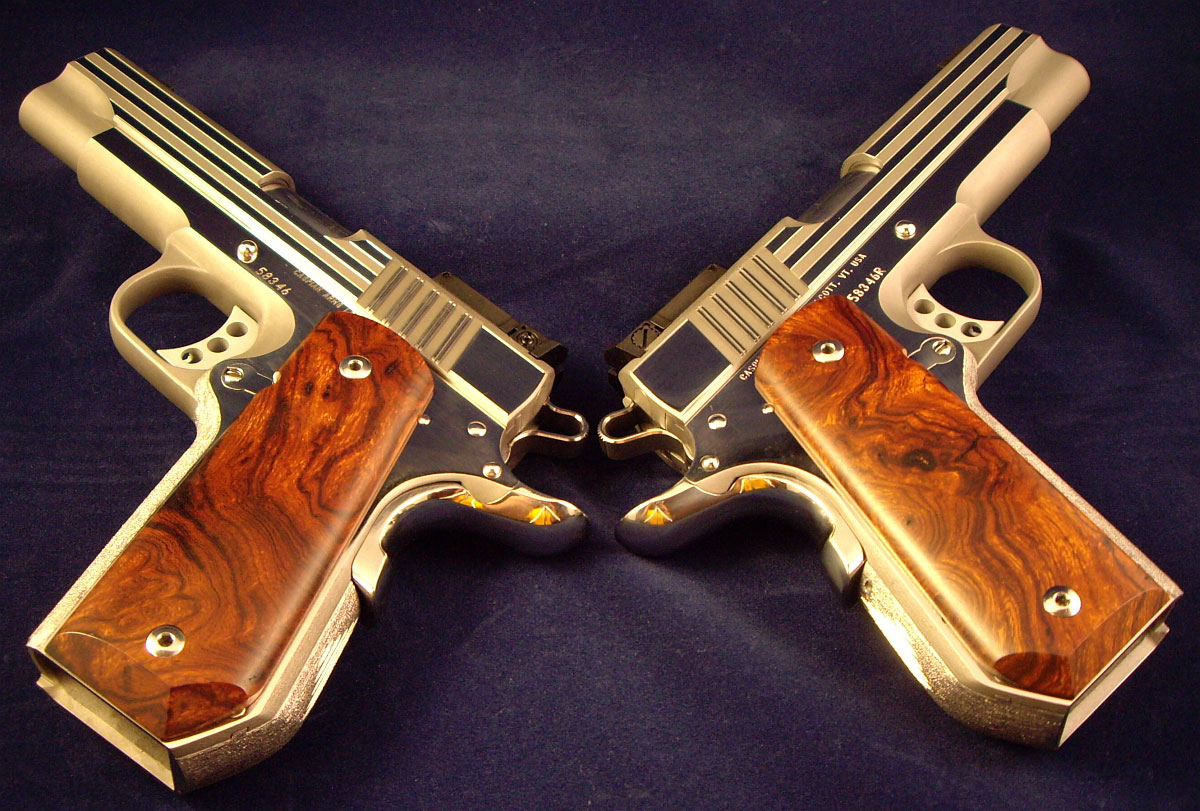
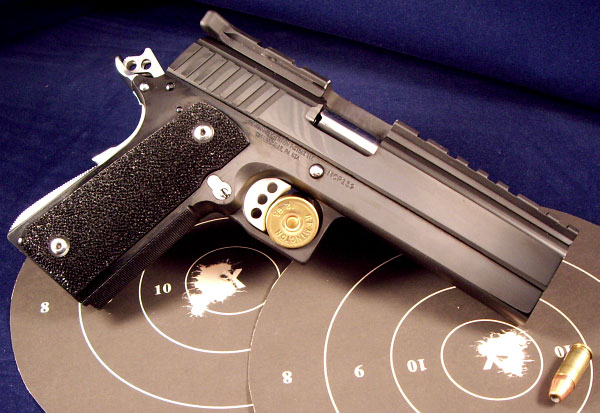
Ace gunsmith Joe Chambers (aka Joe C), who is best known for his custom pistols, recently joined our Shooters’ Forum. Guns built by Joe have been used to win 49 class championships at the NRA Camp Perry National Championships, as well as many regional, state and local matches. He has built guns for collectors, concealed carry and action pistol competitors as well. Joe’s custom pistols have been featured in American Handgunner Magazine. Chambers’ guns are noted for their outstanding reliability and accuracy. He has built 1911s chambered in .38 Super that will put ten (10) shoots in under 1.00″ at fifty (50) yards. (We’ve seen some factory rifles that can’t do that!)
You can view impressive Chambers-built customs on Joe’s website ChambersCustom.com. Here are some samples:
Chambers Gains Precision Rifle Knowledge Through Forum
While the AccurateShooter Forum’s main focus is on precision rifles, it’s good to know that someone with Joe’s skills and abilities can help forum members who have questions about 1911 pistols and custom pistol-smithing. In return, we invite our experienced rifle shooters to share their long-gun knowledge with Joe. A budding interest in long-range and F-Class rifle shooting drew Chambers to our Forum. He came to the right place. Many of the nation’s top F-Class shooters (both F-TR and F-Open) frequent our board. No doubt Joe will advance his knowledge of rifle shooting through participation in our Forum. Welcome aboard Joe — we are pleased to include you in our community of precision shooters!
Story tip by Tanner F. (aka Flybuster). We welcome reader submissions.
Here, from the National Shooting Sports Foundation (NSSF), are eight (8) Free Targets that can be downloaded as PDF files and printed. All targets are available as PDFs and print on standard 8.5″ x 11″ paper. In the future, other targets may be posted on the NSSF Target Page. Want more FREE targets? Visit AccurateShooter.com’s Target Archive to access dozens of FREE, printable target designs, including load-testing targets, varmint targets, NRA bullseye targets, and fun targets.
Click a target to view and print. Right-click and ‘Save As’ to save PDF to your computer.
Story by By Kyle Jillson forThe NRA Blog
The Kentucky Wildcats won the 2012 NCAA team smallbore championship yesterday, shooting a 2328 to win the Smallbore Title and secure a 3-point lead over 2nd place Army in the overall (combined smallbore and Air Rifle) 2012 NCAA Rifle Championships. Last year the Wildcats came into the second day’s Air Rifle competition with a 7-point lead and held on by three to claim the school’s first National Championship. Today at the French Field House Kentucky hopes to maintain the lead in the Air Rifle championship and take home a National Championship for the second consecutive year.
Heading into Saturday’s Air Rifle competition, here are current Team Scores and rankings::
1. University of Kentucky: 2328
2. U.S. Military Academy (West Point): 2325
3. Texas Christian University: 2323
4. Alaska-Fairbanks: 2312
5. University of Nevada Reno: 2306
6. Jacksonville State University: 2304
7. UTEP: 2303
8. West Virginia University: 2297
TCU’s Sarah Scherer Wins Individual Smallbore Championship
Friday afternoon the top eight shooters from the smallbore relays stepped up to the firing line for the 2012 individual smallbore finals. When the final scores were totaled, TCU’s Sarah Scherer was the victor, edging West Point’s Michael Matthews by just one point. Scherer, who recently qualified for the US Olympic Team, took the individual smallbore title with a 99.6 in the finals and a total aggregate of 688.6. This was her second win in smallbore; the first coming in TCU’s national championship run in 2010.


 Forum member Marcus Åström from Sweden has come up with a perfect luxury item for style-conscious shooters: bullet-shaped silver cufflinks. Just the thing to impress the guys at your next range session (or corporate board meeting). Who wouldn’t like silver bullets on their cuffs? Silver bullets did the job for the Lone Ranger didn’t they?
 Marcus reports: “Check out these amazing cufflinks I have had made by Sofia Winberg, a jewelery smith in Stockholm. The silver links in the photo above are based on a Hornady 7mm Interbond 139gr bullet. I choose this bullet since it was the one with which I shot my first deer. Here’s how these are made. When Sophia receives your sample bullet, she makes a mold from it and then casts the silver bullet body. If the bullet has a tip, she attaches a small silver cap and shapes it to match the original tip. She can also make links from copper bullets or finish the metal so the bullet-cufflinks appear moly-coated. Sophia can also make cufflinks from cartridge cases. She replaces the primer with one in silver, with or without the firing pin mark.”

 The
The  CMP 2012 Summer Air Rifle Training Camps and Clinics
 1. Built-in Angle Compensation
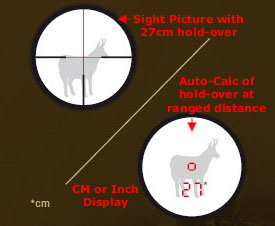 2. Hold-Over Values (Inches or CM)
 3. Elevation Click Values to Correct POI

 The TCU rifle team used a dominating effort in air rifle to erase a five-point deficit to claim its second national championship in the last three seasons. TCU’s top-scoring Air Rifle shooter, Sarah Scherer, finished third in the air rifle individual finals, which was won by another lady shooter, West Virginia Mountaineer Petra Zublasing. Congrats to Petra!
 Ace gunsmith Joe Chambers (aka Joe C), who is best known for his custom pistols, recently joined our