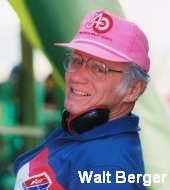
Last weekend, at a 100/200 benchrest match in Visalia, CA, Walt Berger, founder of Berger Bullets, won both the Light Varmint (LV) and Heavy Varmint (HV) Grand Aggregates, as well as the Two-Gun Overall title. That’s an impressive sweep.
Walt, who is in his mid-eighties, beat a field of talented shooters who were 20-40 years younger. What’s that line: “Old age and treachery always triumphs over youth and skill”? Actually, Walt has plenty of skill and it wasn’t treachery that earned Walt his Visalia victories. He made the right wind calls, aimed true, and he had good equipment.
Walt was shooting a Saguaro-actioned rifle fitted with the new Nightforce 15-55x52mm Competition Scope. The light weight of the Saguaro action (just 26.6 oz.) and a shorter-than-usual 20 1/4″ barrel allowed Walt to make weight in the 10.5-lb Light Varmint Class, even with the 27.87-ounce Nightforce Comp Scope. Walt did switch to a heavier barrel for the 13.5-lb Heavy Varmint class. But his LV results suggest that Walt could have won the HV Agg using the lighter barrel as well. Walt was using 6mm Berger Column FB bullets for both LV and HV.
L to R: Jim Nicolas, Tom Price, Don Nielson, Walt Berger, Bill Summers, George Pizzillo, Duke Rovarino, George Lozano, Joe Stanovich. CLICK HERE for full Match Results.
Shorter, Lighter Barrels for Short-Range Benchrest? — Boyd Allen
Given Walt Berger’s success with a 20.25″ barrel at Visalia, I wondered how much weight one could save with a shorter barrel and the svelte Saguaro action. I ran some models using Dan Lilja’s FREE Barrel Weight Calculation software which predicts stiffness and barrel weight. Using this software, I could model different barrel profiles and diameters, with the goal of saving weight without sacrificing stiffness.
I came up with an optimized barrel contour with a shorter cylinder length and more taper (.800″ at muzzle). The Lilja program said this barrel (at 20.5″) would be just as stiff as a typical 21.5″ benchrest barrel, but would be roughly 13.5 ounces lighter. That’s right, by changing the barrel profile and trimming 1″ from the barrel OAL we can save over thirteen ounces without losing stiffness (at least the software says so).
A Saguaro action is 3.9 ounces lighter than a Stolle Panda. Combine that with the 13.5-ounce weight saving from a shorter barrel (with optimized contour) and you get a total weight savings of 17.4 ounces — more than a pound! That opens up a whole new world for 10.5-lb LV rifles. That extra pound lets a shooter run a heavier scope, or he can put another pound of weight into the stock and/or tuner.
I discussed the topic of shorter, reduced-weight benchrest barrels with two world record-holding benchrest shooters who were at the Visalia match. They both observed that, while shorter barrels shot well, shorter barrels produced more blast/noise, causing flinch problems. Accordingly, both of these shooters stopped using shorter barrels. I wonder if “double coverage” ear protection (with custom molded plugs and electronic muffs) would attenuate the blast enough to make the shorter barrels more “shootable”. Perhaps, then, we would see more shorter, lighter-contour barrels at matches.
A digital version of the NRA Tournament Operations Guide is now available FREE online. While supplies last, there are still some copies of the previous version available through the NRA Program Materials Center. However, the newer, free online version will replace it.
The 56-page NRA Tournament Operations Guide is loaded with information that will help your club or organization run efficient events. Featured topics include tournament planning, range operations, statistics, awards, and much more. A great resource for all match directors, the new guide covers eight different shooting disciplines.
Read the Complete Tournament Guide Right Here
A full version of the Tournament Guide is embedded below. Use the white arrows to move from page to page within the document. The down arrow advances one page at a time. Or, you can simply use the scroll bar on the right. NOTE: The “+” control zooms the page to 100% (or larger) for easier reading:
This story by Kerrin Brinkman courtesy the NRA Blog.
Can you imagine a shooting match that draws a couple hundred thousand spectators? Amazing right? Well that’s how many people turned out to watch the 2013 Int’l Biathlon Union (IBU) World Biathlon Championships (WBC) recently held in Nové Město in the Czech Republic.
At the 2013 WBC, event organizers constructed a stadium and filled it with 201,000 spectators to watch the best biathletes in the world. Among national teams at the WBC, Norway dominated, winning an incredible eight of the eleven competitions, including all three relays. Tora Berger and Emil Hegle Svendsen each won two individual events and contributed to the relay Golds. Tarjei Boe added Gold in the mass start. These eight Gold medals were a record for the IBU World Championships; no other nation has been so prolific or dominant.
On the other hand, biathletes from 12 different countries won medals — and that was a new record for medal distribution. In 2011 at Khanty Mansiysk, Russia, 11 nations took home a medal. This year 12 nations won at least one medal. Tim Burke from the USA earned a Silver Medal in the 20K event. This was the first medal for the red, white, and blue since Josh Thompson won the 20K Silver in 1987.
Lapua Polar Biathlon .22 LR Ammo Wins 97% of all 2013 WBC Medals
In the world of precision shooting, it’s unusual for one ammo-maker to completely dominate a major shooting event. But that’s exactly what happened at the 2013 World Biathlon Championships. An amazing 32 out of 33 total medals awarded in Nova Mesto went to biathletes shooting Lapua ammuntion, specifically Lapua .22 LR Polar Biathlon. That works out to 96.9% of ALL medals at this year’s IBU World Championships. Hats off to Lapua for producing the winningest biathlon ammunition ever made.
The 8th Annual Shilen Swap Meet kicks off a month from now. Rain or shine, the Swap Meet will be held from 8:00 am to 3:00 pm on Saturday, March 23rd, in the Shilen parking lot (Ennis, TX). The event is open to “all comers” — both buyers and sellers. There are NO fees or costs. Anyone can set up a table or just back their truck up and drop their tailgate. There will be gun stuff everywhere — buy and sell as much as you like. And there will be FREE FOOD — complementary chili, frito pie, water, tea, or coffee.
Shilen does request advanced notice from Swap meet attendees, especially folks selling shooting gear: “Please call (972) 875-5318 if you plan on attending so we can have a rough head count. If you want to put up a table please call, fax or email us and let us know. We will add you to the list of vendors.”
Big Discounts on Barrels
Shilen’s ‘Swap Meet Barrels’ will be BACK. These are first-quality barrels built for customers who requested a specific contour, twist rate, or caliber, but later changed their minds. Shilen let these customers modify their orders, but some of these custom-ordered barrels remain in inventory. These pre-ordered “orphan” barrels will be sold at deeply discounted prices at the Swap Meet. NOTE: All warranties still apply; these are NOT lower quality or factory seconds.
Factory tours will be given. During the morning tours, the drill, ream and rifle machine will be operating. Schedule so far is that factory tours (with RUNNING machines) will be offered at 8:00 am, 8:30 am, 9:00 am, 9:30 am, 10:00 am, 10:30 am, 11:00 am and 11:30 am. Tours will continue in the afternoon, but no machines will run then.
New Nightforce 15-55x52mm Competition Scope — Field Report by Darrell Buell
A few weeks ago at SHOT Show, Nightforce Optics introduced a new Competition Scope. When Nightforce heard about the upcoming U.S. Team practice session in Phoenix, the optics-maker overnighted us two prototype Comp Scopes to wring out under match conditions.
From the start, we were impressed by these new 15-55X Competition Scopes. Darrell mounted one on his personal competition rifle, and the other on a mocked-up action, so people could hold it up safely in a steady fashion behind the firing line. The new scopes acted like magnets, drawing people from all over the Berger SW Long Range Nationals to check them out.
The new Competition Scope is a 15-55x52mm. The new scope’s ED (extra-low dispersion) glass yields outstanding resolution. Remarkably, the resolution in the Competition scopes is even slightly better than the Nightforce 12-42x56mm NXS, with its larger 56mm objective lens. The color is definitely ‘crisper’ as well. Not surprisingly, the image quality is what most people noted first (see through-the-lens photo at right). The glass is great, and Nightforce included other thoughtful features as well. First is the side parallax adjustment that competitors have been wanting for years (this is one of the draws for the NXS scope in competition). The higher zoom range (with 55X power on tap), and the 60 MOA of vertical travel is also a much-asked-for (and useful) feature.
In competition, the high-quality glass in the new Comp Scopes proved very beneficial. The Berger SW LR Nationals took place in Phoenix, in February, so conditions ranged from cold and windy, to warmer with moderate mirage. In some of the heavier mirage conditions (not massive mirage, by any means, but enough that the magnification on a 12-42X NXS would probably have been turned down to 32-35 power), the Competition Nightforce stayed at 45 power and above. The turrets were the usual Nightforce precision, good defined, tactile adjustment clicks (5 MOA per revolution). The only improvement there would be to have the windage turrets adjust in ¼ MOA clicks (yielding 10 MOA per revolution), which Nightforce assures us that will be done for the Team scopes. [Current production 15-55X Competition Scopes have 1/8 MOA windage clicks.]
The Team’s response to the prototype scopes was overwhelmingly positive. Nightforce has generously agreed to provide 10 new Competition scopes for the USA F-Class Team competing in South Africa next month. The Bloemfontein Range will be an excellent test of the new 15-55X scope’s capabilities!
Visit to Nightforce Production Center in Idaho
The prototype scopes had to be returned to Nightforce, and as it wasn’t much of a detour, Team Captain Darrell Buell paid a visit to Nightforce’s Orofino, Idaho production facility. Nightforce rolled out the welcome mat, providing not only a highly detailed tour of the location, but also the opportunity to say a few words in front of a meeting of all of the day shift and evening shift staff. It was good fun for everyone, the staff seemed genuinely fascinated by what the Team was doing with their scopes all over the world, and Darrell was equally interested in the attention and quality that was invested by the staff there in each scope produced.
During the tour Nightforce provided a convincing demonstration of the rugged durability of NF optics. Each assembly station had a steel pillar fixture near the bench; the pillars were covered in a thin layer of rubber padding. As a scope was completed, the technician would grasp it by the ocular end, and strike the objective end (quite sharply) on the rubber-coated pillar three times. The scope would then be placed back on a optical test stand, and the image checked for shifting. This ‘strike test’ was then repeated three additional times (with associated checks), so that the top, bottom, left side, and right side were all tested and checked.
In a video filmed during an “online town hall”, Vice President Joseph Biden told a questioner that a modern, semi-automatic firearm is not needed for self-protection or home defense. Biden told the questioner to buy a double-barreled shotgun instead.
V.P. Biden: “Katy, if you want to protect yourself, get a double-barrel shotgun, have the shells of a 12-gauge shotgun, and I promise you, as I told my wife, we live in an area that’s wooded and somewhat secluded. I said, Jill, if there’s ever a problem, just walk out on the balcony here, walk out, put that double-barrelled shotgun and fire two blasts outside the house. I promise you who’s ever coming in is not [going to] — you don’t need an AR15. It’s harder to aim. It’s harder to use. And, in fact, you don’t need 30 rounds to protect yourself. Buy a shotgun. Buy a shotgun.”
The Vice President went on to say the government has to make some limits on the weapons people can buy. Otherwise, he said, the wrong people would have flamethrowers and rocket launchers and billionaires could buy “fully-loaded” fighter jets.
If you own an RCBS ChargeMaster 1500 electronic powder scale/dispenser, or are thinking about purchasing one, here are a few tips that can cut your loading times and eliminate some petty annoyances.
Mute That Annoying Beep
Some ChargeMaster users complain about the loud beep at the end of each cycle. There’s a simple way to silence the beep — and you don’t have to cut any wires or permanently disable the speaker. To mute the beep, simply hold down the Zero button until “beep off” displays. Repeat this procedure to restore the beep function.
Activating the Auto-Dispense Mode
You can set the ChargeMaster to automatically dispense your pre-programmed charge as soon as you put the pan back on the scale. Simply press and hold the “Enter” button. The code “Auto” should then appear on the display. At this point, push “Disp” to dispense the first charge. When you replace the pan, the unit will automatically dispense the same charge. For some people this is an added convenience. You can always go back to the default manual dispense method by changing the dispense mode using the “Enter” button again.
Use a McDonald’s Straw to Reduce Over-Throws
Jaco Brink provided another useful tip to avoid “over-throws” (excess charge weight): “The RCBS employee advised me to take a McDonnell’s straw (because it is thicker than a normal straw), cut off about a half inch piece and put it into the tube where the powder exits. This caused the last part of an extruded powder to cluster less, and reduced the amount of overthrows dramatically.”
Instructional Video
The video below shows how to set up and calibrate a Chargemaster 1500. Be sure to level the unit carefully, both left to right and front to back. Starting at the 1:44 mark in the video you can see the unit dispense a 50-grain charge in 30 seconds. The slow, final trickle stage takes about half of the total time.
How to Shorten Dispensing Times
The last tip is for advanced users only. You can alter the programming settings to speed up powder dispensing dramatically. One user reported that, by re-programming his machine, his cut his dispensing time for a 30-grain load from 22 to 13 seconds “with no overthrows”. WARNING: once you change the parameters, there is no “restore” command to set everything back to the defaults. So proceed carefully. The speed enhancement procedure is described on the pages linked below:
Like crosswords? Like guns? Well, thanks to Shooting Sports USA (SSUSA), you can try a crossword puzzle that tests your knowledge of gun stuff and competitive shooting. In the February 2013 digital edition of Shooting Sports USA magazine, you’ll find a crossword puzzle created just for shooters. There are some easy items, such as the location of the annual NRA National Pistol Championships. Other entries are more difficult, and may require some research. To print the crossword puzzle before you start working, click this Page 12 link, and then select the print icon. Spoiler alert — all the answers appear on PAGE 14 of the same February issue of SSUSA.
This week on Gun Girl Radio, Julie Golob interviewed the talented Maggie Reese for a fun “girl talk” episode Gun Girl-style. Maggie is a two-time 3-Gun Ladies National Champion as well as a Season Two contestant on the History Channel’s Top Shot TV show.
The podcast interview explores Maggie’s journey from new shooter to national champion. Maggie talks about the challenges that she faced along the way, such as dealing with injuries. Julie and Maggie also chat about their experiences of shooting and competing with other women. Maggie shares some of her secrets to having fun and looking great on the range. In addition to talking all things competition shooting, Julie and Maggie share some reality TV insider Top Shot talk. CLICK HERE to listen to this episode. You can also subscribe to get future Gun Girl Radio podcasts.
About Gun Girl Radio Gun Girl Radio is a proud part of the Firearms Radio Network. The show features information and insider perspectives on shooting sports, training, hunting and all things outdoors by two of the firearms industry’s most talented female shooters, Randi Rogers and Julie Golob. Click icon at right to learn more. Gun Girl Radio releases a new podcast each Wednesday at 12:00 pm CST.
Article based on story by Kyle Jillson for NRABlog
Kirsten Weiss was the 2012 NRA Women’s Smallbore Three Position (3-P) Champion. In this video, Kirsten condenses ten years of competitive shooting experience into an easy-to-understand segment about the fundamentals of aiming, head position, and proper cheek placement. Kirsten explains, “proper aiming is a relationship between the eye, the sights, and the target. Head position on the stock is the basic prerequisite to good aiming. And the cheek placement must be consistent every single time.” Kirsten also has a tip for scope fitting: “Once your cheek placement is comfortably achieved… make sure the scope comes to you — don’t move your head to the scope, [which requires] changing head/neck position. Adjust your scope to your eye in a comfortable way.”
So why are the fundamentals so important? Kirsten explains: “Even elite snipers and top-level competition shooters go back to basics to review and refresh their knowledge every once in a while. This reinforces knowledge, ingrains proper technique, and polishes out developmental flaws.”
Kirsten Weiss of Cornwall, PA was the 2012 NRA Women’s National Champion at the NRA Smallbore 3-P Championships held at Camp Perry, OH. She won the 2012 3-P smallbore championship in only her second trip to Camp Perry. Her first came nine years ago.
Back then she was still learning what it takes to be a top competitive shooter. Her skills still raw, she placed second in the Sharpshooter Category. Not good enough. She resolved to get better — and she did.
Weiss would go on to earn a spot on the Nebraska Cornhuskers rifle team. Her tenacity and techniques would garner recognition from USA Shooting and a sponsorship from Lapua Ammunition after a top eight finish at the Olympic Trials. She also has a been involved in hunting since age twelve. In fact, it was in the field that the foundation of her shooting skills began.


 Last weekend, at a 100/200 benchrest match in Visalia, CA, Walt Berger, founder of Berger Bullets, won both the Light Varmint (LV) and Heavy Varmint (HV) Grand Aggregates, as well as the Two-Gun Overall title. That’s an impressive sweep.

 A digital version of the
  At the 2013 WBC, event organizers constructed a stadium and filled it with 201,000 spectators to watch the best biathletes in the world. Among national teams at the WBC, Norway dominated, winning an incredible eight of the eleven competitions, including all three relays. Tora Berger and Emil Hegle Svendsen each won two individual events and contributed to the relay Golds. Tarjei Boe added Gold in the mass start. These eight Gold medals were a record for the IBU World Championships; no other nation has been so prolific or dominant.


 The new Competition Scope is a 15-55x52mm. The new scope’s ED (extra-low dispersion) glass yields outstanding resolution. Remarkably, the resolution in the Competition scopes is even slightly better than the Nightforce 12-42x56mm NXS, with its larger 56mm objective lens. The color is definitely ‘crisper’ as well. Not surprisingly, the image quality is what most people noted first (see through-the-lens photo at right). The glass is great, and Nightforce included other thoughtful features as well. First is the side parallax adjustment that competitors have been wanting for years (this is one of the draws for the NXS scope in competition). The higher zoom range (with 55X power on tap), and the 60 MOA of vertical travel is also a much-asked-for (and useful) feature.


 If you own an RCBS ChargeMaster 1500 electronic powder scale/dispenser, or are thinking about purchasing one, here are a few tips that can cut your loading times and eliminate some petty annoyances.
 Like crosswords? Like guns? Well, thanks to

 This week on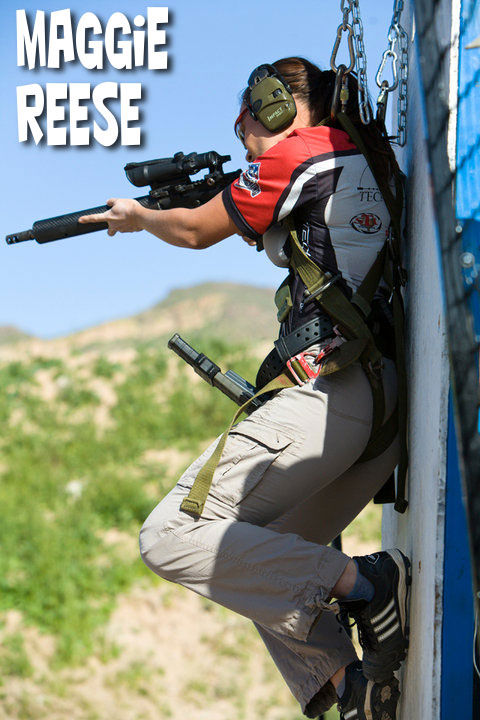


 Kirsten Weiss of Cornwall, PA was the 2012 NRA Women’s National Champion at the NRA Smallbore 3-P Championships held at Camp Perry, OH. She won the 2012 3-P smallbore championship in only her second trip to Camp Perry. Her first came nine years ago.


