|
|
November 16th, 2013
Conventional .308 Winchester brass has a large primer pocket with a large, 0.080″-diameter flash hole. Last year, Lapua began producing special edition .308 Win “Palma” brass that has a small primer pocket and a small flash hole, sized 1.5mm (.059″) in diameter. Tests by U.S. Palma Team members showed that the small-flash-hole .308 brass possibly delivers lower Extreme Spread (ES) and Standard Deviation (SD) with some bullet/powder/primer combinations. All things being equal, a lower ES should reduce vertical dispersion at long range.
Why Might a Small Flash Hole Work Better?
The performance of the small-flash-hole .308 brass caused some folks to speculate why ES/SD might be improved with a smaller flash hole. One theory (and it’s just a theory) is that the small flash hole creates more of a “jet” effect when the primer fires. Contributing Editor German Salazar sought to find out, experimentally, whether this theory is correct. German explained: “During one of the many internet forum discussions of these cases, Al Matson (AlinWA) opined that the small flash hole might cause the primer flash to be propagated forward more vigorously. In his words, it should be like shooting a volume of water through a smaller nozzle, resulting in a flash that reaches further up the case. Now that kind of comment really sparked my curiosity, so I decided to see what I could see.”
More Primer Testing by Salazar
You can read more about this test and other primer experiments on RiflemansJournal.com.
Salazar Primer Tests: Small Rifle Primer Study | Large Rifle Primer Study
Large and Small Flash Hole .308 Cases — But Both with Small Primer Pockets
To isolate the effect of flash hole diameter alone, German set up a test with the two types of .308 case that have a small primer pocket: Remington BR brass with a 0.080″ flash hole and Lapua Palma brass with a 0.062″ flash hole. NOTE: German reamed the Lapua brass to 0.062″ with a Sinclair uniforming tool, so it was slightly larger than the 0.059″ factory spec. The Remington brass has a .22 BR headstamp as this brass was actually meant to be re-formed into .22 BR or 6 BR before there was factory brass available for those cartridges.

German set up his primer testing fixture, and took photos in low light so you can see the propagation of the primer “blast” easily. He first tested the Remington 7 1/2 primer, a primer known for giving a large flame front. German notes: “I thought that if there was a ‘nozzle effect’ from the small flash hole, this primer would show it best. As you can see from the photos, there might be a little bit of a flash reduction effect with this primer and the small flash hole, the opposite of what we expected, but it doesn’t appear to be of a significant order of magnitude.”
Remington BR case, 0.080″ Flash Hole, Remington 7.5 Primer.

Lapua Palma case, 0.062″ Flash Hole, Remington 7.5 Primer.

Next German tested the Wolf .223 primer, an unplated version of the Small Rifle Magnum that so many shooters use. German notes: “This is a reduced flame-front (low flash) primer which has proven itself to be very accurate and will likely see a lot of use in the Lapua cases. With this primer, I couldn’t detect any difference in the flash produced by the small flash hole versus the large flash hole”.
Remington BR case, 0.080″ Flash Hole, Wolf .223 Primer.

Palma case, 0.062″ Flash Hole, Wolf 223 Primer.

German tells us: “I fired five or six of each primer to get these images, and while there is always a bit of variance, these are an accurate representation of each primer type and case type. You can draw your own conclusions from all this, I’m just presenting the data for you. I don’t necessarily draw any conclusions as to how any combination will shoot based on the pictures.”
Results of Testing
Overall, looking at German’s results, one might say that the smaller diameter of the small flash hole does not seem to have significantly changed the length or size of the primer flame front. There is no discernible increased “jet effect”.
November 16th, 2013
 Kirby Allen of Allen Precision Shooting, www.apsrifles.com, has developed a .30-caliber jumbo-sized magnum he calls the 300 Raptor. The 300 Raptor (center in photo) is based on Allen’s 338 Excalibur parent case (far right in photo), necked down to 30 cal with shoulder moved forward to increase case capacity. Allen states: “This is the largest capacity and performance .30 caliber magnum on the market that can be used in a conventional sized receiver.” Kirby Allen of Allen Precision Shooting, www.apsrifles.com, has developed a .30-caliber jumbo-sized magnum he calls the 300 Raptor. The 300 Raptor (center in photo) is based on Allen’s 338 Excalibur parent case (far right in photo), necked down to 30 cal with shoulder moved forward to increase case capacity. Allen states: “This is the largest capacity and performance .30 caliber magnum on the market that can be used in a conventional sized receiver.”
Shoot 200s at 3600 fps
Performance of Allen’s new 300 Raptor is impressive. Allen claims that “200gr Accubonds can be driven to nearly 3600 fps, 230gr Berger Hybrids to 3350 fps, and the 240gr SMK to right at 3300 fps. These loads offered case life in excess of 6-7 firings per case and many of my test cases have over 8 firings on each case so they are not an overly hot load showing the potential of this big .30 caliber.”

To showcase the new cartridge, Allen built up a prototype rifle with a McMillan A5 stock, Raptor LRSS Action with extended tenon, and a Jewell trigger. The first 300 Raptor Rifle is currently on its second barrel, a new 30″, 3-groove 1:9″-twist Lilja in a custom APS “Raptor Contour”. This distinctive dual-fluted contour runs full-diameter almost to the end of the stock, and then steps down and tapers to the muzzle, where a beefy Medium 3-port ‘Painkiller’ Allen Precision brake is fitted.

Story tip by EdLongrange. We welcome reader submissions.
November 15th, 2013
Replace your scope with an iPhone? That is now possible with the Inteliscope. This new product provides a rigid mount for an iPhone that attaches to your firearm’s Picatinny rail. A special software App allows the Inteliscope to be zeroed, with a variety of user-selectable reticles. Simply tap a button on the iPhone screen to switch reticles. You can even record video of your shooting session. The Inteliscope system costs $99.00, which includes rail mount, iPhone holder, and iOS App.


This set-up offers some benefits for short-range plinking and tactical-style shooting with relatively large targets. It may be best for Paintball and Airsoft applications. The built-in Shot Timer is useful for action shooting events. However, we have concerns about the long-term durability of an iPhone when used on a centerfire rifle. In addition, this kind of set-up is cumbersome and not particularly weatherproof. Therefore it has questionable utility for a hunter in the field.
On the other hand, this device could be a superb training aid. The Inteliscope provides a large display that can be viewed from a relatively wide angle. This allows a trainer/instructer to see how the shooter is aiming the rifle. The iPhone’s video-capture capability lets the shooter record his practice session. The ability to “share the view” (with an instructor) and record video (for later analysis), makes the Inteliscope a very valuable training tool. We know that juniors will enjoy seeing their targets through a digital screen.
Watch Video to See How Inteliscope App Displays Reticle on Gun-Mounted iPhone


Is There an Optical/Digital System in Your Future?
We doubt that most of our readers will want to purchase an Inteliscope. Since magnification is limited to the zoom capability of the iPhone, and the lens is small and cheap, this device will never provide the sharpness, clarity, or resolution of a fine rifle-scope. However, we think the Inteliscope is important because it shows how a small lens, combined with a digital viewing screen, can completely replace iron sights or a conventional optical scope.
We think the Inteliscope is important as a precursor of future integrated optical + digital technologies. In truth, a combined optical/digital system may be more suited to benchresters than hunters. A small, high-magnification optic (not much bigger than a pill bottle) could be mounted to the scope rail of a benchrest rifle. Windage and elevation could be adjusted externally, or via software. Light would pass through the optic’s lens to a high-resolution sensor — the kind already used in quality digital cameras. Then the “view” from the lens could be passed to a digital screen (or iPhone) via a cord, or via a wireless blue-tooth or WIFI connection. The screen (or iPhone) could then be placed on the bench in a position most convenient for the shooter. The Inteliscope demonstrates how software can provide the aiming reticle. With the very best high-magnification competition scopes now approaching $3000.00, it is time to look at other solutions. By reducing the size of the lens system and outputting the “view” to an iPhone or similar device, the entire cost of the rifle-mounted optic could be much less than we are paying now for premium rifle-scopes.
November 15th, 2013
 Forum Member Okey developed a cool, low-budget, long-range target cam system that displays target views on a large, flat-screen TV. Initial testing shows the system works very well. The TV monitor is installed in a Shooting Shack that allows year-round shooting, even in cold weather. The big monitor allows shooters to easily see their groups from any shooting position in the shack. Forum Member Okey developed a cool, low-budget, long-range target cam system that displays target views on a large, flat-screen TV. Initial testing shows the system works very well. The TV monitor is installed in a Shooting Shack that allows year-round shooting, even in cold weather. The big monitor allows shooters to easily see their groups from any shooting position in the shack.
Okey tells us: “Here’s a system my buddy and I put together. He is the brains behind it. I had the charge card. This is a home-made wireless target cam for long range shooting. It runs off a motorcycle or car battery. It uses a plain old camcorder camera, and a 2.4 GHz wireless digital link. The goal was to design something that has at least a 1000-yard range with good battery life. The transmitter puts out less than a watt, and runs on 12 volts. The camera runs on 7 volts, so there’s an on-board voltage regulator. The system draws a little less than one amp, so battery life estimate is simply the amp-hour rating of the battery. Everything was done to permit fairly rough handling, but it’s obviously not bullet-proof. It will last until somebody puts a 6mm hole in it.”


Back at the shack, there’s a high-gain receiving antenna, the receiver, and a wall-mounted flat TV. Okey notes: “Since the transmitter is fairly low power, we needed lots of antenna gain. We cobbled the system together and tested it at 100 yards before the conversion to DC power. It had lots of headroom, and should perform well without adding any more antenna gain. The system has worked well at 600 yards, with a reliable signal and good image. Look below for the image of the targets at 600 yards. We had the image zoomed to eight sheets of paper and could still see the hits.”

Recommended Equipment Sources
The 700mW 2.4 GHz A/V transmitter and receiver were sourced from ProtectionDepot.com. Combo price for both transmitter and receiver was a reasonable $179.00 (NOTE: it is $159.99 ON SALE right now, November 2013). The 2.4 gHZ, 24 dBi antenna cost only $57.99 from L-Com.com.
 
November 15th, 2013
 A poll conducted for the National Shooting Sports Foundation has found Americans are highly skeptical of the reliability of user authorized technology for firearms. They also say overwhelmingly that they would not be likely to buy a so-called “smart gun” and overwhelmingly oppose any government mandate requiring the use of this technology should it become available. A poll conducted for the National Shooting Sports Foundation has found Americans are highly skeptical of the reliability of user authorized technology for firearms. They also say overwhelmingly that they would not be likely to buy a so-called “smart gun” and overwhelmingly oppose any government mandate requiring the use of this technology should it become available.
Asked “How familiar are you with efforts to develop a firearm that will only fire for a specific authorized person(s)?”, only 20 percent of respondents said they were very or somewhat familiar with the concept of “smart gun” technology. When told that such firearms would incorporate biometric or radio frequency identification (RFID) with an activation system that would rely on battery power, 74 percent of respondents said that these firearms would not be reliable at all or very reliable. Gun owners overwhelmingly (84%) believed a smart gun would not be reliable, while a clear majority (60%) of non-gun owners also believed they would not be reliable.
An overwhelming 74 percent of respondents overall said that they would not buy or would not very likely buy such a smart gun. Some 70 percent of the survey sample said that they did not believe that government should mandate that all firearms produced incorporate smart gun technology should it become commercially available.
Can Technology Be Trusted? Watch this Video for a Chilling Vision of Future Gun Control:
These findings were among the results of a national scientific poll of more than 1,200 Americans conducted in October by McKeon & Associates and released by the NSSF. Although attempts to develop and market firearms equipped with authorized user recognition technology have been discussed for many years, the topic has been revived in recent months by some gun control advocates, remarks by President Obama and by the depiction of a smart gun in the latest James Bond movie. Read the NSSF press release for more details.
November 14th, 2013
 Wouldn’t it be great if you could apply a durable, two-part, commercial-grade coating on gun parts, with the ease of “rattle can” spraying. Until recently, you had to have some pro-grade equipment to apply multi-stage coatings. Now that has changed thanks to a new “can-in-a-can” developed in Europe. DuraCoat® can now be applied, in your choice of nine colors, from a single, convenient rattle can. The secret is the new type of twin-chamber can construction. An inner chamber holds the DuraCoat hardener (catalyst), while an outer chamber contains the DuraCoat color coating liquid. Wouldn’t it be great if you could apply a durable, two-part, commercial-grade coating on gun parts, with the ease of “rattle can” spraying. Until recently, you had to have some pro-grade equipment to apply multi-stage coatings. Now that has changed thanks to a new “can-in-a-can” developed in Europe. DuraCoat® can now be applied, in your choice of nine colors, from a single, convenient rattle can. The secret is the new type of twin-chamber can construction. An inner chamber holds the DuraCoat hardener (catalyst), while an outer chamber contains the DuraCoat color coating liquid.
The “can-in-a-can” design keeps the two elements completely separate until you are ready to apply the coating. It’s really quite ingenious. Duracoat’s owner, Steve Lauer, found this innovative dual-chamber aerosol can design in Europe. We believe his company, Lauer Custom Weaponry is the first to introduce this spray can technology in the American gun coating market.

Video Shows How to Apply DuraCoat with New Twin-Chamber Aerosol Can
 DuraCoat is a two-part coating system. Once the DuraCoat is mixed with the hardener, a chemical reaction occurs. That is why the two fluids must be kept separated until it’s time to coat a project. When you’re ready, you mix the two products by pushing a plunger in the bottom of the can. This is done by attaching a red button to the bottom of the can. Push down on the can and you’ll here a “pop” that indicates the hardener can migrate into the main chamber. Shake the can for a couple minutes and you are good to go (provided the product to be coated has been prepped properly.) DuraCoat is a two-part coating system. Once the DuraCoat is mixed with the hardener, a chemical reaction occurs. That is why the two fluids must be kept separated until it’s time to coat a project. When you’re ready, you mix the two products by pushing a plunger in the bottom of the can. This is done by attaching a red button to the bottom of the can. Push down on the can and you’ll here a “pop” that indicates the hardener can migrate into the main chamber. Shake the can for a couple minutes and you are good to go (provided the product to be coated has been prepped properly.)

DuraCoat is Versatile
Duracoat can be used on carbon steel, stainless steel, aluminum, metal alloys, wood, plastic and many other surfaces. No baking or pre-heating is required. DuraCoat is not just a thin cosmetic layer like conventional paint. When properly applied, DuraCoat offers good abrasion resistance and very effective protection against corrosion. DuraCoat Aerosol is currently offered in nine (9) popular colors: Matte Black, Woodland Green, Parkerized Gray, OD Green, White, Combat Gray, Pink Lady, Magpul Flat Dark Earth, and Blackhawk Coyote Tan. View DuraCoat Color Chart.
November 14th, 2013
 Do you need a solid, yet affordable front pedestal rest for load testing or varmint shooting from a bench? Here’s very good deal from Grafs.com. Right now the Caldwell Rock BR front rest is on sale for $129.99. That’s $20-$50 cheaper than you’ll find it elsewhere. And Graf’s $129.99 price includes ground shipping (after a single $6.95 handling fee for any order). The Caldwell BR rest isn’t super high-tech, but at 15.5 pounds, it provides a solid platform, with a wishbone-style, cast-iron base. A knob on the left allows easy windage adjustments. The three-lobe bag works fine for prairie dog safaris and general use. For competition, you may want to upgrade to a higher-quality front bag from Edgewood or Protecktor (this may require some minor modification to bag cradle). Do you need a solid, yet affordable front pedestal rest for load testing or varmint shooting from a bench? Here’s very good deal from Grafs.com. Right now the Caldwell Rock BR front rest is on sale for $129.99. That’s $20-$50 cheaper than you’ll find it elsewhere. And Graf’s $129.99 price includes ground shipping (after a single $6.95 handling fee for any order). The Caldwell BR rest isn’t super high-tech, but at 15.5 pounds, it provides a solid platform, with a wishbone-style, cast-iron base. A knob on the left allows easy windage adjustments. The three-lobe bag works fine for prairie dog safaris and general use. For competition, you may want to upgrade to a higher-quality front bag from Edgewood or Protecktor (this may require some minor modification to bag cradle).
We think this $129.99 price is a stellar deal. Check out the prices for the Caldwell Rock BR rest at other vendors (prices effective November 14, 2013):


Will this Caldwell Rock rest perform as well as a Farley, John Loh, or SEB front rest? Obviously not, but not everyone needs a state-of-the-art rest costing more than a factory hunting rifle. And consider this, you can buy the complete front rest for less than the cost of some of the super-deluxe, large-footprint rear bags. If you’re looking for a general-purpose rest that may see hard use around a ranch or farm property (or on varmint hunts), keeping your investment down isn’t such a bad idea.

November 14th, 2013
 The November 2013 Edition of Target Shooter Magazine is now available. The “cover boy” on this edition is Irish shooter Joe Melia, winner of the 2013 European F-Class Championships held at England’s Bisley Ranges. This month’s Target Shooter Magazine features an in-depth report on the Euro F-Class event, a review of the CZ Sporter rifle by Dick Wright, a feature on Benchrest Shooting by our friend Vince Bottomley, and a variety of other interesting articles. The November 2013 Edition of Target Shooter Magazine is now available. The “cover boy” on this edition is Irish shooter Joe Melia, winner of the 2013 European F-Class Championships held at England’s Bisley Ranges. This month’s Target Shooter Magazine features an in-depth report on the Euro F-Class event, a review of the CZ Sporter rifle by Dick Wright, a feature on Benchrest Shooting by our friend Vince Bottomley, and a variety of other interesting articles.
Download in PDF or iPad Formats
Target Shooter magazine is offered at a reasonable cost of just £0.83 (about $1.33 US) per issue. Target Shooter is currently available in two digital formats: 1) Downloadable PDF file; and 2) Apple iPad eZine available from the App Store.
NOTE: Past editions (prior to July 2013) are available to download for FREE from Target Shooter’s website. GO TO Free Download Page.

November 13th, 2013
Steven Blair’s recent report on the .300 WSM for F-Class stirred quite a bit of interest. If you’re a serious F-Open competitor, you’ll definitely want to read that article, which covers the pros and cons of the .30-Cal WSM loaded with the ultra-high-BC 230gr Berger Hybrid bullets.
If you’re thinking about building a .300 WSM for F-Class, here’s a rig that can give you some design and hardware ideas. This eye-catching custom .300 WSM F-Open rig belongs to Forum member Keith T. (aka “KT”). With its striking “bumblebee” color scheme, it will certainly get noticed on the firing line.
Click Photos to see full-screen versions.
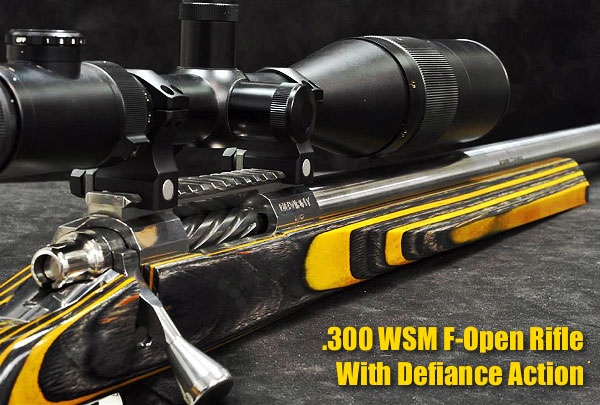
Bold Bumblebee .300 WSM for F-Class
Forum member Keith T. (aka “KT”) just got his hands on his new .300 WSM for F-Class and long-range competition. It’s a handsome brute, decked out in a “bumblebee” (yellow and black) laminated stock. Keith’s rifle features a Defiance Machine Deviant Long Magnum action (with Jewell trigger) in a Precision Rifle & Tool (PR&T) F-Class Lowboy stock. Keith has two 30″-long, 1:9″-twist barrels for the gun, one made by Brux Barrels, and the other by Bartlein. Both barrels have identical .300 WSM chambers cut with the same reamer. Keith will test both and then use the best-performing of the two in competition. Riding on top is a Nightforce 12-42x56mm Benchrest Model scope. All the work was done by Accurate Ordnance (AO), based in Winder, Georgia.
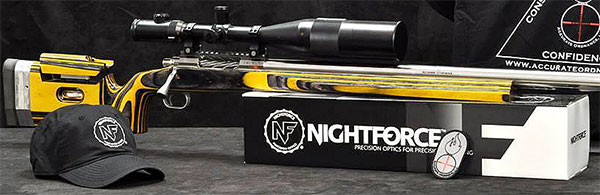
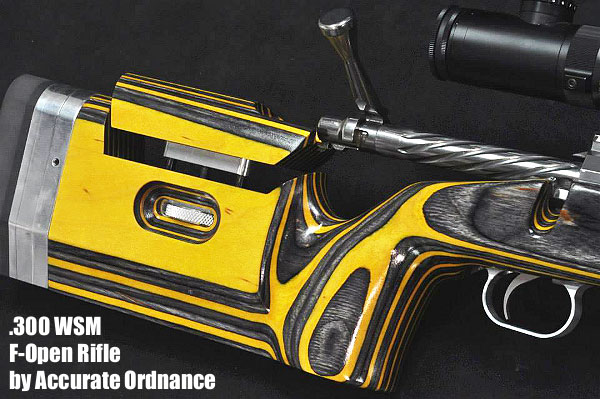
Keith reports: “This one took a while to get built due to parts availability issues, but I’m glad it’s done! Thanks to Accurate Ordnance and Nightforce and all their help.” NOTE: Accurate Ordnance tells us that a rifle like this can normally be completed in 6-8 weeks, once all key parts are in hand.
November 13th, 2013
 Why is ammo in short supply? Quite simply because Americans are buying ammunition (and reloading supplies) like never before, grabbing everything that comes off the production line. Consider this, ATK (NYSE:ATK), which owns Alliant Powder, CCI, Federal, RCBS, Bushnell, Savage and many other gun industry brands, reported a huge increase in revenues, mostly due to increased ammo sales. Why is ammo in short supply? Quite simply because Americans are buying ammunition (and reloading supplies) like never before, grabbing everything that comes off the production line. Consider this, ATK (NYSE:ATK), which owns Alliant Powder, CCI, Federal, RCBS, Bushnell, Savage and many other gun industry brands, reported a huge increase in revenues, mostly due to increased ammo sales.
ATK reported that second-quarter sales in its Sporting Group — which includes ammunition as well as optics, reloading gear and sport-shooting and tactical accessories — were up 48 percent to $421 million compared to $284 million in the same period last year. The company said the increase in sales was driven by higher volume in ammunition, sales from Savage of $57 million, and a previously announced ammunition price increase. ATK reported that its overall net income for the quarter was up 42 percent. Counting both military and civilian (Sporting Group) production, ATK produces over 6.5 Billion rounds of ammunition every year. Yep, that’s “B” as in Billion. That includes everything from .22 rimfire up to tank ammo.

$387,000,000 of Ammo for the Military
In related news, ATK announced that it has received orders for approximately $387 million for ammunition to be produced at its Lake City Army Ammunition Plant. The orders fall under the plant’s new production contract, which began Oct. 1, 2013, and include a mix of 5.56mm, 7.62mm and .50-caliber high-quality military ammunition.

|


