|
|
October 9th, 2013
 A while back your Editor was in New Mexico, on a prairie dog expedition. While in the field, my companions and I used two pairs of Steiner 8x30mm Military/Marine binoculars to spot the critters. Finding the Prairie Dogs (PDs) could be challenging in the high grass. Often, a PD would reveal only its head — a small target at distances approaching 400 yards. We really needed sharp optics with high contrast to spot the dogs hiding behind tufts of grass or dry brush. A while back your Editor was in New Mexico, on a prairie dog expedition. While in the field, my companions and I used two pairs of Steiner 8x30mm Military/Marine binoculars to spot the critters. Finding the Prairie Dogs (PDs) could be challenging in the high grass. Often, a PD would reveal only its head — a small target at distances approaching 400 yards. We really needed sharp optics with high contrast to spot the dogs hiding behind tufts of grass or dry brush.
The Steiner Military/Marine binoculars performed superbly. I came away very impressed with these armored 8x30mm binoculars. The glass is bright and super-sharp. And the rubber-armored body is truly rugged. These binoculars offer both right and left diopters — important for me as my right eye requires more correction than the left eye. One great feature of the Steiners is the focusing system which keeps everything you can see in focus. This really is a big deal. You don’t have to constantly fiddle with focus — everything past about 20 yards is in sharp focus all the time. As one Steiner owner reports: “Focusing set-up is worth the price of admission. Set it and forget. Amazing. This single feature makes these worth owning.” And the sharpness is impressive. I compared the Steiners’ image with a 6.5-20×40 Leupold EFR riflescope set at 8X. Both 8×30 Steiners were brighter than the Leupold scope, and the Steiners resolved individual blades of grass and fine details better than the Leupold. Of course, comparing a binocular optic with a riflescope is like comparing apples and oranges. The advantages of binoculars (compared to a monocular scope) are well known — the brain combines the two images (left eye and right eye) to create a more vivid, 3D effect, with greater perceived contrast.

Good Binoculars are a “Must-Have” Item for Hunters
After three days in the prairie dog fields I came away convinced that a good set of binoculars is absolutely essential for any varmint hunter. As the PD population was fairly thin where we were shooting, we probably spent five minutes glassing for every minute actually behind the trigger. Over 90% of the dogs were first spotted with binos rather than riflescopes. We had a fixed (non-rotating) bench so it was difficult to swing the rifle more than about 30° from one side to another (60° total arc). With the binoculars, and their wide field of view, we could quickly scan a much wider arc.


 Steiner 8×30 Military/Marine Binocs are Just $227.98 Steiner 8×30 Military/Marine Binocs are Just $227.98
At the end of our hunt, I told my host that I planned to purchase a Steiner 8×30 Military/Marine Binocular just like the one we used during our hunt. When I arrived home I was amazed to see that the Steiner 8×30 Military/Marine is available for just $227.98 on Amazon.com, with free shipping for Prime members. That’s a great value, considering the ruggedness and optical quality of the unit.
The 10×50 Steiner Military/Marine is also offered on Amazon.com. It has more magnification and better low-light performance. However, it currently runs about $489.98, more than twice the price of the 8×30 Military/Marine! Unless you really need the 10×50’s extra low-light capability, the 8×30 M/M is the smart choice.
October 8th, 2013
Here’s a great deal on an excellent spotting scope. Right now Amazon.com has the Pentax PF80-ED Angled spotting scope body for just $684.95 with FREE Shipping for Prime members. Supplies are very limited, so don’t hesitate. Mind you, this is just for the BODY ONLY — but the PF80-ED body alone sells elsewhere for $899.00 (See: Optics Planet PF-80ED).
Amazon.com also has the Pentax PF-80ED with straight body for just $629.00 (eyepiece not included). With either straight or angled version, a Pentax 20-60X zoom eyepiece will cost another $240 or so from Amazon.com, but you can find used models for less on eBay.
The PF-80ED has a large objective lens with high-definition glass. Focusing is fast and precise. You will have to purchase an eyepiece separately — but rest assured, the Pentax eyepieces are some of the best available, with large-diameter, astronomy-style mounts, and wide-angle view with extended eye relief. We use a Pentax PF100-ED and PF80-ED, with both zoom and fixed-focal-length eyepieces. The Pentax eyepieces are outstanding.
We actually prefer the PF80-ED (vs. the PF100) for most duties because it is MUCH more compact, and sits more steady on the tripod. While the PF80-ED has been out for a few years, it still compares favorably with spotting scopes that cost twice as much. To do better, you’ll need to spend over $2000.00 for a Kowa, Leica, Nightforce, Swarovski, or Zeiss spotting scope with low-dispersion glass. And, with most of these brands, that two grand will only get you the spotter body — you’ll then need to spend $400-$700 for the eyepiece. We think it’s hard to beat a PF80-ED at this sales price. Even after purchasing the eyepiece your total cost is about $925.00.
October 8th, 2013
Here’s an interesting challenge that could earn you $5000.00 worth of guns. (You like challenges right?) Clever gun customizers out there have a chance to win $5k worth of Ruger products by designing a 50th Anniversary Special Edition 10/22. So go to it — put bells and whistles on a 10/22 and see if Ruger likes your concept. After Ruger selects ten finalists, Ruger’s customers will vote for the winning rifle design. CLICK HERE To enter the Contest.

Ruger wants its fans to help design a Ruger 10/22 rifle to commemorate the 50th anniversary of Ruger’s popular rimfire rifle. Just submit photos of your ultimate 10/22 and include info on the build (stock, barrel, muzzle brake etc.). After Ruger narrows the entries to ten (10) finalists, Ruger fans will then vote for their favorite design. The winning designer will receive a production version of his rifle, a trip to Ruger’s Newport, NH plant, and $5,000 to be used toward the purchase of Ruger products. The remaining nine finalists will each receive a standard catalog Ruger firearm of their choice.

Contest Entrants must submit up to three photos of their customized 10/22, provide a list of parts used, and give a brief description of their design. Submissions will be accepted October 7 through October 18, 2013. On October 21, Ruger will announce the ten finalists and fans can vote for their favorite design. For Official Contest Rules, visit www.Ruger.com/1022Contest.
October 7th, 2013
 Yes old dogs can learn new tricks. Just five years ago Forum member Henry Pasquet (aka “HenryP”) got started in 1000-yard benchrest shooting. He was 66 at the time. Henry worked hard, learned fast, and pursued accuracy with a vengence. That all paid off when Henry won the 2013 IBS 1000-yard Nationals this summer, finishing as the Two-Gun Overall National Champion. Henry was kind enough to talk about his rifle, his reloading methods, and his strategy for success. In fact, Henry was eager to share “everything he knows, so that other guys can fast-track their learning process”. Henry told us: “I want to share every lesson I’ve learned, so that other guys can improve their game and enjoy the sport more.” Henry also wants to encourage other senior shooters: “If you pay attention to details (when reloading), and get a good rifle with a good barrel, age is not a handicap. With a good set-up, older guys can compete with anyone out there. This is one sport where you can be a champion in later life.” Yes old dogs can learn new tricks. Just five years ago Forum member Henry Pasquet (aka “HenryP”) got started in 1000-yard benchrest shooting. He was 66 at the time. Henry worked hard, learned fast, and pursued accuracy with a vengence. That all paid off when Henry won the 2013 IBS 1000-yard Nationals this summer, finishing as the Two-Gun Overall National Champion. Henry was kind enough to talk about his rifle, his reloading methods, and his strategy for success. In fact, Henry was eager to share “everything he knows, so that other guys can fast-track their learning process”. Henry told us: “I want to share every lesson I’ve learned, so that other guys can improve their game and enjoy the sport more.” Henry also wants to encourage other senior shooters: “If you pay attention to details (when reloading), and get a good rifle with a good barrel, age is not a handicap. With a good set-up, older guys can compete with anyone out there. This is one sport where you can be a champion in later life.”
Click on Rifle Photos to View Full-screen Versions

Q&A with Henry Pasquet, IBS 1000-Yard National Champion
Q: First, do you have any advice for older shooters getting started in their golden years?
Henry: You’re never too old. In this sport, you can excel even in your 60s, 70s and beyond. At this stage in life, we now have the time and money to get good equipment and rifles. Plus, our years of work experience help us to think, analyze, and thereby make progress. In this game, we older guys can definitely compete on a par with younger shooters.
HARDWARE
Q: Tell us about your Nationals-winning rifle and bench gear. Is there anything unique about your hardware that gave you an edge?
Henry: At the Nationals, I used my 17-lb Light Gun for both Light and Heavy Class. This rifle has a 1.55″, round BAT LP/RE action, fitted with a Bartlein barrel chambered for the .284 Shehane (an improved version of the .284 Winchester). The barrel was near-new; this was the first time I had used it this year. A great barrel and great batch of Berger 180gr VLDs all made a difference. Jay Cutright chambers my barrels. Jay’s metal-work is so precise that I can screw any barrel he’s chambered to any BAT action I own. The laminated stock was modified by Tommy Shurley from a standard 3″-wide fore-end to a 5″-wide True-Trac with an adjustable 3″-wide rear plate. It’s not pretty but it tracks like a Heavy Gun stock. Tommy made my other stocks as well.

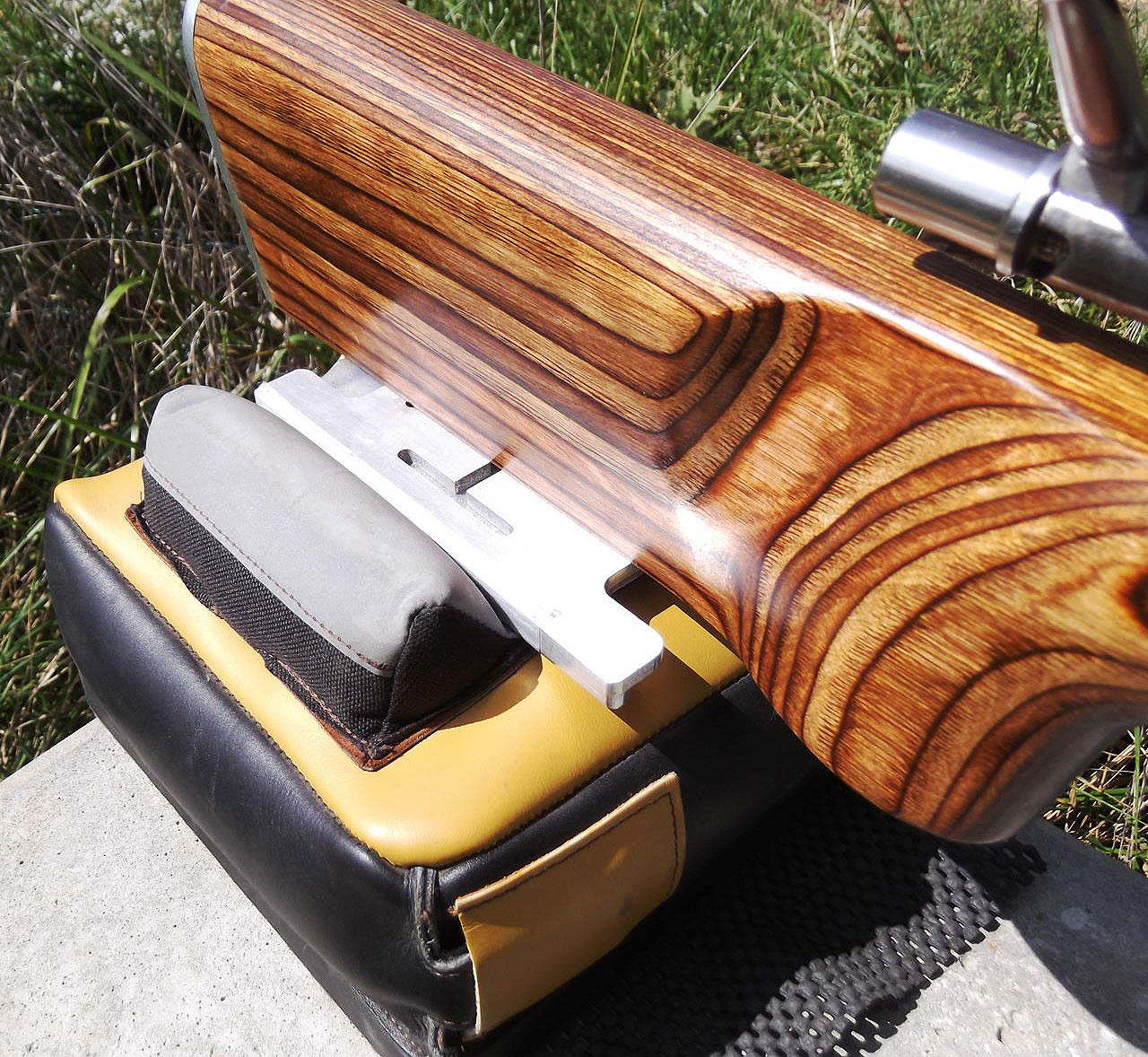
 On top is a Nightforce 12-42x52mm Benchrest scope with CH-3 reticle. I used a Fulghum (Randolph Machine) front rest with an Edgewood bag made with the low-friction 3M material. In the rear I use a special-order Protekor rear “Doctor” bag with ears spaced 3 inches apart. The rear bag also has the new 3M material on contact surfaces (photo at right). On top is a Nightforce 12-42x52mm Benchrest scope with CH-3 reticle. I used a Fulghum (Randolph Machine) front rest with an Edgewood bag made with the low-friction 3M material. In the rear I use a special-order Protekor rear “Doctor” bag with ears spaced 3 inches apart. The rear bag also has the new 3M material on contact surfaces (photo at right).
Q: During the Nationals, at the last minute you switched guns. Why did you go from a 6mm Dasher to a 7mm Shehane?
Henry: I had planned to use my Light and Heavy Dashers, but after placing the Dasher on the ready line, decided to switch to the .284 Shehane. It was still early in the morning and I felt that the heavier bullets would be easier to see against the berm. The Dasher had actually been giving tighter groups under perfect conditions, but seeing the impact is important.
Q: Tell us about the combined tuner/muzzle brake on some of your barrels. How does this improve rifle performance and how do you set the “tune”? Do you tune the barrel to the load?
Henry: I use a tuner or tuner/brake on every barrel. I started with Time Precision tuners. Art Cocchia advised getting a load with a good known accuracy node with minimum extreme spread, which controls vertical. Do not go for the hottest loads, which just reduces brass life. Then use the tuner and tune the barrel to the load. The .284 Light Gun needed a muzzle brake and tuner. I had a local gunsmith cut a thread on the muzzle brake for a tuner I got from Sid Goodling. (Eric Bostrom developed an almost identical unit at the same time. I use Eric’s tuner/brakes on all my new barrels.) Just before Nationals, I tried going up and down one marker. Down one mark cut the group in half! Think how much range time (and barrel life) that saved me. Using a tuner is easier than messing around changing loads and tweaking seating depths. Tuners definitely can work. Last year I shot a 3.348″ 10-shot group at 1000 with my .284 Win Heavy Gun fitted with a Time Precision Tuner.

Q: What are the advantages of your stock’s 5″-wide fore-end and 3″-wide rear plate? Is there a big difference in tracking and/or stability? Does the extra width make the rifle easier to shoot?
Henry: I had true Heavy Guns with 5-inch fronts and 3-inch rears. They tracked well. I felt the same result could be had with a Light Gun. I talked two stock makers into making them. I initially had the standard rear stock until Tommy Shurley and Mike Hearn came out with an adjustable rear plate. The stocks track perfectly. You can see your scope’s crosshairs stay on the target the whole time and push the rifle back for the next shot. There is no torquing (gun wobbling) when cycling the bolt. Us old guys need all the help we can get. I am getting rid of my 45-pound Heavy Guns and replacing them with Light Guns with heavy barrels.

Q: Some people say the .284 Shehane is not as accurate as the straight .284 Winchester. You’ve proved them wrong. Why do you like the .284 Shehane? More speed, less pressure?
Henry: The reason I rechambered my 7mm barrels to .284 Shehane was not velocity, pressure, or brass life. It was all about bolt lift. My straight .284 almost required me to stand up to eject brass. I damaged an extractor and had to send the bolt back to BAT. With the .284 Shehane, my bolt cycles like there is no case to eject.
Reloading Methods
Q: People want to know about your load and your loading methods. What can you reveal?
Henry: For my .284 Shehane at the Nationals, I loaded 52.5 grains of Hodgdon H4350 and Federal BR-2 primers behind Berger 180gr VLDs. I usually anneal the brass each winter. I have used the same brass for years. I use Redding bushing dies, apply Imperial sizing wax, resize, wipe off wax, clean and uniform the primers pockets using the RCBS Trim Mate Case prep center, then apply Imperial dry neck lube with a bore mop.
 To dispense powder, I use a RCBS ChargeMaster set 0.1 grain below my desired load and then weigh them on a Sartorius GD-503 magnetic force restoration scale to get identical charges. I use a K&M Arbor Press with seating force gauge when seating the bullets with a Wilson inline die. My “target” seating force on the K&M dial is 20-23 units for Dashers and 35-40 units for the .284 Shehane. I put any variables aside for sighters. I do not weigh brass, bullets, or primers. My bullets were so consistent that I did not sort by bearing surface. I did trim the Berger VLDs to the shortest bullet length with a Hoover Trimmer, and then pointed the meplats just enough to close them with a Whidden pointer. I sort my bullets to 0.005″ overall length, rejecting about five percent. To dispense powder, I use a RCBS ChargeMaster set 0.1 grain below my desired load and then weigh them on a Sartorius GD-503 magnetic force restoration scale to get identical charges. I use a K&M Arbor Press with seating force gauge when seating the bullets with a Wilson inline die. My “target” seating force on the K&M dial is 20-23 units for Dashers and 35-40 units for the .284 Shehane. I put any variables aside for sighters. I do not weigh brass, bullets, or primers. My bullets were so consistent that I did not sort by bearing surface. I did trim the Berger VLDs to the shortest bullet length with a Hoover Trimmer, and then pointed the meplats just enough to close them with a Whidden pointer. I sort my bullets to 0.005″ overall length, rejecting about five percent.
Q: What kind of precision are you looking for in your reloads? Do you trickle to the kernel? Does this really help reduce extreme spread?
Henry: I try to keep my charge weights consistent to one kernel of powder. I use the Omega powder trickler with a Sartorius GD-503 lab-grade balance to achieve that. For accurate dispensing, put very little powder into the Omega so you can drop one kernel at a time. Single digit ES (Extreme Spread) is the goal. This does make a difference at 1000 yards. If you get the same push on the same bullet with the same neck tension, good things are going to happen.
Q: You believe consistent neck tension (i.e. grip on the bullet) is really important. What methods are you using to ensure consistent bullet release?
Henry: I apply Imperial dry neck lube to the inside of my case-necks with a bore mop. The K&M arbor with seating force gauge shows the need to do this. If you put a bullet into a clean case, it will be jerky when seating the bullet. You may see 40 units (on the K&M dial) dropping to 20, then slowly increasing pressure. I explained to a friend that not lubing the neck is like overhauling an engine without lubing the cylinders. Smooth entry gives the bullets a smooth release.
Barrel Cleaning
 Q: You go 60-80 rounds between cleaning and the results speak for themselves. What is your barrel cleaning procedure? Do you think some guys clean too often or too aggressively? Q: You go 60-80 rounds between cleaning and the results speak for themselves. What is your barrel cleaning procedure? Do you think some guys clean too often or too aggressively?
Henry: I cringe when I see people wearing out their barrels with bronze brushes between relays. I clean my barrels at the end of each day when I get home. I shot my best-ever 1K Heavy Gun group (3.348″) at day’s end after 60 to 80 rounds. After trying other solvents, I have gone back to Wipe-out’s Carb-Out and Patch-Out products. I use about four patches of Carb-Out, let it sit a few minutes, then use one stroke of a nylon brush followed by Patch-Out until the barrel is clean. I use a bore mop to clean inside the chamber, then some Break Free LP on the bolt followed by bolt grease on the lugs and cocking part. I use a bore guide when anything goes down the barrel.
Shooting Skills and the Learning Process
Q: Henry, you can shoot long-distance on your own property in Missouri. How important is practice, and what do you do during a typical practice session?
Henry: I can shoot 1000 yards on my farm. I have a concrete bench using a slab from a yard furniture place on concrete blocks. Two 4 x 8 sheets of plywood hold four IBS targets. I never practice. I only test, keeping a notebook with all the info. I do most of my testing at 300 to 500 yards, shooting off my deck so I can see my shots immediately.

Q: How much of your success do you credit to really accurate rifles, versus superior shooting skills?
Henry: I do not consider myself another Carlos Hathcock or some master marksman. I am an average 1000-yard shooter, but I do work hard getting the most out of my rifles. Four other people have shot their first 1000-yard matches with my rifles, including my wife, and all of them won relays! I loaned my Dasher to another shooter two years ago and he got second at the 600-yard Nationals. Others will tell you that the rifle must be “on” to win. If your barrel or bullets are average, don’t expect to perform above average in competition.
Q: What you do enjoy most about long-range benchrest shooting? What are the attractions of this sport?
Henry: The sport offers good people and a real challenge. 1000-yard shooting keeps us all humble, but we still keep trying to see how good we can do. I am thankful for Robert Ross providing the only match location that I can shoot regularly.
Q: Henry, you have been a Forum member for many years. Have you learned important techniques from other Forum members and other shooters?
Henry: I have followed the AccurateShooter Forum since 2008. At my age I am not good at computers. I copied and analyzed many articles, especially on the .284 and the Dashers. Without AccurateShooter.com, I would probably still be shooting double-digit (10″+) groups at 1000 yards, and I sure wouldn’t have my name on a National Championship trophy.
Q: You are in your 70s now and have only been shooting competitively for a few years. How did you get so good so fast? How did you manage to beat shooters who are decades younger?
Henry: I had 20/10 vision when I was young, but am down to only 20/20. I have been interested in long range shooting for a long time including ground hog hunting. I went to some VHA jamborees also. In 2008, I went to the Williamsport Benchrest School with a friend from Pennsylvania, John Haas. We would compare notes frequently. I bought a BAT three lug from Tom Mousel in Montana. We also compared notes and made each other better. At IBS matches I studied other shooters’ equipment and techniques. I tried some, accepting some and rejecting some.
Here’s my advice:
Always be ready to learn something new. If it makes sense, try it. I would also encourage other older shooters not to quit. Stick to it. You can make enormous progress in a few seasons.

October 7th, 2013
 Planning to buy a gun soon, and worried about the effect of the Federal government shutdown? Many government services have been temporarily terminated (and Federal facilities closed). However, the background check system for firearms purchases is still up and running. The NSSF reports that The FBI’s National Instant Criminal Background Check System (NICS) Section is remaining fully operational and maintaining normal business hours. Accordingly, if you go to a gun store to purchase a firearm, the shop should be able to run a NICS background check in normal fashion. Planning to buy a gun soon, and worried about the effect of the Federal government shutdown? Many government services have been temporarily terminated (and Federal facilities closed). However, the background check system for firearms purchases is still up and running. The NSSF reports that The FBI’s National Instant Criminal Background Check System (NICS) Section is remaining fully operational and maintaining normal business hours. Accordingly, if you go to a gun store to purchase a firearm, the shop should be able to run a NICS background check in normal fashion.
However, some other firearms-related services of the Bureau of Alcohol, Tobacco, Firearms and Explosives (ATF) have been halted for the time being. The ATF’s Office of Enforcement Programs and Services (EPS), which includes the imports, firearms technology, NFA branches, and the licensing center and firearms industry programs branch now processing marking variances, is effectively shut down, operating only with minimal staff.
October 7th, 2013
 Here’s a new scope that may be well-suited for short-range varmint hunting (for smaller critters) and for rimfire tactical matches. Bushnell has released a new, affordable 2-7x32mm variable rifle scope with a Bullet Drop Compensating (BDC) reticle configured for the .22 LR rimfire cartridge. Anyone who has shot the .22 LR past 50 yards knows that this round drops a lot in a short distance. The “Drop Zone” BDC reticle, with multiple aiming points out to 125 yards, helps you stay on target. The reticle is calibrated for 38-40 grain, .22 LR high-velocity loads, with a 50-yard zero. This new scope, part of Bushnell’s AR line of scopes, features a 1″ main tube, target-style turrets, and side-focus parallax adjustment. MSRP is $149.99, but web vendors have lower prices. Amazon.com sells the scope for $131.23 with free shipping for Prime Members. Here’s a new scope that may be well-suited for short-range varmint hunting (for smaller critters) and for rimfire tactical matches. Bushnell has released a new, affordable 2-7x32mm variable rifle scope with a Bullet Drop Compensating (BDC) reticle configured for the .22 LR rimfire cartridge. Anyone who has shot the .22 LR past 50 yards knows that this round drops a lot in a short distance. The “Drop Zone” BDC reticle, with multiple aiming points out to 125 yards, helps you stay on target. The reticle is calibrated for 38-40 grain, .22 LR high-velocity loads, with a 50-yard zero. This new scope, part of Bushnell’s AR line of scopes, features a 1″ main tube, target-style turrets, and side-focus parallax adjustment. MSRP is $149.99, but web vendors have lower prices. Amazon.com sells the scope for $131.23 with free shipping for Prime Members.
October 6th, 2013
This story has all the ingredients: exotic location, exotic hardware, cool POV video (with John Lee Hooker blues soundtrack), plus something you’ve probably never seen before — a gravity-fed cartridge caddy that loads a PPC round into a benchrest rig with the push of a button. Watch this video to see Benchrest in Argentina with some very cool equipment:
Soundtrack includes John Lee Hooker’s blues classic “Boom, Boom” (starting at 0:28).
This video was filmed by our friend, Frenchman Pascal Fischbach, during his recent visit to Argentina. In Buenos Aires, Pascal met with action-maker extraordinaire Carlos (“Carlito”) Gonzales, creator of the CG Thunderbolt action. The video shows Carlito shooting groups with his CG-actioned benchrest rifle and MCF (“Manual Cartridge Feed”) ammo caddy. Look for the push-button control at the 1:15″ time-mark. The five-shot groups, shown at 1:20″, are pretty impressive. Even more impressive is how flawlessly this trick cartridge-fedding system works.
About Carlito’s Benchrest Rifle
 The rifle features Carlito’s CG thunderbolt action, in a low-profile carbon-fiber stock also made by Gonzales. Up front is a Bukys-style tuner. If you watch the video carefully, you may wonder “how do the cartridges get into the action?”, since you won’t see the shooter (Carlito) pulling rounds from a loading block. Well the secret is that metal contraption to the left of the gun. It is a gravity-fed caddy connected, via cable, to a hand control. After working the bolt to extract a fired case, the shooter can push a button and the next round drops down from the upper left into the left port/right eject action. Simply close the bolt and you’re ready to roll. For more information, visit Benchrest.com.ar or email casagonzalec [at] benchrest.com.ar . The rifle features Carlito’s CG thunderbolt action, in a low-profile carbon-fiber stock also made by Gonzales. Up front is a Bukys-style tuner. If you watch the video carefully, you may wonder “how do the cartridges get into the action?”, since you won’t see the shooter (Carlito) pulling rounds from a loading block. Well the secret is that metal contraption to the left of the gun. It is a gravity-fed caddy connected, via cable, to a hand control. After working the bolt to extract a fired case, the shooter can push a button and the next round drops down from the upper left into the left port/right eject action. Simply close the bolt and you’re ready to roll. For more information, visit Benchrest.com.ar or email casagonzalec [at] benchrest.com.ar .


External Horizontal Cartridge-Feeder
The Gonzales loading device is an open-ended, covered metal tray situated on the left side of the action (but it does not touch the gun — it is supported by an arm attached to the front rest). This feeds into the left-side loading port. The cases are gravity-fed, but the shooter has positive control over feeding. A cable with a push-button control runs from the magazine down to the rear foot of the pedestal rest. You just push the button to drop one cartridge from the magazine. We don’t know exactly how the cartridge is released in the magazine itself, but in the video below you can see how the push-button works. This device has been approved for competition by USA and International benchrest sanctioning bodies.

Photo by Rich Pollock of Benchrest.ca

Video Shows Cable-Operated Cartridge Feeder in Action
October 6th, 2013
Gunsmith Mike Sosenko and long-time AccurateShooter Forum member John Adams have been using a modified .243 Winchester case with great success in Varmint Silhouette matches at the Pala Range in Southern California. Officially called the “.243 BR-K” (and informally dubbed the “6BR Long”), the wildcat is basically a .243 Winchester with less body taper and a 30-degree shoulder. The design essentially grafts a 6mmBR Norma “top end” to the .243 Winchester case. After fire-forming, Mike and John can reload this case using normal, unmodified 6BR neck-sizing and seater dies.
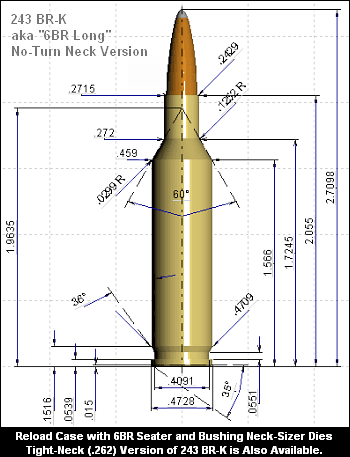
Compared to a .243 Winchester, the .243 BR-K’s body length is about .006″ longer, and the shoulder is about .0055″ wider. The main difference is the shoulder angle (30° vs. 20°), and the location of the neck-shoulder junction (“NSJ”). Based on reamer prints, the base to NSJ dimension is 1.718″ on the 6BR Long, compared to 1.804″ for the .243 Winchester. Neck length is a bit shorter because “the neck shrinks a little when the shoulder blows out” according to Sosenko. We’ve provided a mock-up diagram of the .243 BR-K, but you should check with Dave Kiff of Pacific Tool & Gauge for exact dimensions. Dave created the reamers for both the 6mm and 22-caliber versions of this wildcat. Ask for the “22 BR-K” or “.243 BR-K” reamer designs.
 |
 |
Wicked Velocity with Stable Brass
The main advantage of the .243 BR-K is serious velocity in a case that is very stable. Mike’s favorite load is the 95gr Berger VLD pushed by Reloader 22. With a stout load of RL22 and Federal 210m Primers, Sosenko is getting 3450 fps with the 95-grainer, with no bullet blow-ups. This is with a 1:8.5″ twist Broughton 5R barrel finished at 28.5″. The cases are holding up very well. Mike has a half-dozen loads on his brass and he hasn’t had to full-length size yet. Mike runs a .262″ tight neck, but there is also a no-turn version of the case (see illustration). Accuracy is excellent. Mike says the round delivers repeatable 1/4 MOA groups at 100 yards in testing. He has also experimented with N160, but, thus far, Reloader 22 has delivered smaller groups with better ES and SD.
VIEW 243 BR-K REAMER PRINT (No-Turn Neck)
John Adams shoots a no-turn (.274″) neck .243 BR-K with 105gr Berger VLDs. He’s getting about 3230 fps using Reloader 22. John says he can push the 105s faster, but 3220-3240 fps “seems to be the sweet spot.” John notes that “after about five reloadings on a case, it gets a little tight”. John then full-length sizes with a custom Hornady FL bushing die. “The Hornady custom shop dies work great” according to John. Adams also shoots a version of this wildcat necked down to 22-caliber. It has demonstrated outstanding velocity and good accuracy in initial testing with a 9-twist barrel. Using the 80gr Amax bullets, John is getting 3570+ fps speeds. John feels that his 22 BR-K needs some more development work. “The .243 BR-K is proven. We know what works. With the 22 I want to try different seating depths, experiment with a few different bullets, and fine-tune the velocity.”
Whitley’s 6mm Super X
Robert Whitley shoots a variant of the .243 Winchester he calls the 6mm Super X. This features a 30° shoulder, and slightly less body taper. He gains a little case capacity over the standard .243 Win, and he says the cartridge is extremely accurate with both 105-108 grain pills and the heavier 115s: “Here’s a picture of a .243 Win (left), a 6mm Super X (center), and a 6XC (right). All I can say is the 6mm Super X has been good to me and I have shot many a clean in 600-yard High Power matches with it with either DTAC 115s or Berger 115s.”

While Mike Sosenko and John Adams use their BR-Ks to push 95s and 105s at high velocities, Robert takes a different approach with his Super X. He shoots the high-BC 115s and keeps velocities under 3000 fps. A long-range High Power shooter, Robert demands consistency during long shot strings. That means backing off from max attainable speeds, at least with the 115s. Robert writes:
“You can get 3050 fps with H4831SC and the 115s with no problem, I did it in testing multiple times, but to me that also does not mean anything because I shoot loads where they are the most consistent and accurate over a 22+ shot string. I have never found that any of the 6mm cartridges I have used with 115s will stay consistent, tight and accurate the whole way at 3050 fps for 22+ shots straight. I have tried 115s in the .243 Win, the 6CM, the 6mm Super X, the 6XC, the 6-6.5 x 47 Lapua and none of them ever stayed consistent and tight for 22 shots straight with the 115s at that speed. Most of the time with all the 6mm cartridges, if you get the 115s much over 2975 fps, they won’t hold tight for 22+ shots straight. Now if you’re a bench rest shooter and you only need to do a few sighters then 5 or 10 shots for record, you can run 3050 fps or more and the groups will likely hold tight during your string, but not when you need to go 22+ shots straight with no break. I have shot many different 6mm cartridges and done a lot of testing with many different powders, moly and non-moly bullets. I don’t find the ‘consistent accuracy’ (for 22+ shots straight) at those higher velocities.”
October 6th, 2013
Carl Zeiss Sports Optics is extending its ZEISS/Kenton Industries Custom Turret Promotion through December 31, 2013. Through this special offer, when you purchase a new CONQUEST HD5 Riflescope, you get one of two Kenton Custom Turrets calibrated for your specific load — either a LR Hunter Turret or Speed Dial Turret. Eligible scope models are the Zeiss CONQUEST HD5 3-15×42 #20 reticle with Lockable Target Turret, and the CONQUEST HD5 5-25×50 #20 reticle with Lockable Target Turret. The retail value for the free custom elevation turret is $125.00
 Mike Jensen, President of Carl Zeiss Sports Optics USA explains how the system works: Mike Jensen, President of Carl Zeiss Sports Optics USA explains how the system works:
“With our custom turret system, [just] set the dial to the number 4 for 400 yards and you’re done. No complicated math, and no color codes to compensate for the bullet drop. The numbered markings on the custom turret by Kenton Industries are easy to read and intuitive. Add the available ‘no-hold-over’ PLEX reticle with the Kenton custom target turret and you have an extremely accurate and very robust long-range shooting setup.”
To receive a free ZEISS/Kenton Custom Ballistic Turret, the qualifying CONQUEST HD5 Riflescopes must be purchased from an authorized ZEISS dealer before December 31, 2013. Offer details and order forms can be found at Kentonindustries.com or at www.zeiss.com/sports. The order form requires ballistic info such as cartridge, ammunition type, bullet weight, and zero range. The custom turret will be shipped within 2-3 weeks. This offer is valid for U.S. customers only.

For more information on ZEISS products visit www.zeiss.com/sports or the Zeiss Facebook Page.
October 5th, 2013
 This story is not (directly) about guns and ammo, or reloading gear, or any of the little details of our sport. It, instead, is about life… and, sadly, about death. As you may know by now, Tom Clancy died this week at age 66. Clancy created a new fiction genre that entertained millions — the “military techno-thriller”. Tom was a damn fine writer, and like you and me, he was also a true “gun guy”. He will be missed. This story is not (directly) about guns and ammo, or reloading gear, or any of the little details of our sport. It, instead, is about life… and, sadly, about death. As you may know by now, Tom Clancy died this week at age 66. Clancy created a new fiction genre that entertained millions — the “military techno-thriller”. Tom was a damn fine writer, and like you and me, he was also a true “gun guy”. He will be missed.
Tom Clancy’s unexpected passing was a “wake-up call” for your Editor. I turn 58 this month. That number is not much less than 66, the number of years Clancy got to spend on our blue planet. This got me to thinking, “What if I only had ten more years to live — how would I want to live my life? What really counts the most? What things would I do differently? What dreams would I pursue?”
From the demographics of this website, I know we have thousands of readers in their 50s, 60s, and 70s. Hopefully we will all live long, happy, and fruitful lives. But it’s not a bad idea to consider that we are all mortal, and the clock is ticking. Consider this — in the United States, the average male life expectancy is 76 years*. Using that number as a benchmark, I personally may have another 18 years to enjoy life and to do the things I love — shooting, traveling, sailing, camping, listening to music, being with friends and family. Breaking that down into months, I have 216 more months to do fun and rewarding stuff. Just 216 months — that’s a real number my brain can comprehend all too well. If I live an average lifespan, that means I also only have 939 more weekends to do all that I want to do. With less than 1000 weekends remaining, I don’t want to waste a single one. Here’s a chart that shows how many more weekends you may have, based on your current age:

Living a Life with More Good Times, and Fewer Regrets
Recently, a group of men, very near the end of their lives, were surveyed. They were asked if they would do things differently if they could live their lives over again. The vast majority of these men gave surprisingly similar responses, which fit into five “Life Lessons”. These “Top 5 Regrets of the Dying” were reported in a story by Bronnie Ware, writing for the AARP online magazine. Ware writes: “When questioned about any regrets they had or anything they would do differently, common themes surfaced.” Here are the five regrets most often mentioned by older men:
1. I wish I’d had the courage to live a life true to myself, not the life others expected of me.
“This was the most common regret of all. When people realize that their life is almost over and look back clearly on it, it is easy to see how many dreams have gone unfulfilled. ”
Lesson: Don’t wait to follow your dreams. Be true to yourself.
2. I wish I didn’t work so hard.
“This came from every male patient [surveyed]. All of the men… deeply regretted spending so much of their lives on the treadmill of a work existence.”
Lesson: Don’t let your work crowd out other important aspects of life.
3. I wish I’d had the courage to express my feelings.
“Many people suppressed their feelings in order to keep peace with others. As a result, they settled for a mediocre existence and never became who they were truly capable of becoming.”
Lesson: Express yourself truthfully. Don’t suppress your feelings for decades.
4. I wish I had stayed in touch with my friends.
“There were many deep regrets about not giving friendships the time and effort they deserved. Many [were] so caught up in their own lives that they had let golden friendships slip by over the years.”
Lesson: Take an interest your friends’ lives; keep bonds of friendship strong.
5. I wish that I had let myself be happier.
“This is a surprisingly common [regret]. Many did not realize until the end that happiness is a choice.”
Lesson: Affirmatively pursue the things that bring you happiness. Don’t just stick to old habits.
Turn Off the Computer, and Do Something Memorable with Your Friends Today
How does this all apply to our shooting hobby? Well, if (like me) you are middle-aged (or older), go have some fun this weekend! Load up your rifle and get to the range. Don’t put off doing the things that make you happy. Call those old buddies you may not have seen in a long time. Renew friendships. Get out into nature. And start figuring out how you can live your dreams. As the saying goes, “Time waits for no man”.
*One of our readers pointed out that the numbers actually work out better than this, because once a man survives to later life, men of his surviving age cohort enjoy a projected lifespan longer than the average projected lifespan from birth. For example, using actuarial tables, a man born exactly 60 years ago (still alive today), has a calculated life expectancy of 23.4 years… meaning he would live to age 83.4 years, on average. CLICK HERE to see actuarial-predicted longevity based on your birthdate.

|