IBS Report and photographs by Dick Grosbier
Over Labor Day weekend the Union County Sportsmans Club (Weikert, PA) hosted the 43rd annual IBS 100/200 Score Nationals. This club has a reputation for hosting fine events, and this match certainly lived up to that reputation. With 63 guns on the line, this year’s Score Nationals was well-attended. All in all this was as good a Score Nationals as I have attended in quite a while. I tip my hat to the Union County crew for running an excellent match. Weather was warm and a little muggy both days. I do not believe we ever had a drop of rain (despite a 30% chance of rain forecast). Mirage was very minimal as it was overcast both days. Winds started out very calm and slowly increased all day long both days.
Left to Right: IBS Score 2-Gun Winner Dean Breeden, Varmint For Score Grand Agg Winner Herb Llewellyn, Hunter Class Grand Agg Winner Gary Long.
On Saturday, Herb Llewellyn started out on a tear in Varmint For Score (VFS) class and stayed hot, finishing the 100-yard event with a 250-25X score. We witnessed some really fine shooting in less-than-perfect conditions. Junior Shooter Kevin Donalds Jr. (photo below) laid down a fine 250-24X to finish second. Kevin, who turns a ripe old 13 years of age in a few days, shot a remarkable 250-25X Aggregate a few months back. To the best of my memory those are the only two 250-25X scores in IBS this year. A.R. Edwards was third with 23X.
In Hunter Class Dean Breeden shot 250-17X beating more than 50% of the VFS shooters, and for those of you who do not fully understand Hunter Class, the big thing to remember is they shoot 6-power scopes. Peter Hills from Maine also shot a 250 in HTR with 9X.
Sunday the shooters lined up for the 200-yard event. Shooting his 6 PPC, Hal Drake shot a 250-14X, proving that a PPC can still win in a Score match (at least at the longer ranges). Second place (as at 100 yards) went to a Kevin Donalds, but this time it was Kevin Donalds Senior who was the runner-up, posting a 250-13X. Third place honors went to Dean Breeden also with 250-13X. In Hunter Class, veteran shooter Gary Long shot 248-5X to beat K.L. Miller under Creedmoor tie-breaker rules. Dave Thomas was third with 247-7X.
You may have noticed that nobody in the top three on Saturday was in the top three on Sunday. This led to some interesting results in the VFS Grand Aggregate. Top Man was Herb Llewellyn, with a 500-36X. Herb’s victory at the Nationals pretty much puts the last nail in the coffin of anybody trying to catch Herb in the Score Shooter Of the Year race.
Second in the Grand was Herb’s lovely wife Kim with a 500-34X. Third place went to Randy Jarvais who learned the hard way to not drop the first X! Randy tied with Kim for total score all weekend but Kim shot a 5X on the first target and Randy got a 4X. Fourth in the Grand went to 200-yard winner Hal Drake with 500-33X, and Ricky Read rounded out the Top Five with 500-32X.
Gary Long won the Hunter Grand division with 497-22X, Dean Breeden was second with 496-20X, and third was Dave Thomas with 496-14X. It was great to see Dave back shooting again. Dean Breeden put in a repeat performance as IBS Score 2-Gun winner with a 996-51X score, Larry Feusse was second with 990-46X and Dudley Pierce was third with 987-44X.
IBS 43rd Annual 100 / 200 Yard Score Nationals
Union County Sportsman’s Club — August 31st to September 1st, 2013
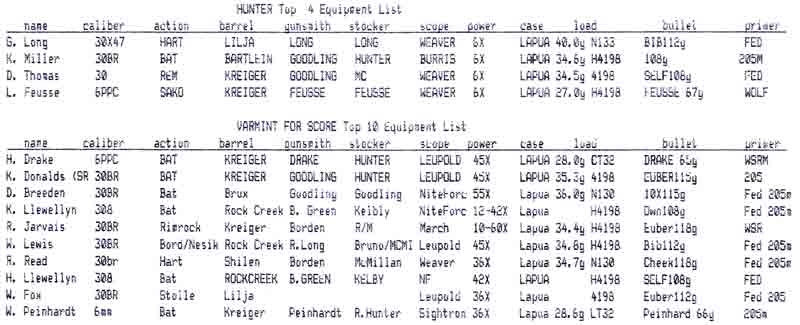
CLICK Equipment Lists Below to See LARGE Versions
Praise for the Match Crew and Kitchen Crew
I cannot say enough good things about the target crew and range officer Mark Trutt. They ran a very efficient match. I do not recall a single delay all weekend from loose- or erroneously-hung targets. We started promptly at 9:00 am and finished around 2:00 pm both days. Range officer Mark Trutt did an outstanding job when confronted with a tricky situation regarding IBS Score 2-Gun shooters. The range has 40 benches and we had a very nice turnout of 63 guns on the line but it simply was not justified to run a third relay so Mark judiciously added around 10 minutes between each relay to allow 2-gun shooters some time to reload. I don’t think the time would even have been noticed but the target crew was speedy and efficient, so we ended up with a little extra time on the line. I personally felt it made for a very nice, laid-back pace for competitors shooting only one gun. Scoring was fast and efficient for the most part.
The Kitchen crew deserves praise for the fine breakfasts and lunches. In good Weikert tradition, we were treated to “Mama Trutt’s” fresh-baked cookies each afternoon. — Dick Grosbier
American Kenny Adams is the new F-Open World Champion, winning the individual title last week at Raton, New Mexico. ‘King Kenny’ rose to the top through with skill, countless days of practice, and great determination. He put in the trigger time, including many long days at Raton. But when we cornered Kenny after his win at the Worlds he was quick to give credit to his gunsmith, Stick Starks of S&S Precision Rifles in Texas.
Kenny told us: “I want to thank my gunsmith, Stick Starks from S&S — he got me going in this thing in the right direction four and a half years ago. Working with Stick has probably shaved a couple of YEARS off my learning curve.” Kenny’s world-beating rifle features a Panda F-Class action placed in a Robertson F-Class stock. The Krieger barrel is chambered for the 7mm RSAUM.
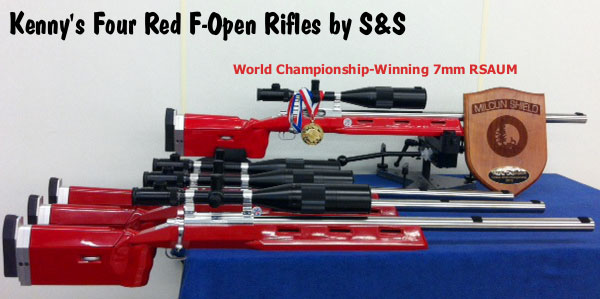
Kenny Has Four Red F-Class Rifles All By S&S
What’s interesting is that Stick Starks made Kenny three other F-Class rigs, all with red Robertson stocks and Panda F-Class actions. So, counting the championship 7mm RSAUM, Kenny owns a fleet of four fire-engine-red F-Class rigs, all built by Stick at S&S. These three other red rifles were originally chambered in 6.5-284, 6mmBR, and 6.5×47, but Kenny switches barrels (and chamberings) to suit the venue and course of fire. In Raton, Kenny had two (2) of the red rifles chambered in 7mm RSAUM and two (2) chambered for the .284 Winchester. However, in the Individual World Championship he shot just one rifle, a 7mm RSAUM (shown below). He used the second 7mm RSAUM-chambered rifle in the F-Open Team Championship. This second RSAUM (used for team shooting) is the one pictured above, but his other RSAUM is identical in all respects. He did not shoot either .284 Win during the Worlds.
Kenny’s World-Beating 7mm RSAUM Load
For his 7mm RSAUMs Kenny loads Hodgdon H4350 powder and Federal 215m primers into Nosler or Norma RSAUM brass. In the RSAUM he runs Berger 180gr Hybrid bullets seated “just touching” the lands. For his .284 Winchester-chambered rifles he loads necked-up Lapua 6.5-284 brass with 180gr Hybrids pushed by H4831sc powder and Federal 210m primers. Interestingly, he is very precise with his charge weights. Using a Sartorius Magnetic Force Restoration scale, Kenny tries to hold his powder charges to within 1-2 kernels charge-weight consistency.
While Kenny praised S&S for building great rifles, Stick is quick to say that Kenny deserves the credit: “He’s the man that pulled the trigger. He’s the man that beat the world. You can’t believe how dedicated Kenny is to his sport. He spends so much time shooting and practicing — true dedication. Kenny hung in there, never gave up, did the best a man can hope to do. Yeah you have to have good equipment, but you do have to have dedication in this sport. Buy the best equipment you can and the rest is up to you — learning how to read conditions. That’s all there is to it.”
S&S Can Build You a ‘Kenny Clone’ for $3800.00
By the way, if you want a gun just like Kenny’s, Stick told us: “I’ve got barrels, Panda F-Class actions, and I have one last Robertson F-Class stock left. Just one — these aren’t made any more you know. A complete build, with barrel of your choosing and Jewell trigger, will be about $3800.00.”
S&S Precision Rifles is a leading gunsmithing operation based in Argyle, Texas. Stick Starks and the crew at S&S build very accurate rifles, that also exhibit superb craftsmanship. While S&S built a championship-winning F-Open gun for Kenny, they can also built short-range benchrest rigs, as well as varmint and hunting rifles — all with hallmark S&S quality. S&S can handle every aspect of gunsmithing — chambering, bedding, even stock-painting.
In the video above, the folks at S&S put together some tack-drivers for their customers. There are some nice glimpses of bedding work, and barrel finishing. Watch carefully — at the 40-second mark you’ll see a sub-1/4″, 10-shot group that S&S co-owner “Stick” Starks shot at 200 yards with his 6.5×47 Lapua rifle. That’s serious accuracy. Half-way through the video, Stick offers advice for shooters looking for a super-accurate fun gun for club shoots: “If you want to shoot [at] 100 and 200 yards, I’d get me a 6BR or a 30 BR. It would be the most fun gun you ever had… and the barrel will probably last three or four thousand rounds.” If you want a gun to shoot at primarily 500-600 yards, Stick recommends the 6.5×47 Lapua chambering: “Run it with the Berger 130s and Hodgdon H4350 powder. That H4350 works great with the 130 Bergers.”
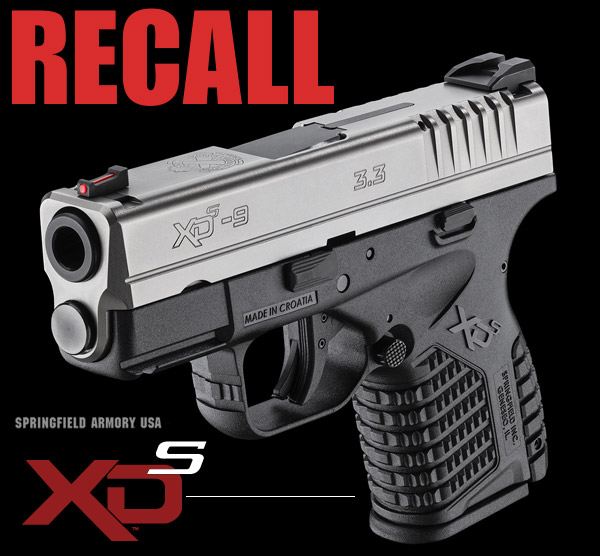
Springfield Armory (Springfield) is recalling certain 3.3 XD-S™ 9mm and 3.3 XD-S™ .45ACP pistols (serial numbers below). The reason for the safety recall is that “under exceptionally rare circumstances, some 3.3 XD-S™ 9mm and .45ACP caliber pistols could experience an unintended discharge during the loading process when the slide is released, or could experience a double-fire when the trigger is pulled once.” This could cause serious injury or death. If you own an XD-S 9mm or .45 ACP pistol subject to recall, stop using the pistol, carefully unload it, and return it to Springfield. Springfield will install new components that should eliminate the potentially dangerous condition.
This Safety Recall Applies to:
Springfield 3.3 XD-S™ 9mm pistols – serial numbers between XS900000 and XS938700.
Springfield 3.3 XD-S™ .45ACP pistols – serial numbers between XS500000 and XS686300.
Note: This Safety Recall does not apply to any XD® or XD(M)® pistols.
If you have one of the affected XD-S 3.3 pistols, go to the Springfield Recall Notice Page (or call 800-680-6866). Click on the Get Started link at the top of the Recall Notice Page. Enter your serial number and click Next. The serial number is located on the frame beneath the dust cover (accessory rail). If your pistol is subject to recall, you will need to provide your contact info. If you no longer own the 3.3 XD-S™ 9mm or .45ACP pistol, please advise Springfield of the current owner.
Springfield will provide a return authorization and mailing label, so owners can return affected XD-S pistols at no cost. Springfield will then install upgraded components, and return the pistol. Visit www.springfieldrecall.com for further information or call 800-680-6866.
Report and Photographs by Tony Chow
On August 12th to 16th, USAMU’s Fort Benning range hosted the 2013 USA Shooting 300m National Championships. This match, held every four years, nominates athletes to represent the United States at the 300m World Championships, due to be held in 2014, in Granada, Spain.
300m Shooting — A World-Class Challenge
300m shooting is a challenging discipline. With much smaller scoring rings than NRA targets, the 300m target can bedevil even the most experienced High Power shooters, especially in tricky wind conditions. While European 300m shooters typically use expensive rifles from the likes of Gruenig & Elmiger (G&E) and Bleiker, less costly American-made equipment has proven to be every bit as competitive. Case in point are the free rifles used by the USAMU team, all of which are built from American target actions such as Panda and BAT, fitted with Krieger barrels, and glass-bedded into Anschütz stocks.
The competition took place in unseasonably mild weather for this time of the year in Georgia. As the popularity of 300m shooting is limited in the United States, 21 shooters in total took part in four days of competition. Despite the light participation, the athletes included some of the best international rifle shooters in the country. The relaxed and club-like atmosphere belied intense and high-level competition on the firing line.
Electronic targets record all shots as 10, 9, 8, etc., with the X-count being the first tiebreaker. Each whole number score is accompanied by a more precise score that ranges from 0-100. An official 10, for example, could be anything from 91 (on the edge of the ring), all the way to 100 (dead center). The more precise score is NOT used officially for score keeping in ISSF competition, but could be in the future, as already is the case in 50m prone and 10m air rifle.
3P Course of Fire and Results
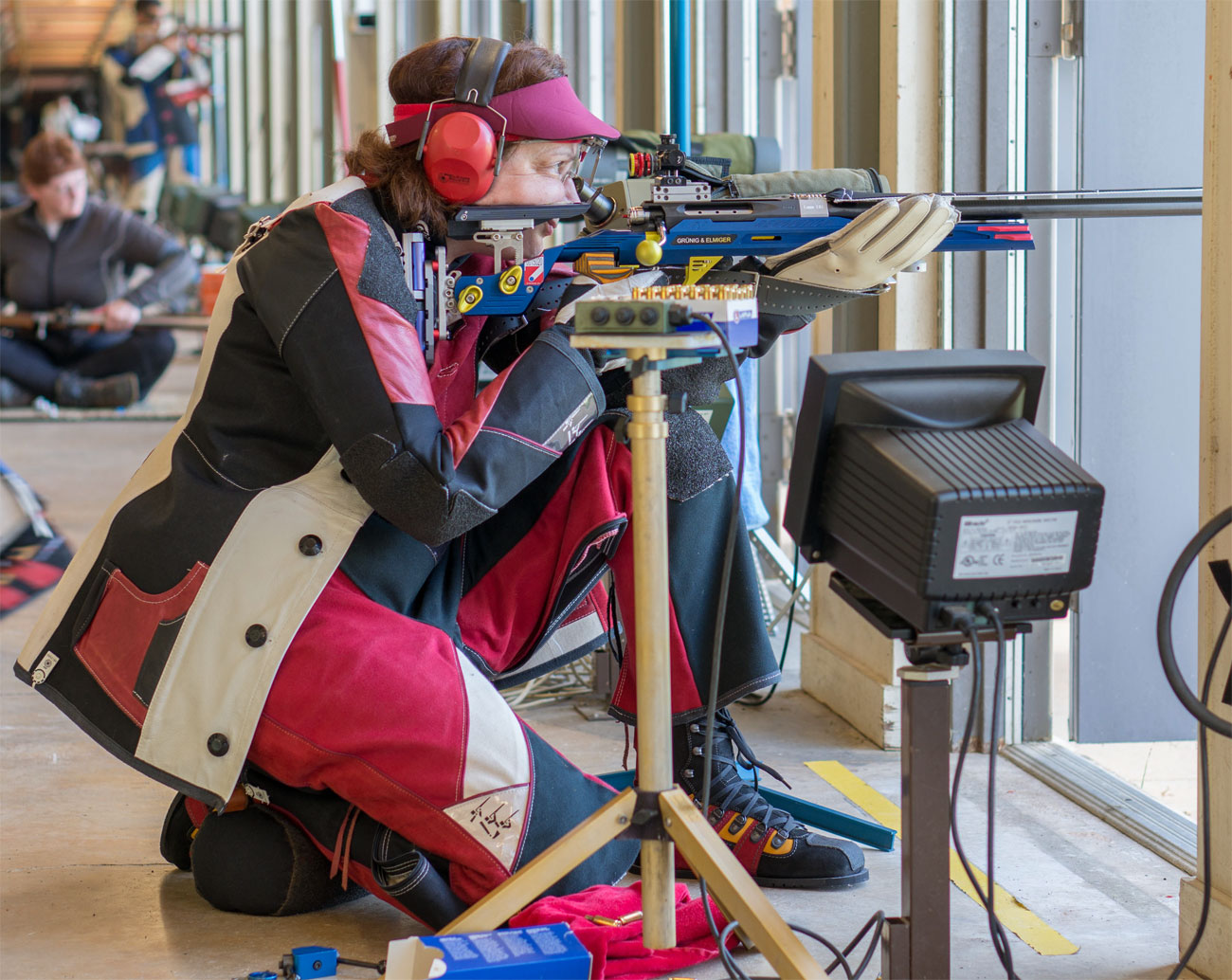
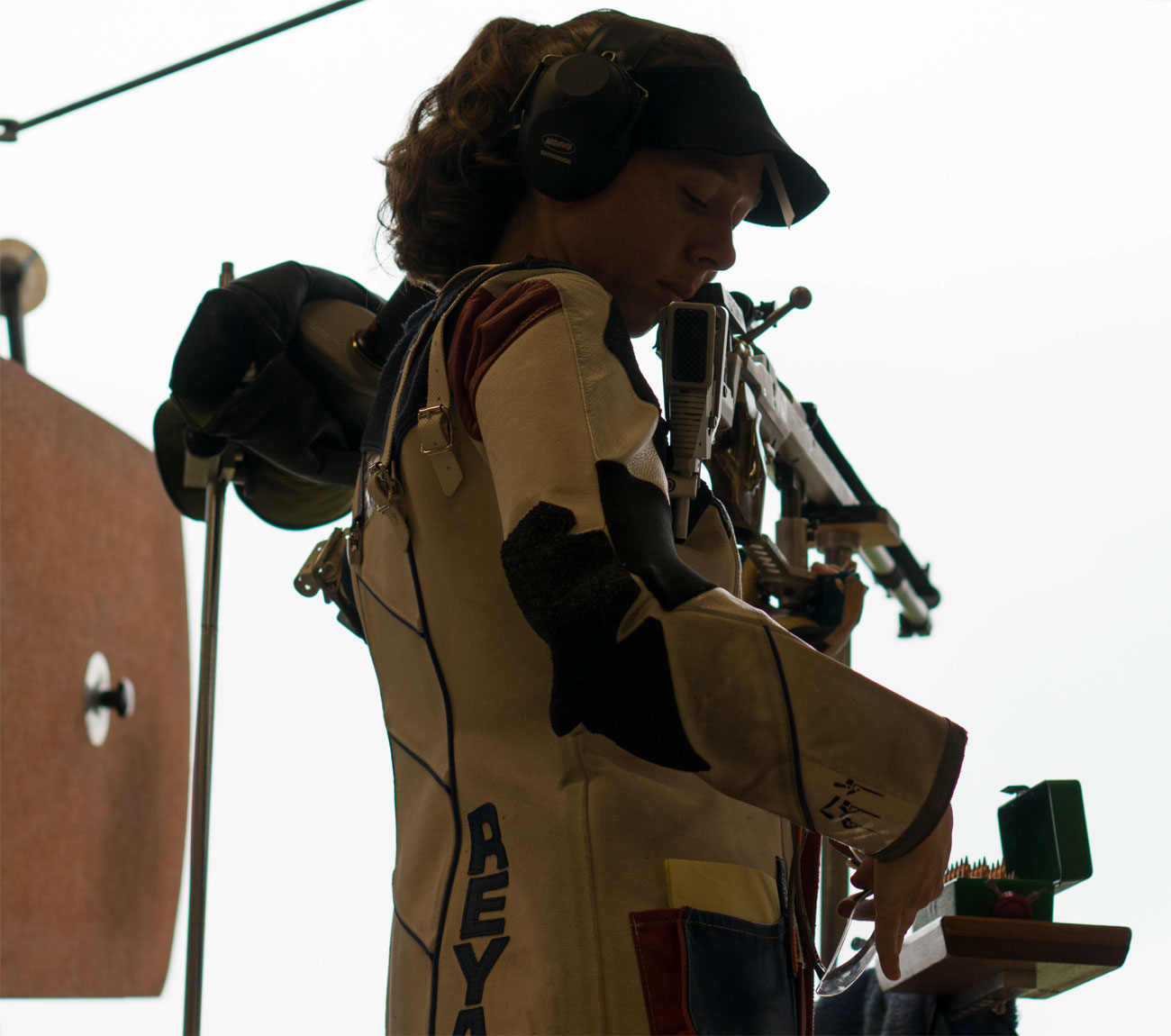
The 3P events occupied the first two days of competition. Athletes shot in three positions–kneeling, prone, and standing — using free rifles, mostly chambered in 6BR. Under ISSF rules, men fire 40 record shots in each position, while women fire 20 record shots in each position. Each event is repeated on the second day, and the two-day aggregates determined the winner. In Men’s 300m 3P, USAMU’s Joseph Hall, who had never shot a 300m match before, beat his more experienced teammates Joseph Hein and Michael McPhail to take gold. Among women, USAMU’s Erin Lorenzen edged out 2008 World Championship veterans Reya Kempley and Janet Raab for the gold.
The prone and Standard Rifle events followed in the second half of the competition. The 300m prone match is shot by both men and women, using same free rifles as in the 3P events. The Standard Rifle match is another 3-position event, except contested only among men, using rifles strictly limited in external shape and adjustability. Cooler temperatures and intermittent rain made conditions trickier to read than during the first two days. In men’s prone, USAMU’s Eric Uptagrafft took gold, edging out Unit teammates Hall and McPhail. In women’s prone, Erin Lorenzen once again came out on top over Reya Kempley (photo below) and Michelle Bohren.
In the Standard Rifle event, AMU’s Joseph Hall continued his good form and took another gold over teammate Joseph Hein. Equally noteworthy is the third place finisher Steve Goff. Goff, an AMU Hall of Famer who now competes as a senior in USAS matches, beat back much younger challengers to earn the third and final slot in the 2014 US Men’s Standard Rifle Team.
Cartridge Options for 300m Shooting — by Tony Chow
The cartridge of choice in 300m is 6mmBR Norma (aka 6BR). The AMU shooters all shoot Norma Diamond Line 6BR factory ammo, loaded with moly-coated 105gr Berger HPBT bullets, with the notable exception of prone match winner Eric Uptagrafft, who shoots handloads with HBN-coated bullets in his 6mm Dasher. Civilian shooters mostly shoot the 6mmBR as well, also preferring Berger bullets. I was the odd man out shooting a Gruenig & Elmiger (G&E) chambered in 6.5×47 Lapua. That cartridge was actually the result of a collaboration between G+E and Lapua to create an alternative to 6BR, though in the 300m world, it never managed to catch on. There was one shooter using 6.5-284 and another shooting a wildcat cartridge called “.260 BMR (boomer)”.
I’m not the authority on the pros and cons of various calibers. I doubt that most world-class 300m shooters concern themselves too much with these matters. The 6BR is simply good enough. It holds well inside the 10-Ring, is relatively economical, and offers extremely long barrel life when using mild factory loads. G+E rates its chrome-moly, cut-rifled 6BR barrels as capable of lasting 7,000 rounds. The AMU gunsmith, Glenn Sulser, told me that the AMU’s policy is to re-barrel at the 4,500-5,000 round mark.
Longer cartridges such as 6.5×47 and 6XC are supposed to offer easier feeding, but in my observation, the nose-heavy nature of 6BR is, in practice, not a major problem for 300m shooters. One of the advantages of 6.5×47 is even longer barrel life, and that’s the reason I went for this caliber myself. But looking back now, the greater recoil and extra cost in brass and powder are probably not worth it.
Factory Ammo vs. Handloads — Cost Considerations
One of the advantages the AMU shooters enjoyed over the civilians is that the Unit marksmen had an unlimited supply of ammo, and therefore could shoot as many sighters as they wished. In a 15-minute sighting-in period, it was not uncommon for AMU shooters to fire 20+ sighter shots, just as they do in smallbore. We civilians had to settle with under 10 sighters, in order to leave enough for the match.
Unless you are filthy rich or have someone else paying for the ammo, reloading is definitely the only way to go. A reloaded round costs under 50 cents a piece. The European factory ammo costs nearly $3 a round these days (as sold in the USA).
A lead-free “utopia” where bullets are banned and hunting is, for all practical purposes, eliminated — that’s apparently what some legislators want California to become. California Assembly Bill AB 711 would completely ban the use of traditional lead ammunition for hunting anywhere in the state. What’s more, many legislators acknowledge that this ban could, in the near future, be applied to all shooting sports in the Golden State. If you can’t buy bullets, you can’t shoot — and that seems to be the real agenda.
NSSF has purchased billboards in the Sacramento area to urge opposition to AB 711 and has been airing radio commercials that reveal the role of the anti-hunting groups behind this ill-conceived legislation. This week, the opposition to AB 711 was joined by a major state labor organization. NSSF urges all California hunters, target shooters and gun owners to contact their state legislators to oppose AB 711.
To understand more about the issue, read a well-reasoned editorial published in the Outdoor Wire. Even non-Californians should be concerned, because other states might follow California’s lead in the future. And AB 711 is not the only serious anti-gun measure on the table. In addition to AB 711, several other highly restrictive measures are in the works. Proposed legislation would place ALL semi-automatic rifles with detachable magazines on California’s list of banned “assault weapons”. Another bill would block Californians from purchasing long guns unless purchasers pass a state-mandated written test.
Eurenco, current owner of the Vihtavuori Oy powder manufacturing facility in Finland, has been seeking a new owner for the facility for many months. Well it looks like there is a buyer, Nammo Group, parent company of Lapua. The acquisition is not final — “Due Diligence” must still be completed. However, if the deal goes through, this will be good news for fans of Vihtavuori rifle and pistol propellants such as the popular N133, N135, N140, N150, and N320. N133 is winningest modern powder in the short-range benchrest game and N320 is an outstanding pistol powder favored by many .45 ACP bullseye competitors. Here is the text of the notification issued Friday August 30, 2013 by the Nammo Group.
Ruger recently announced the new Ruger American Rimfire™ series of bolt-action rimfire rifles, chambered in .22LR or .22 Magnum. These rifles feature an interesting convertible polymer stock and the .22LR versions can run 10/22 magazines. You could say the new rifles borrow features from the centerfire Ruger American Rifle® series, while offering mag interchangeability with 10/22 rimfire rifle. Ruger offers both full-sized (22″ barrel/13.75″ length of pull) and compact (18″ barrel/12.5″ length of pull) models, both of which are available in either .22 LR or .22 Magnum. All models have a suggested retail price of $329.00.
Comb Height Adjusts with Interchangeable Stock Modules
Ruger’s new rimfires feature interchangeable stock modules that provide variable comb heights. Standard models come with long length of pull modules, while compact models come with short length of pull modules. By simply removing the rear sling swivel stud, stock modules can be changed in seconds.
.22LR Models Can Use All 10/22 Magazines
Models chambered in .22LR feature the detachable, flush-mounted 10/22® BX1 10-round rotary magazine and accept all 10/22® magazines. Models chambered in .22 Magnum use the detachable, flush-mounted JMX1 9-round rotary magazine.
Dove-Tailed Action and Bolt with 60° Bolt Throw
Standard 3/8″ dovetails for rimfire rings are milled into the actions, which are also drilled and tapped for mounting Weaver-style bases. The 60-degree bolt can be removed with an easy-to-use, receiver-mounted bolt release that does NOT require a pull of the trigger.
Integral Bedding Block for Action
The new rimfire rifles also feature a patent-pending Power Bedding® integral bedding block system that positively locates the receiver and free floats the barrel. Additional features include a blued, hammer-forged barrel with fiber optic front sight and adjustable, folding leaf rear sight.
New Product Tip from EdLongrange. We welcome reader submissions.
Compared to bolt-action rifles, direct gas impingement AR-platform rifles tend to be filthy, maintenance-intensive beasts, requiring regular disassembly and cleaning of the innards. Op-rod style AR variants run cleaner and cooler, but they still require regular maintenance. Now there is a versatile, compact multi-tool that performs a variety of critical servicing/maintenance tasks for AR-platform rifles.
Weighing just 6 ounces, the new D-CAT from Space Age Weaponry fits in the storage compartment of a standard AR-15 fixed butt stock. Brownells says the D-CAT (“Deployable Compact Armorer’s Tool”) is the “only tool necessary to assemble the AR-15/M16 from component parts, or perform a complete disassembly”. The video below explains the feature and functions of the $149.99D-CAT.
The D-CAT is made from quality materials: 6061-T6 Aircraft Aluminum, 303 Stainless steel, and H13 Tool Steel. Bits, punches, and other small parts are located in the tool magazine, within the torque handle. Simply rotate the magazine gate to expose the individual compartments. Within the magazine you will find a 1/8″ punch, a flat blade driver, front sight adjustment tool, and a 3/16″ and 9/64″ hex driver. There is also a spare punch pocket and a Hammer/Trigger pin pocket. This is also the mode in which the D-CAT is used as a screwdriver. The driver makes use of a standard ¼” hex well so the tool can be augmented to serve as a general purpose driver for any bit you choose to carry.
Tool Tip from EdLongrange. We welcome reader submissions.
Now there is new fun and inexpensive way to get started in Three Gun competition, the fastest-growing action shooting sport. NRA Sports Activities has developed the Three Gun Experience (3GE) program utilizing rimfire (.22LR) pistols and rifles, along with 12ga or 20ga shotguns. Targets, specifically designed for rimfire and shotgun, are placed at relatively close (but safe) distances. Most importantly, the NRA envisions that match organizers will provide firearms and ammunition at matches — so participants don’t have to purchase a brace of firearms just to try out the sport.
NRA 3 Gun .22 (3GE -.22) equips attendees with the same firearms and ammunition — creating a level playing field for fun and fast competition. The new 3GE program is intended to help ranges reach new shooters and maximize the number of participants in any given day or weekend event. For questions regarding hosting a 3GE event please contact NRA Sports Recreational Shooting at 1-800-672-3888 or email nrasports@nrahq.org.
On August 29, 2013, the Obama administration announced two Executive Orders that will restrict the importation and domestic transfers of certain classes of firearms. These two Executive Orders operate as law by fiat, not subject to Congressional concurrence.
One Executive Order bans the re-importation of surplus U.S.-made rifles, including M1 Garands and M1 Carbines. Such rifles are used in Civilian Marksmanship Program (CMP) competitions. For decades the CMP has sold M1 Garands and M1 Carbines, many re-imported from arsenals overseas, to qualified American shooters. The White House stated: “Today, the Administration is announcing a new policy of denying requests to bring military-grade firearms back into the United States to private entities, with only a few exceptions such as for museums.”
It is unclear how this Executive Order will enhance public safety, since FBI crime statistics show that such vintage arms are virtually never employed in the commission of crimes. Professor John R. Lott Jr., former chief economist at the United States Sentencing Commission, observes: “Despite the scary rhetoric, the White House is leaving out one important point: it isn’t pointing to any cases where imported U.S.-made military weapons have been used in a crime. And the reason is obvious: there probably aren’t any.”
The second Executive Order changes the rules on acquisition and transfers of National Fireams Act (NFA) firearms (such as machine guns) and other NFA items (such as sound moderators) through Corporations and Firearms Trusts. When sold to individuals, such items do require background checks. However, the White House claimed: “At present, when the weapon is registered to a trust or corporation, no background check is run. ATF reports that last year alone, it received more than 39,000 requests for transfers of these restricted firearms to trusts or corporations.” It is the intent of this Executive Order to block a significant number of NFA transfers to Firearms Trusts and Corporations. Again, it is unclear how the new restrictions on NFA transfers will reduce crime. In fact, BearingArms.com asserts that: “Only two [registered] NFA machine guns — neither of which were acquired via gun trusts — have been used in murders in 79 years.”
Professor Lott challenges the need for changes to the NFA Laws as they pertain to corporations: “Again, the Obama administration doesn’t provide examples of people using a corporation to register handguns or semi-automatic rifles as a way to bypass criminal background checks. More importantly, it fails to point to any cases where such guns have been used in crimes. Yes, when registered to a corporation, any officer is allowed to possess the machine gun, but [the transfer] still requires a NICS check for the person actually picking up the gun.” READ Lott Commentary.
Thoughts On Executive Orders — by Tony Chow It’s important to realize that the anti-gun people aren’t interested in gun control as a practical measure to combat “gun violence” or achieve “gun safety”. They are animated above all by a reflexive dislike of guns, and an abhorrence of the very notion of an armed citizenry. Their motives are ideological, rather than practical. To them, it doesn’t matter whether a type of firearm is used in crimes or not; the only good gun is a banned gun. This explains why the efforts in the 70s and 80s to restrict handguns, which still account for the vast majority of gun crimes, were abandoned in favor of an assault on “assault weapons”, .50-caliber rifles, and now, vintage “military-style” rifles and already heavily-restricted NFA weapons — firearms that, though used infrequently or not at all in crimes, are easy to describe in scary terms to the general public.
Tony Chow is a target shooter who competes in smallbore and 300-meter disciplines.


 IBS Report and photographs by Dick Grosbier





 American Kenny Adams is the new F-Open World Champion, winning the individual title last week at Raton, New Mexico. ‘King Kenny’ rose to the top through with skill, countless days of practice, and great determination. He put in the trigger time, including many long days at Raton. But when we cornered Kenny after his win at the Worlds he was quick to give credit to his gunsmith, Stick Starks of



 I’m not the authority on the pros and cons of various calibers. I doubt that most world-class 300m shooters concern themselves too much with these matters. The 6BR is simply good enough. It holds well inside the 10-Ring, is relatively economical, and offers extremely long barrel life when using mild factory loads. G+E rates its chrome-moly, cut-rifled 6BR barrels as capable of lasting 7,000 rounds. The AMU gunsmith, Glenn Sulser, told me that the AMU’s policy is to re-barrel at the 4,500-5,000 round mark.


 A lead-free “utopia” where bullets are banned and hunting is, for all practical purposes, eliminated — that’s apparently what some legislators want California to become. California Assembly Bill AB 711 would completely ban the use of traditional lead ammunition for hunting anywhere in the state. What’s more, many legislators acknowledge that this ban could, in the near future, be applied to all shooting sports in the Golden State. If you can’t buy bullets, you can’t shoot — and that seems to be the real agenda.
 Eurenco, current owner of the Vihtavuori Oy powder manufacturing facility in Finland, has been seeking a new owner for the facility for many months. Well it looks like there is a buyer,


 Now there is new fun and inexpensive way to get started in Three Gun competition, the fastest-growing action shooting sport. NRA Sports Activities has developed the Three Gun Experience (3GE) program utilizing rimfire (.22LR) pistols and rifles, along with 12ga or 20ga shotguns. Targets, specifically designed for rimfire and shotgun, are placed at relatively close (but safe) distances. Most importantly, the NRA envisions that match organizers will provide firearms and ammunition at matches — so participants don’t have to purchase a brace of firearms just to try out the sport.
 On August 29, 2013, the Obama administration announced two


