|
|
November 18th, 2014
Sig-Sauer has commenced a contest with a Grand Prize that should make any gun guy (or girl) drool. The lucky winner of Sig’s P320 Take-a-Shot Contest will get a custom-fitted Pelican case with TWO Handguns, a 9mm MPX PSB, a 300 BLK MCX Carbine, mags, and more. You even get two cases of ammo (9mm and 300 BLK). Along with this Grand Prize, Sig is giving away twenty (20) P320 pistols.

The Grand Prize will be awarded in a contest between two finalists. One finalist will be chosen based on the popularity of a video he (or she) creates. In addition, the Top 10 video entrants will each win a P320 9mm pistol. The video’s theme should be: “The P320 is Epic because (fill in the blank)”. Submit your video between now and November 30, 2014.
The second way you can be “in the running” for the Grand Prize is to submit a Sweepstakes Entry Form (no purchase required). Even if you’re not selected for the Grand Prize competition, you can win a valuable Sig handgun. For 10 business days from December 1 – December 12, Sig will give away one Sig P320 9mm pistol every day. From the ten winners, one will be chosen at random to win a trip to Las Vegas to compete for the Grand Prize.
The two (2) semi-finalists (one from the Sweepstakes Drawing and one from the Video Contest) will each win 5 days and 4 nights in Las Vegas. There they will compete one-on-one at the SIG SAUER Range Day on January 19, 2015 in the P320 Take-A-Shot Competition for the $10K Grand Prize.

The Ultimate SIG SAUER Collection, worth over $10,000, comes in a Pelican Case filled with:
SIG 9mm MPX PSB (with two extra mags), SIG 300 BLK MCX Carbine (with two extra mags), M11-A1 Pistol, MK25 Pistol, P226 Threaded Barrel, M11-A1 Threaded Barrel. In addition the Grand Prize winner receives One Case of 9mm V-Crown™ JHP Elite Performance Ammo, and One Case of 300 BLK Elite Performance Ammo.
November 17th, 2014
Sierra Bullets has released Version 7 of its respected Infinity Exterior Ballistics software, available now for $39.95 for Windows computers. Renowned Sierra Ballistic Consultants Ted Almgren and Dr. Bill McDonald, who have written all Sierra Software since 1970, also wrote Infinity Version 7. Both are retired scientists from a major aerospace company. Infinity Exterior Ballistics Software version 7 is a sophisticated solver that can output multiple trajectory charts. A built-in database includes bullets and cartridges offered by 15 manufacturers, both U.S. and foreign.
This 13-minute Video Demonstrates the Many Features of Infinity 7 Ballistics Software:
This sophisticated program computes the effects on the bullet trajectory of variations in firing conditions. For example, you can change altitude of the firing point, target angle (uphill/downhill), wind speeds, or even modify the Ballistic Coefficient. In fact, you can change any inputted firing condition or combination of conditions.
One very handy function is the “back-to-zero” calculation. Infinity 7 software will compute where your gun is zeroed if you know that it shoots high by a measured amount at a known range.

Compare Trajectories with Five Different Bullets
One very powerful feature of Infinity 7 is its trajectory comparison capability. With most ballistics programs (such as the JBM online ballistics calculator), you can only view one bullet’s trajectory (and associated drop chart) at a time. Not so with Infinity 7. This software handles up to five different bullets at a time. You can compare downrange velocity, energy, drop, bullet path height, or crosswind drift with results shown in bolt tabular and graphical format. That helps you select the best bullet for your gun and application. The ability to compare downrange ballistics of five different bullets at once is particularly helpful for hunters, who can compare the “hitting power” of different projectiles at various distances.
You can purchase Infinity 7 Ballistics Software as a standalone product for $39.99, or you can buy the Infinity 7 Suite for $59.95, which includes the Sierra Bullets 5th Edition Reloading Manual on CD-ROM. If you prefer a printed loading Manual, a combo pack with Infinity 7 software CD-ROM plus published (hard-back) Reloading Manual is offered for $64.95.
November 17th, 2014
 There are many benefits to shooting with both eyes open especially when shooting shotguns and handguns, but training yourself to do it can be challenging for some. For many, it is a struggle to fight the natural instinct to close one eye. So how do you train yourself to kick that habit? There are many benefits to shooting with both eyes open especially when shooting shotguns and handguns, but training yourself to do it can be challenging for some. For many, it is a struggle to fight the natural instinct to close one eye. So how do you train yourself to kick that habit?
How to Train to Keep Both Eyes Open
The first step is to determine if you can see the sights with both eyes. If you can’t get a clear sight picture on target with both eyes open, or if you see two front sights or some other strange configuration that is nearly impossible to decipher, then shooting with both eyes open may not work for you. It’s not the end of the world. It’s more important that you acquire a proper sight picture and hit your target.
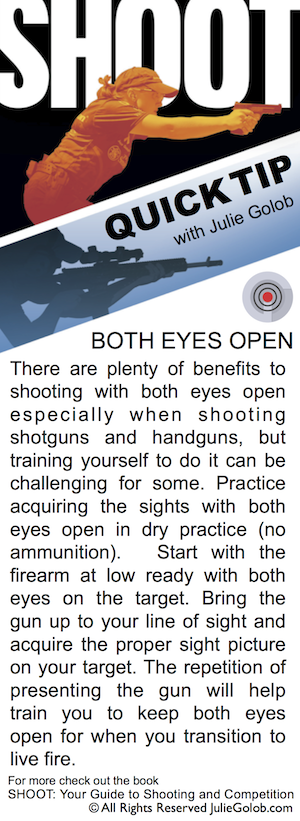 If you are a competition shooter that struggles with this you can get a little help from some frosted tape. In most cases it; just a matter of determining your eye dominance and placing a piece of tape on your eye protection on the lens in front of your non-dominant eye. The tape blocks this eye from seeing the sights, but still allows you full access to your peripheral vision. If you are a competition shooter that struggles with this you can get a little help from some frosted tape. In most cases it; just a matter of determining your eye dominance and placing a piece of tape on your eye protection on the lens in front of your non-dominant eye. The tape blocks this eye from seeing the sights, but still allows you full access to your peripheral vision.
An effective way to prevent yourself from closing an eye is to spend a good amount of time dry firing. (Dry fire means NO AMMO!) Practice acquiring the sights with both eyes open. Start with the firearm at low ready with both eyes on the target. Bring the gun up to your line of sight and acquire the proper sight picture on your target. The repetition of presenting the gun will help train you to keep those eyes open when you transition to live fire. As with any habit, you’ll need to train yourself to stop — this means more than just a few times dry firing.
When you hit the shooting range, you may find that despite all that dry-fire practice, you still close an eye. It might be a matter of sympathetic reaction to recoil. Using .22 caliber, airsoft guns and light loads can help you transition to larger calibers and full power ammunition. Just as you had to concentrate keeping both eyes open in dry fire, it’s likely you will have to do the same during your live fire training as well.
For more shooting tips visit www.JulieGolob.com and also read my book, SHOOT: Your Guide to Shooting and Competition. It’s available in print and eBook formats from these vendors:
      
November 16th, 2014
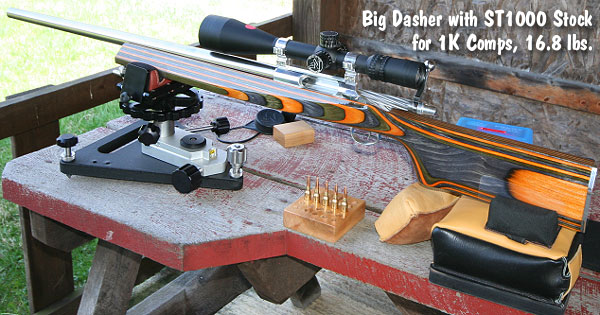
Forum Member Chuck L. (aka “Ridgeway”) has created a handsome duo of 6mm Dashers for competitive benchrest and varmint matches in Pennsylvania. Both guns are built on Kelbly Panda RBLP actions, with Bartlein 8-twist barrels, and Shehane Laminated Tracker Stocks. However, the two rifles are not exact twins, as you can see. One, which we’ll call the Big Dasher, is built on a Shehane ST1000 Tracker stock. The other gun, the Small Dasher, sports Shehane’s “Baby Tracker” stock — a design used with great success by Richard Schatz. The Big Dasher, optimized for 1000-yard competition, also has a slightly longer freebore — 0.136″ vs. 0.104″ for the Small Dasher.
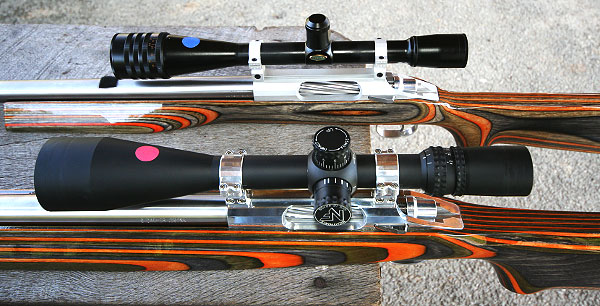
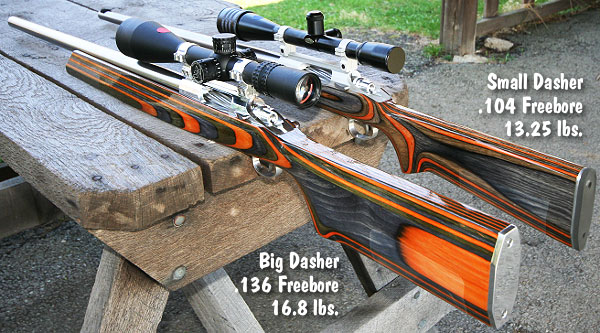

Chuck tells us: “I don’t get out shooting competition as much as I want due to time and family, but when I do compete, I shoot a Groundhog match at Southfork Rifle Club in Beaverdale, PA. Info on Southfork Club events can be found at Southforkrifleclub.com. The Southfork match is basically a 100-, 300- and 500-yard match with one sighter the entire match and 5 shots at each yardage for score. The Small Dasher, with the shorter ‘Baby Tracker’ stock, was set up for the Southfork Rifle Club’s ‘Light Unlimited’ class which has a 13.5-lb max weight.” (Editor: ‘unlimited’ is a misnomer for a weight-limited category.)
Chuck adds: “The Big Dasher with the heavy ST-1000 stock is set up for 1000-yard benchrest matches in Light Gun class. I hope to shoot a couple 1K matches with it at Reade Range in southwest Pennsylvania. I am still in load development for this rifle since it was just finished in January. One ironic thing is, it shoots the same load I’m shooting out of the lighter gun rather well. The only difference between the two chambers is the freebore is roughly thirty thousandths longer on the 1K gun (Large Dasher). I will also shoot this at Southfork in the ‘Heavy Unlimited’ class.”
| Specifications for the Dasher Duo:
Small Dasher (13.5-pounder): Chambered for 6mm Dasher with approximately .104 freebore and a .264 NK. (No way of knowing exactly since it freebore was done in a separate operation by Kelbly.) Components are: Shehane Baby Tracker stock, Kelbly Panda RPLB action, Bartlein 1:8″ LV barrel at 26 ¾”, Kelbly Rings, Weaver T36, Jewell trigger. The barrel was chambered by Kelblys and the stock was bedded, glued and balanced by a shooting buddy (Forum Member johara1). I clear-coated the stock with auto urethane. Total weight is 13 lbs., 4 ounces.
Big Dasher (1K Light Gun, 17-pounder): Chambered for 6mm Dasher with a .136 freebore and .264 neck (PTG Reamer). Components are: Shehane ST-1000 stock, Kelbly Panda RPLB action, Bartlein 1:8″ HV 5R barrel at 28″, Shehane +20-MOA rings, Nightforce NXS 12-42x56mm, Jewell trigger. The barrel work, pillar installation, and bedding was done by Dave Bruno. The stock was clear-coated by Chuck with auto urethane. Chuck also made the rear butt plate and balanced the rifle. Total weight: 16 lbs., 13 ounces. |
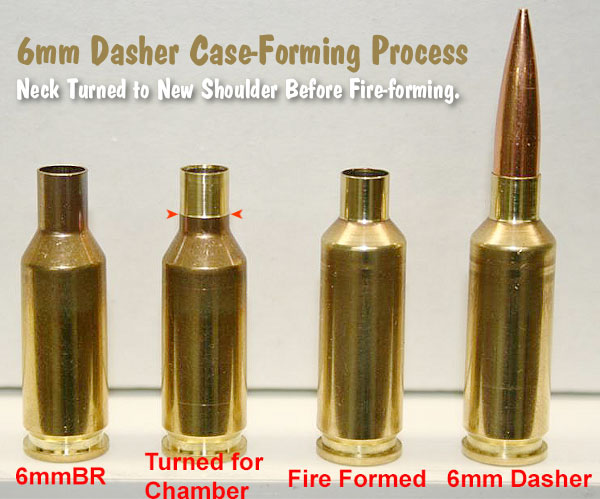
Dasher Case-Forming: Neck-Turn then Fire-form with Bullets Hard in Lands
To fireform, I turn my cases down to fit the chamber and stop where the false shoulder makes snug contact with the chamber. Fire-forming rounds are loaded up with a 29-grain charge of H4895 or Varget and a 108gr Berger bullet seated hard into the lands about 0.020″ past initial contact with the rifling. It takes about three firings to make a nice clean Dasher case with a sharp shoulder. I anneal about every 3-4 firings. I have many cases that have about 10+ firings on them and they are still shooting well. The primer pockets are a little looser, but still hold a primer.
Both Dashers Group in the Ones at 100 Yards
My main bullet for both rifles is the 107gr Sierra MK, loaded with Reloder 15 powder, Lapua cases and CCI 450 primers. My main load for the Small Dasher is 33.0 grains of Reloder 15. This load shoots in the ones at 100 yards. For the Big Dasher, I’m still working on a load, although the same 33.0 grain load shoots in the ones in the heavier gun as well. I’m still looking for more velocity and my ‘max’ node. So far, I’ve gone well above 33.0 grains of RL 15 without pressure signs, but that load produces vertical at 100 yards, so I’m going to tinker with the load until I see pressure or it starts to shoot.
November 16th, 2014
Most of us assume that if we weigh our powder carefully (down to the tenth of a grain or less) we can achieve a uniform powder fill from case to case in our handloads. Weighing does ensure that the weight of the propellant in each case is the same, but is the column of powder the same by volume each time? “Not necessarily” is the answer. An interesting experiment by our friend Boyd Allen demonstrates that the manner in which you place kernels in the case can make a significant difference in the height of the powder column within the brass case.
Using a Gempro 250 scale, Boyd measured exactly 30.6 grains of Vihtavuori N-133 powder. He then inserted this powder in the same cartridge case multiple times. (The case has a fired primer in place.) But here is the key — Boyd used various filling techniques. He did a slow fill, and a fast fill, and he also experimented with tapping and drop tubes. What Boyd discovered was that you can start with the exact same weight of powder (in fact the very same set of kernels), yet end up with vary different fill heights, depending on how you drop the kernels into the case. Look at the photos. Despite variations in lighting, the photos show the same 30.6 grains of powder, placed in the same cartridge, with four different methods.
Boyd Explains the Procedure Used for his Experiment.
EDITOR’s NOTE: So there is no misunderstanding, Boyd started with a weighed 30.6 grain charge. This identical charge was used for ALL four fills. After a fill the powder was dumped from the case into a pan which was then used for the next fill technique to be tried. So, the powder weight was constant. Indeed the exact same kernels (of constant weight and number) were used for each fill.
Boyd writes: “I used the same powder for all fills, 30.6 gr. on a GemPro 250 checked more than once. All fills employed the same RCBS green transparent plastic funnel. The fast drop with the funnel only overflowed when it was removed from the case neck, and 15 granules of powder fell on the white paper that the case was sitting on. The fast-funnel-only drop with tapping, was done with the funnel in place and the case and funnel in one hand, while tapping the case body with the index finger hard, many times (about 20 fast double taps). My idea here was to “max out” the potential of this tapping technique.
The slow drop with the funnel and 10″-long .22 cal. Harrell’s Precision drop tube, was done by holding the scale pan over the funnel and tapping the spout of the pan repeatedly on the inside of the funnel about 1/3 down from the top, with the scale pan tilted just enough so that the powder will just flow. Many taps were involved, again, to max out the technique.
Again, to be clear, after each case filling, the powder was poured from the case back into the scale pan carefully. You may notice the similarity between the fast drop with the drop tube, and the funnel only with tapping. Although I did not photograph it, fast tube drop and tapping (combined) improved on tapping alone, but only to about half as far down the neck as the slow with drop tube. Due to the endless possible permutations, I picked four and left it at that.
I believe that I can make the rough judgment that the scale pan funnel and drop tube technique, which involved a longer drop period, and probably less velocity at the top of the tube, left more room in the top of the case neck than the slow drop from the measure with the same drop tube. You have both pictures, so you can make the comparison.” — Boyd
Does Powder Column Height Variance Make a Difference?
Boyd’s experiment proves pretty conclusively that the method of dropping a given weight of powder can affect the height of the powder column in the case and the degree of powder compression (when a bullet is seated). He showed this to be true even when the exact same set of kernels (of constant weight) was used in repetitive loadings. This raises some interesting questions:
1. Will subsequent cartridge transport and handling cause the powder to settle so the variances in powder column height are diminished?
2. If significant inconsistencies in powder column height remain at time of firing, will the difference in fill level hurt accuracy, or result in a higher extreme spread in velocity?
3. Is there any advantage (beyond increased effective case capacity) for a tight (low level) fill vs. a loose (high level) fill?
We don’t know the answer to these follow up questions. This Editor guesses that, if we tested low-fill-height rounds vs. high-fill-height rounds (all with same true fill quantity by weight), we might see meaningful differences in average velocity. I would also guess that if you fired 10 rounds that exhibited quite a difference in powder column heights, you might see a higher ES/SD than if you shot 10 rounds loaded with a very consistent powder column height (either high or low). But further testing is needed to determine if these predictions are true.
November 16th, 2014
Eley sponsors many of the world’s top rimfire shooters, who have shared their Tips from the Top for 2014. Five ace smallbore shooters provide advice on how to shoot better, how to train more effectively, and how to stay motivated even when “the going gets tough”. If you’re a competitive shooter (in any discipline) you can benefit from reading these words of wisdom from world-class shooters.

Henri Junghaenel, current world #1 ranked, 50M prone rifle shooter.
Focus on Fundamentals: Good performance requires a solid technical foundation. One can hunt after personal bests or one can try to work on the technical basics. The latter will probably lead to better results sooner.
Stay Motivated Over Time: Be persistent and don’t lose your motivation on your way to success. Shooting, like every other sport, requires a learning process which takes a lot of time.
Don’t Yield to Outside Pressures: Don’t let the expectations from others impact yourself. If some people try to put pressure on you (consciously or unconsciously), don’t let them!
Bill Collaros, 2013 Australian WRABF World Cup (Benchrest) and RBA team captain.
Don’t Skimp on Hardware: Ensure your equipment is a good as you can buy. This includes: rests, bags, rifle, scope, and ammunition.
Tune to Your Ammo: Ensure that the ammunition you have is tested and your rifle is tuned to it, to get the smallest possible group.
Train in All Conditions: Train in all sorts of wind and conditions so you know how your rifle and ammunition react in all circumstances.
Stine Nielsen, 2012 Olympic finalist for 3-Position Smallbore Rifle.

No Excuses: When I train, I train by my motto: “A loser has excuses. A winner has a plan.” And when I shoot in competitions I think about that mantra.
Stay Focused: When I stand at a shooting range, I have a good focus on my shooting and myself. I also have a good will to want to shoot 110%.
Zorana Arunovic, current world #2 ranked, 25M women’s pistol shooter.
Never give up: No matter how hard it is you should always find something that will inspire you to keep going further. I find my inspiration in the success of other athletes. They inspire me to work more and harder. I would say to any young athletes, never give up, no matter how hard it is.
João Costa, current world #2 ranked, 50m pistol shooter.
Breathing is Key: In shooting as in life, breathing is of paramount importance. So, when shooting try to be calm and quiet. On the bench in front of me I have my pistol, the scope, the magazine and my choice ammo then I count:
1… Eley – breathe
2… Eley – breathe
3… Eley – breathe
4… Eley – breathe
5… Eley – breathe
Story find by EdLongrange. We welcome reader submissions.
November 15th, 2014
How much can you save reloading your own ammo? Well that depends on the cost of components and how much you have invested in your reloading gear. UltimateReloader.com has created a handy online Reloading Costs Calculator that lets you quickly compare the cost of reloaded ammo vs. factory ammo. Just enter the costs of powder, primers, bullets, and brass, and the Calculator will tell you the cost per round, per 20-rd box, per 50-rd box, and cost per thousand. Note — when setting the price of the brass you need to divide the initial cost by the number of predicted reloads. For example if you have 500 pieces of brass that cost $40/100 to buy ($200 total), but you get 8 reloads per case, then you put $25.00 in the Calculator ($200 total brass cost divided by 8).

True Reloading Cost Should Include Amortized Tool Expenses
Ah… but there is a catch. To understand the true cost of reloading, you also need to consider the costs of your tools and accessories, amortized over the tools’ loading lifespan. Let’s say you have $1000.00 invested in presses, dies, tumblers, measuring tools and other accessories, with a residual value of $500.00 (upon resale). If you load 5,000 rounds with those tools over their lifespan, you need to add $0.10 per round for tooling costs (your investment minus residual value, divided by the number of rounds loaded). The UltimateReloader.com Calculator does not include amortized tooling costs, but that’s something you can easily figure out on your own.
Excellent Resource for Reloading Videos
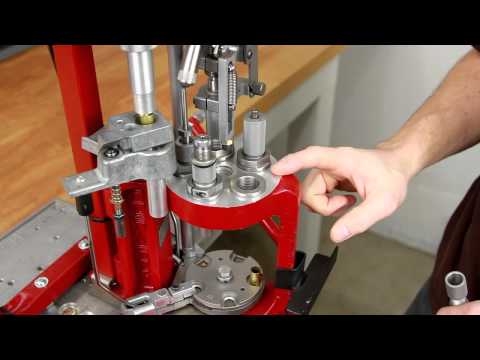
After you’ve tried out the Reloading Costs Calculator, check out the other content on UltimateReloader.com. This site features some of the best gun-related “how-to” videos on the internet. With sharp video and clear audio, the production quality is very high. If you use a progressive press (Dillon, Hornady, RCBS), you should definitely watch UltimateReloader.com’s videos — you’ll probably learn a new trick or two. In the sample video below, you can see how Hornady’s new Bullet Feeder works with its Lock-N-Load Progressive press.
November 15th, 2014
 On “Black Friday”, the day after Thanksgiving, stores nationwide offer big discounts on merchandise. There are some amazing deals to be had in retail outlets — if you’re willing to fight hordes of crazed consumers. On “Black Friday”, the day after Thanksgiving, stores nationwide offer big discounts on merchandise. There are some amazing deals to be had in retail outlets — if you’re willing to fight hordes of crazed consumers.
Thankfully, many smart merchants now offer Black Friday deals online, so you can avoid the mobs. Traditionally, electronics, video games, clothing, toys, and home furnishings are discounted deeply on Black Friday. But there are also many money-saving opportunities on guns, shooting accessories, hunting gear, and reloading supplies.
To aid your Black Friday deal hunting, SlickGuns.com has assembled a list of gun- and shooting-related Black Friday bargains and special promotions. On the SlickGuns’ Black Friday 2014 Deal Page you’ll find a long list of Black Friday sale items including air guns, handguns, ammunition, reloading gear, gun safes, hunting gear and much more. SlickGuns.com also has scans of the Black Friday print flyers so you can see deals that may not be listed on websites.
CLICK HERE for Gun-Related Black Friday Deals

Outdoor gear vendors offering Black Friday Sales/Promotions include Bass Pro Shops, Big 5, Brownells, Cabela’s, Dick’s Sporting Goods, Gander Mountain, Sports Authority, Sportsman’s Warehouse, Walmart (and more). On the SlickGuns.com website, you can access all Black Friday Specials with one click, and then narrow your search by vendor, product category, or price.
November 14th, 2014
Gear Review by GS Arizona
This article originally appeared in the Rifleman’s Journal website.
Many of you have doubtlessly read Bryan Litz’s articles in our Daily Bulletin and on his Applied Ballistics website about various current long-range bullets. Bryan’s work carries a great deal of weight in the world of ballistics, so his comments (and mathematical proofs) regarding the benefits of bullet pointing certainly caught my attention. Bullet pointing, like meplat trimming, is an effort to reduce the ballistic inconsistency created by the somewhat jagged tip of the jacket where the bullet forming dies bring it to a point in the manufacturing process. Of course, we could eliminate this problem altogether by shooting closed-tip, open-base bullets like the Lapua D46, but that merely shifts the jacket problem to the other end of the bullet.

In any event, hollow point bullets rule the accuracy world today, so John Whidden, multi-time National Long Range Champion at Camp Perry and a talented gunsmith and designer to boot, came up with a very handy tool to let us make those hollow points pointier. Let’s have a look at John’s tool and see how it works.

The Whidden Bullet Pointing Die System uses a Forster bullet seating die body as its basic structure and that’s a good choice given the quality machining Forster does on these. The real heart of the tool comes in two parts: the caliber sleeve and the pointing die that fits inside the sleeve. In fact, to point up different caliber bullets, you only need to change the caliber sleeve, everything else remains the same. The last item is the bullet base that slips into a standard .308 shellholder and supports the bullet as it goes into the die body.
 It took me less than five minutes to get everything set up, including changing the caliber sleeve from 6mm to .30 caliber. John’s instruction sheets are well illustrated and clearly written; you should have no problem getting up and running. It took me less than five minutes to get everything set up, including changing the caliber sleeve from 6mm to .30 caliber. John’s instruction sheets are well illustrated and clearly written; you should have no problem getting up and running.
Pointing the bullets is as easy as sizing a piece of brass. You can see in the top photo the difference between a few pointed bullets and a few un-pointed ones. The innermost pointed bullet in the picture was my first attempt and I adjusted the die a little after that, you can see that the others are closed a little more. John even includes a couple of sample bullets so that you can see one done right and one done wrong. That is a nice addition that can help you achieve the desired results.
I think Bryan’s work supports the validity of this concept and John’s tool puts it into practice in a simple-to-use manner that makes it just about impossible to do any damage to the bullet. I have shot pointed bullets in various calibers at many matches now. Pointing is not a “miracle cure”, but I believe that pointing bullet tips can produce long-range accuracy gains, through reduced vertical dispersion, for many popular types of match bullets. The Whidden Bullet Pointing Die System retails for $220.00 (with one insert). Additional die inserts are $42.00 each. Extra caliber sleeves are also $42.00. You can purchase directly from Whidden Gunworks, or from Sinclair International.

November 14th, 2014
Got Bipod? If you’re in need of an adjustable two-legged friend for the front of your favorite rifle(s), Midsouth has you covered. Right now Midsouth Shooters Supply has a wide selection of Harris Bipods in stock at attractive prices. For example, the Harris 6″-9″ BR model with leg notch is just $69.68. That’s ten bucks cheaper than we’ve found elsewhere. From small to tall, Midsouth carries Harris bipods for your intended applications. Midsouth also sells a variety of authentic Harris mounting adapters, including rail adapters, and flat fore-end adapters.


|


