|
|
December 22nd, 2014
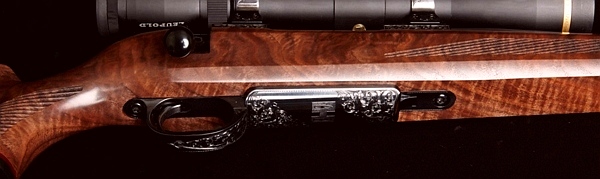
Hornady Manufacturing has created its first-ever rifle. Well, kind of, sort of, maybe…. In actuality, Hornady hired Bill Wiseman & Company to craft the barrel and action and Hornady commissioned Lucid Solutions (Clem Boyd) to build the stock. But the Hornady name IS now engraved on the side of a rifle receiver and that does represent a genuine first. This one-of-a-kind rifle, serial number “H-001″, is a bolt-action hunter, chambered for the .300 RCM cartridge. The historic “Hornady Number One” rifle has two (2) stocks — a highly figured walnut stock plus a second camo-pattern Hogue synthetic stock. So this rifle is not just a safe queen — it was designed to work in the field as well.


This “Hornady Number One” rifle was commissioned as the featured 2015 SHOT Show Gun. It will be displayed in Las Vegas and auctioned on Gunbroker.com. As of December 22, the bid price was already over $14,525 with 45 bidders. The action and bottom metal is elaborately engraved by Baron Engraving of Trumbull, Connecticut. “We’ve had the privilege of designing and engraving more than a dozen SHOT Show rifles, shotguns, handguns and knives but it’s a unique privilege to be asked to help craft the Hornady Number One”, said David Baron.

Not Just a Beauty Queen, This Rifle Can Shoot
Bill Wiseman & Company, of College Station, Texas crafted the barrel and action for this special rifle. This outfit is the leading producer of test receivers/barrels for the firearms industry. About the Hornady project gun, Bill Wiseman commented: “Our Wiseman barrels have earned a bit of a reputation for accuracy. Now I guess there will be at least one other rifle out there as accurate as our Texas Safari rifles.” The 24-inch blued barrel is fluted and fitted with a muzzle brake. Thus far, the gun has shown impressive accuracy. Three test-firings of the “Hornady Number One” using 180-grain SST, 165-grain GMX and 150-grain SST Hornady cartridges produced groups between ¼” and ½” at 100 meters.
About the Stocks
“Hornady Number One” is equipped with two separate custom-fitted stocks, one for shooting and one for display. A very special select American Walnut stock was selected, fitted and checkered by Clem Boyd of Lucid Mfg. Systems & Solutions (Mitchell, SD). Boyd’s challenge was to design a functional walnut wooden stock that would frame the beauty of the Wiseman barreled-action. Several weeks of design went into a Solidworks 3-D CAD model before the group made any CNC machine cuts. The stock was produced from a XXX walnut blank grown in the Great American Heartland and selected for the vertical-line color pattern. The stock shape incorporates the natural hex design of the receiver.
The trademark Hornady name was inlaid into the stock using African Padauk wood wafers. Padauk was also used for red-tone grip cap and butt pad spacers.

Oops. Someone mounted the Leupold scope incorrectly. The diopter marks should be TDC, meaning the scope should be rotated 90° clockwise.
The Lucid stock design repeats the hexagon features in the forearm, allowing a wide forearm floor to aid in bench rest practice. The stock features a distinctive 13.5° linear checkering pattern on the grip and side panels. A custom aluminum bedding block supports the barreled action. Recoil is absorbed through a 1″ black recoil pad. Three swivel studs provide multiple options for carry and tripod use.

Auction Details and Extras
The GunBroker.com auction will conclude at 5:00 pm Eastern Time on Friday, January 23, 2015, the last day of the 2015 SHOT Show. During the Show, the rifle will be displayed at the GunBroker.com booth in a custom glass and walnut display case. In keeping with SHOT Show tradition, this 2015 SHOT Show rifle will be auctioned on GunBroker.com. At its current $14.5K bid price, “Hornady Number One” has a ways to go before it sets a record. The all-time record SHOT Show auction price was $136,014.00 set in 2013. To complement the Hornady package, the gun will be delivered with a case of Hornady .300 RCM ammo, with each box signed by Hornady President, Steve Hornady. In addition, the high bidder will receive a signed Letter of Authenticity from Hornady Manufacturing.
December 22nd, 2014
Story based on Report by Lars Dalseide for NRABlog.com
NRAstore merchandise buyer Brian Evans has a list of his best-selling products, based on online sales. In ascending order, the Top 5 best-selling products for this 2014 holiday season are:
5) Critical Food Supply – The Critical Food Supply ($134.95) provides 56 nutritious meal servings in an easy-to-transport bin. Perfect for emergencies, varieties include chili macaroni and tortilla soup.
4) Concealed Carry Hooded Sweatshirt – Developed exclusively for the NRAstore, this CCW Hooded Sweatshirt has a discrete compartment for carry pistols. This $59.95 hoody is the only product of its kind, according to the NRAStore.
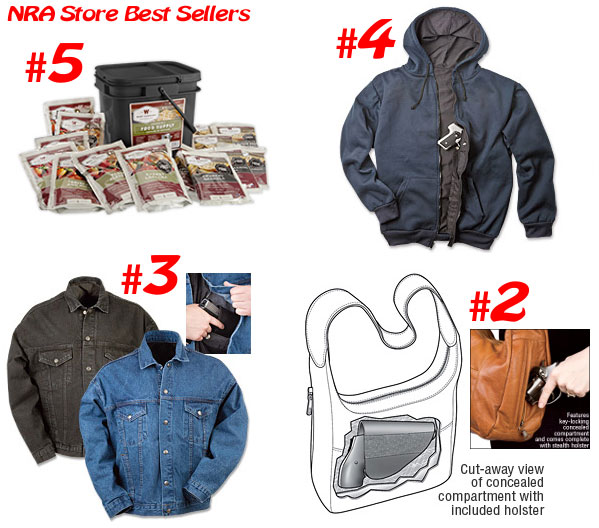
3) Concealed Carry Denim Jacket – Made in the USA, this $84.95 denim jacket is specially engineered with CCW features for NRA members.
2) Concealed Carry Handbag – This $149.95 leather handbag features a discreet, lockable side compartment that securely holsters a self-defense handgun. (Available colors: red, cognac, and black.)
And the #1-Selling item is the NRA Handgunner Backpack
The Handgunner Backpack ($119.95) features a slide-out, four gun cradle, with pockets for ammo and other range gear. Measuring 17″ wide, 22″ high and 9″ deep, the pack has plenty of room for gear.

 Quad-Pistol Gear Hauler Quad-Pistol Gear Hauler
The cleverly-designed Handgunner Backpack carries up to four pistols. Undo the zipper, slide out the compartment, place your pistols in one of the four foam gun cradles. Store your magazines in a zip-up side pocket with six (6) individual mag sleeves. There are also specially designed compartments for ammo boxes, muffs, protective eyewear, target stapler, and more. You’ll find handy embroidered patches showing the right spot for each gear item.
Lars Dalseide, editor of the NRAblog, tells us this pack is comfortable and sturdy. The shoulder straps and the rear back panel feature moisture-wicking padding and the pack comes with a waterproof cover. And the pack won’t collapse when you set it on a bench — it stands up on its own.
December 22nd, 2014
 Sometimes you’ll get a barrel that doesn’t stabilize bullets the way you’d anticipate, based on the stated (or presumed) twist rate. A barrel might have 1:10″ stamped on the side but it is, in truth, a 1:10.5″ twist or even a 1:9.5″. Cut-rifled barrels, such as Kriegers and Bartleins, normally hold very true to the specified twist rate. With buttoned barrels, due to the nature of the rifling process, there’s a greater chance of a small variation in twist rate. And yes, factory barrels can be slightly out of spec as well. Sometimes you’ll get a barrel that doesn’t stabilize bullets the way you’d anticipate, based on the stated (or presumed) twist rate. A barrel might have 1:10″ stamped on the side but it is, in truth, a 1:10.5″ twist or even a 1:9.5″. Cut-rifled barrels, such as Kriegers and Bartleins, normally hold very true to the specified twist rate. With buttoned barrels, due to the nature of the rifling process, there’s a greater chance of a small variation in twist rate. And yes, factory barrels can be slightly out of spec as well.
Before you purchase a bunch of bullets and set off to develop loads it’s wise to determine the true twist rate of your new barrel. Sinclair International, in its Reloading Press Blog provides a simple procedure for determining the actual twist rate of your barrel. Read on to learn how….
How Twist Rate Affects Bullet Stability
Most of you know that the twist of the rifling in the barrel is what puts spin on the bullet. As a bullet is pushed down the barrel and compressed into the rifling, the bullet follows the path or twist of the rifling. The combination of velocity and bullet spin is what stabilizes the bullet. Finding the twist rate for your barrel will help you in selecting appropriate weight bullets for your firearm. Remember, the general rule is that the faster the twist rate for a given caliber, the longer the bullet (of that caliber) you will be able to stabilize. (Generally speaking, a longer bullet will also be a heavier bullet, but the bullet geometry dictates the needed twist rather than the weight per se.)
Determining Barrel Twist Rate Empirically
Twist rate is defined as the distance in inches of barrel that the rifling takes to make one complete revolution. An example would be a 1:10″ twist rate. A 1:10″ barrel has rifling that makes one complete revolution in 10 inches of barrel length. Rifle manufacturers usually publish twist rates for their standard rifle offerings and custom barrels are always ordered by caliber, contour, and twist rate. If you are having a custom barrel chambered you can ask the gunsmith to mark the barrel with the twist rate.

Erik Dahlberg illustration courtesy FireArmsID.com.
Sinclair’s Simple Twist Rate Measurement Method
If are unsure of the twist rate of the barrel, you can measure it yourself in a couple of minutes. You need a good cleaning rod with a rotating handle and a jag with a fairly tight fitting patch. Utilize a rod guide if you are accessing the barrel through the breech or a muzzle guide if you are going to come in from the muzzle end. Make sure the rod rotates freely in the handle under load. Start the patch into the barrel for a few inches and then stop. Put a piece of tape at the back of the rod by the handle (like a flag) or mark the rod in some way. Measure how much of the rod is still protruding from the rod guide. You can either measure from the rod guide or muzzle guide back to the flag or to a spot on the handle. Next, continue to push the rod in until the mark or tape flag has made one complete revolution. Re-measure the amount of rod that is left sticking out of the barrel. Use the same reference marks as you did on the first measurement. Next, subtract this measurement from the first measurement. This number is the twist rate. For example, if the rod has 24 inches remaining at the start and 16 inches remain after making one revolution, you have 8 inches of travel, thus a 1:8 twist barrel.
This rifling illustration was created by Danish graphic artist Erik Dahlberg. It is published here courtesy FireArmsID.com, an excellent website for forensic firearms examiners.
December 21st, 2014
 Want to watch some very cool super-slow-motion videos of projectiles drilling bugholes and blasting through stuff? Then check out these videos from Remington’s R&D Center. We guarantee you’ll be entertained. You’ll find some truly amazing high-speed videography. Many video sequences are captured with ultra-high-speed cameras running hundreds of thousands of frames per second. This allows stunning slow-motion playback. Want to watch some very cool super-slow-motion videos of projectiles drilling bugholes and blasting through stuff? Then check out these videos from Remington’s R&D Center. We guarantee you’ll be entertained. You’ll find some truly amazing high-speed videography. Many video sequences are captured with ultra-high-speed cameras running hundreds of thousands of frames per second. This allows stunning slow-motion playback.
You’ve no doubt heard the term “tack-driver”. Are there rifles that really drive tacks? Well Remington has given us something just as good — a “nail driver”. In the video below, you can see a bullet “hit the nail on the head”, driving a nail into the target. Very cool indeed…
Driving Tacks — Hitting Nailheads with Bullets (Slow Motion)
Remarkable High-Speed Photography Shows Bullet Performance
You can see some amazing things — bullets busting concrete blocks, smashing through wood, drilling ballistic gelatin, and tearing through skin and gel (so you can see how bullets would perform in game animals). Our favorite sequence shows five shots forming a nice, clustered group — you can actually see the bullets fly into the paper target one after another. Here are some of the video highlights.
Five Shots with .30-06 into Paper (Slow Motion)
Busting Concrete Blocks with Bullets (Slow Motion)
Bullets Penetrate through Skin and Gelatin (Slow Motion)
Dances with Gel (Slow Motion)
Story tip from EdLongRange. We welcome reader submissions.
December 21st, 2014
 Here’s a valuable web resource our readers should bookmark for easy access in the future. ShootForum.com offers a vast Bullet Database, which includes over 3900 bullet designs in all. We counted nearly 200 different 6mm bullets! The bullet info comes from the makers of QuickLOAD Software. Access to the online database is FREE. Most database entries include Caliber, Manufacturer, Stated Bullet Weight, True Bullet Weight, Length, Sectional Density (SD), and Ballistic Coefficient. In many cases multiple BCs are provided for different velocity ranges. Here’s a valuable web resource our readers should bookmark for easy access in the future. ShootForum.com offers a vast Bullet Database, which includes over 3900 bullet designs in all. We counted nearly 200 different 6mm bullets! The bullet info comes from the makers of QuickLOAD Software. Access to the online database is FREE. Most database entries include Caliber, Manufacturer, Stated Bullet Weight, True Bullet Weight, Length, Sectional Density (SD), and Ballistic Coefficient. In many cases multiple BCs are provided for different velocity ranges.
The coverage of the Bullet Database is amazing. Manufacturers in the database include: A-Square, Barnaul, Barnes, Berger, Brenneke, Calhoon, CDP, CheyTac, ColoradoBonded, CT, DAG, David Tubb, Delsing, DEWC, DKT, DTK, DYN, Federal, Fiocchi, FMJ, FN, Fortek, FP, Freedom, Frontier, GECO, Gian-Marchet, GPA, GS-Custom, H&N, Hawk, HeviShot, Hirtenberger, Hornady, HP, Igman, IMI, IMI-Samson, Impala, JDJ, JLK, Klimovsk, Lapua, LEADEx, LEE, Lehigh, LIMA, LostRiver, LYM, MEN, Mil, Norinco, Norma, NorthFork, Nosler, PMC, PMP, Powell, PrviPartizan, Rainier, RCBS, Reichenberg, Remington, RN, RNFP, RUAG, RWS, Sako, Sellier-Bellot, Shilen, Sierra, Sinterfire, Speer, Stoklossa, SWC, Swift, Swiss, The Gun Haus, TMJ, WestCoast, Winchester, WM-Bullets and Woodleigh.
The database is great if you’re looking for an unusual caliber, or you want a non-standard bullet diameter to fit a barrel that is tighter or looser than spec. You’ll find the popular jacketed bullets from major makers, plus solids, plated bullets, and even cast bullets. For those who don’t already own QuickLOAD software, this is a great resource, providing access to a wealth of bullet information.

December 21st, 2014
What do you get for the shooter “who has everything”? How about a custom-crafted, laser-engraved ammo display case. Technoframes produces a series of ultra-sleek Ammo display units, and high-tech pistol racks. The CNC-machined display boxes, fitted to your choice of cartridge, look great. There are many varieties to choose from, including wood, metal, and plexiglass. We like the fact that many of the boxes are lockable.


Technoframes’ impressive billet-aluminum pistol racks, with magazine-style gun holders (fitted with Neodymium magnets in their bases) put ordinary plastic or wire-framed racks to shame.

Last but not least, Technoframes also makes a plexiglass-sided gun transport box and a double-tiered, two-pistol/six-magazine gun display box with removable inner tray. These units look like they were produced by “M” for James Bond.
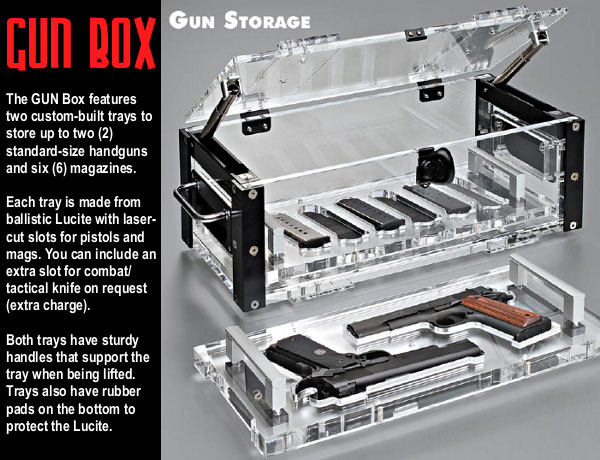
Technoframes is the world’s leading producer of high-end CNC-machined ammo and handgun storage solutions. Along with display cases, Technoframes offers Snap Caps and historical replica ammunition. For more info, visit Technoframes.com.
December 20th, 2014
Tactical matches are becoming more and more popular every season. Along with F-Class, the tactical discipline is one of the fastest-growing forms of competitive rifle shooting. Rich Emmons, one of the founders of the Precision Rifle Series (PRS), has written an insightful article about getting started in the tactical game. Here are highlights from Emmon’s PRS — Intro to Competition article.

Precision Rifle Series — Intro to Competition
by Rich Emmons, PRS President
Tactical Shooting with a precision rifle is not like other disciplines, there is no set course of fire or format. That is what makes it so fun!

First, you have to ask yourself what do you want to accomplish. When I was introduced to long range shooting, immediately a light turned on for me, once I saw how easy it was to hit 300–600 yard targets. What I quickly learned from my first competition and the many that followed was there is so much to learn and shooting in competition put everything you thought you knew to the test. So back to the question: “What do YOU want to accomplish?”. The reality is you may not know yet, you just think it is cool to have a bad ass rifle and scope that can make almost any shot. Now if you’ve got that rifle and scope, it’s time to take it to the next level.
Watch PRS 2012 Championship (Click arrows icon to view full-screen version.)
Getting Started — What to Expect
If you’re reading this, you have probably already have been bitten by the long range shooting bug. It can seem quite intimidating to just jump in with a new bunch of shooters you don’t know and shooting lingo you don’t quite understand yet. But here is the key — show up and shoot! I guarantee you if you show up to a match as a new shooter, other experienced shooters will guide you along and give you help on anything you need.
|
AUDIO: Click Button to hear Rich Emmons Talk about the Precision Rifle Series. |
Now, a couple things you should just expect. You’re not as good as you think you are. Don’t expect to come into your first match and beat all the veterans. That just doesn’t happen unless you have had some really good coaching or other shooting competition experience to get you ready for this type of competition. If possible, find a local rifle club that has monthly long range matches, or any type of match will help prepare you for a larger PRS event. Getting involved with a rifle club and starting out shooting monthly matches is definitely the way to jump into competition shooting.
The Gear You Need
The first question that many ask is: “What kind of rifle/caliber/scope do I need?” The easiest answer to this is, the best you can afford. It’s no secret the gear is expensive. It took me several years of buying sub-par gear and eventually trading up to figure this out. Now, a guy can get a real sense of pride of doing it on the cheap, or with a factory rifle. I’ve seen many old Savage 10FPs take down custom rigs that cost 10 times as much. And if that’s all you can afford, then eventually you will learn the limitations of yourself or your gear. As for choice of cartridge/caliber, the Precision Rifle Blog has analyzed three years worth of match results from the best tactical shooters in the nation. CLICK HERE to read an article that reveals what the “top guns” use.

Making Good Ammo
Producing quality reloads is something you have to master. It’s not hard at all, you just have to pay attention to detail, and eventually you are going to do something stupid like mis-priming your brass, or skip a row of brass when dumping your powder. Everybody has their own horror story of some reloading failure that cost them a stage or even a match. So load to perfection, work with your rifle to find what load it likes the best, then start your practice.

Practice Makes Perfect
You want to become ONE with your rifle, learning everything you can about its functionality. Getting comfortable with the operation of your rifle is key. Learn the feel of your trigger, dry-firing until you wear the paint off your bolt handle. Learn how the rifle works best — pay attention to little things like the sound and feel of the bolt feeding a round from the mag (or when it doesn’t). Learn how to remove a jammed round quickly, learn how to reload a magazine quickly. Learn to scan across a field and find targets in a quick manner, seeing the targets with your eye and coming into the scope on target. These are some of the basic practices that separate the new shooters from the seasoned ones.


December 19th, 2014
The RCBS Rock Chucker is a rugged, classic design that can last a lifetime. If you are looking to get started with hand-loading, or just need another press for your reloading room, the Rock Chucker is a great choice. And now it’s easier than ever to purchase a Rock Chucker. Right now, Bullets.com has slashed the price on its RCBS Rock Chucker Supreme presses. As part of an inventory reduction sale, Bullets.com is now offering the RCBS Rock Chucker Supreme (with full RCBS warranty) for just $99.95. Act soon — this offer is limited to supplies on hand.

More Savings — $10.00 Rebate from RCBS
Getting a great press for under one hundred bucks is hard to beat. But get this — RCBS is currently offering a $10.00 rebate with any qualifying RCBS product purchase of $50.00 or more made before December 31, 2014. So… if you buy this press before the end of 2014, you can get a $10.00 RCBS rebate. That lowers your effective cost to $89.95 for the Rock Chucker Supreme. That is one amazing deal. CLICK HERE for REBATE INFO.
December 18th, 2014
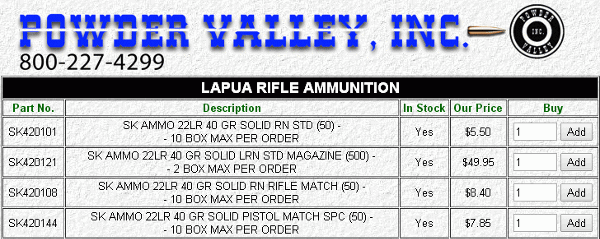
If you need rimfire ammunition, Powder Valley Inc. (PVI) just received a large shipment of SK .22 LR ammunition from Europe. This is good quality, German-made ammo, much better than the bulk-pack Federal and Winchester fodder. SK is run by the same parent company that owns Lapua. Right now the practice-grade 40gr .22LR SK Standard ammo is $5.50 per box of 50 cartridges, while the rifle Match grade ammo is $8.40 per box. Act quickly ladies and gents. This will probably sell out pretty quickly. To find this on the PVI site, click “Ammo” then “Rifle Ammo” then “Lapua”.
December 18th, 2014
Sierra has announced a new line of plastic-tipped MatchKing bullets. “Say What!? — that can’t be right…” you may be thinking. MatchKings have always been jacketed, hollowpoint bullets. Until now, plastic tips have been reserved for other Sierra projectiles, such as BlitzKing varmint bullets. But that is changing with the introduction of Sierra’s line of Tipped MatchKing (TMK) bullets featuring green acetal resin tips.

Plastic Tips Offer Better BC
Sierra says the plastic tips on TMKs enhance the Ballistic Coefficient (BC): “The major advantage of adding a tip to the bullet is the reduction of drag, producing a more favorable ballistic coefficient.” Stated BCs for the new TMK bullets are listed below. These BC numbers look good, and they have been verified with real-world testing: “We shot [all the new TMKs] multiple times (we actually test our BC numbers instead of letting a computer tell us what it is) and those numbers are all proven out!”
There will be six (6) new TMK bullets, two in .224 caliber, and four in .308 caliber. The six new tipped bullet types should be available in “early 2015″. Sorry, Sierra will not be offering 6mm, 6.5mm, or 7mm TMKs for the time being, although Sierra will introduce more TMK varieties in the future. Currently, Sierra is focusing on “the most popular calibers”. Notably, the new 22-Cal 77gr TMK has a 0.420 BC — identical to the BC of Sierra’s 80gr non-tipped HPBT MatchKing. So, you get the BC of a heavier bullet in a lighter projectile that can be pushed faster. That’s big news for .223 Rem and 22-250 shooters.
New Bullet Shapes Along with Plastic Tips
In addition to the bullet tip, some of these new TMK bullets have slightly modified shapes compared to previous-generation, non-tipped MatchKings (SMKs) of like caliber/weight. Sierra’s technicians reported: “The [plastic] point on the tip is smaller than the meplat on a SMK and if you look, you will also see the ogive on most of these [new TMKs] have been changed as well. Most of the big BC gains are from the reshaped ogives from the legacy SMK product.”


 



|


