Here’s a smart new product that could save your life (or the life of a loved one). The EPIC-id bracelet stores your vital information on a shockproof, weatherproof USB flash drive that can be instantly accessed by an EMT or doctor. Your Editor just bought two of these med-info bracelets — one for himself and another for a diabetic family member. If you’re a shooter, or spend much time outdoors, you should have this device or some other kind of tag that provides your vital info (such as blood type and drug allergies) to first responders.
If you’re injured, first responders need to know if you have a medical condition, have drug allergies, or take any medications. With this bracelet, that vital info is available even if you can’t communicate. The EPIC-id Emergency Band stores medical data on a USB flash drive that can be “read” by any computer or mobile device with a USB port. Firefighters, EMTs, and medical professionals can instantly determine your name, emergency contacts, insurance, and medical information. (Read my experience below).
It’s easy to load your medical data on to the device. Standardized emergency info forms come pre-loaded — just insert the Epic-ID into any computer to fill out the forms. PC and Mac™ compatible, the waterproof EPIC-id features a durable stainless steel clasp and trim-to-fit silicone band.
Editor’s Story — Why This Is Important
Just this past Wednesday July 8th, at 2:00 am, a family member was rushed to the hospital after suffering a stroke. She was non-responsive and unable to communicate at all. This created problems for EMTs because they were unaware of her current medications, insulin needs, resusitation preferences, and some relevant past medical history. After that experience I decided to buy these bracelets for her and myself. The good new is that she survived… but it was close.
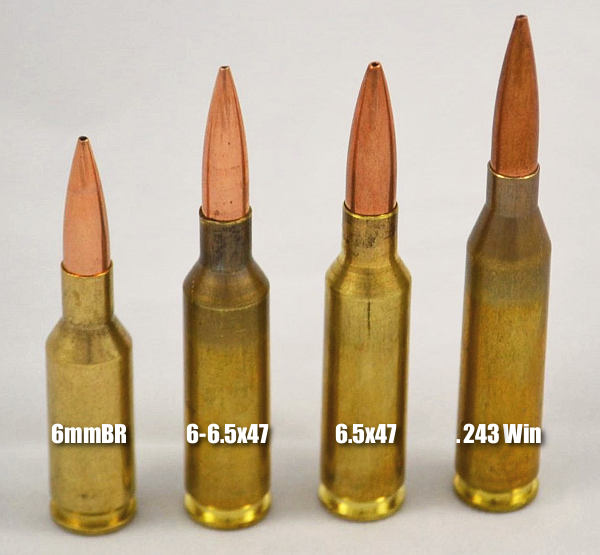
Initially drawn to the 6mmBR and 6mm Dasher, I realized these cartridges wouldn’t feed from an AICS magazine system without extensive modification. I took a look at the 6mm Creedmoor, 6XC, and 6mm-6.5×47 Lapua (aka 6×47 Lapua), all of which feed well from a detachable magazine. At right you can see the 6×47 Lapua in an AICS magazine. It has the “Goldilocks factor” — not too long, not too short.
The ability to simply convert 6.5×47 Lapua brass to 6×47 brass by running the parent 6.5mm brass through a full-length Forster sizing die in a single step was what made me choose the 6×47 Lapua over the 6mm Creedmoor and 6XC (both excellent cartridges in their own right). I also own a 6.5×47 Lapua rifle, so I had a supply of 6.5×47 brass ready to neck-down. Being able to create 6×47 brass easily (one pass and done) was very appealing.
Left to right, below: 6mmBR, 6-6.5×47 Lapua, 6.5×47 Lapua, and .243 Winchester.
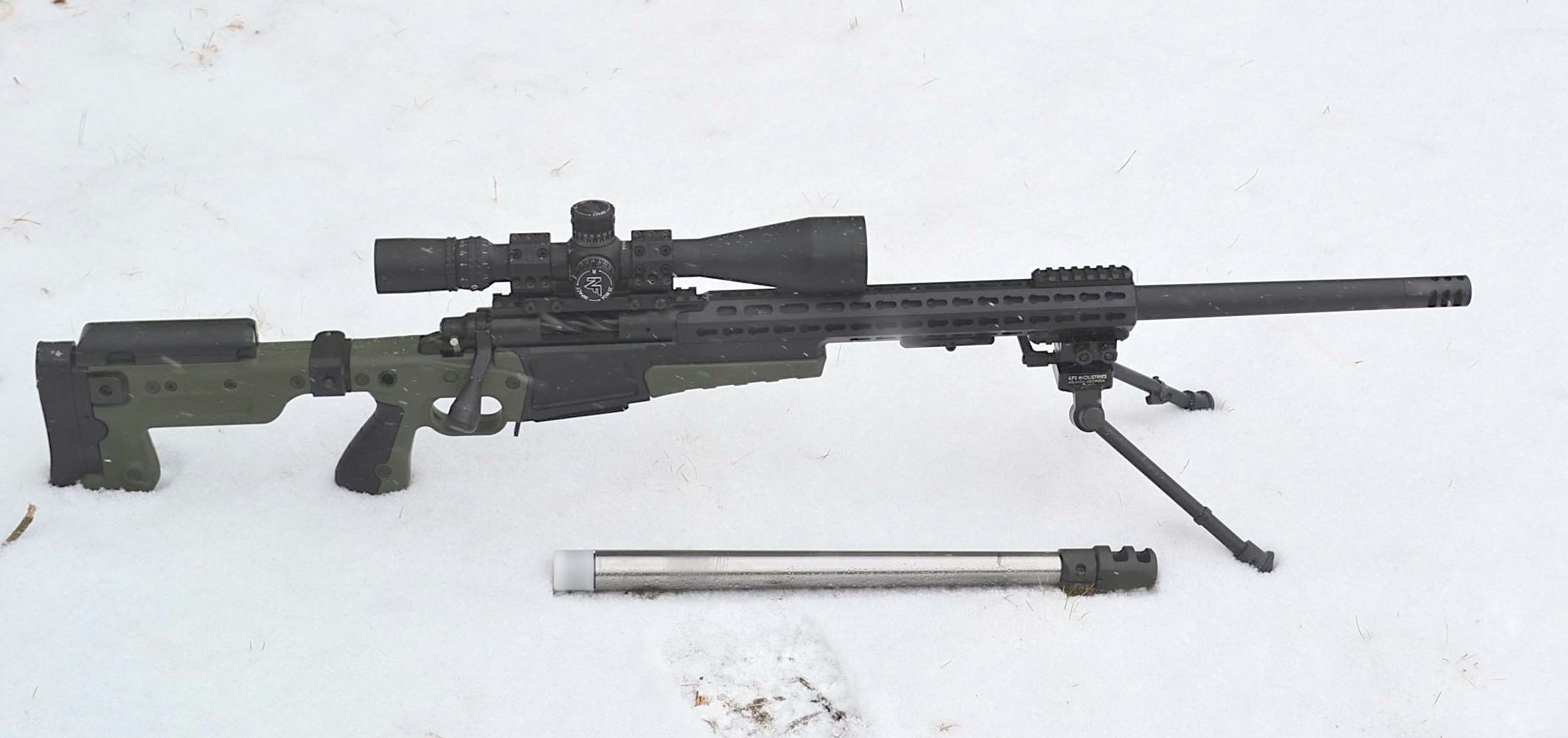
I cut the chamber end off my .243 Win barrel, threaded and chambered my rifle for the 6×47 Lapua cartridge. I have written a lengthy article on this cutting and re-chambering process. Home gunsmiths interested in this process can READ MORE HERE.
When the re-chambering was complete, I headed to the range and worked up a set of eight loads using Berger 108 BTHPs, H4350, Lapua brass, and CCI 450 primers.
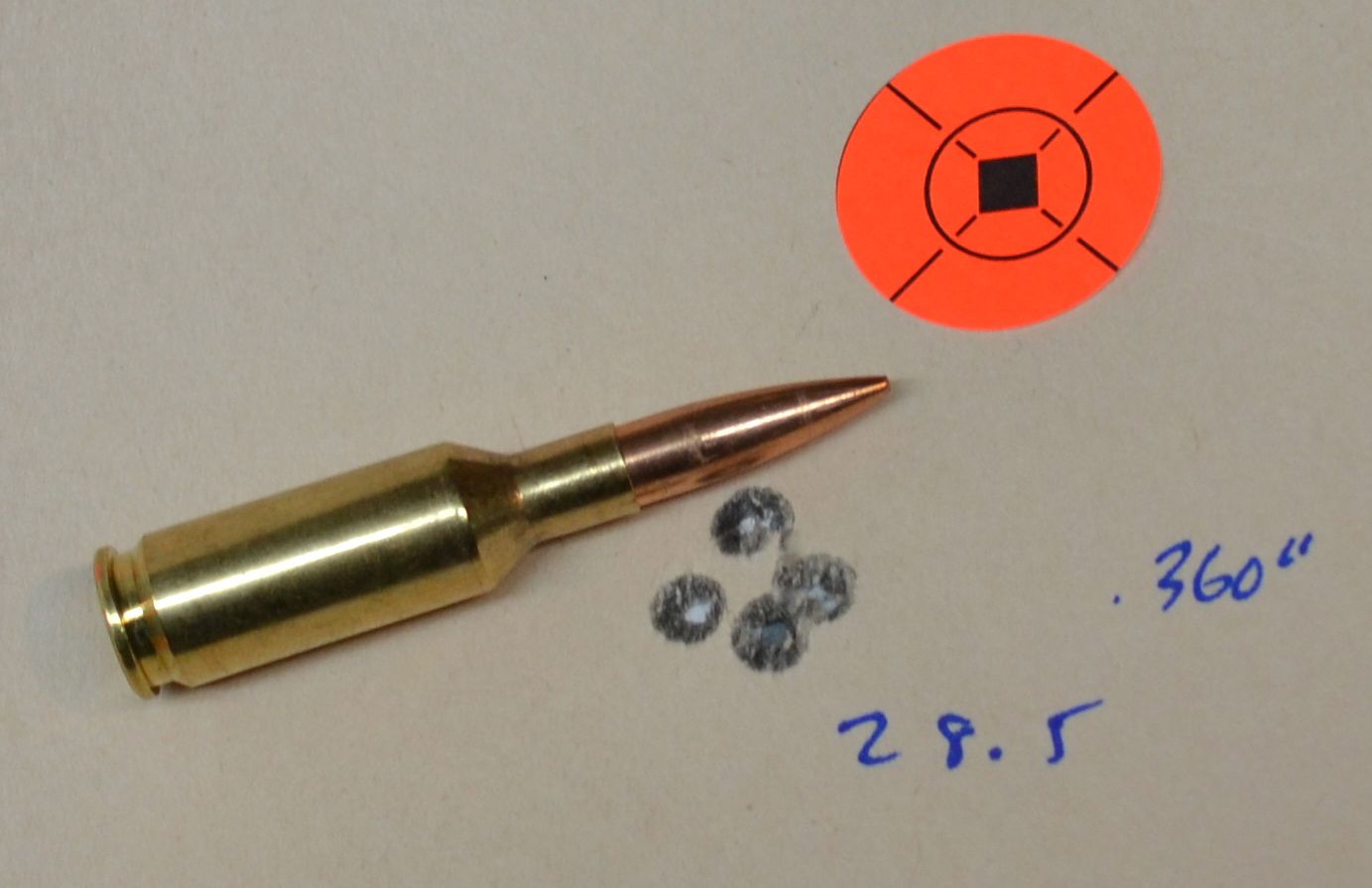
Load development was a little trickier than with the 6.5×47 Lapua parent cartridge. The accuracy nodes were smaller. However, once I dialed in a load with Hodgdon H4350 and the 108-grain Berger BTHP, the rest was history. The 6×47 rig is now one of the most consistent rifles I own, holding just above 0.3 MOA for 5-round groups. Below is a 100-yard test target with 108-grain Berger BT in the 6×47 Lapua. Five-shot group sizes are (L to R): .369″, .289″, and .405″. The average size was .354″ or .338 MOA. [Editor: We think that is excellent accuracy for a tactical-type rifle shot from bipod.]
Learn More about this 6×47 Lapua Project
I’ve written more about this 6×47 rifle on my Rifleshooter.com website. To learn more about my experience with the 6×47 Lapua, click this link: 6-6.5X47 Lapua Review.
About the author: Bill has been a serious shooter for over 20 years. A former Marine Corps Sergeant, he’s competed and placed in High Power Rifle, ISPC, USPSA, IDPA, 3-Gun, F-Class, and precision rifle disciplines. In addition to being an NRA-certified firearms instructor and range officer, Bill has hunted big game in North America, South America, and Africa. Bill writes extensively about gunsmithing, precision rifles, and the shooting sports on his blog, Rifleshooter.com.
F-Class shooting (both F-Open and F-TR) is one of the fastest-growing forms of rifle competition. Each season many new shooters hit the line and attendance at the big matches increases every year. But if you’re new to the game, you may ask “Where can I shoot an F-Class match?”. Well, Forum member Rod V. (aka Nodak7mm) has compiled a useful list of 109 ranges around the USA where F-Class matches are held (plus 6 “possibles”). With venues from Alabama to Wyoming — you should find an F-Class program not too far from home. The list, in Excel spreadsheet format, provides range locations and weblinks (where available). Click the link below to download the F-Class Range List (.xls file):
Note — this list, now in its 19th Revision, is augmented regularly, but info is still being gathered. No claim is made that the list is comprehensive. But it still covers the the lion’s share of the important F-Class venues nationwide. If you know of a range that should be added to the list, please post the location on our F-Class Range List Forum thread. Rod will update the list as new range info is received. Rod writes: “Range information is wanted and welcomed. I would like your help on collecting specific info on Clubs/Ranges where known F-Class matches are held.” Here’s a partial sample from Rod’s list:
Tikkas are boring, nondescript hunting rifles right? Wrong. Check out this Tikka T3 tactical with “attitude”. For the British Shooting Show in 2014, the folks at Osprey Rifles placed a Tikka T3 action into a modern modular chassis: “A standard factory Tikka T3 was fully Cerakoted and dropped into a Third Eye Tactical chassis stock which also had the Cerakote treatment. It certainly pulled a crowd and was sold on the Show’s first day! We have been commissioned to do another one straight away.”
If you have been waiting to acquire a chronograph, it may be time to buy. Brownells.com now has the popular new MagnetoSpeed Sporter Chronograph in stock for just $179.99. This Sporter model shares most of the capabilities of the $399.00 MagnetoSpeed V3, but at a much, much lower cost. Like all MagnetoSpeeds, the Sporter is easy to set up. Just attach the unit to your barrel with a strap and toggle clamp. There is no need to go downrange to set up tripod and skyscreens, or run wires.
We’re impressed by the Sporter chrono (as are other shooters — this unit is selling out nationwide). Like the V3, the Sporter faithfully records shots, even in complete darkness. Shot strings are recorded digitally and can be transferred to a smart phone via MagnetoSpeed’s XFR accessory (and Apps).
What’s the downside? The manufacturer says the Sporter is limited to 1″-max diameter barrels. In actuality, it can go a bit bigger than that. We have used it successfully on a 1.15″ straight contour barrel — but “your mileage may vary”. Second, the manufacturer says the new Sporter is NOT designed for use with airguns or shotguns. We have tested the original MagnetoSpeed with air rifles and it successfully recorded .177 and .22 pellet velocities, once we adjusted the sensitivity.
This Video Shows How to Use the Magnetospeed Sporter Display
Here is the XFR Device that allows Sporter and V3 chronos to work with smartphone Apps:
With MagnetoSpeed’s $24.99 XFR adapter and associated Apps, you can download your current shot series from Sporter and V3 chrono displays to an Android or iOS device. Once synced, users can rename the current shot series, delete irrelevant shots, email the data, reconfigure the display settings (units and sensitivity level), and clear the display’s current series.
Barrel nut system allows “Pre-Fit” barrel installation on a Remington action. CLICK photo to zoom.
REMAGE Project Report by Bill, Rifleshooter.com Editor
Installing a new barrel on your Remington 700 (especially without a lathe) may seem like a daunting task, but thanks to companies like McGowen Precision Barrels, there are easier alternatives. By adopting a Savage-style barrel nut on a 1 1/16″ thread for a Remington 700 receiver, pre-chambered (aka “pre-fit”) barrels can be easily swapped with just a few hand tools. This system is sometimes called a REMAGE conversion (for “REMington savAGE”).
The existing barrel is simply removed from the action (normally the hardest part) and the new barrel is screwed on with the Go Gauge in place. The barrel nut is tightened against the action, headspace verified with the Go Gauge, and you are off to the range. It takes all of the machine work out of the barreling process. Note: the barrel nut has a slightly larger diameter and some stocks may require minor inletting. Also if you are shooting fired brass from another rifle with the same chambering, you should FL-size the brass before loading it for your new pre-fit barrel.
Bill has been a serious shooter for over 20 years. A former Marine Corps Sergeant, he’s competed and placed in High Power Rifle, ISPC, USPSA, IDPA, 3-Gun, F-Class, and precision rifle disciplines. In addition to being an NRA-certified firearms instructor and range officer, Bill has hunted big game in North America, South America, and Africa. Bill writes extensively about gunsmithing, precision rifles, and the shooting sports on his blog, Rifleshooter.com.
Ever heard of the Canadian Rangers, an element of the Canadian Armed Forces (CAF) Reserve? Founded in 1947, the Rangers serve as the CAF’s eyes and ears in sparsely-settled northern and coastal areas of Canada. The Rangers cover the remote frontiers, performing public safety as well as security duties. For their entire history, the Canadian Rangers have always used a compact model of the Lee-Enfield No. 4. But that’s about to change…
Stirring Rapid-Fire Demonstration by Canadian Rangers
The Rangers have decided to replace their beloved (but antiquated) Lee-Enfields for something more advanced — the Tikka T3 Compact Tactical Rifle (CTR) in .308 Winchester.
Canadian Ranger Model Tikka Compact Tactical Rifle Features:
1. Barrel, Bolt, and Action made by Colt Canada under license from SAKO.
2. Larger bolt handle and enlarged trigger guard to accommodate gloved hands.
3. Protected front and rear iron sights.
4. Laminated stock in unique gray/orange or red colour with Ranger Crest.
5. Two-stage trigger with three-position safety.
The first 125 prototypes have been delivered to the Rangers for field testing. Feedback from the Rangers will be incorporated in the final production rifles. The contract calls for 6500+ production rifles to be delivered to the Rangers by end of 2018.
In addition to the rifle, the package will include a custom-molded Pelican hard transport case, plus a soft transport case (outfitted with sling and cleaning kit). Both hard case and soft case feature the Canadian Ranger Crest.
TekMat.com sells a wide selection of printed rubber mats used for gun cleaning and servicing. These mats are made from wetsuit-like neoprene sandwiched between fabric layers. One side of each mat is printed with an exploded diagram of a particular pistol, rifle, or shotgun. The 17″ x 11″ Handgun mats cost $13.99. Long Gun mats measure 36″x12″ and cost $24.99. Most mats are black, but some of the mats are offered in gray and/or Olive Drab.
The July 8th (Wednesday night) episode of Shooting USA features the 1874 Sharps rifle, a lever-action breech-loader favored by plains buffalo hunters. Christian Sharps patented his signature rifle design in 1848. The Sharps Model 1874 was an updated version, chambered for metallic cartridges. According to firearms historian/author Garry James, the Sharps rifle “came in all sorts of different calibers from .40 all the way up to .50, and jillions of different case lengths and styles and configurations”.
Sharps rifles have enjoyed a new-found notoriety, thanks to Hollywood. Tom Selleck starred as Matthew Quigley in the hit movie Quigley Down-Under. In a famous scene (watch below), Quigley used his 1874 Sharps to hit a wooden bucket at very long range*. In this movie clip, Selleck explains the 45-110 cartridge, the rifle’s double-set trigger, and the Vernier rear sight. (45-110 refers to .45 caliber and case capacity of 110 grains of black powder).
The Sharps rifles used in the movie were made by Shiloh Rifle company (Powder River Rifle Company). There were actually three (3) Sharps rifles made for the movie. One went to the NRA’s National Firearms Museum while another was raffled off to support NRA shooting programs. The headline photo shows the third rifle, Selleck’s favorite, which the actor retained for some years until deciding to sell it. This third rifle (with spare barrel and associated items) were sold at auction in 2008.
* Based on the way the movie is edited, we figure the bucket is placed at about 800 yards. A typical speed for a horse galloping is 35 mph, and the horse ran (with rider holding bucket) for 46.5 seconds (0.775 minutes). To calculate yardage, divide 35 by 60 to get miles per minute, times 0.775 for distance traveled over time. Then multiply by 1760, the number of yards in a mile. That gives us 795.66 yards.
While many of us now favor digital photography over “old-fashioned” 35mm film, don’t toss those old 35mm film canisters, especially the clear Fuji-type with secure snap-in lids. Small plastic film canisters have a multitude of uses for the shooter and reloader.
Here Are Things You Can Do with Plastic Film Canisters:
1. If you weigh powder charges after throwing them with a manual powder dispenser, throw the charges first into a film canister and then use that to drop the powder into the measuring pan on your scale. The canister will catch every kernel of powder. If you throw charges directly into a weighing pan, powder can sometimes bounce out. Using the film canister will help keep spilled powder off your loading bench and floor.
2. Store extra sets of foam ear-plugs in the canister. You never want to be without ear protection. This editor has four film canisters filled with plugs. Two go in the range kit, one goes in the car’s glove compartment, and a second stays in a lock box I use to transport pistols. This way I never find myself at the range without ear protection.