Lots of slots — that’s what you’ll find on the top of RCBS’s new Pro-Chucker 7 progressive reloading press. This thing has SEVEN (7) stations, which gives you great flexibility when reloading. You have plenty of extra slots for special dies such as crimp dies or powder-check dies. The 7-hole interchangeable die-plate (aka tool-head) is am impressive bit of engineering — it looks like the cylinder for a super-sized revolver.
Our friend Gavin Gear of UltimateReloader.com got his hands on one of the first production models of the new Pro Chucker 7 progressive press. Gavin reports: “This 7-station auto-indexing progressive is the ‘big brother’ of the RCBS Pro Chucker 5, and is built on the same frame. While it shares most of the same internals, there are a few differences”. Key differences include a seven-station shellplate and seven-station die-plate (vs. five stations on the Pro Chucker 5). In addition the priming system is slightly different and the Pro Chucker 7 comes with a much larger powder hopper.
Watch Pro Chucker 7 Unboxing Video:
To demonstrate the new features of the Pro Chucker 7, Gavin has produced an unboxing video that shows the components of the system. This is a completely different design than the RCBS 2000 system progressive press (which this editor owns). The Pro Chucker series 5 and 7 presses have a more compact frame and a more conventional, vertical column priming system. They don’t take up much more space on your loading bench than a turret press, yet they offer full progressive capability, creating one loaded round with every pull of the handle.
If you are considering purchasing a progressive press (whether green, red, or blue), you should watch the video and see the press features. Gavin Gear will demonstrate how the Pro Chucker 7 works with another video to be released in the near future.
Bryan Litz with his F-TR Nat’l Championship-winnning rifle, and the man who built it, John Pierce.
Bryan Litz knows something about bullet shapes and dimensions. He’s the chief designer of many of Berger’s projectiles, including the successful line of Hybrid bullets. Bryan also understands how bullets actually perform in “real world” competition. Bryan won BOTH the Mid-Range and Long-Range National F-TR Championships this year, a remarkable accomplishment. With Bryan’s technical expertise combined with his shooting skills, few people are better qualified to answer the question: “how should I sort bullets when loading for competition?”
Bullet Sorting Strategies — OAL vs. Base to Ogive
At the 2015 Berger Southwest Nationals, Forum member Erik Cortina cornered Bryan Litz of Applied Ballistics. Erik was curious about bullet sorting. Knowing that bullets can be sorted by many different criteria (e.g. weight, overall length, base to ogive length, actual bearing surface length etc.) Erik asked Bryan to specify the most important dimension to consider when sorting. Bryan recommended sorting by “Base to Ogive”. Litz noted that: “Sorting by overall length can be misleading because of the nature of the open-tip match bullet. You might get a bullet that measures longer because it has a jagged [tip], but that bullet might not fly any different. But measuring base to ogive might indicate that the bullet is formed differently — basically it’s a higher resolution measurement….”
Ballistics Q & A in Shooter’s Forum
Got more questions about bullets? Our Shooters’ Forum has a special area for Bullets & Ballistics topics. There you can get your own questions about bullets and ballistics answered by Bryan Litz and other experts from Applied Ballistics.
Doan Trevor is a master gunsmith and stock-maker who works in the old style. He still hand-crafts stocks from start to finish, and does all the metal-work on the custom rifles he builds. Starting with highly-figured woods, Doan carves and shapes his stocks largely by hand, with meticulous attention to detail. Each rifle he builds is optimized for its intended discipline, and custom-fitted for the customer.
With the help of his talented wife Sue (who does the photography and builds the web pages), Doan has created a wonderful website, DoanTrevor.com, that is a feast for the eyes. You can see beautiful wood-stocked rifles being hand-crafted. Doan also illustrates how he creates custom metal parts, and how he beds barreled actions into the finished stocks.
Set aside a few minutes and visit Doan’s website. Be sure to click on the site’s secondary pages: Rifle Building, Woodworking, and Metalworking. You’ll find dozens of high-quality photos and fascinating information on gun-building.
For more information, visit DoanTrevor.com, or call (505) 890-0368, 10am-5pm M-F.
Looking for a perfect gift for a hunter or target shooter? What gift could be more well-received by an avid shooter than a new firearm? And there’s still time to save on a Savage. Right now you can save up to $75.00 on the purchase of select Savage rifles. Put the money you save with this “cash-back” rebate into ammo or hunting gear. This cash-back rebate is good through 12/31/2015.
Qualifying Rifles and Rebate Rules
A $75.00 Rebate is offered for these products: the Model 10 Predator Hunter, 11/111 Long Range Hunter, 11/111 Lightweight Hunter, 11/111 Lady Hunter, 11/111 FCNS Hunter, 16/116 Bear Hunter or 16/116 FCSS Weather Warrior. A $50.00 Rebates is offered for the choose any Trophy Hunter XP, Trophy Predator Hunter XP, AXIS or AXIS II XP. Rimfire shooters who purchase any Mark I, Mark II, Model 93, Model 93R17, B.MAG or Model 42 will be eligible for a $25 mail-in Rebate.
Firearms must be purchased between August 1, 2015 and December 31, 2015. Rebate coupon must be received by January 31, 2016. Offer valid in U.S.A. and Canada. USA funds only. For all the details and restrictions go to SavageArms.com/Promotions.
Looking for a tough, heavy-duty gun case for under $100? The excellent Plano All-Weather Rifle Case is now just $68.67 with free shipping. That’s an awesome deal. This Plano shares many features of a much more expensive Pelican case at a fraction of the price. An O-Ring runs all around the lid, providing dust protection and a watertight seal. The bottom-level foam is pre-configured into little “pluckable” cubes, so you can easily customize the case for your rifle (no “hot-knife” work required). The interior size is 43″ x 13″ x 5″. That’s big enough for most AR-platform and hunting rifles. For long-barreled competition rifles, you will want to detach the barreled action from the stock — and then place them in two different slots (one for the stock, one for the barreled action.) We’ve transported long-barreled F-Open rifles in cases like this — just separate the rifle into two parts first.
REAL REVIEWS: Here are comments from verified purchasers of the Plano Tactical case:
This gun case is everything I expected. Latches very securely and is durable enough to handle laying in the bed of my truck bouncing down a dirt road. The foam is nice because it allows for almost exact shaping to your rifle and accessories. I plan on ordering three more. You can’t beat this price. — Coach
The absolute best without busting my wallet. NOTHING wrong with this case … nothing. Clamps are solid and do not slip open when bumped. You will not go wrong with owning this model/price gun case. Satisfied! — SF67n2
This Plano All-Weather Case offers great value for the money. A similar, 44″-long Pelican model 1720 case retails for about $240.00. The Plano offers most of the same capabilities of the Pelican, for about one-third the price. Both cases are watertight (with O-Ring seal), both cases have pressure release valves, and both cases have strong “gorilla-proof” outer shells. If you need more capacity, Plano also makes a large Double Scoped Rifle Case with wheels for $114.99 (51.5″ x 12.63″ x 5.25″ interior). All gun case prices are subject to change.
Christmas Day is just a week away. Books have always been popular holiday gifts. If you haven’t completed your holiday shopping, here are some recommended titles that should please the serious shooters and firearms enthusiasts on your shopping list. For shooting clubs, books also make great end-of-season member awards. Most of us would rather have a useful book than one more piece of wood to toss in a box in the closet.
Here Are TEN TITLES Recommended for Serious Shooters:
If you’re a serious long-range shooter, consider adding this book to your library. Relying on extensive ballistics testing, Modern Advancements contains some fascinating research results, including the effects of twist rate on muzzle velocity, BC, and precision. Other sections detail the evolution of modern rifle, bullet, and optics designs. And there is an important comparison test of chronographs. Laser rangefinders and wind measurement devices are explained in detail by contributing author Nick Vitalbo. This book is a valuable resource for anyone who wants to understand the current “state of the art” in today’s shooting world. There is a ton of “hard science” in this book — not just opinions.
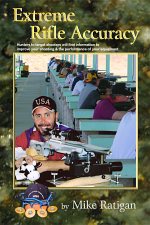
This book should be on the shelf of every short-range benchrest shooter. (Shooters in other disciplines will find the book helpful as well.) Butch Lambert says Mike’s book is “far and away the best Benchrest book written. Very comprehensive, it touches on every aspect of our game.” Mike’s 368-page book is dedicated to getting the most from modern rifle accuracy equipment with an emphasis on shooting 100-200-300 yard group benchrest tournaments. This book covers the most popular hardware plus new equipment offerings are covered, including external mount scopes, actions, triggers, stocks, wind flags, and more. Also covered are rifle handling techniques, note taking, tuning, bullet selection, goals, and match strategies. Mike provides many tips that will help active competitors update their own competitive program.
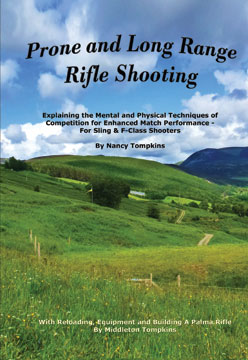
Nancy Tompkins is one of the greatest long-range shooters in American history. She has won five National Long-range Championships. Tompkins’ treatise is a must-read for serious Palma, F-Class, and High Power shooters. The revised Second edition includes F-Class equipment and techniques, and newly updated information. Color pictures. Topics include Mental & Physical training, Reading Wind & Mirage Shooting Fundamentals, International Competition, and Loading for Long Range. Nancy Tompkins is a 4-time winner of the National Long Range Championships, and has won countless other major events. Nancy has been on six Palma Teams (as both a shooter and a coach).
Tony Boyer, the most successful shooter in the history of short-range benchrest competition, shares many of his match-winning tips in this 323-page book. The book covers all aspect of the benchrest discipline: loading, windflags, rest set-up, addressing the rifle, and match strategies. This is a high-quality publication, filled with valuable insights. Every serious benchrest shooter should read Tony’s book. Boyer has dominated registered benchrest in a fashion that will never be duplicated, having amassed 142 U.S. Benchrest Hall of Fame points. The next closest shooter, Allie Euber, has 47 Hall of Fame points. This handsome, full-color book is 323 pages long, with color photos or color illustrations on nearly every page.
This book by 11-time National High Power Champion David Tubb focuses on position shooting and High Power disciplines. Section One covers fundamentals: position points, natural point of aim, breathing, triggering mechanics and follow-through, sling selection and use, getting started, getting better, avoiding obstacles. Section Two covers mechanics of offhand, sitting, and prone positions. Section Three covers shooting skills, including wind reading and mental preparation. Section Four covers the technical side of shooting, with extensive disuctions of rifle design, load development, reloading barrel maintenance, and rifle fitting. We consider this book a “must-read” for any sling shooter, and there is plenty of good advice for F-Class shooters too.
Many of our Forum members have recommended The Wind Book for Rifle Shooters by Linda Miller and Keith Cunningham. This 146-page book, published in 2007, is a very informative resource. But you don’t have to take our word for it. If you click this link, you can read book excerpts on Amazon.com. This lets you preview the first few chapters, and see some illustrations. Other books cover wind reading in a broader discussion of ballistics or long-range shooting. But the Miller & Cunningham book is ALL about wind reading from cover to cover, and that is its strength. The book focuses on real world skills that can help you accurately gauge wind angle, wind velocity, and wind cycles.
Rifle Accuracy Facts by Harold R. Vaughn, (Softcover and Hardcover, Used Price Varies)
Decades after it was written, Vaughn’s work remains a seminal treatise on accuracy. Vaughn was a serious scientist, working for the Sandia National Laboratories. Many “gun writers” toss out hunches about rifle accuracy. Vaughn, by contrast, did serious empirical testing and statistical analysis. Vaughn wondered why some guns shot well while seemingly identical rifles did not. Rifle Accuracy Facts covers a wide variety of topics, including internal ballistics, chamber design, barrel vibration, bullet imbalance, external ballistics, scope design and more. Writer Boyd Allen notes: “If you are serious about precision shooting, Vaughn’s book belongs in your library.”
The Accurate Rifle by Warren Page, $14.95 (Softcover), $20.99 (Hardcover)
We include this book in our list because it is an older classic that has been out of print for a while. Warren Page was the shooting Editor of Field & Stream magazine for 24 years. Long out of print, this seminal work on rifle accuracy was republished in 1996 with an updating chapter by Dave Brennan, long-time Editor of Precision Shooting magazine. If you are interested in the progress of rifle accuracy, it is worth reading this book to see how technology has developed over time (and what older methods still work today). This would make a great gift for an older shooter who grew up reading Warren Page articles in Field & Stream.
Steven Boelter’s 352-page book is a comprehensive study of all types of rimfire ammunition (including 17s and 22 mags), with over 600 photos. In a remarkable undertaking, Steven Boelter fired every brand and sample of rimfire ammo he could acquire (including .22 LR, 17 Mach 2, 17 HMR and .22 WMR), and recorded all the results. In all, Steven tested 11 brands and 137 different rimfire rounds, firing over 32,000 test rounds.
Always controversial, Bill Calfee is nonetheless a major player in the world of rimfire accuracy. Calfee-built rimfire rifles have set many records and won many titles. He harbors strong opinions about what works and what doesn’t, but if you are involved in rimfire competition you should read this book. This work covers all aspects of rimfire gunsmithing and accurizing: barrels, tuners, chambering, triggers, stock design, bedding, action design and much more. He examines each aspect of rimfire accuracy discussing all of the components and their contribution to the improved accuracy. We don’t agree with all of Calfee’s theories about accuracy, but this book still remains a “must-read” for those serious about precision rimfire shooting.
Butch Lambert of ShadeTree Engineering provided this tip. Butch notes that many 6 PPC benchrest group shooters also enjoy shooting in score matches. But to be really competitive in the BR for score game, that means shooting a 30BR, which has a wider, .308-class rim (0.4728″ diameter). Likewise, if you want to compete in 600-yard registered BR events or in varmint matches, you probably want to run a bigger case, such as the 6BR, 6mm Dasher, or 6-6.5×47. Those cartridges also have the larger 0.4728″ rims.
To convert a PPC-boltface action to shoot the bigger cases you can spend a ton of money and buy a new bolt. That can cost hundreds of dollars. The simpler solution is to turn down the diameter of the larger cases on a lathe. Butch explains: “We’ve seen plenty of interest in rebating case rims. This lets you shoot a 30BR in score matches using your PPC action. All you need is a new barrel. This saves buying another bolt, receiver, or rifle if you have a PPC boltface. Anyone who has access to a lathe can do this job pretty easily. Yesterday I turned 150 case in about an hour.” Below are photos of a rebated 6BR case, along with the lathe form tool Butch uses to rebate the case rims.
Rodney Wagner shot the smallest 5-shot, 600-yard group in the history of competitive rifle shooting. First measured at a mere 0.349″, then certified on the IBS Record books at 0.336″, Rodney’s group is mind-blowingly small — and it was centered for a 50 score. This amazing group shows what can be done with a great gun, a talented shooter, and superb hand-loaded ammunition. Today’s Tech Tip reveals some of Rodney’s reloading methods that helped him put five shots you could cover with a dime into a target 600 yards away.
Creating Ultra-Accurate Benchrest Ammunition
Rodney takes great care in loading his brass, and he employs a few tricks to get superior consistency.
Fire-Forming — To prepare his cases for fire-forming, Rodney starts by turning his Lapua brass to just past where the new neck-shoulder junction will be: “I just cut enough for the 6mm Dasher neck. A little bit of the cut shows on the shoulder after forming.” Then Rodney runs a .25-caliber K&M mandrel through the whole neck, expanding the neck diameter. After the entire neck is expanded, Rodney re-sizes the top section with a Wilson bushing, creating a false shoulder. Then, as further insurance that the case will be held firmly in place during fire-forming, Rodney seats his bullets long — hard into the lands. When fire-forming, Rodney uses a normal 6mmBR load of 29.8 grains of Varget: “I don’t like to stress my brass before it has been hardened. I load enough powder to form the shoulder 95%. Any more than that is just wasted.” Rodney adds: “When fire-forming, I don’t want to use a super-hard primer. I prefer to use a Federal 205, CCI 200, or Winchester — something soft.” Using a softer primer lessens the likelihood that the case will drive forward when hit by the firing pin, so this helps achieve more consistent “blow lengths”.
Ammo Loading — Rodney is fastidious with his brass and weighs his charges very precisely. Charges are first dispensed with an RFD manual powder measure, then Rodney trickles kernel by kernel using a highly-precise Sartorius GD-503 laboratory scale. He tries to maintain charge-weight consistency within half a tenth of a grain — about two kernels of Varget powder.
One important technique Rodney employs is sorting by bullet-seating force. Rodney batch-sorts his loaded rounds based on seating force indicated by the dial gauge on his K&M arbor press: “I use a K&M arbor press with dial indicator strain gauge. When I’m loading I pay lots of attention to seating effort and I try to batch five rounds that feel the same. For record rounds I try to make sure I get five of the same number (on the dial). When sorting based on the force-gauge readout, you need to go slow. If you go too fast the needle will spike up and down before you can see it.”
In practice, Rodney might select five rounds with a gauge value of 25, then another five with a gauge read-out of 30 and so on. He places the first five like-value rounds in one row of his ammo caddy. The next like-value set of five will go in the next row down. By this method, he ensures that all five cartridges in a five-round set for a record target will have bullets seated with very consistent seating force.
Unlike some top shooters, Rodney does not regularly anneal his cases. However, after every firing, he does tumble his Dasher brass in treated corncob media. After sizing his brass, before seating the bullets, he runs a nylon brush in the necks: “The last thing I do before firing is run a well-worn 30 caliber nylon brush in the necks, using a small 6-volt drill for power. This is a quick operation — just in and out the neck”. Sometimes, at the end of the season, he will anneal, but Rodney adds: “If I can get 10 firings out of the case I’ve done good.” He usually makes up new brass when he fits a new barrel: “If it is a good barrel (that I may shoot at the Nationals), I’ll usually go ahead and prepare 200 pieces of good brass.”
Tips for 600-Yard Shooters New to the Game
In the course of our interview with Rodney, we asked if he had any tips for shooters who are getting started in the 600-yard Benchrest Game. Rodney offered some sensible advice:
1. Don’t try to go it alone. Find an old-timer to mentor you. As a novice, go to matches, watch and ask questions.
2. Go with a proven cartridge. If you are shooting 600 yards stick with a 6mmBR or one of the 6BR improveds (BRX or Dasher). Keep it simple. I tried some of the larger cartridges, the 6XC and 6-6.5×47 Lapua. I was trying to be different, but I was not successful. It wasn’t a disaster — I learned something. But I found the larger cases were not as accurate as a 6BR or Dasher. Those bigger cartridges are competitive for score but not for group.
3. You don’t have to spend a fortune to be competitive. Buy a used rifle from somebody and find out if you like the sport. You can save a lot with a used rifle, but do plan on buying a new barrel immediately.
4. Don’t waste weeks or months struggling with a barrel that isn’t shooting. My best barrels, including this record-setting Brux, started shooting exceptionally well right from the start.
Rodney’s record group was measured at 0.349″ at the match, then IBS record-certified at 0.336″.
The new Star Wars movie, The Force Awakens, opens this Friday in theaters nationwide. The latest film in the Star Wars saga (and the first in a decade), The Force Awakens will surely entertain Sci-Fi fans. But gun enthusiasts will also find items of interest in this film. It may surprise you, but many of the notable prop guns in Star Wars movies were created from actual firearms — from competition air pistols to military carbines. Take a look at that poster above. Check out the “blaster” in Harrison Ford’s hand — that’s based on a real firearm. To test your knowledge of Stars Wars firearms, take the quiz below, created by the NRA Blog. Enjoy the quiz and “may the Force be with you….”
It may seem obvious, but you need to be careful when changing primer types for a pet load. Testing with a .308 Win rifle and Varget powder has confirmed that a primer change alone can result in noteworthy changes in muzzle velocity. To get more MV, you’ll need a more energy at some point in the process — and that potentially means more pressure. So exercise caution when changing primer types
We are often asked “Can I get more velocity by switching primer types?” The answer is “maybe”. The important thing to know is that changing primer types can alter your load’s performance in many ways — velocity average, velocity variance (ES/SD), accuracy, and pressure. Because there are so many variables involved you can’t really predict whether one primer type is going to be better or worse than another. This will depend on your cartridge, your powder, your barrel, and even the mechanics of your firing pin system.
Interestingly, however, a shooter on another forum did a test with his .308 Win semi-auto. Using Hodgdon Varget powder and Sierra 155gr Palma MatchKing (item 2156) bullets, he found that Wolf Large Rifle primers gave slightly higher velocities than did CCI-BR2s. Interestingly, the amount of extra speed (provided by the Wolfs) increased as charge weight went up, though the middle value had the largest speed variance. The shooter observed: “The Wolf primers seemed to be obviously hotter and they had about the same or possibly better ES average.” See table:
Varget .308 load
45.5 grains
46.0 grains
46.5 grains
CCI BR2 Primers
2751 fps
2761 fps
2783 fps
Wolf LR Primers
2757 fps
2780 fps
2798 fps
Speed Delta
6 fps
19 fps
15 fps
You can’t extrapolate too much from the table above. This describes just one gun, one powder, and one bullet. Your Mileage May Vary (YMMV) as they say. However, this illustration does show that by substituting one component you may see significant changes. Provided it can be repeated in multiple chrono runs, an increase of 19 fps (with the 46.0 grain powder load) is meaningful. An extra 20 fps or so may yield a more optimal accuracy node or “sweet spot” that produces better groups. (Though faster is certainly NOT always better for accuracy — you have to test to find out.)
WARNING: When switching primers, you should exercise caution. More speed may be attractive, but you have to consider that the “speedier” primer choice may also produce more pressure. Therefore, you must carefully monitor pressure signs whenever changing ANY component in a load.




 One important technique Rodney employs is sorting by bullet-seating force. Rodney batch-sorts his loaded rounds based on seating force indicated by the dial gauge on his K&M arbor press: “I use a K&M arbor press with dial indicator strain gauge. When I’m loading I pay lots of attention to seating effort and I try to batch five rounds that feel the same. For record rounds I try to make sure I get five of the same number (on the dial). When sorting based on the force-gauge readout, you need to go slow. If you go too fast the needle will spike up and down before you can see it.”


