|
|
September 15th, 2015

Report by David and Donna Matthews
The 2015 IBS 1000-Yard National Championships were held September 4-5 at the Hawks Ridge Gun Club in Ferguson, North Carolina. Attendance was great, with 103 Registered Light Gun shooters and 89 Heavy Gun competitors. After a practice day, the competitors tried on Friday and Saturday to master the unpredictable conditions at Hawks Ridge. The 1000-Yard National Match for 2015 featured a three-target Aggregate for each Division (i.e. six targets total for both classes).
The Hawks Ridge range is quite unique — it’s a very wide-open, over-the-hills range. Conditions constantly change (and change very quickly according to several competitors). The management and membership of this range put on a great event this year. Several shooters said this was one of the best-run National-level matches they had ever attended.

Jim Bauer Won the IBS 2015 Nationals shooting a 6mm Dasher in both Light Gun and Heavy Gun Classes. Here’s his match-winning Heavy Gun. Smithed by Gordy Gritters, Bauer’s Heavy Gun featured a BAT action, Kreiger barrel (in barrel block), Shehane stock, and Nightforce scope.

Bauer Drives Dashers to Victory
 The Two-Gun Champion and Overall winner was Jim Bauer with 24 rank points. In second place was Robert McMichael with 36 rank points. Bauer shot great in both Light Gun (LG) and Heavy Gun (HG) matches, posting Top 10 finishes in both classes. Bauer ran 6mm Dashers in both Divisions (LG and HG) with Vapor Trail bullets. By contrast, McMichael shot big cartridges — a .284 Shehane in LG and a .300 WSM in HG, using Berger Bullets for both calibers. Top lady shooter was Donna Matthews while Amber Brewer won the Junior Division. John Stecik won a BenchSource Annealing machine for shooting the Best Light Gun Target (50 score with a 3.758″ group). Steve Knight shot the Best Heavy Gun Target (100 with 4.407″ group), to win a Douglas barrel. The Two-Gun Champion and Overall winner was Jim Bauer with 24 rank points. In second place was Robert McMichael with 36 rank points. Bauer shot great in both Light Gun (LG) and Heavy Gun (HG) matches, posting Top 10 finishes in both classes. Bauer ran 6mm Dashers in both Divisions (LG and HG) with Vapor Trail bullets. By contrast, McMichael shot big cartridges — a .284 Shehane in LG and a .300 WSM in HG, using Berger Bullets for both calibers. Top lady shooter was Donna Matthews while Amber Brewer won the Junior Division. John Stecik won a BenchSource Annealing machine for shooting the Best Light Gun Target (50 score with a 3.758″ group). Steve Knight shot the Best Heavy Gun Target (100 with 4.407″ group), to win a Douglas barrel.

CLICK HERE for Complete Match Results and Equipment List
PDF File — scroll to bottom of document for EQUIPMENT LIST.
The Hawks Ridge Gun Club Range and Facility
The 1000-yard shooting facility is a covered pavilion that has 15 shooting benches located in the rolling hills of Wilkes County North Carolina. The Club has a great Barbeque grill on site, which the McNeil family employed to perfection, delivering an outstanding Barbeque chicken meal on Friday night.

One veteran shooter commented that when you can take 103 of the best shooters in the country and hold a event that had very little to any issues you have accomplished something. Range officials were quick to point out that it took a lot of hard work from Hawks Ridge Club members as well as support from the IBS, the sponsors, and the competitors.
Outstanding Prize Table
Over $20,000 worth of prizes were awarded at this year’s IBS 1000-Yard Nationals. Prizes included: Nightforce scopes, Sightron Scopes, BAT Action, Defiance Action, Baity Action, Shehane stocks, rests, reloading tools, Sierra and Berger bullets, and more. Many thanks should go to Stanley Taylor from Douglas Barrels for his time and energy in acquiring prizes for the match.

September 15th, 2015
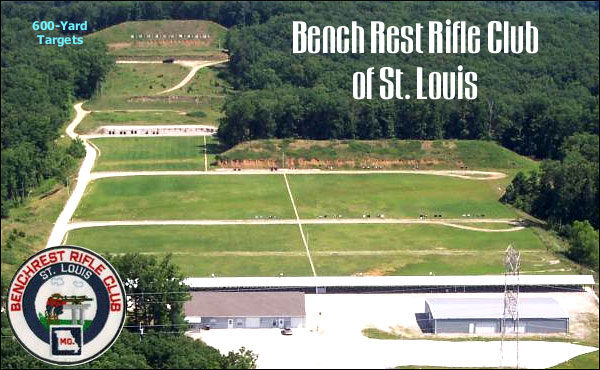
The NBRSA short-range Group Benchrest Nationals commenced this week at the St. Louis Benchrest Club Range in Wright City, Missouri. This will be followed, next week, by the World Benchrest Shooting Federation (WBSF) Championships at the same venue. Lapua staffer (and Forum member) Kevin Thomas trekked to Missouri for this combined National/International event. Kevin reports: “The best benchrest shooters [on the planet] will fight it out over the next two weeks to see who can shoot the smallest groups possible. And I’ve got to say, many of these shooters are truly amazing. It doesn’t hurt a bit that virtually all of them are shooting Lapua brass, either.”
The WBSF event has attracted shooters from around the world. Benchrest aces from Australia, Canada, Great Britain, and South Africa are already in St. Louis, with other international competitors set to arrive next week. On Monday, Day One of the NBRSA Nationals, the Unlimited Class rigs showed off their capabilities. As shown below, these heavy rail guns represent the pinnacle of precision in the 100/200-yard benchrest game.

Here’s living legend Walt Berger, founder of Berger Bullets. Now in his late 80s, Walt is still competing at a very high level. Walt is proof that Benchrest shooting is truly a “sport for a lifetime”.

Here’s a beautiful Missouri sunrise captured as Kevin Thomas drove to St. Louis for the 2015 NBRSA Benchrest Championships.

September 15th, 2015

Someone spending thousands of dollars on a once-in-a-lifetime hunt might consider getting Geovid rangefinding binoculars. Leica’s award-winning Geovid combines a superb binocular optic with a laser rangefinder AND a ballistic computer. With this single device you can spot your game, find the distance to your target, and calculate the elevation correction. Geovids even take a micro-SD card so you can upload your customized ballistics table.

|
At around $3200.00 (street price) Geovids are very expensive, but for a serious hunter the Geovid’s capabilities justify the price*. The glass is excellent, the rangefinder offers outstanding performance, and you never have to pull out a PDA or mobile device to run ballistics. The Geovid even does angle correction and can output elevation click values. With the Geovid, you have one tool that does three jobs exceptionally well. When you’re climbing a mountain in pursuit of a Trophy Elk, carrying less gear makes sense.
Now through October 31, 2015 you can save $300.00 on a new 8×42 Geovid HD-B, or 10×42 Geovid HD-B. That makes this state-of-the-art tool much more affordable. To get a $300.00 mail-in rebate from Leica, submit a sales receipt with the Leica Rebate Form. |
|
*We have a good friend who works as a professional hunting guide and gunsmith in New Mexico. For years he made do with well-used Steiner binoculars and an older Leica LRF. On our last visit to NM, he proudly showed us his new Leica Geovid. I told him: “John, those Geovids cost a fortune… are they really worth the money?” He told me: “On one of my first hunts after getting the Geovid, I took along the Steiners for comparison. It was late in the day. I glassed a ridgeline about 700 yards away with the Steiners, and saw nothing. Then I got out the Geovid, looked at the same area and saw two large Elk in among some trees. That made the hunt a success for me and my client. Yes the Geovids are worth it… the glass really makes a difference in low light. And I can range as I’m spotting — that’s a big deal.”
If you are considering the Geovids, you’ll find that Geovid owners have high praise for these rangefinding binoculars. Here are reviews from verified purchasers who have used Geovids on hunts:
“Optical quality is second to none, these binos are in a class by themselves (the only competition IMHO are the Swarovski EL Range). Direct comparison of optic image quality to my lesser-brand binos really demonstrated the difference for me. The image is bright and clear across the entire field of view which is also wider than my standard 10×42 binos. Low-light gathering capability at dawn and dusk is considerably better than my lesser brands and should extend my evening hunting times by another 5 to 10 minutes. The laser ranging capability is amazing! The reading is almost instantaneous[.] The display is a red open target square that’s easy to see in all light conditions.” — Jackson611
“These Binos are the best range-finders on the market, not even talking about the glass yet. The range report is almost instantaneous. If you choose to load your ballistics data on the SD card you will be glad you did. It gives you bullet drop out to 1000 yards. Now let’s get to the glass. I have Swarovski 15×56 binos. These Leicas are just as clear, but small enough to wear around your neck. The price is high, but I learned a long time ago, that you get what you pay for with optics. And if you hunt out west, your optics will make or break your hunt.” — Matt
September 14th, 2015

Our friend Grant Guess recently had a “close encounter” with a bad primer. An apparently defective primer caused part of the casehead on one of his rounds to blow out. This, in turn, allowed high pressure gas to vent through the damaged primer pocket. Take a good look, boys and girls. This is yet another very good reason to wear safety glasses. The cartridge was a 6.5-06, handloaded in necked-down Winchester-headstamp .270 Win brass. Grant reports:
“I had a blow through between the primer and the primer pocket today. The action was really smoking and I got a face full of gas. This was a reasonably light charge. Thank God for safety glasses.
I should also mention that it appears there is a 3/64 hole that is halfway between the primer and the primer pocket. Like it burned a small jet hole through both of them.”
Could this happen to you? It just might. On seeing this damaged case, one of Grant’s Facebook friends, Chris D., observed: “Search the internet, you will see a lot of these pin hole ‘in the corner’ failures. Obviously Winchester has some issues with the LR primers.”
Careful Examination Reveals Apparent Primer Defect
After this incident, Grant examined the damaged case: “I pinned the flash hole and it is not over-sized or under-sized. The primer clearly has an area where it had a defect. At [50,000 CUP], it doesn’t take much of a defect to cause issues. There was a slight bit of pucker-factor on the next shot….”

September 14th, 2015

 If you have a rifle chambered in .260 Remington, you may be wondering if the Lapua .260 Brass is worth the money compared to domestic-made brass. Well, the answer is “yes” if you demand consistent weight and dimensional uniformity (including neckwall thickness). If you have a rifle chambered in .260 Remington, you may be wondering if the Lapua .260 Brass is worth the money compared to domestic-made brass. Well, the answer is “yes” if you demand consistent weight and dimensional uniformity (including neckwall thickness).
Mike Harpster of Dead Center Sports took the time to weigh and measure Lapua .260 Rem brass. His test show this brass to be extremely uniform. Weight variance was less than one (1) grain in a 20-case sample. And case neckwall thickness was very consistent.
Report by Mike Harpster: Lapua .260 Rem Brass Test Results (with Comparisons)
I pulled twenty (20) pieces randomly from one Lapua box to do some measurements. I weighed them on my Mettler-Toledo digital lab scale and here are the individual weights of each case. Remarkably, the Lapua brass had less than one grain total weight variance among all 20 cases!
While checking the Lapua brass I remembered I had just received some Winchester brand .308 brass, so I thought it would be interesting to do a comparison between the two brands. I again pulled 20 cases at random from a bag of 50 and repeated the same measurements. The results are shown in the right half of the table below.
Weight Variance Lapua .260 Rem Brass vs. Winchester-Brand .308 Win Brass
| LAPUA .260 Rem Brass |
Winchester .308 Win Brass |

| 
|
Average: 172.20 grains
ES: 0.94 grains
SD: 0.259 |
Average: 158.49 grains
ES: 2.64 grains
SD: 0.678
|
 Winchester Brass Further Inspection Winchester Brass Further Inspection
The flash holes on the majority of the Winchester brass were not round or centered and they had large burrs inside. The neck wall thickness was pretty consistent, varying only .0015″ (.0125″ – .014″). As you can see in the photo (right) many of the Winchester cases were badly dented while the Lapua brass showed very few minor dents. The annealing on the necks of the Lapua brass was clearly evident while the Winchester showed no signs of being annealed. [Editor’s note: Winchester tumble-polishes its brass before shipping — so you would not notice annealing coloration if annealing had been done.]
Lapua Brass Further Inspection
With sample Lapua .260 Rem cases, I also measured the neck wall thickness in four places with calipers, not the most accurate method but I feel confident that the thickness did not vary more than .001″ over the 20 cases (.0145-.0155). The inside diameter of the neck measured .260 which would give .004 of neck tension out of the box. I visually checked the flash holes and I did not find any flakes of brass or burrs inside, the holes were round and centered.
Summary — This Lapua Brass is Impressive
I have never done these measurements on any other brass so I don’t know how they compare, but I am very impressed with the overall quality of the Lapua .260 brass. If they prove to hold up to the repeated firings I get from my Lapua 6BR brass I believe .260 shooters will be very happy.
Mike Harpster — Dead Center Sports
105 Sunrise Drive
Spring Mills, PA 16875
phone: 814-571-4655
www.deadcentersports.com
September 14th, 2015

 As more competitive shooting organizations (such as the U.S. F-TR Team) and manufacturers (such as Berger Bullets), turn to social media to distribute news and information, Facebook has become a much more valuable resource for shooters. Match reports (and photos) often appear first on Facebook, and many vendors post exclusive discount offers for their Facebook “friends”. AccurateShooter has an active Facebook page, and we are close to reaching 7000 “Likes”. Will you help us reach the 7000 mark? As more competitive shooting organizations (such as the U.S. F-TR Team) and manufacturers (such as Berger Bullets), turn to social media to distribute news and information, Facebook has become a much more valuable resource for shooters. Match reports (and photos) often appear first on Facebook, and many vendors post exclusive discount offers for their Facebook “friends”. AccurateShooter has an active Facebook page, and we are close to reaching 7000 “Likes”. Will you help us reach the 7000 mark?
UPDATE: Thanks Facebook Fans! We now have 6816 Likes (and counting!).
If you haven’t visited Facebook lately, check it out. You’ll find lots of valuable information being shared among serious shooters. And Accurateshooter.com also posts popular news items and updates on our AccurateShooter Facebook Page. You’ll find links to many other Facebook pages of interest, such as the USAMU Page, the Sinclair Int’l Page, the USA F-TR Team Page, the CMP Page, the Berger Bullets Page, and the Target Shooter Magazine page. Visit the page at www.facebook.com/AccurateShooter.
 Facebook members can network with our page by simply clicking the “Like” (thumbs up) button near the top of the page. Facebook users who click the “Like” button can comment on our Facebook postings. In addition, if you visit our Facebook Page and click on the “MORE” button, you’ll find a Blog link with our latest Daily Bulletin items, complete with thumbnails and story summaries. You can also register with our Shooters’ Forum by clicking on the “Sign Up” button. There is no fee to join our Forum. Facebook members can network with our page by simply clicking the “Like” (thumbs up) button near the top of the page. Facebook users who click the “Like” button can comment on our Facebook postings. In addition, if you visit our Facebook Page and click on the “MORE” button, you’ll find a Blog link with our latest Daily Bulletin items, complete with thumbnails and story summaries. You can also register with our Shooters’ Forum by clicking on the “Sign Up” button. There is no fee to join our Forum.
September 13th, 2015

Can you really make a silk purse from a sow’s ear? Would you believe a winning benchrest rifle could be constructed with a stock fashioned from a cast-off log-splitter? Well it can.
Anyone who has attended an IBS benchrest match knows that this brotherhood of shooters includes some “backyard engineers” who can build amazing things with low-cost components. Consider Steve Jordan. He has built a winning Heavy Gun with a gunstock made out of a wood splitter. Check out the photo. The butt section is in the shape of a “V” like an ax. The “V” sits on an adjustable, flat rear sandbag. The flat shaft of the wood-splitter, running horizontally, serves as the main chassis and fore-end. The barrel block sits on top (with the action floated), while the flat, forward section of the shaft rides the front bag. Not only does this “log-splitter” stock work, but Jordan has won IBS matches with it! Sometimes simple and cheap beats expensive and fancy.
Sam Hall Says the Log-Splitter Has Been “Kicking Our Tails”
Sam Hall (multi-time IBS 600-yard champion) reports: “I was not at the first match where Steve Jordan debuted his barrel-blocked, Heavy Gun stock made out of a wood splitter. From what I heard he cleaned house with it that day. When I first heard about this log-splitter rig, I thought guys were pulling my leg. But the log-splitter Heavy Gun really exists. In fact, over the past two years at Piedmont, Steve’s home-built log-splitter HG has won numerous Heavy Gun matches, out-performing nearly all the other Heavy Guns on the line, even those that cost thousands more to build.
Steve made the rifle as economical as possible. Steve’s entire stock is made from a metal wood splitter. From what I understand, Ray Lowman gave him the barrel block. This rides on the shaft of the wood splitter. With this inexpensive, simple rig Steve has been kicking our tails! By the way, Steve’s Heavy Gun is chambered as a 6mm Dasher.”

September 13th, 2015

In response to our Bulletin story about the availability of Norma powders at Midsouth Shooters Supply, one of our Forum members asked: “I’m having trouble finding Reloder 15 for my 6.5×47 Lapua — should I consider running Norma 203B instead?” As we’ve explained before, these two powders, both made by Bofors in Europe, are very, very similar. Here are some hard numbers that should demonstrate how virtually identical these powders really are.
Target Shooter Magazine writer Laurie Holland compared Norma 203B and Reloder 15 using data from QuickLOAD. Laurie also checked load manuals to see how listed charge weights varied for the two propellants. Laurie concluded there was very little difference between Norma 203B and Reloder 15.
 Norma 203B vs. Alliant Reloder 15 Norma 203B vs. Alliant Reloder 15
Commentary by Laurie Holland
Running [203B and RL15] through QuickLOAD doing a ‘charge table’ run for a 130gn Berger VLD at 2.700 COAL in 6.5X47 Lapua, gives very similar positions in the table [for both powders]. The charge required to achieve 62,000 psi estimated pressure varies by a mere 0.2 grains between the pair, Norma 203B being the heavier of the two. The estimated Muzzle Velocity (MV) also varies by a mere 2 fps, RL15 estimated to produce 2,946 fps MV compared to 2,944 fps for N203B at 62,000 psi (with the parameters I used).
If they aren’t the same thing, they’re so close as to make no difference and as Forum Boss points out, they’re made by the same people (Bofors) in the same plant.
[The Berger Reloading Manual includes data for both powders] for the .308 Winchester and heavier bullets (185 to 230 grains). Maximum charges and claimed MVs are not always identical, but are so close as to be marginally different production lots of the same thing, or maybe the result of minor testing variations.
.308 Win Max Charge Weights in Grains (RL15 / N203B) (Berger Manual)

MVs [for the four bullet types] are close but not identical, the largest difference being for the 210s which shows RL15 producing 2,428 fps MV v 2,383 for Norma 203B.
Norma 203B Chemistry
According to the Norma Reloading Handbook #1, Norma 203B has the following composition:
85% Nitrocellulose
7.5% Nitroglycerin
2.0% surface coating
4.6% Various chemicals
0.9% Water
3,957 J/g specific energy
890 g/l specific density
For comparison, the 7.5% NG component compares to 15% in Viht N500 series powders and 10% in Ramshot TAC / Big Game / Hunter.
September 12th, 2015

Each Wednesday, the U.S. Army Marksmanship Unit publishes a reloading “how-to” article on the USAMU Facebook page. This week’s “Handloading Hump Day” post covers an important safety issue — why you should never assume that a stated “book” load for a particular bullet will be safe with an equal-weight bullet of different shape/design. The shape and bearing surface of the bullet will affect the pressure generated inside the barrel. Visit the USAMU Facebook page next Wednesday for the next installment.
Beginning Handloading, Part 13:
Extrapolating Beyond Your Data, or … “I Don’t Know, What I Don’t Know!”
Last week, we addressed several key facets of Service Rifle reloading. Today, we continue our Handloading Safety theme, focusing on not inadvertently exceeding the boundaries of known, safe data. Bullet manufacturers’ loading manuals often display three, four, or more similar-weight bullets grouped together with one set of load recipes. The manufacturer has tested these bullets and developed safe data for that group. However, seeing data in this format can tempt loaders — especially new ones — to think that ALL bullets of a given weight and caliber can interchangeably use the same load data. Actually, not so much.
The researchers ensure their data is safe with the bullet yielding the highest pressure. Thus, all others in that group should produce equal or less pressure, and they are safe using this data.
However, bullet designs include many variables such as different bearing surface lengths, hardness, and even slight variations in diameter. These can occasionally range up to 0.001” by design. Thus, choosing untested bullets of the same weight and caliber, and using them with data not developed for them can yield excess pressures.
This is only one of the countless reasons not to begin at or very near the highest pressure loads during load development. Always begin at the starting load and look for pressure signs as one increases powder charges.
Bullet bearing surface length (BSL) is often overlooked when considering maximum safe powder charges and pressures. In photo 1 (below), note the differences in the bullets’ appearance. All three are 7mm, and their maximum weight difference is just five grains. Yet, the traditional round nose, flat base design on the left appears to have much more BSL than the sleeker match bullets. All things being equal, based on appearance, the RN/FB bullet seems likely to reach maximum pressure with significantly less powder than the other two designs.
Photo 1: Three Near-Equal-Weight 7mm Bullets with Different Shapes
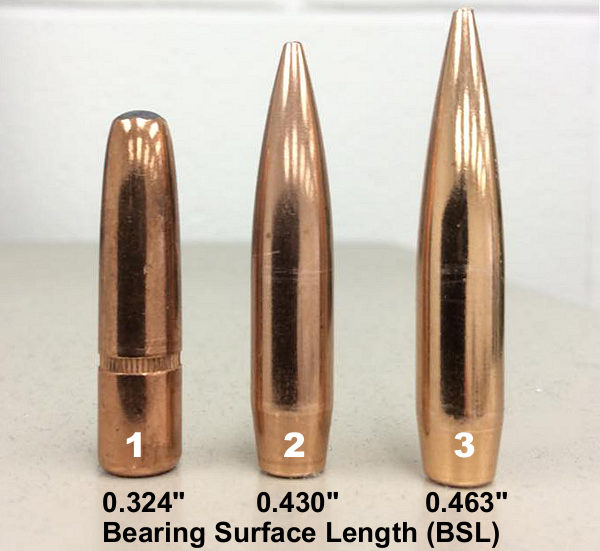
Due to time constraints, the writer used an approximate, direct measurement approach to assess the bullets’ different BSLs. While fairly repeatable, the results were far from ballistics engineer-grade. Still, they are adequate for this example.
Bullet 1 (L-R), the RN/FB, has a very slight taper and only reaches its full diameter (0.284”) very near the cannelure. This taper is often seen on similar bullets — it helps reduce pressures with good accuracy. The calculated BSL of Bullet 1 was ~0.324”. The BSL of Bullet 2, in the center, was ~0.430”, and Bullet 3’s was ~ 0.463”. Obviously, bullets can be visually deceiving as to BSL!
Some might be tempted to use a bullet ogive comparator (or two) to measure bullets’ true BSL for comparison’s sake. Unfortunately, comparators don’t typically measure maximum bullet diameter and this approach can be deceiving.
Photo 2: The Perils of Measuring Bearing Surface Length with Comparators

In Photo 2, two 7mm comparators have been installed on a dial caliper in an attempt to measure BSL. Using this approach, the BSLs differed sharply from the original [measurements]. The comparator-measured Bullet 1 BSL was 0.694” vs. 0.324” (original), Bullet 2 was 0.601” (comparator) vs. 0.430” (original), and Bullet 3 (shown in Photo 2) was 0.602” (comparator) vs. 0.463” (original). [Editor’s comment — Note the very large difference for Bullet 1, masking the fact that the true full diameter on this bullet starts very far back.]
Please join us again next week as we examine other lesser-discussed variables that affect pressure and velocity during handload development. In the meantime, stay safe, and favor center!
September 12th, 2015
 The better, up-to-date ballistics programs let you select either G1 or G7 Ballistic Coefficient (BC) values when calculating a trajectory. The ballistic coefficient (BC) of a body is a measure of its ability to overcome air resistance in flight. You’ve probably seen that G7 values are numerically lower than G1 values for the same bullet (typically). But that doesn’t mean you should select a G1 value simply because it is higher. The better, up-to-date ballistics programs let you select either G1 or G7 Ballistic Coefficient (BC) values when calculating a trajectory. The ballistic coefficient (BC) of a body is a measure of its ability to overcome air resistance in flight. You’ve probably seen that G7 values are numerically lower than G1 values for the same bullet (typically). But that doesn’t mean you should select a G1 value simply because it is higher.
Some readers are not quite sure about the difference between G1 and G7 models. One forum member wrote us: “I went on the JBM Ballistics website to use the web-based Trajectory Calculator and when I got to the part that gives you a choice to choose between G1 and G7 BC, I was stumped. What determines how, or which one to use?”
The simple answer to that is the G1 value normally works better for shorter flat-based bullets, while the G7 value should work better for longer, boat-tailed bullets.
G1 vs. G7 Ballistic Coefficients — Which Is Right for You?
G1 and G7 refer both refer to aerodynamic drag models based on particular “standard projectile” shapes. The G1 shape looks like a flat-based bullet. The G7 shape is quite different, and better approximates the geometry of a modern long-range bullet. So, when choosing your drag model, G1 is preferrable for flat-based bullets, while G7 is ordinarily a “better fit” for longer, boat-tailed bullets.

 Drag Models — G7 is better than G1 for Long-Range Bullets Drag Models — G7 is better than G1 for Long-Range Bullets
Many ballistics programs still offer only the default G1 drag model. Bryan Litz, author of Applied Ballistics for Long Range Shooting, believes the G7 standard is preferrable for long-range, low-drag bullets: “Part of the reason there is so much ‘slop’ in advertised BCs is because they’re referenced to the G1 standard which is very speed sensitive. The G7 standard is more appropriate for long range bullets. Here’s the results of my testing on two low-drag, long-range boat-tail bullets, so you can see how the G1 and G7 Ballistic coefficients compare:
G1 BCs, averaged between 1500 fps and 3000 fps:
Berger 180 VLD: 0.659 lb/in²
JLK 180: 0.645 lb/in²
The reason the BC for the JLK is less is mostly because the meplat was significantly larger on the particular lot that I tested (0.075″ vs 0.059″; see attached drawings).
For bullets like these, it’s much better to use the G7 standard. The following BCs are referenced to the G7 standard, and are constant for all speeds.
G7 BCs:
Berger 180 VLD: 0.337 lb/in²
JLK 180: 0.330 lb/in²
Many modern ballistics programs, including the free online JBM Ballistics Program, are able to use BCs referenced to G7 standards. When available, these BCs are more appropriate for long range bullets, according to Bryan.
[Editor’s NOTE: BCs are normally reported simply as an 0.XXX number. The lb/in² tag applies to all BCs, but is commonly left off for simplicity.]
|


