Reactive targets — whether balloons, steel gongs, or clay birds — always add fun to a range session. But precision shooters may want something more challenging (i.e. smaller) than a clay bird when shooting inside 300 yards. For a change of pace, try shooting at inexpensive pool cue chalks. Less than 1″ square, these will test your marksmanship skills.
Pool Cue Chalks — Cheap, Fun, Dramatic
If you’re looking for a small target that makes a nice big cloud of color when hit, try pool cue chalks — those little blue cubes you use to dust the end of billiard cues. Measuring about 7/8″ per side, billiard chalks make very challenging targets at 100 and 200 yards. When you hit them, if you nail the circular “dimple” in the middle, they disintegrate impressively, tossing blue “smoke” in all directions. Billiard chalks are inexpensive. You can buy a dozen chalks online for about $3.00 — just 25 cents each. And the prices drop with more quantity. One gross of chalks (that’s 144 pieces) costs just $19.95 at ozonebilliards.com.
To see actual hits on chalk at 100 and 200 yards, watch the video above. (WARNING: Soundtrack is loud and advertisement may play before movie.) The movie-maker, Phil of the Random Nuclear Strikes Blog, cautions that: “You’ll notice (in the video) that some of the hits are ‘wiffs’ instead of ‘poofs’. If you look at the picture above, you’ll see the 1/2 inch dimple in the cube face. If you don’t put the bullet in that dimple, it’ll ‘wiff’ on you.”
Garand matches are among the most popular and well-attended of the CMP competition disciplines. When obtained directly from the CMP, Garands are fun to shoot and affordable. However, with these classic battle rifles, you need to ensure that the headspace is set properly to ensure safe function and good brass life.
In the archives of The FIRST SHOT, the CMP’s online magazine, CMP Armorer John McLean has written an excellent article entitled: “Everything You Ever Wanted to Know about Checking M1 Garand Head Space.” We recommend all Garand shooters read the article.
McClean explains: “Excessive headspace will cause the brass to stretch more than it should and increases the likelihood of a case failure. Insufficient headspace may contribute to slam fires, light strikes on primers, misfires and more wear on parts due to the additional force needed to chamber the rounds.”
Garand Head Space Gauges
McClean writes: “Both Forster and Clymer make fine gauges but we have found that there are differences between the two companies’ gauges that make the Clymer gauges best for use with the M1. The headspace that the original manufacturers of the M1 considered correct can be determined by checking new or nearly new rifles that we have here at CMP. With that information we have determined that Springfield Armory and the other manufacturers of the M1 used gauges that were very close to the Clymer dimensions… and therefore we use, and recommend using only the Clymer gauges.”
How to Check for Proper Headspace
In the article, McClean goes on to show how to properly use the “GO”, “NO GO”, and “FIELD” gauges. You’ll want to read the Complete Article. One of the important points McClean makes is that the ejector can affect headspace reading. Accordingly, “the bolt must be disassembled and the ejector removed, or clearance notches must be made on the headspace gauges so there will be no contact between the headspace gauges and the ejector.”
Report by Kyle Jillson from NRABlog.com. Sergeant First Class (SFC) Keith Sanderson of the U.S. Army Reserve has been crowned the 2015 NRA National Pistol Champion. After six wet days at Camp Perry along the shores of Lake Erie, Sanderson unseated defending champion Brian Zins by 14 points – 2655 to 2641.
Sanderson, who served eight years in the Marine Corps and eight years in the U.S. Army, is a renowned sport shooter who holds an Olympic record and won an unprecedented three medals (gold, silver, and bronze) in three World Cups in 2009.
Wet Conditions at Camp Perry this Year
At Camp Perry, you can always expect a little rain to come off the lake, but the midwest is experiencing torrential storms this summer and parts of the range – especially along the firing line – became flooded ponds. This year some shooters even stuck “No Wake” signs in the larger puddles to keep attitudes light despite the muddy situation.
Some competitors wore rubber boots to help navigate the puddles.
The Swarovski Optik website features a blog with interesting technical articles. In the “On Target” series of blog stories, Swarovski has provided a handy explanation of how optics systems work, with exploded diagrams of rifle scopes, spotting scopes, and binoculars. CLICK HERE for Swarovski Optics Blog.
Scope Terminology Focusing Lens
The focusing lens is an adjustable lens inside the optical system for focusing the image at different distances…. In the case of rifle scopes, apart from focusing, the focusing lens also facilitates parallax compensation.
Diopter Adjustment
For rifle scopes, the reticle can be focused using the diopter adjustment on the eyepiece, thereby correcting any visual impairment. [Editor’s Note: Movable eyepiece diopter adjustment is not offered on all rifle scopes. It is a useful feature on Swarovski and other premium scopes. This allows shooters who need eyeglasses to get a sharply focus image even without wearing corrective lenses. Of course shooters should always wear ANSI-certified eye protection. With the diopter, folks who need correction can use inexpensive, non-Rx safety eyewear instead of expensive prescription safety glasses.]
Reversal System
The purpose of the reversal system is to reverse the image by means of prisms in binoculars and telescopes, and lenses in rifle scopes….The lens reversal system is needed in rifle scopes to control the variable magnification and move the exit pupil[.]
Resource tip by EdLongRange. We welcome reader submissions.
“Après moi, le déluge.” Watch this video from rain-soaked Indiana. Yikes, that’s a lot of water coming down… with lightning bolts to boot. Major thunderstorms delayed shooting earlier this week at the NRA National Smallbore Championships in Bristol, Indiana. This year the Smallbore Championships were moved to Bristol to accommodate the World Fullbore Championships being held at Camp Perry. (Some competitors may be wishing the Smallbore events had been sent to a dryer venue.)
Click arrow to see one heck of a downpour (with lightning flashes) on July 13th…
Thankfully, weather conditions have improved during the course of the week, and competition proceded. Here are the scheduled matches for the remainder of the Smallbore Championships:
July 17 — Randle, Dewar, Fired Team Matches, Whistler Boy, and Mentor Match
July 18-19 — Conventional Any Sight Championship
July 20 — Metric Prone Practice
July 21-22 — Metric Prone Championship
How do you build better (more precise) ammo drop tables? With radar, that’s how. Barnes Bullets is using Doppler Radar to develop the drop tables for its new Precision Match line of factory ammunition. The Doppler radar allows Barnes to determine actual velocities at hundreds of points along a bullet’s flight path. This provides a more complete view of the ballistics “behavior” of the bullet, particularly at long range. Using Doppler radar, Barnes has learned that neither the G1 nor G7 BC models are perfect. Barnes essentially builds a custom drag curve for each bullet using Doppler radar findings.
Use of Doppler Radar to Generate Trajectory Solutions
by Barnes Bullets, LLC
Typical trajectory tables are generated by measuring only two values: muzzle velocity, and either time-of-flight to a downrange target, or a second downrange velocity. Depending on the test facility where this data is gathered, that downrange target or chronograph may only be 100 to 300 yards from the muzzle. These values are used to calculate the Ballistic Coefficient (BC value) of the bullet, and the BC value is then referenced to a standardized drag curve such as G1 or G7 to generate the trajectory table.
This approach works reasonably well for the distances encountered in most hunting and target shooting conditions, but breaks down rapidly for long range work. It’s really an archaic approach based on artillery firings conducted in the late 1800s and computational techniques developed before the advent of modern computers.
There is a better approach which has been utilized by modern militaries around the world for many years to generate very precise firing solutions. Due to the sizeable investment required, it has been slow to make its way into the commercial market. This modern approach is to use a Doppler radar system to gather thousands of data points as a bullet flies downrange. This radar data is used to generate a bullet specific drag curve, and then fed into a modern 6 Degree of Freedom (DOF) [ballistics software program] to generate precise firing solutions and greatly increase first-round hit probability. (The 6 DOF software accounts for x, y, and z position along with the bullet’s pitch, yaw, and roll rates.)
Barnes has invested heavily in this modern approach. Our Doppler radar system can track bullets out to 1500 meters, recording the velocity and time of flight of that bullet every few feet along the flight path. Consider the graph below showing a bullet specific drag curve referenced to the more common G1 and G7 curves:
Neither of the standard curves is a particularly good match to our test bullet. In the legacy approach to generating a downrange trajectory table, the BC value is in effect a multiplier or a fudge factor that’s used to shift the drag curve of the test bullet to try and approximate one of the standard curves. This leads to heated arguments as to which of the standardized drag curves is a better fit, or if multiple BC values should be used to better approximate the standard curve (e.g., use one BC value when the velocity is between Mach 1 and Mach 2, and a different BC value when the velocity is between Mach 2 and Mach 3.) Barnes’ approach to creating trajectory tables is to generate bullet-specific drag curves, and use that data directly in a modern, state-of-the-art, 6 DOF ballistics program called Prodas to generate the firing solution.
Story tip from EdLongrange. We welcome reader submissions.
There is one subject as to which we should all be in agreement — the need to wear quality, protective eyewear whenever one uses a firearm. Sadly, it’s not uncommon, at the range, to see shooters wearing no eye protection, or wearing cheap, “dime-store” glasses that can shatter on impact.
This video from Luckygunner Labs shows what can happen with low-quality eyewear. When hit with pellets, the left lens came out and the right lens entered the eye socket!
Read Our Guide to Protective Eyewear
We’ve created a comprehensive Guide to Protective Eyewear. Forum member ChuckW2 told us: “That was the most important article that has ever been posted on this site. I am amazed how many people do not wear glasses while shooting or hunting. Great read….” If you haven’t done so already, read the story. We guarantee you’ll learn something new.
The Eyewear Guide explains the safety standards that apply to protective eyewear and reviews the best lens materials currently available including Polycarbonate, Trivex™, and SR-91. You may not have heard of Trivex, but it is probably the best material out there right now — it’s tough, lightweight, and has better optical properties than Polycarbonate. SR-91 is a good choice for those who need a polarized lens. Our Eyewear Guide also includes a section by Danny Reever on Prescription Shooting Glasses. Danny discusses the available options in lens materials and has many helpful recommendations.
Along with our reviews of lens materials, tint properties, and frame design, we highlight a study done by the NRA’s American Hunter magazine. 10 popular brands of eyewear were tested, with some very interesting results. The testers observed that price does not necessarily assure quality. Relatively inexpensive Bollé VX and Pyramex eyewear both worked better than some expensive brands.
On the other hand, don’t select eyewear simply because it’s cheap or easy to find. American Hunter editor Jeff Johnston observed: “It’s a mistake to assume that any plastic-lens sunglasses off the rack at the local 7-11 are made of polycarbonate and therefore are effective as shooting glasses—cheap plastics are not polycarbonates; in fact, wearing them could be worse than wearing nothing, as they can introduce sharp shards of plastic to your eyes in addition to the projectile(s) that caused them to break.”
We all know Zeiss makes good optics, and now you can save $50-$150 on Zeiss binoculars or Zeiss riflescopes. As part of the Zeiss Summer Field Days promotion, Zeiss is offering $50.00 cash back on select scopes and binoculars (and $150.00 on the Victory HD binos). Hunters may want to take advantage of this offer for the CONQUEST HD5, and Victory HT Scopes with RAPID-Z ballistic reticles. Those are nice optics. To claim the rebate, purchase eligible products between 7/1 and 8/31/2015 at any participating ZEISS Authorized Dealer, then visit the Zeiss Online Rebate Center to register your rebate. Be sure to save your product receipts.
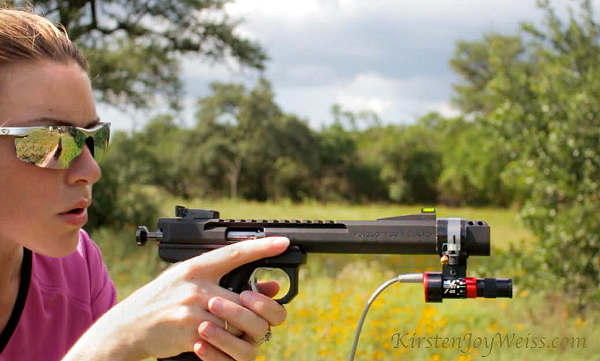
“SCATT” — if you’re an Olympic Class air rifle or smallbore competitor you know what SCATT means. The Russian-made SCATT is a marksmanship training system with an electro-optical sensor that fits on the end of a barrel. The sensor “sees” the target and then tracks your muzzle movement relative to the center of the target, recording a “trace” that can be displayed on a computer. The latest SCATT MX-02 unit works for live-fire training as well as dry-fire training. To learn more about the SCATT electronic trainers, visit SCATTUSA.com.
Pro shooter Kirsten Joy Weiss demonstrates the SCATT MX-02 electronic training system:
The system traces and records valuable information such as hold pattern, shot hold duration, follow-through, recoil pattern, and much more. The latest SCATT MX-02 systems can be used both indoors and outdoors up to 300 meters (and possibly more). READ FULL SCATT MX-02 TEST HERE.
SCATT traces reveal muzzle movements during the aiming process.
Kirsten Joy Weiss, a top-level competitive position shooter, has tested the latest SCATT MX-02 training systtem. She put the MX-02 through its paces, and then produced an informative video that shows how it works. Click on the video above to see Kirsten use the MX-02 with her Anschütz rifle and other guns.
Kirsten was impressed with the SCATT MX-02 she tested:
“We live with tech woven into our every day, so if you had the chance to work with a computer to make you a better shooter — would you? Can a computer train you as well as your favorite coach or, dare to say, better than a human?”
Weiss says it’s like having a little coach with you recording your every move. “If R2D2 had a cousin who knew how to shoot,” Weiss quips, “his name would be the MX-02″.
The SCATT MX-02 can also be used with target pistols.
This Friday, July 17th, the CMP hosts the Vintage Sniper Rifle Match at Camp Perry. One of the most popular vintage rifle matches held each summer at Perry, this is a two-man team competition using scoped rifles of WWI and WWII Vintage. Many competitors use some version of the M1903 Springfield, but you’ll also see scoped M1 Garands, K31s, Mausers, and even a Lee-Enfield or two.
Two-person teams will fire 10 rounds in 20-second intervals from scoped vintage military rifles set on sand bags. One team marksman shoots from the prone position at 300 and 600 yards, while the other serves as a spotter to relay shot position. Marksman and spotter switch positions on the firing lines, allowing each teammate to play both roles. Scores are then combined for an Aggregate team total.
Two M1 Garands, fitted with scopes and lace-on cheekpads.
Who can identify this rifle, with its unusual scope mount?
Our friends at Criterion Barrels have written an interesting article about last year’s Vintage Sniper Rifle Match. It you want an “insider’s perspective” on the 2014 Match, plus Vintage Sniper gunsmithing tips, read this article. Here are some highlights:
About the Match and the Rifles
The Vintage Sniper Match was the brainchild of Hornady’s Dave Emary. The competition was inspired by his father, a World War II scout sniper, who carried a rifle similar to the 1903A4 rifle builds that can be found today on the Camp Perry firing line. Bob Schanen worked alongside Dave and the CMP staff in establishing the various competition rules prior to the first official Vintage Sniper Match in 2011. The match developers made a point to offer some level of flexibility in rifle configuration, allowing specific types of non-issue optics and rifle rebuilds. This helped make the match more inclusive.
Hornady’s Dave Emary and “Gunny” R. Lee Ermey (right):
Bob Shanen has two vintage sniper competition rifles. Both builds are based off of the USMC Model 1941 sniper rifle, a design similar to the M1903A1 National Match rifle. Bob’s rifles both carry 8x Lyman Junior Target Spotter scopes with a thin crosshair reticle. Bob attributes a large part of his rifle’s accuracy to the Criterion M1903 match-grade barrels installed on each rifle by Rick Humphreys, a Milwaukee area gunsmith. These tack-driving barrels are capable of half-MOA accuracy.
Camp Perry — The Venue
The hallowed grounds of Camp Perry have hosted some of the nation’s finest shooters each summer for more than a century. Some of the world’s greatest marksmen have accomplished remarkable feats on the ranges of this lakeside military outpost. Located on the coast of Lake Erie, Camp Perry is positioned just outside of the scenic town of Port Clinton, Ohio. It is our firm belief that every shooter should make the pilgrimage to the Camp Perry at least once in their lifetime. If not participating in an event, visitors should at least make an attempt to meet the competitors, witness the wide selection of firearms used by participants, and pay a visit to the various vendors on base.


 In the archives of
 Sergeant First Class (SFC) Keith Sanderson of the U.S. Army Reserve has been crowned the 2015 NRA National Pistol Champion. After six wet days at Camp Perry along the shores of Lake Erie, Sanderson unseated defending champion Brian Zins by 14 points – 2655 to 2641.


 This approach works reasonably well for the distances encountered in most hunting and target shooting conditions, but breaks down rapidly for long range work. It’s really an archaic approach based on artillery firings conducted in the late 1800s and computational techniques developed before the advent of modern computers.