Readers often ask us: “Is there a decent, easy-to-comprehend book that can help my wind-reading?” Many of our Forum members have recommended The Wind Book for Rifle Shooters by Linda Miller and Keith Cunningham. This 146-page book, published in 2007, is a very informative resource. But you don’t have to take our word for it. If you click this link, you can read book excerpts and decide for yourself. When the Amazon page opens, click the book cover (labeled “Look Inside”) and another screen will appear. This lets you preview the first few chapters, and see some illustrations.
Other books cover wind reading in a broader discussion of ballistics or long-range shooting, such as Applied Ballistics for Long-Range Shooting by Bryan Litz. But the Miller & Cunningham book is ALL about wind reading from cover to cover, and that is its strength. The book focuses on real world skills that can help you accurately gauge wind angle, wind velocity, and wind cycles.
All other factors being equal, it is your ability to read the wind that will make the most difference in your shooting accuracy. The better you understand the behavior of the wind, the better you will understand the behavior of your bullet. — Wind Book for Rifle Shooters
The Wind Book for Rifle Shooters covers techniques and tactics used by expert wind-readers. There are numerous charts and illustrations. The authors show you how to put together a simple wind-reading “toolbox” for calculating wind speed, direction, deflection and drift. Then they explain how to use these tools to read flags and mirage, record and interpret your observations, and time your shots to compensate for wind. Here’s are two reviews from actual book buyers:
I believe this is a must-have book if you are a long-range sport shooter. I compete in F-Class Open and when I first purchased this book and read it from cover to cover, it helped me understand wind reading and making accurate scope corrections. Buy this book, read it, put into practice what it tells you, you will not be disappointed. — P. Janzso
If you have one book for wind reading, this should be it. Whether you’re a novice or experienced wind shooter this book has something for you. It covers how to get wind speed and direction from flags, mirage, and natural phenomenon. In my opinion this is the best book for learning to read wind speed and direction. — Muddler
National Hunting and Fishing Day (NHF Day) takes place on Saturday, September 24, 2016. The annual celebration serves as a reminder that conservation succeeds because of leadership and funding from hunters, shooters and anglers. National, regional, state and local organizations will run thousands of “open house” hunting- and fishing-related events around the country. Events will include Fishing Derbys, Hunting Expos, Wing-shooting tournaments, and much more. Over four million Americans will participate. For information on NHF Day, visit www.nhfday.org. To find NHF Day events in your state, click the links below.
The 31st Annual Gun Rights Policy Conference (GRPC) will be held in Tampa, Florida this weekend, September 24-25, 2016. This important annual conference offers two days of panel discussions and presentations guided by leading figures in the firearms community. More than 75 speakers will cover a wide range of topics, including the upcoming November elections, state legislative activities, working with the news media, and general Second Amendment issues.
Live Streaming of Conference This Weekend
Those who can’t attend the 31st Gun Rights Policy Conference in Tampa this weekend can still “listen and learn”. The GRPC will be live streamed on the conference days – September 24 and 25, 2016. All Americans interested in Gun Rights and the Second Amendment can watch and listen anywhere there is an internet connection. Here are links for the live streams this weekend.
NOTE: Be sure to check the 2016 GRPC Agenda to ensure you won’t miss the most important discussions and presentations.
Notable Conference Speakers
Among the speakers at the GRPC will be Virginia attorney Alan Gura, who argued both the 2008 Heller case and the 2010 case of McDonald v. City of Chicago before the U.S. Supreme Court. Gura will be joined by Alan Gottlieb, founder of the Second Amendment Foundation (SAF); Professor John Lott, author of The War on Guns and a Fox News.com contributor; Tom Gresham, host of nationally-syndicated Gun Talk radio; and self-defense authority Massad Ayoob.
AmmoLand Shooting Sports News will be sponsoring and hosting the LIVE VIDEO feed of the 2016 Gun Rights Policy Conference. Watch it online Sept 24 & 25th 2016.
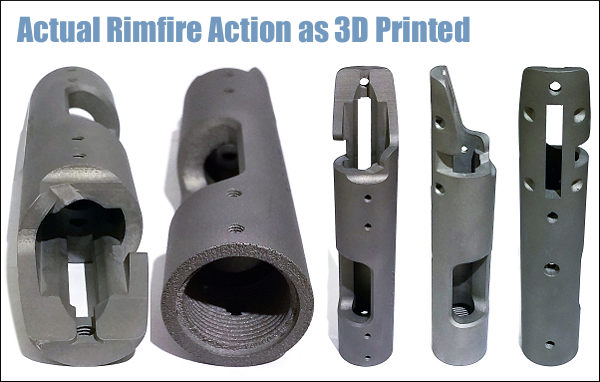
Here’s something truly innovative — a 3D-printed metal rimfire receiver!
Forum member Marcos G. (aka MFP_BOP) has designed and created his own rimfire action. But it’s not machined or forged. This new action was created with a 3D sintered metal printer. A 3D modeler by profession, Marcos has the requisite skill set and access to a very high-tech (and expensive) metal printer. As printed, the actual receiver is shown below. It has just been sent out to be age-hardened to 40 HRC, after which final finish work (e.g. cleaning up tenon threads) will be done. To learn more about this 3D-printing project, read this FORUM Thread.
When most of us think of 3D printing, we think of small plastic parts — nothing as strong as steel. But there are 3D printers that employ sintered metal to build complex metal components. Marcus says the receiver he’s created should have “stated yield and tensile strength similar to investment casting.” The material used for the action is 15-5 PH® Stainless Steel (in sintered form).
The action was designed to use a PT&G 40X rimfire bolt. Marcos notes that “There is an extraction cam inside of the action, something that would be very hard or impossible to do by regular machining and/or EDM.”
Born in Brazil, Marcos now lives in New Zealand. He tell us that: “New Zealand is a very gun-friendly country. I just need my A-CAT license to make [a receiver.]” So there are no special legal restrictions (as might apply in the USA). The printer is EOS270 laser metal sintering machine. Marcos says: “The current price for one of those machines is in five figures, but I am 99.99% sure that in 5-7 years this technology will be readily available to anyone.”
As designed, the receiver was 1.4″ in diameter. Marcos reports it came out of the printer at 1.403″. The designed boltway is .690″ and it came out .687″. Marcos notes: “I haven’t noticed any warping. The threads are rough, really! Interior and exterior finishes are really good though, probably because of the way it’s been printed: upside down (must have gone through tumbling afterwards). I will have to run some taps and single-point-cut the tenon threads to clean them up.”
Marcos says the actual printing process took a lot of time: “I should have asked how long it took to be printed!” But consider this, the 7″-long receiver is created in layers only 20 microns thick, so you can understand why the process took so long.
Reasons to Print a Rimfire Receiver
Marcos 3D-printed his own action basically to save money: “Some may be asking why I printed this receiver. Here’s a little history… I tried different ways to bring a Stiller 2500X action into New Zealand. The final price to my door was NZ $3000.00 (about $2195.00 USD). Designing and making one would be way cheaper, but I felt nobody here could machine the internal abutments with precision. Also printing was still a little cheaper and printing offered the chance to put in it all details I wanted — such as M4 threads, internal cam, and fillets.”
Doug Koenig proved two things this past weekend at the 2016 NRA World Shooting Championship. First, he showed that he is one hell of a shooter, maybe the best action shooter ever. Second he proved that trick, custom race-guns WILL out-perform off-the-shelf firearms. As originally conceived, the WSC has been a multi-discipline match in which competitors shoot an assortment of manufacturer-supplied firearms. But this year, a rule change allowed “BYO” firearms and ammunition in the new Professional Open Division (Pro Open). Koenig’s choice to run in Open Class proved to be a good one — he walked away with a check for $25,000 and the title of 2016 “World Shooting Champion”.
Competing in the Pro Open Division (using his own guns for most stages), Koenig dominated, winning all 12 stages while racking up 3000 points, effectively a “perfect” score. Only a couple shooters competed in Pro Open using their own guns and ammo. Though some say he made it look easy, Koenig, a 17-time Bianchi Cup Champion, insisted this was a tough match. After the awards ceremony, Koenig told Shooting Sports USA: “This was a really great match — and a fun test of all the different shooting disciplines. [The WSC] is without a doubt one of the most difficult matches that I have ever shot. I have a lot of respect for the other disciplines that I have never done before.”
Curiously, only a couple competitors competed in Pro Open, while there were 67 shooters in the regular Pro Class, and 131 Amateurs. Given Koenig’s thorough trouncing of the Pro Stock competitors, one wonders what will happen to the WSC event next year. Will more shooters join the Pro Open ranks? Will there even be a Pro Open Division next year? Koenig served notice that if you want to win the overall title, you better bring your own guns. But that would seem to change the signature theme of the WSC — shooting “normal”, box-stock firearms. One wonders how the other competitors felt about Koenig capturing $25K and the title of “World Champion”, while they shot off-the-shelf hardware.
Nonetheless, Koenig deserves full credit for his superb, 3000-point “perfect” performance. In winning all twelve stages (including some disciplines he had never shot before), Koenig’s 2016 WSC performance was truly one for the ages.
Greg Jordan won the Professional (Stock) Division with a score of 2934. Jordan had a very strong performance with class wins in the 2-Gun, 3-Gun, and America’s Rifle Challenge stages. Pro Stock runner-up, 41 points back, was Mark Yackley with a 2893 score.
Brilliant Performance by Amateur Competitor Nate Dudley
The Top Amateur at the 2016 WSC was Nate Dudley with 2879 points. Dudley’s strong showing would have placed him ahead of all but four of the Pro Stock shooters*. That’s remarkable. Nate beat 63 Pros, including last year’s WSC Champion Bruce Piatt who finished 8th in the Pro (Stock) division.
The Miculeks — America’s First Family of Shooting
Lena Miculek won the Ladies Championship with a score of 2816, and Lena’s mom, Kay Miculek was the second-place lady. Lena’s father, the legendary Jerry Miculek, finished 9th in the Pro Stock Division.
*Fourth-place Pro Ryan Muller scored 2881 points, while fifth-place Pro Nick Atkinson had 2878 points.
At the request of our readers, we provide select “Deals of the Week”. Every Monday morning we offer our Bargain selections. Here are some of the best deals on firearms, hardware, reloading components, and shooting accessories. Be aware that sale prices are subject to change, and once clearance inventory is sold, it’s gone for good. You snooze you lose.
1. Cabela’s — Rem 700 ADL Varmint, $309.99 with 10% Off Coupon and Remington $50.00 Rebate
OK, here’s the deal of the year for hunters. You can get a complete Remington 700 ADL Varmint Rifle in 22-250 or .308 Win for $309.99. That’s less than you might pay for a used Rem 700 action by itself. Here’s how it works. The current Cabela’s Sale Price is $399.99. Use online discount code STOCKUP16 to knock 10% off the price. That brings it down to $359.99. OK, there’s more — now through September 30, 2016, Remington is offering a $50 Mail-in Rebate on Rem 700 ADLs. When you get the $50.00 back from Remington, your net cost for this rifle is $309.99. CLICK HERE for Remington Rebate INFO.
IMPORTANT: Remington $50.00 Rebate valid on purchases made from 8/1/16 through 9/30/16. All Rebate requests must be postmarked by 10/29/16.
2. Midsouth — Alamosa Gun Case for 50″ Scoped Rifle
We’ve been looking for a jumbo, well-padded soft case like this for a long time. Something big enough to hold long-barreled match guns, with enough padding to protect nice finishes and enough room for tall scopes. We are impressed with the new Alamosa Gun Case from Allen Company, which holds guns up to 50″ in length. We measured a 28″-barreled bench gun and this case was just big enough. If you have an adjustable buttplate, muzzle brake, or tuner, you might need a longer case (measure your rifle before ordering the Alamosa case). There’s a lot to like with the Alamosa case. The pockets are large and the shape provides plenty of room for big optics. You can purchase this case from Midsouth for $43.05, or from Amazon.com for $48.46 with free PRIME shipping.
— Extra-wide design to accommodate bi-pods and large scopes
— Multiple External Pockets
— Rugged Endura fabric with soft-knit lining
— Lockable zippers, padded handle
3. Cabela’s — 10% Off Guns & Ammo + Free Shipping ($99 Min)
Cabela’s is having a big Sale on Firearms now, in advance of hunting season. You’ll find very competitive prices on rimfire and centerfire rifles. To make things even better, with a $99 minimum order you can get 10% Off plus FREE shipping with CODE STOCKUP16. This promo applies to ammunition as well (minimum order $99.00). If you need rifle, pistol, or shotgun ammo, the FREE Shipping offer can save you quite a lot. NOTE: This offer expires 10/2/16 at 11:59 p.m. (EDT), so place your orders soon.
4. CDNN Sports — HK 416 .22LR Rimfire Rifle, $379.99
If you are looking for an AR-type .22 LR rifle for cross-training and rimfire tactical matches, the HK 416 is a fine choice. Made by Walther under license, these HK 416 D145RS rimfire rifles are accurate and reliable. This is a good deal at $379.99! The HK 416 normally sells for $550.00 to $600.00. One purchaser writes: “Great .22. I have had this gun a couple of months and have put about 500 rounds of 5 different brands of ammo through it. Not one FTE. I have shot other brands that can’t get through one 30-round mag without a failure.” CLICK HERE for Product Details.
Need quality .22 LR rimfire ammo at an affordable price? Consider Norma. Most folks think Norma only produces centerfire ammo and cartridge brass. As a result, people haven’t been looking for Norma rimfire ammo. Their loss is your gain. Accurate, reliable Norma .22 LR ammunition is in-stock right now at leading online vendors. This is good quality ammo, made in Europe. Bullets.com has Norma Tac-22 ammo in stock at $5.25 per 50-rd box (SKU: BL7819). In addition, Bullets.com offers Norma Match-22 ammunition at $7.50 per 50-rd box (SKU: BL11887).
6. Amazon — RAVPower 22000 mAh Battery Bank, $39.99
This is one of the most powerful, fast-charging USB-type power banks you can buy. Rated at 22000 mAh, it has 50% more “juice” than many units selling for around $35.00. This RAV Power machine charges up quickly and boasts three “intelligent” ports for optimal charging of smartphones, iPads, tablets, and other devices. After looking at a number of competitive battery banks, your Editor bought this RAVPower 22000 mAh unit to charge his own phone and iPad. It can deliver a total current output of 5.8A (2.4A max per port), allowing it to charge two iPads and one iPhone 6s at optimal charging speeds. This unit can also power a LabRadar Chronograph for a full weekend of shooting (6-7 hours per day).
Here is a very good deal on a decent 55-inch-high Stack-On Safe that offers a lot of capacity for the money. The claimed capacity is 24 long guns, that might work for smaller, unscoped rifles or shotguns. For scoped rifles, you might fit a dozen comfortably. There are convertible shelves that can hold handguns, optics, or other valuables. This safe will be delivered to your location — it is not available for in-store pick-up. Shipping surcharge applies. External Safe Dimensions are 55.00″ High x 29.25″ Wide x 20.25″ Deep. Shipping weight is 436 pounds.
For pure plinking fun, it’s hard to beat rimfire shooting at reactive targets. We’ve used this inexpensive Rimfire Spinner target, and it has proven easy to set up and durable. We like the fact that there are three target diameters (3 5/8″, 2 1/4″, 1 5/8″) — that let’s new shooters get their confidence. You can set this spinner target close for pistols or at 50 yards with .22 LR rifles. This Birchwood Casey Target is also offered by Amazon.com for $19.99 with FREE Prime Shipping.
Sightron 10X-50x60mm Riflescope Field Test Review by James Mock
Mr. Allen Orr of Sightron was kind enough to loan me one of their fine SIII riflescopes for testing. Since I shoot 600-yard score matches more than anything else, I requested the 10-50x60mm model with MOA-2 reticle. This is a premium scope in every way and it may be the very best buy for a long range scope today. Real world price for this scope is around $950-$1000 ($977.61 on Amazon.com). This represents a good value considering the scope’s build quality and features: 50X max magnification, 1/4-MOA adjustments with 10 MOA per revolution, ExactTrack windage and elevation system, Zack-7 lens coating, 60mm objective lens, target knobs with zero stop, and lifetime warranty. The MOA-2 reticle’s hash marks span 2 MOA at 24X and 1 MOA at 48X. Eye Relief is ample: 4.5″ at 10X and 3.8″ at 50X. Field of view at 100 yards is 9.6′ at 10X, 2.2′ at 50X.
NOTE: Sightron also offers this scope with 1/8-MOA clicks with a Fine Cross-Hair Reticle, Target Dot Reticle, and Mil-Dot Reticle. There are also multiple Sightron SIII 10-50x60mm models with illuminated reticles.
Sightron SIII 10-50x60mm Shows Excellent Repeatability
After receiving the scope, I mounted it on my BAT 6mm Dasher and did my “standard tests”. I shot the “square” and the adjustments were spot on and the repeatability was faultless. I also shot a group at two powers (24X and 50X) and the point of impact was the same.
In our August 600-yard match, I used the scope and was favorably impressed. I did not have the opportunity to shoot 600 yards prior to the match but I do have a 100-meter range at my house. From past experience, after zeroing my Dasher at 100 I simply dial up 11 MOA to shoot at 600 yards. The weather in Louisiana has been something that I have never seen before and the August 20th match was moved to August 27th, but there was still standing water in front of the targets. Also, the fog was so heavy that the start of the match was delayed for 45 minutes.
Sightron Nails a 50 Score on First-ever Match Target
When the match started, the Sightron with 11 MOA dialed in was perfect for elevation and a little right. After a couple of clicks I was ready to shoot. My first target was a pleasant surprise — scoring a 50-1X. I was very impressed with this scope and I shot it at 48X all day in the heavy mirage. I ended up finishing third, two points behind the winner.
With its 60mm objective lens, this is a large scope. It is 16.9″ long and weighs 30.1 ounces. If you can tolerate that weight in the discipline you shoot this scope represents a great value for the long-range shooter. I am favorably impressed with it. For you varmint shooters, this scope with its wide range of power would make a superb addition to you favorite prairie dog rig. Do note, as we explained above, there are other versions of this scope with 1/8-MOA clicks if that is your preference. Good shooting — James Mock
Why You CANNOT Rely on the MV Printed on the Ammo Box!
When figuring out your come-ups with a ballistics solver or drop chart it’s “mission critical” to have an accurate muzzle velocity (MV). When shooting factory ammo, it’s tempting to use the manufacturer-provided MV which may be printed on the package. That’s not such a great idea says Bryan Litz of Applied Ballistics. Don’t rely on the MV on the box, Bryan advises — you should take out your chrono and run your own velocity tests. There are a number of reasons why the MV values on ammo packaging may be inaccurate. Below is a discussion of factory ammo MV from the Applied Ballistics Facebook Page.
Five Reasons You Cannot Trust the Velocity on a Box of Ammo:
1. You have no idea about the rifle used for the MV test.
2. You have no idea what atmospheric conditions were during testing, and yes it matters a lot.
3. You have no idea of the SD for the factory ammo, and how the manufacturer derived the MV from that SD. (Marketing plays a role here).
4. You have no idea of the precision and quality of chronograph(s) used for velocity testing.
5. You have no idea if the manufacturer used the raw velocity, or back-calculated the MV. The BC used to back track that data is also unknown.
1. The factory test rifle and your rifle are not the same. Aside from having a different chamber, and possibly barrel length some other things are important too like the barrel twist rate, and how much wear was in the barrel. Was it just recently cleaned, has it ever been cleaned? You simply don’t know anything about the rifle used in testing.
2. Temperature and Humidity conditions may be quite different (than during testing). Temperature has a physical effect on powder, which changes how it burns. Couple this with the fact that different powders can vary in temp-stability quite a bit. You just don’t know what the conditions at the time of testing were. Also a lot of factory ammunition is loaded with powder that is meter friendly. Meter friendly can often times be ball powder, which is less temperature stable than stick powder often times.
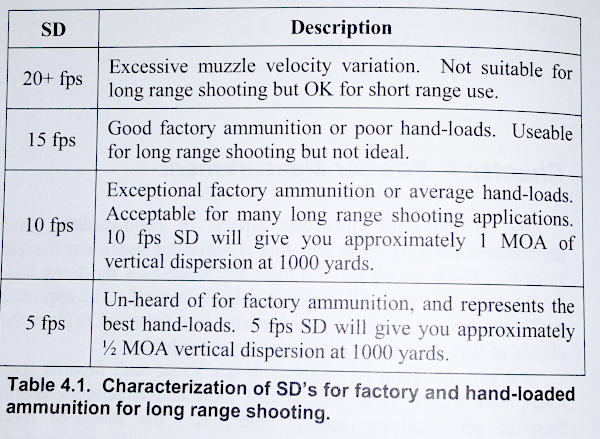
3. The ammo’s Standard Deviation (SD) is unknown. You will often notice that while MV is often listed on ammo packages, Standard Deviation (normally) is not. It is not uncommon for factory ammunition to have an SD of 18 or higher. Sometimes as high as 40+. As such is the nature of metering powder. With marketing in mind, did they pick the high, low, or average end of the SD? We really don’t know. You won’t either until you test it for yourself. For hand-loaded ammo, to be considered around 10 fps or less. Having a high SD is often the nature of metered powder and factory loads. The image below is from Modern Advancements in Long Range Shooting: Volume II.
4. You don’t know how MV was measured. What chronograph system did the manufacturer use, and how did they back track to a muzzle velocity? A chronograph does not measure true velocity at the muzzle; it simply measures velocity at the location it is sitting. So you need to back-calculate the distance from the chrono to the end of the barrel. This calculation requires a semi-accurate BC. So whose BC was used to back track to the muzzle or did the manufacturer even do that? Did they simply print the numbers displayed by the chronograph? What kind of chronograph setup did they use? We know from our Lab Testing that not all chronographs are created equal. Without knowing what chronograph was used, you have no idea the quality of the measurement. See: Applied Ballistics Chronograph Chapter Excerpt.
5. The MV data may not be current. Does the manufacturer update that data for every lot? Or is it the same data from years ago? Some manufacturers rarely if ever re-test and update information. Some update it every lot (ABM Ammo is actually tested every single lot for 1% consistency). Without knowing this information, you could be using data for years ago.
CONCLUSION: Never use the printed MV off a box of ammo as anything more than a starting point, there are too many factors to account for. You must always either test for the MV with a chronograph, or use carefully obtained, live fire data. When you are using a Ballistic Solver such as the AB Apps or Devices integrated with AB, you need to know the MV to an accuracy down to 5 fps. The more reliable the MV number, the better your ballistics solutions.
Do you know which one of your eyes is dominant? It’s easy to determine eye dominance with a simple exercise. Pick an object about 6-10 feet away (a light switch or door knob works well). Make an “OK” sign with your right hand (see photo) and hold that about 18″ from your face. Now, with both eyes open, look through the circle formed by your thumb and index finger. Center the circle on the object, so you can see the object in the middle.
Now, here’s the important part — while still holding your hand up, centered on the object, first close your right eye. If you don’t see the object anymore, then your right eye is dominant. If you still see the object, then repeat the procedure with the left eye shut and right eye open. If you don’t see the object when your left eye (only) is closed, then you are left-eye dominant.
The digital archives of Shooting Sports USA contain many interesting articles. A while back, Shooting Sports USA featured a “must-read” expert Symposium on Eye Dominance, as it affects both rifle and pistol shooting. No matter whether you have normal dominance (i.e. your dominant eye is on the same side as your dominant hand), or if you have cross-dominance, you’ll benefit by reading this excellent article. The physiology and science of eye dominance is explained by Dr. Norman Wong, a noted optometrist. In addition, expert advice is provided by champion shooters such as David Tubb, Lones Wigger, Dennis DeMille, Julie Golob, Jessie Harrison, and Phil Hemphill.
Top Rifle Champions Talk About Eye Dominance:
David Tubb — 11-Time National High Power Champion
I keep both eyes open, always. Some use an opaque blinder in rifle or shotgun shooting. If you close your non-dominant eye, you will not get as good a sight picture. If your aiming eye is not your dominant eye, you have even more of a problem to overcome.
Lones Wigger — World, National and Olympic Champion Rifleman
Shooters should try to use the dominant eye unless the vision is impaired and the non-dominant eye has better vision. You should always shoot with both eyes open since this will allow the shooting eye to function properly.
Dennis DeMille — National Service Rifle Champion
I close my non-shooting eye initially. Once I pick up my sight picture, it’s not something I focus on. For those that use a patch, I recommend that they use something white to block their view, rather than cover the eye.
Bruce Piatt — 2015 World Shooting Championship Winner
Some shooters, especially those with nearly equal or cross-dominance, will naturally find themselves squinting one eye. When anyone does this, you are also closing your dominant eye to some extent and adding stress to your face.
Here’s a very cool 3D Animation showing pistol rounds being fired. Computer-generated graphics provide a look inside the cartridge at the moment of ignition as the primer fires and the flame front moves through the ignited powder. It’s really kind of mesmerizing. If you’ve every wondered just what happens inside your cartridges the moment that firing pin strikes, then watch this video…
Watch Video to See Handgun Ammo Being Chambered and Fired:
This animated video from German ammo-maker GECO (part of the Swiss RUAG group of companies) reveals the inside of a pistol cartridge, showing jacket, lead core, case, powder and primer. Employing advanced 3D rendering and computer graphics, the video shows an X-ray view of ammo being loaded in a handgun, feeding from a magazine.
Then it really gets interesting. At 1:32 – 1:50 you’ll see the firing pin strike the primer cup, the primer’s hot jet streaming through the flash-hole, and the powder igniting. Finally you can see the bullet as it moves down the barrel and spins its way to a target. This is a very nicely-produced video. If you’ve ever wondered what happens inside a cartridge when you pull the trigger, this video shows all. They say “a picture’s worth a thousand words”… well a 3D video is even better.


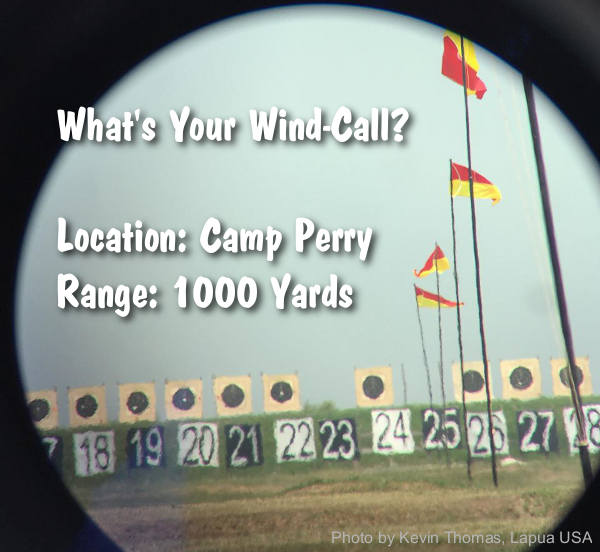
 Readers often ask us: “Is there a decent, easy-to-comprehend book that can help my wind-reading?” Many of our Forum members have recommended The Wind Book for Rifle Shooters by Linda Miller and Keith Cunningham. This 146-page book, published in 2007, is a very informative resource. But you don’t have to take our word for it. If you click this link, you can read book excerpts and decide for yourself. When the Amazon page opens, click the book cover (labeled “Look Inside”) and another screen will appear. This lets you preview the first few chapters, and see some illustrations.





 Do you know which one of your eyes is dominant? It’s easy to determine eye dominance with a simple exercise. Pick an object about 6-10 feet away (a light switch or door knob works well). Make an “OK” sign with your right hand (see photo) and hold that about 18″ from your face. Now, with both eyes open, look through the circle formed by your thumb and index finger. Center the circle on the object, so you can see the object in the middle.

 This animated video from German ammo-maker


