The Burris Eliminator III is an impressive piece of electro-optical technology. With a push of a button, a built-in laser rangefinder senses the distance to your target and the Eliminator’s microprocessor instantly calculates the required hold-over based on your load’s ballistics. The calculated aiming point is then displayed in the reticle with an illuminated red dot on the vertical cross-hair. Just put the bright red dot on the target and make the shot. We’ve used this scope out to 600 yards on small steel targets and it worked flawlessly.
If you ever wanted to get one of these advanced scopes for your next hunt or prarie dog safari, now is a great time to buy. Burris is now offering $100 off Burris Eliminators: “Our most popular rebate ever has returned for 2016, so if you missed out last year, this time you’ve got no excuses.” Eliminator III LaserScopes (Item # 200116 or 200120) purchased between August 1st and December 31st, are eligible for a $100 mail-in rebate. CLICK HERE for Rebate Form and Full Instructions.
To Receive Your Rebate:
Fill out the coupon with your name and shipping address and send proof of purchase the original UPC barcode from box and a copy of your sales receipt to:
Yes, there are ten (10) shots. In the lower left (7 o’clock) of the group, two shots overlap!
Stunning 1000-Yard 10-Shot Group You’re looking at a stunning feat of rifle accuracy. That’s a sub-3″, ten-shot group shot at 1000 yards, all 10s or Xs. Measured at 2.856 inches, this group by shooter Mike Gaizauskas works out to 0.2727 MOA. Nearly quarter-MOA for ten shots at 1K! And the vertical for 7 of 10 shots is under an inch. Now that’s impressive. This was done with an IBS Heavy Class Benchrest gun, chambered for the 6.5×47 Lapua, a mid-sized cartridge originally designed for 300m competition.
Gun Specs: 6.5×47 Lapua chambering, Krieger 30″, 1:8″-twist barrel, Lapua 139 grain Scenars, Hodgdon H4350, CCI BR4 primers, Nightforce NSX scope. Smithed by Mark King, stock by Mike Gaizaukaus.
This amazing group, which establishes new IBS world records, was shot at the Harry Jones Memorial 1000-Yard Gun Club range in Fairview, West Virginia. Set in wooded, rolling hills, this range is shielded on all sides by thick stands of trees. It’s a beautiful facility, and you can see why, when conditions are right, the Harry Jones range can be about as close to shooting in a “tunnel” as you’ll ever get at 1000 yards. The Harry Jones Club in WV hosted the 2014 IBS Long-Range Nationals.
Mike’s remarkable 10-shot performance may be a Score Record as well as a group record, because all ten shots were in the 10-Ring and, under IBS rules, group size is the tie-breaker, rather than X-Count. Mike’s target was scored 100-3X, with two of the three Xs just clipping the outside of the X-Ring. Match directors reported: “On 7/24/2016, two new pending IBS 1000-yard world records were shot by Mike Gaizauskas with a 6.5X47 Lapua: 1) Heavy Gun Group (2.856″) and 2) Heavy Gun Score (100-3X). Congratulations Mike!” Here are the listed IBS records that will be broken, when this target is certified:
► Current IBS 1000-Yard Heavy Gun 10-Shot Single Group Record: 3.044″, Joel Pendergraft, 4/18/2009.
► Current IBS 1000-Yard Heavy Gun 10-Shot Single Group Score Record: 100 points, with 3.353″ group size tie-breaker, Gary Nicholson, 7/27/13.
Best 1000-Yard 10-Shot Groups Ever
This jaw-dropping 2.856″ group by Mike Gaizauskas also handily breaks the current NBRSA 1000-Yard, ten-shot Heavy Gun Record, which was 3.9912″ set by Bill Johnston on November 17, 2015. FYI: IBS and NBRSA Light Guns only shoot five-shot groups, so there is no equivalent IBS or NBRSA Light Gun 1K ten-shot record.
Only one other 10-shot, 100-score 1000-yard group was better than this in the history of rifle competition on this planet. Back in 2010, at a Williamsport match, Matt Kline shot a 2.815″ 100-4X. Depending on how Mike’s 2016 2.856″ group is finally measured, it could end up smaller than Matt’s. The difference (before final IBS verification) is only 0.041″, a mere four hundredths of an inch.
In 2014, Jim Richards fired a 10-shot Light Gun group at 1000 yards initially measured at 2.6872″. Shot under Williamsport Rules at the Deep Creek Range in Montana, that 10-shot group may be the smallest ever at 1K. However, the whole group was out in the 8 Ring, for a score of 80, not 100.
About the 6.5×57 Lapua Cartridge
To learn more about the record-setting 6.5×47 Lapua cartridge, including bullet and powder options and reloading tips, visit our comprehensive 6.5×47 Lapua Cartridge Guide.
The 6.5x47mm Lapua was developed in 2005 as a precision cartridge for 300m CISM rifle matches. Lapua (of Finland) and Swiss rifle-maker Grünig & Elmiger created this new cartridge to match the “pure accuracy” of the 6mmBR, but with even better ballistics. Following its debut as a 300m match cartridge, the 6.5×47 has proven to be a popular “jack of all trades”. Shooters have adopted this efficient, mid-sized cartridge because it offers excellent accuracy, mild recoil, good ballistics, and ample barrel life (plus it feeds well from a magazine). The 6.5×47 Lapua has won two NBRSA 600-yard Nationals. Now that this modern, mid-sized cartridge has set an all-time record for grouping precision at 1000 yards, we expect more shooters to experiment with this cartridge in the mid- and long-range benchrest disciplines.
Story Tip by Boyd Allen. We welcome reader submissions
In this video, Bryan Litz of Applied Ballistics explains how to choose a bullet for long-range shooting and explains what you should be looking for when developing a long-range load. Bryan notes that, with a new rifle build, the bullet you select may actually dictate your gun components. When starting from a “clean slate”, once you select a bullet, you will then pick a barrel, twist rate, and cartridge that are appropriate for that bullet. In choosing a long-range projectile, Bryan recommends you choose a high-BC bullet “that is known for precision”. Then you need to find an ultra-consistent, reliable load.
This video is worth watching. Bryan Litz makes some very good points.
Load Development — Why Consistency is Key (and Half-MOA May Be Good Enough)
After choosing a bullet for your long-range project, then you need to develop a load through testing. Bryan explains: “Once you’ve selected a bullet … and you have selected the components around that bullet, the most important thing to remember in hand-loading is consistency. You’re going to do some testing to see what combination of powder charge, powder type, and seating depth give you the best groups and lowest standard deviations in muzzle velocity.”
Bryan says that if you develop a load that can shoot consistent, half-minute groups in all conditions, you should be satisfied. Bryan says that many long-range shooters “spin their wheels” trying to achieve a quarter-MOA load. Often they give up and start all over with a new bullet, new powder, and even a new cartridge type. That wastes time, money, and energy.
Bryan cautions: “My advice for hand-loaders who are long-range shooters, is this: If you can get a load that is reliable and can shoot consistent, half-minute groups with low MV variation and you can shoot that load in any condition and it will work well, then STICK with THAT LOAD. Then focus on practicing, focus on the fundamentals of marksmanship. The consistency you develop over time by using the same ammunition will mean more to your success in long range shooting than refining a half-minute load down to a quarter-minute load.”
Bryan notes that, at very long range, shooting skills and wind-calling abilities count most: “Your ability to hit a 10″ target at 1000 yards doesn’t improve very much if you can make your rifle group a quarter-minute vs. a half a minute. What’s going to determine your hit percentage on a target like that is how well you can calculate an accurate firing solution and center your group on that target. A lot of people would be more effective if they focused on the fire solution and accurately centering the group on the target [rather than attempting to achieve smaller groups through continuous load development].”
Editor’s Note: We agree 100% with the points Bryan makes in this video. However, for certain disciplines, such as 600-yard benchrest, you WILL need a sub-half-MOA rifle to be competitive at major matches. Well-tuned, modern 600-yard benchrest rigs can shoot 1/4-MOA or better at 100 yards. Thankfully, with the powder, bullets, and barrels available now, 1/4-MOA precision (in good, stable conditions) is achievable with a 17-lb benchgun built by a good smith with premium components.
Looking for a great price on an excellent hunting rifle? Here is the Tikka Deal of the Decade. EuroOptic.com has received nearly 3,500 Tikka T3 rifles, which will be sold at deep discounts as part of an inventory clearance program by Beretta, Tikka’s parent company. The Tikka T3 is a good, stout rifle with a smooth, 3-lug action, crisp trigger, and quality barrel. Accuracy is typically well under 1 MOA (for three shots). T3 barreled actions also are a good “core” for a tactical build. The strong T3 action handles detachable magazines, and fits a variety of third-party stocks such as McRees Precision G7 and G10 chassis systems.
Our friend Jason Baney of EuroOptic.com tells us: “We have two tractor-trailer loads of Tikka T3 rifles (about 3500 units) dropping here today…and the sale prices are amazingly low. I am sure it will take a day or so to get all the rifles in the system, then they will show in stock. Everything currently showing on our site should either be in stock or coming in stock this week. Feel free to order/backorder through the link below, or give us a shout.”
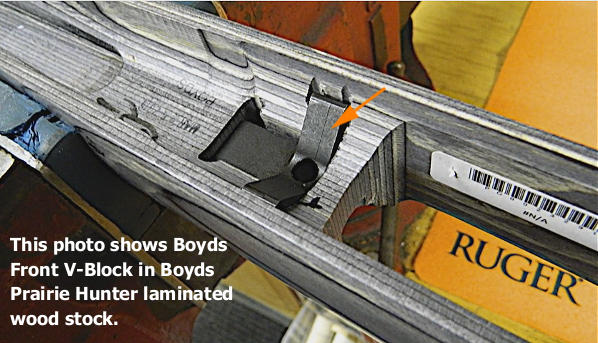
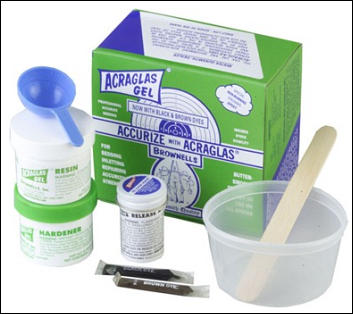
The NRA’s American Rifleman showcased an interesting project this week — an upgraded Ruger American Rifle Predator in 6.5 Creedmoor. The video below shows how a laminated wood stock from Boyd’s Gunstocks was adapted for the Ruger. A Boyds Prairie Hunter model in gray laminate was selected. This was custom-bedded to the Ruger’s action using Brownell’s Acraglas.
All Ruger American Rifle models employ dual aluminum V-Blocks to support the action. These fit slots in the underside of the action. Boyds makes its own version of these V-Blocks which were installed in the Boyds stock to secure the action.
Project leader Joe Kurtenbach says the size, shape, and geometry of the Boyds V-Blocks is very accurate, so they fit the Ruger action well. To further support the action, Acraglas bedding compound was applied to the inside of the stock, after release compound was applied to the barreled action. With this DIY bedding job, the Boyds laminated stock is definitely an improvement over this original “Tupperware” factory stock.
DIY Bargain Hunter Upgrade
American Rifleman states: “The Ruger American has some great features—hammer-forged barrel, reliable action, crisp trigger — but many would not consider the molded, polymer stock to be among them. Luckily, there are aftermarket options to enhance the rifle’s utility and aesthetics. A durable, attractive stock from Boyds Gunstocks and some DIY action bedding, using Brownells Acraglas, is the next step in the precision-driven hunting rifle build.”
Choice of Gun and 6.5 Creedmoor Chambering
For this project, American Rifleman’s Joe Kurtenbach selected one of his favorite cartridges, the 6.5 Creedmoor. Introduced in 2007 by Hornady, the accurate, flat-shooting 6.5 Creedmoor has proven very popular with both hunters and tactical/PRS shooters. The Ruger American Rifle Predator was chosen for its affordable price, reliable action, and Ruger Marksman adjustable trigger.
In this video, Kurtenback explains how and why the 6.5 Creedmoor chambering and Ruger American Rifle were chosen for the Precision Hunter rifle build project.
At the request of our readers, we provide select “Deals of the Week”. Every Monday morning we offer our Bargain selections. Here are some of the best deals on firearms, hardware, reloading components, and shooting accessories. Be aware that sale prices are subject to change, and once clearance inventory is sold, it’s gone for good. You snooze you lose.
If you shoot long range, you need a scope level. This Discovery scope level is fully CNC-machined to close tolerances for a good fit. It is available with three inner diameters to fit scopes with 1″, 30mm, or 34mm main tubes. The 1″ version is just $11.99 while the 30mm model is $13.95 and the large 34mm version is $15.95. You could easily pay $35.00 or more for a 30mm scope level. Purchasers have praised this product: 89% of verified buyers rated this five stars.
2. CDNN Sports — Smith & Wesson SW1911TA E-Series, $999.99
This is a very accurate, high quality Smith & Wesson 1911. The SW1911TA Tactical E-Series™ (“Enhanced”) sells elsewhere for around $1170.00 so this CDNN $999.99 special is a very good deal. This pistol features tritium night sights, front rail, high-quality wood grips, and snakeskin-style slide serrations. We’ve shot this S&W pistol. With our handloads, our sample SW1911TA was more accurate than a $2850.00 Wilson Combat CQB 1911 we tried for comparison. YMMV but expect excellent accuracy and a really fine trigger right out of the box. Some folks may not like the external extractor, but in our mind it’s a smart feature that improves reliability. Think about it, the most reliable semi-auto handguns — Sigs, Glocks, HKs — all have external extractors.
3. Amazon — Plano Double Rifle Case with Wheels, $118.64
This Plano Double Scoped Rifle Case is an Amazon Best Seller for good reason. It offers the functionality and durability of an SKB-type hard case for HALF the money. This is under $120.00, while the equivalent SKB is around $240.00, so you can buy two Planos for the price of one SKB. The 51.5″ interior will fit most scoped competition rifles up to about 29″ barrels (measure your own rifle to make sure). The handles are convenient and beefy and the wheels make this case easy to move through airports and parking lots. This is a very tough, roomy case for the money.
This is a totally new kind of hearing protection. Walker’s Razor-X and Razor-XV operate like electronic muffs — allowing you to hear commands and conversations while still blocking gunshots and other loud noises. The Razor-X combines a collar unit (containing the electronics) with retractable, foam-tipped ear buds. Unlike conventional earmuffs, the Razor-X system doesn’t interfere with your cheek weld. The patent-pending earbuds allow the user to be in loud environments without damaging their hearing, providing an impressive 31dB of noise reduction.
To ensure a good fit (for optimal noise reduction), the Razor-X and Razor-VX come with two styles of noise-reducing foam tips. The Razor-X also features an auto-shut off after 4 to 6 hours. An AC wall adapter with USB port and a one-meter micro USB cord is provided.
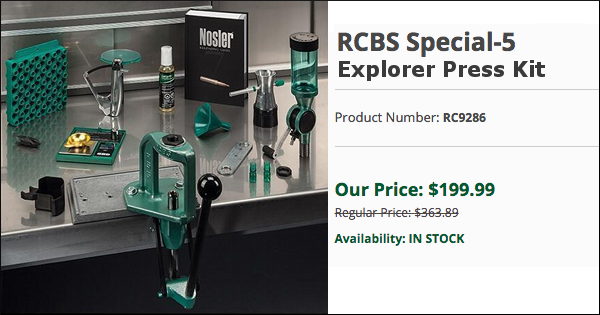
5. Natchez — Special 5 Reloading Press Kit, $199.99
This is an excellent entry-level reloading kit, which is on sale for $199.99 at Natchez Shooters Supplies. We like the relatively compact Special 5 press for most reloading duties. Eventually you many want to add an additional large heavy press, but this will get the job done. This kit includes an RCBS Powder Measure, Digital Scale, Powder Trickler, Hand Priming Tool, Load Manual, Loading Tray, and more. It’s hard to beat this combination of tools for under $200.00.
6. MidwayUSA — Pro Series Folding Shooting Mat, $89.99
We like this folding shooting mat for three main reasons. First, it has nice half-inch-thick EVA high-density foam inside. That 0.5″ padding makes this mat MUCH more comfortable than thin mats when shooting from concrete or hard ground. Second, at 76″ long x 35.5″ wide, the mat is big enough for tall guys and there’s plenty of width for log-books, ammo boxes, and other gear. Third, the multi-cam pattern is distinctive. When you’re at a big match with many competitors, this mat is easy to spot, so you can quickly find your place on the firing line. The Multi-cam Pro Series Folding Shooting Mat is currently on sale for $89.99, marked down from $189.00. It is also offered in OD Green for $89.99.
7. Amazon — Long Range Shooting Handbook, $13.02 plus s/h
This 250-page book is Amazon.com’s #1 Top Seller among shooting books. The author, a former U.S. Army Sniper Instructor, knows his stuff. Ryan’s Long Range Shooting Handbook contains a thorough discussion of MOA and MilRadian concepts. The handbook is broken down into three section: Part One covers equipment, terminology, and basic principles. Part Two covers the theory of long range shooting. Part Three offers practical advice on implementing the information taught. This book has earned rave reviews — 91% of verified purchasers gave the book Five Stars. Note, we show the Prime Price. However, this book is available from other Amazon sellers starting at $13.02 plus $3.99 shipping.
8. Sportsman’s Guide — Frankford Arsenal Case Tumbler Kit
For just $69.99, this Frankford Arsenal Kit provides everything you need to clean brass: Vibratory Tumbler, Rotary Media Separator, Bucket, Corn Cob Media (3 lbs.), and Brass Polish. The Case Tumbler holds up to 600 9mm cases or 350 .223 Rem cases. The separator system is generous, with a 3.5-gallon bucket. NOTE: Sportsman’s Guide Buyers Club members can purchase for $62.99.
What happens inside a rifle chamber and barrel when a cartridge fires can’t be seen by the naked eye (unless you are a Super-Hero with X-Ray vision). But now, with the help of 3D-style computer animation, you can see every stage in the process of a rifle round being fired.
In this amazing video, X-Ray-style 3D animation illustrates the primer igniting, the propellant burning, and the bullet moving through the barrel. The video then shows how the bullet spins as it flies along its trajectory. Finally, this animation shows the bullet impacting ballistic gelatin. Watch the bullet mushroom and deform as it creates a “wound channel” in the gelatin. This excellent video was commissioned by Czech ammo-maker Sellier & Bellot to demonstrate its hunting ammunition. The design, 3D rendering, and animation was done by Grafické studio VLADO.
Watch Video – Cartridge Ignition Sequence Starts at 1:45 Time-Mark
Video find by Seb Lambang. We welcome reader submissions.
Berger Twist-Rate Stability Calculator
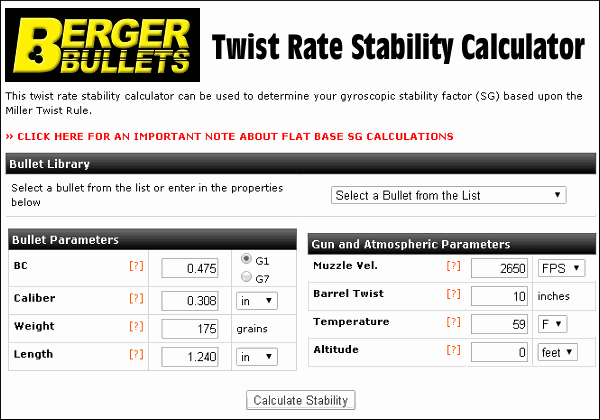
On the Berger Bullets website you’ll find a handy Twist-Rate Stability Calculator that predicts your gyroscopic stability factor (SG) based on mulitiple variables: velocity, bullet length, bullet weight, barrel twist rate, ambient temperature, and altitude. This cool tool tells you if your chosen bullet will really stabilize in your barrel.
How to Use Berger’s Twist Rate Calculator
Using the Twist Rate Calculator is simple. Just enter the bullet DIAMETER (e.g. .264), bullet WEIGHT (in grains), and bullet overall LENGTH (in inches). On its website, Berger conveniently provides this info for all its bullet types. For other brands, we suggest you weigh three examples of your chosen bullet, and also measure the length on three samples. Then use the average weight and length of the three. To calculate bullet stability, simply enter your bullet data (along with observed Muzzle Velocity, outside Temperature, and Altitude) and click “Calculate SG”. Try different twist rate numbers (and recalculate) until you get an SG value of 1.4 (or higher).
Gyroscopic Stability (SG) and Twist Rate
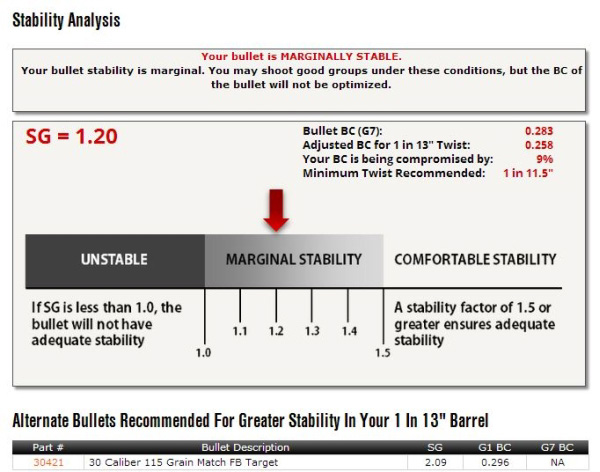
Berger’s Twist Rate Calculator provides a predicted stability value called “SG” (for “Gyroscopic Stability”). This indicates the Gyroscopic Stability applied to the bullet by spin. This number is derived from the basic equation: SG = (rigidity of the spinning mass)/(overturning aerodynamic torque).
If you have an SG under 1.0, your bullet is predicted not to stabilize. If you have between 1.0 and 1.1 SG, your bullet may or may not stabilize. If you have an SG greater than 1.1, your bullet should stabilize under optimal conditions, but stabilization might not be adequate when temperature, altitude, or other variables are less-than-optimal. That’s why Berger normally recommends at least 1.5 SG to get out of the “Marginal Stability” zone.
In his book Applied Ballistics For Long-Range Shooting, Bryan Litz (Berger Ballistician) recommends at least a 1.4 SG rating when selecting a barrel twist for a particular bullet. This gives you a safety margin for shooting under various conditions, such as higher or lower altitudes or temperatures.
Story idea from EdLongrange. We welcome reader submissions.
Earlier this week, on July 27th, the CMP held the 2016 Vintage Sniper Rifle Match at Camp Perry. This unique event is a two-man team competition using scoped rifles of WWI and WWII Vintage. This has become of of the most popular rifle matches held at Perry, with 259 teams competing this summer. Many competitors use some version of the M1903 Springfield, but you’ll also see scoped M1 Garands, K31s, Mausers, and even a Lee-Enfield or two. (Semi-Auto shooters are scored separately). This year the Vintage Sniper Match was won by the “Yogi & BooBoo” family team of Silas Fentress and Wesley Fentress, with a 396-13X score. Close behind was runner-up duo Donald Schedler and John Watson (394-13X). Winning the semi-auto division were Brian Dobish and Clayton Maugans (373-8X).
Two-person teams will fire 10 rounds in 20-second intervals from scoped vintage military rifles set on sand bags. One team marksman shoots from the prone position at 300 and 600 yards, while the other serves as a spotter to relay shot position. Marksman and spotter switch positions on the firing lines, allowing each teammate to play both roles. Scores are then combined for an Aggregate team total.
Two M1 Garands, fitted with scopes and lace-on cheekpads.
Who can identify this rifle, with its unusual scope mount?
Our friends at Criterion Barrels have written an interesting article about the 2014 Vintage Sniper Rifle Match. It you want an “insider’s perspective” on the 2014 Match, plus Vintage Sniper gunsmithing tips, read this article. Here are some highlights:
About the Match and the Rifles
The Vintage Sniper Match was the brainchild of Hornady’s Dave Emary. The competition was inspired by his father, a World War II scout sniper, who carried a rifle similar to the 1903A4 rifle builds that can be found today on the Camp Perry firing line. Bob Schanen worked alongside Dave and the CMP staff in establishing the various competition rules prior to the first official Vintage Sniper Match in 2011. The match developers made a point to offer some level of flexibility in rifle configuration, allowing specific types of non-issue optics and rifle rebuilds. This helped make the match more inclusive.
Hornady’s Dave Emary and “Gunny” R. Lee Ermey (right):
Camp Perry — The Venue
The hallowed grounds of Camp Perry have hosted some of the nation’s finest shooters each summer for more than a century. Some of the world’s greatest marksmen have accomplished remarkable feats on the ranges of this lakeside military outpost. Located on the coast of Lake Erie, Camp Perry is positioned just outside of the scenic town of Port Clinton, Ohio. It is our firm belief that every shooter should make the pilgrimage to the Camp Perry at least once in their lifetime. If not participating in an event, visitors should at least make an attempt to meet the competitors, witness the wide selection of firearms used by participants, and pay a visit to the various vendors on base.
Do you have “fuzzy sight syndrome”? Are you frustrated because you can no longer see both your iron sights and your target sharply? Here’s a product that can help. Lyman’s new EyePal is basically an adaptation of aperture or “peep” sights (sometimes called “diopter sights”). The EyePal works by restricting the viewable image to a small-diameter circle. This improves depth-of-field dramatically, which in turn keeps everything in focus, both sights AND Target. This principle has been used for some time with the Merit adjustable optical disc that attaches to shooting glasses with a rubber cup. The EyePal does much the same thing — for a lot less money.
Simply apply the EyePal to any eyewear and you should see an immediate improvement in focus (both near and far). Lyman explains: “The EyePal provides a small image where everything is in focus. This is particularly useful to shooters who have limited near vision but have good far vision. The EyePal enables you to simultaneously see the target, and iron sights — all in focus.”
How Do EyePals Work?
The EyePal is a modern adaptation of the century-old peep sight, which some folks call a pin-hole sight (remember those pin-hole camera experiments back in school?). The EyePal enables you to simultaneously see the target, your front and rear sights — all in focus.
EyePal stick-on apertures are made of a static cling material. This allows EyePals to be easily placed on safety eyewear and prescription glasses without marring the surface or leaving a residue when removed. EyePals are inexpensive (about $25.00 per set), easy to use, and long-lasting.


 You’re looking at a stunning feat of rifle accuracy. That’s a sub-3″, ten-shot group shot at 1000 yards, all 10s or Xs. Measured at 2.856 inches, this group by shooter Mike Gaizauskas works out to 0.2727 MOA. Nearly quarter-MOA for ten shots at 1K! And the vertical for 7 of 10 shots is under an inch. Now that’s impressive. This was done with an IBS Heavy Class Benchrest gun, chambered for the 6.5×47 Lapua, a mid-sized cartridge originally designed for 300m competition.


 All Ruger American Rifle models employ dual aluminum V-Blocks to support the action. These fit slots in the underside of the action. Boyds makes its own version of these V-Blocks which were installed in the Boyds stock to secure the action.