Annealing Made Perfect (AMP) Annealing Machine Review
Review by Bill Gravatt I had been following the progress of Alex and Matt Findlay with Annealing Made Perfect for almost three years as they pursued making the best annealing product for the private reloading market. The short explanation of why we anneal brass is to return the brass to a softer and consistent hardness after the brass has work-hardened from repetitive firing and sizing. As the President/co-owner of Sinclair International for over 21 years I saw a lot of products come through our doors that annealed brass but these products always seemed like they had very little supportive data and research behind them. Most of them were based on some type of torch system. The New Zealand-based father/son team of Alex and Matt spent these past three years addressing the challenging questions about annealing:
- What is the correct temperature to reach when annealing?
– How long should you take to get to that temp and how long should you remain there?
– How frequently should you anneal?
– Can you ruin your expensive brass?
– How do we make the process repeatable for the handloader?
– How do you accurately measure the case hardness?
They worked closely with the Electrical Engineering Department at the local University of Technology and invested a lot of capital into detailed metallurgical research. Their decision to use induction heating was because of its repeatability and the ability to reach exacting and consistent temperatures. Induction annealing is achieved by placing the cartridge in a magnetic field thereby inducing eddy currents within the brass and heating the brass without contacting the brass physically. To learn more, I suggest you visit the AmpAnnealing.com website. It is very informative.
Why should you anneal? If you are just a casual reloader, than annealing isn’t necessary but if you a serious wildcatter or competitive shooter you may want to consider it. More and more competitive shooters anneal their cases (not necessarily for adding life to the cases) to achieve more consistent pressures and velocities.
My first favorable impression was received by just opening the extremely well-packed shipping box. You could tell these guys take a great deal of pride in their product. The unit comes with three cartridge-specific pilots (you decide on which pilots), a shellholder collet, a power cord, a thorough, well-written, easy to follow instruction manual, and a USB cord for future software updates.
This machine is so easy to use that I was up and running within a few minutes. All I had to supply was the shells, the correct shell-holder and an aluminum pan to drop the hot cases into. I started annealing some unturned .308 Winchester cases (Lapua headstamp) that had four firings. First I screwed the pilot for .308 cases (#11) into the machine, placed my .308 shellholder into the supplied shellholder/collet and turned the power on. The display fired up right away and soon registered the program level that the machine was set to.
Since the machine uses induction heating, you need to set the heating level for the correct setting for the brass you are using. The alloy being used isn’t as important as the thickness or amount of brass in the neck and shoulder region. For example, Lapua and Norma have more brass in that area so the setting would be higher for these brands than Winchester brass. Also, if you have neck-turned brass, the setting would be reduced from the standard setting because there would be less mass in the air gap.
This manufacturer-produced video shows how the AMP annealing machine operates:
The settings are obtained by referring to the “Settings” section on the AMP website and are broken out by cartridge, brand, standard unturned cases, and then neck-turned cases with various amounts of wall thickness removed. A great service that AMP provides to the handloader is that you can send sample cases of your brass to them (U.S. location in Wolcott, Indiana) and they will test the hardness for you and send you the exact setting for your specific lot of brass.
My setting for unturned Lapua .308 Winchester brass was “92”. The buttons on the front of the machine allow you to adjust the setting quickly. After you set the program number, the setting is locked in after the first use until you change it again. I placed the first case in the shellholder, lowered the assembly down through the pilot and into position. I then hit the start button which illuminated immediately and then about 6 to 7 seconds later, the light went off signaling that heating was completed.
Now, be aware, these cases are extremely hot. I lifted the case out using the shellholder/collet and then dropped it into my aluminum pan. I then placed another case into the holder, put it into the machine and then repeated the process. Once I got the coordination down, I did 100 .308 Win cases in about 24 minutes. I did some 6mmBR cases later (Lapua) and annealed 100 cases in about 15 minutes at the “75” setting. I found myself raising my shop stool a little higher than normal so I was at a comfortable height in relationship to the top of the machine. Very easy to do — I actually had a student do a few cases with me and she had no problem at all following the instructions.
There is a thermal cut-off that prevents the machine from overheating. Depending on the setting, this can occur after 20 to 35 minutes of continuous use. When this has occurred, simply leave the machine on and the fans will cool it down so you can resume annealing. This isn’t surprising considering the amount of heat being generated.
All in all, I found this machine extremely easy to setup and operate. Now, does it work? I have test batches of brass that I am going to run over the chronograph in 10-round strings. I plan on running at least 10 strings of annealed brass and 10 strings of unannealed brass out of the same lot, same number of reloadings/firings and out of the same gun. I plan on alternating annealed strings and unannealed strings with a cooling off period every 20 rounds. When I do testing, I have my wife pre-label my batches as Batch A and B so I won’t know what rounds I am shooting until I get back from the range. I’ll make the results available as soon as I can. My expectation is that velocities will be more consistent based on my understanding of the lab results that the Findlays have achieved with their Annealing Made Perfect machine. For more information, visit their website at AmpAnnealing.com.
At the request of our readers, we provide select “Deals of the Week”. Every Monday morning we offer our Bargain selections. Here are some of the best deals on firearms, hardware, reloading components, and shooting accessories. Be aware that sale prices are subject to change, and once clearance inventory is sold, it’s gone for good. You snooze you lose.
1. Bullets.com — 6mm Dasher Brass from Norma
It’s finally here, ladies and gentlemen — factory-made Dasher brass. That means no more fireforming! This 6mm Dasher brass has been custom crafted by Norma exclusively for Bullets.com. A special blend of brass together with special treatment of the primer pockets has produced casings that will last for many firings under normal use. The necks have been specially lengthened and are .290″ from shoulder. Overall length is 1.598″ and neck walls are approximately .013″ thick. Available in packs of 100 ($109.95) or 500 ($529.95).
NOTE: This extra-sturdy brass has a thicker rim which may not work in your standard shell holder. Custom shell holder item BL12100 is designed to accommodate the heavy rim of these cases.
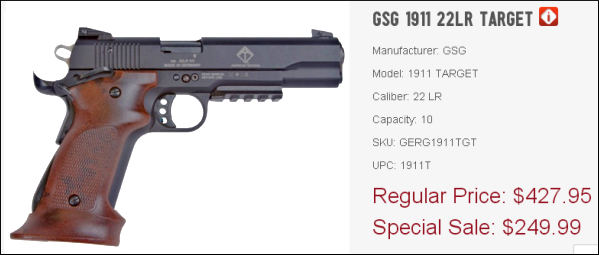
2. CDNN Sports — 1911-Type .22 LR Target Pistol
Everyone should have an accurate .22 LR target pistol. This German-made GSG 1911 22LR pistol shares the look, feel, and ergonomics of J.M. Browning’s classic model 1911 so it’s good for cross-training. We’ve tried this pistol and the trigger is pretty darn good — though don’t expect it be be as nice as a S&W Model 41. But consider that the GSG costs just $249.99. By contrast, MSRP on a new Model 41 is a steep $1369.00. For cross-training and target work the GSG is a very good value.
3. Monmouth Reloading — Sig Sauer Kilo 2000 LRF, $499.00
This excellent laser rangefinder rivals other premium LRFs selling for hundreds more. Head-to-head field tests with Leica, Zeiss, and Swarovski LRFs proved that the new Sig Sauer Kilo 2000 can play in that league, but at a much more affordable price point. Sig accomplishes that with tight beam divergence and state-of-the-art DSP technology which allows the Kilo 2000 to range faster (and more reliably) at longer distances. Optic magnification is 7X. The Kilo 2000 weighs 7.5 oz and measures 3″ x 4.2″ x 1.3″.
SAVE MORE: Right now you can save an additional $110 off every Rangefinder Monmouth Reloading sells, including the Sig Kilo 2000. To save an additional $110, use Coupon Code LRF 110. That will lower your cost to $389.00 for the Kilo 2000, which is a total steal. (Time-Limited Offer!)
4. Cabelas.com — Rock Chucker Supreme Reloading Kit
Everything you see above can be yours for just $225.00, after manufacturer’s rebate. Right now, Cabela’s is selling the Rock Chucker Supreme Master Reloading Kit for $300.00. That’s a good deal as this Reloading Kit sells elsewhere for up to $360.00. But he’s the real incentive — if you spend $300.00 on RCBS products in 2016, RCBS will send you a $75.00 rebate. With that REBATE, your net cost is just $225.00 for the entire Kit.
5. Amazon — Motorola Walkie Talkies, $42.56 per Pair
Walkie-Talkies are “must-have” items for long-range shooting. The 22-CH Motorola MH230R Two-Way Radio is Amazon’s #1 Best Seller in FRS/GMRS Handheld Radios. This under-$45.00 set offers 22 channels with a claimed range up to 23 miles (We’ve used them and they worked at 3 miles line of sight). The kit includes: 2 radios, 2 belt clips, 1 dual drop-in charger, 1 charging adapter, 2 NiMH rechargeable battery packs. Run-time is about 10 hours — plenty for a full day of shooting. There is also a newer version, the Motorola T260 for $59.00.
6. Amazon — Nikon 1-4x20mm M-223 Scope with BDC, $212.46
Under the CMP’s new Service Rifle Rules, you can use an optic with up to 4.5X magnification and 34mm objective. If you have money to burn, you could purchase the excellent new Nightforce 4.5x24mm SR scope for $1950.00. Or, if you would rather put your money into barrels, bullets, and brass, you can spend a whole lot less. This little Nikon 1-4x20mm M-223 can do the job and right now it’s on sale for under $215.00! You could buy NINE of these Nikons for the price of one Nightforce SR. That certainly makes you think about priorities.
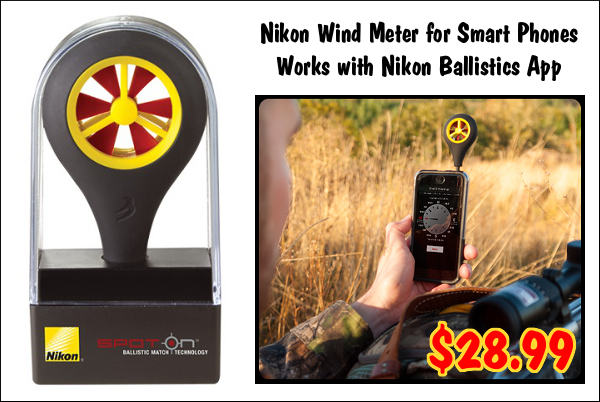
7. Grafs.com — NEW Nikon Wind Meter for SmartPhones, $28.99
Here’s a great new gadget for under $30.00. Nikon’s new Spot On™ Ballistic Wind Meter plugs directly into the headphone port on most popular smart phones. The Spot On Wind Meter reads both wind speed and direction and inputs the data directly into Nikon’s free Spot On Ballistics Mobile App (available for iOS and Android). This allows you to quickly determine and calculate wind drift corrections without needing a separate, dedicated wind meter. When not in use, the Nikon device easily fits in a pocket.
8. Amazon – Frankford Arsenal Master Tumbler Kit, $56.65
This Master Tumbler Kit contains everything you need to tumble rifle or pistol brass. Now on sale for $56.65, this Kit contains: Vibratory Tumbler, Rotary Media Separator, Plastic Bucket, 3 lbs. Cleaning Media, and 4 oz. Brass Polish. This product has received excellent reviews from verified purchasers.
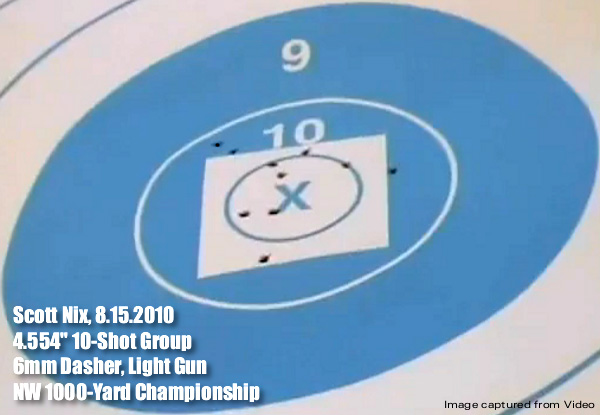
How well can the 6mm Dasher perform at 1000 yards when conditions are good, and the shooter is riding a hot streak? Well here’s a shot-by-shot record of Scott Nix’s 4.554″ 10-shot group shot at Missoula, Montana at the Northwest 1000-yard Championship a few years back. All 10 shots were centered for a 100-6X score. That’s about as good as it gets. If Scott had stopped after 5 shots, his group would have been under 3 inches!
Video Demonstrates Amazing 1000-Yard Accuracy
Watch the video. You can see the group form up, shot by shot. It’s pretty amazing. Scott’s first shot (at the 45-second mark of the video) was right in the X-Ring, and four of Scott’s first five shots were Xs. That’s drilling them! This video was recorded from the pits at the 1000-yard line, during record fire.
In our Shooters’ Forum, you’ll find a lengthy thread about accuracy problems with a Savage LRPV, chambered in 6mmBR. The gun would repeatedly split groups at 100 yards, and at 300 yards, the “flyers” would open up the groups to 1.5 MOA or larger. Interestingly, the factory test target (at right) showed a split group — not a good sign.
The gun’s owner, forum member LR_Shooter, tried a variety of tweaks: “I did this, done that… [changed] torque, tang floated, bedded action, recut chamber, and [adjusted firing pin]”. But nothing really helped. Frustrated, LR_Shooter asked his fellow Forum members for help. Much advice was proffered, including the novel idea of removing the middle action screw in the Savage 3-screw target action. Some of the advice proved helpful, but none of the suggested remedies produced a major improvement. This rifle, out of the box, tossed flyers and no amount of tweaking (or changes in shooting technique) really cured the basic problem. That is, until, the factory barrel got replaced…
New Criterion Pre-Fit Barrel Works Wonders
LR_Shooter acquired a Criterion pre-fit barrel from Jim Briggs at Northland Shooters Supply (NSS). These pre-fits are designed for easy installation with the standard Savage barrel nut. Wouldn’t you know it, with a new 30″ heavy-contour barrel on the LRPV, the gun started shooting way better. No more crazy fliers, no more split groups, no more excessive vertical. And the improvement came without any other major modifications. LR_Shooter reports: “I got a replacement barrel from Jim at NSS. It is a 30″ bull Criterion barrel. So far, without playing with torque screws and having my old setup… I’m very satisfied with the barrel I got. Now I have no problem getting [groups] under 0.25 MOA. Finally this thing can shoot!” The targets below, shot with the new Criterion barrel, speak for themselves. The left target was shot at 100 yards, while the target on the right was shot at 300 yards (very impressive).
Targets Shot with Savage LRPV Fitted with Criterion Barrel
Moral of the Story — Sometimes A New Barrel Really Is the Right Solution
All of us have struggled at times with a rifle that won’t live up to expectations. This Editor personally struggled for over a year with a .260 Rem Savage with a factory tube. The gun tended to split groups and the POI walked as the barrel heated. I tried one powder/primer combination after another, working through a variety of seating depths over many months. I was persistent. Out of stubbornness, I just believed that sooner or later I’d find the magic load.
Well folks, sometimes there’s really nothing you can do about a sub-par barrel. It is what it is. To really improve a gun’s accuracy (particularly a gun with a factory tube), you may need to open your wallet and get a quality aftermarket barrel. Spending months trying one recipe after another may simply be an overwhelming waste of powder, bullets, and your precious time.
Albert Einstein supposedly said: “Insanity is defined as doing the same thing over and over again, and expecting different results.” Well that sort of describes my efforts with my .260 Rem. Once I had enough evidence that my barrel split groups no matter what load combo (and seating depth) I tried, it was time to pony up for a new barrel. When I did finally screw on a nice PacNor 3-groove Supermatch, that Savage suddenly became a true tack-driver. As re-chambered in 6mmBR with the Pac-Nor, in calm conditions, my Savage will now consistently shoot in the twos with heavy bullets, and it can sometimes dip down into the ones with Berger 80gr flat-base bullets. The moral of the story here is simple — don’t waste weeks or months chasing your tail with a barrel that just won’t deliver (after a reasonable amount of testing). Save up for a custom barrel, get it chambered properly, and stop your cycle of frustration.
Contact Information for Northland Shooters Supply:
E-mail: briggs.j-b@q.com (that is Q.com not G.com)
Phone: (763) 682-4296
Fax: (763) 682-6098
Mailing address:
P.O. Box 333
Buffalo, MN 55313
A new firearms TV show, GunVenture, premiers on the Sportsman Channel tomorrow, Monday, June 27th, 2016. This high-production-value TV series is hosted by Tom Gresham, the star and creator of GunTalk radio. In GunVenture’s first episode, Tom heads west to visit with RECOIL Magazine Editor Iain Harrison. After testing products at the range and visiting with local gun companies, Tom still has time to take a jeep tour of the red rocks of Sedona.
The new GunVenture TV show features on-location adventures with a firearms focus. All aspects of shooting will be covered — from hunting to target shooting, and everything in-between. You’ll see a wide variety of firearms, from rimfires, to .50 Cal, and even full-auto (as demonstrated by Harrison, a Top Shot Champion who served as a Captain in the English Army.)
Along with Tom Gresham, GunVenture features Ryan Gresham and Top Shot Alumnus Chris Cerino in front of the camera. The GunVenture crew will visit major gun-makers and provide an in-depth look at all aspects of American gun culture. Shooting sports coverage will be augmented by off-road adventures, and other “Man Card” activities — such as driving a tank and using a flame thrower.
Here is a longer, two-minute Preview of Episode One (may not play on mobile devices):
GunVenture SHOW TIMES
Mondays at 10:00 p.m. ET
Tuesdays at 1:00 a.m. ET
Tuesdays at 9:00 a.m. ET
Thursdays at 1:30 p.m. ET
Saturdays at 11:30 p.m. ET
Sportsman Channel can be found on DirecTV Ch. 605, DISH Network Ch. 395, AT&T U-Verse Ch. 642, and on your local cable provider. Check your local listings for additional info and broadcast times.
Behold… the Holy Grail, Hodgdon Varget powder. Among all the rifle propellants on the market, Varget may have been the hardest to find in the last couple of years. But take heart, Midsouth Shooters Supply and Powder Valley Inc. now have 1-pound containers of Varget in stock for immediate delivery. To get to the PVI order screen, from the PVI Home page, click “Powders” then click “Hodgdon”.
Over the years, Hodgdon Varget has proven to be one of the most accurate powders ever created. And it is also exceptionally temp-stable. In the .308 Win, 6mmBR, 6mm Dasher and other popular cartridges, Varget has set many records and won countless matches. It meters well (for an extruded powder) and can be used in a very large range of calibers and cartridge types. If you need Varget… don’t hesitate. Supplies are limited. This may sell out by the end of the day today..
TIME STAMP: This Notice Issued at 9:30 am EST Saturday, June 25, 2016.
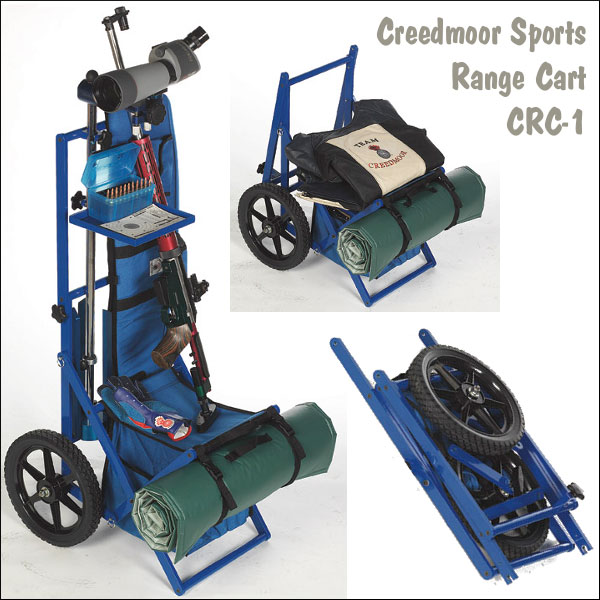
High Power and F-Class shooters have a ton of gear they need to carry out to the firing lines. To do the hauling, you can certainly purchase a factory-made, purpose-built cart that folds up and has all the bells and whistles. The Creedmoor Sports CRC-1 (photo right) is a proven, quality product that works great. You’ll find these used by top shooters at Camp Perry. But the Creedmoor CRC-1 cart costs $499.95.
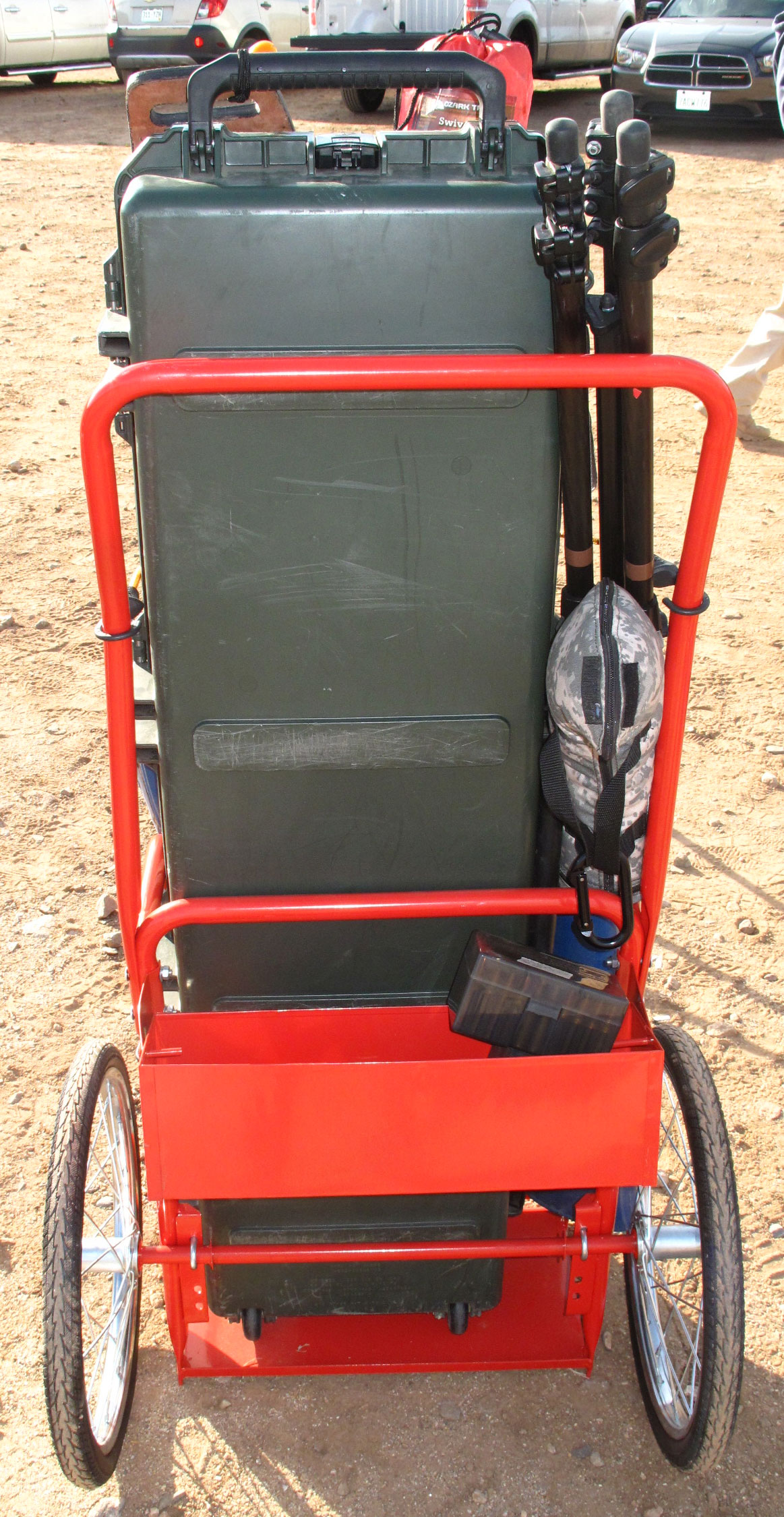
For a fraction of that price ($59.99), plus a few dollars more for do-it-yourself enhancements, you can have a heavy-duty cart that will haul all your gear just fine, though it doesn’t fold up. In the top photo is a Harbor Freight Welding Cart we saw at the Berger Southwest Nationals. This rig is carrying a rifle in hard gun case, bipod, folding chair, shooting mat, tripod, spotting scope, rear sand-bag, and ammo box — that’s a lot of gear!
Check out the Harbor Freight Welding Cart, item #65939. This cart is ON SALE right now for just $59.99. Overall size is 29-1/2″ L x 20″ W x 49″ H, and width between side rails is 18″. The wheels (with tires) are 20 3/4″ in diameter for smooth rolling. Consider that, if you made your own cart from scratch you could easily pay $30.00 or more just for the large-diameter wheels and axle. Do note — this cart has air-filled tires. Be sure to inflate before you go to the Range!
As sold, the Harbor Freight Welding Cart can benefit from upgrades for range use. But with a few bungee cords (and some creativity), the cart can be adapted pretty easily to hauling your gun gear. If you want to enhance the basic cart, it’s easy to add plastic side-panels on the bottom unit, and fit a barrel-holding system on the cross-tube. This ensures rifles and gear won’t flop forward. (A small piece of wood under the bottom panel provides a bit of extra lift that will keep the bottom plate out of the dirt and gravel.)
Berger Ballistician Bryan Litz has been preparing for the King of Two Miles match next week. He’s been out testing a VERY high-BC bullet — Berger’s new prototype .375 caliber 400-grainer. In the photo above, you can see Applied Ballistics intern Mitch Fitzpatrick (flanked by twin LabRadar chronos) shooting at a target set at 2400 yards. Next week, at the King of Two Miles event, the challenge will be even greater — Bryan and his team will be shooting out to roughly 3600 yards.
Bryan reports: “We’ve been preparing for the King of Two Miles match next week. Last Friday we shot 2400 yards at Thunder Valley Precision in Ohio, measuring time of flight and refining the custom drag model for our bullet. We are logging flight times over three seconds and the bullet is still supersonic at 2400 yards! Tomorrow we’re shooting 1800 yards as a final verification before we load up and begin traveling out west.”
OPTICS for Extreme Long Range Bryan is running Nightforce ATACR scopes on his .375 rifles. These ATACRs offer 120 MOA (or 35 Mils) of elevation. That’s impressive, but you still need more “up” for these extreme distances.
Bryan notes: “No scope has enough elevation to dial direct to two miles even with these large-caliber, high-performance rifles. You need some kind of external adjustment, or use a steep rail (e.g. +80 MOA). This works but can sacrifice your ability to zero under 1000 yards.”
This video shows a hit at 2400 yards with the .375-caliber bullet. The target is 8’x8′ square. The targets Bryan will shoot at next week’s King of Two Miles competition will be up to 1200 yards further than this. (Two miles is 3520 yards).
If you’re interested in this kind of Extreme Long Range shooting, consider attending the Applied Ballistics Seminar. The next seminar will be held July 18-19 in Michigan. Bryan says: “We’ll be sharing our experiences and lessons learned in the Two Mile shooting match among many other things we’re working on.” CLICK HERE for Seminar INFO and Registration.
For the International Benchrest Shooters (IBS) by Frank Danisienka
The IBS Executive Board has voted to create two new awards. These awards recognize the significant performance of a select number of shooters. Patches for Score shooting a perfect score of 750, and a perfect target of 250-25X, were designed by the board. To score 250, you need to shoot five (5) tens on each of the five record targets at a particular yardage. To score 750 you need to do that at all THREE yardages — 100, 200, and 300 yards. Certificates accompanying the patches document the commitment to excellence and dedication by these shooters to our sport.
Perfect 750 Multi-Yardage Score — A Rare Occurrence
In the long history of IBS competition only 16 members have shot a perfect score of 750 in one match! That’s 250 at 100 yards, 200 yards, and 300 yards. This very select group of shooters includes: Al Weaver, Rod Morton, Dave Short, Dennis Collins, Ken Livengood, Wayne Shaw, Dick Spencer, Hal Drake, Kim Llewellyn, Shaun Shank, Roy Hunter (2), Dean Breeden, John Bosley, Wayne France, Ricky Read and John Cascarino.
Dean Breeden is one of only 16 Shooters to have recorded a 750 total score in a match.
All Xs — the Perfect Target, 250-25X
The remarkable feat of shooting a perfect 250-25X target has been accomplished 37 times by 26 members. They are: Dennis Collins (2), Ted Parreco, Jeff Buchannan, Carl Baker, James Goody, Joe Enterkin, Rich Whiteash, Dean Breeden (2), David Apple, Al Weaver, Rod Morton, Mike Bigelow, Ken Livengood (3), Roger Avery (2), Joe Pellegrene, Mark Ludinsky (3). Herb Llewellyn (2), Jackie Stogsdill, Hal Drake (2), Johnny Lorick, Ron Collins, Wayne France (2), Shaun Shank, Steve Jaynes, Kevin Donalds Jr., Randy Jarvais (2).
Our sport continues to evolve toward perfection both in the quality of the equipment and the skill of our members and these awards recognize them for their accomplishments.
Amidst the hue and cry (and Congressional sit-ins) calling for more gun control, few observers have actually looked at the facts. Do we, in fact, have an increasing gun crime problem in this nation? Is gun violence spiraling out of control, as the anti-gunners would have you believe?
What do the verified FACTS say (as opposed to the ‘sky is falling’ anti-gun zealots)? Well, the truth of the matter is that major gun-related crime rates have been steadily on the decline for more than a decade. Likewise, most of the major violent crime rates have been declining over the past two decades. What’s more, even accidental gun deaths have been declining despite a huge rise in gun ownership.
So the next time someone tells you that guns must be outlawed to halt a terrible increase in gun crime, you can respond, with 100% certainty, that gun-related crime is going down, not up.
And interestingly, as the supply of handguns has increased, the amount of property crimes has plummeted. Maybe the bad guys are thinking twice before breaking and entering…
Gun Facts™ debunks common myths about gun control. It is intended as a reference guide for journalists, politicians and anyone interested in learning about gun control facts… crime, and the Second Amendment. The free Gun Facts e-book provides over 100 pages of indexed information.
Credit Boyd Allen for finding this first chart. We welcome reader submissions.


 I had been following the progress of Alex and Matt Findlay with Annealing Made Perfect for almost three years as they pursued making the best annealing product for the private reloading market. The short explanation of why we anneal brass is to return the brass to a softer and consistent hardness after the brass has work-hardened from repetitive firing and sizing. As the President/co-owner of Sinclair International for over 21 years I saw a lot of products come through our doors that annealed brass but these products always seemed like they had very little supportive data and research behind them. Most of them were based on some type of torch system. The New Zealand-based father/son team of Alex and Matt spent these past three years addressing the challenging questions about annealing:





 How well can the 6mm Dasher perform at 1000 yards when conditions are good, and the shooter is riding a hot streak? Well here’s a shot-by-shot record of Scott Nix’s 4.554″ 10-shot group shot at Missoula, Montana at the Northwest 1000-yard Championship a few years back. All 10 shots were centered for a 100-6X score. That’s about as good as it gets. If Scott had stopped after 5 shots, his group would have been under 3 inches!
 In our


 High Power and F-Class shooters have a ton of gear they need to carry out to the firing lines. To do the hauling, you can certainly purchase a factory-made, purpose-built cart that folds up and has all the bells and whistles. The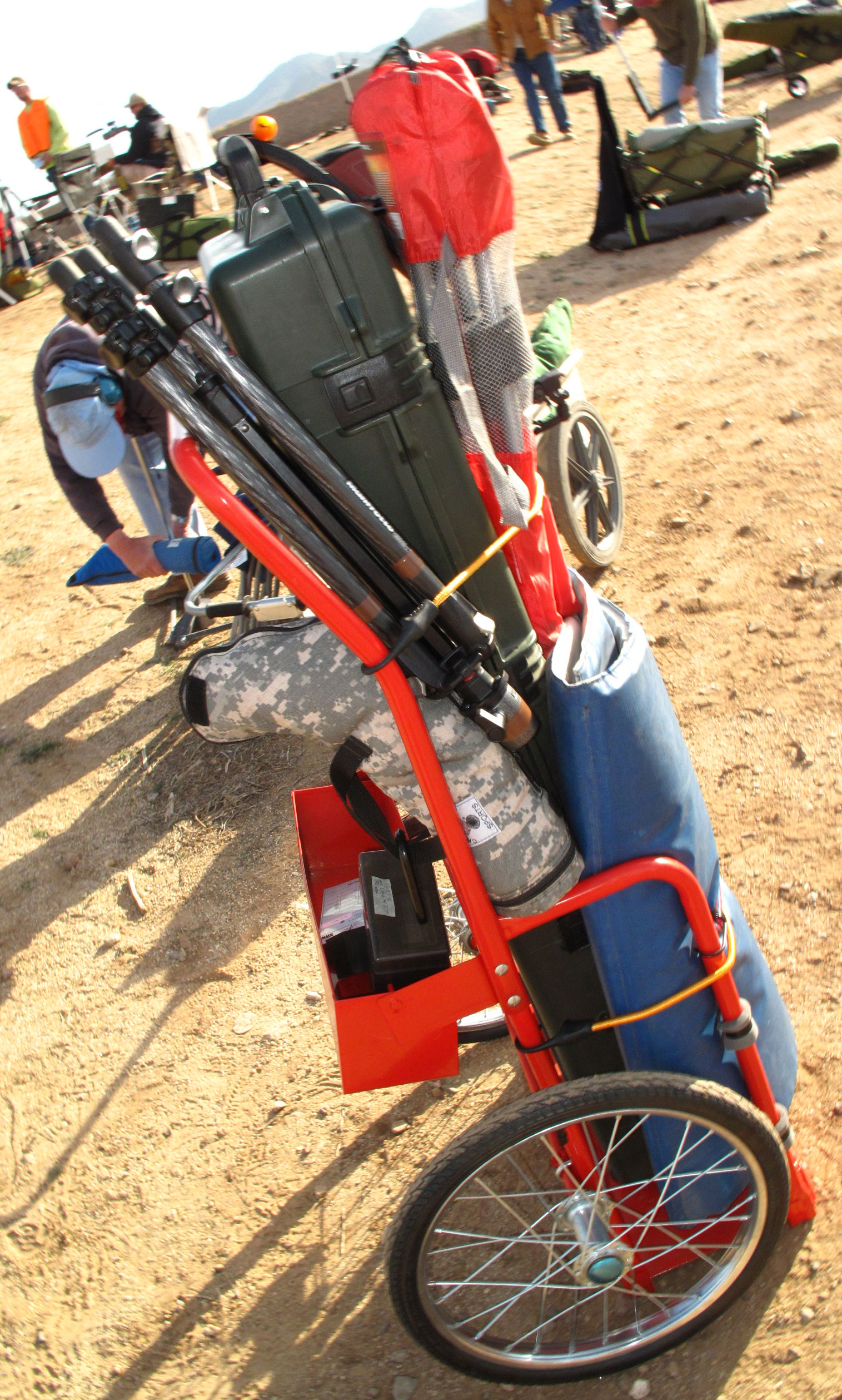


 Berger Ballistician Bryan Litz has been preparing for the
  Bryan is running


