The relatively new Ruger Precision Rimfire has generated considerable interest because it is an affordable, chassis-style platform well-suited for tactical/practical cross training. It also offers some cool features including a +30 MOA scope rail and adjustable bolt throw length (from 1.5″ to ~3.0″). The adjustable bolt lets you switch to a longer, centerfire-style bolt “run” for consistent cross-training. That’s clever.
Introduced at the beginning of 2018, the Ruger Precision Rimfire has now been in the hands of multiple reviewers who have tested the little rifle for accuracy, reliability, and functionality. This smallbore chassis rifle has been tested with a variety of ammo and in both bench and “tactical” style sessions. Here are three videos that put the Ruger Precision Rifle though its paces.
VIDEO ONE — Impressive Accuracy Suppressed from Bipod at 130m
In this video, a UK-based shooter tests the Ruger Precision Rimfire with a suppressor. He came away mighty impressed with the rig’s accuracy, stating: “It is a flippin’ laser. Oh my god I’m impressed with that — five minutes in and it’s grouping literally like that [makes small “OK” sign with thumb and index] on the steel at 130m”. (Time-mark 2:40+)
VIDEO TWO — 22 Plinkster Explains Gun Features
In this video, popular YouTube gun tester 22 Plinkster explains the Ruger Precision Rimfire’s features in detail. Then he puts an early production example through its paces. He gets good accuracy from a bench, but also tries some off-hand shooting, demonstrating the rifle’s suitability for tactical cross-training.
With Federal Gold Medal Ultra-Match, 22 Plinkster produced a 5-shot group well under half-inch (with first three overlapped and the last two in same hole) at 50 yards. Note 22 Plinkster’s bench set-up. He uses a second rabbit-eared sandbag in the FRONT. This “field expedient” solution is clever. The front bag’s ears mate well with the rifle’s tubular fore-arm, adding considerable stability. And the front sand-bag helpd absorb vibration, always a good thing. For a varminter who doesn’t want to carry a bulky front rest, this is worth trying. The bag in front functions like a compact version of the large, heavy Bulls Bag.
VIDEO Three — Five Ammo Types and Front Rest
Here is detailed review from Down-Under that was positive. From bench, with Caldwell front rest, five different ammo types were tested: SK Rifle Match, SK Standard Plus, Eley Match, Eley Edge, and CCI High Velocity. The tester reports: “I was able to get 0.9″ 10-shot groups at 50 yards and 1.5″ 10-shot groups at 100 yards using Eley Edge. Overall the rifle is good but I don’t honestly think I achieved any greater accuracy over my standard Ruger American Rimfire Rifle.” We think that’s a fair assessment. This is an accurate rifle, but other affordable bolt actions can probably rival the accuracy, so the buying decision should be based on the rifle’s other features — such as the chassis.
For Ruger Precision Rifle owners, this .22 LR offers ergonomics just like their centerfire rig. This PRS-style .22 LR rig has some very interesting features, including adjustable bolt throw that lets shooters change from a rimfire 1.5″ bolt throw to a short-action centerfire 3″ bolt throw, reducing the chance of short-stroking your bolt in competition. The Ruger Marksman trigger adjusts from 2.25 to 5.0 pounds.
RUGER PRECISION RIMFIRE Important Features:
Quick-Fit Stock with adjustable cheekpiece and adjustable LOP
18″ barrel, pre-threaded for brakes and Silent-SR® suppressor
Barrel can be removed and replaced easily with AR-style tools
Picatinny scope rail with +30 MOA built-in elevation
Front 15″ free-float M-Lok handguard
Adjustable Trigger 2.25 to 5 pounds
Accepts all Ruger 10/22 magazines
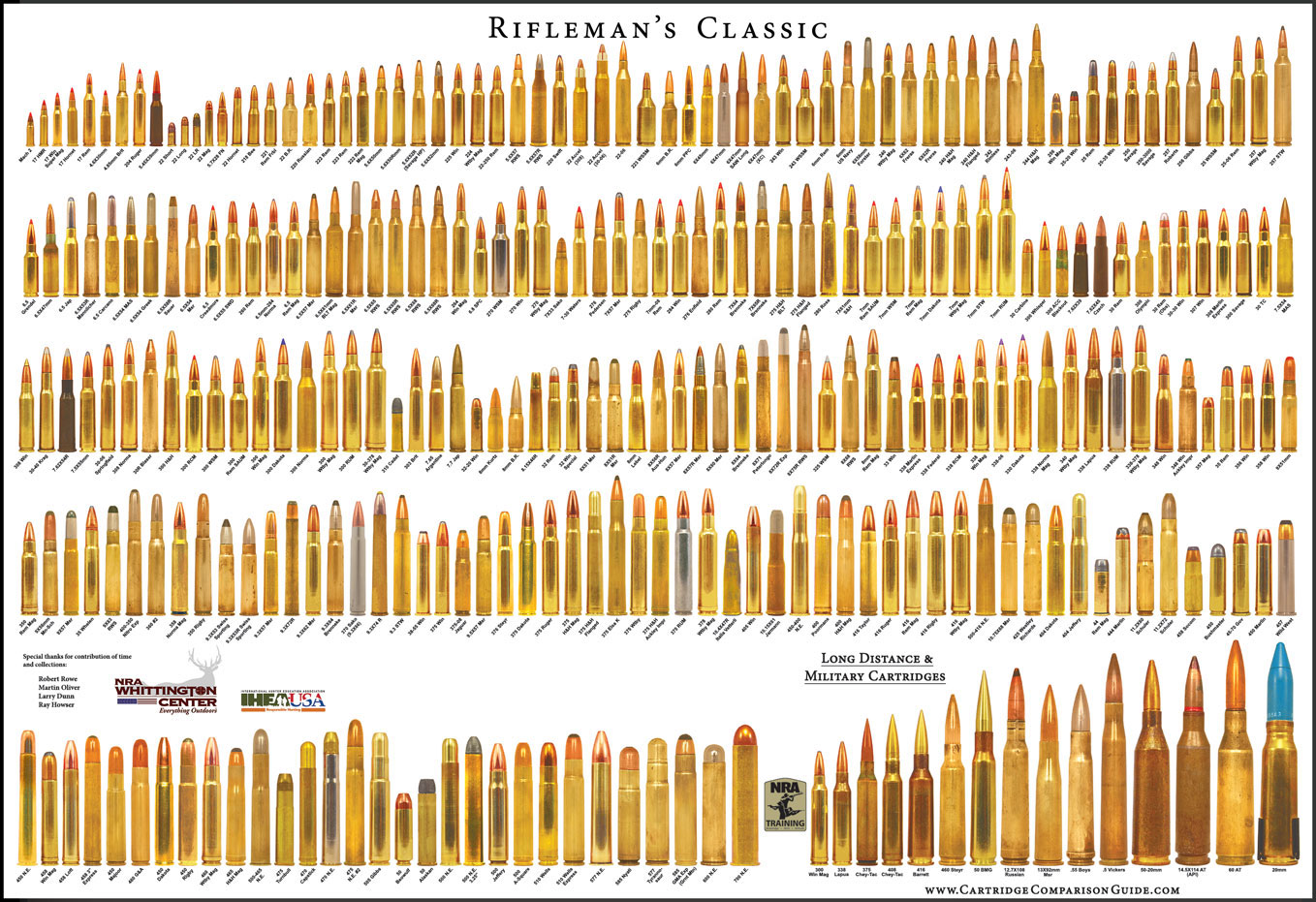
Need something for the walls of your “man cave” or reloading room? Looking for a great Xmas gift for one of your shooting buddies? The creators of the Cartridge Comparison Guide offer a collection of wall posters showing ammunition types from 17 caliber rimfire cartridges all the way up to giant 35mm military rounds. ChamberIt.com offers 15 different large wall posters that display a huge variety of cartridge types.
For example, the Rifleman’s Classic Poster (below), a full 38 inches wide and 27 inches tall, is the most comprehensive. This $17.99 poster displays over 300 rifle cartridge types at true size (within 4/1000 of an inch). Cartridges shown range from .17 caliber all the way up to the big boomers (including some cannon shells). The Rifleman’s Classic Poster includes nearly all American Standardized Rifle Cartridges and many European rifle cartridges.
Rifleman’s Classic Poster Click to view large size poster.
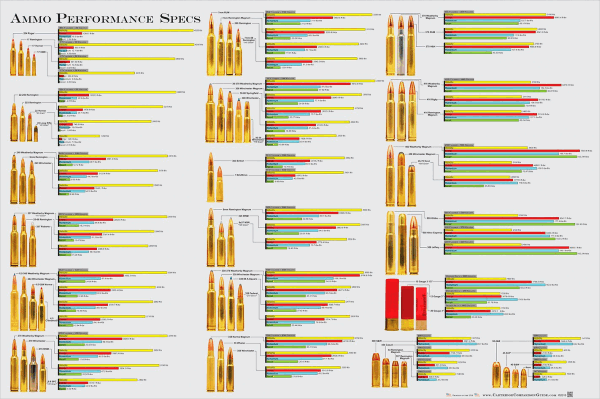
Ammunition Performance Specifications Poster
There is also an interesting Ammo Performance Specs poster. This shows dozens of popular hunting cartridges with the velocity, energy, momentum and recoil for each cartridge displayed in a bar graph.
This shows the actual size of the Ammo Performance Poster as displayed on a wall.
Christmas is coming soon. Books have always been popular holiday gifts. If you haven’t completed your holiday shopping, here are some recommended titles that should please the serious shooters and firearms enthusiasts on your shopping list. For shooting clubs, books also make great end-of-season member awards. Most of us would rather have a useful book than one more piece of wood to toss in a box in the closet. Check out these twelve titles — for yourself or your shooting buddies.
Here Are TWELVE BOOKS Recommended for Serious Shooters:
If you’re a serious long-range shooter, consider adding this book to your library. Relying on extensive ballistics testing, Modern Advancements Volume II is a great successor to Volume I that contains some fascinating research results. UK gun writer Laurie Holland notes: “Volume II of the Modern Advancements series is as fascinating as Volume I and if anything even more valuable given a series of ‘mythbusters’ tests including: case fill-ratio, primer flash-hole uniforming, neck tension, annealing, and much more. The work also addresses that perennial discussion of a bullet ‘going to sleep’ and shooting smaller groups (in MOA) at longer distances than 100 yards.” The amount of testing done for this Volume II work, with a staggering amount of rounds sent downrange, makes this book unique among shooting resources. There is a ton of “hard science” in this book — not just opinions.
Glen Zediker’s latest book, Top-Grade Ammo, is a great resource for all hand-loaders — beginners through advanced. This 314-page guide covers every aspect of the reloading process — component sorting, priming, sizing, bullet seating and more. With 430 photos, Top-Grade Ammo is a richly-illustrated, step-by-step guide to producing high-quality handloads. Unlike many reloading books, Top-Grade Ammo is current and up-to-date, so it covers modern practices and the latest precision reloading tools. While Zediker focuses on producing match-grade ammo for competition, this book will also help novice reloaders on a budget. This book features a special “lay-flat” binding so it’s easy to use as a benchtop reference. To view Chapter List and sample pages visit ZedikerPublishing.com.
Thinking of getting started in the Practical/Tactical shooting game? Looking for ways to be more stable when shooting from unconventional positions? Then you may want to read Marcus Blanchard’s Practical Shooter’s Guide (A How-To Approach for Unconventional Firing Positions and Training). Unlike almost every “how to shoot” book on the market, Blanchard’s work focuses on the shooting skills and positions you need to succeed in PRS matches and similar tactical competitions. Blanchard provides clear advice on shooting from barricades, from roof-tops, from steep angles. Blanchard says you need to train for these types of challenges: “I believe the largest factor in the improvement of the average shooter isn’t necessarily the gear; it’s the way the shooter approaches obstacles and how they properly train for them.”
Nancy Tompkins is one of the greatest long-range shooters in American history. She has won five National Long-range Championships. Tompkins’ treatise is a must-read for serious Palma, F-Class, and High Power shooters. The revised Second edition includes F-Class equipment and techniques, and newly updated information. Color pictures. Topics include Mental & Physical training, Reading Wind & Mirage Shooting Fundamentals, International Competition, and Loading for Long Range. Nancy Tompkins is a 4-time winner of the National Long Range Championships, and has won countless other major events. Nancy has been on six Palma Teams (as both a shooter and a coach).
Ryan Cleckner is noted for his ability to explain complex topics in an easy-to-comprehend manner. Now Cleckner has authored a book, the Long Range Shooting Handbook, which expands on the topics covered in Cleckner’s popular NSSF video series. The Long Range Shooting Handbook is divided into three main categories: What It Is/How It Works, Fundamentals, and How to Use It. “What It Is/How It Works” covers equipment, terminology, and basic principles. “Fundamentals” covers the theory of long range shooting. “How to Use It” gives practical advice on implementing what you’ve learned, so you can progress as a skilled, long range shooter. You can view Sample Chapters from Ryan’s Book on Amazon.com.
Tony Boyer, the most successful shooter in the history of short-range benchrest competition, shares many of his match-winning tips in this 323-page book. The book covers all aspect of the benchrest discipline: loading, windflags, rest set-up, addressing the rifle, and match strategies. This is a high-quality publication, filled with valuable insights. Every serious benchrest shooter should read Tony’s book. Boyer has dominated registered benchrest in a fashion that will never be duplicated, having amassed 142 U.S. Benchrest Hall of Fame points. The next closest shooter, Allie Euber, has 47 Hall of Fame points. This handsome, full-color book is 323 pages long, with color photos or color illustrations on nearly every page.
This book should be on the shelf of every short-range benchrest shooter. (Shooters in other disciplines will find the book helpful as well.) Butch Lambert says Mike’s book is “far and away the best Benchrest book written. Very comprehensive, it touches on every aspect of our game.” Mike’s 368-page book is dedicated to getting the most from modern rifle accuracy equipment with an emphasis on shooting 100-200-300 yard group benchrest tournaments. This book covers the most popular hardware plus new equipment offerings are covered, including external mount scopes, actions, triggers, stocks, wind flags, and more. Also covered are rifle handling techniques, note taking, tuning, bullet selection, goals, and match strategies. Mike provides many tips that will help active competitors update their own competitive program.
This book by 11-time National High Power Champion David Tubb focuses on position shooting and High Power disciplines. Section One covers fundamentals: position points, natural point of aim, breathing, triggering mechanics and follow-through, sling selection and use, getting started, getting better, avoiding obstacles. Section Two covers mechanics of offhand, sitting, and prone positions. Section Three covers shooting skills, including wind reading and mental preparation. Section Four covers the technical side of shooting, with extensive disuctions of rifle design, load development, reloading barrel maintenance, and rifle fitting. We consider this book a “must-read” for any sling shooter, and there is plenty of good advice for F-Class shooters too.
Rifle Accuracy Facts by Harold R. Vaughn, (Softcover and Hardcover, Used Price Varies)
Decades after it was written, Vaughn’s work remains a seminal treatise on accuracy. Vaughn was a serious scientist, working for the Sandia National Laboratories. Many “gun writers” toss out hunches about rifle accuracy. Vaughn, by contrast, did serious empirical testing and statistical analysis. Vaughn wondered why some guns shot well while seemingly identical rifles did not. Rifle Accuracy Facts covers a wide variety of topics, including internal ballistics, chamber design, barrel vibration, bullet imbalance, external ballistics, scope design and more. Writer Boyd Allen notes: “If you are serious about precision shooting, Vaughn’s book belongs in your library.”
Many of our Forum members have recommended The Wind Book for Rifle Shooters by Linda Miller and Keith Cunningham. This 146-page book, first published in 2007, is a very informative resource. But you don’t have to take our word for it. If you click this link, you can read book excerpts on Amazon.com. This lets you preview the first few chapters, and see some illustrations. Other books cover wind reading in a broader discussion of ballistics or long-range shooting. But the Miller & Cunningham book is ALL about wind reading from cover to cover, and that is its strength. The book focuses on real world skills that can help you accurately gauge wind angle, wind velocity, and wind cycles. NOTE: The new Hardback Edition will release in February 2019, but you can pre-order now.
Bullseye Mind (Mental Toughness for Sport Shooting) by Dr. Raymond Prior, $14.00 (Softcover).
Having a Bullseye Mind means thinking in ways that create confidence and consistency, even under pressure. A “must-read” for competitive shooters, Bullseye Mind is a mental training book written specifically for the shooting sports. The book is well-organized, with handy highlighted lists and key “talking points”. Each chapter concludes with examples from a world-class shooters such as: Matt Emmons, 2004 Olympic Gold Medalist; Vincent Hancock, 2-time Olympic Gold Medalist; Jamie Corkish, 2012 Olympic Gold Medalist; Petra Zublasing, 2014 World Champion/ISSF Shooter of the Year; and Nicco Campriani, 2012 Olympic Gold Medalist, 2010 World Champion. This book has earned rave reviews from competitive shooters who found it really helped their “Mental Game”. One recent purchaser states: “This book is as though you had a coach in your back pocket…”
Cartridges of the World (15th Edition, 2016), belongs in every serious gun guy’s library. This massive 680-page reference contains illustrations and basic load data for over 1500 cartridges. If you load for a wide variety of cartridges, or are a cartridge collector, this book is a “must-have” resource. The latest edition includes 50 new cartridges and boasts 1500+ photos. The 15th Edition of Cartridges of the World includes cartridge specs, plus tech articles on Cartridge identification, SAAMI guidelines, wildcatting, and new cartridge design trends. In scope and level of detail, Cartridges of the World is the most complete cartridge reference guide in print. Cartridges of the World now includes a 64-page full-color section with feature articles.
The National Rifle League (NRL) conducts tactical, multi-stage field matches around the country. Along with the Precision Rifle Series (PRS), NRL matches attract many of the top tactical/practical shooters in the country. In addition, the NRL offers serious prizes donated by major sponsors such as Nikon, Kelbly’s, Howa, Benchmark Barrels, and Manners Composite Stocks,
The NRL recently announced its Official 2019 Match Schedule. This includes 18 national level 2-day matches across the nation, culminating with the NRL Championship match. It features NRL representatives in locations from past seasons such as Arizona, Nebraska, Idaho, Oklahoma, Utah, New Mexico, Colorado, Washington, and Wyoming. The schedule also announces new locations in states such as Texas, South Dakota, Iowa, and Kentucky. The 2019 NRL Season is set to kick-off on February 16th, 2019 in Arizona. Here is the list of events, with date, location, and match directors.
National Rifle League (NRL), is a 501c3 non-profit organization dedicated to the growth and education of precision rifle shooting. In 2019 the NRL looks to continue the League’s growth and success. “The NRL Executive Board of Directors is honored to have these exceptional match directors as part of the 2019 season who are committed to bringing quality events and help lead the way into the future of the precision rifle community,” stated Travis Ishida, Founder of the NRL.
For more information and the entire 2018 season schedule, visit www.nationalrifleleague.org. 2019 sponsorship opportunities are available for this new season.
Location Date Match Director / State Representative
1. Axisworks Long-Range Challenge – Wikieup, Arizona Feb. 16 – 17, 2019 Christ Tressler, Rusty Ulmer
2. Rifles Only – Kingsville, Texas Feb. 22 – 23, 2019 Jacob Bynum
3. Big Horn Steel Classic – Omaha, Nebraska March 9 – 10, 2019 Chaz Macrander
4. PRSID Gem State Stand Off – Vale, Oregon March 23 – 24, 2019 Nate Lauerman, Seth Howard
5. Silent Night – Ninnekah, Oklahoma April 6 – 7, 2019 Justin Watts
6. South Dakota Steel Classic – Orient, South Dakota April 27 – 28, 2019 Michael Kane
7. JC Steel Targets Challenge – Ritzville, Washington May 4 – 5, 2019 Jake Vibbert, Sean Johnson
8. Prairie Rock Shoot Out – Broadwater, Nebraska May 18 – 19, 2019 Lee Anderson
9. The Vortex Rampage – Mt. Auburn, Iowa June 1 – 2, 2019 Jim See
10. Dog Valley Precision Challenge – Nephi, Utah June 8 – 9, 2019 Cole Quarnberg
11. New Mexico Smith Ranch Shootout – Bloomfield, NM June 22 – 23, 2019 Dusty Brixner, Scotty Freidline
12. The Revolution at Rockcastle – Park City, Kentucky June 29 – 30, 2019 Adam Vaught
13. Mile High Shootout – Craig, Colorado July 13 – 14, 2019 Robert Quigley
14. Heatstroke Open – Camargo, Oklahoma July 20 – 21, 2019 Matt Clem, B.J. Bailey
15. Rock Lake NRL Steel Challenge – Cheney, Washington Aug. 31-Sept. 1, 2019 Doug Glorfield
16. Monster Lake Mayhem – Cody, Wyoming September 27 – 28, 2019 Phillip Velayo, Caylen Wojcik
17. West Coast Showdown – Pala, California October 19 – 20, 2019 Jorge Ortiz, Scott Satterlee
18. 2019 NRL Championship – Navasota, Texas December 6 – 8, 2019 Dave Ferguson, Prentice Wink
Women are arming themselves — millions of females now have carry permits. What factors should women consider when choosing a handgun for self-defense? What are good choices for a lady’s defensive handgun, suitable for concealed carry? Is a self-loading pistol better than a revolver?
We thought it was best for to hear the ladies’ own perspectives on these questions. After all they are the ones who will be carrying the firearm in a purse or on their person. In this article we include three videos focusing on handgun options for females. The videos cover six key factors: function, size, weight, ergonomics, reliability, and concealability.
Classic Swiss Precision — the Sig P239
The single-stack Sig P239 is an ultra-reliable, compact pistol with a grip suitable for smaller female hands. Weighing 25 oz. in 9mm, it is slightly heavier than polymer-framed handguns, but that may be a good thing. During my handgun training days, this Editor found most women shot the Sig P239 better than Glocks, with more control over recoil. This is a hammer-fired pistol with decocker but no separate safety. There are many other good handgun options for concealed carry — some smaller, thinner and lighter, but the Sig P239 provides a good benchmark for reliability and accuracy. Shown is the .40 S&W model. We prefer the 9mm Luger version. Photo Creative Commons BY-SA 3.0.
Choosing a Self-Defense Handgun — Ladies Explain the Options
Not Just a Guy Thing — 23% of Gun Owners are Women
Here’s an interesting statistic — according to an NSSF survey, the percentage of gun owners who are female has increased dramatically since 2005. Back in 2005, just 13% of U.S. gun owners were women. By 2012 that number had risen to 23% — a huge increase in less than a decade.
The vast majority of first-time female gun buyers acquire a handgun for defensive purposes. However, the statistics also show that many new female gun owners are also getting involved in sport shooting and/or competitive shooting.
NRA News host Cam Edwards has interviewed Celia Bigelow, who has written about the rise of gun ownership among ladies on the Townhall.com website. Tune in to the interview on Cam Edwards’ YouTube Channel. CLICK HERE for interview.
Progressive reloading presses offer shooters speed and efficiency in producing custom-tailored rifle and pistol ammunition. However, there is a wide choice of Progressive Presses and a bewildering array of options to consider. In this video, the 6.5 Guys and UltimateReloader.com’s Gavin Gear provide an overview of the leading Progressive Presses on the market along with key considerations for precision rifle shooters. If you are considering getting a Progessive for rifle ammo reloading, you should watch this informative, 25-minute video.
10 Tips for Reloading Precision Rifle Ammo on a Progressive Press:
1. Make sure the brass is very clean. Don’t mix old range pick-up brass with newer brass.
2. Apply a thin, spray lube to all cases before the sizing/loading cycle.
3. Consider priming your brass separately (with a hand or bench tool) before the operation. Then inspect the primers before loading powder and bullets.
4. Always wear eye protection when loading with the Progressive, particularly if you are priming cases.
5. With tape, mark the powder measure/dropper with the powder type and charge weight.
6. Cycle a few cases, sizing and adding powder but NOT seating bullets. Weigh the powder charges to ensure the powder measure is dispensing the correct charge. Sometimes this will change a couple tenths as it “settles down” after the first few charges.
7. Check the brass for shoulder bump and bullet seating depth carefully for the first few rounds, then check again periodically.
8. Try to maintain a steady pace and operate the handle the same way every time.
9. Visually inspect the powder charge in each case (before bullet seating), and use a lock-out die if your Progressive Press has enough stations.
10. Never, ever mix pistol and rifle powders! If you have previously loaded pistol ammo with your Progressive, make sure ALL the powder (every flake and kernel) is removed from all components of the powder-dropping system before you add rifle powder.
Loading Pistol Ammo on a Dillon
The .45 ACP is probably our favorite centerfire pistol cartridge. In this video, Gavin Gear shows how to load this popular round on a Dillon 550B Progressive Press:
Visit these sites for more Reloading and Precision Shooting Videos:
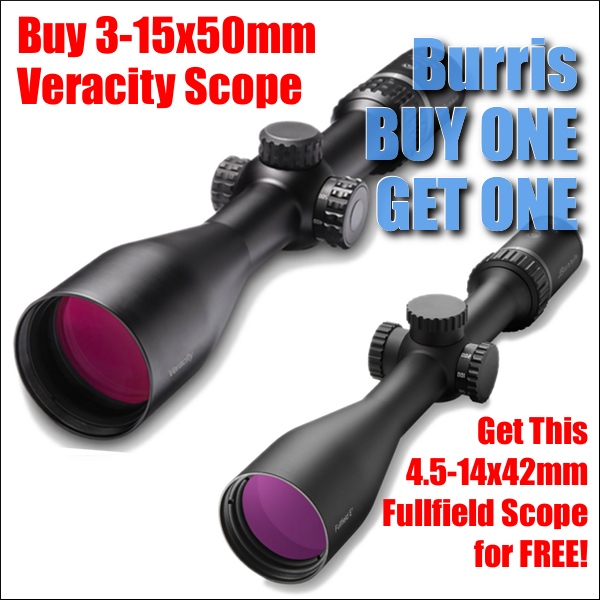
If you buy a Burris 3-15x50mm Veracity scope this month, you will get a 4.5-14x50mm Burris Fullfield Scope for FREE — a $379.00 Value. The Front Focal Plane Veracity is Burris’s top-of-the-line hunting scope featuring 5x zoom, wide field-of-view, zero stop, and Burris Forever warranty. Those who purchase a 3-15x50mm Veracity by December 31, 2018 will receive a free Fullfield E1 4.5-14x42mm Long Range MOA reticle scope, a $379 value. The Veracity/Fullfield E1 offer is available in a special bundle package at participating Burris retailers.
The Veracity is a good FFP scope that PRS competitors and hunters should consider. The Veracity line earned both the Editors Choice and Great Buy awards in Outdoor Life Magazine’s 2016 Optics Test. These Veracity scopes also feature excellent Ballistic Plex reticles that feature vertical hold-over hash marks plus “Christmas Tree”-type windage holds.
$100 Rebate on Burris Eliminator III Laser Rangefinder Scope
The Burris Eliminator III is an advanced electro-optical device that combines magnified optics with a built-in laser rangefinder and micro-processor. With the push of a button the Eliminator III ranges your target. Then the micro-processor “brain” instantly calculates the required holdover for that distance, and displays a red dot on the reticle. Simply put the red dot on the center of your target and pull the trigger.
Now through December 31, 2018 you can save $100.00 on the purchase of the 4-16x50mm Burris Eliminator III LaserScope. That’s a significant savings on a proven product. We think this LaserScope is particularly handy for varmint hunters working a large prairie dog field, with critters near and far, at ranges from 100 out to 800 yards. With the Eliminator, you can range a P-Dog mound instantly, then just place the red dot on the animal and you’re good. No fussing with drop charts or scope clicks.
How To Get $100 Rebate
Purchase a Burris Eliminator III 4-16x50mm LaserScope (Item # 200116 or 200119) and get a $100 Rebate. (Other models do not qualify). To receive the Burris $100 Mail-in Rebate, you must submit three things: 1) Proof of Purchase; 2) Original UPC Code from product box; and 3) Mail-In Rebate Form.
Send All Items HERE:
$100 Eliminator Rebate
Dept #BS18-5028
P.O. Box 472
Scottsdale, AZ 85252-0472
This article is part of Sinclair Int’l Step-By-Step Reloading Series. Most of the products mentioned in this article are sold through Brownells.com.
by Roy Hill, Brownells/Sinclair Copywriter
Making your own precision handloads is a meticulous journey with many steps, many important matters to consider, and many sets of measurements to calculate. For those who pursue the perfect group, the highest score, the really long accurate shot, the rewards more than outweigh the effort. Choosing the right cases, deburring the flash holes, making the primer pockets uniform, trimming the cases, and lubricating them are all familiar – and critical – steps along the journey. And now that your brass preparation is complete, you are at last ready to start running the cases through your press and fill them with primers, powder, and bullets. The very first die the brass encounters is the sizing die. You insert the case, work the press’s lever to return the case to its correct pre-fired dimensions – and the journey continues.
There are three types of sizing dies to think about: neck, full-length, and small base. All three have specific benefits and potential drawbacks, and you should choose the type of die you use by thinking very carefully about what kind of shooting you plan to do with your handloads. No matter which type you select, most sizing dies will also punch out the old spent primer with some sort of decapper assembly that uses a hardened steel rod. Many types of sizing dies use an expander ball inside the die to make sure the neck of the case will accommodate a bullet after being sized. With some size dies, the expanders are easily removable and interchangeable, letting you get exactly the neck tension you want. If you are reloading for pistol cartridges, carbide sizing dies allow you to quickly resize without applying any lube to the case. But rifle cases always need lube.
Neck-Sizing Dies Neck-sizing dies resize only the neck of the case. The benefit of sizing only the neck is that the brass is “worked” very little, letting you reuse the same cases many times over. Also, cases that have already been fired in your rifle are perfectly fireformed to fit that rifle’s chamber, which can help accuracy. However, neck-sized cases will fit only the specific rifle they were originally fired in, and may still require a little extra force to chamber or extract.
Sinclair recommends that neck-sized-only cartridges should not be used any in other rifle besides the one they were originally fired from [unless they are also FL-sized], or in any action other than a bolt-action. Neck-sized-only rounds are great for the target range or the benchrest but should not be used in critical situations like military or police operations, or hunting. And if you fire them enough times, neck-sized cases will still need to be full-length sized periodically for you to keep using them.
Full-Length Sizing Dies Full-length sizing dies do exactly what their name says: resize the full length of the case, not just the neck. Full-length sizing helps create handloads that will function in any rifle, not just the one from which the cases were originally fired. The potential downside of full-length sizing is that it may shorten case life because it works the brass more than neck sizing. But it’s possible to “tune” today’s full-length sizing dies so they barely work the brass at all, as this article by Sinclair Reloading Tech Ron Dague shows.
Illustration Shows How a Full-Length Sizing Die Works
Another way to reap the benefits of full-length sizing is to use Redding’s full-length bushing dies, which size the full length of the case but use a system of interchangeable bushings that enable you give the case neck the bare minimum of resizing needed. To see how finely adjustable bushing dies are, and how they resize the case while fully supported, CLICK HERE for Video. The neck bushing helps you precisely control the neck tension to help increase the consistency and accuracy of your handloads.
Small Base Dies
A Small Base Die is just another type of full-length sizing die, but one that is typically used when reloading for semi-automatic rifles, like the AR-15, M14, or AR-style .308 rifles. (It may also work well for bolt guns that need extra sizing on the lower section of the case.) A small base die works exactly like a full-length sizing die, only it compresses the brass just a bit more, usually about .001″ more, and may even push the case shoulder back just a hair. Small base dies give that extra bit of compression to the brass to help make sure the case will properly extract from a semi-automatic firearm. The upside is that you get precision handloads that should work flawlessly in your semi-automatic. The downside is case life is really shortened, especially compared to brass used only in one bolt-action rifle, because the brass is worked more.
Shoulder Bump Gauges
A handy tool for setting up your full-length sizing dies as close as possible to your rifle’s chamber is the Sinclair bump gauge. The bump gauge lets you resize the case as little as possible, to extend case life and help your handloads fit your rifle almost like a neck-sized only die. You use deprimed cases fired in your rifle and bump gauge inserts to help you set up the die so it resizes the case only about .001″ to .004″, depending on what type of rifle you’re shooting.
Video shows how to use a shoulder bump gauge to set up your full-length dies
Article Find by EdLongrange. We welcome reader submissions
Shooting Industry Magazine just released its December 2018 issue, which you can read for free online. This December issue includes a SHOT Show Preview, but more importantly, there is also a 24-page New Product Showcase. Here you can see a variety of new products, including those from some of our favorite manufacturers: McMillan (MC3), Leupold, Warne, Vault Pro, Champion and more…
Are you feelin’ lucky? Well here’s your chance to win. For 12 Days in December (Dec. 5-16), Powder Valley is giving away a total of $15,000 worth of products from big name suppliers. That averages well over $1,000 worth of product prizes every day. This is top-of-the-line stuff, including Powder from Accurate, Alliant, Hodgdon, IMR, Ramshot, and Shooters’ World, Bullets from Berry’s, Nosler, Sierra, Speer, and Zero, Ammunition from Hornady, Nosler, and Zero, plus Reloading Hardware from Hornady. Each day there will be a new set of prizes. Not only will there be huge giveaways we have added something new this year! With the support of some great companies we will be offering discounts and free hazmats on the days these companies are represented. Keep a watchful eye — this is big stuff!
It’s easy to qualify to win one of the Daily Giveaway prize packages. Simply visit Powder Valley’s Facebook Page, and make a comment on the featured Daily Giveaway Post. You don’t have to fill out any forms, but you must have a Facebook account so you can comment. Each day the folks at Powder Valley will select winners from among the visitors who commented. In days ahead there can be multiple daily winners. And on Day 12 there will be very special prize give-aways including Powder Valley Gift certificates. NOTE: You can enter multiple times by commenting on multiple days, but sorry, if you win, you are no longer eligible.
Powder Valley Daily Giveaway — New Prizes Every Day
Powder Valley’s 12 Days of Christmas promo kicks off Wednesday, December 5th, 2018. To enter, you must visit the Powder Valley Facebook Page. Once there, scroll down to find the Giveaway of the Day. You need to comment on that post to be entered. Winners will be selected by lottery from those who comment. Each successive day, through December 16th, there will be another product giveaway post. Also on some of the 12 days we will have additional discounts and free hazmats so follow closely.
Here are some of Last Year’s Prizes… Stay Tuned for the 2018 Giveaways!
To be entered in this Powder Valley Contest, you need to go to the Powder Valley Facebook Page and post a Facebook Comment for the Daily Prize story. NOTE: You MUST post your comment on Powder Valley’s Facebook Site, NOT HERE. And you need to comment each day to be entered in that particular day’s contest. To have repeat chances to win you need to comment on multiple days. Got it?