Anschutz .22 LR rifle set up for F-Class competition. Photo courtesy Sportschieben Blog.
Here’s a relatively new discipline we think will grow in years ahead — Smallbore F-Class with .22 LR rimfire rifles. Rest-supported prone rimfire matches have been held around the world for quite some time, but only a few years ago was the discipline officially codified in the NRA Smallbore Rulebook. And the first-ever Smallbore F-Class National Championship was held in July 2018 in conjunction with the Smallbore Nationals at Camp Wa-Ke’-De in Bristol, Indiana. The Nationals involved multiple days of prone shooting at 50 meters and 100 yards.*
Jim Murphy, a respected centerfire shooter and coach, became America’s very first Smallbore F-Class National Champion, shooting an impressive 2374-146X score in 2018. Fourteen points behind, but with the same X-Count, was runner-up David Pessall (2360-146X). Jess Huehn finished third with 2358-137X.
Competitors could either shoot F-TR style with a bipod, or use a front rest. In this photo from the inaugural NRA National Championship you can see a shooter with SEB Coaxial Rest at top, with a competitor using a low-profile bipod at bottom. Note the extended handle used to adjust bipod elevation. This is not a coaxial joystick, but rather a long handle attached to the mariner wheel.
Smallbore F-Class — The Future Looks Bright
With the high cost of centerfire ammunition, and the limited number of 1000-yard (or even 600-yard) ranges, we can envision that Rimfire F-Class will become a popular event at ranges across the country. Clubs don’t even need benches — just a 100-yard target bay and flat ground for the shooters. You can start with an inexpensive rimfire rig and Harris bipod. Then work up from there. Here is a custom rimfire F-TR style rig that belongs to F-Class ace and past centerfire F-TR National Champion James Crofts.
And Vudoo Gun Works has a new .22 LR Single Shot Target Rifle that should prove ideal for rimfire F-Class. It features the new V22-S single-shot action, McMillan stock, and Flavio Fare BR-VS trigger.
Smallbore F-Class Course of Fire
The Smallbore F-Class Nationals was completed on paper targets at 50 yards and 100 yards. According to Shooting Sports USA: “The tournament ran during the any sight and metric phases of the 2018 NRA National Smallbore Rifle Championships, featuring a daily course of fire which mirrored the sling shooters, 40 shots at 50 meters on the A-50 target, a Metric Dewar, followed by 40 shots at 100 yards on the A-33 target. Although the international targets were shot throughout, the first two days were titled ‘conventional’ and the last two ‘metric’.”
The specifics of the match such as rifle requirements, rests, and sights may be found in the Provisional Smallbore Rifle F-Class Rules (Section 23), found on page 65 of the current NRA Smallbore Rifle rulebook. Any rules not covered in Section 23 will [reference] the normal rules of Sections 1 through 22.
* All ‘short range’ F-Class was shot at 50 meters on the A-50, the 50 meter International Shooting Sports Federation (ISSF) target. All ‘long range’ stages were shot at 100 yards using the NRA A-33 target, the ISSF 300-meter target reduced to 100 yards.
Superb Accuracy with Criterion Pre-Fit Barrel and Creedmoor Sports Ammo
Check out that 0.188″ group. Can you believe that was shot with factory .308 Win ammo? A while back our friends at Criterion Barrels tested some .308 ammo from Creedmoor Sports. This was loaded with Lapua’s 175gr Scenar HPBT bullet in Lapua brass. The results speak for themselves. Any time factory ammo can shoot inside quarter-MOA, that’s impressive. This ammo was used in a “Rem/Age” project rifle. That term refers to a Remington action rifle that has been re-barreled with a pre-fitCriterion barrel. The new barrel is secured with a Savage-style barrel nut. Hence the term “Rem/Age” or “Rem-Age”.
Criterion posted: “I think we may have a new favorite factory match load for the nitrided Rem/Age build.” Another reader added: “[Creedmoor’s] 175 Scenar .308 ammunition is top notch.” FYI, this group was shot on our load development target, which you can download for free from our Targets Page.
Why do Criterion barrels shoot so well? One reason is that Criterion’s barrel steel is carefully stress-relieved. In the photo below, Criterion Rack 1A (aka the “Coffin”) has been loaded with barrel blanks — made ready for the stress-relieving process.
Working with Pre-Fit Barrels
While they may require the purchase of some additional tools and a bit of a learning curve to install, using Rem/Age pre-fit barrels offer advantages over gunsmith chambering and barrel-fitting. In this video, 8541 Tactical explains how to install a Criterion 6.5 Creedmoor “pre-fit” barrel. You save money and time — you don’t have to wait for a gunsmith to chamber the barrel. While Criterion recommends that a competent gunsmith oversee the pre-fit installation, if you understand the use of go/no-go gauges and you have a barrel vise and action wrench set up to remove the original barrel, putting on a pre-fit barrel CAN be a DIY project. You don’t have to pack up your rifle to ship it off to a smith.
Armageddon Gear Founder Tom Fuller competes in PRS and supervised the 2020 AG Cup.
We know many readers have wondered if Hornady A-Tip bullets are good enough for competition. Well at least in the PRS world, it looks like these aluminum-tipped, high-BC bullets are more than capable of winning. The top four shooters in the 2020 Armageddon Gear Cup all used 110gr 6mm Hornady A-Tips. Of course in PRS/NRL, accuracy standards are different. In the hands of a very good PRS shooter, a half-MOA rifle can win. PRS is not benchrest where you need bullets that can shoot in the “ones”. But still, this is an impressive performance for Hornady’s A-Tips, at least in PRS-type tactical competition.
Hornady A-Tip bullets were used by the first, second, third, and fourth place competitors at the 2020 Armageddon Gear Cup match, held October 30-31 in Blakely, Georgia. Austin Orgain took first place, followed by Robert Brantley (2nd), Tate Streater (3rd), and Dave Preston (4th). All four shooters were using Hornady 6mm 110-grain A-Tips. Winner Austin Orgain stated “A-Tip bullets are the most forgiving bullets I have ever loaded… Combine a high-quality bullet with high BCs, you have a winning combination.”
The Hornady A-Tip was designed as a low drag, high-BC match bullet. The most striking features of A-Tip bullets are the long, aluminum tips. The highly-uniform aluminum tips are precision-machined. Hornady claims that these tips “coupled with highly refined AMP bullet jackets… and optimized boattails” yield reduced drag compared to other bullets of similar weight.
About the Armaggedon Gear Cup Match
2020 marked the second year of the Armageddon Gear (AG) Cup, an invitational match at the 2300-acre Arena Training Facility in Georgia. This year showcased an all-star line-up of tactical talent, with the nation’s top PRS/NRL shooters invited. This is a big money event. In 2019 $41,000 in prize money was up for grabs, with the overall match winner guaranteed twenty thousand ($20,000) in cash and a $1000 prize for the winner of each of the 20 Stages. You can watch last year’s AG Cup on Shooting USA’s Vimeo Channel.
Top rifle competitors use the AutoTrickler system because it offers a superior combination of speed and precision in dispensing powder loads. With an AutoTrickler fitted to a compatible lab-grade magnetic force restoration scale, you can achieve single-grain weight consistency with your hand-loads. That kind of load weight uniformity does help deliver low ES/SD that translates to reduced vertical at long range. Adam MacDonald’s AutoTrickler system is so good that it can truly be called a “game-changer” in the precision handloading world.
As good as the AutoTrickler may be, there are some simple ways to keep it functioning better, or to improve your productivity. Here are three videos by F-Class John that provide very helpful tips for AutoTrickler owners. The first video shows general set-up and installation. The second video shows a simple but brilliant trick to speed up the process — use two identical powder measure cups shaved to be the EXACT same weight. In third video, F-Class John shows important maintenance tips to keep your AutoTrickler components running smoothly and quietly.
AutoTrickler V3 — General Set-Up and Operational Advice
In this video, John offers some general advice for setting-up the AutoTrickler system. He explains how you can get the machine optimized. For example he notes that you want to set the initial drop weight (from the powder measure) in an optimal range: “When you set the original drop you need it to be about 1 to 1.5 grains below. Some people set it too close to the final weight they want and it actually doesn’t let the trickler unit work as efficiently, consistently and accurately as it will if you start 1 to 1.5 grains low.”
John also explains how to hook up the cords and how to position the trickler unit. John places his AutoTrickler on a 30-lb piece of granite, with a thin polymer “anti-static” pad on top. John also uses a line conditioner and grounding wire to provide the best electrical flow to the scale and trickler. Interestingly, the granite was an inexpensive “surplus” piece taken from a kitchen top installation.
John also shows how the angle of the trickler unit can be adjusted. Another smart tip involves marking the white trickler tube belt bushing. That makes it is easier to discern slow movement and determine when the trickler is completely stopped.
If you own an AutoTrickler or plan to purchase one, we definitely recommend you watch this entire video.
Are you experience chattering when powder is dispensed? John also explains (3:20 – 5:30 time mark) how to replace a small rubber “wiper” part in the dispenser unit. This can help prevent chattering or kernel-cutting as the powder charge drops into the pan from above.
Use Two Identical-Weight Powder Cups to Load Faster
In this second video, F-Class John shows how you can use TWO identical powder cups to speed up your reloading. This is a VERY clever and relatively inexpensive upgrade. You can use 600-grit wet sandpaper to make the weight of the twin cups absolutely identical. John says: “I just lightly sanded the bottom of these until they both weighed exactly the same on my scale.” He can now use one cup to load a case while the other cup is receiving the next powder charge.
AutoTrickler V3 General Maintenance Tips
If you have been running an AutoTrickler for quite some time, you have probably noticed some noise or vibration. This video shows some very simple maintenance procedures that will have your AutoTrickler running great again. F-Class John reveals some components that can get dirty or worn after considerable use. The video identifies the items that may require a cleaning or adjusting. In the video John shows how to do those tasks quickly and easily.
In the last three minutes of the above video John shows an important process involving the trickler unit motor. The motor’s attachment screws tend to loosen slightly over time. After removing the pulley drive wheel, you want to gently tension the four Phillips screws. Then reattach the wheel and drive belt. Doing this simple process should reduce unwanted vibration.
Written by Sierra Bullets Ballistic Technician Duane Siercks
One of the first things new reloaders notice is that load data varies between reloading manuals. The Sierra Bullets Technicians frequently get inquiries asking us to explain why the load data appears to be inconsistent. This article explains five key factors that can influence published load data.
Example of load data variances for two 168 grain bullets:
Here are five reasons why the load data varies:
The Bullet
Basically, the similarities in the .30 caliber 168 grain Match bullets (for example) end with weight and diameter. The bullets likely have dimensional differences such as bearing surface length. Bearing surface has a large effect on pressure and velocity. There are also differences in boat tail, flat base, ogive and over-all lengths, which each help determine the cartridge over-all-length (COAL). With different COAL’s, we can expect changes in pressure and velocity also. In some calibers there are differences in bullet diameter with different bullet manufacturers.
It is also worth noting that bullet manufacturers do not all use the same copper alloy for their jackets. This produces more or less friction that results in load pressures and velocities. The solid copper bullets also vary quite a bit in comparison to a lead core and copper jacketed bullet.
The Gun
Each gun is unique, even if you are using the same make, model, and caliber. Special consideration should be used to consider that not all firearm chambers are the same either, creating more variables that need consideration. There can be drastic differences in the throat length. This controls the amount of “jump” that a bullet experiences when the cartridge is fired.
The Powder
Within normal manufacturing tolerances, you can see some variation in a given powders burn rate between different lots of the same powder. So naturally when two different Manuals are produced, it would be doubtful that the same lots would be tested.
The Cartridge Cases
New cases are almost always near minimum specs in dimension. A load fired in a new case would likely have slightly more pressure that when fired in a re-sized case. This would certainly be true if we were loading into fire-formed cases that have had minimal re-sizing done. Fired cases that are full length resized most of the time be slightly larger than the new unfired cases. This gives you differences in case capacity. The same powder charge placed within a new case and a full length resized case will produce different pressure levels and probably different velocities.
Conditions
Temperature can cause pressure increases or decreases. Hot temperatures tend to cause pressures to increase, while cold temperatures will usually do the opposite. Humidity and altitude can impact pressures and velocities likewise.
Conclusion
As you can see, an amazing number of variables effect any load combination. With the differences in the manuals, you’re just seeing firsthand examples of what took place when the data was collected with that particular set of components and firearm. Think of a reloading manual as a report. In essence, a reloading manual says, “We tried this particular component combination, and these are the results we obtained.”
Remember that you may or may not reach the same maximum load safely. There is no “one load fits all bullets.” The minimum load data offers a safe place to start. The maximum load data listed should always be regarded as a safety guideline and not necessarily a goal! Your gun should shoot accurately without breaching the maximum load data. The best advice is: always start low and work your load up!
If you have questions about variances in load data or other reloading questions, please call our ballistic technicians at 1-800-223-8799 or send us an email at sierra [at] sierrabullets.com.
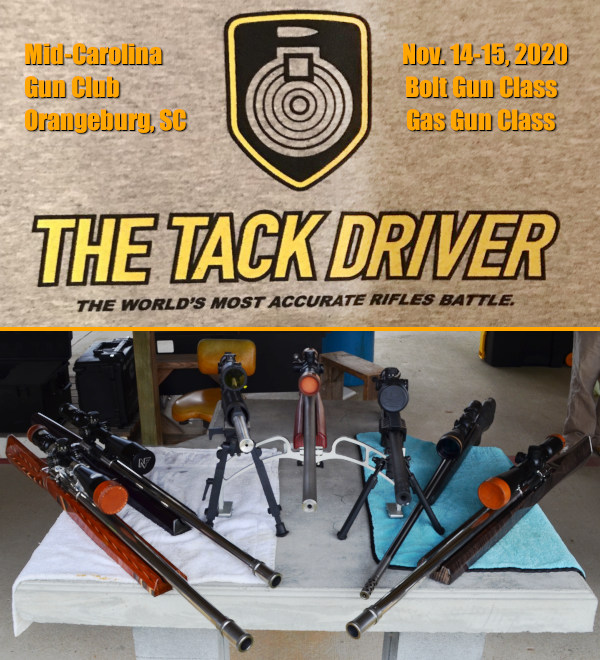
The Tack Driver Showdown is a one-of-a-kind “all comers” rifle match. This match is long overdue — we will finally get to see what rifle types are truly the MOST accurate, at least out to 300 meters. The Tack Driver Showdown match will be held November 14-15, 2020 at the Mid-Carolina Gun Club in Orangeburg, South Carolina. Co-Sponsored by the IBS, the organizers have invited virtually any type of rifle (except railguns) to compete at 300 meters for group and score honors. There are 100+ competitors pre-registered for the event this weekend. No organization membership is required.
Unlike any other rifle match in the world, on the firing line you will see 6 PPC LV/HV rifles, 30 BR score rigs, 17-lb 600-yard and 1000-yard benchrest guns, F-TR rifles, F-Open rifles, Palma rifles, PRS rifles, and maybe even an AR15 or two.
The concept behind the event is to settle the unending arguments about which guns are TRULY the most accurate. The 6PPC is king in 100/200 group competition, the 30BR rules 100/200 score, 6mmBRs and 6BR Improveds dominate in 600-yard Benchrest, the .284 Win is the leading F-Open cartridge, and various 6mms and 6.5mms win PRS matches. It will be interesting to see which chamberings and bullet weights will “rule the roost” at 300 meters. Match Director Jim Cline will post match results throughout the weekend on the AccurateShooter.com Forum.
Tack Driver Showdown targets will be placed at 300 meters (328 yards). That’s not even “mid-range” by benchrest standards, but it should be far enough that the higher BCs of the bullets shot by F-Class and 600/1000-yard benchrest rigs could come into play.
Basic Information on the Tack Driver Shoot:
There are two divisions — bolt-action rifles and semi-auto gas guns. There are no specific design limits other than a 22-lb maximum weight, and a .338 maximum caliber. IBS President Jeff Stover tells us: “We envision the full array of the world’s most accurate rifles on the line: short and long range benchrest rifles, F-Class, AR, other tactical, egg-shoot rifles, whatever…[.]” Key rules are listed below. Semi-autos will need chamber flags, otherwise bolts must be out at all times. You do not have to be a member of the IBS to shoot. The range will be open Friday, November 13th starting at 12:00 noon for practice and flag setting.
Cash Payouts for the Winners in both Group and Score
Match Director Jim Cline tells us: “1st place through 3rd place will be paid in both score, group, and Grand Aggregate finishing positions. Team Cash option also available- 4 man teams $100. The Grand Aggregate team winner takes all.”
2020 Tack Driver Showdown Rules Overview
1. No membership in any organization is required.
2. Any gun .338 caliber and under is legal (other than rail guns), with a 22-pound weight maximum.
3. There are two divisions: 1) Bolt Guns; and 2) Gas Guns.
4. All shooting will be done off benches.
5. Shooters may use bipod, bags, or rest combination but no one-piece rests.
6. You have to shoot the same gun at all targets. If you have a catastrophic failure, you have to continue with a gun of the same caliber and cartridge.
7. No electronic equipment of any type will be allowed on the bench or downrange.
8. No spotting scopes are allowed on the bench.
9. No people may coach or spot for competitors.
10. Chamber flags and brass catchers are required for gas guns.
2020 Tack Driver Showdown Match Course of Fire
1. There will be 5 group targets and 5 IBS 200-yard score targets placed at 300 METERS.
2. Targets will alternate between Score and Group each day: Day 1 Score/Group/Score/Group/Score; Day 2 Group/Score/Group/Score/Group.
3. All relays will be 7-minute matches with one 3-minute sight-in period on Saturday first target only.
4. Benches will be rotated for the second day’s course of fire.
5. Winner will be determined by place of finish at each discipline.
Covered Firing Line at Mid-Carolina Gun Club. Photo from 2019 100/200m Score Nationals.
For more information, including camping/RV details at the Mid-Carolina Gun Club venue, contact Jim Cline at 843-957-6546, or post questions on this Accurateshooter Forum Thread.
“On that day, let us solemnly remember the sacrifices of all those who fought so valiantly, on the seas, in the air, and on foreign shores, to preserve our heritage of freedom, and let us reconsecrate ourselves to the task of promoting and enduring peace so that their efforts shall not have been in vain.”
– 1954, President Dwight D. Eisenhower, Veterans Day proclamation.
102 Years Later…
On the 11th hour, of the 11th day, of the 11th month of 1918, bugle calls signaled the ‘cease fire’ ending the First World War. (The official Armistice was signed earlier that morning.) To those who endured it, WWI was the “Great War”, “the War to End All Wars.” Tragically, an even greater conflict consumed the world just two decades later.
Today, 102 years after the end of WWI, Americans mark the anniversary of the WWI Armistice as “Veterans Day”. In Canada it is known as Remembrance Day. On this solemn occasion we honor all those who have served in the military in times of war and peace.
While more WWII veterans pass away each year, there are still over 20.4 million veterans in the United States. Take time today to honor those soldiers, sailors, and airmen who have served their nation with pride. Today we remember that… “All gave some, and some gave all.” History of Veterans Day.
Former Secretary of Veterans Affairs Dr. James Peake asked Americans to recognize the nation’s 20.4 million living veterans and the generations before them who fought to protect freedom and democracy: “While our foremost thoughts are with those in distant war zones today, Veterans Day is an opportunity for Americans to pay their respects to all who answered the nation’s call to military service.”
On Veterans Day we especially need to remember the seriously wounded combat veterans. These men and women summon great courage every day to overcome the lasting injuries they suffered in battle. Some of these soldiers have lost limbs, yet volunteered to return to combat duty. That is dedication beyond measure — true patriotism.
National Veterans Day Ceremony
The Veterans Day National Ceremony is held each year on November 11th at Arlington National Cemetery. The ceremony commences precisely at 11:00 a.m. with a wreath laying at the Tomb of the Unknowns and continues inside the Memorial Amphitheater with a parade of colors by veterans’ organizations. The ceremony is intended to honor and thank all who served in the U.S. Armed Forces. Major regional ceremonies and events are also held throughout the country.
Here’s big news for .22 LR rimfire benchrest competitors and smallbore F-Class shooters. Vudoo Gun Works is now offering precision single-shot rimfire actions, and complete Benchrest/F-Class style target rifles. Vudoo will be selling the new V-22S Single Shot Action, the Vudoo/Flavio Fare BR-VS 0.7-2.8 oz. trigger, and complete single-shot target rifles with benchrest and F-Class-style modern low-profile stocks. With a Rem 700 footprint, the V22-S action can also be used for smallbore silhouette and prone rigs. That’s good news for .22 LR competitors in many disciplines.
About The Vudoo V-22S Single-Shot Action
The all-new V-22S action was designed for optimal function in single-shot applications. The action has a three-lug bolt, six o’clock ignition, and the bolt can be dis-assembled without tools. Vudoo claims the action’s 60-degree bolt lift is “the smoothest and lightest of any three-lug [rimfire] design on the market”. The V-22S will be offered in various configurations: right bolt/right port, right bolt/left port, left bolt/left port and left bolt/right port. There is an integral 11mm dovetail mount and optional 0, 20, 30, or 40-MOA Picatinny rails. Another first for this type of action is a complete color-coded mainspring kit with mainsprings ranging from 13 to 18-pound force. The action is currently priced at $1405.00 MSRP.
Vudoo Gun Works V-22S Action Features
Rem 700 Short Action Footprint
Rem 700 Pinned Trigger Interface
Three Lug, 60-Degree Bolt Throw
Six O’Clock Ignition — Vertical Sear Fire Control
Tool-less Bolt Assembly/Disassembly
Color-Coded Mainspring Kit (13-18 lbs.)
Integral 11mm Dovetail Mount
Picatinny Rail 0, 20, 30 or 40 MOA
Trigger Options — Flavio Fare BR-VS or your Choice of Rem-Compatible Triggers
A newly-designed fire control system yields precise, consistent ignition thanks to the Vudoo/Flavio Fare BR-VS Trigger. Vudoo Gun Works teamed up with Flavio Fare to co-develop a trigger for the new fire control system. The BR-VS Trigger adjusts from .7 to 2.8 ounces with heavier pull weight ranges coming soon. [Editor: We have talked to folks who have tried this new trigger and they say it is outstanding.] If you prefer a different trigger, a 60-degree cocking piece will be available as an option.
Complete Rifles Starting at $2800.00
Vudoo Gun Works will offer complete single-shot target rifles with three different match stocks: McMillan Kestros, McMillan Edge, Grayboe Renegade SS. These rifles will be fitted with the new BR-VS trigger, or other trigger of your choice. Complete rifle price ranges from $2800 to $3450 depending on options.
Vudoo Designer Talks about V22-S Action
Mike Bush, Design Engineer and Co-Founder of Vudoo Gun Works told us: “The V-22S is a ground-up Gen 3 design, which is where the tool-less bolt assembly/disassembly started. We rolled this design backwards into what are our current Gen 2 Repeater actions and we couldn’t wait to get the new Single-Shot out and in the hands of competitors, target shooters and those with a general passion for rimfire”.
Mike says the design really works: “I’ve not seen a system that offers better concentric alignment, repeatability and smoothness of operation… add to this, the six o’clock ignition and our new Vudoo/Flavio Trigger, and I think you’re going to see big differences downrange.”
More Details about the V22-S Action
Some folks have asked whether Vudoo’s new action is devived from the Remington 40X rimfire action. Vudoo states: “The V22-S departs from the 40X in that the 40X was a full size center fire receiver converted to handle the diminutive .22LR cartridge. The V-22 has been designed from the ground up as a true-to-scale Rimfire receiver that fits the Rem 700 footprint. The V-22 has a very unique control-round-feed protocol. The bolt has full capture control of the cartridge from the time it leaves the magazine until it ejects the spent round out the ejection port. [So] the cartridge is controlled in a way that it never touches anything on its entrance into the bore. There is no feed ramp, nor does the projectile go in at an angle that would damage it in any way. We all know how susceptible the soft lead of the .22 LR is to accuracy degrading damage and minor nicks during the chambering process. It is eliminated in the V-22’s geometry.”
This stunning Westley Richards & Co. shotgun was made for the 1981 nuptials of Lady Diana Spencer and HRH Prince Charles. It is rare, has a unique history of ownership, and is also elaborately decorated.
Jim Supica, Director of the NRA Firearms Museum, has written a trio of articles about gun collecting. If you are thinking of starting your own collection of firearms, you should read Supica’s informative articles. The first talks about the basics of gun collecting, the second explains the five key factors that govern gun values, and the third article explains where to find rare and valuable arms. Today we want to highlight the five factors that contribute most to a gun’s value, according to Supica:
Make and Model, Condition, Rarity, History, Art — These are the five factors that … appeal to collectors and help determine the value of collectible guns.
Make and model tends to be the starting point for evaluating collectible guns for most collectors and will be a basic threshold requirement for those with specialized collections.
Factors here include the quality of a particular manufacturer’s products, the historical usage of the guns in question, and the brand’s aura of romance. As an example of that last (and most intangible) factor, consider that Colt Single Action Army revolvers were for several decades the most prevalent focus for collectors interested in full-size revolvers from the post-Civil War to turn of the 20th Century-era, and there is no question that Colts were widely used during that time. In recent years, there has been a refreshing trend in gun collecting to look at a broader range of guns than the traditional blue chip Colts, Winchesters, and Lugers.
Colt Single Action Army Revolvers remain among the most prized (and collectible) firearm.
2. Condition (and Originality)
Obviously, condition plays a major role in the value of a collectible firearm. The classic advice to new collectors in this regard has always been to hold out for guns in the best condition and pay the extra premium they demand. This condition-emphasis seems to have developed in the 1970s and 1980s. In the early post-WWII years of gun collecting there was more interest in rare variations and history, and fewer collectors to whom a few percentage point difference in remaining original finish was of much concern.
Although the highest-condition guns continue to bring record prices, it seems that the pendulum is beginning to swing back the other way, a trend met with my hearty approval. The appeal of “mint” guns has been largely lost on me, and seems to be more appropriate to coin or stamp collecting than a field in which the possible historic usage of the artifact holds so much interest and significance. There is a definite segment of the collector market that is not overly concerned with perfect condition, so long as the gun is original and has not been messed with in a more recent (and, in my opinion, usually misguided) attempt to enhance its desirability.
3. Rarity
In terms of rarity, the well-worn saying that “just because a gun is rare doesn’t mean it’s valuable” remains true to a certain extent. There may only be five known examples of a particular gun, but if only three people care about it, the market is saturated. However, there does seem to be more interest in cornering the rare variations within established collecting fields. There is a bit of a resurgence of the collecting philosophy of completing a punchlist of models and variations within a specialization, and this lead to vigorous competition for the rarest examples in these fields. In emerging collecting fields, when new research is published revealing the rarity of certain variations there can develop a brisk interest in those guns.
4. History
Individual guns with a known history of ownership by a specific individual or usage in a specific historical event have always captured the fascination of collectors, as well as historians and the general public. This seems to reflect a basic human interest and shows no sign of abatement. A positive trend here seems to be an increase in general understanding of the type of documentation which must accompany a historically attributed firearm to give it the credibility to justify a premium price, and the importance of creating and preserving such documentation.
This Beretta has extra value because it was owned by pilot Chuck Yeager. Photo NRA Museum.
5. Art (Decorative Embellishment)
Fine engraved guns are collected more for their artistic value than for their worth as firearms. Here the market for classic works by the great engravers of the 19th and early 20th Centuries remains strong, as well as for factory-engraved pieces from more recent years. Interest in recent non-factory engraving seems to have diminished, as has… the trend of adding modern engraving to older firearms.
Here is a matching set of three three beautifully engraved pistols by the late Indiana engraving wizard Ben Shostle — a Luger, a Mauser, and a Colt. Photo courtesy Amoskeag Auction Company.
Factory-custom engraving should not be confused with mass-produced, factory-made commemorative firearms, which flooded the market in the 1960s and 1970s. A couple of major manufacturers worked this genre to death, and prices on commemoratives have been stagnant for many years now, although the market for these shows some signs of renewal.
CAUTIONARY WORDS about RESTORATION
With prices for high-condition original finish guns running away from the budgets of many collectors, period-of-use refinished guns and older factory-refinished guns are finding more enthusiastic buyers than they did a few years ago.
The availability of excellent-quality restoration services is another factor that I anticipate may impact collector preferences in the future. The top restoration artists are reworking guns to “as new” condition with such skill that it has become increasingly difficult for even knowledgeable collectors to distinguish mint original finish guns from the best restorations.
When such restoration is disclosed to a prospective buyer (as it ethically should be), the prices the gun will bring are significantly below a similar gun with original finish, and may be less than the original cost of the pre-restoration gun plus the cost of the rework. This creates a mighty incentive for deception by a motivated seller, either by active misrepresentation (a.k.a. “fraud”) or passively by simple failure to mention the modification.
Many visitors to the site ask us, “I’ve got a .223 and .308. What will a 6mmBR Norma (6BR) give me that I’m not getting already?” Well first you may well average somewhat smaller groups than your current .223 or .308 rifle (assuming the 6BR has a quality barrel and trigger). A good .308 Winchester can be superbly accurate, no question about that, but the lesser recoil of the 6BR works in the shooter’s favor over a long string of fire. Even with a Rem 700 or Savage action factory action, a 6BR with a benchrest stock, premium barrel, and a high-quality chambering job should deliver 5-shot groups in the high twos to mid-threes, provided you do your job. We have one 6BR rifle that shoots Lapua factory-loaded 6BR ammunition in the low twos and high ones. That’s exceptional, we admit, but it still shows how the 6BR is an inherently accurate cartridge, even with factory loads.
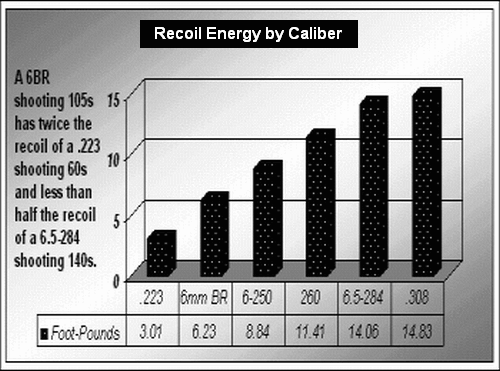
Compared to a .223, the 6BR offers a better selection of high-BC projectiles and small-maker match projectiles (such as Bart Sauter’s “Hammer” and the Vapor Trail line). The 6BR will also deliver considerably more power on the target. Compared to the .308 shooting 168gr MatchKings, a 6BR shooting 105-107gr bullets offers better ballistics all the way out to 1000 yards. (The story changes with .308s with very long barrels pushing the 180-210 grain projectiles). Plus, for most people, the 6BR is just easier to shoot than a .308. Recoil is less than half of the .308 Win cartridge. Both the .308 and 6BR chamberings offer good barrel life, but the 6BR uses 15-18 grains less powder, saving you money. Here’s how the 6BR stacks up vs. a number of popular calibers:








 Vudoo Designer Talks about V22-S Action


 Many visitors to the site ask us, “I’ve got a .223 and .308. What will a 6mmBR Norma (6BR) give me that I’m not getting already?” Well first you may well average somewhat smaller groups than your current .223 or .308 rifle (assuming the 6BR has a quality barrel and trigger). A good .308 Winchester can be superbly accurate, no question about that, but the lesser recoil of the 6BR works in the shooter’s favor over a long string of fire. Even with a Rem 700 or Savage action factory action, a 6BR with a benchrest stock, premium barrel, and a high-quality chambering job should deliver 5-shot groups in the high twos to mid-threes, provided you do your job. We have one 6BR rifle that shoots Lapua factory-loaded 6BR ammunition in the low twos and high ones. That’s exceptional, we admit, but it still shows how the 6BR is an inherently accurate cartridge, even with factory loads.