This summer the Civilian Marksmanship Program (CMP) will host Smallbore and Air Gun events during the annual CMP National Matches in Port Clinton, Ohio. The National Matches, held at the Camp Perry National Guard Training Base since 1907, is conducted through a partnership between the CMP and the Ohio National Guard. All events are open to the public, with spectators allowed.
The National Smallbore and National Air Gun phases run in tandem, along with the National Pistol series, to allow athletes the option of competing in a variety of disciplines during their Camp Perry visit. Additional Aggregate events have been included for those firing in air rifle and three-position smallbore competitions, with challenging elimination team matches also part of the Air Gun and Smallbore schedules.
This year’s rimfire (smallbore) matches are scheduled for July 9-19, 2025. There will be iron sights and “any sights” (scoped) prone events as well as 3×20 (three-position) individual and team matches. All smallbore events are held on Camp Perry’s Petrarca Range, featuring a covered firing line and CMP’s own outdoor electronic targets. See below:
Air Rifle and Air Pistol Events at Camp Perry
For air rifle and air pistol competitors can attend the National Air Gun Championships, held on the electronic target range within the Gary Anderson CMP Competition Center. There will be two days of training sessions, followed by two days of 60-shot competitions. The Air Rifle events will run July 10-13, while Air Pistol will follow on July 14-17.
About the CMP National Matches:
The 2025 CMP National Matches will include the CMP National Trophy Pistol and Rifle Matches, National Games Matches, National Smallbore Matches, National Air Gun Championships, and the National Mid-Range and Long Range Matches. The month-long summer series also includes a variety of educational clinics for all experience levels.
To learn more about the upcoming CMP National Matches and review the National Matches schedule, visit the CMP website at thecmp.org/cmp-national-matches.
This popular video, viewed 3.8 million times on YouTube, provides a clear explanation of Minute of Angle (MOA) and how that angular measurement is used. Among novice shooters, there is much confusion over this term. In this NSSF Video, Ryan Cleckner, a former Sniper Instructor for the 1st Ranger Battalion, defines the term, “Minute of Angle” (MOA) and explains how you can adjust for windage and elevation using 1/4 or 1/8 MOA clicks on your scope. This allows you to sight-in precisely and compensate for bullet drop at various distances.
For starters, Ryan explains that, when talking about angular degrees, a “minute” is simply 1/60th. So a “Minute of Angle” is simply 1/60th of one degree of a central angle, measured either up and down (for elevation) or side to side (for windage). At 100 yards, 1 MOA equals 1.047″ on the target. This is often rounded to one inch for simplicity. Say, for example, you click up 1 MOA. That is roughly 1 inch at 100 yards, or roughly 4 inches at 400 yards, since the target area measured by 1 MOA increases in linear fashion with the distance.
More Minute of Angle (MOA) Explanatory Videos
This Gunwerks video explains that Minute of Angle subtends approximately 1″ for each 100 yards (well, 1.047″ to be more precise). That means a Minute of Angle increases in actual measured size the greater the distance of the target from the shooter.
This lengthy (24-minute) video defines Minute of Angle, and uses multiple diagrams to illustrate how MOA angular measurements works. The video also how MOA-based click values translate to point-of-impact changes at various distances.
At the request of our readers, we provide select “Deals of the Week”. Every Sunday afternoon or Monday morning we offer our Best Bargain selections. Here are some of the best deals on firearms, hardware, reloading components, optics, and shooting accessories. Be aware that sale prices are subject to change, and once clearance inventory is sold, it’s gone for good. You snooze you lose.
NOTE: All listed products are for sale to persons 18 years of age or older. No products are intended for use by minors.
⏺️ » impressive new compact radar chrono — competition for Garmin
The new Athlon Rangecraft Velocity Pro Radar Chronograph is an impressive and very affordable compact chrono, now $349.99 at EuroOptic. This employs Doppler radar allowing ultra-accurate velocity readings and convenient set-up. Since the unit isn’t triggered by a muzzle blast, it can work with suppressors, muzzle brakes, and other muzzle devices. The Rangecraft Vel Pro reads velocities between 65 fps and 5000 fps so it works for all types of firearms. NOTE: If this Athlon Chrono is back-ordered and you don’t want to wait, Scheels.com may have inventory in stock at $399.99.
2. Palmetto SA — Panzer 12ga Tactical Shotgun, $279.99
⏺️ » Amazing deal on excellent defensive 12ga shotgun
The Panzer Arms M2 Tactical is an excellent 12ga defensive shotgun with 18.5″ barrel, scope rail, ergonomic grip, and integral sights. This shotgun features an inertia-driven system, which helps to reduce recoil and increase accuracy. Whether you’re looking for a bedside gun or a shotgun for 3-Gun matches, this is a great option for the price — just $279.99 on sale. NOTE: Many accessories and parts for the Benelli M2 can be used on the Panzer Arms M2, making it easy to find the parts you need.
3. Graf & Sons — Harris Bipod Sale, 20% Off, Many Sizes
⏺️ » Save 20% on rugged, reliable Harris bipods
If you need a good general-purpose bipod consider grabbing a Harris Bipod. On sale now at Graf’s, Harris bipods are available in multiple styles and leg lengths. Deluxe models offer swivel and cant options. And spring-loaded adjustable legs can quickly adapt to any terrain. Choose various rail mounting options including Picatinny rail and sling-stud. Made from aluminum with a black hardcoat anodized finish, Harris bipods are built to last. We still have 35-year-old Harris bipods that perform perfectly.
4. Amazon — Walker’s Slim Fit Earmuffs, $28.69
⏺️ » Popular NRR23 electronic muffs at super-low price
Walker’s makes excellent electronic ear muffs. And right now you can get the popular Walker’s Razor Slim Ultra Low Profile for under $30.00 on sale at Amazon. That’s an amazing price for sophisticated NRR23-rated muffs that protect your hearing while allowing you to hear range commands. These Razor Slim Muffs boast a low-profile design with slim yet comfortable ear cups. A variety of color choices are offered starting at $28.69 for Black with Teal. Or pay $30.46 for the all-black model.
5. Amazon — 52″ Rifle Case (Black or Camo), $31.99
⏺️ » Very good long case with handy, zippered pockets — black or camo
Here’s a good 52″ rifle case that can hold a long hunting or competition rifle. The padding is good and there are handy zippered storage compartments. The main side pocket has an open mesh fabric so you can see what’s inside. This 52″ case is on sale for just $31.99 on Amazon with your choice of dark black or tan camo pattern fabric. This is a good value for a large 52″ case. There is also a light gray version for $29.99.
6. Natchez — Winchester Lake City M193 Rifle Ammo, $74.99
⏺️ » Quality USA-made 5.56 NATO ammo for rifle practice
If you shoot an AR-15 in 3-gun or service rifle competition, or you do a lot of varmint hunting, you may want to to stockpile some quality ammo. With this deal you can get 150 rounds of quality American-made 5.56×45 ammo for just $74.99. That works out to just fifty cents per round. This Winchester USA Lake City M193 55gr Rifle Ammunition will also work in .223 Rem bolt-action varmint rifles.
⏺️ » Great price on handy targets that display hits brightly
These handy 6″ Splatter Targets (#ad) make it easy to identify where your shots are hitting. The target design is good for aiming with bright red vertical and horizontal lines, plus a center “X”. When a shot lands on the target, a bright yellow on black circle instantly appears at point of impact. These 6″-diameter stick-on targets are easy to apply to any target backer. Get a handy 100-target roll now for $26.99 on Amazon.
8. Creedmoor Sports — Fix It Sticks AR15 Kit, $70.60
⏺️ » Handy, compact tool kit great for AR15 rifle maintenance
If you own an AR-15 then you know cleaning and maintenance can be a real chore — Black Rifles run dirty. We recommend the Fix It Sticks AR15 Maintenance Kit, which has the vital tools you need (including special items for cleaning action components). The soft carrying case has molded-in bit holder that is designed to hold any bit/accessory with a standard 1/4″ Base (including Fix It Sticks Torque Limiters), and any 8-32 threaded component.
9. Amazon — Wheeler Engineering 100-Piece Professional Screwdriver Set, $82
⏺️ » Good value with tons of handy tools and major discount
Wheeler’s 100-Piece Professional Gunsmithing Screwdriver Set (#ad) is a great tool kit for gun owners. The bits are made from S2 steel and hardened to 56-58 Rockwell “C”. When designing this big kit, Wheeler’s engineers first measured the screws on over one hundred modern and antique firearms to make sure there are bits that fit a wide range of gun actions, components, and parts systems.
⏺️ » Handy cheap tool for interactive target shooters — fun at long range too
These handy wire target holders can be used for fun short-range pistol shooting and for more challenging rifle shooting at 300 yards and beyond. Clay rifle targets are good for fun local club matches. A 6″-diameter clay pigeon is one-MOA at 600 yards — a serious challenge. These Birchwood Casey Wire Clay Target Holders (#ad) are easy to use. Drive the holder into the ground, slightly open the wire ring, and then insert the clay disc. You can easily set up multiple targets.
As an Amazon affiliate, this site can earn revenues through sales commissions.
When most shooters think of biathlon, they imagine the winter sport which combines cross-country skiing with rimfire rifle shooting. Now there’s a new type of biathlon, a true “run and gun” competition with rifles and pistols. The Gun Run competitors move on foot over natural terrain, with 5-8 shooting stages over the course, typically 5 km (about 3 miles).
The Gun Run is a two-gun, centerfire biathlon. It is designed to test your physical fitness, marksmanship, and equipment. Competitors will carry their rifle, pistol, ammunition, mags and anything they believe they need to complete the course. They will travel over various distances depending on the match — but most often a 5 kilometer marked course consisting of natural terrain, roads, and trails. There will be anywhere from 5 to 8 shooting stages. There are night events, two-person team events, and even a land navigation event where you must use map and compass to complete the course.
The Gun Run is not a CrossFit competition and it’s not USPSA. This is a challenging event that test personal fitness and marksmanship with both rifle and pistol.
How to Participate in The Gun Run Events
Click below for the list of The Gun Run 2025 Events with links to sign-up pages. The next competition is the Gun Run Land Nav slated for May 24, 2025 at DeWitt’s Outdoor Sports in Ellerbe, North Carolina. This is a special, more challenging event. Instead of following a 5k course marked with signs, competitors will navigate an unknown distance course using a map and compass. After, that, the next Gun Run event will be held June 21, 2025 at The Sawmill Training Complex in Laurens, SC 29360.
Origins of The Gun Run
This isn’t a new concept … matches like this originated in Texas 20 years ago and have spread all over the country. Prior to that, Colonial Era Americans would gather on the village green sometimes multiple times a week and conduct close order drill with rifle marksmanship competitions. Shooting is as old a past time for this country as this country is old.
Fitness Challenge
Carrying all your gear in 90 degree weather up and down hills is not easy. Having the best gear and being a good marksman can help but having a level of fitness where you can maneuver with gear on is extremely important. The end result of all of this is improving your training plan. Whether it be physical or on the range, every event you compete in should give you areas to work on. Sometimes new kit needs to be bought but most often it is our fitness that needs the most improvement.
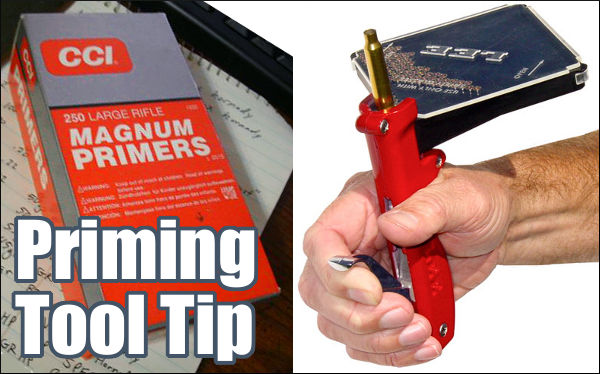
From time to time, we all encounter a primer that doesn’t go off. It’s normal to attribute the problem to a bad primer. But sometimes there are other explanations. George S., one of our Forum members, experienced a couple failures to fire, but he learned that the issue was his priming TOOL, not his primers. Here’s what George told us. There’s a lesson to be learned:
“I had issues with CCI 450s when I had my first 6BR barreled. I had probably three or four out of 20 rounds that failed to fire. the primers were dented but didn’t fire. I called CCI since I had bought a case of them. The tech was decent enough but had the audacity to tell me I was not seating the primers all the way in the pocket. I proceeded to let him know I had been reloading longer than he had been alive and I knew how to seat a primer.
Turns out that I did and I didn’t! I was using the RCBS primer tool I had used for years and the primers felt just fine to me. I finally decided to check the tool and since I had a new one I took the seating pins out and measured them. The seating pin on the tool I had been using for years was shorter by a few thousandths! I then used the pin from the new primer tool and darned if the primers that didn’t seat down to the bottom of the cup.
I switched to a K&M primer tool for seating the CCI primers and have not had a problem since. It was the combination of harder cup and lack of proper seating. I did call the CCI tech back and apologized for being an idiot.”
Another Forum member witnessed a problem cause by misuse of a priming tool: “I did … see a failure to fire on a Rem 9 1/2 primer only a week ago. That was in the new Rem muzzleloader that uses a primed case to ignite the pellets. After watching the muzzleloader’s owner seat his primers, I believe that it was operator error not the primer. He was seating the primer and then squeezing the priming tool so hard that his hands hurt after a few. We got that corrected.”
One of the most popular items in our Shooters’ Forum is the ongoing “Pride and Joy” thread. Since 2009, Forum members have posted photos and descriptions of their most prized firearms. Here are some of the most recent “Pride and Joy” rifles showcased in our Forum. Do you have a gun you’d like to see featured there? Register for the Forum and you can add your favorite gun to the list.
For this week’s Sunday GunDay we’ve selected five fan favorites from the Pride and Joy Archives. First up is a beautiful .284 Winchester with a one-of-a-kind Claro Walnut stock crafted by the owner.
.284 Winchester in Owner-Crafted Claro Walnut Stock
Here is a unique Claro Walnut tactical/practical rig. Notably, the rifle’s owner, Forum member CStuck, built the handsome stock himself: “I crafted the stock, installed the Remage barrel, pillar-bedded the rig, and put all the pieces together.” Key components for this wood-stocked beauty include a Defiance Tenacity RH Long Action mated to a McGowen 28″ Heavy Palma 1:9″-twist barrel chambered for the .284 Win GAP. The scope is a Burris XTR II 5-25x50mm in an MPA BA Mount. The trigger is a Timney HIT. The rifle feeds from a Hawkins DB magazine.
6BRA with BAT Action, Brux Barrel — The Blue Beauty
Next is a blue 6BRA beauty from Forum Member RiflePainter: “This is my brand new 6BRA Light Gun built by Jason Danley at Danley Precision! Jason did all of the work including paint. Brass was done by Darrel Jones at DJ’s brass service.” This features a Johnny Byers stock painted in HOK Custom Oriental Blue Candy mix. The action is a BAT DS Left-load, Right-eject, Right bolt fitted to a 1.5 oz. Jewell trigger. The barrel is a 28″ Brux HV 1:8″-twist chambered for the 6BRA (6mmBR Ackley) and fitted with a Harrell’s radial muzzle brake. On top is a Sightron SIII 10-50x60mm optic riding in BAT 1-piece scope rings.
Eye-Catching 30 PPC — 13-YO Grandson’s First Competition Rifle
We like this project because it connects a grandfather with his grandson. These family connections are very important. Forum member 20PPC posted: “Here is my 13-year-old grandson Remy’s first competition rifle. We just finished it up.” The rifle is chambered for a 30 PPC with a 1:17″-twist Lilja HV barrel fitted with an Ezell tuner up front. The action is a Stolle Panda RBLP, Right Eject fitted with a Kelbly trigger. The stock is a Robertson JTR model wearing a very snazzy finish, which looks like many coats of clear over an orange/gold hydro-dip (we think). On top is a 45X Sightron fixed-power scope. This eye-catching grandson’s rig will definitely get noticed at the range.
Click image for full-screen view.
Twin Grendels with Handsome Wood, One with Home-made Tuner
Here are a pair of 6.5 Grendel bolt-action rigs. Forum member Ramblerman posted: “The Twin Grendels are finished! My buddy Tom did the wood and I did the metal — more testing this weekend. Mine now sports a tuner I made (see bottom photo).”
6BRA in Green Wheeler Stock with Krieger Barrel
Last but not least, here is a serious IBS/NBRSA Light Gun for 600/1000-yard competition, owned by Forum member “6.5×47″. Chambered for the ultra-accurate 6BR Improved (aka 6BRA), this rifle features a polished BAT ‘B’ action with roller upgrade. The action is mated to a 28″ Krieger 1:7.5″-twist HV barrel. The 6mm Krieger is chambered for .272″ case-neck, with .115″ freebore. The BAT action is glued and screwed in an Alex Wheeler stock with green candy paint. Note the wide fore-end with side plates and the adjustable stock keel in the rear. Another advanced feature is a slick removable weight system in the butt stock. A Jewell benchrest trigger resides inside a BAT trigger guard.
Left to Right, Sherri Jo Gallagher, Mother Nancy Tompkins, and Michelle Gallagher — All Champions.
Happy Mother’s Day
Today we want to wish Happy Mother’s Day to all the moms around the world. All of us must remember that we literally owe our lives and our well-being to our mothers, who brought us into the world. Without the love, support, caring, and nurturing of our mothers, none of us would be here. So to mothers everywhere, we say:
“Thank you. Bless you. May your lives be filled with happiness today and everyday.”
At the top is a cherished photograph of the one of the greatest moms in the shooting community, Nancy Tompkins, along with her two little girls (who both turned into pretty darn good shooters themselves). On Nancy’s right is Michelle Gallagher, multi-time National Long-Range Championship. On the left is Sherri Jo Gallagher, who was the second woman in history to capture the NRA National High Power Championship at Camp Perry. Who was the first woman ever to accomplish that feat? You guessed it — Nancy Tompkins, Sherri’s mom, was the first-ever female High Power Champion. Nancy is married to another great shooter, Mid Tompkins. This is truly America’s “First Family of shooting”.
Nancy Tompkins is one of the greatest long-range shooters in American history. She has won the National Long Range Championship 5 times (1986, 1997, 1999, 2003, and 2015), the across-the-course National High Power Championship (1998), the Metric Smallbore Nationals (2012), and the Fullbore Nationals (2012). She has also been the Wimbledon Cup winner (1993) and a 7-time Leech Cup winner (1995, 1997, 1999, 2003, 2005, 2011 and 2012). She has won both team and individual medals in the World Championships and has been on 8 Palma Teams (as both a shooter and a coach).
Tompkins’ treatise, Prone and Long Range Rifle Shooting, is a must-read for serious Palma, F-Class, and High Power shooters. The revised Second Edition includes F-Class equipment and techniques, and newly updated information. Topics include Mental and Physical training, Reading Wind and Mirage Shooting Fundamentals, International Competition, and Loading for Long Range.
Team Smith & Wesson shooter Julie Golob has a message for Mother’s Day (Sunday, May 12th). Julie writes: “While some are using Mother’s Day week to push a gun control agenda, I’d like to encourage moms to ‘Take a Moment’. Talk to your kids about firearms safety. Help them learn what to do around firearms and have an open, honest discussion about guns and gun safety.
I truly believe that, no matter if you are pro-gun or anti-gun, everyone should know and understand the basic rules of firearm safety. It is equally important for parents to have the discussion about guns and what to do if your child finds one. Both the NSSF’s Project ChildSafe and the NRA’s Eddie Eagle GunSafe® Program are excellent. They offer resources for parents, educators, and child care providers to help ensure kids stay safe.
In this video, Julie encourages parents to have “the talk” about firearm safety with their kids sooner rather than later, and provides tips for how to have a helpful discussion. Sherra Scott, a mom and a certified NRA instructor, agrees with Julie: “Whether you have firearms in your home or not, if you have children in your life, please watch this video and talk WITH them about firearm safety and what to do if they come into contact with a firearm.”
Bolt Action Reloading is a popular YouTube channel that has amassed 97,000 subscribers. For this Saturday Video Showcase we are featuring seven (7) interesting videos. If you’re getting started in reloading, definitely watch the video on Five Common Mistakes. And all handloaders can benefit from the videos which covers affordable tools, all under $50.00 (at time of filming).
Getting Started in Reloading — Lessons Learned
This is a very helpful video for anyone getting started in reloading. The host summarizes the important lessons he has learned over the years. Here he covers some of the common issues handloaders face and how to avoid problems as you get started. As he notes: “When you are getting started reloading, some things you learn the hard way. In this video I cover things that I wished I knew before I got started [reloading]. There were several things that held me back when I started and in this video we cover 10+ of them.”
Five Common Mistakes Made by Novice Handloaders
This video spotlights five (5) common mistakes made by people when they get started hand-loading ammunition. These are some of the most common errors and misconceptions that affect “newbie” reloaders. Here are the five common problems encountered by folks getting started in handloading:
1. Not Using LOAD DATA from a Reliable Source — Use verified, properly developed load data from a powder maker or bullet maker. Don’t trust private social media posts. And always start conservatively.
2. Inconsistent Case Sizing — this can be the result of sloppy die set-ups or not knowing how to measure cases correctly.
3. Cartridge Overall Length (COAL) Variances — Don’t assume that COAL book values apply to your ammo. You should measure your own cases based on your chamber, headspace, and bullet choice. AccurateShooter.com recommends you use QuickLoad or Gordon’s Reloading Tool software to help adjust loads for different COAL.
4. Hand-Loading Is Not Always a Money-Saver — For a cartridge you don’t shoot much (say a .30-06 for hunting only), hand-loading might not save you money once you count the cost of dies and tools.
5. Reloading Kits Are NOT Complete — Don’t assume that the $500 reloading kit you acquired (with press, powder measure, scale etc.) has all the components and tools you actually need. You will still need dies, comparators, and many other tools.
Primer Pocket Uniforming — Is It Worth the Time and Effort?
With Lapua and Peterson brass we have had very good results — great accuracy and with low ES and SD — using brass that has NOT had the primer pockets uniformed with some kind of cutter. We always do check to make sure there are no flakes or obstructions in the flash holes, but we generally do NOT need to cut into the pockets. But with lesser brands of brass you can benefit from uniforming your primer pockets. And yes there are some top shooters who DO uniform pockets even on premium-brand brass. That is up to you. This video explains the process for primer pocket uniforming and looks at some test results.
Developing a Load — OCW vs. 10-Round Ladder
This video talks about two methods of determining an accurate load. We include this video here because many people are curious about Optimal Charge Weight (OCW) load development. Frankly, however, we believe there are better, more reliable ways to find a good load — many people have wasted many hours and much barrel life on the OCW quest. NOTE: With a good cartridge of known accuracy, such as a 6mmBR or 6mm Creedmoor using top-quality brass, we really do NOT advocate either method described in this video. We suggest you do a search to find the best bullet choice and powder choices. Then, if you are shooting from the bench with a custom barrel, consider starting in the lands, about .003-.005 past first touch. NOT full jam!! If you are shooting in conditions where you may have to unload a round during a match, start .020″ back from first touch. Chronograph every round. Shoot three-shot groups at 100 yards, looking to keep all shots touching. Many people doing OCW waste a ton of time (and barrel life). And one bit of advice for people with average factory barrels — it may be pointless to expect anything much under 1 MOA from that barrel no matter what you do.
Handloading Cool Tools — All Under $50.00
Along with powder measure, dies, and reloading press, there are a wide variety of tools that can help achieve good results when handloading ammo. This Bolt Action Reloading video identifies ten (10) tools that can be acquired for $50.00 or less. Here is the list:
1. Check Weights (00:20) — These help ensure your scale is measuring properly.
2. Digital Calipers (00:57) — You can spend $200+ on calipers, but you can get good results from caliper that cost less than $50.00, and every reloader should have a back-up set of calipers.
3. Comparator Sets (01:26) — These are fittings that attach to calipers. Bullet Comparators are sized to fit a bullet diameter to get reliable base-to-ogive measurements. Case comparators fit the neck of the cartridge, allowing you to measure shoulder bump.
4. Stock Case Remover (02:48) — This allows you to remove a brass case that may be stuck in a die.
5. Imperial Sizing Die Wax (03:20) — There are many types of case lubricants, but Imperial Die Wax is still a popular choice and very affordable.
6. LEE Cutter and Lock Stud (03:44) — This is a cheap way to trim cases. We prefer a Forster trimmer or a deluxe power trimmer but LEE system is inexpensive.
7. Chamfering and Deburring Tools (04:38) — After brass is trimmed to length you need to chamfer and deburr the case necks. Good chamfering/deburring tools are “must have” items for hand-loaders.
8. Case Neck Brushes (05:50) — If you don’t tumble your brass it’s a good idea to brush the inside of your fired cases before seating bullets. A couple swipes is all it takes — and you may find you get more consistent seating if you leave a bit of carbon in the necks.
9. Primer Pocket Swage Gauge (Ballistic Tool) (06:24) — These little tools let you check the dimensions of your primer pockets.
10. Decapping Die (06:57) — The decapping die removes spent primers without sizing the case. This is very handy if you want to remove primers before tumbling brass. NOTE: If your cases have small-diameter flash-holes you need to check the diameter of the decapping rod.
11. Powder Trickler (07:40) — A good trickler is an absolute “must have” when manually weighing each charge. The trickler allows you to add a couple grains at a time.
12. Powder Funnel with Drop Tube (08:45) — While most folks have a basic funnel, a deluxe funnel with a drop tube helps to get a full charge and more consistent powder density.
13. Kinetic Bullet Puller (09:36) — This is like a hammer that holds a loaded round. Using kinetic energy this tool can unseat a bullet with a couple of whacks. However, if you must unload a large quantity of rounds you’ll want a cam-lock bullet puller (09:58) that works with your press.
14. Caliber Specific Reloading Trays (10:28) — These are handy if you are loading specific cartridges. There is less wobble for each round.
Setting Neck Tension with Expanders and/or Bushings
There are three main ways (in addition to collet dies), by which you can set the neck diameter on cartridge brass and thereby control neck tension or the “grip” on the seated bullet. First, the sizing die itself can reduce the neck diameter. This can be a fitted die with the neck honed to a precise diameter. Or, the die can take neck bushings, which allow a range of neck tensions via different bushing internal diameters. Because they allow a wide range of tension settings, bushing dies are popular and effective. You can also have a die that takes the neck dimension down a few thousandths, but then have an expander mandrel that brings the neck inside diameter to an exact dimension. This has the advantage of keeping the INSIDE of the neck perfectly round, with any variances in neck-wall thickness pushed to the outside. This Bolt Action Reloading video explains the use of neck bushings and expander mandrels.
Full-Length-Sizing vs. Neck-Sizing of Cases
NOTE: At AccurateShooter.com we recommend that handloaders always full-length size their brass for many important reasons. Virtually all champion shooters in multiple disciplines full-length size their brass. Full-length sizing can achieve record-setting accuracy, and, importantly, it offers consistent shoulder bump with each loading. But we know that people are curious about neck-sizing, so we are including this video.
This video compares identical charge-weight loads tested with full-length-sized 6.5 Creedmoor brass vs. neck-sized 6.5 Creedmoor brass. The tester states: “I use the 142gr Sierra Match King HPBT loaded with Alliant Reloder 16. There is velocity and group data at 150 yards. FYI, we recommend always full-length sizing most cartridge brass, bumping the shoulder about .003″ (or more if required in a semi-auto).”
Here are two different bullet types, seated to the same CBTO length, but different COAL. Note the shiny scratches on the bullets made by the comparator tool which indicates a point on the bullet ogive near where the ogive will engage the rifling.
Effects Of Cartridge Over All Length (COAL) And Cartridge Base To Ogive (CBTO) – Part 2 by Bryan Litz forBerger Bullets. Part One of this series focused on the importance of COAL in terms of SAAMI standards, magazine lengths, seating depths, and pressure levels. Another measure of length for loaded ammunition is highly important to precision, namely Cartridge Base to Bullet Ogive Length (CBTO).
Figure 2. Chamber throat geometry showing the bullet jump to the rifling or lands.
Look at Figure 2. Suppose the bullet was seated out of the case to the point where the base of the bullet’s nose (ogive) just contacted the beginning of the riflings (the lands) when the bolt was closed. This bullet seating configuration is referred to as touching the lands, or touching the riflings and is a very important measurement to understand for precision hand-loading. Due to the complex dynamics of internal ballistics which happen in the blink of an eye, the distance a bullet moves out of the case before it engages the riflings is highly critical to precision potential. Therefore, in order to systematically optimize the precision of his handloads, it’s critically important that the precision hand-loader understands how to alter bullet seating depth in relation to the barrel rifling. Part of the required knowledge is understanding how to accurately and repeatably measure the Cartridge Base To Ogive (CBTO) dimension. This is explained in the FULL ARTICLE.
Bryan Litz offers an extended discussion on how to measure CBTO using different tools and methods, including the Hornady OAL gauge. You can read this discussion in the full article found on the Berger Bullets website. CLICK HERE to Read Full Article.
Why Not Use CBTO as a SAAMI Standard?
If CBTO is so important to rifle accuracy, you might ask, “Why is it not listed as the SAAMI spec standard in addition to COAL?” There is one primary reason why it is not listed in the standard. This is the lack of uniformity in bullet nose shapes and measuring devices used to determine CBTO.
Benefits of Having a Uniform CBTO
There is another aspect to knowing your CBTO when checking your COAL as it pertains to performance. With good bullets, tooling, and carefully-prepared cases you can easily achieve a CBTO that varies less than +/- .001″ but your COAL can vary as much as .025″ extreme spread (or more with other brands). This is not necessarily bad and it is much better than the other way around. If you have a CBTO dimension that varies but your COAL dimension is tight (within +/- .002″) then it is most likely that your bullet is bottoming out inside the seater cone on the bullet tip. This is very bad and is to be avoided. It is normal for bullets to have precisely the same nose shape and it is also normal for these same bullets to have nose lengths that can vary as much as .025″.
Summary of Cartridge Base To Ogive (CBTO) Discussion
Here are four important considerations regarding bullet seating depth as it relates to CBTO:
1. CBTO is a critical measurement to understand for handloaders because it’s directly related to precision potential, and you control it by simply setting bullet seating depth.
2. Tools and methods for measuring CBTO vary. Most of the measurement techniques have pitfalls (which may give rise to inconsistent results) that you should understand before starting out.
3. A CBTO that produces the best precision in your rifle may not produce the best precision in someone else’s rifle. Even if you have the same rifle, same bullets, same model of comparator gauges, etc. It’s possible that the gauges are not actually the same, and measurements from one don’t translate to the same dimension for another.
4. Once you find the CBTO that produces the best precision in your rifle, it’s important to allow minimal variation in that dimension when producing quality handloads. This is achieved by using quality bullets, tooling, and properly preparing case mouths and necks for consistent seating.




 Happy Mother’s Day
 Nancy Tompkins is one of the greatest long-range shooters in American history. She has won the National Long Range Championship 5 times (1986, 1997, 1999, 2003, and 2015), the across-the-course National High Power Championship (1998), the Metric Smallbore Nationals (2012), and the Fullbore Nationals (2012). She has also been the Wimbledon Cup winner (1993) and a 7-time Leech Cup winner (1995, 1997, 1999, 2003, 2005, 2011 and 2012). She has won both team and individual medals in the World Championships and has been on 8 Palma Teams (as both a shooter and a coach).
 Team Smith & Wesson shooter


 Effects Of Cartridge Over All Length (COAL) And Cartridge Base To Ogive (CBTO) – Part 2


