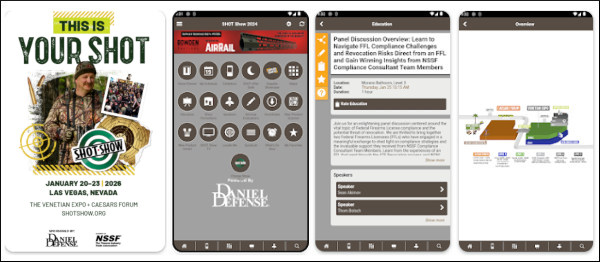
Headed to SHOT Show in Las Vegas? Then you should download the FREE SHOT Show Mobile App. Available for all mobile devices, this App really makes it easier to plan your SHOT Show schedule, and navigate the SHOT Show Exhibit zones. The 2026 SHOT Show Mobile App is now available for download. There are versions for Apple (iOS) and Android smartphones and tablets. And there is even an Apple Watch version. Apple users will find the App in the App Store, Android users will find their version in the Google Play Store. Learn more at SHOT Mobile App Page.
Handy Interactive Map
The App includes an interactive map that can direct you from your current location to your next destination. Arrange your meetings with a handy scheduling calendar. And you can search for any SHOT exhibitor by name or product category. In addition, the App lists major show events as well as important new products.
SHOT SHOW 2026 APP FEATURES
— Locate Exhibitor Booths with searchable Vendor Database/Floor Map
— Build a personalized Schedule and bookmark Exhibitors
— Visit bookmarked Exhibitors with Quick Route Feature
— Multi-Device Sync for smartphones, tablets, laptops
— Up-to-date Exhibitor, Speaker, and Event information
The 2026 SHOT Show takes place January 20-23 at the Venetian EXPO and Caesars Forum in Las Vegas, Nevada. Media Day at the Range takes place Monday the 19th in Boulder City, NV. To learn more about SHOT Show, including seminar times, educational resources, event listings, and hotel/travel information, visit SHOTShow.org.
What anti-corrosion products really fight rust effectively? You’ll hear many opinions, but what do actual field tests reveal? One rifle shooter, who posts on YouTube as BlueonGoldZ, wanted to separate myth (and marketing claims) from reality, so he completed his own long-term rust test using metal samples. First he used ordinary tap water spray, and then he did a second, longer-duration test with a salt-spray solution. Nine different products were tested: Break Free CLP, Corrosion-X, Frog Lube, M-Pro 7, Outers, Pro-Shot Zero Friction, Rem Oil, Slip 2000, and Tetra Gun Triple Action CLP.
BlueonGoldZ initially examined each product for its “beading” properties with a normal tap water spray. But the main test involved many multiple weeks of exposure after a “dense” salt-water spray. (No rust formed after two weeks tap water exposure, so the test was accelerated with salt-water exposure).
The clear winners in the test, as shown by the screen shot above, were Corrosion-X (Best), and Frog-Lube (Second Best). The photo shows the test samples two weeks after being sprayed with salt water. The results are pretty dramatic — you can see with your own eyes what happened. We think this is a very useful bit of real-world research.
Results from Similar Long-Term Salt Exposure Test
Unfortunately, BlueonGoldZ’s test did NOT include Eezox, which we have found to be extremely effective (on a par with Corrosion-X). In another long-term test of corrosion preventatives, the two best rust fighters were Eezox and Corrosion-X in that order. Since that test was completed, Corrosion-X, already an excellent product, has been enhanced. CLICK HERE for Long-Term Salt Exposure Test Report.
With rain and snowstorms hitting the USA this Christmas week, we know many readers will be sheltering inside to stay warm and dry. Here are some good FREE reading materials to help spend the time indoors.
Google, a company we all know for its internet search service, has undertaken a massive project known as Google Books under which they are scanning and making available millions of out-of-print books with uncertain copyright ownership.
Below you will find a list of books, each with a clickable title link and brief description. The title link will take you to the Google Books page for each book. You can read the entire book online, or you can download it to your computer as a PDF file and save it (or print it). You can also create your own Google Library and save the books there for access from any computer. Most of these books are hundreds of pages long, so consider your paper and toner supply before printing!
The Bullet’s Flight From Powder to Target, Franklin W. Mann, 1909, 384 pages.
This is the original and still widely read and highly regarded book on internal and external ballistics. Dr. Mann was a tireless experimenter and had the resources to pursue his interest with the best equipment available. A close friend of Harry Pope as well as other notable experimenters in the early days of smokeless powder, Mann’s work is thorough and well documented. If you’re interested in ballistics, this is the foundation that you must know in order to understand the ensuing century of work in that field.
Irish Riflemen in America, Sir Arthur Blennerhassett Leech, 1875, 216 pages.
This book chronicles the Irish rifle team’s trip to America in 1874 to compete against the best of America’s riflemen as organized by the Amateur Rifle Club of New York when the fledgling NRA ignored the Irish challenge. The book also includes a great deal of history of Irish target shooting and an account of a hunting trip in the American West by members of the party. Well worth reading.
The American Rifle, Townsend Whelen, 1918, 637 Pages.
Townsend Whelen was — and remains for many of us — the dean of American firearms writers. Here is a man who truly did it all and wrote about it with the authority of experience and the modesty of a true gentleman. Despite his roots in Philadelphia society, Whelen sought outdoor adventure and hard living and he found it; we are all richer for his ability to document it so well. This book, written immediately after (and during) the Great War gives a great insight into the period from a rifleman’s perspective: equipment, reloading, shooting — it’s all here. A long book and worth every page.
Suggestions to Military Riflemen, Townsend Whelen, 1909, 243 pages.
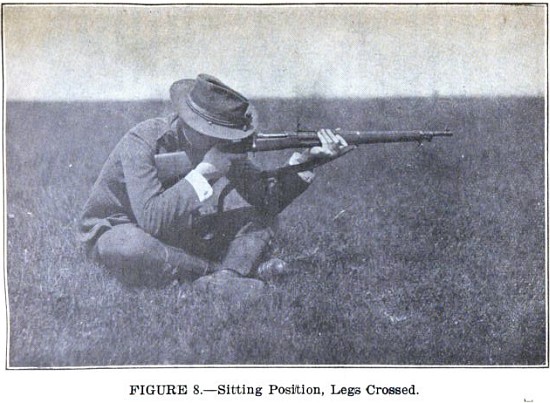
Townsend Whelen’s pre-war book on marksmanship which brought him to national prominence in the military establishment. Whelen, who coached the national championship winning Army rifle team at Sea Girt in 1906, covers all aspects of shooting the Model 1903 rifle, including long-range shooting. There is also an appendix covering the Krag-Jorgensen as it was still used by various state guard units at the time. Positions, sights, zeroing, windage, score books, slow-fire, rapid-fire, long-range, ammunition, vision; it’s all here. Every topic you see covered in a modern book on marksmanship was covered by Whelen in this book. You can’t know where you’re going if you don’t know where you’ve been — this is a “must read” for the serious marksman and student of history.
Modern Rifle Shooting From the American Standpoint, W. G. Hudson, 1903, 155 pp.
Dr. Hudson was one of the leading lights of the early smokeless era (as well as the Schuetzen era), a contemporary and friend of Mann and Pope, Hudson was a tireless investigator of all things related to accuracy. This hard to find book is an introduction to target shooting with a detailed overview of equipment and practices and is well illustrated with many images of top level equipment of the day.
Manual for Rifle Practice: Including Suggestions for Practice at Long Range, George Wood Wingate, 1879, 303 pages.
Wingate was the central figure in the founding of the National Rifle Association of America. Like Whelen’s manual 30 years later, Wingate’s book was adopted as the training manual by many military organizations. An authoritative view of marksmanship instruction in the day of the Trapdoor Springfield, Sharps, Remington Rolling Block, and Peabody military rifles. Includes diagrams and instructions for their care.
How I Became a Crack Shot — With Hints to Beginners, W. Milton Farrow, 1882, 204 pp.
Milton Farrow was one of the top shots of his time. Well-bred and highly educated, modesty was not among Farrow’s virtues. This makes for entertaining reading as he describes his travels and shooting accomplishments. The Hints for Beginners section has advice that remains sound these many years later.
The Gun and its Development, William Wellington Greener, 1907 (8th Ed.) 786 pages.
Originally published in 1881, Greener’s book covers all aspects of the firearms world at that time and this 8th edition has many updates. While much of the text focuses on shotguns, there is a great deal of other material in this massive tome, including coverage of gunpowder and explosived, pistols, rifles, target shooting, rifle clubs and much more of interest to the modern rifleman. Many great period advertisements at the end will make you wish for a time machine!
Cartridge Manufacture, Douglas Thomas Hamilton, 1916, 167 pages.
This book is a well-written, technical presentation of small arms cartridge manufacturing during the Great War. An inside look at all processes at the Frankford Arsenal including case manufacture, bullet manufacture, loading and packaging. A useful historical treatise on the topic.
These book titles were found by our close friend (and ace marksman) German Salazar. Sadly, German passed away unexpectedly in June, 2022 at age 62. German was a great inspiration to this site who helped guide the creation of the AccurateShooter Forum. A brilliant man, expert attorney, and top-tier marksman, German has been sorely missed in the shooting sports world.
It’s almost Christmas. In parts of Europe hunting season continues well into winter. To celebrate the hunting lifestyle, we’re reprising a story from Europe that showcases the beauty of nature that can be experienced on a hunting trip.
If you need a break from your hum-drum day at the office, how about taking a virtual vacation to Norway, where you can explore the scenic mountains in the Fjord region?
Forum member Kenneth Skorpen (aka “Sal”) has created a cool video of a deer-hunting trip he took in Norway. He didn’t bag a buck on this trip, but the walk in the Fjordland mountains took Kenneth through some spectacular scenery. (At the 11:25 time mark you’ll see an amazing sunset over the Fjord.) Kenneth did encounter a doe that had fallen down the mountain, and apparently broken its neck (14:35 time mark). The terrain is very steep, and Kenneth observed that: “I feel fortunate to be able to do this, but I also feel very tired in my legs. Did you know that the hares around here have shorter left legs due to the steep hills?”
More Hunting/Shooting Videos from Norway
You can watch more interesting hunting and shooting videos from Norway on Kenneth Skorpen’s Streken Vertebrae YouTube Channel. Here are some links:
And here is another Skorpen video showcasing beautiful Norwegian landscapes. This was filmed during a February rifle testing session with targets at 1100 and 1400 meters. You’ll see some stunning snow-capped scenery here, starting at the 4:30 time mark.
Top to bottom: Remington firing pin assembly with ISS, Tubb SpeedLock alloy-composite system without ISS (current versions have dual, opposite-wound springs), and Remington short action firing pin assembly without ISS.
The U.S. Army Marksmanship Unit regularly publishes technical articles on the USAMU Facebook page. One informative USAMU article covered mechanical issues and related ignition irregularities that can cause vertical fliers even with good ammunition in an otherwise excellent rifle. We highly recommend you read this article, which offers some important tech tips.
Vertical Dispersion: Mechanical/Ignition Issues?
Poor or inconsistent ignition has long been known to be one of the “usual suspects” when one encounters vertical fliers that just shouldn’t be there. By having a sense of some of the basic principles involved, and a few basic areas to check, the shooter may avoid colsiderable frustration, not to mention time, expensive loading components and barrel wear.
Is your well-built rifle of high-quality components plagued with vertical fliers across more than 1-3 handload combinations? Consider the bedding, crown and scope/sight mounts. Are they correct? If so, then you might check for ignition issues before boldly undertaking an extensive, expensive, and quite possibly fruitless quest for the “magic handload”.
SEEING IS BELIEVING: While the author had been aware for many years that poor ignition should be considered and ruled out when dealing with vertical fliers in an otherwise-excellent rifle, actually seeing the problem and its almost instantaneous cure really drove the lesson home.
He was working with a “dot” rifle – a .22 LR match rifle that really stacked bullets into little piles at 50 yards and beyond. With one lot of ELEY Tenex, it produced consistent “bughole” groups at 50, but with another, selected lot of Tenex, similar groups were regularly ruined by single, vertical fliers that did not appear in other rifles. Rather than spending days burning up expensive, select ammunition looking for “magic lots”, he contacted a well-respected rimfire gunsmith and explained the situation.
Without so much as batting an eye, the highly-experienced ‘smith tore into the rifle’s action, and quickly found the cause(s) of the problem. He discovered a demonstrably weak firing pin spring, plus a chip out of the face of the firing pin where it contacted the cartridge rim.
After replacing and tuning the offending parts, the rifle immediately began shooting tiny, bughole groups with the previously “unacceptable” lot of Tenex. Centerfire rifles can also benefit from ensuring positive, consistent ignition. A wise riflesmith is literally worth his weight in gold!
So, what are some issues we as shooters can inspect in our rifles to help determine if ignition woes could be part of our problem? At the club level, ask yourself if that “experienced” Remington, Winchester 70, or even Springfield-based match bolt gun you’re using is still running its’ original 40-80 year-old factory striker spring? If so, a new replacement is cheap insurance against current or future problems. (And BTW, it might be best to stick to the normal, factory-spec spring weight. A super-powerful spring can cause vertical, just as a weak one one can.) Along with that, a routine check for proper firing-pin protrusion is a quick preventive measure that can rule out potential issues.
Other areas to consider are the centering and consistency of the firing pin’s operation in the bolt. Admittedly, with the increasing use of precision-machined custom actions, this is becoming less an issue every day. Below is the firing pin assembly from a custom BAT action:
However, particularly with factory actions, a very quick and easy check is to remove the bolt, let the firing pin go forward, and look at the firing pin tip through the firing pin hole. Is the tip off-center in the hole, and possibly striking it as it moves forward? Is the hole out-of-round or burred from being struck repeatedly? If so, a trip to the riflesmith is likely in order.
Similarly, machining issues in the bolt/firing pin system can lead to rough and erratic firing pin movement, in which the firing pin drags against an internal surface of the bolt. In high-quality rifles these issues are relatively rare, but not unheard-of, and it takes mere minutes to rule them out. It may be worthwhile to remove the cocking piece/firing pin/spring assembly and look for any unusual gouges, dings, peening, burrs or signs of abnormal wear.
This task is especially easy with Winchester 70s, Springfields, and the similar Mauser 98s, involving little more than the push of a button and unscrewing the cocking piece assembly. This is just one of the many reasons these tried-and-true actions have earned such a loyal following in the field, among hunters who must maintain their rifles away from a shop.
Particularly with older rifles, watch for and remove excess grease (or even Cosmoline!) from both the firing pin assembly and inside the bolt. This can help improve firing pin speed and consistency. Other bolt-action designs may need a take-down tool or other measures.
As part of this inspection, AFTER ENSURING THE RIFLE IS UNLOADED, slowly cock the rifle, dry-fire, and repeat several times. Listen carefully near the action for inconsistency in the sounds it generates. Does the striker falling make the same sound each time? Do you hear or feel grinding upon operation? If so, where?
Be sure to check the operation of the cocking piece (bolt shroud), firing pin within the bolt shroud, the cocking piece cam and the rear of the bolt body where the cocking piece cam operates. As with our examination for abnormal wear marks discussed above, look for marks indicating roughness or a possible need for light polishing. Then, clean and lightly grease the bearing surfaces while you’re at it.
Remington 700 bolt shroud and cocking cam
These are relatively easy checks that shooters can undertake to perform a preliminary inspection on their own. Other mechanical issues can also cause ignition issues, chiefly centered around the action of the trigger, sear and sear spring. If these are suspected, a trip to an experienced, qualified riflesmith for diagnosis is recommended. We hope you find this information helpful! Join us again next week, and in the meantime, enjoy the shooting sports safely!
Do you know which one of your eyes is dominant? It’s easy to determine eye dominance with a simple exercise. Pick an object about 6-10 feet away (a light switch or door knob works well). Make an “OK” sign with your right hand (see photo) and hold that about 18″ from your face. Now, with both eyes open, look through the circle formed by your thumb and index finger. Center the circle on the object, so you can see the object in the middle.
Now, here’s the important part — while still holding your hand up, centered on the object, first close your right eye. If you don’t see the object anymore, then your right eye is dominant. If you still see the object, then repeat the procedure with the left eye shut and right eye open. If you don’t see the object when your left eye (only) is closed, then you are left-eye dominant.
The digital archives of Shooting Sports USA contain many interesting articles. A while back, Shooting Sports USA featured a “must-read” expert Symposium on Eye Dominance, as it affects both rifle and pistol shooting. No matter whether you have normal dominance (i.e. your dominant eye is on the same side as your dominant hand), or if you have cross-dominance, you’ll benefit by reading this excellent article. The physiology and science of eye dominance is explained by Dr. Norman Wong, a noted optometrist. In addition, expert advice is provided by champion shooters such as David Tubb, Lones Wigger, Dennis DeMille, Julie Golob, Jessie Harrison, and Phil Hemphill. NOTE: If the story doesn’t open at the links, go to the ssusa.org home page first, indicate you are over 18, and then CLICK HERE.
Top Rifle Champions Talk About Eye Dominance:
David Tubb — 11-Time National High Power Champion
I keep both eyes open, always. Some use an opaque blinder in rifle or shotgun shooting. If you close your non-dominant eye, you will not get as good a sight picture. If your aiming eye is not your dominant eye, you have even more of a problem to overcome.
Lones Wigger — World, National and Olympic Champion Rifleman
Shooters should try to use the dominant eye unless the vision is impaired and the non-dominant eye has better vision. You should always shoot with both eyes open since this will allow the shooting eye to function properly.
Dennis DeMille — National Service Rifle Champion
I close my non-shooting eye initially. Once I pick up my sight picture, it’s not something I focus on. For those that use a patch, I recommend that they use something white to block their view, rather than cover the eye.
Bruce Piatt — 2025 World Action Pistol Team Championship — Member of Winning Team CMP-USA
Some shooters, especially those with nearly equal or cross-dominance, will naturally find themselves squinting one eye. When anyone does this, you are also closing your dominant eye to some extent and adding stress to your face.
At the request of our readers, we provide select “Deals of the Week”. Every Sunday afternoon or Monday morning we offer our Best Bargain selections. Here are some of the best deals on firearms, hardware, reloading components, optics, and shooting accessories. Be aware that sale prices are subject to change, and once clearance inventory is sold, it’s gone for good. You snooze you lose.
NOTE: All listed products are for sale to persons 18 years of age or older. No products are intended for use by minors.
Natchez — SIG Sauer Optics Sale
⏺️ » Big discounts through 12/19/2025 — Optics and more
Riflescopes from SIG Sauer Optics offer great value for the price. SIG optics have high-quality glass, a wide variety of reticles, and many zoom options. On sale now at Natchez, SIG optics are known for their optical clarity, durability, and great value for the price. With these discounts, this is a great opportunity to buy.
EuroOptic — Outdoor Apparel & Gear Sale
⏺️ » Great deals on jackets, boots, bibs, vests, gloves, packs and more
If you need quality outdoor clothing and gear, check out EuroOptic’s Outdoor Apparel and Gear Sale. There are excellent jackets, vests, gloves, boots, bibs, winter hats and other clothing on sale with major discounts up to 80%. In addition, hunter backpacks and carry packs are on sale. With top brands like Sitka and Stone Glacier you’ll find rugged, comfortable, quality gear at some of the lowest prices of the season.
As an Amazon affiliate, this site can earn revenues through sales commissions.
Forum member 1LessDog calling in coyotes in a cold North Dakota winter landscape.
Forum member DNorton posted: “I live way up north where our white sandy beaches look like this!”
There is a nice thread in our Forum appropriately entitled “Winter Time”. You’ll find some great backcountry images taken by our Forum members. Winter is a special time in the outdoors. Forum member JDP explains: “Winter is the best time to shoot! One of the few of life’s ironies that works in my favor. The range is empty and barrels keep cool, no bugs, no waiting on people, no mirage. Yup, this world needs more thin blooded snow birds. This cool weather is terrible and dangerous, tell your friends! Do people get lonely while shooting or something? It’s the true holiday season in multiple ways.”
These two images come from Forum member Bill K on a winter varmint safari. He posted: “This was Varmint Shooter’s truck [showing the outside temperature] when we set up.” Brrrr… that’s cold.
The above photo is from Forum member 1LessDog, who posted: “The mound behind the Coyote is a Indian burial mound. There are six of them within a half mile of this one. I would really like to know how many coyotes I have shot off the mound. I would guess 4-5 a year over 35 years. It is one of my favorite spots to call from… any time I have a South to Southeast wind[.]”
Forum member Bojo posted images of his hunting trip in Northwestern Pennsylvania last week. Bojo wrote: “It was an early winter for us — temps from low 20s to mid 40s through a week’s swing. Our cold hits hard in January/February.”
The Vortex Blog contains an interesting article featuring recommended gear for a coyote hunting trip in late winter/early spring. This Vortex article covers all the items you’ll need: rifle, optics, shooting sticks, insulated clothing, Laser Rangefinder, game calls, carry packs and more.
In the article intro, Vortex notes: “Winter snow and cold temps don’t get Vortex’s Bill Krivanek down. In fact, quite the opposite. This time of year, he’s fired up about calling coyotes and putting a little fur on the ground. “There’s so much to love about these crafty critters”, said Bill. “They nearly always have the advantage. When you get one to come in to shooting range, you’ve really accomplished something. It’s as exciting as hunting gets.” CLICK HERE to read the FULL Article with a complete description of each item, shown in the lead photo above.
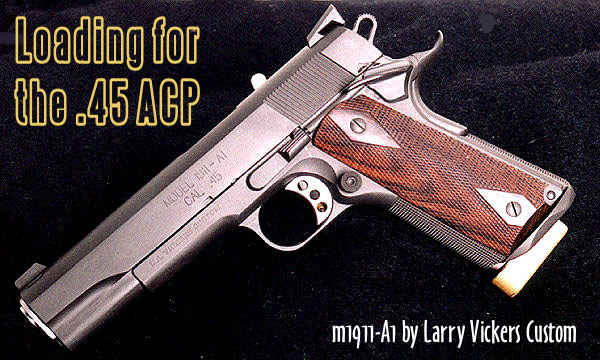
If you want to compete in top handgun competitions such as the CMP matches at Camp Perry, you’ll need good ammo that has low ES, consistent powder charge, uniform cartridge OAL, and consistent crimp. Every with action pistol matches you’ll want ammo that is very uniform. One miss on steel can mean losing a match. The following USAMU article provides rock-solid pistol reloading advice, explaining how to load accurate, reliable handgun ammo.
The U.S. Army Marksmanship Unit (USAMU) fields pistol teams as well as rifle and shotgun competition squads. Consequently the USAMU’s Reloading Shop loads tens of thousands of pistol rounds every year. In this article, the USAMU’s handgun experts talk about reloading for handguns — with smart tips on how to achieve superior accuracy with 100% reliability. This article, which offers important insights on COAL, primers, crimps and more.
Precision Pistol Reloading — Recommended Methods
Optimize the Taper Crimp
One often-overlooked aspect of handloading highly-accurate pistol ammunition is the amount of crimp and its effect on accuracy. Different amounts of taper crimp are used with various handloads to obtain best accuracy. The amount is based on bullet weight, powder burn rate and charge, plus other factors. It is not unusual for our Shop to vary a load’s crimp in degrees of 0.001″ and re-test for finest accuracy.
Use Consistent Brass
Brass is also important to pistol accuracy. While accurate ammunition can be loaded using brass of mixed parentage, that is not conducive to finest results, particularly at 50 yards. It is important for the serious competitor/handloader to use brass of the same headstamp and ideally one lot number, to maximize uniformity. Given the volumes of ammunition consumed by active pistol competitors, using inexpensive, mixed surplus brass for practice, particularly at the “short line” (25 yards), is understandable. However, for the “long line” (50 yards), purchasing and segregating a lot of high-quality brass to be used strictly for slow-fire is a wise idea.
Importance of Uniform COAL
Uniformity of the Case Overall Length (COAL) as it comes from the factory is also important to achieving utmost accuracy. More uniform case lengths (best measured after sizing) contribute to greater consistency of crimp, neck tension, ignition/burn of powder charge, and so on. Cartridge case-length consistency varies from lot to lot, as well as by maker. Some manufacturers are more consistent in this dimension than others. [Editor’s note: It is easy to trim pistol brass to uniform length. Doing this will make your taper crimps much more consistent.]
Primers and Powders — Comparison Test for Accuracy
Pay attention to primer brands, powder types and charges. Evaluating accuracy with a Ransom or other machine rest at 50 yards can quickly reveal the effect of changes made to handload recipes.
Bullet Selection — FMJ vs. JHP
Bullets are another vital issue. First, there is the question of FMJ vs. JHP. A friend of this writer spent decades making and accuracy-testing rifle and pistol bullets during QC for a major bullet manufacturer. In his experience, making highly-accurate FMJ bullets is much more difficult than making highly-accurate JHPs, in large part due to the way the jackets are formed. Small die changes could affect accuracy of FMJ lots dramatically.
The CMP now allows “safe, jacketed ammunition” in Excellence-in-Competition (EIC) Service Pistol matches, although wadcutter ammunition is prohibited. Thus, the option to use very accurate JHP designs simplifies the life of CMP Service Pistol shooters in pursuit of the Distinguished Pistol Shot badge.
Hopefully, these tips will be helpful to any pistol shooters interested in accurate handloads, not just “Bullseye” shooters. Small tweaks to one’s normal routine can pay big dividends in improved accuracy and make practice and competition more rewarding. Stay safe, and good shooting!
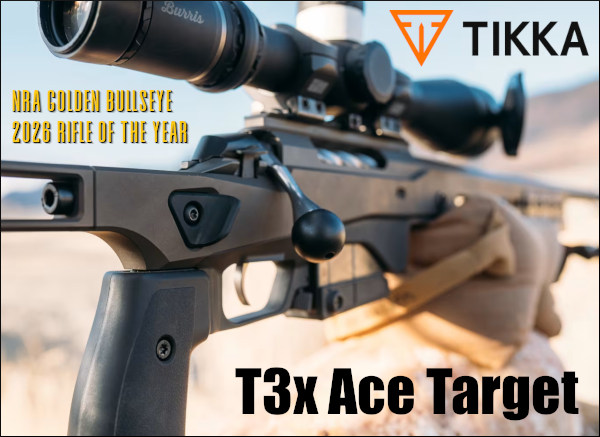
The Tikka T3x Ace Target was named the 2026 American Rifleman Golden Bullseye “Rifle of the Year”.
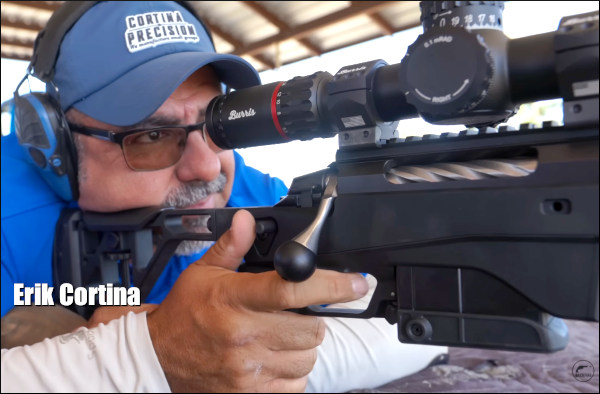
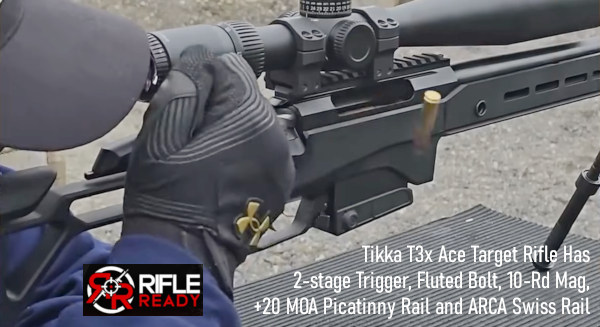
The Tikka T3x ACE Target rifle has been named the 2026 American Rifleman Golden Bullseye Rifle of the Year, a highly coveted award presented annually by NRA Media. This impressive factory rifle is a great choice for PRS/NRL competition. It boast a good chassis with full-length ARCA rail, modular magwell, and adjustable cheekpiece. The action is smooth with a nice fluted bolt and big bolt handle knob. On top of the action is a +20 MOA Picatinny rail which helps with long-range shooting. This rifle has shown very good accuracy with factory ammo, aided by an excellent 2-stage trigger that adjusts from 2 to 4 pounds.
Available chamberings are .223 Rem, 6.5 Creedmoor, and .308 Win with prices starting at $1799.00 at EuroOptic.com. The 6.5 Creedmoor with 26″ barrel would be our choice for PRS/NRL competition.
SPECIAL REPORT: NEW Tikka T3x Ace Target Rifle for PRS/NRL
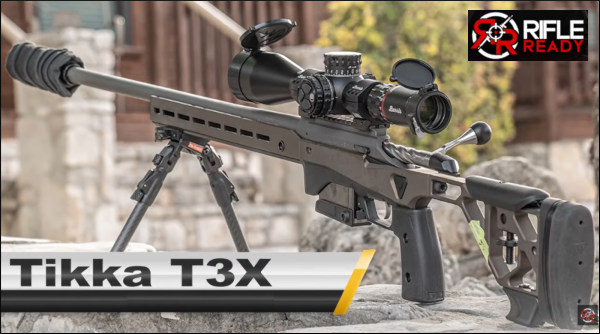
Tikka is best known for its rugged and accurate hunting rifles. But recently Tikka has introduced an impressive new line of T3x Ace Target chassis rifles. These 10.6-lb rigs have impressive alloy chassis stocks, with modular M-LOK and Arca-Swiss compatible fore-ends, and interchangeable magwells. Optimized for PRS/NRL competition, the Tikka T3x Ace Target has a fine 2-stage adjustable trigger, plus a rear stock section with adjustable cheek-piece and nicely-designed attached lower bag rider. NOTE: Tikka also offers the rimfire .22 LR Tikka T1x Ace Target rifle for practice and competition. This is cool because NRL-22 Matches are now very popular.
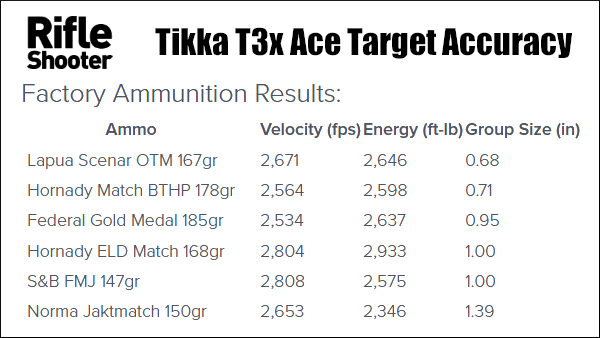
Accuracy Testing Results Rifle Shooter, a leading UK gun publication, did extensive accuracy testing of the Tikka T3X Ace Target. This testing is featured in the above video. Shooting from a bench with rear bag and front tripod, the test rifle delivered MOA (or better) accuracy with five out of six types of factory ammo. The best group, 0.68″ for 5 shots, was shot with Lapua ammunition with 167gr Scenar bullets. Here are the test results:
In another test of a Tikka T3X Ace Target, top F-Class shooter Erik Cortina achieved half-MOA or better groups with SAKO 6.5 Creedmoor ammo. Watch Erik shoot the Tikka T3x Ace Target in the video below, starting at 8:22 time-mark.
Tikka T3X ACE Target Rifle Features
2-Stage Adjustable Trigger (2-4 lbs)
Spiral-fluted Bolt with Coned Head
+20 MOA Picatinny Scope Rail
Free-floating Hammer-Forged Barrel
Adjustable Cheekpiece and Buttpad
10-shot steel CTR/Tac-style Magazines
23.6″ or 26″ Heavy Barrels with 5/8″-24 threaded muzzles
Full-length RRS ARCA Swiss Rail with barricade stop, M-Lok & QD Sling Mounts
Optional Factory External and Internal Weights
Two Colors: Black or Cerakote Midnight Bronze
Optional Cerakote coating
According to Rifle Ready: “The new Tikka T3X Ace lineup exploded out of SHOT Show 2025 and instantly became one of the most talked-about precision rifles of the year — and for good reason. With multiple testers recording sub-half MOA groups and even extended 15-shot strings under 1 MOA, the Ace is delivering near-custom accuracy right out of the box. Built on the legendary T3C action and paired with a full competition-ready chassis, the Ace Target and Ace Game rifles blend Finnish craftsmanship with modern modularity in a way Tikka fans have waited years for.”
Want to learn more? A Rifle Ready video released this month showcases Tikka T3X features. It covers real-world accuracy tests, reviewer impressions, and the differences between the Target and Game variants. This video does help explain why some shooters say the Ace “beats rifles triple its price”.
In promoting its rifle, Tikka posted: “The T3x Ace Target, crafted with Tikka’s legendary attention to detail, was developed for precision shooters seeking an out-of-the-box competition-ready platform. With its optimized barrel profile, enhanced ergonomics, and refined trigger system, the Ace Target embodies the advanced engineering and shooter-focused design Tikka is known for.” The video below features a test of the .223 Rem variant.






 With rain and snowstorms hitting the USA this Christmas week, we know many readers will be sheltering inside to stay warm and dry. Here are some good FREE reading materials to help spend the time indoors.




 If you need a break from your hum-drum day at the office, how about taking a virtual vacation to Norway, where you can explore the scenic mountains in the Fjord region?

 Is your well-built rifle of high-quality components plagued with vertical fliers across more than 1-3 handload combinations? Consider the bedding, crown and scope/sight mounts. Are they correct? If so, then you might check for ignition issues before boldly undertaking an extensive, expensive, and quite possibly fruitless quest for the “magic handload”.


 Do you know which one of your eyes is dominant? It’s easy to determine eye dominance with a simple exercise. Pick an object about 6-10 feet away (a light switch or door knob works well). Make an “OK” sign with your right hand (see photo) and hold that about 18″ from your face. Now, with both eyes open, look through the circle formed by your thumb and index finger. Center the circle on the object, so you can see the object in the middle.











 Use Consistent Brass