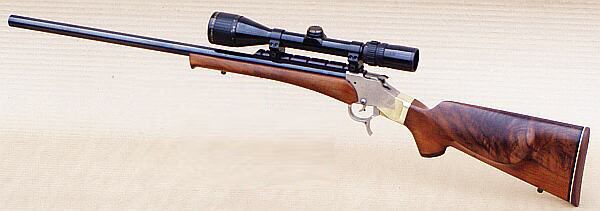
In the video below, Forum member (and F-Class ace) Erik Cortina shows how to install a Jewell Benchrest trigger into a Kelbly F-Class Panda action. You could follow the same simple procedure to install a Jewell in a standard Panda action. Kelbly’s sells both standard and long versions of the F-Class Panda action. Both versions feature integral recoil lugs in the front.
To see more detail in this “how-to” video, you can zoom it to full-screen size. Simply click the full-screen icon (4-cornered frame) just to the right of the YouTube logo in the lower right.
We have all been there — you place a piece of tumbled brass in the shell-holder of your press, raise it into the die, and suddenly it is like somebody hit the brakes. The case is stuck in the die. Your first instinct is to reverse it out. You crank on the handle, and BANG! The rim rips off the case head and you are looking at a piece of brass stuck in the die.
A stuck case is one of the boo-boos that all of us reloaders have faced from time to time. If proper lubrication is applied, then it should not be a problem. No matter if you are a seasoned reloader or new to it, this situation can happen. Take your time, use the proper procedures, and you will be back in business in no time! This article explains how to avoid stuck cases (through proper lubrication) and how to use a stuck case removal system.
What Causes Stuck Cases
One of the first common mistakes reloaders face is the stuck case. It can be caused by too much or too little lube. Too much and a vacuum can be formed causing the case to become suctioned into the die. Too little lube and friction is the culprit. So what is the cure? There is no exact cure, but the best lube that we have found so far is just a dab of Imperial Sizing Die Wax on your fingers and applied in a thin coat on the body of the case, not the shoulder or neck. Too much of this wax can cause the vacuum effect, or can eventually load your die up with gobs of residue. If it is applied to the shoulder area, or the leftover wax moves up into the shoulder region of the die, you will see dents or dimples in the shoulder. [AccurateShooter.com Editor’s Note: For normal full-length sizing of small cases such as 220 Russian/PPC, 6mmBR, 6.5 Grendel, or 6.5×47 Lapua we recommend Ballistol (aerosol) lube. It is very slippery, goes on very thin, and does not gum up the die.]
A great way to ensure that your dies are clean is to use a simple chamber mop with a dab of your favorite solvent on it and clean out the die. Be sure all of the solvent is out after cleaning by spraying the die out with Quickscrub III or use a clean chamber mop. If you are storing your dies, you can apply a thin coat of a good oil to protect the steel such as TM oil or Starrett M1 Spray.
This video shows how to use an RCBS Stuck Case Removal Kit:
Using a Stuck Case Removal Kit
If you do stick a case in your die there are a few good stuck case removal kits available. Each one works in a similar fashion. I have found the Hornady kit very effective and easy to use. [Editor: Forster, Lyman, and RCBS also make good kits for removing a case stuck in a die.]
Basically what you do is remove the die from the press. Unscrew the decapping assembly and pull it out as far as you can. You then need to drill/tap threads into the stuck case head (this is why it is suggested to unscrew the decapping assembly as far as you can to get it clear of the drill bits). Once this is done screw the die back into the press. You then install the included shellholder attachment on the shellholder ram, and thread it into the case via a small wrench. With some elbow grease you can reverse the stuck case out of the die with the leverage of the press, and not damage the die.
However if the case is stuck… REALLY stuck, you may pull out the threads on the case and you are still left with a stuck case in the die without any way to pull it out. If the case is really difficult to remove even with the use of a stuck case removal kit, do not try to be Hercules with the press ram. Here is a trick that may work. Take the die with the stuck case and place it in your freezer for a couple of hours. Then repeat the removal with the cold die. The freezing temperatures may cause the brass to contract, and make removal easier. If this does not work it is recommended to send it to the die manufacturer. They will be able to remove the case without damaging the die.
Another fix if you can remove the decapping assembly completely is to use a tap hammer and a punch or small wooden dowel to knock the stuck case out. This isn’t the best way since it is very possible that you will damage the die internally or externally on the threads, or both. Send the die to the manufacturer to have this done properly. You will be happier in the long run.
This article appears courtesy Sinclair International. It first appeared in Sinclair’s Reloading Press Blog.
Big news for High Power rifle shooters — Electronic Targets will be employed at the 2022 High Power Rifle National Matches at Camp Atterbury, Indiana. That means faster relays, quicker scoring, and NO PIT DUTY!
The 2022 NRA High Power National Matches will run at Camp Atterbury from July 8-28, 2022. Registration is now open. Click HERE to Register.
Silver Mountain Targets Electronic Targets at Camp Atterbury This Summer
The NRA has confirmed that the Silver Mountain Targets electronic target system will be deployed for the High Power Rifle phases of the 2022 National Matches at Camp Atterbury, Indiana. The Silver Mountain Targets (SMT) technology, the “fourth generation of Electronic Target System”, is an OPEN SENSOR system fitted to conventional wood target frames. It uses four sensors to plot shot location (and score value) with great precision. Scores are transmitted via a WiFi network to mobile devices placed at each shooting station. Along with shot location, the score values are listed and recorded on the receiving devices.
“The NRA has been working with the Indiana State Rifle and Pistol Association (ISRPA), as well as the Central Indiana High Power Rifle Shooters (CIHPRS) in order to bring electronic targets to the NRA National Matches”, said Joseph P. De Bergalis, Jr., Executive Director of NRA General Operations.
Over the past three years, the NRA has confirmed that Silver Mountain Targets systems have worked very effectively in rifle competition. The SMT sensor technology is now proven in competition: “In 2019, the ISRPA chose Silver Mountain Targets for our High Power matches including the ISRPA Across the Course State Championships and the Governor’s Cup match in 2019″, said ISRPA President Charles Hiltunen. “We did an extensive comparison of alternatives and Silver Mountain Targets best fit our needs. Since then we have been very happy with the targets.”
“Silver Mountain Targets is very excited to be chosen for the very first deployment of this technology at the NRA National Matches. Our advanced modular architecture represents the latest in electronic target technology,” said SMT’s David Schnelle. “The system is designed to be easily expandable and provide a high level of reliability. System components are battery-powered to simplify deployment on a military range and allows the system to even operate if there is a power outage. Communications between targets and the firing line is a highly reliable WiFi connection, utilizing any WiFi-capable device to display competitors’ shots.”
“The National Rifle Association is pleased to continue our improvements at Camp Atterbury in order to better serve the competitive shooting community and further promote the shooting sports”, said Cole McCulloch, Director of NRA Competitive Shooting.
“With the Silver Mountain Target system, we will be able to run more relays in less time and reduce demands on competitors and staff. We are also very pleased that technical representatives from Silver Mountain Targets will be on-site for the entire championship to ensure optimum performance and to train NRA staff and volunteers on the technology.”
Have you ever wondered how Olympic-class position shooters hold their aim so steady? Those bulky shooting coats help, but there is a lot of bio-mechanics involved also. Top shooters employ their body structure to help support the weight of their rifles, and to steady their aim. This interesting video, produced by GOnra Media, demonstrates rifle hold and body alignment for prone, standing, sitting, and kneeling positions. Olympic Gold Medalist Jamie Corkish (formerly Jamie Gray) demonstrates the proper stance and position of arms and legs for each of the positions.
Ideally, in all of the shooting positions, the shooter takes advantage of skeletal support. The shooter should align the bones of his/her arms and legs to provide a solid foundation. A shooter’s legs and arms form vertical planes helping the body remain stable in the shooting position.
Jamie Corkish, London 2012 Gold Medalist in Women’s 3 X 20, has retired from top-level competitive shooting. However, Jamie remains involved in the shooting sports as a Public Relations/Marketing representative for ELEY, a leading maker of rimfire ammunition. Jamie also works with shooting clubs and educational institutions to promote smallbore target shooting.
Images are stills from GOnraMedia video linked above.
We think everyone should have a .22 LR pistol or revolver (and probably both). Whether for plinking, target shooting, or self-defense, a good .22 LR can perform a multitude of tasks. Today, with the help of YouTube reviewers, we look at a variety of .22 LR pistols, focusing on compact .22s that can serve for self-protection, as well as plinking fun.
Can a .22 LR be an effective defense weapon? One retired officer posted: “As a police officer I saw more people killed by .22 or small caliber than with a 9mm or larger. I would not want to be shot by one. The benefits I see are minimal recoil, the ability to conceal, easier follow-up shots, [and] cheap ammo meaning more range time and training.”
Top .22 LR Handguns for Self-Defense — Video Reviews
LuckyGunner’s Top Compact Rimfire Handguns
Ammo supplier LuckyGunner.com has a very active YouTube Channel. There you’ll find numerous videos pertaining to .22 LR firearms and shooting. In this video, LuckyGunner host Chris Baker provides specific recommendations for compact .22 LR pistols and revolvers suitable for CCW use. This video focuses primarily on small and light rimfire pistols and revolvers.
Best Small .22 LR Rimfire Handguns for Concealed Carry
Best Six .22 LR Handguns for Defensive Use — 22 Plinkster
YouTube host 22 Plinkster has shot hundreds of thousands of .22 LR rounds through dozens of .22 LR handguns and rifles. Here are his “Pick Six” of compact .22 LR handguns that can work for self-defense. All of these pistols are compact and relatively light-weight. 22 Plinkster adds: “I didn’t list a few handguns in this video for a few reasons. Yes, there are other great options out there, but other guns can’t be concealed as easy as the guns that are in this video. Pistols like the Walther PPQ or the Taurus TX22 will make my top 5 list, just not this one.”
22 Plinkster’s “Pick Six” of .22 LR Pistols
Big Collection of Rimfire Pistols from the Major Manufacturers
This lengthy 53-minute video reviews nearly 20 semi-auto .22 LR Pistols. This is one of the most comprehensive comparison on the internet. The reviewer compares the Glock 44 with many other options on the market, including rimfire pistols from Beretta, Ruger, SIG Sauer, Smith & Wesson, Taurus, Walther and more. Target-style pistols are reviewed as well as smaller carry-style .22 LR pistols.
Numerous .22 LR Pistols Compared with Close-ups and Descriptions of features
Ten .22 LR Handguns compared including three rimfire revolvers
The next video, below, is another round-up with ten different .22 LR handguns. There are semi-autos from Beretta, Ruger, Smith & Wesson, and Walther. This video also features the tiny North American Arms .22 revolver, the classic S&W Model 63 revolver, and the Ruger LCR-22 compact carry revolver. The reviewer praised the Ruger SR22, which his wife carries. He says the “SR22 has so far been flawless — not one misfire. It is incredibly accurate and reliable. At only 0.9″ thick it is very conceable”.
Top Ten Concealed Carry .22 LR Pistols with Commentaries
The Effectiveness of the .22 LR Cartridge is Under-Rated
The folks from Lucky Gunner state: “Pocket pistols and revolvers chambered for the humble .22 LR are easily dismissed as carry guns suitable only for novices and the elderly. While there are some definite drawbacks to relying on a small gun that fires small bullets for self-defense, it also may have significant advantages that even skilled and experienced shooters can benefit from.” This video has been viewed 3.5 million times!
.22 LR Mini-Mag Tested in Ballistic Gel — You May Be Surprised
Here are two videos that reveal how a .22 LR Mini-Mag performs in test gel. In both videos, testers shoot the CCI .22 Mini-Mag into ballistic gel. The results are pretty impressive. This is still a .22 LR cartridge, but the potent Mini-Mag packs some punch, particularly at close ranges.
Of course a larger centerfire round carries more energy. But the Mini-Mag can do the job. One knowledgeable YouTube commenter, a retired LEO with 41 years of service, stated: “NEVER underestimate the power of a .22 LR CCI Mini-Mag. During my career, when working with a Medical Examiner, I [witnessed] bodies riddled with a .22. I don’t have to paint GORY details.”
BONUS Video: How .22 LR Ammunition is Made
If you’ve never seen how .22 LR rimfire ammunition is made, check out this video filmed at the Federal ammunition production plant in Anoka, Minnesota. This narrated video shows every stage of the process, from the melting of lead for the bullets to the final packing into boxes. The video host observes: “We were offered a rare glimpse into Federal’s rimfire plant in Anoka, MN to watch how .22 LR ammunition is made. We all know the basic components involved — each cartridge consists of a case with primer, propellant, and a bullet. Watching them all come together on a massive scale with a choreographed dance of modern automated machinery is a surprisingly gratifying experience.”
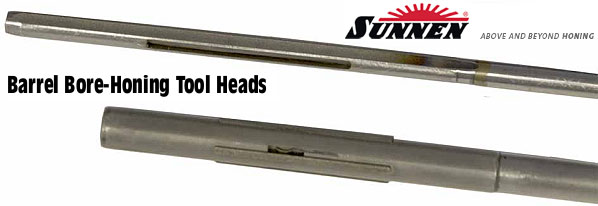
Some custom barrel makers are now honing barrels (after drilling) to improve bore diameter uniformity, smooth the interior finish, and reduce barrel lapping times. For years, large-scale manufacturers of hammer-forged barrels have employed honing. Now the process is being used by smaller, “boutique” barrel-makers. This article explains how and why barrel honing is done. Take the time to watch the video. For anyone with an interest in barrel-making, this video from Sunnen Products Co. is an eye-opener.
Barrel Honing Process Demonstrated (Worth Watching!):
For custom barrel makers, honing is a time-saver and cost cutter. A few minutes on a honing machine can cut lapping times in half, leaving a cross-hatched surface finish in single or low double-digit Ra. Honing is the same process used to make diesel fuel injectors with bore roundness and straightness controlled to fractions of a micron (<0.000040"), with surface finish Ra ≤0.15 µm (6 µin).
A key manufacturing process used for hammer-forged barrels is now getting attention from the makers of custom button-rifled barrels. This process is precision bore-honing. Honing produces a high-quality bore surface fast, which is critical to hammer forging. (Why is honing so important with hammer forging? Surface finish is the one feature of the barrel that cannot be controlled in hammer forging. Surface imperfections in a barrel blank tend to be amplified as the blank is formed on the rifling mandrel. And if the bore is chromed afterwards, imperfections in the surface finish become even more obvious.)
Honing dramatically improves bore diameter size uniformity and accuracy, surface finish and roundness throughout the length of the barrel. It can certainly be used in place of a pre-rifling lap. The chief difference between a lapped and honed bore is the direction of the finish lines in the bore. Honing leaves fine spiraling crosshatch lines, while a lap leaves lines going longitudinally in the bore. After rifling the manufacturer can remove the crosshatch finish with a quick lap if desired. Honing is fast, accurate, and can be automated. Its surface quality and geometry can duplicate lapping, except for the longitudinal lines of the lapped finish.
In 2015 Frank Green of Bartlein Barrels told us: “We worked with Sunnen and we did all the initial testing on the prototype machine for them. The machine works great! We ordered and received … a new manufactured machine with the changes we wanted on it and [subsequently] ordered a second one.”
The Sunnen hone secures the barrel blank in a 3-jaw chuck, with honing oil pumped into one end while the tool works from the opposite end. Sunnen’s specialized Long Bore Tool uses metal-bond diamond or CBN superabrasives to quickly remove reamer marks, waviness, tight spots and other imperfections left by upstream processes.
Sunnen states that: “Honing is an ideal replacement for hand-lapping barrel blanks before rifling. It quickly removes reamer scratches and surface waviness without labor-intensive hand lapping. By producing a consistent bore diameter (±0.0001″ or less), parallelism, roundness and surface finish end to end, honing yields more consistent performance from rifling buttons and cutters, resulting in a constant groove depth. The ideal bore geometry reduces distortion of the bullet shape.”
Computer-Controlled Bore-Honing
Honing can be done with great precision through the use of advanced, computer-controlled honing machines. Sunnen Products Company offers an advanced machine for .17 to .50-caliber barrels (see control panel below). The spindles on this machine can correct bore size imperfections so small only an air gauge can measure them. The consistency this allows improves bore uniformity, which, in turn, produces more accurate barrels for the precision market.
Sunnen Products Company is the world’s largest vertically-integrated manufacturer of honing systems, tooling, abrasives, coolants, and gauging for precision bore-sizing and finishing. Sunnen’s customers include manufacturers of diesel and gas engines, aerospace components, hydraulic components, oil field equipment, and gun/cannon barrels. Sunnen employs more than 600 people worldwide.
Brownells’ Do-It-Yourself (DIY) video series provides logical, step-by-step installation help for triggers, stocks, and springs. Nine separate videos cover Brownells various DIY Kits. Not sure if you’re up to the project? Just watch each video to see what’s involved. The nine DIY kits are:
This video shows Remington 700 after-market trigger installation:
In the Do-It-Yourself videos, Brownells’ Gun Techs proceed step-by-step, showing you exactly how to install the parts on your gun. Each kit also comes with complete, illustrated instructions you can take to the bench. To learn more, click the links above, or CLICK HERE to visit Brownells’ DIY Kit online page.
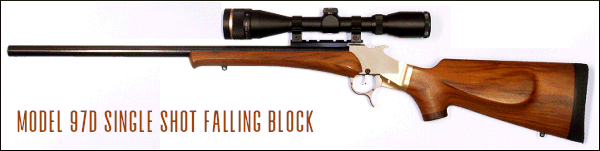
While a 16.5-pound benchrest gun is wonderfully stable on the bench, it’s not what you want in a field rifle. There is much to be said for a slim, light-weight, and easy-handling firearm when it comes to a walking varmint adventure. Eben Brown, who runs E. Arthur Brown Company, has created just such a rifle — the Model 97D Falling Block. When chambered for the 6PPC cartridge it delivered quarter-MOA accuracy in a splendidly portable package that tips the scales at just over six pounds without scope. The Model 97D is fairly unique in its lightweight and compact format — that makes it a great field-carry varmint rig. [Editor’s Note: This is an older article and we use some more recent photos of other model 97D Rifles to better illustrate the design and layout.]
Catalog photo of EABCO Model 97D Falling Block rifle.
Excellent Accuracy Made Easy for Sport Shooters
by Eben Brown, E. Arthur Brown Company
You don’t have to be a benchrest competitor to enjoy shooting one of the most accurate centerfire cartridges in the world, the 6mm PPC. With no complicated brass forming or finicky reloading processes, you can be shooting near half-inch groups right from the start and hone your skills to near quarter-inch groups by your second outing–at least that’s how it worked for me, and I’m NOT a good bench rest shooter! Developed by Louis Palmisano and Ferris Pindell, the 6PPC has won more bench rest accuracy competitions than any other cartridge. Easily made from Lapua .220 Russian brass, the 6mm PPC has a small primer and uniquely small flash hole that is credited for much of its inherent accuracy. The “short, fat” shape and nearly straight body contribute to efficient, consistent powder burning and stable chamber performance (it grips the chamber well during ignition).
The Brown Model 97D — A Slim, Accurate 6-Pound Rifle
The 97D was developed from the EABCO “BF” falling block silhouette pistols that have won world championships and set 500-meter distance records. In operation, the 97D falling block slides perpendicularly and closes the breech with absolutely zero camming leverage. This makes it a perfect test-bed to measure the chamber performance needed for hand-loading most other single-shot rifles accurately. At the reloading bench, I worked up a load with the now fully shaped 6mm PPC brass. I full-length sized the brass, trimmed, and primed each case the same as I would with any other cartridge, and began loading. With the resultant load, I easily shot a 5-shot 1/4″ group, a personal best for me. See target photo at right.
Making 6mm PPC Cartridges
Full-length size, prime, charge with powder, and seat a bullet… sounds like what you do with any other cartridge, doesn’t it? In fact, the only difference with 6mm PPC is that it has to be fired once (fire-formed) to expand to its final shape and size. But even fire-forming shots produce exceptional accuracy. I shot several 3/4″ groups while fire-forming at 100 yards, with my best group at nearly half-inch–so the time spent fire-forming was wonderful! In the photo, the parent .220 Russian case is on the left, while the fire-formed 6PPC case is on the right.
The EABCO 6mm PPC Chamber – 6PPC without Neck-turning!
We dimensioned our 6mm PPC chamber reamer to cut a chamber that fits Lapua 220 Russian brass closely without neck-turning. Naturally we recommend you use the Lapua brass for best results.
[Editor’s Note: We asked Eben if he had tried a 6BR chambering in a model 97D. He explained that, because of the extractor design, the falling block action works better with a smaller rim diameter: “The larger .308 rim width creates some issues. This design works best with cartridges no wider than the 30/30 case, or the 7.62×39 case, from which the 22 Russian case was derived. Cases with .308-sized rims develop more bolt thrust and work best with a different type of extractor than we use in the 97D. I love the 6BR, but I recommend the 6PPC for our 97D.”]
6mm PPC Reloading Data for Model 97D
The following loads were worked up in a Model 97D Rifle with 24″ barrel chambered for 6mm PPC with the chamber neck reamed to .275″ to fit Lapua brass without neck-turning. Lapua 220 Russian brass was full-length sized and fire-formed to 6mm PPC using 65gr V-Max bullets, CCI BR4 primers, and 24.5gr of VV N135 powder. Eben cautions: Load at Your Own Risk — Always start 10% low and work up
The following optimum loads were worked up with Vihtavuori N135, 58gr and 65gr V-Max bullets, and CCI BR4 primers. Please Note: There really is no “standard” for 6mm PPC. It can be finicky. But once you find what works best for you, the cartridge performs superbly. The accuracy will astound you.
Model 97D Specifications
OAL (with 24″ Barrel): 38″
Approx. Weight without Scope: 6-6.5 lbs.
Barrel: 17-26″ Chromoly or Stainless
Stock: Walnut w/Hardwood Grip Cap
Trigger: Tuned 16-24 ounces
This video shows the Loading Technique for Model 97D Rifle
Powder Selection — Choosing the Right Propellant
I’ve found that my maximum single-shot loads reach the same level of performance as bolt gun loads when I use one level slower burning powder type and proper chamber preparation. For example, when the VihtaVuori loading guide shows a maximum with VV N133, my best single shot load ends up being with the slower burning VV N135. Here’s the simplest way to proceed: Use a starting load from the loading guide and increase the powder charge until you detect some resistance to block movement with your thumb. Next, charge a case with that same amount of powder, tap it to settle, and look to see if the case is full to the base of the neck. If it’s not full, step up to the next slower-rated powder and repeat the load development process. There’s a powder burn rate chart for all brands of powder in the front of the current VihtaVuori Loading Guide. When you have the maximum load that will fill the case and still allow the 97D single-shot to open and eject freely after firing, you’re ready to shoot some groups!
Loading for Best Chamber Performance
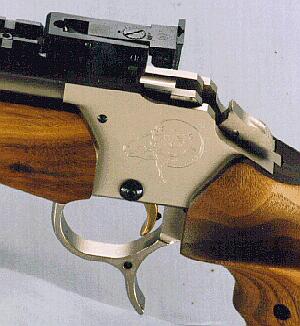
In the model 97D rifle you can check chamber performance easily. After firing a shot, see if you can press the block downward with only your thumb on the top of the block. If it moves freely, you’ve got good chamber performance.
I use three pressure indicators when developing loads on the Model 97D. First I check the block with my thumb. Then I check to see if the cartridge sticks at all when ejecting. And finally, I check the primer for the excessive flattening that would indicate too much pressure. Generally, the hottest load that still allows the gun to open and eject freely ends up being my most accurate shooting load.
Chamber Preparation
Best chamber performance happens when a cartridge grips the chamber and does not drive backward significantly. When you want something to grip (rather than slip), you want to make sure there is no lubricant on the gripping surfaces. Case forming lube and gun oil are the two lubricants you want to remove. Clean your 6mm PPC cases after sizing (I wipe mine with a paper towel and Windex). Clean your chamber with a chamber sized jag and patch wetted with acetone. (Note: protect your chamber with a thin coat of Clenzoil when you’re not out shooting.)
Conclusions of a Single-Shot Sport Shooter
I love the 6mm PPC! It was easy to hand-load for the cartridge and it was easy to get excellent results. The group shot on this page was with the 65gr bullet and a rifling twist of 1:10. I usually recommend a 1:12 twist and the 58gr bullet because customers have reported superb accuracy (better groups than I can shoot). But the 5-shot ¼” group I shot with this set-up is my personal best ever–so naturally I’m thrilled!
While it’s hard to beat the 6PPC’s accuracy in a Model 97D rifle, my company currently offers the rifle in a variety of chamberings including 17 Hornet, 219 Donaldson Wasp, and 6mm BRM. The 97D Standard features a blued 24″ chrome-moly barrel, French Gray receiver, anodized buttstock transition, 2-ring scope mount and swivel studs.– Eben Brown
About the production Model 97D Rifles: “The 97D is a small frame single shot rifle that’s suitable for big game as well as small game and varmint hunting. It originally evolved from our World Champion long range silhouette pistol action and incorporates the same accurate gun making processes. The 97D action itself is inherently accurate and simple. Onto this we fit an EABCO Accuracy Barrel, precision turned and threaded between centers. Each chamber is individually reamed on-center and individually head spaced. We feel the crown is so critical to accuracy that we leave it until after the gun is finished. Our 11 degree target crowns are cut last and left bright — our trademark finishing touch.”
Every Saturday we present interesting, informative videos for our Daily Bulletin readers. Here we feature five YouTube videos that offer a ton of useful information for serious shooters. We start with a great video about setting up rifle, rest, and bag on the bench. Then Hall-of-Fame benchrest shooter Speedy Gonzalez shows smart methods for cleaning barrels. Next F-Class Ace Keith Glasscock explains how to optimize your rifle after travel. In the fourth video, AutoTrickler inventor Adam MacDonald shows how to optimize the AutoTrickler V4. Next the truly outstanding 21st Century Power Neck-Turning lathe is showcased.
How to Set Up Your Rifle, Rest, and Bag on the Bench
To get the best results in benchrest shooting, you need to set up all the gear on your bench properly. That includes front rest placement, rear bag position, spotting scope set-up, and placement of cartridge holder/caddy, and possibly an elbow/forearm rest. When setting up the hardware, you need to align the front rest and rear bag properly to get optimal tracking. In addition you want to make sure the rear bag doesn’t slide or rotate a bit from shot to shot. And you also want to set your seat height/location so the shooter’s position is optimal and comfortable. This helpful video shows how to set up your rifle and gear for a benchrest match or load development/practice at the range. Credit to Boyd Allen for finding video.
Cleaning Barrels with Speedy — Smart Techniques
There are many effective methods to clean barrels. But some are more efficient that others and can help you do the job more quickly, with less effort. Here respected gunsmith and Hall-of-Fame benchrest shooter Speedy Gonzalez shows his procedures for cleaning competition barrels. He uses Sharpshoot-R Liquid Patch-Out and Wipe-Out Accelerator as primary solvents. Watch carefully — Speedy has some clever techniques for starting a patch in the rifling, and he is also careful about exiting the muzzle when brushing. Speedy also explains the importance of keeping your rods clean. And he prefers nylon brushes because, as the barrel starts to get wear in the throat, “the bronze bristles will actually start eating into that and you’ll see little grooves if you have a good borescope.” (See video 00:38-01:35)
Getting Rifle Ready After Traveling — Keith Glasscock
Keith Glasscock is one of America’s top F-Class shooters, having finished Second at the National Championships multiple times. Keith, who has an engineering background, runs the popular Winning in the Wind YouTube channel. There you’ll find great advice on wind reading, load tuning, precision reloading and many other topics. In this video, Keith offers very smart advice on how to re-assemble your rifle after you have traveled to a match or practice destination. Keith explains how to check the fasteners on the gun and set up the scope properly if you removed it while traveling.
Adjusting AutoTrickler V4 with its Inventor, Adam MacDonald
Adam MacDonald is the brilliant Canadian engineer who created the AutoTrickler series of automated powder dispensing systems. These work with advanced scales to dispense powder rapidly, but with a precise final trickle accurate to a single kernel. In this video, Adam explains how best to adjust and calibrate the AutoTrickler V4 when using powders that flow at different rates.
21st Century Power Neck-Turning Lathe — Great Tool
Turning case-necks can be tedious and tough on older hands if you’re using hand-held tools. Quite a few years ago 21st Century released a great compact, neck-turning lathe that delivers superb, consistent results. This Editor uses that original lathe with hand crank and I can affirm that it works great. It is easy to use, fast, and the turned necks come out smooth with consistent rim thickness. But you still had to turn a crank. Well, in 2018, 21st Century created an upgraded Power Neck-Turning Lathe with an electric motor and lever to advance the cases to the cutter. The power head glides on stainless steel guide rails. Power is controlled with a red button in the feed handle.
This advanced, powered mini-lathe is absolutely superb. It works brilliantly and makes the task of turning case-necks fast and VERY easy. And there is even a 3-Way trimmer upgrade that will trim cases to length at the same time as the necks are turned.
BONUS — How to Spot Fake Online Sellers of Components
With the shortage of premium reloading components, particularly powder and primers, many handloaders are desperate to find components when even big companies such as Midsouth and MidwayUSA are completely sold out. Enter the scammers. There are criminals, many based overseas, who have created entire websites designed to steal your money. You might find such a site when searching for “Varget powder in stock” or “CCI BR4 primers”. These sites look like regular business webstores, with product photos and modern shopping cart systems. But it’s all a scam.
Key giveaways are: 1) The site does NOT take Visa, Mastercard, or Discover but requires payment with Zelle, Venmo, Bitcoin, or AppleCash only; and 2) The site has hard-to-find powders, such as Varget and H4350, that nobody else has, and you can put thousands of pounds in the shopping cart.
Bottom line here — if the site allows you to order vast amounts of powder and/or primers, and does not take ANY major Credit Card types, it is almost surely a scam. If you see links to pay with Crypto-Currency (such as Bitcoin) run away!
Federal’s latest podcast features Hickok45, one of the most popular gun-centric YouTube video creators. Guest host Julie Golob connects with Hickok45 to talk guns, ammunition, and making videos. Golob and Hickok45 continue their discussion into the Tech Talk segment and Hickok45 talks about his favorite cartridges and firearms.
This “It’s Federal Season” Podcast offers covers a variety of topics including Hickok’s entry into the gun industry, what ignited his YouTube channel, and a day in the life of Hickok45. We recommend this podcast. Both Hickok45 and Julie are bright, articulate, and very knowledgeable.
“Being an average guy is the reason that I believe we’ve excelled,” Hickok45 told podcast host Julie Golob. Hickok, a retired middle school English teacher, started his run as a prolific content provider in 2007 and has seen a lot of changes during his tenure of making videos. “I take a lot of pride in providing an honest look at firearms,” says Hickok45.
That “honest look” method has proved hugely successful. Hickok45 now has over 6 million subscribers on his popular YouTube channel. His videos have, collectively, racked up over 2 billion views.
Episode No. 33 – Gun Talk with Hickok45
The latest “It’s Federal Season” podcast features Hickok45 and guest host Julie Golob. They discuss a day in the life of the YouTube legend, how he started making his videos, and his favorite cartridges to shoot at the range. Episode is highly recommended.
Click Arrow to Start Audio Podcast:
Watch Two of Hickok45’s Most Popular Rifle Videos
Want more from Hickok45? CLICK HERE to visit the Hickok45 YouTube Channel. Here are two “fan favorite” Hickok45 videos. The U.S. Military Rifles video has over 14 million views, while the 1860 Henry Rifle video has over 23.5 million YouTube views!


 A stuck case is one of the boo-boos that all of us reloaders have faced from time to time. If proper lubrication is applied, then it should not be a problem. No matter if you are a seasoned reloader or new to it, this situation can happen. Take your time, use the proper procedures, and you will be back in business in no time! This article explains how to avoid stuck cases (through proper lubrication) and how to use a stuck case removal system.




 The Brown Model 97D — A Slim, Accurate 6-Pound Rifle
 Making 6mm PPC Cartridges
 The EABCO 6mm PPC Chamber
 The following optimum loads were worked up with Vihtavuori N135, 58gr and 65gr V-Max bullets, and CCI BR4 primers. Please Note: There really is no “standard” for 6mm PPC. It can be finicky. But once you find what works best for you, the cartridge performs superbly. The accuracy will astound you.
 Loading for Best Chamber Performance