The NRA Blog ran an feature on Silhouette shooting by NRA Silhouette Program Coordinator Jonathan Leighton. Here are selections from Leighton’s story:
NRA Silhouette Shooting
The loud crack from the bullet exiting the muzzle followed by an even louder ‘clang’ as you watch your target fly off the railing is really a true addiction for most Silhouette shooters. There is nothing better than shooting a game where you actually get to see your target react to the bullet. In my opinion, this is truly what makes this game so much fun.
Metallic Silhouette — A Mexican Import
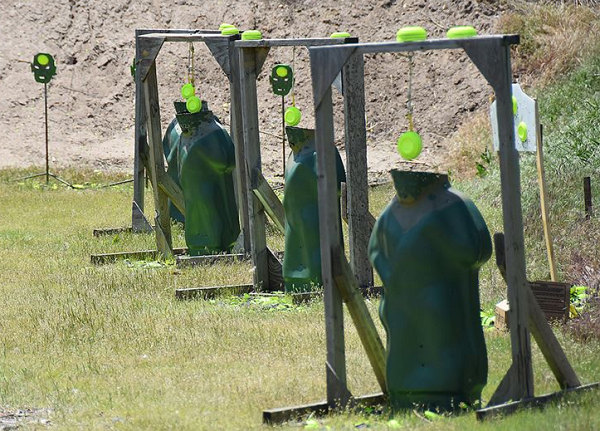
Silhouette shooting came to this country from Mexico in the 1960s. It is speculated that sport had its origins in shooting contests between Pancho Villa’s men around 1914. After the Mexican Revolution the sport spread quickly throughout Mexico. ‘Siluetas Metalicas’ uses steel silhouettes shaped like game animals. Chickens up front followed by rows of pigs, turkeys, and furthest away, rams. Being that ‘Siluetas Metalicas’ was originally a Mexican sport, it is common to hear the targets referred to by their Spanish names Gallina (chicken), Javelina (pig), Guajalote (turkey) and Borrego (ram). Depending on the discipline one is shooting, these animals are set at different distances from the firing line, but always in the same order.
Before Steel There Was… Barbeque
In the very beginnings of the sport, live farm animals were used as targets, and afterwards, the shooters would have a barbeque with all the livestock and/or game that was shot during the match. The first Silhouette match that used steel targets instead of livestock was conducted in 1948 in Mexico City, Mexico by Don Gonzalo Aguilar. [Some matches hosted by wealthy Mexicans included high-ranking politicians and military leaders].
As the sport spread and gained popularity during the 1950s, shooters from the Southwestern USA started crossing the Mexican border to compete. Silhouette shooting came into the US in 1968 at the Tucson Rifle Club in Arizona. The rules have stayed pretty much the same since the sport has been shot in the US. NRA officially recognized Silhouette as a shooting discipline in 1972, and conducted its first NRA Silhouette Nationals in November of 1972.
Silhouette Ace Eric Mietenkorte Shooting Smallbore Silhouette — Perfect Form:
Now There Are Multiple Disciplines
The actual sport of Silhouette is broken into several different disciplines. High Power Rifle, Smallbore Rifle, Cowboy Lever Action Rifle, Black Powder Cartridge Rifle, Air Rifle, Air Pistol, and Hunter’s Pistol are the basic disciplines. Cowboy Lever Action is broken into three sub-categories to include Smallbore Cowboy Rifle, Pistol Cartridge Cowboy Lever Action, and regular Cowboy Lever Action. Black Powder Cartridge Rifle also has a ‘Scope’ class, and Hunter’s Pistol is broken into four sub-categories. Some clubs also offer Military Rifle Silhouette comps.
Where to Shoot Silhouette
NRA-Sanctioned matches are found at gun clubs nation-wide. There are also many State, Regional, and National matches across the country as well. You can find match listings on the Shooting Sports USA website or contact the NRA Silhouette Department at (703) 267-1465. For more info, visit SteelChickens.com, the #1 website dedicated to Silhouette shooting sports.
The NRA Convention will be in the Lone Star State this year — in September. Originally slated for May 2021, the National Rifle Association’s 2021 Annual Meetings & Exhibits are now scheduled for September 3-5, 2021 at the George R. Brown Convention Center in Houston, Texas. The 2021 NRA Annual Meetings will celebrate NRA’s 150th anniversary as the oldest civil-rights organization in the country. The Exhibits Hall will be full of product and outfitter displays. More than 850 exhibitors will provide show-goers with a look at the latest firearms, ammunition, and accessories.
The NRA Annual Meetings & Exhibits is free for all NRA members, while some special events do require tickets. The organization plans to have a powerhouse lineup of political speakers, as well as an event exclusively for women exploring their right to keep and bear arms. Country music artists, seminars, workshops and more are available for the celebration of a lifetime.
Get the latest information on the 150th NRA Annual Meetings & Exhibits at NRAAM.org.
Are you thinking of getting involved in Pistol Competition? Along with IDPA, the U.S. Practical Shooting Association (USPSA) offers fun, sanctioned matches throughout the country. The USPSA production division allows you to be competitive without spending a fortune on a custom-built handgun. Hundreds of handguns are approved for competition on the USPSA Production Gun List. But some Production Division guns are better than others — at least in the opinion of active competitors. Two guns dominated the rankings — representing 51% of all pistols shot in Production Division:
At last year’s USPSA Nationals, competitors were surveyed. From the shooter surveys, we are able to determine the most-favored USPSA Production handguns. Here we present the top five, as ranked in the January/February 2021 issue of USPSA webzine.*
The most popular USPSA Production Division pistol, by far, is the CZ-USA Shadow 2 ($1350 retail). A full 39% of all Production class competitors at Nationals used CZ’s Shadow 2. With an all-metal frame, this beefy (46.5 oz.) pistol handles recoil well. It offers excellent accuracy out of the box. The Shadow 2, offered in various colors, features an ambidextrous safety, fiber-optic front and HAJO rear sights, and 17-round magazine. Shooting Sports USA states that: “Competitive shooters will also appreciate the double-action trigger, which is smooth and light with little to no reset.”
Here is the latest “Optics Ready” version of the CZ-USA Shadow 2 Pistol:
Being used by 12% of Production Division shooters, the EAA Tangfolio Witness Elite Stock II ($1302 MSRP) is the second most popular USPSA Production pistol. Crafted with chrome-finished metal slide and frame, this is a handsome pistol. Weighing a hefty 45 ounces (2.69 lbs), this pistol handles recoil well. This pistol has a 4.5″ barrel and holds a 17-round magazine.
Three Other Popular USPSA Production Division Pistols
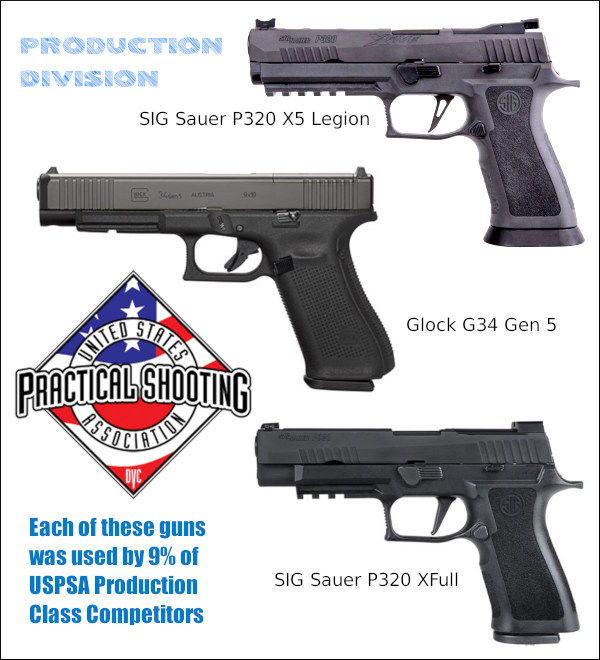
Tied for third place among USPSA Production pistols are two SIG Sauer 9mm handguns along with the well-known 9mm Glock 34. The long-slide Glock G34 ($700 retail) was used by 9% of the Production Division shooters at the USPSA Nationals. Likewise 9% of the shooters used SIG Sauer’s P320 ($600 retail) or the uprated P320 X5 Legion model ($900 retail). The P320 and P320 X5 are very similar, but the X5 offers an optics-ready slide, a longer frame, flared magazine bases, and skeletonized trigger. Shooting Sports USA states: “A heavy gun at 41.7 ounces, the X5 is a specially-designed version of the P320 for competitive shooting. Equipped with a grip module that has a weighted insert and an elongated slide… the X5 is not only popular for Production division, but also for Carry Optics competition.”
This Editor owned a Glock 34 for many years. My gun was very accurate, helping me win local IDPA matches. With its low bore axis, the Glock 34 comes back on target very quickly so you can make fast follow-up shots. As you’d expect, my Glock was extremely reliable. However, I was not a fan of the Glock’s trigger pull, which was somewhat vague and inconsistent. I think one reason for the #1 ranking of the CZ Shadow 2 is its superior trigger.
* This link takes you to the USPSA digital magazine archive. However, you must be a registered member of the USPSA to view the digital magazines or download PDF versions.
Gavin Gear, founder of the UltimateReloader.com website, has created a very popular YouTube Channel. Over the past 13 years, Gavin has produced hundreds of videos covering nearly every aspect of reloading, rifle assembly, and gunsmithing. When important new reloading products are released, you’ll often find that the very first, in-depth reviews come from Gavin. He seems to get the new stuff before ANYone else.
And Gavin’s multi-product reviews are legendary, such as his remarkable 14-Press Shootout. That video, in which Gavin set up and operated 14 different single-stage presses, has received over 583,000 views, making it Gavin’s third most popular video of all time. The Single-Stage Shootout video, along with Gavin’s five other most popular videos, are linked below.
Consider this a “Greatest Hits” showcase, with a half-dozen Ultimate Reloader videos that have, collectively, been watched nearly 8.5 million times. We present these videos in descending order of total YouTube views, leading with Gavin’s epic .223 Rem vs. 5.56 video, which has been watched over 5 million times.
.223 Rem vs. 5.56x45mm — 6.3 Million Views
Full Story:https://bit.ly/2neNXAS
This video explains essential facts and corrects common misconceptions related to both .223/5.56 ammunition, as well as .223/5.56 rifles. Gavin provides insight on chamber specs, pressure levels, barrel twist rates, military 5.56 crimped brass, and other important topics. If you are new to the AR world, this video is definitely worth watching. And that’s why it now has garnered over 6.3 MILLION YouTube views, making it one of the most popular gun-related videos ever. Gavin adds: “Don’t forget to check out the full write-up on UltimateReloader.com.”
Lee Loadmaster loading .45 ACP — 1.08 Million Views
The .45 ACP is a classic cartridge, and one of the best for a starting reloader. The case diameter is large enough that you can see the case fill level easily. Also you can pick a powder that won’t allow a mistaken double charge (the case will overflow). In this video, from Gavin’s early days on YouTube, Gavin shows how to run a Lee Loadmaster progressive. Lee should be paying Gavin royalties, as this video have been watched over 1 million times.
AR Handguard Upgrade Step-by-Step — 870,000 Views
The AR15 is truly “America’s rifle”. Along with buttstock replacement, one of the most common upgrades done by AR owners is changing out the front handguard. In this video, Gavin shows how to replace your stock handguard with a modern free-floating system. There can be accuracy improvements with this upgrade, and this also allows you to optimize the ergonomics and weight balance of your black rifle.
Full Story:https://bit.ly/2WS9jE0
This truly may be the “ultimate” reloading press video. Running a full 41 minutes in length, this video shows the features/operation of no less than fourteen (14) modern single-stage presses. No other reloading gear review even come closes to this video in terms of the variety of products covered and the sophistication of the tests. In his full story, Gavin offers comparison charts with sizing force and seating precision comparisons. He also measures ram to press frame fit.
Anyone considering purchasing a single-stage press should watch this video from start to finish. A typical gun magazine review might look at two or three presses, load a few rounds, and then offer some subjective comments. Gavin studied 14 presses, did very thorough testing, and delivered tons of objective data. Listed below are 13 of the presses tested. Click each press name for specific details and test results:
Lee Loadmaster Loading .223 Rem/5.56 NATO — 526,000 Views
Here’s another early video from the Ultimate Reloader YouTube Channel. Gavin shows how to produce .223 Rem/5.56x45mm ammo with an affordable Lee Loadmaster progressive. Gavin explains how to set up the Loadmaster and how to best control priming, case sizing, and powder-dropping operations. For anyone thinking about getting a progressive press, this video is worth watching. Gavin has created many other videos reviewing progressive presses from Dillon, Hornady, and RCBS. And just last year he showcased the amazing Mark 7 Apex 10, a ten-station progressive press marketed by Lyman. Gavin’s Mark 7 Apex 10 was equipped with both case-feeder and bullet feeder, allowing very impressive production rates.
How It’s Made: BAT Custom Rifle Actions — 489,000 Views
Full Story:https://bit.ly/3hD2d11 BAT Machine Co. makes some of the finest custom actions you can buy. Numerous national and world records have been set with BAT actions. To create this 31-minute video, Gavin traveled to Idaho to visit the BAT Machine production center in Post Falls, ID. Gavin talked with BAT’s founder Bruce Thom. The video features extensive footage of advanced CNC machines used to produce the superb BAT actions.
Click Image Below to Visit the Ultimate Reloader YouTube Channel:
When you make a reloading mistake, you may need to “pull down” assembled ammo. The embedded UltimateReloader.com video demonstrates how to use the Hornady Cam-Lock bullet pulling system.
When Reloading Goes Bad — The Danger of Over-Charging
Our friend Gavin Gear of UltimateReloader.com was recently reloading some 9mm pistol ammo with his Hornady progressive press. As part of his reloading procedure, he visually checks the cases — and he noticed that the charges seemed high. Sure enough, his most recently-produced rounds were about two grains over spec. He diagnosed the issue: “I was using a powder measure without a baffle. What happened was, over the course of the loading session, things settled in, and the charge level increased.”
Not knowing just when his powder measure started delivering too much powder, Gavin decided, for safety’s sake, to pull down all the ammo he had just reloaded. Yes that’s time-consuming, but it’s better than the alternative — having a dangerous Kaboom while shooting. With fast-burning pistol powders, a two-grain over-charge could cause a blown case, damaged firearm, and/or serious injury.
Watch Cam-Lock Bullet Puller Used to Remove Bullets from Loaded Ammo:
Use of Bullet Puller starts 4:00 minutes into video.
Gavin says it is vitally important to perform safety checks during the reloading process: “You’ve got to do it — check every single round to make sure there IS powder, and that there’s not too MUCH powder. Double, Triple, Quadruple check your components… and your powder charges. You can’t be too careful.”
To pull down a loaded round, first place the cartridge in the shellholder on your press ram. Then raise the round up into the bullet puller device installed where a die would go. The Hornady Cam-lock bullet puller works by clamping the bullet in a collet when you flip down the red-coated lever. Then, with the case held by the rim in the shell-holder, the bullet exits the cartridge as the press ram is lowered. It takes time, but it’s pretty fool-proof once you get the hang of it. This entire process is illustrated in Gavin’s video, starting near the four-minute mark.
The Hornady Cam Lock Bullet Puller has four (4) key components: 1. Cam-Lock die body; 2. Cam-Lock lever; 3. Stem; and 4. Collet (Caliber-specific).
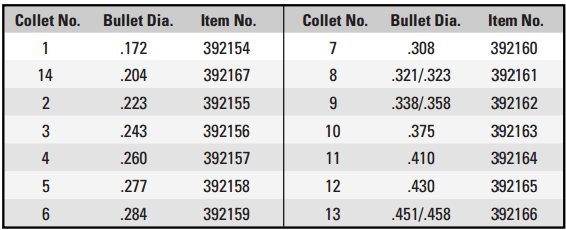
NOTE: In order to use this tool, you’ll need the appropriate collet for each diameter range of bullets you intend to pull. For example use collet #3 for 6mm, collect #6 for 7mm, and collet #7 for .308 Caliber.
RCBS Lock-Out Die
A good safety option for users with progressive presses is the RCBS Lock-Out Die. This has a charge detection rod that dips into each case after powder has dropped. You adjust the die to the proper charge height for your desired load. If the actual dispensed charge is too high or too low, the Lock-Out Die senses the problem and stops the press from advancing to the next case (it does this by preventing the ram/shellplate from fully elevating). We’ve used the Lock-out die with success for both pistol and rifle cartridges. It’s sensitive to about one-half grain with pistol powders.
This Lock-Out Die works with Hornady and Dillon progressives as well as with RCBS progressives. It does take up one die station on the press.
Many notable shooting matches are being held this month. As Pandemic restrictions recede, competitive shooters are getting back to the range, and that’s definitely a good thing. F-Classers are competing in Tennessee this weekend (see V² Finale Report), and PRS/NRL aces will be competing in Colorado.
The Colorado tactical match is something new — the inaugural Koenig Shooting Sports Precision Rifle Competition. This challenging event takes place this weekend, June 12-13, at the Cameo Shooting and Education Complex outside Grand Junction, Colorado. Doug Koenig will serve as the match director.
This two-day event is expected to attract some of the best precision rifle competitors in the nation, all vying for points to earn an exclusive spot at the year-end PRS Pro Series Finale. Utilizing the picturesque landscape and natural terrain props found at the Cameo Shooting Complex, each competitor’s skills will be put to the test while engaging an assortment of steel, reactive, and automated moving targets at distances from 300 to over 1000 yards.
“I want to thank Ruger not only for their support but also for their continued commitment to this sport,” commented Koenig. “The introduction of the Ruger Precision Rifle disrupted the world of PRS by making it a much more affordable discipline to participate in, so it is only fitting that they are the presenting sponsor of this exciting event.”
Doug Koenig and the Ruger Precision Rifle
“Koenig” (or König) means “king” in German. That is indeed appropriate for Doug Koenig, 19-Time Bianchi Cup winner, who is now starting to conquer the rifle world as well. Koenig, considered by many to be the best action pistol shooter on the planet, proved he’s an ace with rifles too, as he has had multiple PRS Production Division victories. Koenig, Captain of Team Ruger, shoots a Ruger Precision Rifle (RPR), chambered in 6mm Creedmoor. Notably, Production Division limits rifles to $2000.00 for the gun ($4000.00 overall with scope). You can buy an RPR for around $1350.00 typically ($1320.99 at KyGunCo).
In this video, Gavin Gear Shows How to Accurize a Ruger Precision Rifle:
This Interesting Cut-Away Animation Shows How the Ruger Precision Rifle Functions:
Hornady’s 2021 Zombies in the Heartland 3-Gun Match
Nearly 400 zombie hunters armed with handguns, shotguns, and rifles converged in Grand Island, Nebraska, June 4-6, 2021 to battle the “undead” during the 9th Annual, Zombies in the Heartland 3-Gun Match hosted by Hornady and the Heartland Public Shooting Park.
Shooters from 20 different states tested their talent in the 10-stage match. Specially developed reactive zombie targets kept shooters engaged and entertained. Participants shot from a suspended motorcycle, through a burned-out auto yard, and while sitting in a parked pickup truck where shooters were required to turn the wheel to see targets.
The top shooters in each class were:
Open: Jon Wiedell, 1st overall
Tactical: Riley Kropff, 2nd overall
Amateur: Jeremiah Ochsner
PCC: Kelly Neal
Lady: Dakota Overland
Junior: Logan Toland
Senior: Tony Holmes
Super Senior: Jerry Miculek, 3rd overall
“We look forward to this match every year,” said Jeremy Millard, Hornady Engineer and Match Director. “Competitors from many different states travel to this match because they enjoy the environment, stages and camaraderie,” Millard added.
“The Zombie Match would simply not be possible without the help of our amazing volunteers” said Steve Hornady, President. “In addition, all of the sponsors that donate to this match – thank you. We had a prize table valued at $130,000 this year, that’s incredible,” Hornady added.
Zombies in the Heartland Highlights Video. This well-made 2017 video is worth watching! This video offers Shooter’s POV views of many stages including full auto:
Over 8 million Americans purchased their first firearm, typically handguns, over the last year and a half. These first-time gun owners definitely need to train with their new guns. In addition, all CCW permit holders should definitely practice regularly. For many, pistol practice is an indoor experience. Indoor ranges are most convenient for those who live near urban centers, where the biggest threats to public safety currently exist. This article talks about indoor firearms training and the proper procedures you should follow at indoor ranges.
This Video Covers Basic Gun Range Safety Rules and Etiquette
FIVE IMPORTANT SAFETY PROCEDURES for Indoor Ranges
1. Follow the Three Fundamental Rules for Safe Gun Handling
ALWAYS keep the gun pointed in a safe direction. ALWAYS keep your finger off the trigger until ready to shoot. ALWAYS keep the gun unloaded until ready to use.
2. Follow ALL Range Officer Instructions
ROs are the first and final authority on any range and their decisions are generally final. Arguing with a Range Officer may just get you thrown out.
3. Don’t Bother Others or Touch Their Guns
Respect other shooters’ privacy unless a safety issue arises. Do NOT engage other shooters to correct a perceived safety violation unless absolutely necessary – inform the RO instead. NEVER handle or touch another shooter’s firearm without their permission!
4. Know Your Range’s Rules
Review and understand any and all range rules and requirements/expectations. For example, what is the range’s maximum rate of fire? Are you allowed to collect your brass?
5. Know What To Do During a Cease Fire
IMMEDIATELY set down your firearm, pointed downrange, and STEP AWAY from the shooting booth (or bench). Range Officers do not want shooters trying to “secure/unload” their firearms in a cease fire situation — they want the shooters separated from their guns instantly.
BAD RANGE BEHAVIOR — Five Things NOT to Do at the Range
Here are the five worst behaviors we’ve seen at indoor ranges. These behaviors are both dangerous and inconsiderate. Any one of these behaviors can get you permanently banned from an indoor range.
1. Sweeping other individuals after loading a weapon behind the firing line is very bad. All your weapons should be empty until you reach your shooting station.
2. Turning the handgun sideways while trying to clear a malfunction or insert/remove a magazine. This will point the muzzle at a fellow shooter. Or, after shooting a gun, the shooter fails to clear the weapon and then places the gun somewhere near the shooting station with the muzzle in an unsafe position.
3. Reacting unpredictably when firing a high recoil handgun. We’ve seen people take a second shot by accident with the muzzle way off target.
4. Not obeying range commands — in particular continuing to shoot during called cease-fires.
5. Poorly aimed shooting that hits target frames or carriers, causing ricochets.
Double-Up on Hearing Protection When Shooting Indoors
When shooting indoors we recommend quality muffs with earplugs underneath, offering double protection. When inside an enclosed range, with other shooters blasting away right next to you, you really need effective hearing protection. But you also need to hear range commands and be able to communicate. That’s why we recommend electronic muffs with plugs underneath.
For pistol shooting, we like the latest Howard Leight Impact Pro Muffs. These offer an impressive 30 dB Noise Reduction Rating (NRR). In addition, these muffs are pretty comfortable and offer Headphone Functionality so you can connect to your smartphone, MP3 player, or other audio device. These muffs are a good value. These are an Amazon’s Choice for $56.35.
Fans of PRS/NRL competition should check out this Armageddon Cup show. Shooting USA offers a special hour-long edition devoted to the second Armageddon Gear AG Cup Invitational. The show airs today, Wednesday 6/9/21 at 9:00 PM Eastern/Pacific (8:00 PM Central) on the Outdoor Channel. You can also stream the show anytime on Vimeo.
The 2020 AG Cup showcased an all-star line-up of tactical talent. 42 of the nation’s top PRS/NRL marksmen were invited to the three-day match at the Arena Training Facility in Georgia. $90,000 was up for grabs at this event — the highest cash payout in the history of rifle competition. There’s $1,000 for the winner of each stage and $50,000 for the overall winner of the Cup.
Watch Video for Highlights of Armageddon Gear Cup Tactical Match:
This full, 48-minute AG CUP episode can be streamed on Vimeo for $0.99. Or you can watch an unlimited number of Shooting USA shows for a $3.99 per month subscription. Click the video above to preview the broadcast.
2020 was the second year of the Armageddon Gear Cup match. With $90,000 in total prizes (and $50K for the Cup Winner) there couldn’t be more excitement or more pressure as the field of 42 competitors is cut down to 12 finalists. Those dozen finalists started Day Three with a clean record in their quest for the Cup title and huge pay-out.
Armageddon Gear Founder Tom Fuller competes in PRS and supervised the 2020 AG Cup.
In this hour-long Shooting USA special, John Scoutten and Armageddon Gear’s Tom Fuller report the action and interview top competitors. The winner of each of the 20 stages received a $1000 cash prize. During the show, you can watch the competitors adapt to challenging stage set-ups and weather conditions. With $1000 at stake for each stage, a single miss can cost serious money!
Arena Training Facility — 2300 Acres
The 2300-acre Arena Training Facility is a premier shooting facility with multiple shooting ranges from 50m to 2100m. Arena’s 1000-yard covered Known Distance range offers multiple benches, steel and paper targets out to 1000 yards. On Arena’s UKD (unknown distance) range shooters can engage steel out to 2300 yards. This 2100m UKD range boasts a 3-Story Shooting Tower, Air-Conditioned Shoot House, and multiple Positional Challenges.
Armageddon Gear — Tactical Accessories Armageddon Gear, founded by former U.S. Army Ranger Tom Fuller, sells support bags, gun cases, slings, suppressor covers, scope covers, and other accessories popular with the PRS/NRL crowd. Armageddon Gear now provides products to the U.S. Military, Law Enforcement, as well as PRS/NRL competitors.
Armageddon Gear Game-Changer Bag
Shooting USA is available On Demand via Vimeo.com. Watch a single episode for $0.99, or get a full-month subscription for $3.99 and watch as many shows as you like with limited commercial interruptions.
Pieter “Piet” Malan is a South African precision rifle shooter and hunter who has created an impressive YouTube Channel with over 300 videos. While Pieter’s Impact Shooting Channel focuses primarily on tactical PRS/NRL type disciplines, his channel also includes dozens of videos of interest to hunters and anyone who handloads rifle cartridges. We particularly like Pieter’s tech review videos which explain important reloading methods and showcase new products.
Here are four Peiter Malan tech videos. Topics include annealing, hydro-forming, case priming, and how to record video with spotting scopes. As a bonus for you hunters out there, we added Pieter’s latest hunting video, Kudu Hunting Paradise Part 2. After watching that, you’ll probably want to book an African Safari.
Hydro-forming Dasher Brass Using Hammer Method
Fire-forming 6mm Dasher brass can be fairly costly if you factor in barrel life along with the cost of components. If you figure a new 6mm custom barrel, chambered and fitted by a top smith, could cost $650.00 and may only be good for 1300 rounds (in competition), barrel cost per shot is $0.50 (fifty cents). Add the price of a bullet, powder, and primer, and you are approaching $1.00 per round. Given those numbers, it makes sense to hydro-form your 6mm Dasher brass. In the USA, DJ’s Brass will hydro-form and then anneal your cases for $0.60 per case. That’s not much more than the barrel cost per shot alone for fire-forming.
In this video, Pieter Malan explains the hydro-forming process for Dasher brass and shows how he does the job using the mallet method with hydro-forming dies. He shows that it takes some technique (and multiple hammer blows) to get a good result, with a case that will fit in the chamber.
Annealing Cartridge Brass with AMP Annealer
With premium cartridge brass for popular match cartridges now approaching $1.20 (or more) per case, you want that new brass to last. But after multiple firings, even the best cartridge brass will start degrading. That’s where annealing comes in. Proper, precision annealing can restore case-neck consistency, reducing ES/SD and improving accuracy. Some top shooters anneal after every firing to keep their brass in top condition. Others will anneal after every 4-6 firings.
Today with the advanced AMP microprocessor-controlled annealing machine, brass cartridge annealing is easier yet more precise than ever. The AMP Annealer provides advanced electrical induction annealing with ultra-precise temperature control set perfectly for your cartridge type and brand of brass. In this video, Pieter shows how to use the AMP Annealer to anneal 6mm Dasher cases and other cartridge types.
Primal Rights CPS — World’s Most Expensive Priming Tool
Seating primers can be a “dark art”. Many top shooters prefer to seat “by feel” using a hand tool. Others prefer lever-equipped, bench-mounted tools that offer higher work-flow rates and less strain on the hands.
There are many bench-mounted priming options — Forster has a tool, as does RCBS, and Lee. At the top of the heap is the $600 Primal Rights Competition Primer Seater (CPS). This may be the most precise bench priming tool ever created. It is certainly the most expensive at $600.00. But the CPS delivers something special — superb, repeatable depth control, along with the ability to prime up to 1000 cases per hour. For some reloaders, that precision + productivity will justify the high price. In this video Pieter reviews his Primal Rights Competition Primer Seater.
How to Record Video Through Your Spotting Scope
There are many things viewed through a spotting scope that you might want to record for posterity — a successful hunting shot on a game animal, or steel targets being hit in a PRS match. In addition, after a match, it can be useful to study the wind conditions and mirage that occurred during a match. This can help improve your wind reading skills as you watch what unfolded.
In this video, Pieter shows how to mount a smartphone to the eyepiece of a spotting scope with a plastic adapter. This allows you to record, for posterity, what the scope is “seeing”. In addition, this allows the viewer to see the scope’s magnified image conveniently without having to strain into the eyepiece and focus on a very small exit pupil.


 The NRA Blog ran an feature on Silhouette shooting by NRA Silhouette Program Coordinator Jonathan Leighton. Here are selections from Leighton’s story:
 Metallic Silhouette — A Mexican Import
 Before Steel There Was… Barbeque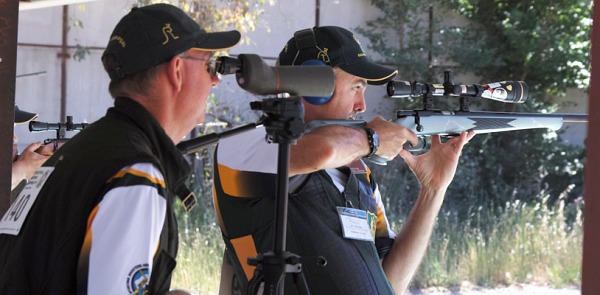




 RCBS Lock-Out Die