Koenig Triumphs for 19th Time
Team Ruger Captain Doug Koenig has just won the Bianchi Cup (NRA Action Pistol Championship) for the 19th time in his career. That is a remarkable accomplishment, as the the Bianchi Cup is considered by many to be the most unforgiving and difficult pistol competition on the planet. This legendary competition draws the top pistoleros from around the world. The Bianchi is Tough — for a chance to win overall, you basically have to “shoot clean”, with perfect stages.
Koenig won the Open Division and finished First Overall, capturing the title with a final 1920-182 Aggregate — truly impressive. Koenig took the win shooting a Ruger Custom Shop SR1911 Competition pistol. This championship was held at the Green Valley Rifle & Pistol Club in Hallsville, MO.
Koenig nailed perfect scores of 480 on all four Bianchi Cup events: Practical, Barricade, Moving Target and Falling Plates. That quadruple perfect performance earned Koenig an Aggregate score of 1920. In addition he completed the match with 182 total X-Ring hits, six more than the nearest competitor. By the way, Koenig (aka König) means “King” in the German language. There is no question that Koenig is King of the Bianchi Cup.
“Winning the Bianchi Cup title for the 19th time in my career is very special on its own,” said Koenig. “But to do so after the difficult year we’ve all faced, and to do so wearing a Team Ruger jersey, has made this win that much more meaningful for me.”
What skills does it take to win a Bianchi Cup? You need speed, accuracy, control, and discipline. Koenig explains some of these techniques in these two videos below. You’ll find 30 more Doug Koenig Videos on the NSSF YouTube Channel:
Lapua now offers a FREE Ballistics App. This was the first mobile ballistics App utilizing the 6DOF calculation model, making it one of most accurate ballistics Apps on the market. With this free mobile App you can calculate trajectories, range, bullet drop, turret adjustments and more.
Lapua’s sophisticated FREE Ballistics App has many great features — much more than you’d expect for a free App. If you do much shooting past 300 yards, or use a wide variety of bullets and/or cartridge types, definitely download the App and give it a try. For more details, read the Lapua Ballistics App User Manual. This handy PDF file explains how to set up the App and utilize all its powerful features.
Smith & Wesson plans to expand its GUNSMARTS video series with over thirty new educational videos for both new and experienced firearms owners. Hosted by legendary shooter Jerry Miculek, talented competitor Julie Golob, and industry expert Ken Scott, Smith & Wesson’s GUNSMARTS Series 2 covers a comprehensive set of topics. These subjects will include firearms education, shooting tips, gear recommendations, and more. These videos can provide valuable information for all firearms owners, not just new handgun purchasers.
To See ALL S&W Gunsmarts Videos, click these Series 2 and Series 1 Playlist Links:
Matt Spafford, S&W’s Sr. Marketing Manager, said, “We received an overwhelming amount of positive feedback after the launch of GUNSMARTS in 2020, and as such, we’ve developed GUNSMARTS Series 2. This new content series provides new, exciting videos to help both new and experienced gun owners improve their firearm knowledge and skillset. We hope that GUNSMARTS Series 2 encourages firearms owners to get outside, enjoy the shooting sports, and brush up on their skills.”
GUNSMARTS Series 2 content is hosted on YouTube. New GUNSMARTS videos will be released weekly throughout the summer, starting on June 1st. There are currently five (5) Series 2 videos available, along with forty (40) Series 1 videos. To watch the entire Smith & Wesson GUNSMARTS Series, CLICK HERE to access the YouTube Playlists.
GUNSMARTS — Joining a Range and Getting Instruction
In this GUNSMARTS Series 2 video, Ken Scott outlines the benefits of joining a range facility. Ken also explains how all new shooters can benefit from formal instruction.
GUNSMARTS — What to Expect When Shopping for a Handgun
In another GUNSMARTS Series 2 video, Ken Scott covers what to expect when visiting a gunstore to shop for a firearm. Ken explains the key factors when considering different types of firearms and setting a budget for your purchase.
For more information and updates on Smith & Wesson products and events, visit Smith & Wesson’s Facebook Page and YouTube Channel.
The fastest speed shooters in the nation showcased their skills at the Steel Challenge World Speed Shooting Championship this past April. Competing at the Talladega Marksmanship Complex in Alabama, dozens of top handgun and rifle shooters took on the Steel Challenge course. This consists of multiple 5-target close-range stages. Speed is king. The shooter with the lowest overall time wins. There are multiple pistol and revolver classes, both rimfire and centerfire. Increasing in popularity (and speed) are the rimfire rifle and pistol-caliber centerfire rifle classes. For both rifle and pistol there are iron sights as well as optics divisions. There are 13 gun classes in total, the most for any shooting championship.
The 2021 Steel Challenge will be featured June 2, 2021 on Shooting USA, broadcast on the Outdoor Channel. The Shooting USA video below covers the classes and course of fire for the Steel Challenge.
Shooting USA Video covers Course of Fire, Firearms Classes, and Target Layouts (1:20)
Definitely watch this 4-minute video produced by Shooting USA. It explains the classes, shows the stages, and illustrates ALL the different gun classes, pistol AND rifle. You can also see some of the world’s fastest shooters including Jessie Harrison (1:47, 3:44) and Max Michel (3:48). And if you want to be amazed by the speed of competitors shooting semi-auto rimfire rifles, watch the rifle run starting at (00:30) — five targets hit in under two seconds!
Here is Jessie Harrison, the fastest lady pistol shooter on the planet. At the 2021 World Speed Shooting Championship, Jessie won the Ladies Overall Open title for the 13th time with a total time of 93.03 seconds. Full Report on SSUSA.org.
Steel Challenge 2021 World Speed Shooting Championship
Practical shooting in all of its forms boils down to speed and accuracy and the one practical shooting sport that tests those two elements exclusively is steel shooting. Shooting USA calls it “drag racing with guns”. Draw and shoot five (5) steel targets with time as your score. With divisions expanded to rimfire rifles and pistol-caliber carbines, the times are now regularly setting new world records.
The Steel Challenge is a test of speed, accuracy and equipment that anyone and everyone can enjoy. By design, even someone who has never seen competitive steel shooting before, can tell a good run from a bad run. The unmistakable sound of five shots and five hits is an instant marker of success. There are eight standardized 5-plate stages, including the “Showdown” stage illustrated below.
Steel shooting has evolved over the years, but the courses of fire remain unchanged. The original concept for the Steel Challenge was designed around centerfire handguns drawn from a holster, starting with the shooter’s wrists above shoulders. Historically, 80 seconds was the time to beat and only a handful of competitors have done it. Since the inception of the low ready divisions, the time to beat has dropped to 60 seconds. That record was finally beaten in 2020. In the centerfire handgun match, the fastest times are posted by competitors using their enhanced open guns, with compensators and red-dot optics.
The competition was founded in 1981 by Mike Dalton and Mike Fichman, in Southern California. The two Mikes wanted an exciting alternative to paper targets and came up with the all-steel format. The Steel Challenge World Speed Shooting Championships have grown to one of the largest professional pistol competitions in America. In 2021, scores of competitors competed at the Talladega Marksmanship Park for glory and cash prizes. The Steel Challenge is governed by the Steel Challenge Shooting Association (SCSA) that consists of eight standardized stages with three types of steel targets: small circle, big circle, and square. Here is a steel challenge layout in Germany.
At the 2019 Alabama Steel Challenge State Championship, then 19-year-old Rimfire Rifle Optic Class shooter Chris Barrett set the fastest total time in the 35-year history of Steel Challenge: 59.82 seconds. SEE FULL Story at RangeStore.net.
Each year, on the last Monday in May, Americans honor the sacrifices of military men and women who paid the ultimate price in their service to our nation. More than 1 million American men and women have died in military service during wartime, including more than 666,000 combat deaths. On May 31, 2021, we again pay tribute to these men and women and remember their service to their country.
This is what Memorial Day symbolizes — a time Americans take a clear look at both our past and our future. One day each year, when we acknowledge the debt we owe to those men and women who — because they so cherished peace — chose to live as warriors.
Could anything be more contradictory than the lives of our soldiers? They love America, so they spend long years in foreign lands far from her shores. They revere freedom, so they sacrifice their own that we may be free. They defend our right to live as individuals, yet yield their individuality in that cause. Perhaps most paradoxically of all, they value life, and so bravely ready themselves to die in the service of our country. — Deborah Y. Parker
Moment of Remembrance
Memorial Day Observances will range from parades to memorial ceremonies and organized moments of silence. The Memorial Day National Moment of Remembrance honors America’s fallen warrriors. Established by Congress in 2000, the “Moment” asks Americans, wherever they are at 3:00 p.m. local time on Memorial Day, to pause for one minute, in an act of national unity and respect for the fallen.
What Is Memorial Day?
Memorial Day is a federal holiday in the United States for remembering the men and women who died while serving in the country’s armed forces. The holiday, which is celebrated every year on the last Monday of May, was formerly known as Decoration Day and originated after the American Civil War to commemorate the Union and Confederate soldiers who died in the war. By the 20th century, Memorial Day had been extended to honor all Americans who have died while in the military service.
On Memorial Day, the United States flag is traditionally raised to the top of the staff, then solemnly lowered to half-staff position until noon, when it is raised again to full-staff for the rest of the day. The half-staff position is to remember the more than one million men and women who have given their lives for this country.
Flags and flower leis adorn each grave in the National Memorial Cemetery of the Pacific in observance of Memorial Day, 1991. (U.S. Navy photo by OS2 John Bouvia, released).
Many people visit cemeteries and memorials, particularly to honor those who have died in military service. Many volunteers place an American flag on each grave in national cemeteries.
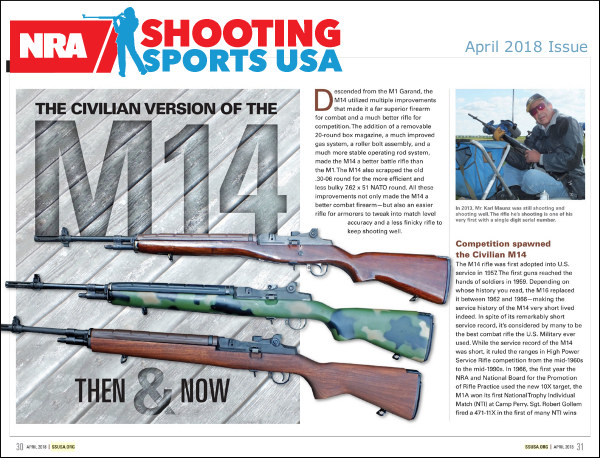
“Descended from the M1 Garand, the M14 utilized multiple improvements that made it a far superior firearm for combat and a much better rifle for competition.” — Dick Jones, Shooting Sports USA.
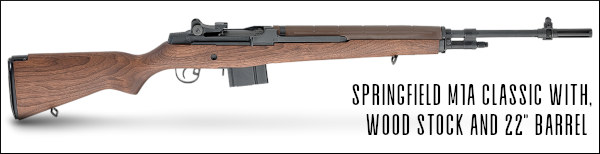
In the April 2018 issue of Shooting Sports USA, you’ll find a good article on the civilian version of the M14, now sold commercially as the Springfield M1A. An evolution of the battle-proven M1 Garand, the M14 was designed to shoot the 7.62×51 (.308 Win) round instead of the larger .30-06 Springfield cartridge used in WWI, WWII and Korea. While the vast majority of today’s M1As are chambered for .308 Win/7.62×51, Springfield Armory also produces a 6.5 Creedmoor version.
Dick Jones reports that accurized M14/M1As could post remarkable scores: “The accuracy potential of the M14/M1A is unquestionable. During their reign as service rifles, they produced multiple perfect 200 scores at 600 and 1000 yards in the hands of top shooters. This is a difficult feat with a modern, scoped, magnum-caliber rifle and remarkable with an iron-sighted battle rifle. Good competition rifles can group 10 shots under one MOA, and the meticulously-massaged rifles used by the top shooters during my career would consistently put up 10 shots under an inch at 200 yards off a test cradle.”
Springfield M1A at Camp Perry National Matches
For many years, the semi-auto version of the M14 was “top dog” in iron sights Service Rifle competition. Now that discipline is dominated by .223 Rem (5.56×45) AR-type rifles, but the bigger .308-caliber rifle, now sold as the M1A, remains popular. The CMP hosts a major M1A Match every year at Camp Perry, sponsored by Springfield Armory. Significant prizes are awarded. In past years M1A Match competitors took home over $25,000 worth of cash and merchandise in 2016. This year’s Springfield M1A match will be held at Camp Perry on August 8, 2021.
In this video, YouTube Reviewer Hickok 45 compares the M1 Garand and the M14/M1A:
See how the modern M1A is built in this Springfield Armory Video:
As racing improves automobiles, competition improves firearms, and the current crop of Springfield M1As, from the Basic to the top-of-the-line Super Match and Loaded models, reflects the years of development. The M14 and its variants are still in service today and it’s still considered by many to be the best battle rifle in the history of the U.S. Military. — Dick Jones, Shooting Sports USA
Many shooters prefer to deprime their brass before resizing. That way they can tumble cases or keep primer debris off their main press. To deprime cases before sizing or cleaning you can use a Depriming Die (aka “decapping die”). This pushes out the spent primer without changing the neck or body of a case. Such decapping dies work fine, but they do require the use of a press. Here is a handy alternative — a cool tool that allows you to deprime brass anywhere — no press needed.
Handheld Primer Removal Tool From Frankford Arsenal
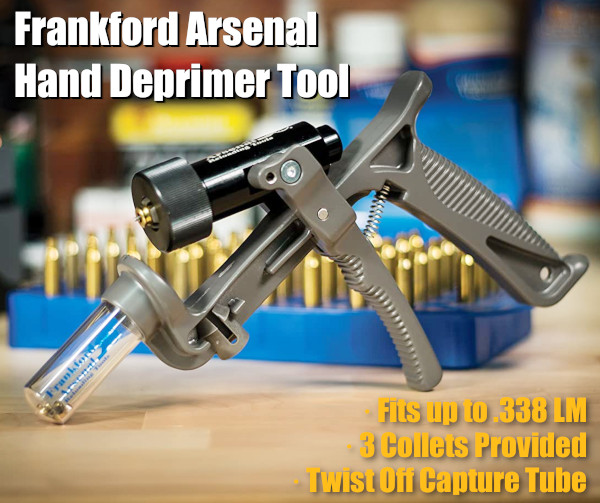
This cleverly-designed Hand Deprimer Tool allows you to deprime cartridge cases without a press. This hand-tool from Frankford Arsenal will deprime brass and capture primers conveniently. You can deprime your cases while watching TV or relaxing in your favorite chair.
This device lets you remove spent primers anywhere — no press needed and all the mess (cups/anvils/residue) stays in the capture chamber. This tool comes works with nearly all common case types up to .338 Lapua Magnum. With good leverage, this tool does the job quicklyi and efficiently. Forum members have praised this handy tool, but recommend wearing a thick glove if doing more than 100 cases in a sesssion.
This handy depriming tool is very versatile. With a universal, cylinder-style cartridge-holder, the tool can deprime a wide variety of cartridge types from .20 caliber up to .338 caliber. Three different plastic collets are provided to handle for different diameter cases. Spent primers are captured in a removable spent primer catch tube. Simply twist off the clear catch tube to dump the spent primers. With die-cast metal construction, this tool should last through many thousands of depriming cycles. MSRP is $54.99. Right now it is $44.99 on Amazon with 82% 5-star ratings.
User Modifications — Grip Padding and High-Volume Capture
Many users recommended putting some kind of padding on the grip and front lever to reduce pressure on the fingers. This can be done with a wrap or a rubber covering. In addition, users have adapted the unit with an attached hose and large primer capture jug. If you depriming hundreds of cases at a time, this hose conversion may make sense.
Review from actual owner: “I have owned one of these for about eight years and deprimed over 10,000 cases with this tool. I have never had to replace a single part on it. You will have to adjust the return spring every so often, but that is a very easy task. If you are depriming a LOT of brass, the handle can tear up your hand a bit. Solution: Wear a Mechanics Glove. Easy Peasy! You will NOT regret this purchase.”
How to Adapt Tool for Small Flash Hole Brass
The Frankford Arsenal Deprimer Tool was designed for LARGE flash-hole brass. To deprime brass with small (1.5mm/0.59″) small flash-holes, as found on Lapua .220 Russian and 6mmBR cases, you will need to reduce the pin diameter. A smaller pin is “in development” according to the manufacturer. Frankford Arsenal currently recommends purchasing a replacement pin and “sanding it down” to the smaller diameter. NOTE: This is NOT difficult — simply spin the stock pin in some sandpaper.
Interested in PRS/NRL and other tactical disciplines, but don’t want to spend a fortune on optics? Vortex offers a new scope, the Vortex Venom 5-26x56mm FFP (First Focal Plane) optic with 5X zoom range. Offered with in both MOA and MIL versions, the new Venom ($699.99 MSRP) can be purchased right now for $499.99 “street price” from EuroOptic.com. Choose either the MOA model or MRAD version.
Vortex claims the new Venom allows new tactical shooter to “get into the game at an affordable price without compromising optical quality, or giving up the features they need to be competitive”. You get a 34mm main tube, 85 MOA elevation with 25 MOA per revolution for the MOA version, or 25 MRAD elevation and 10 MRAD per turn for the MIL version. For both models, the scope weighs 35 ounces and is 15.3″ long.
The Venom 5-25x56mm comes equipped with the advanced EBR-7C reticle in the first focal plane (see below). This reticle features a precise center dot with a “Christmas Tree” pyramid of ultra-fine sub-tensions and holdover dots to compensate for bullet drop and wind drift. The Venom 5-25x56mm also features Vortex’s RevStop zero-stop system, allowing the shooter to return to their original zeroing after making finely tuned adjustments in the field.
User Q & A about Vortex Riflescope Options
Q. What is the difference between the new Venom and the Vortex Strike Eagle?
Vortex: The main differences will be that the Strike Eagle has locking turrets, an illuminated reticle, and a slight step up optically compared to the Venom. This VIDEO should explain the differences pretty well: Venom vs. Strike Eagle vs. Diamondback.
Q: Optically what is the difference between the Venom and the Vortex PST Gen 2? Looks like they both use the same lens and different coating.
Vortex: The Viper PST Gen II will be a noticeable step up optically. It will have better clarity, resolution, and low-light performance when compared to the Venom.
Sako Ltd. was founded on April 1, 1921. This year Sako celebrates its 100th birthday. Now part of the Beretta firearms family, this prestigious Finnish firearms manufacturer has a rich history of producing quality rifles constructed by skilled master craftsmen.
The original Sako factory was established as part of the Finnish Civil Guard and was designed to meet its gun repair needs. The workshop became an independent financial unit on April 1, 1921. Sako marks that date as its moment of establishment. The workshop was initially called Suojeluskuntain Ase-ja Konepaja Osakeyhtiö (Civil Guard Firearm and Engineering Co Ltd). In 1927, it became a limited company with its name abbreviated to the acronym Sako.
Sako is manufacturing a limited edition of numbered Sako TRG 22 “Finland 100″ rifles with white camouflage, inspired by Sako’s 100-year anniversary.
The TRG 22 “Finland 100″ Jubilee model is offered in .308 Win caliber. The white snow camouflage coloring of the stock and barreled action of this collector’s item reflects the severity of the Finnish winter, and pays homage to the heroes of the Winter War. The Sako TRG 22 “Finland 100″ rifle has the text “Finland 100″ and the gun’s serial number laser-engraved on its frame. The rifle is packaged in a carry case with an engraved Jubilee knife.
Brownells’ Do-It-Yourself (DIY) video series provides logical, step-by-step installation help for triggers, stocks, and springs. Nine separate videos cover Brownells various DIY Kits. Not sure if you’re up to the project? Just watch each video to see what’s involved. The nine DIY kits are:
This video shows Remington 700 after-market trigger installation:
In the Do-It-Yourself videos, Brownells’ Gun Techs proceed step-by-step, showing you exactly how to install the parts on your gun. Each kit also comes with complete, illustrated instructions you can take to the bench. To learn more, click the links above, or CLICK HERE to visit Brownells’ DIY Kit online page.


 Koenig Triumphs for 19th Time