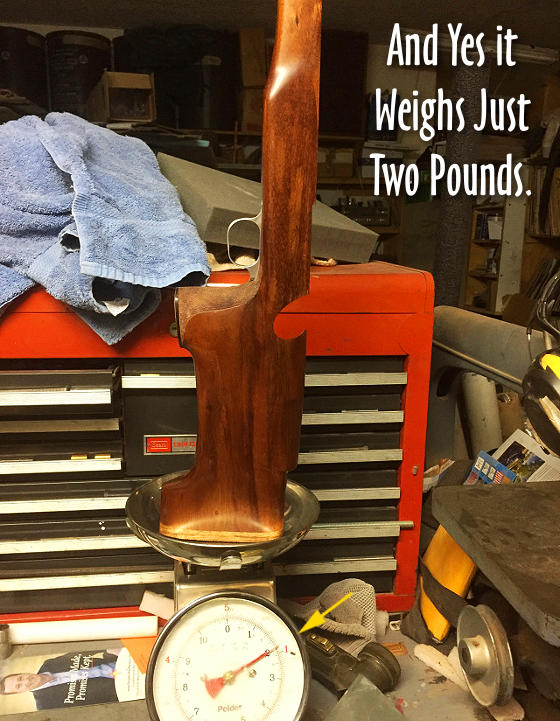
Gunsmith/stockmaker Doan Trevor created a lovely, one-of-a-kind silhouette stock for an Anschutz rimfire action. Built as a true custom design, this stock combines ideal standing position ergonomics with light weight — the entire stock weighs a mere two pounds. This project really showcases Doan’s remarkable skills with wood. Read the full story about this project (with more photos) at DoanTrever.com.
Doan explains his design process: “A customer came to me wanting to know if I could build a silhouette stock that was 2 pounds or less. I used the Koa wood because it is a lower specific gravity than Walnut (which makes it lighter) and stronger. I was still able to use pillar bedding and keep the weight down. The fore-end could be shortened to reduce the weight even more.
Since the drops on a silhouette rifle are different than a prone rifle, I kept the pistol grip from the prone rifle which is comfortable and tried to come up with a higher cheek piece and more drop to the buttplate. All of this required lots of hand carving.”
Vudoo Gun Works has introduced its new Vudoo Three 60 three-lug repeater rifle. This is an impressive repeater rimfire rifle. The Vudoo Three 60 features a 3-lug bolt with a 60-degree throw and a 12 O’Clock ignition. This combination uses the same internal 3-lug geometry of the Vudoo V22s single shot action, ensuring light bolt lift along with smooth and consistent bolt alignment with the bore.
Users will enjoy the same accuracy performance known across the entire Vudoo family of rifles. The Vudoo Three 60 will be offered alongside the already popular V22 two lug repeater, V22m Magnum repeater, and V22s Single Shot Target Rifle.
The Patented Vudoo Three 60 Rimfire repeater action was engineered in response to requests for a 3-lug 60-degree bolt throw repeater action. Like all current Vudoo V22 actions, the Three 60 fire control group offers a toolless disassembly by way of a unique bayonet-style locking system between the shroud, bolt body, and bolt nose.
Vudoo Gun Works Three 60 Rifle Features Remington 700 Short Action Footprint
Remington 700 Pinned Trigger Interface
Available in right and left hand
60 Degree Bolt throw
12 O’clock Ignition
3 Lug Bolt Design
Toolless Bolt Disassembly
New Vudoo Three 60 Should Please 3-Lug Centerfire Rifle Owners
Paul Parrott, Vudoo Gun Works CEO, explains: “The Three 60 configuration has been highly requested by our Vudoo family and [is] the logical next step in our product line. Is it more accurate than the 2-lug version? No, it’s just the next evolution in our ongoing commitment to redefine rimfire. The guys who will love it most are 3-lug centerfire shooters and those needing more bolt/optic clearance.”
ORDER CHANGE/UPDATE: Customers who have existing, not-yet-completed orders can change their order (for $50 more) to the new Vudoo Three 60 by CLICKING HERE. Then fill out the ORDER UPDATE PAGE.
Today, Wednesday April 7, 2021, Shooting USA TV features the Hornady Precision Hunter Steel Challenge. This is a unique, one-of-a-kind match set in 2000 acres of natural terrain at the Cameo Shooting Complex in Colorado. The match replicates long-range hunting challenges, with steel targets sized to simulate the vitals of western game animals. Some 135 competitors engaged steel targets in 20 challenging stages.
Match Director Scott Satterlee says, “This is as close as it can get to mountain hunting. We have vital-sized targets out there. They are 12-inch squares turned to diamonds which are really difficult to hit”.
SHOOTING USA TV Air Times
View Shooting USA on the Outdoor Channel: Wednesdays 9:00 PM (Eastern and Pacific); 8:00 PM Central.
NOTE: If you miss the 1/13/2021 broadcast, you can still view the show on Vimeo for a small 99-cent fee, or just $1.99 per month unlimited. LINK HERE: Shooting USA on Vimeo.
The inaugural Hornady Precision Hunter Steel Challenge took place in Colorado August 8 and 9. This unique competition involved lots of hiking with various shooting positions in challenging natural terrain. The unique match was hosted at the Cameo Shooting Complex near Grand Junction, CO.
There were 135 registered competitors — quite a turn-out for a physically demanding match in a fairly remote location. Congrats to Heavy Class and Overall Winner Brian Black who topped the field with 140 Match points (100% of possible). Brian shot a 6.5×47 Lapua with Berger 6.5mm 140gr Hybrids. Brian’s winning rig featured a Lone Peak Arms Fuzion action, Benchmark barrel, and XLR Element chassis.
The Hornady Precision Hunter Steel Challenge tests a rifleman’s fitness and skills as marksman and hunter. The stages were blind with a 4-minute time limit to move to the shooting area, locate, range, and engage targets. Shooters could choose between two rifle weight classes (light or heavy) and had to meet a minimum power factor cartridge requirement that helped even the playing field. The match featured a diverse course of fire with a good mix of prone and natural terrain shooting positions.
Hunting Ammo Tested by Shooting USA
In this same episode, Shooting USA tests a variety of Hornady hunting ammo offerings on the G.A. Precision private gun range in Missouri. (We’d love to have our own private range like that!) Jason Hornady says his company starts the design of all hunting ammunition with bullet selection: “For us it started with the bullet … for us the bullet still makes the cartridge.”.
This story features a unique, American-designed rimfire rifle, chambered for the potent .17 HMR round. The current generation T-Bolt has a tang-mounted ambidextrous safety, a choice of barrel contours, lengths, and finishes, and a variety of stock options. What sets the T-Bolt apart from other rimfire rifles is the way the action cycles. There is not a conventional bolt that requires four distinct motions (lift bolt handle up/pull back/move forward/rotate handle down). With the T-Bolt you simply pull the handle straight back to extract a round, then return it forward to chamber a new round from the Double Helix magazine. The cocking effort is divided between back pull and forward movement so the effort is relatively light and easy.
Among current rimfire rifles, the Browning T-Bolt ranks high for fit and finish. The bluing is very nice and the T-Bolt even boasts a gold-plated trigger shoe. Many different stock types have been offered in recent years including some very nice AA Maple stock models as shown below (click to zoom). These T-Bolt rifles exhibit very fine craftmanship. Current models are made in Japan under license to Browning.
Click image for full-screen T-Bolt photo with detail.
Browning T-Bolt Sporter AA Maple Model
RECEIVER – Steel; High polished finish; Drilled and tapped for scope mounts
BARREL – Medium Sporter; Blued finish; Free-floating; Semi-match chamber; Recessed crown
ACTION – Straight pull bolt action; Top-tang safety; Adjustable trigger
STOCK – AA Maple; Gloss finish; Checkered
FEATURES – Sling swivel studs installed
PRODUCTION – Limited quantities
T-Bolt Owner Talks about Function and Accuracy
“I have a Browning T-bolt in .17 HMR, but with the maple stock. It is probably my favorite .17 HMR rifle (also the most expensive). The rifle feels smaller than some of my other .17 HMR rifles. I think the length of pull is a little shorter. I do like the light weight and trim handling of the rifle and the straight-pull bolt can be cycled really quickly. Mine is quite accurate and will shoot one-inch groups at 100 yards with both Hornady ammo and the CCI A17 ammo.” — RexRay, Varminter.com Forum member.
Pros and Cons of the Browning T-Bolt
The T-Bolt has a reputation for good accuracy, provided you have a good lot of .17 HMR ammo (we recommend checking for bullet run-out before you shoot for groups). The straight-pull action works as advertised — it is fast, smooth, and easy-to-operate. The Double Helix magazine (covered below) is excellent. It is very compact yet ultra-reliable. Another plus is that the T-Bolt has been produced in many different versions, with a variety of stocks, and even a stainless action version.
What are the negatives? Some of the stocks have a somewhat short length-of-pull, but this is easily solved with spacers. The main complaint is the factory trigger — some owners say it is too heavy at about 4 pounds, though the break is clean. For varmint work, we could live with the stock trigger and put money saved into optics.
If you prefer a very light trigger, JARD makes a T-Bolt replacement trigger. Featuring an aluminum housing, the JARD T-Bolt trigger can be ordered with 12-, 16-, or 20-ounce pull weights. The JARD trigger offers a crisp, clean break significantly lighter than stock. But at $249.99 the JARD trigger is fairly expensive. Additionally there have been a couple complaints about slam fires at the lowest weights so we recommend the 20-ounce. Here is one owner review, from a Rimfire Central thread: “The new Browning T-Bolt is a great rifle in all aspects except for the trigger. In my case when I received my JARD trigger it was an almost drop-in installation with very little adjusting or fooling around. For me it made a decent little rifle a great little rifle.”
Browning Double Helix 10-Round Magazine
The T-Bolt’s patented 10-round rotary Double Helix™ magazine is a unique design that feeds very reliably and is easy to load. The Double Helix magazine uses a torsion drive spring and interlocking gear design to maintain correct timing and exact cartridge alignment for smooth, reliable feeding. The translucent gray body allows for easy verification of the number of remaining cartridges. We like the fact that the Double Helix provides TEN-round capacity while fitting nearly flush with the bottom of the action.
The Browning Double Helix rotary box magazine system is easy to load, easy to carry, and easy to use. The smooth, rounded exterior contours of the Double Helix, along with twin gripping grooves, tapered shape and a slightly extended baseplate design make insertion positive, while the spring-assisted drop-free magazine ejection feature allows for rapid magazine changes. T-bolt owners confirm that feeding and reliability is excellent — the magazine design puts cartridges in perfect alignment with the chamber.
Other Browning T-Bolt Variants
In recent years, Browning has produced T-Bolt rifles in a variety of models, with many different stock types and various barrel lengths/contours. Most of the photos above showcase the AA Maple Sporter T-Bolt, which is currently out of production, though still available from some dealers (if you search). We like the looks of the AA Maple T-Bolt, but there many other stock options including dark brown, Black, Green, and various camouflage finishes. Use the links below to see all the T-Bolt configurations.
Here are 4 other T-Bolt variants, first the new-for-2021 T-Bolt Target with muzzle brake, then the Limited Edition Cerakote T-Bolt Speed model, and two discontinued T-Bolts, a composite-stocked carbon finish model and a Varmint Special with stainless action and thumbhole laminated stock. Current production T-Bolts are offered in three rimfire chamberings: .17 HMR, .22 LR, and .22 WMR. Barrel contours and lengths (from 16.5″ to 22″) vary from model to model.
Do you like the T-Bolt? Well there is a 5% Off Rebate Program available right now that covers the T-Bolt and all other Browning firearms.
.17 HMR Cartridge — Fast and Deadly on Small Varmints
We are big fans of the .17 HMR round. It’s just about perfect for ground squirrels, and is effective on prairie dogs out to about 200 yards. The three main .17 HMR producers have been CCI, Federal, and Hornady. Choose from 17gr or 20gr bullets — both work well in the varmint fields. Norma also makes .17 HMR ammo with 17gr V-Max bullets. This Norma .17 HMR ammo has shown very good accuracy.
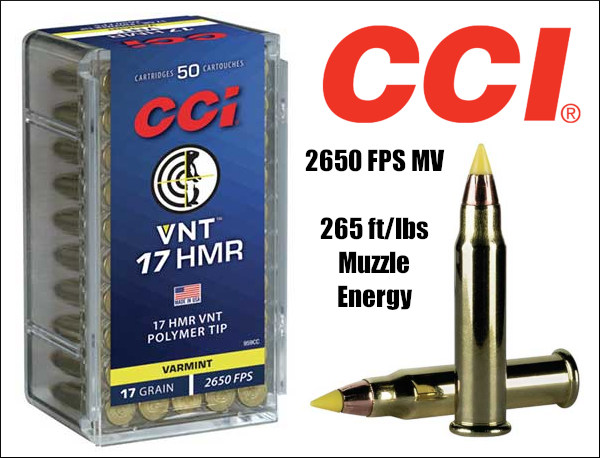
CCI .17 HMR TNT offers 2650 FPS Velocity
For varmint work we like CCI’s latest .17 HMR VNT ammo. This boasts class-leading 2650 FPS muzzle velocity. Engineered to combine good accuracy with high impact energy, this CCI TNT ammo features a 17gr polymer-tipped bullet designed for rapid expansion. We also like the Norma .17 HMR ammo. “With outstanding accuracy and excellent energy transfer… The .17 HMR has a very loyal following among hunters and target shooters alike”, said Paul Lemke, G.M. for Norma/RUAG.
This video shows the process of cut-rifled barrel-making by Krieger Barrels, one of the world’s best barrel manufacturers. Krieger cut-rifled barrels have set numerous world records and are favored by many top shooters. The video show the huge, complex machines used — bore-drilling equipment and hydraulic riflers. You can also see how barrels are contoured, polished, and inspected.
For anyone interested in accurate rifles, this is absolutely a “must-watch” video. Watch blanks being cryogenically treated, then drilled and lathe-turned. Next comes the big stuff — the massive rifling machines that single-point-cut the rifling in a precise, time-consuming process. Following that you can see barrels being contoured, polished, and inspected (with air gauge and bore-scope). There is even a sequence showing chambers being cut.
Click Arrow to Watch Krieger Barrels Video:
Here is a time-line of the important barrel-making processes shown in the video. You may want to use the “Pause” button, or repeat some segments to get a better look at particular operations. The numbers on the left represent playback minutes and seconds.
Krieger Barrel-Making Processes Shown in Video:
00:24 – Cryogenic treatment of steel blanks
00:38 – Pre-contour Barrels on CNC lathe
01:14 – Drilling Barrels
01:28 – Finish Turning on CNC lathe
01:40 – Reaming
01:50 – Cut Rifling
02:12 – Hand Lapping
02:25 – Cut Rifling
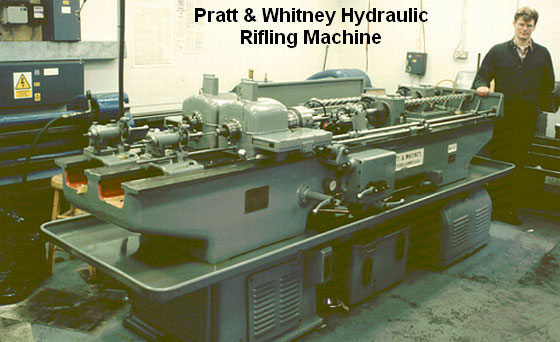
“At the start of World War Two, Pratt & Whitney developed a new, ‘B’ series of hydraulically-powered rifling machines, which were in fact two machines on the same bed. They weighed in at three tons and required the concrete floors now generally seen in workshops by this time. Very few of these hydraulic machines subsequently became available on the surplus market and now it is these machines which are sought after and used by barrel makers like John Krieger and ‘Boots’ Obermeyer. In fact, there are probably less of the ‘B’ series hydraulic riflers around today than of the older ‘Sine Bar’ universal riflers.” — Geoffrey Kolbe, Border Barrels.
Three Shots Standing at 400 Yards in 4.37 Seconds Could you hit a silhouette target at 400 yards, shooting offhand? Probably, with a little practice. Now try doing that three times in just 4.37 seconds, including picking up/mounting the rifle! Not possible? Watch the legendary Jerry Miculek do that in this impressive demonstration of rapid-fire rifle shooting.
Jerry Miculek — that name is synonymous with revolvers. But Jerry is also one heck of a rifleman, as he demonstrates in this video. Grabbing his AR rifle from the top of an oil drum, Miculek proceeds to put shots on three different steel targets at 400 yards — all in under 4.4 seconds. Most of us would be lucky to make one successful shot in that time limit. Watch the successful 3-shot sequence starting at 2:19 time-mark in the video.
In this video, Jerry hits not one but THREE c-zone targets at 400 yards. And he does this in under 4.4 seconds starting with his rifle laying on a support. It took Jerry two tries (on his first run he hit 2 out of 3 in 4.65 seconds). On the second attempt (see video starting at 2:19), it takes Jerry just 4.37 seconds to shoulder his rifle, aim, and fire three shots, each hitting a separate steel target. Wow. That’s truly remarkable. Most of us would need ten seconds (or more) just to get the scope on the first target.
Trust us folks, this ain’t easy. It takes remarkable marksmanship skills to shoot with this kind of precision at this kind of pace. As Jerry would say himself, “Not bad for an old guy who needs glasses”.
The firearms and shooting accessories price-search website Gun.Deals has created a useful collection of new long guns for 2021. These run the gamut from tactical rifles to classic lever-action guns. There are new super light-weight models such as the Savage 110 Ultralite and the Nosler Model 48 Carbon Mtn. Rifle with carbon-stock and carbon-wrapped barrel. For young shooters, or folks looking for a fun yet very affordable .22 LR rig, there is the Winchester Wildcat 22 Suppressor Ready. And if you like something new and very different, there is the brand new straight-pull Savage Impulse Big Game. SEE ALL RIFLES.
From these 10 rifles, here are three of our favorites:
Springfield Armory Waypoint
The new Model 2020 Waypoint rifles feature optional carbon-wrapped barrels, TriggerTech triggers, and carbon-fiber, hand-painted camo stocks. The excellent TriggerTech trigger easily adjusts from 2.5 to 5.0 pounds. The base Model 2020 Waypoint has a fluted stainless barrel. The carbon-wrapped barrel is an extra-cost option, as is the adjustable cheekpiece.
Savage Impulse Straight-Pull Rifle
Savage’s new Impulse series of straight-pull bolt rifles is the first American-designed and crafted straight-pull centerfire rifle. The new Impulse features an innovative Hexlock bolt-locking mechanism with six spherical bearings that move radially outward into a ring in the barrel extension, thereby locking the bolt in place. That barrel extension is held in the receiver assembly by four cross-bolts on the lower front section. Ahead of the barrel extension is a conventional recoil lug and a familiar Savage barrel nut.
Winchester Wildcat 22 Suppressor Ready
Winchester has introduced a Wildcat SR, a suppressor-ready version of its popular Wildcat 22 semi-auto .22 LR rifle. This new Wildcat SR comes with a 16.5″ barrel threaded 1/2-28 TPI at the muzzle (with muzzle cap). This will allow the Wildcat SR to fit most rimfire suppressors as well as many muzzle brakes.
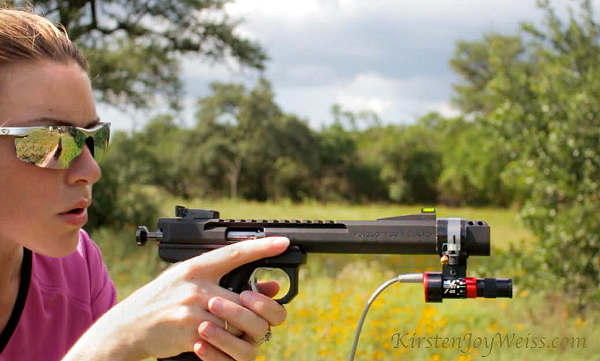
“SCATT” — if you’re an Olympic Class air rifle or smallbore competitor you know what SCATT means. The Russian-made SCATT is a marksmanship training system with an electro-optical sensor that fits on the end of a barrel. The sensor “sees” the target and then tracks your muzzle movement relative to the center of the target, recording a “trace” that can be displayed on a computer. The latest SCATT MX-02 unit works for live-fire training as well as dry-fire training. To learn more about the SCATT electronic trainers, visit SCATTUSA.com.
Pro shooter Kirsten Joy Weiss demonstrates the SCATT MX-02 electronic training system:
The system traces and records valuable information such as hold pattern, shot hold duration, follow-through, recoil pattern, and much more. The latest SCATT MX-02 systems can be used both indoors and outdoors up to 300 meters (and possibly more). READ FULL SCATT MX-02 TEST HERE.
SCATT traces reveal muzzle movements during the aiming process.
Kirsten Joy Weiss, a top-level competitive position shooter, has tested the latest SCATT MX-02 training systtem. She put the MX-02 through its paces, and then produced an informative video that shows how it works. Click on the video above to see Kirsten use the MX-02 with her Anschütz rifle and other guns.
Kirsten was impressed with the SCATT MX-02 she tested:
“We live with tech woven into our every day, so if you had the chance to work with a computer to make you a better shooter — would you? Can a computer train you as well as your favorite coach or, dare to say, better than a human?”
Weiss says it’s like having a little coach with you recording your every move. “If R2D2 had a cousin who knew how to shoot,” Weiss quips, “his name would be the MX-02″.
The SCATT MX-02 can also be used with target pistols.
Forum member Erik Cortina has produced a series of YouTube videos about reloading hardware and precision hand-loading. Here we feature Erik’s video review of the Forster Co-Ax® reloading press. The red-framed Co-Ax is unique in both design and operation. It boasts dual guide rods and a central handle. You don’t screw in dies — you slide the die lock ring into a slot. This allows dies to float during operation.
Erik does a good job of demonstrating the Co-Ax’s unique features. At 1:00 he shows how to slide the dies into the press. It’s slick and easy. At the two-minute mark, Erik shows how sliding jaws clasp the case rim (rather than a conventional shell-holder). The jaws close as the ram is raised, then open as it is lowered. This makes it easy to place and remove your cases.
At the 5:20 mark, Erik shows how spent primers run straight down into a capture cup. This smart system helps keep your press and bench area clean of primer debris and residues.
While many Co-Ax users prime their cases by hand, the Co-Ax can prime cases very reliably. The priming station is on top of the press. Erik demonstrates the priming operation starting at 4:20.
Smart Accessories for the Co-Ax from Inline Fabrications
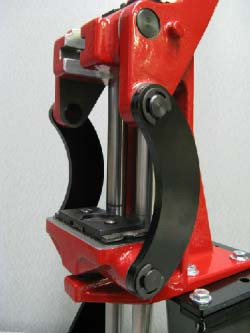
Forum member Kevin Thomas also owns a Co-Ax press, which he has hot-rodded with accessories from Inline Fabrications. Kevin tells us: “Check out the add-ons available from Inline Fabrications for the Co-Ax. I recently picked up a riser mount and a set of linkages for mine and love the results. The linkages are curved. When you replace the original straight links with these, the work area opens up substantially and the the press becomes much easier to feed.” CLICK HERE for Co-Ax Accessories.
Inline Fabrications Forster Co-Ax Accessories
Forster Co-Ax Curved Side Linkage (For Better Access)
You may want to monitor Gun Talk Radio this Sunday, March 28, 2021. This Gun Talk episode will be one of the most important of the year. The broadcast covers efforts in Washington to throttle the Second Amendment along with a shocking decision by the 9th Circuit Court of Appeals denying citizens the right to carry firearms. This broadcast airs Sunday, 3/28/21 from 2:00 PM to 5:00 PM Eastern time. You can interact with the Gun Talk team by calling 866-TALK-GUN with comments and questions.
Multiple Gun Rights Issues Covered on Sunday
Important topics include the 9th Circuit’s recent ruling in Young v. Hawaii that the Second Amendment does not guarantee the right to bear arms outside the home, state preemption laws, a bid to end the FOID card, examining the partnership between the gun industry and the mental health industry. The show also covers the recent Boulder, Colorado shooting and a U.S. Senate hearing on the prevention of gun violence. Top Shot’s Chris Cheng testified in the Senate Judiciary Committee Hearing on Gun Violence Prevention. Chris stops by to talk about the hearing. CLICK HERE for Video of testimony at Senate Hearing.
In this Gun Talk episode journalist Emily Miller examines the Ninth Circuit’s latest decision regarding open carry. CLICK HERE to read Miller’s analysis of that Circuit Court decision issued Friday, 3/24/2021.
Young v. Hawaii Decision Goes Against Supreme Court Precedents
Speaking about the 9th Circuit’s recent 7-4 ruling in Young v. Hawaii, the NSSF says that upholding Hawaii’s ban on carry ignores the clear language of the Second Amendment and U.S. Supreme Court precedent of the landmark 2008 Heller decision and 2010 McDonald decision, which displayed the exact opposite findings. The Ninth Circuit’s ruling underscores the need for the U.S. Supreme Court to accept firearm-related cases for review to settle the long-standing disputes. Lower courts have failed to apply Supreme Court precedents and are effectively treating the Second Amendment as a second-class right.
“The blatant defiance of the Supreme Court to undermine Heller and hollow out rights afforded to individuals by their Creator and clearly protected by the Constitution is unconscionable,” said Lawrence G. Keane, NSSF Senior VP and General Counsel. “It is with amazing boldness that the Ninth Circuit brazenly sets aside not just the previous findings of the Supreme Court, which legally they are bound to apply, but actively chooses to ignore plain English and refuses to acknowledge the right to bear arms. We look forward to filing an amicus brief when this heads to the Supreme Court.”
On Gun Talk Radio this week, Tom Gresham covers the shooting in Boulder and the calls for new gun control laws that were launched within minutes of the breaking news. With random attacks always comes talk of mental health, and Walk the Talk America’s Michael Sodini will address mental health issues on the Sunday show. In addition, Illinois State Senator Neil Anderson talks about lifting the Illinois requirement to have a Firearm Owners Identification Card (FOID) in order to purchase or own a gun.
Gun Talk Radio Broadcast Times — and Podcast Archive
This broadcast airs Sunday, March 28, 2021 from 2:00 PM to 5:00 PM Eastern time on radio stations nationwide. Past podcasts can be heard online via the GunTalk Podcast Center and Apple iTunes. The Gun Talk podcast archive has many great shows. Click the link below to hear a recent show (1/3/2021) about mainstream media and financial industry bias against firearms and shooting sports enterprises.
Podcast about Boulder Colorado Shooting and Gun Control
Podcast about Impending Gun Control Laws:
Tom Gresham’s Gun Talk Radio show airs live on Sundays from 2PM-5PM Eastern, and runs on more than 270 stations. Listen on a radio station near you or via LIVE Streaming. All Gun Talk shows can also be downloaded as podcasts through the GunTalk Podcast Center or Apple iTunes. Gun Talk is also available on YouTube and GunTalk.com.




 Vudoo Gun Works Three 60 Rifle Features


 Hunting Ammo Tested by Shooting USA


 In recent years, Browning has produced T-Bolt rifles in a variety of models, with many different stock types and various barrel lengths/contours. Most of the photos above showcase the AA Maple Sporter T-Bolt, which is currently out of production, though still available from some dealers (if you search). We like the looks of the AA Maple T-Bolt, but there many other stock options including dark brown, Black, Green, and various camouflage finishes. Use the links below to see all the T-Bolt configurations.