Do you have trouble seeing your bullet holes (on paper) when shooting past 400 yards? That’s a common issue even with premium ($1600+) high-magnification scopes. Here’s a target that solves that problem. A hit creates a larger black circle that’s much more visible than a plain bullet hole, making this target ideal for use at longer range (500 yards and beyond).
The 12″ square Birchwood Casey white background Sight-In Target displays a black “halo” around each hit (like the yellow circle on a conventional Shoot-N-C). Larger than bullet diameter, the “halos” can be easily seen with a high-magnification scope at long range (see video below). The self-adhesive target features four diamonds with contrasting red box centers. For precise aiming, you can position your cross-hairs to align with the corners of the boxes. Or, you can put a target dot sticker in the middle.
This video shows Black Shot Halos on white background:
While we envision using this target with optics at long range, Birchwood Casey says that open sights show up well against the white background, making these targets well-suited for indoor ranges or use in low light conditions.
This white background grid target has five aiming points and a 1-inch grid overlay for quick and easy sight adjustments. It comes with target pasters that allow shooters to cover up bullet holes and continue using the target for added value. The White/Black Shoot-N-C 12″ Sight-In Targets come in 5-packs with 75 target pasters for $7.19 from MidwayUSA or $8.09 on Amazon.
High-Viz Option — Yellow on Black Grid with Yellow Halos
If you prefer seeing ultra-high-contrast yellow/green “halos” for your hits, Birchwood Casey also makes adhesive grid targets with five yellow-edged diamonds. Red circles provide precise aiming points in the middle of each box. You can quickly estimate group size or dial-in your zero using the hi-viz yellow 1″ grid lines. These yellow-on-black targets are available in three sizes: 8″ square, 12″ square, and 17.5″ square. These yellow-on-black grid targets start at $4.95 for an 8″ six-pack.
Looking for a faster, easier, and more accurate way to measure bullet positions on your loaded rounds? Check out the Accuracy One Seating Depth Comparator. This unique tool provides a shoulder-to-ogive measurement instead of the traditional cartridge base-to-ogive measurement. The Accuracy One Comparator just might work for you. This unique tool allows a very rapid and secure measurement that provides a precise determination of the bullet seating depth in the case.
Accuracy One Seating Depth Comparator
Product Review by F-Class John
You probably check your loaded ammo by measuring cartridge base to ogive, but have you ever considered there may be a better way? Curt at Accuracy One has considered the question, and after exhaustive research and testing he created the Accuracy One Seating Depth Comparator. As opposed to looking for a base to ogive measurement, this tool measures from the shoulder to ogive, which is arguably the more repeatable number when it comes to accuracy.
Click Arrow to Watch Video Tool Review
As Curt explains, “Well, when you fire a chambered cartridge, the strike from the firing pin first pushes the cartridge forward until it bottoms against the shoulder. The primer is then ignited. What this means is that your seated bullet depth consistency can more accurately be gauged using the dimension from shoulder to ogive. Using this dimension, you effectively eliminate any small variances in your sized case length from the equation”. As a result, it made sense that when he was designing the measurement tool his goal was to create a universal insert that allowed a user a quick, easy, accurate and repeatable process that measures from mid-shoulder to ogive.
The comparator fits cartridges from .22 to .30 Caliber with 0.400″ and larger shoulder diameters. The tool fits so many bullet sizes because of the specific taper that Curt developed. This ensures that any caliber in that range makes good contact along the ogive. As I used this tool and talked to people about it, I kept getting skeptical comments with people asking how it could measure the ogive on that many calibers accurately. I had to remind them that the ogive is not a single point on the bullet but in fact the entire curve from the tip of the bullet to the point it straightens out. As a result, it’s only important that the tool you use is consistent in what point along the ogive it measures and that’s where the Accuracy One Seating Depth Comparator shines. According to Curt, he went through countless iterations on his design until he was able to accurately and repeatably measure all those calibers (.22 to .30).
How to Use the Accuracy One Seating Depth Comparator
Using the comparator is simple. There are alternative methods. The easiest way is to simply zero the indicator, insert a loaded round, note the measurement and compare any future rounds against it for variation. An alternative to this is a method I use. I insert a loaded round and then zero the indicator. This allows you to see the exact variation without mental math (and frankly it’s faster this way). I also use this method to sort loaded rounds for matches in order from shortest to longest ensuring that rounds that measure the same are fired together.
Bonus Option — Measuring Length to Lands with Tool
Another great use for this Accuracy One comparator is to take my initial depth to lands. This helps ensure my seating depth was properly set. Using a case with very light neck tension, I load a bullet, and with a stripped bolt I load and close it. Then I can remove the round and take a measurement, zero the indicator and make a note of it in my book. After that the comparator will remember the new zero until it’s zeroed again and if that happens by accident, I can always reference the number that my round measured and pull on the indicator stem until that number is found and then zero it again. I found this entire process fast, easy and repeatable as I loaded rounds and needed to check for any seating depth variance.
Tool Pricing:
Seating Depth Comparator without Indicator: $65.00
Seating Depth Comparator with Indicator: $115.00
Gauge Stand: $47.00
Purchase Options
You can buy the tool with or without an Digital Indicator. Accuracy One also makes a Primer Depth Gauge. Both Accuracy One tools employ the same digital indicator. This helps save money as you can order the comparator alone if you already have one (either from another Accuracy Tool or another tool).
The Accuracy One Seating Depth Comparator is essentially the same size as the Accuracy One Primer Depth Gauge, so you can even utilize Accuracy One’s primer gauge storage case. There is also an optional stand that I HIGHLY RECOMMEND as it can hold either the seating depth OR primer gauge, making for amazingly simple one-handed operation while you’re loading.
CONCLUSION — Tool Is Precise, Repeatable, and Fast
Overall, this tool left me feeling confident in my depth setting and I found it quick and easy compared to past methods. At the end of the day there are several ways to skin the proverbial cat when it comes to measuring seating depth. But if you’re looking for what just might be the most accurate, consistent and speediest method, give the Accuracy One Seating Depth Comparator a try.
This Armalite AR-50A1 .50 BMG rifle was modified by G.A. Precision.
If you’re a fan of big boomers, and love shooting steel, then definitely watch this Wide Open Magazine video. This covers a .50 BMG build by our friends at G.A. Precision (GAP). The rifle started as an Armalite AR-50A1 ($3359.00 MSRP). Then GAP fluted the barrel and swapped the factory muzzle brake with a more compact brake from American Precision Arms*. Then, as modified, the entire rig was given a rugged Cerakote finish.
The video has nice background music, great aerial drone footage, and of course some serious firepower. Using Hornady .50 BMG ammo, GA Precision’s George Gardner and his Wide Open friends shoot the big Fifty from the bench as well as prone. Enjoy!
About the .50 BMG Cartridge
The .50 Browning Machine Gun (.50 BMG, aka 12.7×99mm NATO or 50 Browning) is a cartridge developed for the Browning .50 caliber machine gun in the late 1910s, entering official service in 1921. Under STANAG 4383, it is a standard cartridge for NATO forces as well as many non-NATO countries.
John Browning had the idea for this round during World War I in response to a need for an anti-aircraft weapon, based on a scaled-up .30-06 Springfield design, used in a machine gun based on a scaled-up M1919/M1917 design that Browning had initially developed around 1900. According to the American Rifleman: “The Browning .50 originated in the Great War. American interest in an armor-piercing cartridge was influenced by the marginal French 11 mm design, prompting U.S. Army Ordnance officers to consult Browning. They wanted a heavy projectile at 2700 FPS, but the ammunition did not exist. Browning pondered the situation and, according to his son John, replied, ‘Well, the cartridge sounds pretty good to start. You make up some cartridges and we’ll do some shooting’.”
* In the video, George mistakenly says “American Patriot Arms”, but the brake is made by Georgia-based American Precision Arms.
In April 2020, the National Rifle Association (NRA) launched NRAWomen.com, a website dedicated to the fastest-growing group of firearm owners — America’s women. This website serves the increasing number of female gun owners, huntresses, and competitive shooters. Female involvement in firearms is growing significantly. Consider these numbers: Statistica estimates that 19% of women in the USA owned firearms in 2020, while 23% of women surveyed in a 2011 Gallup Poll stated they owned a gun.
Here are four videos from the NRAWomen.com website, all worth watching. For each example, click the links to read the related articles on NRAWomen.com.
1. How to Sight-In Your Hunting Rifle
This video and related article offer good basic advice for sighting-in a hunting rifle. There are a series of six points covered. Here’s Tip #1: “Find a safe place to shoot your rifle with a backstop. If possible, use a bench and a rock-solid shooting rest. Sighting-in is all about consistency, so the less human error you have, the better. For safety, be sure to also bring ear and eye protection.” READ FULL ARTICLE on NRAWomen.com.
2. Buying Your First Handgun — Factors to Consider
Buying your first firearm can be overwhelming, with all the choices available. And personal preference/fit are especially important with handguns that may be carried on your person. This video follows two first-time buyers as they select their first handgun. The video explains factors to consider: Ergonomics, Accuracy, Caliber, Concealability, Recoil, Reliability, and Price. RELATED Articles on NRAWomen.com.
3. Cartridge Case Material Varieties — Brass, Nickle-Plated Brass, Aluminum, Steel Alloy
The case of a cartridge holds bullet, powder, and primer. Brass cases are most popular, but nickle-plated brass cases are also common and reloadable (though they generally don’t last as long as plain brass). Major manufacturers produce aluminum-cased pistol ammo, such as CCI Blazer. Aluminum pistol cases can shoot great, but are not (normally) reloadable. Finally, some large manufacturers, mostly foreign, produce steel-cased ammo. All different case types have certain advantages and disadvantages, though conventional brass is definitely the best choice for hand-loaders. This video explains pros and cons of each type of cartridge case construction. RELATED Articles on NRAWomen.com.
4. Modular Safes — Smart Option for Easier Moving
This article features a great video showing how to assemble a modular safe in under 30 minutes. This article also explains the benefits of modular gunsafes — primarily easier transport and installation. “Modular safes have been around for a few years now and are becoming more popular. Here’s why: The safe comes delivered to you in panels, so you can bring them into your home one at a time and put it together anywhere you like. This makes it easy to carry up and down stairs, onto elevators or anywhere! Security — Is it as secure as one that comes pre-assembled? The answer is, absolutely.” READ FULL ARTICLE on NRAWomen.com.
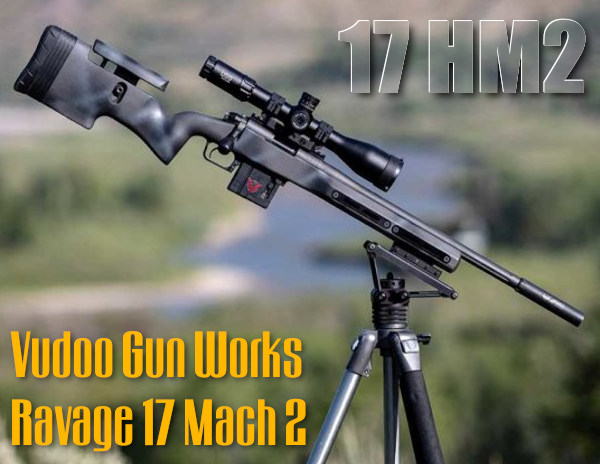
Vudoo Gun Works now offers V-22 action rifles chambered for the 17 Hornady Mach 2 (aka 17 HM2) rimfire cartridge. The 17 Mach 2 runs 2010-2100 FPS, making it much more potent than the .22 LR for varminting. Along with the added speed, the 17 Mach 2 is also much flatter shooting than the .22 LR, making it more fun to use past 150 yards. When you want to go back to the .22 LR for paper punching at 50-100 yards, simply spin on a .22 LR barrel, and use the same action and same magazines. So, you can have one rimfire rifle that shoots two rimfire cartridge types. That’s smart.
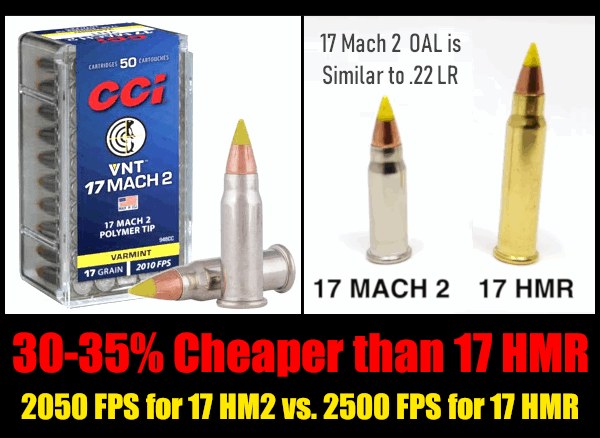
Because the 17 Mach 2 shares similar OAL and cartridge diameter/rim sizes as the venerable .22 LR, the 17 HM2 runs perfectly in actions and magazines designed for the .22 LR. Vudoo says: “The dimensional similarities of traditional .22 LR, which the V-22 action has been designed around, made the 17 HM2 a natural performer in our rifles. The addition of the 17 HM2 gives our customers access to a wide range of high-velocity projectiles to better suit a variety of sporting applications.”
Vudoo Gun Works currently offers a variety of rifles chambered in 17 Mach 2. The Ravage Ridgeback model (top photo) has a composite stock with adjustable cheekpiece. There is also a Ravage Renegade (shown below). For those who prefer a metal chassis, Vudoo offers its V-22 barreled action in the MPA alloy chassis. Vudoo has lighter, “walk-around stocks” and barrel profiles for hunters, and we like the Apparition model with the KRG Bravo Chassis. All Vudoo 17 HM2 models use the V-22 action. Multi-shot models employ Vudoo .22 LR magazines.
Which Voodoo 17 Mach 2 to Buy?
We see the 17 HM2 round primarily as a varmint cartridge, secondarily as a fun-shooting round for steel and reactive targets. As yet it is not really for competition because there is no organized .17 Caliber rimfire League, and the 17 Mach 2 is not allowed for rimfire silhouette. That may change and the Mach 2 might be allowed in some local range fun matches, but it’s not really a competition cartridge.
That said, it is a great round for small critters such as ground squirrels. Accordingly, we recommend a Vudoo option that has a conventional stock that can work with both bipod or front rest, used in the field off bipod or shot from a portable bench or tripod. You’ll want a magazine-fed rig to allow quick follow-up shots on critters.
For this we recommend the Ravage in the Renegade stock for $2295.00. This has a fairly straight buttstock toe in the rear so it works well with a rear bag. There are seven (7) different stock finishes available. If you want an adjustable cheekpiece and forearm rails you can get the Ravage in the Ridgeback stock for $300 more ($2595.00). Vudoo call this “A purpose-built competition/target rifle with an impressive list of options.” All Ravage Models promise sub-MOA accuracy. You can probably beat that with the best lots of 17 Mach 2 ammo.
Vudoo V-22 17 Mach 2 Rifle Features
Short action Remington 700 footprint
Magazines fit std AICS-form bottom metal
Large selection of aftermarket triggers
Large selection of aftermarket stocks
17 HM2 converts to .22 LR with bbl swap
Vudoo Rimfire Rifle Specs
Action: V-22, Patented Vudoo Rimfire repeater action with control-round-feed
Chamber Options: .17 HM2, .17 HMR, .22 LR, .22 WMR
Barrel: 416R stainless, cut-rifled, Vudoo chamber, 16.5″, 18″, 20″, or 22″, Kukri contour
Trigger: Timney 510v2 preset at 2 lbs. (Upgradable to other Timney, Trigger Tech, or Huber at add’l cost)
Because the 17 Mach 2 fits .22 LR magazines and has the same OAL and rim size, it can be shot from a Vudoo .22 LR action. Just spin on a 17 HM2-chambered barrel, get some ammo, and you are good to go. WARNING: Never shoot a .22 LR in a 17-caliber barrel.
About the 17 Mach 2 (17 HM2 Cartridge)
The 17 Mach 2 was developed by Hornady and ELEY in 2004 to give varmint hunters a high-velocity rimfire cartridge that fits in standard rimfire-length actions. With a selection of V-MAX or NTX bullets, the 17 HM2 is capable of taking ground squirrels and prairie dogs at ranges of up to 220 yards. We like this cartridge because 17 HM2 ammo has historically been 35% less expensive than 17 HMR ammo. And with the current shortages, we’ve seen 17 Mach 2 at HALF the price of 17 HMR ($11/box vs. $22/box). When you’re shooting hundreds of rounds a day in the varmint fields, that price savings adds up.
What Kind of Accuracy Can You Expect?
Vudoo .22 LR rifles have shown exceptional rimfire accuracy. Accordingly we believe the 17 Mach 2 versions should be impressive. But frankly, the limit will be the ammo. You may want to sort through each box and check for run-out and COAL. With Hornady 17 HM2 ammo, we usually find 2-4 rounds per 50-ct box with short-seated bullets or very high bullet run-out. You can sometimes actually see the bullet tilted off-axis. Use those for foulers or short range.
Accurateshooter.com built a 17 Mach 2 benchrest rifle some years ago with a match barrel, custom action, and wide-forearm benchrest stock. We saw many 5-shot groups in the 0.7″ range at ONE HUNDRED yards with early ELEY-made 17 Mach 2 ammo. Yes, 0.7 MOA at 100. The current Hornady ammo is not as consistent. We’ve heard good things about the CCI VNT 17 HM2 ammunition introduced in 2019, but we haven’t tested it yet.
Yes 17 Mach 2 Ammo IS Available Right Now
Readers may be asking “Can I actually get 17 Mach 2 ammo right now?” The answer is a definite “YES”. While popular centerfire ammo is hard to find, and many types of .22 LR ammo is out of stock, we found 17 HM2 ammo in stock right now at many vendors. Here are some examples in stock on 3/14/2021:
One Rimfire Rifle Can Shoot Two Calibers — .17 and .22
Here is the Vudoo V-22 action in an MPA chassis. You can have one .22 LR barrel for NRL22 Matches and another 17 HM2 barrel for varminting. Best of both worlds. Both cartridge types will run from the same magazine, with no modifications required other than a barrel swap. WARNING: Never shoot a .22 LR through a .17-Caliber barrel!
About the Vudoo V-22 Action — Important Design Features
The Vudoo V-22 action resembles a Remington 40X action at first glance. However, there are many key differences. Vudoo’s engineers explain: “First off, the V-22 departs from the 40X in that the 40X was a full-size, centerfire receiver converted to handle the diminutive .22 LR cartridge. The V-22 has been designed from the ground up as a true-to-scale Rimfire receiver that fits the Rem 700 footprint as far as stocks and chassis systems go. The V-22 also runs a full size short action bottom metal (DBM) and our V-2210 magazine has an AICS form factor so it pops right in Chassis’ or other DBM’s made for such.
V-22 Actions Boast Controlled-Round Feeding
Vudoo’s V-22 action has a unique control-round-feed design. The bolt fully controls the rimfire cartridge from the time it leaves the magazine until it ejects the spent round out the ejection port. The significance of that is two-fold. Great feed and extraction reliability and…equally as important, the cartridge is controlled in a way that it never touches anything on its entrance into the bore. There is no feed ramp, nor does the projectile go in at an angle that might damage it in any way. Potential bullet damage is avoided through the V-22’s smart design.
17 Mach 2 — Best Rimfire Varmint Bang for the Buck?
If you are looking for a capable, squirrel-busting round or a fun plinking round, you should definitely consider the 17 Mach 2, especially since CCI has committed to production of the little cartridge. CCI now offers its “Gen 2″ 17 Mach 2 VNT Ammo. This features a Speer bullet with a very thin jacket and yellow polymer tip. G1 BC is 0.125 with 2010 FPS muzzle Velocity. CCI claims “explosive terminal performance” on small varmints.
Considering that 17 HMR ammo is typically running $17 to $22 a box (when you can find it), the 17 Mach 2 is an excellent value by comparison. It is available right now for $8.99 per 50ct box at Sportsman’s Warehouse. That’s just $0.18 per round. Other vendors have 17 Mach 2 in stock now for $10-$12/box.
When you consider overall “bang for the buck”, for many shooters, it makes sense to use the 17 Mach 2 rather than a 17 HMR or 17 WSM. You save money, barrel life is a little longer, and the 17 Mach 2 is still a much more potent cartridge than the .22 LR. Check out this comparison, and note how the 17 Mach 2 has a much flatter trajectory than the .22 LR. For small varmint shooting, we think the 17 Mach 2 is clearly the better choice.
Hornady’s 17 Mach 2 has a 2100 FPS muzzle velocity vs. 1255 FPS for “High-Velocity” .22 LR.
Are you tired of making a mess in your gun room and picking up patches off the floor? If you clean at the range, would you like to make life much easier (no hunting for patches on dirty ground)? Then consider the MTM Gun Cleaning Patch Catcher. It is currently just $9.19 on Grafs.com and $9.89 on Amazon.
This handy see-through green container fits on the end of your rifle or shotgun barrel. It works with all patch types and bore sizes and fits virtually all barrel diameters, large and small. Simply slip the MTM Gun Cleaning Patch Catcher over your barrel to contain all the patches pushed out the muzzle. No more mess and stains on your bench/table. When cleaning tasks are done, simply remove the Patch Catcher and dump the contents into the trash. Watch the video to see how the MTM Patch Catcher works. Note how it also retains the solvent spray and/or drips.
One owner explains: “This box straps over the muzzle end of a barrel and keeps the mess completely contained. Excess cleaning solvents collect in the bottom. Patches fall off the jag and are captured as well when the cleaning rod is withdrawn. It also completely contains the splatter burst when a bore brush exits the muzzle of whatever firearm is being cleaned.” (D.J. Bradley)
Here are actual user reviews from verified customers:
“It’s been a long time since I bought something that is just WOW brilliant but this patch catcher is just that. It is so simple, so neat, so clean and so effective. It fits perfectly on all my rifle barrels and catches patches, brush spray and most importantly most of the smells of solvents. I can now clean my rifles in the house without inviting the wrath of my darling wife.” — Emmitt P. (Amazon)
“The MTM Patch Catcher works great! It is easy to adjust to different size barrels, and … all the gunk stays in the trap! Now, no more cleaning up the work bench/floor area after gun cleaning. This trap is a must have! I never knew I needed one of these until I got the MTM one from Graf’s. My buddy had a different brand, and it was hard to use. On his, the trap that holds the dirty patches and ‘juice’ would not stay in place, and some times most of the gunk ended up on the floor.” — Michael T (Grafs.com)
“This little device is more than a patch catcher. It also contains that dirty, smelly spray when a bore bristle exits the barrel. With the [MTM Patch Catcher] top open, it will also catch spray cleaners and lubes when used on small parts.” — TwoBoxer (Amazon)
Ever shot a straight-pull (aka toggle-link) action rifle? We like these action types, which were developed for Biathlon competitors who needed to shoot fast, but were not allowed to use semi-auto actions. The biathlon-style toggle action features a lever on the side of the action. Pull the lever back with your index figure to open the bolt, then push forward with your finger to close the bolt*. It’s fast and efficient. With some practice, you can cycle the action in a couple of seconds — nearly as fast as a semi-auto.
The Volquartsen Summit .22 LR rifle is based on a concept originally developed by Primary Weapons Systems. Designed for both competition shooting as well as small game hunting, this unique rifle features a straight-pull, toggle-style action with a Ruger 10/22 profile. That means you can run 10/22 magazines, swap into stocks inletted for the 10/22, and even use after-market 10/22 barrels. The CNC-machined receiver features an integral 20 MOA Picatinny Rail. The Magpul stock adjusts for length of pull. Weight is 5.8 pounds, so this is easy to carry in the field.
The Summit features a lightweight carbon fiber-wrapped barrel, threaded 1/2×28 at the muzzle to be suppressor-ready. One of our favorite features on this little rifle is the trigger — which has a light, crisp 1.75-lb pull weight. Watch the video above to see the Summit .22 LR in action. The tester, 22 Plinkster, was impressed with the rifle’s ease of use and accuracy. The Summit delivered a 0.277″ group at 50 yards, shot from the bench.
Good Field Test of Summit Straight-Pull Rifle by Dustin Ellermann
Past Top Shot Champion Dustin Ellerman demonstrates the Summit’s impressive accuracy by hitting small candies at 50 yards (06:13 start/06:55 impact). In rapid-fire drills, Dustin also shows the ease and speed with which the Summit action can be cycled.
* Biathlon shooters cycle their Fortner toggle actions even faster, using their THUMB to close the bolt. This allows them to get the index finger on to the trigger blade faster. The whole process takes maybe a second — as fast as you can say “snick-snick”. To use the thumb effectively, you need a stock with a more vertical pistol grip. The Magpul stock on the Summit moves your thumb a bit too far back to use comfortably to close the lever without shifting the hand.
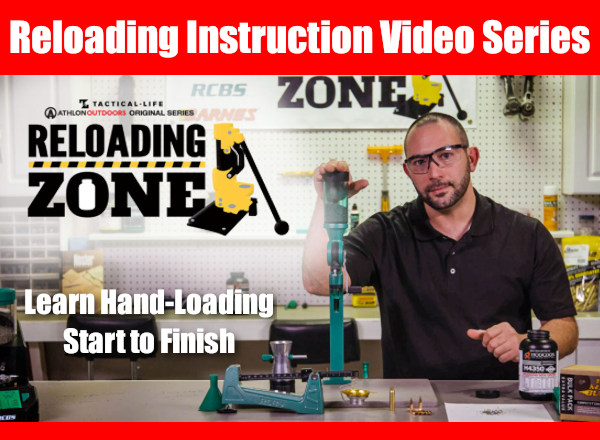
With 7 million new gun owners, and ammo hard to find at reasonable cost, hundreds of thousands of Americans are looking to get started with handloading. While we always recommend new reloaders have a living, breathing human teacher/mentor. It is possible to learn important skills through instructional videos. Here’s a good 4-part series that can help reloading novices AND serve as a refresher course for those who need to brush up their skill set).
This 4-part video series first guides the new hand-loader through the gear/hardware selection process. Then the videos cover, step-by-step, all the key processes of reloading from start to finish. If you are new to hand-loading, or just want a reloading refresher course, we recommend you watch this 4-part series from Tactical Life, part of the Athlon Outdoors Network.
WARNING!! We have embedded the Videos below. You can watch ALL four videos, but each will play back at the TOP. NOTE: They are all the same for the first 30 seconds, so you may want to skip forward. These videos may play back better if you go to the Tactical Life Website. Access: CLICK HERE.
Learn More in Tactical Life’s The Complete Book of Reloading (2020 Edition)
This publication includes over 2000 handgun and rifle loads. In addition, The Complete Book of Reloading (2020) reviews 8 modern Progressive Presses. Take note — there is a special report on the LabRadar Chronograph. Long-range Hunters will enjoy a feature article on the new 6.5 PRC Cartridge. In the “Handloaders’ Stockpile” a variety of new products to make your hours at the bench more productive are reviewed. The issue also has feature stories on Wildcat Cartridges, Subsonic loads, and .44 Magnum loads for both rifle and pistol. There is a Bonus 33-Page Hodgdon and Alliant Load Data Guide.
Here are the main tools you’ll need to assemble an AR-platform rifle
With the anti-gun agenda pushed by radical Democrats in Washington, many Americans are anxious to buy an AR-15, or put together an AR-platform rifle while it is still legal to do so. In Canada, the government ordered confiscation of AR-type modern sporting rifles, and both Joe Biden and Kamala Harris applauded that Executive Order. And Joe Biden recently called for a complete ban on semi-auto ARs and full-capacity magazines. With the prospect of radical gun control, we understand why many Americans are looking to buy, and/or build an AR-15. This article explains how.
If you ARE planning to put together an AR-platform rifle or want to upgrade your AR with a new barrel or trigger group, then you should check out the AR-15 Rifle Build DVD from our friends at UltimateReloader.com. This DVD covers all the details of a custom build, using high-resolution video sequences, and helpful supporting graphics.
In this DVD, Gavin Gear guides you through the entire process including selecting components, acquiring and using the necessary tools, assembly steps and details for each component, and even mounting a scope. Building an AR-15 can be overwhelming, but with the right guidance and help it’s not difficult and can be very rewarding. With this DVD you’ll be able to build your AR-15 with confidence.
Upper: Barrel / Gas Block / Gas Tube
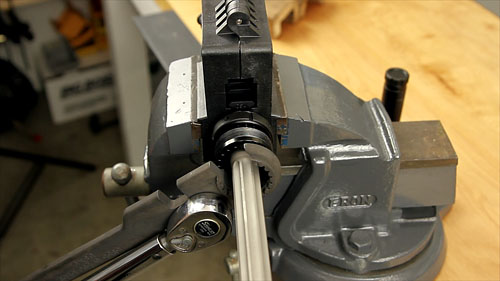
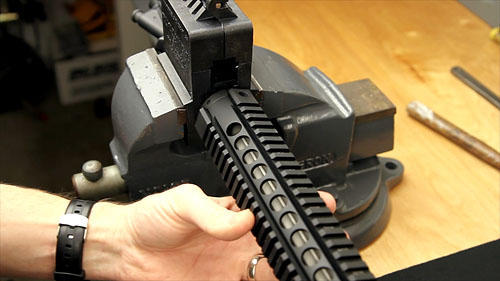
Upper: Handguard Installation
UltimateReloader.com’s AR-15 Build DVD is available just $9.90 (plus $3.80 shipping/handling). This DVD can pay for itself many times over by showing you how to do your own gunsmithing (and get quality AR components at attractive prices).
Can you form a wildcat cartridge such as the 6mm Dasher or 6 BRA (BR Ackley) without expending primer, powders, and bullets? Absolutely. Using the hydro-forming method you can form improved cases in your workshop with no firing whatsoever, so there is no wear on your precious barrel. Watch this video to see how it’s done for the 6 Dasher:
6 Dasher Case Hydro-Forming Demonstration:
Forum member Wes J. (aka P1ZombieKiller) has produced a helpful video showing how to form Dasher cases use the Hornady Hydraulic forming die kit. This includes a two-part die (body and piston), and a special shell holder. To form the case, you insert a primer in your virgin brass, top the case off with with a fluid (water or alcohol), then run the case up into the Hydro-forming die. A few stout whacks with a hammer and your case is 95% formed.
Hydro-Forming Procedure Step-by-Step:
1. Insert spent primer in new 6mmBR brass case.
2. Fill with water or alcohol (Wes prefers alcohol).
3. Wipe excess fluid off case.
4. Place case in special Hornady shell-holder (no primer hole).
5. Run case up into Hydraulic forming die.
6. Smack top piston of forming die 3-4 times with rubber mallet or dead-blow hammer.
7. Inspect case, re-fill and repeat if necessary.
8. Drain alcohol (or water) into container.
9. Remove primer (and save for re-use).
10. Blow-dry formed case. Inspect and measure formed case.
Wes achieves very uniform cartridge OALs with this method. He measured ten (10) hydro-formed 6 Dasher cases and got these results: two @ 1.536″; 2 @ 1.537″; and 6 @ 1.538″.
Three or Four Whacks Produces a 95%-Formed Case
With a Hornady hydro-forming die, hydraulic pressure does the job of blowing out the shoulders of your improved case. The process is relatively simple. Place a spent primer in the bottom of a new piece of brass. Fill the case with water, and then slip it into a special Hornady shell-holder with no hole in the middle. Then you run the case up into the forming die. Now comes the fun part. You gently insert a plunger (hydraulic ram) from the top, and give it three or four stiff whacks with a mallet (or better yet, a dead-blow hammer). Remove the plunger and you have a 95% formed case, ready to load.
Special Shell-Holder
Hornady supplies a shell holder made specifically for the hydro die; there’s no hole in the bottom of it. Just insert a spent primer into the primer pocket and you’re ready to go. The spent primer, combined with the solid shell holder, keeps the water from seeping out of the primer pocket. The primer pushes out a little bit during this process, but it’s impossible for it to come out because of the way the shell holder is designed. The shell holder has a grove which allows the case to slide out of the shell holder even when the primer protrudes a bit.
Another Option — Hydro-Forming by DJ’s Brass Service
If you want to hydro-form your brass to save barrel life but you don’t want to go through the effort, or purchase the hydro-forming dies, there is a very good option. Darrell Jones of DJ’s Brass Service will do the job for a modest charge. You send Darrel your brass and he does all the hard work, preparing perfectly formed brass. Darrell can also anneal and/or neck-turn your cases — all for a reasonable fee.
DJ’s Brass Service offers case hydro-forming to your exact specs. Darrell Jones offers this service for a variety of popular cartridges: 6 PPC, 30 PPC, 30 BR, 6 BRA (BR Ackley), 6mm Grinch, 6 BRDX, 6 BRX, .260 Ackley, .284 Shehane and of course the very popular 6mm Dasher. After hydro-forming your brass, Darrell can also neck-up or neck-down the cases to meet your needs. For example, if you shoot a 22 Dasher, Darrell can hydro-form the cases to a 6 Dasher and then neck them down to .22 caliber. He can also turn the necks to your specs (for an additional charge). Hydro-forming by Darrell costs $0.60 (sixty cents) per case with a minimum order of $60 per hundred. NOTE: After cases are hydro-formed by Darrell, every case is washed, cleaned, and re-annealed. This cleaning and annealing process is included in the $0.60 (sixty cents) per case price.


 While we envision using this target with optics at long range, Birchwood Casey says that open sights show up well against the white background, making these targets well-suited for indoor ranges or use in low light conditions.


 Purchase Options






 Learn More in Tactical Life’s The Complete Book of Reloading (2020 Edition)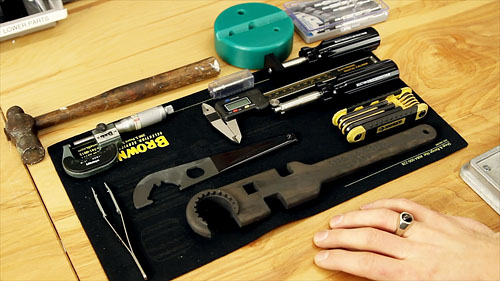


 Hydro-Forming Procedure Step-by-Step:
 Special Shell-Holder


