Sinclair International has created a series of instructional videos illustrating the basics of metallic cartridge reloading. The 8-Part series starts with reloading basics and provides step-by-step, how-to instructions that will help new reloaders get started. Detailed, animated illustrations show you what happens inside the chamber when shooting, and inside the dies during each step of reloading. The videos can be viewed on Sinclair International’s YouTube channel. Shown below is the first video in the series:
Each of the Sinclair videos is hosted by then Sinclair Int’l President Bill Gravatt (now with Creedmoor Sports). Bill doesn’t just show you “how”, he tells you “why”. The how-to segments cover case inspection, proper die set up, case sizing, primer installation, powder measuring, bullet seating, crimping, and even goes into the record keeping needed for the handloader. “We wanted to give shooters who haven’t reloaded a look at all the advantages of creating your own ammo and how easy it is to get started,” said Gravatt, “without telling them they had to have any certain brand or type of equipment to do the job.”
The Eight Video Topics Are:
Part 1 — Intro to Video Series
Part 2 — Intro to Reloading Safety
Part 3 — Metallic Cartridge Components
Part 4 — The Firing Sequence
Part 5 — Tools for Reloading
Part 6 — Loading Bottle-Neck Cartridges (2 videos)
Part 7 — Loading Straight Wall Cartridges
Part 8 — Reloading Series Conclusion
Reloading Tools
Shown below is Part 5 of the video series, covering the tools used for precision reloading.
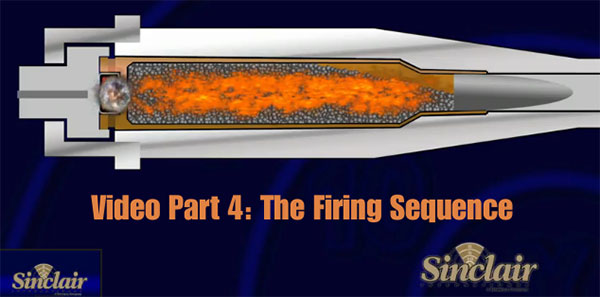
We also strongly recommend the Part 4 Video to readers who are getting started in reloading. This “How Things Work” segment covers the sequence of events inside the chamber (and barrel) when the cartridge is fired. The video includes helpful graphics that show what happens to the primer, powder, cartridge, and bullet when the round is fired. The video also illustrates “headspace” and explains how this can change after firing. We think this video answers many common questions and will help reloaders understand the forces at work on their brass during the firing process.
What anti-corrosion products really fight rust effectively? You’ll hear many opinions, but what do actual field tests reveal? One rifle shooter, who posts on YouTube as BlueonGoldZ, wanted to separate myth (and marketing claims) from reality, so he completed his own long-term rust test using metal samples. First he used ordinary tap water spray, and then he did a second, longer-duration test with a salt-spray solution. Nine different products were tested: Break Free CLP, Corrosion-X, Frog Lube, M-Pro 7, Outers, Pro-Shot Zero Friction, Rem Oil, Slip 2000, and Tetra Gun Triple Action CLP.
BlueonGoldZ initially examined each product for its “beading” properties with a normal tap water spray. But the main test involved many multiple weeks of exposure after a “dense” salt-water spray. (No rust formed after two weeks tap water exposure, so the test was accelerated with salt-water exposure).
The clear winners in the test, as shown by the screen shot above, were Corrosion-X (Best), and Frog-Lube (Second Best). The photo shows the test samples two weeks after being sprayed with salt water. The results are pretty dramatic — you can see with your own eyes what happened. We think this is a very useful bit of real-world research.
Results from Similar Long-Term Salt Exposure Test
Unfortunately, BlueonGoldZ’s test did NOT include Eezox, which we have found to be extremely effective (on a par with Corrosion-X). In another long-term test of corrosion preventatives, the two best rust fighters were Eezox and Corrosion-X in that order. Since that test was completed, Corrosion-X, already an excellent product, has been enhanced. CLICK HERE for Long-Term Salt Exposure Test Report.
Product Review by F-Class John
Case preparation is critical for precision reloading. One must trim cases, debur/chamfer case mouths, clean necks, spruce up primer pockets and do other important tasks. Complete case prep can involve many separate processes, each requiring its own tools. With each of those tools comes additional cost as well as the need for more storage and bench space. To make case prep easier, faster, and more convenient Lyman created the Case Prep Xpress. The Case Prep Xpress, introduced a few years back, combines up to five prep stages into one well-built, stable, versatile unit. Watch this video to see the machine in action:
The Case Prep Xpress features five (5) independently-turning spindles all with the common 8/32 thread. This allows you to attach multiple tools supplied with the unit PLUS many other screw-on prep tools. For our testing we started out using a variety of the 12 included tools and found they cover the majority of case prep tasks. Lyman supplies deburr and chamfer tools, pocket uniformers, reamers and cleaners, as well as an assortment of neck brushes.
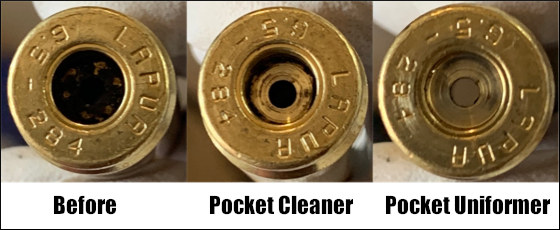
The deburr and chamfer tools worked really well, creating beautiful bevels all while leaving a nice flat edge across the top of the neck which is critical for accuracy and brass life. We found the primer pocket cleaning tool did a good job, but for truly clean pockets we recommend using the primer pocket uniforming tool, which very efficiently removes even hard residues.
The benefit of having interchangeable heads is that you can add your own accessories. We like to use a bore brush with bronze wool wrapped around it for use inside our necks. This worked perfectly once we screwed it in. In fact, we couldn’t think of any 8/32-threaded accessory that wouldn’t work well on this machine. Another great design feature is how all the accessories are oriented straight up. This allows for perfect visual alignment of your cases onto the tools which is critical — especially when performing cutting operations such as primer pocket uniforming.
Along with the five power stations there are six female-threaded storage spots on the sides where tools can be placed to ensure they don’t get lost. We like this feature since there will be more than five accessories you want to use and having them easily available is a great feature. You can keep 11 tools right on the machine (5 on top, 6 on the sides). That way you don’t have to dig through storage bins.
The Case Prep Xpress has a removable front bin to hold brass shavings, and there are two circular trays on either side of the bin. In front is a long tray that holds the provided brush. This makes it relatively easy to clean off brass shavings and other debris from case prep processes.
SUMMARY — Versatile Case Prep Xpress Is A Good Value
For the money, Lyman’s Case Prep Xpress is tough to beat. It performs multiple tasks well while being stable and easy-to-use. Yes there are some multi-spindle prep centers that offer variable or fast/slow RPM spindles while the Lyman’s spindles are all fixed RPM. (See, e.g. the RCBS Brass Boss). However those other systems don’t include all the convenient on-board storage of the Case Prep Xpress, and are more expensive. The Lyman Case Prep Xpress sells for $150-$160 “street price”. It costs $154.99 at Midsouth, and is in-stock now (1/13/2021). This makes the Lyman Case Prep Xpress a fine value — it offers great versatility while saving space and saving money compared to buying five or more separate, powered tools.
Our friend Gavin Gear of UlimateReloader.com got a chance to visit a SilencerCo dealer, The Range LLC in Yakima, WA. During his visit, Gavin was able to test a number of suppressors (aka “moderators” or “silencers”) for both rifle and pistols. Gavin has released a lengthy article covering his experiences. If you are in the market for a suppressor, we highly recommend you read Gavin’s SilencerCo Products Overview on UltimateReloader.com.
Gavin was able to test three SilencerCo suppressors: the Omega 300, the Hybrid, and the Osprey 45. In addition Gavin was able to handle the Maxim 9, an integrally suppressed 9mm handgun.
Gavin reports the Omega 300, which is rated up to .300 Winchester Magnum, is a very popular “can”. According to Gavin, the Omega 300 has become the best-selling rifle suppressor in history for important reasons. First, it has an integral muzzle brake. Second, it can work for multiple calibers, from .223 up to .308. Third, “It is very tough — .300 Win Mag rated, and full-auto rated”.
SilencerCo lineup, from left: Omega 300, Hybrid, Osprey 45
Gavin says the Hybrid Suppressor is an interesting concept: “One suppressor that you can configure for multiple calibers, both rifle and pistol. This includes the ability to change out the threaded mount on the muzzle end, and you can also swap out end caps that will optimize sound suppression for different calibers. The Hybrid… is full-auto rated, and can handle rifle cartridges up to and including .338 Lapua Magnum! But this suppressor can also be used for pistol applications…from 9mm up to 44 ACP.”
We really like rimfire revolvers here at AccurateShooter.com. A good .22 LR wheelgun will be fun, accurate, reliable, and inexpensive to shoot. Rimfire revolvers also offer much less recoil and noise than a centerfire pistol. Your Editor has owned a Smith & Wesson Model 617 for over 15 years. That old S&W has probably fired more rounds than all the other handguns I own, combined — yet it still runs flawlessly and still delivers excellent accuracy.
Ruger offers a big stainless .22 LR wheelgun to compete with the S&W Model 617. This rimfire wheelgun is based on Ruger’s trusted GP100 platform. The Ruger GP100® chambered in .22 LR looks to be a good firearm — strong, versatile, and intelligently engineered. In the video above, the late Jeff Quinn of Gunblast.com tests the Ruger revolver and gives it high marks: “It’s a good hefty gun [42.6 oz.], but not overly large or heavy for a good trail gun. It’s just a really nice, well-made revolver from Sturm Ruger.” The gun Jeff tested had a 3.7-lb SA trigger pull and a 9.8-lb DA pull.
The .22 LR GP100 features a windage and elevation adjustable rear sight with a white outline, a light-gathering fiber optic front sight and the original full-size GP100 rubber grips with hardwood inserts. With all stainless-steel construction, the rimfire GP100 is easy to maintain. Just keep the cylinder chambers and barrel clean and this gun should run forever.
This Review of the .22 LR GP100 by Hickok45 has over 6.6 Million Views:
The 10-shot Ruger GP100 in .22 LR is a durable, well-engineered wheelgun. Ruger’s engineers optimized the GP100’s innards to deliver a smooth double-action pull: “The new GP100 has an improved fire-control system that uses a lighter mainspring than previous Ruger double-action .22 LR revolvers. A number of changes have been made to the GP100 to handle .22. One of which is we’ve done a lot of development on the firing pin location and geometries so that we’re able to put a lighter trigger pull in this gun than you would find in other .22 LR [handguns]. We’ve got a half-underlug barrel, and it’s a smaller diameter so the gun balances real well. We’ve added a narrow-spur hammer and a smooth trigger for comfortable shooting. This is a really comfortable gun to shoot”.
This video from Ruger explains the basic features of the .22 LR GP 100:
Vortex just released its new products for 2021. The stand-outs include new Rangefinding Binoculars with Applied Ballistics software, and four new tripods that should please hunters and tactical shooters. This 2021 lineup also includes two new prism scopes for the Spitfire line, and a solar-operated SPARC red dot sight. All of these new Vortex optics and tripods are available for pre-order now at EuroOptic.com.
Fury 5000 HD RangeFinder Binoculars with In-Display Ballistics
Vortex Fury HD 5000 AB Laser Rangefinding Binoculars
We’re excited to see Vortex’s new Bluetooth-compatible Fury HD 5000 AB rangefinding binoculars. The new 10x42mm Fury HD 5000 AB employs Applied Ballistics software to provide Ballistics solutions visible in the Binoculars. That’s an impressive feature. Vortex brags that the new Fury 5000 HD AB can “solve long-distance shooting with the push of a button”. These binoculars feature in-display wind/drop ballistics solutions, wind bearing (angle) capture mode, plus built-in environmental sensors.
In-display wind/drop solutions via integrated Applied Ballistics® Elite Solver
Pairs with Kestrel® wind meters and Applied Ballistics® Garmin® devices
Customize ballistic profiles via the Fury HD App
Fury HD 5000 AB, $1,999.99 MSRP ($1499.99 at EuroOptic)
New Vortex Tripods — Three Carbon Options
For 2021, Vortex offers four new tripods, three with low-mass, carbon-fiber legs. Prices start at $299.99 MSRP for the compact High Country II. The tall Ridgeview tripod ($649.99 MSRP) goes to full standing height. The top-of-the-line Radian Tripods are great for competition, providing a strong base for heavy PRS rigs. In addition there are a variety of tripod heads and accessories for these tripods.
Radian Carbon Tripod (Premium strength with versatile Ball or Leveling Head)
— Radian Carbon with Ball Head Tripod Kit — $1,199.99 MSRP ($899.99 at EuroOptic)
— Radian Carbon with Leveling Head Tripod Kit– $1,099.99 MSRP ($799.99 at EuroOptic”)
Ridgeview Carbon Tripod (extended height for standing) — $649.99 MSRP ($499.99 at EuroOptic)
Summit Carbon II Tripod (very compact, lightweight) — $549.99 MSRP ($399.99 at EuroOptic)
The SPARC SOLAR harnesses the sun for up to 150,000 hours of battery life, powering a reliable tactical machine that’s always ready.
Auto D-TEC Technology automatically switches from solar to battery power
Motion activation capable
Daylight bright 2 MOA red dot
$399.99 MSRP – SPARC SOLAR Red Dot
Spitfire™ HD Gen II 3x and 5x Prism Scopes.
Redesigned HD optical system cuts inches and ounces off the system.
HD Optical system
Ultra-compact and lightweight design
Purpose built AR-BDC4 reticle for 5.56 cartridges
$549.99 MSRP – Spitfire HD Gen II 3x Prism Scope
$649.99 MSRP – Spitfire HD Gen II 5x Prism Scope
Jessie Harrison — one of the greatest female pistol shooters on the planet. In the video below, Jessie offers good tips on safe handgun mag changes.
In this Pro Tip Video, Jessie Harrison talks about Dry-Fire Pistol Training:
One of our Forum members asked: “Are there any good books on pistol marksmanship? I’m looking for a book that covers techniques and concepts….” Here are eight recommended titles that can make you a better pistol shooter. These books run the gamut from basic handgun training to CCW to Olympic-level bullseye shooting.
Good Guidebooks for Pistol Shooters
There are actually many good books which can help both novice and experienced pistol shooters improve their skills and accuracy. For new pistol shooters, we recommend the NRA Guide to the Basics of Pistol Shooting. This full-color publication is the designated student “textbook” for the NRA Basic Pistol Shooting Course.
If you’re interested in bullseye shooting, you should get the USAMU’s The Advanced Pistol Marksmanship Manual. This USAMU pistol marksmanship guide has been a trusted resource since the 1960s. Action Shooters should read Practical Shooting: Beyond Fundamentals by Brian Enos, and Practical Pistol by Ben Stoeger. Brian Enos is a well-known pistol competitor with many titles. Ben Stoeger is a two-time U.S. Practical Pistol shooting champion. Julie Golob’s popular SHOOT book covers pistol marksmanship, along with 3-Gun competition. Julie holds multiple national pistol shooting titles.
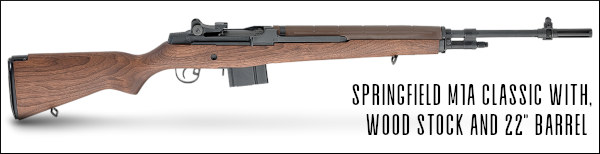
Do you own an M1A rifle? If so, you’ll want to view a new video from Springfield Armory (SA). As part of SA’s new Workbench Video Series, this 9-minute video is a detailed guide to the M1A rifle. The video can benefit any M1A owner or shooter: “These in-depth videos were developed to help new gun owners safely care for and maintain their firearms, as well as provide a useful resource for seasoned gun owners”, notes Steve Kramer of Springfield Armory. In the video, firearms expert Steve Horsman provides a step-by-step guide for the popular M1A semi-auto rifle.
Springfield Armory M1A Workbench Video:
“Descended from the M1 Garand, the M14 utilized multiple improvements that made it a far superior firearm for combat and a much better rifle for competition.” — Dick Jones, Shooting Sports USA.
An evolution of the M1 Garand, the M14 was designed to shoot the 7.62×51 (.308 Win) round instead of the larger .30-06 Springfield cartridge used in WWI, WWII and Korea. While the vast majority of today’s M1As are chambered for .308 Win/7.62×51, Springfield Armory also produces a 6.5 Creedmoor version
For many years, the semi-auto version of the M14 was “top dog” in iron sights Service Rifle competition. Now that discipline is dominated by .223 Rem (5.56×45) AR-type rifles, but the bigger .308-caliber rifle, now sold as the M1A, remains popular. Each summer, the CMP hosts a major M1A Match at Camp Perry, sponsored by Springfield Armory. This is a popular event with 100+ competitors and significant cash prizes.
See how the modern M1A is built in this Springfield Armory Video:
As racing improves automobiles, competition improves firearms, and the current crop of Springfield M1As, from the Basic to the top-of-the-line Super Match and Loaded models, reflects the years of development. The M14 and its variants are … still considered by many to be the best battle rifle in the history of the U.S. Military. — Dick Jones, Shooting Sports USA
Military Version Operation Revealed — M14 Training Film
The original military version of the M1A was the select-fire M14. The 27-minute official U.S. Army video below demonstrates the operation of the M14. Field-stripping is shown from the 5:13 time-mark through 8:30. Cut-away drawings show the M14’s gas operation at 8:40.
Watch M14 Functioning Cycle Starting at 9:25 Mark:
The M14’s complete 8-step functioning cycle is demonstrated from the 9:25 time-mark through 22:41. These eight operations are: 1) Feeding; 2) Chambering; 3) Locking; 4) Firing; 5) Unlocking; 6) Extracting; 7) Ejecting; and 8) Cocking. This movie is fairly long, but every M1A owner should definitely watch this video start to finish.
This is one of the best new pistol accessories we’ve seen in the last decade. The Leupold DeltaPoint Micro is a capable Red Dot optic that mounts on the back of a pistol slide, fitting the normal rear sight slot. That’s very clever. This Micro is much smaller than a typical red dot sight, making this a viable option for a concealed carry pistol. That is a very big deal. You can aim considerably faster because you don’t need to worry about front/rear sight alignment. Plus the battery-powered Red Dot gives a gun owner the ability to aim effectively in dark conditions. Just put the 3 MOA Red Dot on your target.
DeltaPoint Micro Features:
Low Profile Design. Sits so low on the slide that it replicates the same sight plane of iron sights, making it more intuitive to use and more concealable. Fast and Easy to Mount. Mounts directly to rear dovetail — no need to have slide milled or altered. Circular Optic Ring. Acts like a ghost ring sight if the battery dies. Smart Shut-off. Built-in motion sensor shuts off Red Dot after 5 minutes of inactivity, preserving battery. Adjustable Brightness. The 3 MOA Dot has multiple brightness settings. Enclosed Diode. Placed inside the housing, the diode is protected from moisture, dirt, and debris. Lifetime Guarantee. Unlike most electro-optics products, the DeltaPoint Micro is guaranteed for life.
The DeltaPoint Micro is 2.25″ long and 1.25″ tall, while weighing just 1.1 ounces. It’s a direct replacement for the rear factory iron sight and mounts at the same height. Keeping the same height makes it easier for iron sight shooters to adjust to a new system. The Red Dot also aligns with the front sight, making target acquisition fast and intuitive.
Tim Lesser, Leupold’s V.P. of Product Development, is proud of the new DeltaPoint Micro: “No red dot on the market is more compact; its low height-to-bore replicates the same sight plane that iron-sight shooters are used to, allowing for intuitive target acquisition.”
CCW Holders are the “target market” for Leupold’s new, low-profile Red Dot product: “For shooters who need a red dot sight for their personal carry pistol, the DeltaPoint Micro is a rugged reflex sight that delivers rapid target acquisition, increased accuracy … in a sleek, low-profile design.” This is not an inexpensive accessory. The MSRP is $519.99 for either Glock or S&W versions.
Leupold currently produces DeltaPoint Micro optic models for Glock and Smith & Wesson M&P pistols, with more versions (for other guns) likely to be released later in 2021.
Real World Review from The Shooting Wire Shooting Wire Editor Jim Shepherd got a DeltaPoint Micro for testing, and quickly saw its potential: “I decided to mount [the DeltaPoint Micro] on my first-generation M&P Shield. The inability to put an optic on it had become a real problem. To the point it was resting in my safe, not riding in the holster where it accompanied me for several years. The problem wasn’t the Shield, it was my aging eyeballs. I can’t see the sights well enough to shoot [the M&P Shield] accurately.
Even without a lot of range time in on the DP-Micro equipped-Shield, I’ve shot it enough to realize I’m more accurate — and considerably faster — than with iron sights. No more ‘searching’ for a front sight. Now, I’m using dry-fire practice to ‘re-learn’ the Shield with this new optic.” READ FULL Report.
As we release this story, the New Year — 2021 — is just 12 hours away. Perhaps you’ve been eagerly awaiting for the big event, getting champagne (and sparklers) to celebrate the New Year. 2021 will hopefully be a much better year than 2020, what with the Pandemic, riots in the cities, and controversial elections. To mark the dawning of 2021, with hope for a much better year, we expect many folks will open a bottle of champagne. You could pop the cork the traditional way, or read on and learn how to release the celebratory champagne with a rifle shot, as demonstrated by the talented Kirsten Joy Weiss.
Recently at Thorton Winery in Temecula, California, a champagne vintner, we were shown the best way to open a champagne bottle. We were told you should hold the bottle nose up at an angle then rotate the BOTTLE slowly while holding the cork. That works great… but it’s not as stunning as the way sharpshooter Kirsten Joy Weiss opens a bottle of bubbly.
A former competitive smallbore rifle shooter, ace trigger-puller Kirsten Joy Weiss tried a special New Year’s trick shot a few seasons back. In keeping with the festive New Year’s spirit, Kirsten attempted to shoot the cork off a champagne bottle. After a few unsuccessful tries, she managed to hit the cork with at least two shots. But alas the cork did not fly. She actually hit the cork, but it did not release. That was surprising…
Undaunted, Kirsten changed her strategy, aiming for the neck of the bottle. This duplicates the process of “sabering” a champagne bottle — a method of liberating the bubbly by slashing off the end of the neck with a blade. Aiming for the neck of the bottle, Kirsten successfully blew off the top of the bottle. (Apparently, when “sabering” it is actually the pressure within the champagne bottle which does most of the work).






 Vortex Fury HD 5000 AB Laser Rangefinding Binoculars


 Good Guidebooks for Pistol Shooters



 Real World Review from The Shooting Wire
 A former competitive smallbore rifle shooter, ace trigger-puller Kirsten Joy Weiss tried a special New Year’s trick shot a few seasons back. In keeping with the festive New Year’s spirit, Kirsten attempted to shoot the cork off a champagne bottle. After a few unsuccessful tries, she managed to hit the cork with at least two shots. But alas the cork did not fly. She actually hit the cork, but it did not release. That was surprising…


