High-Tech Rimfire Rigs
If you watched the smallbore position and prone shooters at the 2016 Brazil Olympic Games, you couldn’t help but notice the exotic rifles competitors were shooting. There were wood stocks, metal stocks, factory-built rifles, and customized specials. One of the more popular smallbore rifles used at the Olympics and World Cup competition has been the Anschütz model 1913 “Super Match”, fitted with the 1918 “Precise” Alumnium stock. Anschutz does have a newer 2013 model, but this 1913 remains quite popular. The Anschütz model 1913 rifle boasts remarkable adjustability to suit the 3-Position game. The wide range of adjustments allow the the rifle to be customized for the shooter, and modified to best suit each position: prone, kneeling/sitting, and standing.
Customizable rifles like this Anschütz 1913 Super Match “can make a real difference in a shooter’s performance,” explained Jessie McClain of the NRA Competitive Shooting Division. “I went from a decent shooter to making the varsity shooting team my freshman year because of the rifle.” A key feature is the fully adjustable stock, which she called the Porsche of the shooting world. Fully adjustable from the butt plate to the check piece to the hand stop and risers and bolt knobs, the aluminum stock is fully customizable to the athlete … which can be a huge advantage. “Every person is different … a customizable rifle fits anyone. A rifle team can purchase four of these and field a shooting team for years.”
The Modern Anschütz Position Rifle
Smallbore match rifle makers are using modern materials in response to the need for greater adjustability (and enhanced accuracy). One of the most popular designs is the Anschütz model 1913 position rifle with a “1918 ALU Precise” brushed aluminum stock. This looks like it has been crafted in an aircraft plant.
The Anschütz 1913 Precise — Prone Shooting with Ace Marksman
In this 7-minute video, you can see details of an Anschütz 1913 Super Match Rifle (ALU Precise 1918 stock) for the first two minutes. Then the video shows the rifle being shot from prone, viewed from multiple angles (right, left, overhead, front). Watch at the 5:15 time-mark to see how the marksman steadies his rifle for the shot. This video offers good details of feeding and prone holding.
NEXT Generation — the Anschütz Model 2013
This video shows the latest-generation Anschütz model 2013 match rifle with aluminum 2018 stock being used in a benchrest match with riflescope. Note that the 2013 action is slab-sided and silver, rather than cylindrical and blued like the older model 1913. You’ll see good close-ups of the shooter working the action and feeding rounds. Watch closely and you can see the take-up, trigger pull and firing at 00:32 and 00:57 time-marks.
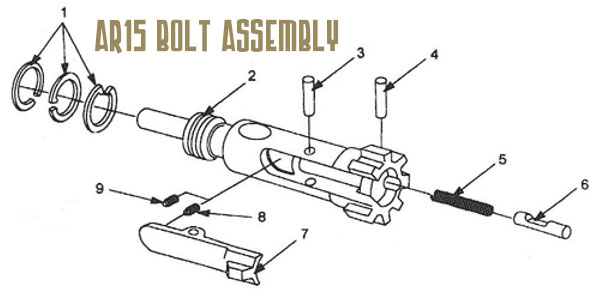
AR-platform rifles can be maintenance-intensive beasts. But some AR owners make the situation worse by not regularly cleaning important small parts, or by using too much oily/greasy lubricants in the wrong places. A properly maintained and lubricated AR15 can shoot hundreds of rounds (between cleanings) without a problem. If you learn where (and where not) to apply lubricant, you’ll find that your AR will run more reliably and the task of cleaning the bolt and bolt carrier will be less of a burden.
Here is a good video that explains AR-15 Cleaning and Maintenance. In this 30-minute NSSF video, Gunsite Academy instructor and gunsmith Cory Trapp discusses the proper way to clean and maintain the AR-15 carbine. Very knowledgeable, Trapp provides rock-solid advice for AR owners. Along with cleaning procedures, this video explains how to inspect key components and how to function-test your AR before each shooting session.
If you want to keep your black rifle running smoothly and reliably, you must clean it regularly and follow the correct maintenance procedures. Here’s another good video that explains how to properly disassemble and clean AR-platform rifles.
Take-Down and Full Cleaning of AR15 by Jerry Miculek
Here ace shooter Jerry Miculek takes down and cleans an AR-platform rifle belonging to his daughter Lena. This is a good video because Lena’s rifle was “run hard and packed up dirty” so you can see where carbon and grease build up. This 35-minute video is very thorough. Jerry is one of the nation’s top action carbine shooters, so listen carefully to his advice on cleaning and lubrication.
GetZoneHunting.com has a vast video library for hunters, with hundreds of helpful videos on all types of hunting. In time for fall turkey season, GetZoneHunting now offers a big collection of turkey hunting videos: At the Ranch – Turkey. On that page you’ll find 13 turkey hunting “how-to” videos. Here are links to five GetZone Turkey Hunting videos with valuable information from skilled, experienced hunters.
At the Ranch Turkey Hunting Videos
At the Ranch – Turkey offers solid advice for turkey hunters. These five videos will help you better understand turkey behavior and have success on your hunt. Click any photo to watch the particular video on the GetZone website. (Work Warning — When each GetZone video opens, it may immediately launch an annoying commercial with loud AUDIO!). There are eight more turkey hunting videos on GetZone’s Turkey Hunting HQ Page.
At the Ranch: Shot Placement for Turkeys — CLICK PHOTO to Watch Video
At the Ranch: Turkey Hunting Essentials — CLICK PHOTO to Watch Video
At the Ranch: The Difference Between a Jake and a Tom — CLICK PHOTO to Watch Video
At the Ranch: Early vs. Late Spring Turkey Hunt — CLICK PHOTO to Watch Video
At the Ranch: How to Plan a Turkey Hunt — CLICK PHOTO to Watch Video
Free Printable Turkey Target from AccurateShooter.com
As a special bonus for our readers, here is a free, printable Turkey Target, so you can practice for your turkey hunting adventure, This special Turkey Bullseye Target was created by our friend and Forum member Pascal (aka “DesertFrog”). CLICK HERE for FREE Turkey Target.
This video from Brownells talks about a the crown of a barrel and how the crown’s condition affects accuracy. As the bullet leaves the barrel of the gun, the shape, alignment and the condition of the crown can affect the accuracy of your shot. A proper crown is essential to ensure that the bullet leaves the barrel correctly and that the propellant gasses behind the bullet are distributed evenly on firing. A square crown without burrs and a smooth transition will normally ensure consistency from shot to shot. By contrast, a damaged crown can cause unpredictable flyers that open your group. That’s why it’s important to have perfect crowns on all your barrels.
The video explains the different types of crowns that can be used. In addition, the video shows how you can chamfer your muzzle in a home shop. If you use a properly-sized pilot, cutting a shallow chamfer is something that most guys with some mechanical skill can handle. Just be sure to use lubricant, flush chips, and don’t rush the job. Cutting the barrel is another matter. At the 1:20 mark the video shows how to use a hack-saw to remove a damaged muzzle section. While this may be fine for an inexpensive rifle that needs a “quick fix”, we do NOT recommend using a hack-saw with a vise for a competition barrel. The reason is that it is too easy for a novice to produce a cut that is not square. We suggest letting a professional gunsmith cut and crown your competition barrels.
For this Sunday GunDay article we feature a “blast from the past” — David Tubb’s engineering tour de force, the Tubb 2000, or “T2K” for short. With the remarkable T2K, David earned multiple NRA High Power championships, and David shot the first-ever perfect score in the NRA Long-Range “any sights” championship 16 years ago.
Our write-up this week focuses mostly on “hardware” because David’s performance with the rifle speaks for itself. He has won eleven High Power National Championships at Camp Perry, and in 2004 David mounted a scope to his rifle and captured the Long-Range “any sights” Championship with a 1450/1450, the first and only perfect score ever logged at Camp Perry. He did this all with his trusty 6XC-chambered T2K, shooting the DTAC 115gr bullet in a 1:7.5″-twist Schneider P5 barrel. For more information about this remarkable competition rifle, read on.
[Editor’s NOTE: Because this is an article from our older Archives, some technical details may have changed with time. For all current specifications on TUBB rifles, including the TUBB 2000, visit DavidTubb.com. For more information on the particular T2K rifle featured in this story, CLICK HERE.]
Mag-Feed Action with Unique Bi-Camming Bolt
The action is machined from 17-4 stainless steel to true benchrest quality standards. The design features a solid top with a loading port. This increases action stability, stiffness, and strength. The loading port is easily accessible and is angled to aid the shooter in single loading rounds. The Tubb 2000 is fed via 10- or 20-round box magazines.
“I prefer using 20-round magazines with the Tubb 2000 because it provides a secure hand hold when shooting off the bipod. For across the course competition, the 10-round magazines are the best choice as they do not encumber sling-supported shooting positions. There is no difference in the functioning or reliability of either capacity magazine.”
One-finger Bolt Operation
Low effort bolt operation was a key goal in the design of the Tubb 2000 action. The exclusive bi-camming design employs two cams that engage during bolt lift to radically reduce bolt lift effort. Bolt lift is 75 degrees. The cone-faced bolt has two locking lugs which are narrower and taller than on conventional actions. This design allows the magazine to be mounted higher in the action for smoother, more positive feeding. The bolt handle is designed for superior performance in sustained fire operation. Its ergonomic shape allows operation with a single finger, if desired. The bolt is machined from 8620 carbon steel and rides back into the butt extension, under the shooter’s face so the bolt can be operated without the shooter having to change his head position. This low center of gravity also improves the rifle’s feel and performance under recoil.
The action features a full-length Picatinny rail that will accept Weaver®-style mounts. The action’s adjustable sight mounting system allows the rail to be mounted at one of three pre-set mounting angles — 0, 5, and 10 degrees — to allow the shooter to level the sights to fit his shooting style. A custom base is available to mount match iron sights. All barrels have a small section at the muzzle turned down to accept a clamping-style front sight mount or cant indicator.
The T2K’s Lock Time is ONE millisecond — over three times faster than a Model 70 Winchester.
Barrel Configuration
Tubb 2000 rifles featured hand-lapped stainless steel match barrels with the exclusive “Tubb Contour.” This unique contour maximizes accuracy and minimizes weight — it’s the perfect balance. According to David: “It’s a contour where the barrel wouldn’t shoot one bit better if it was one bit bigger.” The Tubb 2000 was conceived as a “switch barrel” gun — it’s designed to be easily re-barreled by the customer. This feature means that the same rifle can support different calibers and shooting disciplines. Finished barrels in a variety of calibers were available for “do-it-yourself” installations. The gun shown here has a Schneider barrel.
The Tubb 2000 has, over the years, been offered in a variety of chamberings including: .22-250; .243 Winchester; 6mmBR Norma (6BR); 6XC; .260 Remington; 7mm-08; and .308 Winchester. Available accessories include finished barrels, extra 10- or 20-round magazines, cleaning rod guide, adjustable bipods, custom adjustable handstop, fore-end weight rail, and cant indicator.
Trigger, Stock Adjustment and Other Features
The Tubb 2000 uses the superb Anschütz® fully-adjustable two-stage trigger (with safety); one of the finest available to the precision rifleman. This trigger can also be adjusted to provide single-stage operation. The buttstock assembly, forend, buttstock clamping block, and magazine housing, trigger guard assembly are made from 60-series aluminum, hard anodized in the customer’s choice of 6 colors: light and dark teal, purple, red, forest green, and black. (The T2K Tactical (see below) comes in matte black only.) These four parts are each available in any of the listed colors, allowing the purchaser to design his own distinct rifle.
The buttstock is FULLY adjustable for length, height, cant (angle), and offset. The cheekpiece is adjustable for height. An easily accessible knurled wheel allows the shooter to adjust the cheekpiece from the shooting position. Shooter comfort is further augmented by an ergonomic pistol grip. All adjustment features on the Tubb 2000 were designed for easy shooter access. The butt extension, clamping block, shock housing, and buttplate all have index marks to allow the shooter to record and repeat adjustment settings. The tubular fore-end can be rotated and positioned to accommodate the shooter’s preference. An integral accessory rail accepts a custom adjustable handstop or bipod. The fore-end also incorporates a built-in barrel heat wave blocking system which eliminates optical distortion in the sighting plane.”
David Tubb Explains T2K Stock Adjustments
I advocate setting stock length a little longer than most people might. I am a firm believer that it is best to “reach” slightly for the pistol grip as this ensures a strong, secure hold on the rifle. I pull the rifle firmly into my shoulder pocket when shooting offhand, and also prefer to have what I would characterize as very firm contact between rifle butt and shoulder in the sitting and prone positions as well. When using a sling in prone or sitting, stock length (and sling tension) should be great enough so that, at the least, you have to push the buttpad forward with your hand in order to place the stock into the shoulder pocket. My buttstock is shortest offhand and longest prone. If my standing setting is “0”, I’m usually out about 1-1/2 inches for sitting and about another inch for prone. I have found that many people tend to shoot with a stock that’s too long in sitting and too short everywhere else.
I have found the cast off/on adjustment feature on the buttstock to be of great help to me in attaining the natural shooting positions I desire. For prone, I offset the clamping block so the buttplate moves outward [the index mark on the clamp is to the right of center on the scale on the receiver extension tube]. I swing it a little bit inward for offhand and slightly more inward for sitting. The amounts of cast on/off (in clock-face terms) are approximately 6:30 for standing, 4:30 for prone, and 8:00 o’clock for sitting.
Stock Length Adjustment Procedure
The buttstock is adjustable in length 4+ inches. This adjustment is accomplished by moving the buttplate tube in or out after loosening the four screws on the clamping block. Ensure that the buttstock tube is fully contained in the block. The extent of rearward (lengthening) movement is determined by the front of the buttstock tube fitting flush with the front of the block.
Stock Cast and Cant Adjustment Procedure
The buttstock is adjustable for cast or offset by loosening the four screws on the clamping block and swiveling the block on the receiver extension tube. The buttplate itself is adjustable for cant up to 360 degrees and after loosening the screw directly in the center of the rubber recoil pad is adjustable for height at approximately 1-1/2 inches. The cheekpiece is adjustable vertically approximately one inch. The vertical cheekpiece adjustment is accomplished via the top knurled ring. The lower knurled ring will then secure the setting.
About David Tubb — Tubb 2000 Designer
David Tubb is arguably the winningest centerfire rifleman in history. He has won a record eleven NRA National High Power Rifle Championship titles at Camp Perry, along with six NRA Long Range HP Championships. In addition, David is an NRA Silhouette Rifle legend, having won nearly 30 open, individual National Championship titles in all four rifle categories. David has also won seven Sportsmen’s Team Challenge Championships and multiple Wimbledon Cups. His latest big win was the 2019 NRA ELR Championship in Heavy Gun Class.
For more information on the
Tubb 2000 Rifle contact:
David Tubb Accuracy
and Precision Gun Parts
800 N. 2nd Street
Canadian, TX 79014 DavidTubb.com
Phone: (806) 323-9488
Every serious competitor needs a good spotting scope support. Spotting scopes are not just for iron sights shooters. Even if you have a powerful riflescope, the spotting scope, typically set at 15-25X magnification, lets you observe wind flags, mirage, and other shooters’ targets. If you are looking for a high-quality, made-in-USA support for your spotter, consider the Polecat V2 system from Creedmoor Sports. Our friend Gavin Gear of UltimateReloader.com recently posted this video review:
Creedmoor Sports has offered excellent products for competitive shooters for decades. The Made-in-USA Polecat V2 system is updated version of Creedmoor’s best-selling spotting scope stand. After collecting feedback from shooters across many disciplines for several years, the designers brought some major advances to this scope stand. First, no pretension are adjustments needed. Horizontal and vertical resistance is controlled by the knurled tightening knob. Second, the Polecat boasts a pre-aligned Delrin clamp so you don’t have to spin the clamp to align with the rods during stand assembly. You can order a Polecat V2 with 3/4″-diameter rod for $296.95 or get the 1″-diameter rod version for $364.95.
Either version can be used for both left-handed and right-handed shooters, with about 5″ standoff from the center of the stand to the scope’s centerline. Polecat V2 packages include head, stop collar, one extension rod, and base. Additional aluminum rods are available to extend height.
Polecat V2 Key Features
— Adjustable head (spotting scope mounts to head)
— Bump stop (protects spotting scope from accidental knock if dropped)
— Base with three fold-out legs
— Leveling adjustment for uneven ground (one leg can be adjusted downward, faced in downhill direction)
— Zero play (slop), giving you the ability to quickly and easily make adjustments
— One-handed operation/adjustment
— 1/4″-20 standard spotting scope thread
— The scope may be positioned above or below the scope head
As part of NRA Women TV, hunting guide Kristy Titus hosts a series of videos that explain important strategies and shooting skills for hunters. Titus is a certified instructor who has hunted around the globe. She grew up in the outdoors, running pack mules in Oregon with her father. In these videos, Kristy discusses demonstrates field positions that can be employed during a hunt. She also explains preparation for a hunt, including fitness training.
Shooting Positions and Rifle Support in the Field
Because of interferring terrain features, it’s not common to get a prone shot on game. That’s why hunters nead to practice shooting from various positions. You can use tree limbs or boulders for support (see above). In addition, many hunters bring bipods or tripods to help make that once-in-a-lifetime trophy shot. We have used telescoping Bog-Pod supports on varmint hunts. In this video, Kristy explains various shooting positions and training routines.
Fitness Training — Prepare for the Trek
Kristy explains: “Hunting can lead you into some steep, rough country. It’s really important that you train both your body and your mind to handle the elements and the rigors of hunting. With no two hunting situations being the same, we must train to be adaptable and make the most of every opportunity. The most important aspect of hunting success, ultimately, is the person behind the rifle. So, if you plan on going on a mountain hunt, get out and train your body. Train with your firearm. Get off the bench and have some fun with this. Do some positional shooting or, if you want to add a stress dynamic… have someone put you under a time parameter.”
“When it comes to bolt-action rifle fit, there is no ‘one size fits all’,” says Titus. “When picking out your rifle [consider options] after the purchase to ensure you are as comfortable as possible.”
There’s a good episode of Shooting USA TV this week, featuring the Rimfire Challenge World Championships. This major match attracts hundreds of competitors from around the nation. It’s fast and fun with instant feedback from ringing plates indicating hits. The Rimfire Challenge Championships is family-friendly event that’s great for all skill and experience levels. This week Shooting USA will also feature two dozen new-for-2020 products, including new pistols, rifles, shotguns, optics, holsters, and more.
Shooting USA airs Wednesday 9:00 PM Eastern and Pacific, 8:00 PM Central on Outdoor Channel. You can also watch Shooting USA any time online via Vimeo.com.
The Rimfire Challenge World Championships
The Rimfire Challenge is just about the most fun you can have with .22 LR pistols and rifles. The Rimfire Challenge Championship drew 250 competitors to the Old Fort Gun Club in Arkansas. The competition is similar to the Steel Challenge, but a lower cost, family-friendly rimfire only event. And the steel target set up is different each time, with competitors only knowing how many targets to shoot, and in what order, when they step to the shooting box.
This Rimfire Challenge Championship featured 16 stages — 8 for pistol, 8 for rifle. On each stage, shooters engage 5, 6, or 7 targets, in five separate strings of fire, with the best four runs counting for record.
NSSF Rimfire Challenge Basics
The Rimfire Challenge is a two-gun event so you need a rifle and a handgun (either a semi-auto pistol, or revolver). There are two divisions: 1) Open — Any firearm (pistol or revolver in handgun class) with scopes, optical sights, light gathering scopes, battery powered optics or lasers; and 2) Limited — Pistols and rifles with iron sights, adjustable metallic sights, and/or fiber optic. Bolt-action rifles and lever-action rifles are allowed, but self-loading (semi-auto) rifles are most popular because they can shoot quickly.
Many different stage designs can be employed at Rimfire Challenge matches. Shown above are two examples from the Rimfire Challenge Suggested Courses of Fire.
New-for-2020 Products Also Featured this Week
Shooting USA has assembled many of the new products which were to be unveiled at the NRA Annual Meetings in Nashville, Tennessee. Unfortunately that Nashville NRA event was cancelled due to the pandemic (there will be a smaller NRA Annual Meeting in Tucson, Arizona, October 24, 2020). Jim and John Scoutten review two dozen products that were going to be showcased at the NRA event in Nashville. Here are four of the new products reviewed in this episode:
Shooting USA is available On Demand via Vimeo.com. Watch a single episode for $0.99, or get a full-month subscription for $3.99 and watch as many shows as you like with limited commercial interruptions.
According to the NRA-ILA, the number of concealed handgun permits reached 18.66 million in 2019 – a 304% increase since 2007. And many more have been issued in 2020.
In America, a violent crime happens every 26 seconds (FBI statistics). Because of this, and growing concerns over social unrest and riots, more Americans than ever before are buying handguns and getting CCW permits. To help Americans understand concealed carry laws, get trained properly, and have legal support after an incident, the U.S. Concealed Carry Association (USCCA) was created. This organization has been very successful, experiencing more than 30% year-over-year growth since 2016.
CCW holders can definitely benefit from USCCA membership, primarily because of the legal services that are offered by the USCCA. If you even draw a firearm in an encounter, you will probably need a lawyer, and need one immediately. The USCCA states: “If you ever have to defend yourself or your family, you’ll have access to a local attorney, the financial funding to protect against criminal charges and civil suits, and instant connection to our emergency response team.”
Proper Training is Very Important for CCW Holders
The USCCA recently announced that its organization has reached over half a million members, keeping pace with record-breaking 2020 firearm sales across the nation. This surge in membership demonstrates that firearms education and training remains a top priority. The USCCA also reported a 620% increase in online training/education courses through the first nine months of 2020 compared to all of 2019.
“Record numbers of Americans are embracing their Second Amendment rights and in doing so, they are turning to the USCCA for industry-leading self-defense education, training and legal protection”, said Tim Schmidt, president and founder of the USCCA. “Our mission is to help save lives and so it is both incredible and humbling that more than 500,000 Americans have now joined the USCCA[.]”
Ace tactical shooter and gunsmith Jim See of Elite Accuracy LLC recently tested a Frankford Arsenal rotary brass tumbler. Like the older Thumbler’s Tumblers, this can tumble your cases in a liquid solution. The wet-tumbling process worked very well Jim reports. Posting on Facebook, Jim noted: “I was super impressed with the Frankford Arsenal rotary tumbler and cleaning packs they sent me. I ran 350 pieces of brass for one hour. They now look great.” Jim appreciated not having to deal with dry tumbling media, such as crushed walnut shells. Dry media produces dust and can leave residues or clog flash-holes.
Interestingly, Jim recommends you try wet-tumbling WITHOUT using stainless media. At least give it a try. Tumbling without media simplifies the process and you don’t have to worry about pins stuck in flash-holes or case-necks*. Jim reports: “Stainless steel pins come with the Frankford kit, but mine hit the trash right out of the box. There is no need to clean the inside of your cases 100% and that’s all the pins add to the equation. The brass bumping brass with hot water and Frankford’s liquid cleaner works great all by itself.” One wag stated: “That’s great to hear. Stainless steel pins are a PITA.”
Other Facebook posters concurred with Jim’s evaluation of the Frankford Arsenal Rotary Tumbler:
“I’ve had one for a couple years, and it works well. I usually run about 250-300 Dasher cases at once in it. But I use the pins because I’m OCD about clean brass.” — David W.
“I’ve had one for a year and a half and it definitely works with or without pins.” — Luke C.
“I got one about six months ago and have yet to use any SS media. I just use some dawn, distilled water, and Lemi Shine®. Turns nasty 5.56 range brass bright and shiny.” — Brian D.
“I don’t use the pins either and use a combination of Dawn soap and Lemi Shine.” — Jon N.G.
This video shows how to assemble and operate the Frankford rotary tumbler. NOTE That Jim See does NOT feel that it is necessary to use stainless media.
How to Dry Your Brass — Hair Dryer Vs. Machine
The downside of wet tumbling is that you end up with a pile of wet brass at the end of the cleaning cycle. There are many ways to dry brass, from drying in the sun to using a kitchen oven (be careful not to “overcook” your brass). One Facebook poster asked Jim: “What is your drying method for wet brass, and how long does it take?”
Jim See replied: “To start I just drain off the dirty water, and rinse the brass with clean hot water. Then I roll the brass on a towel for 30 seconds and put the brass in a one-gallon bucket. Next I insert a hair dryer in the bucket (with the brass) and let it run for about 5 minutes. With this procedure, the drying process for me is done in less than 10 minutes.”
Jack Lanhart has another method: “I use a food dehydrator. It takes 30 to 45 minutes.”
For those who don’t want to mess with towels and hair dryers, Frankford Arsenal offers a matching Platinum Series Case Dryer that simplifies the process of drying brass. Lyman also makes an excellent Cyclone Case Dryer. Both drying machines cost about $60.00 and both have multiple levels so you can separate different types of cartridge brass. Lyman states that “The forced heated air circulation of the Cyclone will dry your brass inside and out within an hour or two, with no unsightly water spots.” The Lyman dryer can also be used for ultrasonically-cleaned gun parts.
*The Frankford Rotary tumbler does include media separators if you choose to use the provided pins or other media. CLICK HERE for diagram showing how to use media separators.


 High-Tech Rimfire Rigs




 Trigger, Stock Adjustment and Other Features


 Stock Cast and Cant Adjustment Procedure


