Here are three videos from the U.S. Army Marksmanship Unit (USAMU). On Tuesdays, the USAMU regularly releases a new Training Video. Most of these Training Tuesday Videos cover match rifle shooting, but there are also tips on pistol marksmanship and shotgun shooting. You will find all the latest Training Tuesday videos on the USAMU YouTube Page.
Getting Set-Up for Prone Shooting with Mat and Spotting Scope
SGT Forrest Greenwood of the USAMU Service Rifle Team explains how to set up service rifle gear for a slow-fire, 600-yard course of fire. This video offers some helpful tips for all prone shooters — even F-class competitors. SGT Greenwood explains how to place the mat, set up the spotting scope stand, lay out the log book and ammunition, and then get ready to shoot. SGT Greenwood has earned the Distinguished Rifleman Badge and the President’s One Hundred Tab.
Rifle Shooting from the Sitting Position with SFC Brandon Green
SFC Brandon Green, three-time NRA National High Power Champion, is one of America’s greatest marksmen. In this video Brandon explains the sitting position while SGT Benjamin Cleland demonstrates. This video was filmed at the 2019 Eastern Games Rifle Small Arms Firing School (SAFS) in Butner, North Carolina. The USAMU Service Rifle Team soldiers helped run the SAFS Class hosted by the CMP.
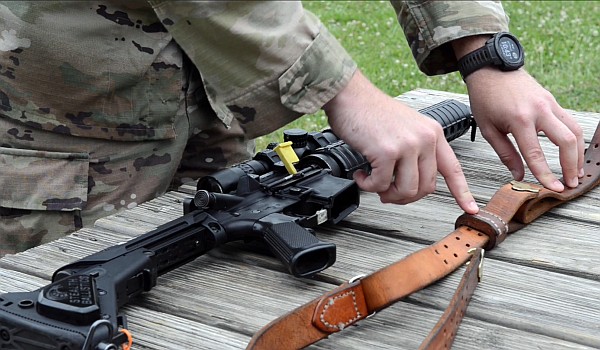
Setting Up a Sling for High Power Service Rifle Standing Position
SPC Kade Jackovich with the USAMU Service Rifle Team offers clear advice on how to set up a sling for the standing portion of a service rifle match. The sling must be adjusted to a shorter length. Kade shows the most efficient method to do this.
Factory-loaded ammunition has become very hard to find, particularly pistol ammo. Concerns over social unrest, personal security, and the upcoming election have spiked demand for loaded ammo. Everyone is asking “where has all the ammo gone?”
Pistol Ammo Hard to Find
In particular, 9mm pistol ammo flies off the shelves as soon as it arrives, and even major online vendors such as Midsouth Shooters, MidwayUSA, and Natchez have very limited supplies.
Need Ammo? Load Your Own…
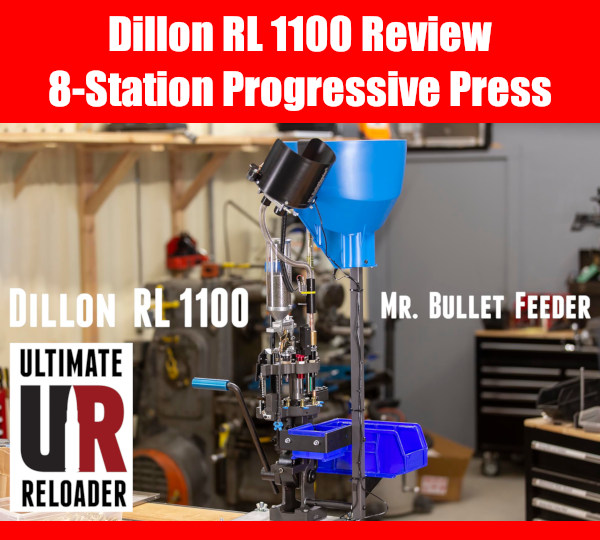
One answer to the ammo shortage is to load your own. And if you want to produce a large quantity of ammo in a short amount of time, the progressive press is the answer. There are many progressive press systems, from modest Lee progressives to high-end, automated systems from Mark 7 (Lyman). In this article we feature the “latest and greatest” progressive press from Dillon — the new eight-station RL 1100 Press with Case-Feeder.
Our friend Gavin Gear of UltimateReloader.com got his hands on Dillon’s impressive new RL 1100. In two videos, Gavin shows how to set up the RL 1100 and then he demonstrates how to produce 9mm pistol ammo with this impressive 8-station press.
Gavin says: “My Dillon RL-1100 is cranking out the 9mm, and in this video we bring it up to ‘full tilt’ speed” [with the MR. Bullet Feeder and the Dillon Case-Feeder]. If you watch the video, you’ll see Gavin produce 9mm ammo at a rate of nearly 50 rounds per MINUTE!
Gavin equipped his new RL 1100 with two cool products from Double Alpha Academy (DAA) — the Mr.Bulletfeeder® as well as an advanced, Magnetic Powder Check. When loading ammo you can never be too safe, so we definitely recommend the use of powder-check dies (we use a conventional RCBS powder-check die on our progressives). The DAA bullet feeding system is an important add-on that significantly increases output rates when used in concert with the Dillon Case-Feeder (blue funnel).
RL 1100 Reloading Stations with Powder Check and Bullet Feeder
RL 1100 Stations shown above:
1. Case inserter
2. Sizer/De-Primer
3. Swager (with hold-down)
4. Priming (no die)
5. Powder charge and expansion (expansion for pistol cartridges only)
6. Double Alpha Magnetic Powder Check
7. Mr. Bullet Feeder bullet feed die
8. Bullet seating and Crimping
Note: In order to accommodate the magnetic powder check die AND the bullet feed die, bullet seating and crimping were combined at the last station.
The RL 1100 has some very impressive features that allow faster and easier ammo production. An Eccentric Roller Bearing Drive System reduces friction. The RL 1100’s heavier frame provides greater rigidity for more efficient cranking. The RL 1100 also boasts an improved shellplate indexing system. Priming is enhanced through a spring-loaded Priming Station Locator and Upgraded Primer Pocket Swager.
Dillon RL-1100 Set-Up Video:
Loading with the “Turbocharged” Dillon RL-1100
Gavin was very impressed with his RL-1100: “This reloading setup is [great]. Every crank of the lever yields a completed cartridge, and the attainable speeds are AMAZING. The case feeder and bullet feeder had no trouble keeping up with my quick pace using this setup. And it is great to know that every powder charge is being checked.
This press is very reliable and smooth, bridging the gap between lower cost home set-ups and six-figure commercial loading equipment packages. What’s next? I’ll be performing a caliber changeover to .308 Winchester.”
The DAA Magnetic Powder Check can be used on a variety of Progressive Presses.
Think you can shoot fast with a bolt gun? Bet you can’t beat these Norwegian speed-demons. Last year, Inge Hvitås recently set a new Mad Minute World Record, putting 39 rounds inside a 16″ circle at 200 meters, all in a single minute. Another Norwegian ace fired 48 rounds in a minute, with 38 in the bullseye. Now that’s spectacular speed and accuracy.
Watch Inge Hvitås Set New Mad Minute World Record:
New Mad Minute World Record — 39 Hits in One Minute (60 seconds)
At the Haga shooting range in Norway, spectators witnessed spectacular speed shooting last summer. Norwegian shooter Inge Hvitås set a new Mad Minute Challenge World Record with 39 hits in ONE MINUTE at 200m. The target was a 40cm (15.75″) bullseye placed at 200m (218 yards). Fellow Norwegian Jesper Nilsstua also shot brilliantly, sending 48 rounds down-range in one minute. Jesper had 38 hits, missing the record by just one. Both shooters were using iron-sighted Sauer 200 STR target rifles, which are normally chambered for the 6.5×55 cartridge. For this event, magazines are limited to 5 rounds and shooters may use slings but no bipods or other support.
Amazing Bolt-Gun Cycling Speed — 48 Rounds in One Minute
Another Norwegian ace, Jesper Nilsstua, missed the Mad Minute Challenge record (by one hit), but boy was he fast. Dennis Santiago (who has done his own Mad Minute drill), was dazzled: “This dude didn’t get the new world’s record of 39 hits in 60 seconds. He ‘only’ got 38 hits after getting off an amazing 48 shots in 60 seconds. Watch the smoothness of his shooting. It’s amazing.”
For the Mad Minute Challenge in Norway, a standard 200m DFS target was used, with 1 point per hit within the black area which is 40cm (15.75″, or 6.9 MOA) in diameter.
True Velocity is a Texas-based ammo-maker with 145 issued patents on its products and technologies. More than 1 million rounds of True Velocity composite-cased cartridges will be delivered through 2020-2021 to the U.S. Army. This revolutionary new ammo will be tested by the U.S. Army’s Next Generation Squad Weapons program. The advantage of the composite cases, which employ various polymers, is primarily weight savings. True Velocity-made ammo is 30% lighter than conventional ammunition. That means that a typical soldier’s load-out can be reduced by many POUNDS with this innovative ammo. And the military can transport much more ammo with existing vehicles and aircraft.
The company claims: “True Velocity’s precision engineering and manufacturing capabilities allow for substantial improvements in consistency over brass. Our proprietary technology and manufacturing process, combined with progressive process and quality control standards … yields a cartridge of unparalleled performance.” In addition, True Velocity can produce ammo in smaller facilities than a typical large ammo plant. The company states: “The company’s manufacturing capabilities can power customizable and highly-portable ‘cells’, allowing for decentralized and automated ammunition production.”
True Velocity’s modern composite cases withstand temperature changes very well and can function well even in sub-zero environments (however you still may have issues with the powder inside at super-low temps). In addition, the composite cases are 100% recyclable. This can make a difference for shooting ranges and training facilities. One question we have, however, is long-term durability. Brass cartridges can remain strong and functional for decades. Some plastics degrade in just a few years. It will be interesting to see how the True Velocity composite cases hold up over time.
True Velocity is an advanced technology and composite manufacturing company based in Garland, Texas. Founded in 2010, True Velocity has more than 250 patents pending or issued on its products, technology, and manufacturing processes. True Velocity products are manufactured in the U.S. in a state-of-the-art, 66,000-square-foot facility and are currently available to public agencies, with consumer products available soon. For more information, visit TVammo.com.
MagnetoSpeed’s technology has completely changed the market for firearms chronographs. With a MagnetoSpeed barrel-mounted chrono you can quickly and easily record muzzle velocity (MV) without having to set up tripods or walk down-range. The compact MagnetoSpeed chronos are easy to set up and transport. With the full-featured V3 model, everything you need comes in a small fitted case. In the top photo are the components used with the MagnetoSpeed V3 Kit:
1. V3 Bayonet sensor
2. Display and control unit
3. Bayonet spacers (plastic and rubber)
4. Cords and mounting hardware (left), suppressor heat shield (right)
5. Alignment rod (square cross-section)
6. Rail adapter (sold separately)
Our friend Gavin Gear of UltimateReloader.com reviewed the MagnetoSpeed V3 and came away impressed. Gavin explains that a good chrono is essential: “If you want to load and shoot precision ammunition, you need the tools that will produce and validate the precision of your loads. A good chronograph is one of those tools! In this post I’m going to introduce you to the MagnetoSpeed V3 chonograph, the high-end electromagnetic chronograph which fills out the top slot in MagnetoSpeed’s equipment portfolio.”
In this 11-minute video Gavin reviews MagnetoSpeed’s top-of-the-line V3 Chronograph. He shows what ships with the unit, how to set it up for both rifles and pistols, and then he puts it through its paces showing how it captures velocity data. Gavin says he will follow-up with future videos showing how to link the MagnetoSpeed V3 to your mobile phone and how to log velocity data for future reference. To learn more about this high-tech chrono, visit UltimateReloader.com.
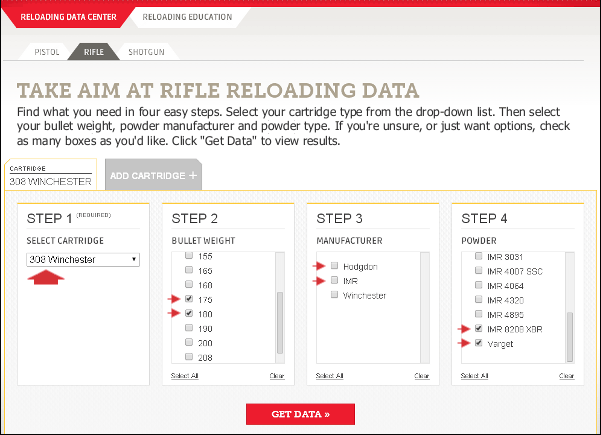
Looking for a good load for a new rifle? Or perhaps you want to try a new powder and bullet combo for an existing rig. One of the best places to start for load data is Hodgdon’s online Reloading Data Center for pistol, rifle, and shotgun reloaders. Check out the Reloading Data Center at www.HodgdonReloading.com.
In the Data Center, you’ll find thousands of load recipes for pistol, rifle, and shotgun. Rifle shooters will find dozens of loads for their favorite Hodgdon, IMR, and Winchester powders such as H4198, H4895, Varget, H4350, and IMR 8208 XBR. And Hodgdon’s Reloading Center is “mobile-friendly” so it works well with smartphones and tables. Navigation is easy, and you can set the search criteria easily choosing your favorite powder or bullets. After choosing a cartridge, you can pre-select specific bullet weights and powder types. That quickly delivers just the information you want and need. You won’t have to scroll through scores of entries for bullets or powders you don’t use.
Mobile users will notice that the current Hodgdon Reloading Center is much more “user-friendly” for smart-phone and tablet users. Controls have been optimized for touch-screens, and buttons are large and easy to use. Likewise the results are displayed in a large, easy-to read format.
How to Get Started with Handloading
Getting started in Reloading? Ultimate Reloader offers a helpful introductory video that covers the basics. In addition, a recent Ultimate Reloader article reviews the types of reloading presses, plus the other gear you’ll need, from dies to powder dispensers.
With the big fires happening on the West Coast, many have wondered about hazards faced by gun owners in fire zones. This important video shows what really happens when loaded ammunition burns. You will probably be surprised. Contrary to Hollywood notions, the ammo doesn’t ignite in a massive explosion. Far from it… basically the rounds “cook off” one by one, and the bullets release at relatively low velocity. We’ve featured this SAAMI research project before, but it is worth reprising for those who have not yet seen the burn tests.
A few years back, SAAMI released an important video concerning ammo and fire. With professional fire-fighters standing by, over 400,000 rounds of ammo were incinerated in a series of eye-opening tests. If you haven’t had the chance to view this video yet, you should take the time to watch it now
The Sporting Arms and Ammunition Manufacturers’ Institute (SAAMI) has produced an amazing 25-minute video that shows what actually happens to sporting ammunition involved in a fire. This video shows the results of serious tests conducted with the assistance of professional fire crews. We strongly recommend you watch this video, all the way through. It dispels many myths, while demonstrating what really happens when ammunition is burned, dropped, or crushed.
Watch SAAMI Ammunition Testing Video
Video Timeline
2:10 Impact Test (ignited outside firearm)
3:40 65-foot Drop Test
5:08 Bullet Impact (.308 Win firing)
7:55 Blasting Cap Attacks
9:55 Bulldozer and Forklift Tests
12:20 Boxed Ammo Bonfire
15:37 Bonfire without Packaging
17:21 Retail Store Simulation Burn
20:55 Truck Trailer Burn
Over 400,000 rounds of ammunition were used in the tests. Some of the footage is quite remarkable. Testers built a bonfire with 28,000 rounds of boxed ammo soaked in diesel fuel. Then the testers loaded five pallets of ammo (250,000 rounds) in the back of a semi-truck, and torched it all using wood and paper fire-starting materials doused with diesel fuel.
The video shows that, when ammo boxes are set on fire, and ammunition does discharge, the bullet normally exits at low speed and low pressure. SAAMI states: “Smokeless powders must be confined to propel a projectile at high velocity. When not in a firearm, projectile velocities are extremely low.” At distances of 10 meters, bullets launched from “cooked-off” ammo would not penetrate the normal “turn-out gear” worn by fire-fighters.
We are not suggesting you disregard the risks of ammo “cooking off” in a fire, but you will learn the realities of the situation by watching the video. There are some amazing demonstrations — including a simulated retail store fire with 115,000 rounds of ammo in boxes. As cartridges cook off, it sounds like a battery of machine-guns, but projectiles did not penetrate the “store” walls, or even two layers of sheet-rock. The fire crew puts out the “store fire” easily in under 20 seconds, just using water.
Additional Testing: Drop Test, Projectile Test, Crush Test, Blasting Cap Test
Drop Test
The video also offers interesting ammo-handling tests. Boxes of ammo were dropped from a height of 65 feet. Only a tiny fraction of the cartridges discharged, and there was no chain-fire. SAAMI concludes: “When dropped from extreme heights (65 feet), sporting ammunition is unlikely to ignite. If a cartridge ignites, it does not propagate.”
Rifle Fire Test
SAAMI’s testers even tried to blow up boxes of ammunition with rifle fire. Boxes of loaded ammo were shot with .308 Win rounds from 65 yards. The video includes fascinating slow-motion footage showing rounds penetrating boxes of rifle cartridges, pistol ammo, and shotgun shells. Individual cartridges that were penetrated were destroyed, but adjacent cartridges suffered little damage, other than some powder leakage. SAAMI observed: “Most of the ammunition did not ignite. When a cartridge did ignite, there was no chain reaction.”
Bulldozer Crush Test
The test team also did an amazing “crush-test” using a Bulldozer. First boxes of loaded ammo, then loose piles of ammo, were crushed under the treads of a Bulldozer. A handful of rounds fired off, but again there was no chain-fire, and no large explosion. SAAMI observed: “Even in the most extreme conditions of compression and friction, sporting ammunition is unlikely to ignite. [If it does ignite when crushed] it does not propagate.”
Blasting Cap Test
Perhaps most amazingly, the testers were not able to get ammunition to chain-fire (detonate all at once), even when using blasting caps affixed directly to live primers. In the SAAMI test, a blasting cap was placed on the primer of a round housed in a large box of ammo. One cartridge ignited but the rest of the boxed ammo was relatively undamaged and there was no propagation.
Hunting season is right around the corner. We know many readers have acquired a new hunting rifles, or perhaps are using new ammo or a new optic. If you’ve got new gear, you’ll want to sight-in and zero your hunting rig properly. Here’s how…
Here’s a simple procedure that lets you get a solid zero in just four shots. Of course you probably want to fire a few more rounds to confirm your zero before you head off to your hunting grounds, but this will let you get on-target with a minimum amount of time and ammo expended. (This assumes your scope is securely mounted, and the bases are not drastically out of alignment.)
QUICK-TIP: The Key to this procedure is Dialing to Shot One Point of Impact (POI). Re-aim at center of target after SHOT ONE. Then with the rifle motionless, use the turrets to put the middle of the cross-hair (reticle) on the first shot location. Be sure NOT to move your rifle while clicking.
1. First, remove the bolt and boresight the rifle. Adjust the position of the rifle so that, looking through the bore, you can see the center of the target with your eyes. Secure the rifle in the rests to maintain its position as boresighted. Then, without moving the rifle, center the reticle. That should get you on paper. With the rifle solidly secured in front and rear rests or sandbags, aim at the center of a target placed at your zeroing distance (50 or 100 yards). Confirm there are no obstructions in the barrel! Then load and fire SHOT ONE. Then, return the gun to the exact position it was when you pulled the trigger, with the cross-hair centered on the target as before.
2. Locate, in the scope, where your first bullet landed on the target. Now, while you grip the rifle firmly so it doesn’t move, have a friend adjust the turrets on your scope. While you look through the scope, have your friend turn the windage and elevation turrets until the cross-hairs, as viewed through the scope, bisect the first bullet hole on the target. Use the turrets to move the center of the reticle to the actual position of shot number one. IMPORTANT: Dial the crosshairs to the hole — don’t move the rifle.
3. After you’ve adjusted the turrets, now re-aim the rifle so the cross-hairs are, once again, positioned on the target center. Keep the rifle firmly supported by your rest or sandbag. Take the SECOND SHOT. You should find that the bullet now strikes in the center of the target.
4. Take a THIRD SHOT with the cross-hairs aligned in the center of the target to confirm your zero. Make minor modifications to the windage and elevation as necessary.
5. Finally, shoot the rifle from a field rest (shooting sticks, bipod, or rucksack) as you would use when actually hunting. Confirm, with SHOT FOUR, that your zero is unchanged. You may need to make slight adjustments. Some rifles, particularly those with flexy fore-arms, exhibit a different POI (point of impact) when fired from a bipod or ruck vs. a sandbag rest.
This Video Shows the Process Described Above:
Fouling Shots and Cold Bore Condition
If you recently cleaned your rifle, you may want to fire two or three fouling shots before you start this procedure. But keep in mind that you want to duplicate the typical cold bore conditions that you’ll experience during the hunt. If you set your zero after three fouling shots, then make sure the bore is in a similar condition when you actually go out hunting.
This week Shooting USA TV features an innovative rifle competition in Colorado, the Hornady Precision Hunter Steel Challenge. This is a unique match set in 2000 acres of natural terrain at the Cameo Shooting Complex in Colorado. The match replicates long-range hunting challenges, with steel targets sized to simulate the vitals of western game animals. Some 135 competitors engaged steel targets in 20 challenging stages.
Match Director Scott Satterlee says, “This is as close as it can get to mountain hunting. We have vital-sized targets out there. They are 12-inch squares turned to diamonds which are really difficult to hit”.
SHOOTING USA TV Air Times
View Shooting USA on the Outdoor Channel: Wednesdays 9:00 PM (Eastern and Pacific); 8:00 PM Central.
NOTE: If you miss today’s broadcast, you can still view the show on Vimeo for a small 99-cent fee, or just $1.99 per month unlimited. LINK HERE: Shooting USA on Vimeo.
The inaugural Hornady Precision Hunter Steel Challenge took place in Colorado August 8 and 9. This unique competition involved lots of hiking with various shooting positions in challenging natural terrain. The unique match was hosted at the Cameo Shooting Complex near Grand Junction, CO.
There were 135 registered competitors — quite a turn-out for a physically demanding match in a fairly remote location. Congrats to Heavy Class and Overall Winner Brian Black who topped the field with 140 Match points (100% of possible). Brian shot a 6.5×47 Lapua with Berger 6.5mm 140gr Hybrids. Brian’s winning rig featured a Lone Peak Arms Fuzion action, Benchmark barrel, and XLR Element chassis.
The Hornady Precision Hunter Steel Challenge tests a rifleman’s fitness and skills as marksman and hunter. The stages were blind with a 4-minute time limit to move to the shooting area, locate, range, and engage targets. Shooters could choose between two rifle weight classes (light or heavy) and had to meet a minimum power factor cartridge requirement that helped even the playing field. The match featured a diverse course of fire with a good mix of prone and natural terrain shooting positions.
Hunting Ammo Tested by Shooting USA
In this same episode, Shooting USA tests a variety of Hornady hunting ammo offerings on the G.A. Precision private gun range in Missouri. (We’d love to have our own private range like that!) Jason Hornady says his company starts the design of all hunting ammunition with bullet selection: “For us it started with the bullet … for us the bullet still makes the cartridge.”.
Reactive targets — whether balloons, steel gongs, or clay birds — always add fun to a range session. But precision shooters may want something more challenging (i.e. smaller) than a clay bird when shooting inside 300 yards. For a change of pace, try shooting at inexpensive pool cue chalks. Less than 1″ square, these will test your marksmanship skills. (If you need a bigger target, that also makes a nice puff of “smoke”, try charcoal briquettes).
Pool Cue Chalks — Cheap, Fun, Dramatic
If you’re looking for a small target that makes a nice big cloud of color when hit, try billiard chalks — those little blue cubes you use to dust the end of pool cues. Measuring about 7/8″ per side, billiard chalks make very challenging targets at 100 and 200 yards. When you hit them, if you nail the circular “dimple” in the middle, they disintegrate impressively, tossing blue “smoke” in all directions. Billiard chalks are inexpensive. You can buy a dozen chalks online for about $3.00 — just 25 cents each. And the prices drop with more quantity. One gross of chalks (that’s 144 pieces) costs just $24.95 at ozonebilliards.com. That’s 17 cents each.
To see actual hits on chalk at 100 and 200 yards, watch the video below. (WARNING: Soundtrack is loud and advertisement may play before movie. Flash plug-in required for playback, so you may see a note that a Flash file is loading.) The movie-maker cautions that: “You’ll notice (in the video) that some of the hits are ‘wiffs’ instead of ‘poofs’. If you look at the picture above, you’ll see the 1/2 inch dimple in the cube face. If you don’t put the bullet in that dimple, it’ll ‘wiff’ on you.” Note — this video may not be available on some mobile devices or computers with Flash disabled.
Watch Billiard Chalks Explode with Blue Smoke When Hit:
NOTE: This movie requires Flash to run.
Forum members who have tried Billiard Chalks say they are definitely fun to shoot. Member Blake says: “[These are] satisfying and cheap reactive targets — I have a 72ct box of [chalks] in every color. They work great if you hit them in the center with anything more powerful than a 22 LR, and they don’t leave much mess to clean up.” Blake offers attachment tips: “I use double-stick tape on the back to hold them onto target rails. Just make sure you stick them to steel so that they have something nice & hard to crush against when you hit them. Put them on thin plywood and they’ll just punch right through!”


 Pistol Ammo Hard to Find




 The Sporting Arms and Ammunition Manufacturers’ Institute (
 We are not suggesting you disregard the risks of ammo “cooking off” in a fire, but you will learn the realities of the situation by watching the video. There are some amazing demonstrations — including a simulated retail store fire with 115,000 rounds of ammo in boxes. As cartridges cook off, it sounds like a battery of machine-guns, but projectiles did not penetrate the “store” walls, or even two layers of sheet-rock. The fire crew puts out the “store fire” easily in under 20 seconds, just using water.


 Hunting Ammo Tested by Shooting USA


