Have you ever expanded a .22 or 6mm cartridge all the way up to .30-caliber? If so, you know this can be a difficult procedure that stresses the case necks and neck-shoulder junction. A significant neck-size expansion done in one big jump can increase run-out, cause doughnuts, or worse yet, even split the brass. Therefore you want to proceed in increments, increasing the neck diameter in stages. One smart way to do that is to use a Progressive Press. This article explains how…
The most successful short-range benchrest-for-score cartridge is the 30 BR. That cartridge, as well as 30 BR variants such as the 30 BRX, all start with the 6mmBR Norma parent cartridge, typically with Lapua 6mmBR brass. To get a nice 30 BR case you want to expand in stages, increasing the inside neck diameter incrementally from .243 to .308.
Darrell Jones of DJ’s Brass Service creates thousands of 30 BR cases each year. He has found a clever way to speed up the process — Darrell uses a Progressive Press. He runs his 6BR brass through four (4) separate Hornady neck-sizing dies with expander mandrels. First there is a .257 die, followed by .264 (6.5mm), .284 (7mm), and then .308. Then a fifth and final K&M die provides one last, slight expansion so the newly-fashioned 30 BR cases perfectly fit the arbor of Darrell’s neck-turning tool.
So to repeat, the case starts as .243 (6mm), then moves in up stages .257, .264, .284, and .308, with a final “finishing” step prior to neck-turning. You can see the expansion in this video, which starts with 6mmBR brass that was first hydro-formed to 6 BRX:
Watch 6mm Cases Expanded to 30-Caliber (6BRX to 30 BRX)
For this demo video, Darrell expands just one case at a time. However, he can also put multiple cases in the progressive — one per station. This takes a little more effort, Darrell says, but the results are still excellent. Darrell tells us: “I do put multiple cases in the progressive to save time. The results are the same — I just wanted to show a single-step process and how it reduces run-out by not stressing the shoulder with one big expansion from 6mm straight to 30 caliber. Doing the operation in multiple stages avoids binds and helps keep the shoulders concentric.”
This same multi-stage procedure can be use to expand other cartridge types. For example you could take .221 Fireball brass in stages up to .308 to create 300 Blackout brass.
Darrell uses caliber-specific, Hornady neck-sizing-only dies with elliptical expanders. Darrell tells us: “The Hornady elliptical expander has a reduced bearing surface that puts less strain on the brass when expanding the necks to the next size.” The fitting at the bottom of the die is the Lock-N-Load die bushing that allows fast die changes.
These particular cases used in the video were first hydro-formed to 6BRX then expanded to 30 BRX before neck turning. DJ’s Brass offers hydro-forming for many popular wildcat cartridges such as 6 PPC, 6mm Dasher, and .284 Shehane.
The sound of bullets ringing steel were heard all over the country over a three week period in July, during the 2020 Scholastic Action Shooting Program (SASP) National Virtual Championship. Over 248,000 rounds were sent down range as SASP athletes competed from their home ranges around the country. Photo and match results were posted on social media. Scores were then tallied and compared among hundreds of entrants. The ability to compete at Nationals from their home range gave teams all over the country the opportunity to finish the season as a team, competing for the national title.
Just last year, the SASP National Championship surpassed the Glock Shooting Sports Foundation (GSSF), to become the largest Action Shooting Match in history. Despite a heavily altered 2020 season, the SASP community continued to break records for participation with 1,656 event entries for the 2020 SASP National Championship.
“Virtual” Championship Held at Multiple Locations throughout the USA
Traditionally held at the Cardinal Shooting Center in Marengo, Ohio, the 2020 SASP Nationals were instead conducted in a multi-location “virtual” format. This arrangement was made “in order to protect the safety of our athletes, coaches, and familie” according to SASP National Director, Rick Leach. “The nature of our sport puts athletes and range officers in close proximity, which we could not in good conscious do with thousands of athletes in Ohio this year. We received hundreds of photos and videos from teams competing in Nationals from their home range.”
You can see SASP 2020 National Championships Results online. Just select the firearm category and class of shooters. For example, here are Centerfire Pistol Men’s results for all categories. Click image to zoom.
“This year we saw participation grow to states that are not always able to make the journey to Ohio each year for Nationals,” said SASP Director of Development, Kelvin Walton. “Although the spectacle of teams converging on the Cardinal Center to compete is part of the Nationals experience, the SASP community made the most out of an unusual season.”
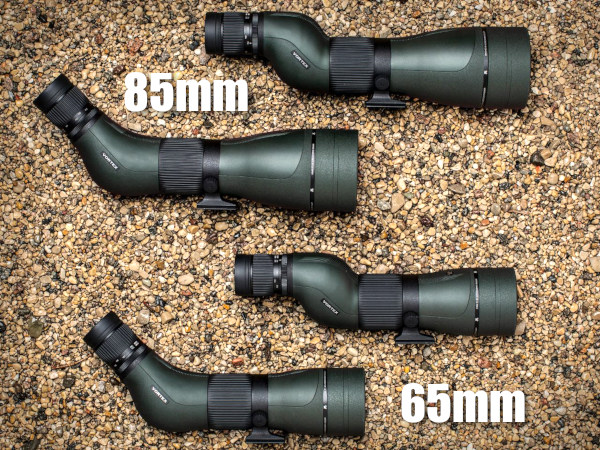
Vortex’s new Diamondback® HD series of spotting scopes offer impressive performance for the price. While you can spend $2500 or more for a premium Fluorite Glass spotter, Vortex’s new HD spotting scopes cost $500-$600 MSRP. These new Diamondback spotters could be affordable options for competitive shooters and hunters. The Diamondback HD line of spotting scopes include both angled and straight body types in 16-48x65mm and 20-60x85mm configurations.
The new Diamondback HD spotters employ an HD optical system with multi-coated lenses. Vortex claims these spotters offer greater light transmission, reduced chromatic aberration, better color fidelity, and enhanced sharpness. Vortex says the “crisp resolution, brighter images, and edge-to-edge sharpness [can reduce] eye strain during long glassing sessions.” We hope to test the 20-60x85mm model to confirm these claims. HD glass should deliver greater low-light performance and clarity.
These new Diamondback HD models boast design upgrades to make them more like Vortex’s higher-end Viper HD Spotting Scopes (which start at $1049.99 MSRP). The big change is the new full-diameter focus ring as you would see on a Swarovski spotter. Vortex says: “[We] took a fresh approach to the spotter’s exterior, introducing a streamlined, snag-free profile. The helical focus wheel provides fast, fine adjustments, and an Arca-Swiss compatible foot means the Diamondback® HD mounts quickly to compatible tripod heads without additional plates. Plus, a neoprene cover comes included, keeping your spotter protected in the field.” The video below reviews the main design features of the new spotters:
Which model should you choose? The 16-48x65mm ($499.99 MSRP) is smaller and lighter, making it easier to pack or move around the firing line. The angled 16-48X spotter OAL is 14.25″ and weight is 49.8 oz., making this a good choice for competition shooters looking for an affordable spotter to watch mirage and shot markers. For hunters and other shooters seeking enhanced low-light performance and magnification, the 20-60x85mm ($599.99 MSRP) offers more light-gathering for just $100.00 more. OAL is 16.0″ and weight is 60.9 oz., about 3/4 pound heavier than its smaller brother. You make the choice.
Jeff Quinn holds his first-ever firearm, a Stevens Model 95 20ga shotgun he received at age 11.
We are sad to announce that Jeff Quinn, founder of GunBlast.com and pioneer internet gun reviewer, passed away on July 27, 2020. He will be missed. We met Jeff a few times at SHOT Show. We can tell you he was a very genuine, forthright man who truly loved the world of firearms. He was committed, to his dying days, to providing honest, reliable evaluations of guns. Over the years, GunBlast’s videos have received over 64 million views.
Jeff Quinn created GunBlast.com in the year 2000, two full decades ago. At the time, very few folks were making gun videos, and even fewer had the commitment to make it a real business. Guns.com explains how Jeff Quinn, with the help of his brother Boge Quinn, helped revolutionize gun reviewing:
“Jeff Quinn was a ‘salt of the earth’ kind of guy [who] loved God, family, and life. When he decided to pursue gun writing in 1999 as a hobby, few expected him to revolutionize the firearms industry — but that’s exactly what he did.
Tired of reading contrived gun reviews in his favorite gun mags, Quinn asked his more tech-savvy brother Boge, ‘If I could write about the gun, can you put it on the internet thing?’ Boge agreed and Quinn got to work. Jeff started photographing and writing about guns … ‘At first, we just reviewed guns that we already had’, said Boge[.] They put it online on a website they called GunBlast. At the time… the internet was still very young.
[At] their first SHOT Show as GunBlast … they visited manufacturers and asked if they could review their guns. ‘A couple of the gun companies would look at me like there was something wrong with me,’ recalled Quinn. Fortunately, a few companies saw the potential and started sending guns for review. Quinn’s personality and look resonated with the gun crowd. You knew right away that he absolutely loved guns and wanted to pass on this passion to the reader. As a result, GunBlast took off.”
In this video, Jeff Quinn’s brother Boge Quinn talks about Jeff’s life, his character, his genuine love of firearms, and the health issues with which he struggled.
Our friend Gavin Gear of UltimateReloader.com often gets to test the latest and greatest reloading tools before they hit the market. He does a good job showing the features of new products with informative videos. Today we present three interesting products that Gavin has reviewed. First off is the impressive new RCBS Rebel reloading press. Next is the versatile three-head Case Prep Trio machine from Hornady. Third, Gavin reviews new Die Lock Rings and Breech Lock Die Bushings from Lee Precision.
RCBS Rebel Single-Stage Reloading Press
Most hand-loaders have used an RCBS Rock Chucker press at one time or another. Recently RCBS unveiled its new Rebel single-stage press. Like the Rock Chucker, the Rebel has a Cast Iron frame, but with a bigger base and taller arch (for a larger opening). The most important change is that this new Rebel press ejects primers out the bottom of the ram. This a big deal — just put a bin under the press to collect spent primers. However — take note — the Rebel has no on-press priming. You need to prime your cases separately. That’s not really a major issue, as we know the majority of our readers prime separately using hand or bench priming tools.
In this video Gavin loads ammo on the new the Rebel single-stage press and explains its notable features, including the primer ejection through the ram.
Note, RCBS is currently running a Buy Green Get Green Rebate Program. The Rebel Press qualifies for a $50.00 Rebate. And right now, MidwayUSA has the Rebel Press on sale for $186.99. So your net cost, after RCBS Rebate, is just $136.99. That’s a great deal on an excellent press.
Hornady Lock-N-Load Case Prep Trio
Hornady’s compact Case Prep Trio machine (item 050160) packs a lot of functionality in a small package. This triple-threat tool has a small footprint, yet it can perform three tasks as well as much more expensive, tower-style case prep units.
Gavin Gear does a nice job explaining the features of the Case Prep trio. Watch this video to see how it can help you perform chamfering, deburring, and pimer pocket uniforming tasks more efficiently.
With three active stations, you can chamfer, deburr and clean primer pockets without having to change tools. The Case Prep Trio ships with inside chamfer, outside chamfer, and deburr tools. You can also use the machine with other optional 8/32 threaded accessories such as primer pocket reamers and case neck brushes. We’ve used this machine and it works well. The only negative is that you will get metal shavings on your bench (unlike some of the larger case prep centers). We’ve seen some guys put a small pan under the power head — then you can just dump the shavings out of the pan.
New Lee Die Lock Rings and Spline Drive Breech Lock Bushings
New basic lock ring in left hand. Older non-splined ring in right hand.
In this recent video Gavin Gear reviews three types of die accessories from LEE. These work for virtually all standard dies, not just LEE-brand reloading dies. The new LEE basic silver-finish die lock rings now feature splines for enhanced grip and compatibility with LEE’s new die lock ring wrench (photo right). They still boast a rubber 0-Ring that helps “float” the die for improved cartridge concentricity.
LEE’s new Ultimate Die Lock Rings have two major improvements — a colorful anodized finish, and a split-ring design with a tensioning screw, that allows these rings to be clamped securely to your dies. Available as a set, this package includes three ultimate die lock rings, and a plastic die lock ring wrench.
Gavin also reviews Lee’s new Spline Drive Breech Lock Bushings for use with presses fitted with LEE’s Breech Lock system. These new Breech Lock bushings allow rapid change-out of dies without modifying the setting. The colorful new bushings feature splines on top that work with the new Lee Lock ring wrench shown above. In addition, the Breech Lock Bushings have a clamp to preserve die depth setting.
If you carry a handgun for self-defense after hours, you may want to equip your pistol with a laser beam aiming system. Pistol lasers can significantly improve your ability to get on target in low-light conditions. Watch this video to learn how to best use a laser-equipped pistol:
Viridian Weapon Technologies is one of the leading makers of laser aiming system, laser/light units, and compact gun-cameras. Right now Viridian is offering great savings on laser systems for Ruger pistols.
Viridian makes lasers for a wide variety of popular handguns, including compact revolvers. You can choose between red lasers and green lasers. Experts say the green lasers have some advantages. The light is stronger and the green beam itself is more visible. Veridian lasers are the choice of leading pistol-makers for factory-installed frame- or grip-mounted laser systems. And Viridian offers an industry-leading 7-Year Warranty plus a 30-day Money-Back Guarantee.
Instant-On Laser System
INSTANT-ON® is now part of most Viridian products, offering ultra-fast laser activation when desired. Just pre-set the Viridian mode, slide your gun into your INSTANT-ON equipped holster, and the INSTANT-ON system is armed and ready. The instant the gun leaves the holster, the Viridian laser is illuminating. Yes, you can also de-activate this feature, so that the laser only comes on when you push a button.
The Viridian C Series, X Series Gen 2 and Gen 3, and Reactor Series are equipped with INSTANT-ON technology and activate
Do you own an M1 Garand, or have you always wanted to acquire one of these legendary semi-auto battle rifles? Well then here is a valuable new resource: The Essential M1 Garand: A Practical and Historical Guide for Shooters and Collectors. This new book by Jim Thompson covers the history of the M1 Garand, and offers practical advice for Garand owners, along with complete parts lists. The book includes annotated military and National Match manuals, a troubleshooting chart, and a section on hand-loading for the Garand. The final Section addresses common questions about the rifle and offers detailed instructions for maintaining this wartime classic. First published in February, 2020, The Essential M1 Garand is available in Print Paperback and Kindle eBook versions. View Table of Contents.
Recommended M1 Garand Manual
Along with The Essential M1 Garand book by Jim Thompson, there are many other good M1 Garand print resources. Among the many M1 Garand manuals available, we recommend the CMP’s U.S. Rifle, Caliber .30, M1: ‘Read This First’ Manual. This booklet covers take-down, reassembly, cleaning, lubrication, and operation. The manual comes with CMP rifles or can be purchased for $3.25 from the CMP eStore. The CMP also offers many other M1 Garand print resources including:
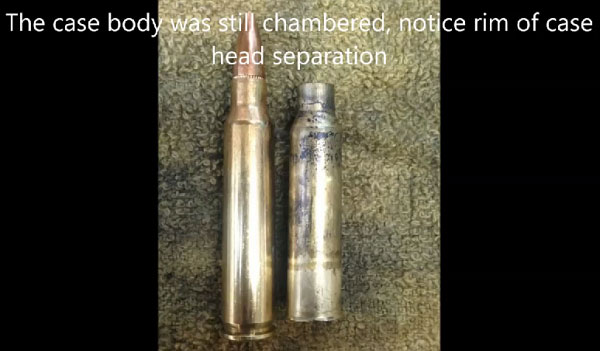
What happens when a round goes off unsafely in an AR? Watch this video and see. At about the 00:40 time-mark the shooter has a malfunction (click no bang), with a round. He then removes the magazine, and clears the chamber (we think). On the next round, at 00:53 you hear a “Bang” and see a big puff of smoke coming out of the upper receiver (see photo at right). This has been called a “detonation” by the video-maker, but we’re not 100% sure what happened. What do you guys think? Watch the video carefully, and state your conclusions in the comment section if you wish.
What Caused this Malfunction? Watch Video…
In any event, the shooter is fortunate his upper did not completely fracture, launching shrapnel into his face or other body parts. This could have turned out much worse. Here are screen-shots from the video, showing details of the gun after the accident, along with the recovered brass case, which separated near the case-head.
Want to learn more about Long Range Shooting? Check out the “Elements of Long Range Shooting” videos from the National Shooting Sport Foundation (NSSF). In this multi-part series, Bryan Litz of Applied Ballistics covers a variety of topics of interest to precision shooters. Today we feature three of these videos. There are five other videos in this series. Watch the entire 8-video “Elements of Long Range Shooting” series on the NSSF YouTube Channel.
Atmospherics and Density Altitude
Bryan Litz explains: “An important element in calculating an accurate firing solution for long-range shooting is understanding the effects of atmospherics on a projectile.” Atmospherics include air pressure, air temperature, and humidity. Bryan notes: “Temperature, pressure, and humidity all affect the air density… that the bullet is flying through. You can combine all those factors into one variable called ‘Density Altitude’.” Density Altitude is used by the ballistic solver to account for air density variables that affect bullet flight.
Bullet Ballistic Coefficients
A bullet’s ballistic coefficient (BC) basically expresses how well the bullet flies through the air. Higher BC bullets have less aerodynamic drag than lower BC projectiles. You will see BCs listed as either G1 and G7 numbers. These correspond to different bullet shape models. Generally speaking, the G7 model works better for the long, boat-tail bullets used for long-range shooting. Notably, a bullet’s drag is NOT constant in flight. The true BC can vary over the course of the trajectory as the bullet velocity degrades. In other words, “BC is dynamic”. That said, you can make very accurate drop charts using the BCs provided by major bullet-makers, as plugged into solvers. However, long-range competitors may want to record “real world” drop numbers at various distances. For example, we’ve seen trajectories be higher than predicted at 500 yards, yet lower than predicted at 1000.
Ballistics Solvers — Many Options
Bryan Litz observes: “When we talk about the elements of long range shooting, obviously a very important element is a getting a fire solution, using a ballistic solver. There are a lot of ballistic solvers out there… Applied Ballistics has smartphone Apps. Applied Ballistics has integrated the ballistic solver directly into a Kestral, and the same solver runs (manually) on the Accuracy Solutions Wiz-Wheel. The point is, if it is an Applied Ballistics device it is running the same solutions across the board.”
About Bryan Litz
Bryan began his career as a rocket scientist, quite literally. He then started Applied Ballistics, the leading company focusing on ballistics science for rifle shooting. A past F-TR Long-Range National Champion and Chief Ballistician for Berger Bullets, knows his stuff. His Applied Ballistics squad was the winning team at the 2017 King of 2 Miles event, and Applied Ballistics recently received a major U.S. defense contract to to execute Phase 1 of the Extreme Sniper Strike Operations (ESSO) project.
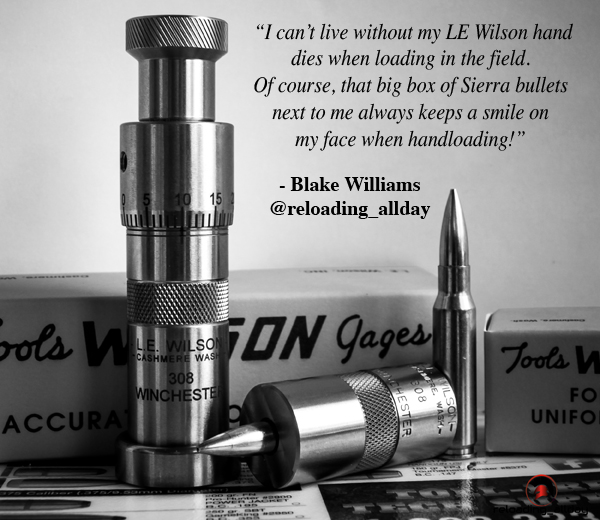
Sierra Bullets asked a few hand-loaders to reveal their favorite reloading tool or accessory: “What is your favorite ‘don’t know how you ever lived without it’ piece of reloading equipment?” Some of the answers are listed below. We were interested to see some high-tech, micro-processor items mentioned, such as the AMP Annealer, and the AutoTrickler powder dispenser. Old standbys, such as the rugged RCBS Rockchucker and Dillon 650, also made the favorites list. You can nominate your own favorite reloading hardware in the comments section of the Sierra Bullets Blog.
Sierra Bullets Ballistic Technician Philip Mahin answered: “A comparator gauge to measure from the base of a case to the ogive of the bullet. This bypasses the tip of the bullet, so I can repeat the same seating depth the next time I visit a specific combination.”
Bill, Editor of Rifleshooter.com, answered: “I have so many favorite reloading tools, it’s hard to pick one. But if I had to, it would be my Forster Co-Ax press. I like the ease [with which] you can change dies and that it doesn’t require traditional shell holders. It’s a great tool to have!”
Sierra Bullets Ballistic Technician Duane Siercks answered: “I don’t know that you would actually call this equipment, but the item that comes to mind would be my reloading room/shoot house. I had always had to squeeze everything into a corner or even an unheated shed. After we bought our current house, I built a garage and placed it so that I had a window looking down a 250-yard range. I built a dedicated room with heat and A/C. It contains my reloading bench and a shooting bench. The shooting bench lets me slide open the window and shoot down the range. It is very handy to not have to load everything up to go to the range. It also makes load development a lot simpler and efficient. I don’t know how I ever got along without it.
I also wonder what I did before I acquired the Lyman 1200 DPS Powder Dispenser. This has made the process so much simpler and much easier. I also have a Lee Precison Universal Decapping Die that I would gladly spend the money on again. This may be a small thing, but it certainly is handy. The Lee would accommodate some very large cases that some of the others were too small for.”
Jon Addis answered: “Putting an A&D FX-120i scale with AutoTrickler and Auto-Throw on the bench has changed the way I reload. It’s kernel accurate in about 15 seconds. Saves time and reduces a variable. And of course, the system is made better by the Area 419 Billet Adjustable base for the trickler and Billet Powder Cup.”
This video shows the AutoTrickler V2 and Auto-Throw Combo:
Sierra Bullets Chief Ballistician Tommy Todd answered: “A brass annealing machine and a RCBS Chargemaster complimented with a Sartorious scale.”
Sierra Bullets Ballistician Gary Prisendorf answered: “RCBS Rock Chucker Press, it’s built like a tank, and it will last me a lifetime.”
Sierra Bullets Production Manager Chris Hatfield also answered: “RCBS Rock Chucker single-stage reloading press.”
Jeremy Kisner answered: “My Giraud trimmer has taken [three operations] and combined them into one easy task. I can now size my brass and then sit down and trim, chamfer, and debur to a 0.001″ tolerance in one motion.”
Dan Blake answered: “My Annealing Made Perfect (AMP) annealer. With consistent neck tension being one of the largest contributions to small Extreme Spread on muzzle velocities, I believe this induction annealer is truly the best on the market.”
This manufacturer-produced video shows how the AMP annealing machine operates:
Trevor Aldinger answered: “Area 419 Master Funnel Kit. In the past I’ve used plastic funnels and even other metal ones. This system fits case necks and flows much better than any others I’ve used, and there is no static since it’s metal. We spend a lot of time and money to get precise charges, I don’t want to lose or miss a kernel because of a cheap funnel.”
Tyler Riley answered: “My RCBS bench primer (priming tool). It has a lot more leverage than a hand primer and still has a good feel to how tight primer pockets are. Makes it much easier on my hands to prime large runs, especially new brass with tight pockets.”
Craig Arnzen answered: “My Annealeez [annealing machine] is one of the best tools in my reloading room. Neck tension is SO important, and annealing every firing really helps with that. This is an inexpensive tool that can anneal a lot of cases at once, and help me produce more consistent ammo.”
Josh Temmen answered: “Time is critical for me so my RCBS Chargemasters are indispensable (pun intended.) They cut down on time at my reloading bench while maintaining the weight tolerances required for long range shooting.”
Josh Bartlett answered: “I have my Dillon 650 set up with Whidden floating tool heads to do decapping and sizing on my match ammo. The case feeder and progressive function of the press save me a TON of time when doing lots of several hundred rounds.”
Ryan Brandt answered: “… A quality set of calipers. My reloading room is full of very nice equipment but little does more to satisfy my perfectionism than a good check with the calipers.”




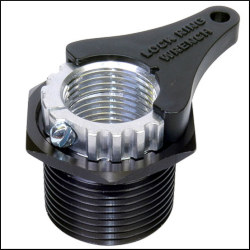 In this recent video Gavin Gear reviews three types of die accessories from LEE. These work for virtually all standard dies, not just LEE-brand reloading dies. The new LEE basic silver-finish die lock rings now feature splines for enhanced grip and compatibility with LEE’s new die lock ring wrench (photo right). They still boast a rubber 0-Ring that helps “float” the die for improved cartridge concentricity.






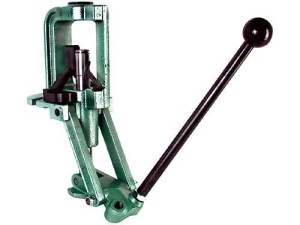 Sierra Bullets Ballistician Gary Prisendorf answered: “


