Many guys getting started in long range shooting are confused about what kind of scope they should buy — specifically whether it should have MIL-based clicks or MOA-based clicks. Before you can make that decision, you need to understand the terminology. This article, with a video by Bryan Litz, explains MILS and MOA so you can choose the right type of scope for your intended application.
You probably know that MOA stands for “Minute of Angle” (or more precisely “minute of arc”), but could you define the terms “Milrad” or “MIL”? In his latest video, Bryan Litz of Applied Ballitics explains MOA and MILs (short for “milliradians”). Bryan defines those terms and explains how they are used. One MOA is an angular measurement (1/60th of one degree) that subtends 1.047″ at 100 yards. One MIL (i.e. one milliradian) subtends 1/10th meter at 100 meters; that means that 0.1 Mil is one centimeter (1 cm) at 100 meters. Is one angular measurement system better than another? Not necessarily… Bryan explains that Mildot scopes may be handy for ranging, but scopes with MOA-based clicks work just fine for precision work at known distances. Also because one MOA is almost exactly one inch at 100 yards, the MOA system is convenient for expressing a rifle’s accuracy. By common parlance, a “half-MOA” rifle can shoot groups that are 1/2-inch (or smaller) at 100 yards.
What is a “Minute” of Angle?
When talking about angular degrees, a “minute” is simply 1/60th. So a “Minute of Angle” is simply 1/60th of one degree of a central angle, measured either up and down (for elevation) or side to side (for windage). At 100 yards, 1 MOA equals 1.047″ on the target. This is often rounded to one inch for simplicity. Say, for example, you click up 1 MOA (four clicks on a 1/4-MOA scope). That is roughly 1 inch at 100 yards, or roughly 4 inches at 400 yards, since the target area measured by an MOA subtension increases with the distance.
MIL vs. MOA for Target Ranging
MIL or MOA — which angular measuring system is better for target ranging (and hold-offs)? In a recent article on his PrecisionRifleBlog.com website, Cal Zant tackles that question. Analyzing the pros and cons of each, Zant concludes that both systems work well, provided you have compatible click values on your scope. Zant does note that a 1/4 MOA division is “slightly more precise” than 1/10th mil, but that’s really not a big deal: “Technically, 1/4 MOA clicks provide a little finer adjustments than 1/10 MIL. This difference is very slight… it only equates to 0.1″ difference in adjustments at 100 yards or 1″ at 1,000 yards[.]” Zant adds that, in practical terms, both 1/4-MOA clicks and 1/10th-MIL clicks work well in the field: “Most shooters agree that 1/4 MOA or 1/10 MIL are both right around that sweet spot.”
Video Podcast about Rimfire Testing June 10, 2020
Lapua’s Rimfire Performance Center East (Ohio) Manager Luke Johnson talks about rimfire ammunition testing on “The Shooter’s Mindset” Podcast this week. During this hour-long episode, Luke explains how rimfire ammo is tested in Lapua’s test tunnel facilities.
During this June 2020 podcast (see video below), The Shooter’s Mindset (TSM) hosts covered all aspects of rimfire performance testing with Johnson. Johnson explained the testing process, the importance of ammo testing, how to best identify good groups, and the benefit of having multiple lots of ammunition while shooting competitively.
“Many shooters are familiar with Lapua’s Rimfire Performance Centers, but have yet to take advantage of the service. Both of our facilities offer shooters the opportunity to test various styles and lots of Lapua ammunition under tightly controlled conditions”, stated Johnson. “Our goal is to help shooters match the perfect lot of ammunition with their rifle so they may hit the range with confidence knowing their ammunition will perform.”
About Luke Johnson — Smallbore Silhouette Champion
Luke Johnson is the manager of the Lapua Rimfire Performance Center housed at the Cardinal Shooting Range near Columbus, Ohio. Luke, a native of Marysville, PA, has a long background of competitive shooting and hunting.
Johnson was a four year letterman for the Univ. of Alaska-Fairbanks D1 Rifle Team. In addition to his 3P/Prone shooting pedigree, Luke is a High Master rifle silhouette competitor and past National Smallbore Silhouette champion.
NRA Smallbore Rifle Silhouette Champion
USA Junior National Champion (50 meter rifle)
NCAA – CRCA All-American
Patriot Conference – All-Conference
About Lapua
Lapua produces the highest-quality small caliber cartridges and components for civilian and professional use. Lapua is a part of the Capstone Precision Group, exclusive U.S. distributor for Berger, Lapua, Vihtavuori and SK-Rimfire products. For more information, visit Lapua.com.
There’s a good episode of Gun Talk Radio this Sunday 6/7/2020. In recent days we have witnessed mass protests, rioting, arson, looting, and even murder in the streets. We have also seen business owners successfully defending their property. The unfolding crisis of urban unrest and violence have certainly caused Americans to consider armed self-defense.
Protecting your family, home, and property during crisis is the focus of Tom Gresham’s Gun Talk® Radio this week. This Sunday, Tom talks with security expert Wayne Black about current events — the rioting and violence. Black talks about training for first-time owners, and explains how best to protect yourself and your family in the case of a riot. Notably, some armed business owners have had success defending their stores — much like the Korean store owners did during the Rodney King riots in Los Angeles. Listeners can call to talk with Wayne and Tom about self-defense and armed security. Call 866-TALK-GUN with your comments and questions, and range reports.
Gun Talk Radio — Podcast Archive
If you miss the live show broadcast or Live Streaming, past broadcasts can be heard online via the GUNTALK PODCAST Site and Apple iTunes. The Gun Talk Podcast Archive has hundreds of past shows you can access via the internet. Listen via your home computer or mobile device. Here’s a recent podcast focusing on firearms selection for self-defense.
Gun Talk Podcast from 5/31/2020 — Security, Riots, and Gun Choices:
All Gun Talk shows are also archived as podcasts for download or online listening. Gun Talk is also available on YouTube, Roku, Apple TV, Amazon Fire TV, and GunTalk.com.
A decade-and-a-half ago, our friend Robert Whitley created the 6mmAR, a wildcat based on the 6.5 Grendel necked down to 6mm. The great thing about the 6mmAR cartridge is that is offers superb accuracy with high-BC 6mm bullets, while working in AR15-platform rifles. The 6mmAR feeds and functions using 6.8 SPC or 6.5 Grendel AR magazines. We provided a full report on the 6mmAR way back in 2006.
Hornady Introduces the 6mm ARC Cartridge for AR15 Platform
Now Hornady, with no apparent credit to Whitley’s 6mmAR, has announced a copycat cartridge, which it calls the 6mm ARC (Advanced Rifle Cartridge). Hornady will offer loaded 6mm ARC ammunition and also cartridge brass. In addition Hornady will produce reloading dies, shell plates, modified case, and other accessories. SEE 6mm ARC SAAMI Specification.
Hornady states: “Hornady® is proud to introduce the new 6mm ARC (Advanced Rifle Cartridge). Recently tested, selected and fielded by a specialized group within the U.S. Department of Defense for its multipurpose combat rifle program, the 6mm ARC is a truly versatile cartridge that maximizes the potential of the AR-15 platform.” Hornady Ballistician Jayden Quinlan adds: “We subsequently modeled and tested a variety of designs in different calibers until we were able to produce the most flexible cartridge possible within the limits of the AR-15 system. The 6mm ARC does much of what larger cartridges can and everything that smaller cartridges can’t.”
NOTE: The rim diameter (0.441) and thickness of the 6mm ARC appear to be identical to the 6.5 Grendel as illustrated on page 40 of the SAAMI Industry Standards. From all we can tell, in other dimensions as well, this is a very close copy of Robert Whitley’s 6mmAR, a 6-6.5 Grendel wildcat. For example, 6mm ARC case length is 1.49″ vs. 1.51″ for 6mmAR. The Guns&Ammo report on the 6mm ARC states: “The 6mm ARC is based on the 6.5 Grendel. Hornady started by necking down the cartridge to 6mm and then pulled the shoulder back closer to the case head .030-inch. … Hornady also set maximum chamber pressure low at 52,000 pounds PSI. This slows extraction and makes it much less violent, prolonging the bolt’s life.”
There is an extensive discussion of the 6mm ARC on the Gun University website. You’ll find dimensions and performance numbers for the new cartridge along with videos showing the 6mm ARC cartridge tested in a Barrett AR-type REC7 DI rifle. Read Gun University Story HERE.
More Velocity Than a .223 Rem, Less Weight and Recoil Than a .308 Win
Hornady says the 6mm ARC “delivers substantially better ballistics than the [.223 Rem] and offers a much lighter gun/ammo system with 30% less weight than the AR-10/308 Win system. This new cartridge delivers less felt recoil than larger short-action-based cartridges, yet takes full advantage of modern, heavy-for-caliber 6mm bullets that provide excellent accuracy and ballistic performance at extended range.”
You can see a ballistic comparison between 6mm ARC, .223 Remington, and .308 Winchester in this Hornady chart:
Notably, a large number of AR gun-makers have committed to producing rifles or uppers chambered for the 6mm ARC. Some of these are: Adams Arms, Barrett, Brownells, Christensen Arms, GAP, Howa, Mossberg, Noveske, Odin Works, Radical Firearms, and Wilson Combat. In addition Geissele and CMC Triggers are listed as suppliers on Hornady’s 6mm ARC webpage.
The Proven Lapua Brass Alternative — 6mmAR and 6mmAR Turbo
If you want 6mm ARC performance in your AR15 with superior case life and consistency, consider doing the 6mmAR or 6mmAR Turbo instead. These are proven designs with winning records in high power competition. Redding produces dies, and complete uppers (with proper Grendel-sized bolt face) are available from 6mmAR.com.
Superior Accuracy with Impressive Ballistics
Robert explained to us: “Lapua’s Grendel brass is of exceptional quality, very hard at the back, with a well-annealed neck area, and it has a small primer pocket and small flash hole. When you start with this kind of brass, you have all the ingredients of great accuracy. Necked down to 6mm, it is like a long-bodied 6 PPC, that feeds and shoots well out of an AR-15. This gives you a case that can handle high pressures, with the accuracy pedigree of the 6PPC. It doesn’t get much better than that.”
To create the 6mmAR simply neck-down parent Lapua 6.5 Grendel brass, which has small primer pocket and small flash hole. Case capacity is 36.0 grains of water, filled to over-flowing. (For comparison the 6mm PPC holds about 32.5 grains). To prepare cases, simply run the 6.5 Grendel brass through a Redding 6mmAR full-length sizing die. The FL die’s internal neck diameter (0.267″) is spec’d to deliver about .004″ tension on the bullet–just right for a gas gun. Redding’s 6mmAR dies were built to Whitley’s specs and closely match the actual dimensions of the Lapua brass. This video from Robert Whitley shows how to form 6mmAR cases from Lapua 6.5 Grendel brass.
Velocities: With the recommended medium-burn-rate powders, bullets in the 85- to 90-grain range can be pushed to the 2800 to 2850 fps range. In most 6mmAR rifles, the 105- to 107-grain bullets can be driven to velocities of 2700 to 2750 fps in a 24″ or longer barrel. More speed is possible, but don’t count on it with the average barrel. If you want more speed the 6mmAR Turbo offers additional case capacity. This allows the 6mmAR Turbo to drive the heavier 6mm bullets at velocities close to 6mmBR Norma cartridge levels.
Magazines: The correct magazines are the key to a reliable, competition-worthy system. For best results with the 6mmAR or 6mmAR Turbo, use special 6.8 SPC mags or Alexander Arms Grendel mags. Those specialized mags will provide better reliability than standard .223 Rem/5.56 mags for the AR15.
Jewell triggers are still the most-used triggers on competition benchrest and F-Class rifles and they are also popular for hunting, varmint, and tactical rifles (with or without safeties). While a Jewell trigger can work for years with minimal maintenance, if the trigger becomes gunked up, it may be necessary to disassemble the trigger for a thorough cleaning. Our friends Ed and Steve, aka the 6.5 Guys, have produced a helpful video that shows how to disassemble and then reassemble a Jewell trigger.
Why You May Need to Disassemble Your Jewell Trigger — the 6.5 Guys
Jewell triggers are a popular choice in the sport of long range precision shooting, and like everything else require regular cleaning and maintenance. In most cases they can be cleaned with charcoal lighter fluid or dropped into an ultrasonic cleaner. Should the situation require, they can be completely disassembled according to the Jewell Trigger Manual.
We ran into a situation where we had to dissemble a trigger due to the entrapment of some sticky dirt that couldn’t be removed with an ultrasonic cleaner. Our first step was to find some step-by-step instructions but we couldn’t find anything.
Recognizing that other shooters might be in the same situation we produced a step-by-step guide and video, published in full on 65Guys.com. These instructions will work with a left- or right-handed trigger. In our case we worked with a left-handed BR model trigger with safety and bolt release.
Step-by-Step Instructions are provided on 65Guys.com website. We recommend you read all the instructions carefully before you even think about disassembling your trigger. This video explains the process so you can get a sense of what is involved.
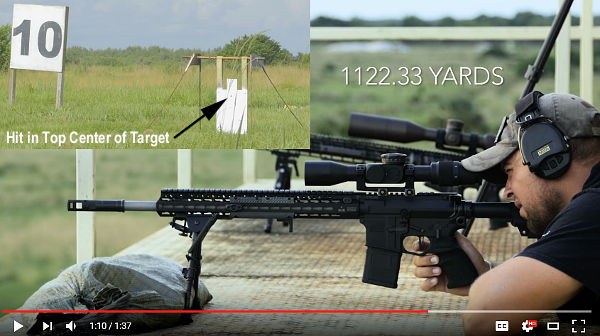
Many of our readers have never had a chance to shoot much past 600 yards. How far away does a 1000-yard+ target really seem to the naked eye? Well this short video answers that question. Gorilla Ammo, the video’s producers, used a camera-carrying aerial drone to fly downrange from the firing line all the way out to 1122 yards (and back again). Watch the drone footage at 0:00-0:07 and especially 0:48-1:03. The “bird’s-eye view” really gives you a sense of the distance. The “fly-back” at 0:48-1:03 time-mark is what makes this video worth watching.
The video features prone shooting at steel targets placed at 750 and 1122 yards. We do apologize for the lame, “oh so serious” voice-over which attempts to make this rather ordinary range session seem like some kind of life-changing experience. (Frankly, you may just want to turn the sound off — it’s that annoying.) It’s really not that big a deal to hit steel at 750 yards with a quality AR-15, chambered in .223 Rem, shooting Sierra 77 grain MatchKings.
Hitting Steel at 1122 Yards with 2540 FPS Ammo Can Be Challenging
The 1122-yard hits are a bit more impressive. Gorilla Ammo lists a relatively sedate 2540 fps Muzzle Velocity for its .223 Rem 77gr SMK ammunition. According to JBM Ballistics, at 1125 yards, that 2540 fps load has 68.3 MOA of drop from a 100-yard zero (firing at sea level and 80° F ambient). Morever the bullet goes trans-sonic around 750 yards (losing stability) and is traveling just 933 fps at impact. And the wind’s the killer — at 1125 yards, with this bullet/load, a mere 2 mph, full-value wind change can move the Point of Impact over three feet!
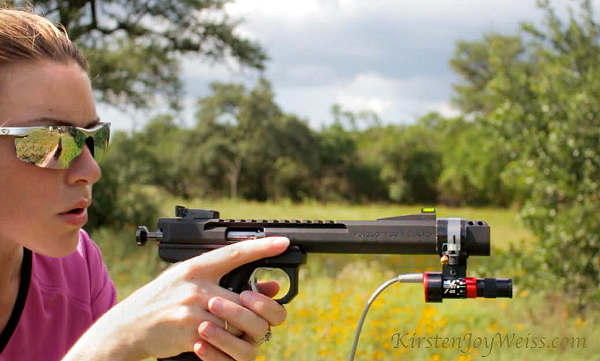
“SCATT” — if you’re an Olympic Class air rifle or smallbore competitor you know what SCATT means. The Russian-made SCATT is a marksmanship training system with an electro-optical sensor that fits on the end of a barrel. The sensor “sees” the target and then tracks your muzzle movement relative to the center of the target, recording a “trace” that can be displayed on a computer. The SCATT MX-02 unit works for live-fire training as well as dry-fire training. There is also a newer SCATT MX-W2 wireless system that works for dry-fire AND live-fire training. To learn more about the SCATT electronic trainers, visit SCATTUSA.com.
Pro shooter Kirsten Joy Weiss demonstrates the SCATT MX-02 electronic training system:
The system traces and records valuable information such as hold pattern, shot hold duration, follow-through, recoil pattern, and much more. The latest SCATT MX-02 systems can be used both indoors and outdoors up to 300 meters (and possibly more). READ FULL SCATT MX-02 TEST HERE.
SCATT traces reveal muzzle movements during the aiming process.
Kirsten Joy Weiss, a top-level competitive position shooter, has tested the latest SCATT MX-02 training systtem. She put the MX-02 through its paces, and then produced an informative video that shows how it works. Click on the video above to see Kirsten use the MX-02 with her Anschütz rifle and other guns.
Kirsten was impressed with the SCATT MX-02 she tested:
“We live with tech woven into our every day, so if you had the chance to work with a computer to make you a better shooter — would you? Can a computer train you as well as your favorite coach or, dare to say, better than a human?”
Weiss says it’s like having a little coach with you recording your every move. “If R2D2 had a cousin who knew how to shoot,” Weiss quips, “his name would be the MX-02″.
The SCATT MX-02 can also be used with target pistols.
We know that many of our readers have never personally participated in a short-range (100/200 yard) benchrest match. That’s understandable — moving backers are required in registered 100/200 benchrest (for group) matches, yet only a small percentage of ranges have that equipment. If you’re curious about the “point-blank” benchrest game, but haven’t had the chance to see it first-hand, check out this video created by youtuber “Taofledermaus”. On his YouTube Channel, you’ll find many other interesting shooting videos, including slow-motion target impact clips. This video shows the LV and HV guns, the flags, the gun-handling, the reloading set-ups, and of course, tiny little groups on targets.
Registered 100/200 Benchrest Match
Viewer Comments on the Video:
“There is a lot more to this game than just pulling the trigger. Record targets are 5-shot groups, 5 averaged together for an Aggregate. Most times the winning Agg is under .250″ for 25 shots at 100 yards. Rifles weigh 10.5 pounds for LV class. Used rifles can be had for about $1500. Then add in another $1000 for rest, bags, loading tools, bullets, powder, not to mention windflags.” — Vmhtr
“Benchrest shooting is sort of an ‘academy of shooting’. Lots of academic thought and measurements, handloading made with anal attention at detail. It’s much more thought than action. Most of those people made their tools themselves. [There are] It’s plenty of seniors because it takes patience, lots of patience. Sure a teenager ain’t gonna bother it.” — THP
“I was surprised they did all their hand loading right there on the spot. — I think you nailed it. It’s a super-precise sport. It’s expensive, it’s slow, and it requires a lot of travel, so it’s well-suited for retired folks. It’s gotta beat golfing!” — Tao
“I used to shoot 6mm PPC in a BR rifle. I spent so much time at the reloading bench that I just gave up on it all and switched to 22 rimfire gallery matches. Saved a lot of my sanity doing that….” — Walt
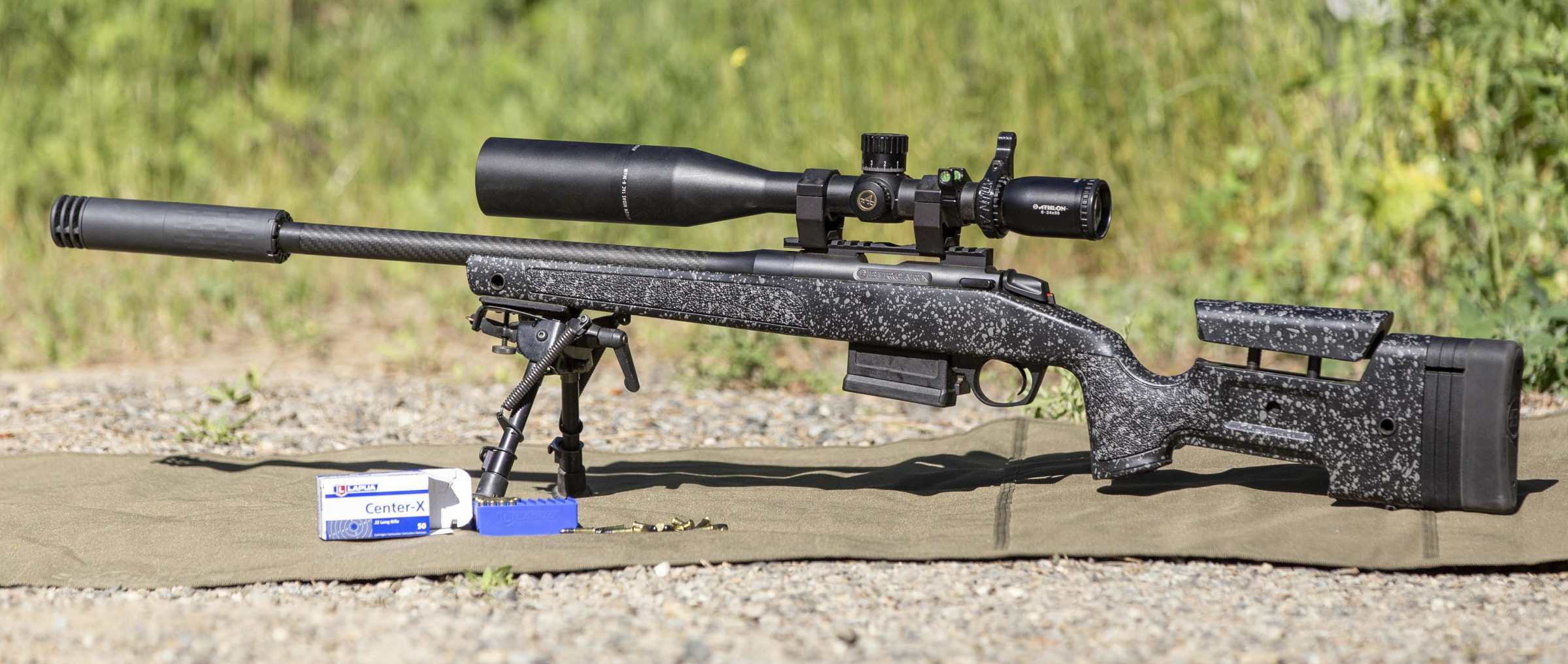
The Bergara B14-R is a high-quality, accurate .22 LR rimfire bolt-action rifle. The rifle’s accuracy and functionality make it a good choice for NRL22 competition. And with stock geometry and ergonomics that duplicate a full-size centerfire rifle, the Bergara B14-R is also an excellent choice for cross-training. By training with a rimfire rifle, you can get essential “trigger time” while saving money. Good centerfire ammo can cost $1.50 per round or more. Decent rimfire ammo can be found for $6.00 per 50rd box. That’s just 12 cents per round.
Click above photo to load full-screen high-rez image.
To find out how well the Bergara B14-R can perform, Gavin Gear of UltimateReloader.com recently tested a B14-R (carbon-covered barrel version) at his private range. Using a variety of Lapua and SK Ammo, this rig delivered impressive results. Watch this video to see the B14-R in action.
“The B14-R is a great shooter, and for me it felt very familiar. Just like shooting one of my centerfire match guns, but without all of the recoil!” — Gavin Gear
Gavin reports: “At the 2020 SHOT Show, Bergara announced the B14-R trainer. The concept? Take the B14 HMR series centerfire rifle formula, and adapt it for rimfire. The result is a .22 LR rifle you can shoot all day long without wearing out your arm or your wallet! It looks/feels like a centerfire long-range precision rifle. And that’s what makes this rifle a GREAT training platform for serious long-range shooters.”
The B14-R comes with a 18″-long 1:16″-twist threaded barrel. The single-stack .22 LR magazine is the same size as a short action AICS mag. The Bergara B14-R shares Rem 700 specs, so it is compatible with Rem 700 stocks and aftermarket triggers. Weight with standard barrel is 9.2 pounds without optics, or 8.1 pounds for the carbon version seen here. MSRP for basic version is $1150.00 and street price is $950.00.
Gavin told us: “I couldn’t wait to get the B14-R out to my new 50-yard ridgeline range to see how it would perform with premium .22 LR ammunition. Once I shot this rifle suppressed, I didn’t want to take off the can. The 18″ barrel really works well with the SilcencerCo suppressor to help keep the overall length reasonable, and balance is spot-on.” NOTE: This rifle has the optional carbon-covered barrel.
As tested, the rifle was equipped with these components:
Athlon Midas TAC 6-14x50mm FFP Scope with MK Machine lever, Lone Star bubble level SilencerCo Omega 300 Suppressor with 1/2×28 direct thread mount Harris S-BRM 6″-9″ Bipod with aftermarket swivel tension lever
Outstanding Accuracy with Lapua and SK .22 LR Ammo
Remarkable accuracy for a factory rifle earned this Bergara its Sunday GunDay selection. Shooting with bipod and rear sandbag, Gavin was able to achieve multiple, sub-half-inch groups at 50 yards. The best group shot with SK Match ammo was a remarkable 0.22″ as measured by Ballistic-X software (see below). That’s an impressive 0.42 MOA at 50 yards. If you watch the video above, starting at 14:40 time-mark, you can watch Gavin shoot that 0.22″ group.
Here are two more groups, both under 0.5″ at 50 yards. Lapua Center-X on left, SK Match on right. Gavin says that “with good conditions, 0.35″ 5-shot groups at 50 yards are easily attainable.”
B14-R Trigger Tested with TriggerScan TS-11
Gavin tested the Bergara’s trigger with the TriggerScan TS-11 from DVORAK Instruments, a very sophisticated, high-tech device. Gavin states: “This trigger works well, and mine was adjustable down to just over 2-lb peak force for pull weight. I ran a 3-scan pass on the B14-R trigger with the pull weight set to minimum [barely over 2 pounds].”
Gavin notes: “You can see how consistent this trigger is by how well the scan graph plots overlap! This trigger is great for an out-of-the-box rifle like this, and it’s great to know that I can always swap out triggers and use the same exact Remington 700-compatible trigger that I’m running in my match guns.”
Gavin Gear’s Closing Thoughts — More to Come
The Bergara B14-R rimfire trainer has been a great rifle to shoot and has exceeded my expectations. The B14-R feels like a full-size PRS rifle, has the same basic features, but is chambered in .22 LR. I have been amazed by the accuracy I’ve achieved with this rifle with Lapua and SK match ammunition — it’s very confidence inspiring.
This rifle feels right and shoots great. I can’t wait to get more steel targets setup, and to go deeper into calculating dope for the ammunition I will shoot with this rifle. Perhaps I’ll think about competing in an NRL22 match at some point. If you are looking for a rimfire trainer, look at the Bergara B14-R for sure. It checks all of my boxes for this type of rifle!
Many of our Forum members have expressed interest in a recoil-reduction system for prone F-Open competition rifles shooting heavy bullets from powerful cartridges. A .300 WSM shooing 200+ grain bullets can definitely take its toll over the course of a match. One system that has been used with considerable success is the hydraulic “Bump Buster” recoil system. This definitely reduces the pounding your shoulder gets during a long match. To illustrate this system, we’ve reprised an article on Bret Soloman’s F-Open rifle from a couple years back. Watch the Videos to see the Bump Buster in action.
On his Facebook page, Hall-of-Fame shooter and ace gunsmith Thomas “Speedy” Gonzalez unveiled an impressive new F-Open rifle built for Bret Solomon. The rifle features Speedy’s new low-profile F-Class stock.
Bret’s gun is chambered for his 300 Solomon wildcat, shooting heavy 210gr bullets, so it can can be a real shoulder-buster, without some kind of buffer. The stock is fitted with a Ken Rucker’s Bump Buster hydraulic recoil reduction system to tame the recoil. The Bump Buster was originally designed for shotguns and hard-hitting, big game rifles. It is interesting to see this hydraulic buffer adapted to an F-Open rig.
Here you can see Bret shooting the gun, coached by Nancy Tompkins and Michele Gallagher:
Bret’s gun features a stainless Viper (Stiller) action, barrel tuner, and an innovative Speedy-crafted wood stock. Speedy says this stock design is all-new: “It is a true, low Center-of-Gravity F-Class stock, not a morphed Palma stock merely cut out on the bottom”. See all the details in this short video:
Stock Features: Glue-in or Bolt-In and Optional Carbon Pillars and Cooling Ports
Speedy explained the features of the new stock design: “Terry Leonard and I started working on an F-Class version of his stocks last year during the F-Class Nationals and came up with what he and I consider the first true low-CG stock in the sport. As you can see by the videos, there is very little torquing of the stock during recoil. I add the carbon fiber tunnel underneath the forearms to save Terry some time. This bonds very well to his carbon fiber skeleton within the stock adding addition stiffness to the forearm to support the heavy barrels found on the F-Class rigs.
We are playing with both glue-ins like we benchresters use and bolt-ins as well. The rifles on the videos are glue-ins. Bret just took delivery today of his first bolt-in employing carbon fiber pillars and the first Leonard stock ever to have cooling ports.”
Need for Recoil Reduction Follows F-Class Trend to Bigger Calibers and Heavier Bullets
In recent years we have seen F-Open competitors move to bigger calibers and heavier bullets in pursuit of higher BC. There is no free lunch however. Shooting a 210gr .30-caliber bullet is going to produce much more recoil than a 140gr 6.5mm projectile (when they are shot at similar velocities). Does this mean that more F-Open shooters will add hydraulic buffers to their rigs? Will a recoil-reduction system become “de rigueur” on F-Open rifles shooting heavy bullets?
Our friend Boyd Allen observes: “You may imagine that shooting a short magnum, or even a .284 Win with heavy bullets, involves a fair amount of recoil, and in the prone position this can be more than a little wearing. It can in fact beat you up over the course of a match. Some time back, Lou Murdica told me about having a hydraulic recoil absorbing device installed on one of his F-Class rifles, chambered in .300 WSM. Lou is shooting heavy (210-215gr) bullets so the recoil is stout. According to Lou, the hydraulic recoil-reduction system made all the difference.”
Story tip from Boyd Allen. We welcome reader submissions.








 On his


