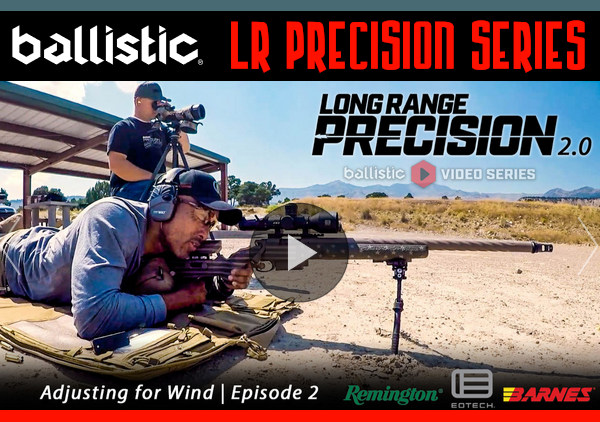
Long Range Precision (LRP) is a useful series of videos product by Ballistic Magazine and sponsored by Remington, Barnes Bullets, and Eotech. All six of the Season 1 LRP videos are embedded below for easy “binge watching”. In addition, all seven Season 2 episodes can be watched online on BallisticMag.com.
In this video series host Sean Utley covers many gear-related topics including rifle configuration, scope selection, chambering choices, ammunition options, bipods/tripods, and chronographs. In addition, the series covers training methods, bullet ballistics, wind reading, and rifle handling.
Most of this is pretty basic stuff, but it can be helpful for newcomers to long range shooting. For example, Season 1 Episode 4 covers chambering options including 6.5 Creedmoor and .308 Winchester.
Season 1, Episode 1: Anatomy of a Long Range Precision Rifle
Season 1, Episode 2: Foundations of Long Range Shooting
Season 1, Episode 3: Mechanics of Long Range Shooting
Season 1, Episode 4: Best Calibers for Long Range Shooting
Season 1, Episode 5: Anatomy of Bullet Flight
Season 1, Episode 6: Critical Equipment for Long Range Shooting
Watch Latest Long Range Precision Season 2 Videos
Along with all these Season 1 videos, there are seven Season 2 videos available on BallisticMag.com. Season 2, Episode 2 is a good video on Adjusting for Wind. And if you are interested in learning how Doppler Radar is used to develop bullet designs, we recommend Episode 7 from Season 2. This 7-minute video covers the latest technology in ballistics radar. CLICK HERE to watch video.
Looking downrange at the 600-yard targets. Camp Perry photo courtesy Dennis Santiago.
Shooting USA TV has an excellent episode this week, with some great features for competitive shooters and fans of historic military rifles. Shooting USA covers the President’s 100 Match at Camp Perry, one of the most prestigious shooting competitions held each summer. In addition, Shooting USA spotlights the M1 Garand rifle. A legendary firearm that helped win WWII, the .30-06 Springfield M1 Garand remains popular in vintage military matches. There is also a major Garand Match each summer at Camp Perry. You can watch Shooting USA Wednesday nights on the Outdoor Channel at 8:00 pm Eastern/Pacific, 9:00 pm Central. Or, you can view each episode the following Thursday (and thereafter) on Vimeo.com
Shooting USA is available On Demand via Vimeo.com. Watch a single episode for $0.99, or get a full-month subscription for $3.99 and watch as many shows as you like with limited commercial interruptions.
» SHOOTING USA Covers the President’s 100 Match
The historic National President’s 100 Match is a huge event. In recent years, there have been over 1000 competitors, making this one of the biggest rifle events of the year. First held in 1878, the President’s 100 match is richly steeped in history. The top 100 competitors overall are designated as the President’s 100. They receive President’s 100 medallions and certificates.
Origins of the President’s Match The National Rifle Association’s President’s Match was instituted in 1878, as the American Military Rifle Championship Match. In 1884, the name was changed to the President’s Match for the Military Rifle Championship of the United States. It was fired at Creedmoor, New York until 1891. In 1895, it was reintroduced at Sea Girt, New Jersey. Today, the match is held at Camp Perry, Ohio.
The President’s Match was patterned after the Queen’s Match for British Volunteers. That British competition was started in 1860 by Queen Victoria and the NRA of Great Britain to increase the ability of Britain’s marksmen following the Crimean War.
The tradition of making a letter from the President of the United States the first prize began in 1904 when President Theodore Roosevelt personally wrote a letter of congratulations to the winner, Private Howard Gensch of the New Jersey National Guard.
After a hiatus in the 1930s and 1940s, The President’s Match was reinstated in 1957 at the National Matches as “The President’s Hundred.” The 100 top-scoring competitors in the President’s Match were singled out for special recognition.
» Shooting USA Features the M1 Garand Vintage Military Rifle
This week’s Shooting USA episode tracks the origins and history of the Garand. An M1 Garand is a great addition to anyone’s personal firearms collection. It is a piece of living history — plus it can be used in Vintage Military rifle matches. Here are some resources for M1 Garand owners.
M1 Garand History
Jean Cantius Garand, also known as John C. Garand, was a Canadian designer of firearms who created the M1 Garand, a semi-automatic rifle that was widely used by the U.S. Army and U.S. Marine Corps during World War II and the Korean War. The U.S. government employed Garand as an engineer with the Springfield Armory from 1919 until he retired in 1953. At Springfield Armory Garand was tasked with designing a basic gas-actuated self-loading infantry rifle and carbine that would eject the spent cartridge and reload a new round. It took fifteen years to perfect the M1 prototype model to meet all the U.S. Army specifications. The resulting Semiautomatic, Caliber .30, M1 Rifle was patented by Garand in 1932, approved by the U.S. Army on January 9, 1936, and went into mass production in 1940. It replaced the bolt-action M1903 Springfield and became the standard infantry rifle known as the Garand Rifle. During the World War II, over four million M1 rifles were manufactured.
One of the most unique and exotic rifles in the NRA Museum is the Fuchs Double Barrel Bolt Action Rifle. “This is the … most substantial bolt action rifle ever made,” said NRA Museums Senior Curator Philip Schreier. This unique double barrel bolt-action rifle loads two cartridges at the same time. It is the world’s only repeating double rifle design. Incorporating titanium components to reduce weight, this .416 Remington Magnum rifle has an eight-shot capacity, feeding from a beautifully engraved massive magazine assembly mounted under the receiver. Hungarian inventor Joseph Szecsei developed this innovative design after being charged simultaneously by three elephants in 1989. These rifles are sold by Fuchs Fine Guns in Innsbruck, Austria.
An engineering tour de force, this elaborately engraved rifle is also a work of art. On the action, and bottom metal are engraved images of the “Big Five” African game species: elephant, cape buffalo, rhino, lion, and leopard. This rifle has been featured on Curator’s Corner on the Outdoor Channel, and it now resides behind glass in the Robert E. Peterson Collection at the NRA Museum.
Here gun builder Gerhard Fuchs explains the features of the exotic double-barreled bolt-action rifle:
This amazing twin-barreled bolt-gun has a unique closing mechanism that locks two separate bolt bodies into the chambers of the right and left barrels. Yes there are two firing pins, two ejectors, two extractors, and two triggers. We’re not sure how one jumbo camming system closes two bolts — Perhaps one of our gunsmith readers can explain how this system works.
This Rifle Has TWO Barrels and TWO Bolts
Just $78,000 at “Half-off Pricing”
Shown here (above and below) is another Fuchs double bolt rifle chambered in .416 Remington. This example, without the “Big Five” animal engravings, sold a few years back on Gunbroker.com for $78,000. That astronomical sum is just half the original cost, according to the seller. This amazing double safari rifle has 22″ barrels and weighs 11.5 pounds.
More Eye-Catching Examples of the Fuchs Double Barrel Rifle
Along with the rifle featured in this article, you can see other Fuchs Double Barrel Repeater rifles with the same twin-bolt action on the Fuchs Fine Guns website. Here are examples.
Can you form a wildcat cartridge such as the 6 Dasher without expending primer, powders, and bullets? Absolutely. Using the hydro-forming method you can form improved cases in your workshop with no firing whatsoever, so there is no wear on your precious barrel. Watch this video to see how it’s done:
6 Dasher Case Hydro-Forming Demonstration:
Forum member Wes J. (aka P1ZombieKiller) has produced a helpful video showing how to form Dasher cases use the Hornady Hydraulic forming die kit. This includes a two-part die (body and piston), and a special shell holder. To form the case, you insert a primer in your virgin brass, top the case off with with a fluid (water or alcohol), then run the case up into the Hydro-forming die. A few stout whacks with a hammer and your case is 95% formed.
Hydro-Forming Procedure Step-by-Step:
1. Insert spent primer in new 6mmBR brass case.
2. Fill with water or alcohol (Wes prefers alcohol).
3. Wipe excess fluid off case.
4. Place case in special Hornady shell-holder (no primer hole).
5. Run case up into Hydraulic forming die.
6. Smack top piston of forming die 3-4 times with rubber mallet or dead-blow hammer.
7. Inspect case, re-fill and repeat if necessary.
8. Drain alcohol (or water) into container.
9. Remove primer (and save for re-use).
10. Blow-dry formed case. Inspect and measure formed case.
Wes achieves very uniform cartridge OALs with this method. He measured ten (10) hydro-formed 6 Dasher cases and got these results: two @ 1.536″; 2 @ 1.537″; and 6 @ 1.538″.
Three or Four Whacks Produces a 95%-Formed Case
With a Hornady hydro-forming die, hydraulic pressure does the job of blowing out the shoulders of your improved case. The process is relatively simple. Place a spent primer in the bottom of a new piece of brass. Fill the case with water, and then slip it into a special Hornady shell-holder with no hole in the middle. Then you run the case up into the forming die. Now comes the fun part. You gently insert a plunger (hydraulic ram) from the top, and give it three or four stiff whacks with a mallet (or better yet, a dead-blow hammer). Remove the plunger and you have a 95% formed case, ready to load.
Special Shell-Holder
Hornady supplies a shell holder made specifically for the hydro die; there’s no hole in the bottom of it. Just insert a spent primer into the primer pocket and you’re ready to go. The spent primer, combined with the solid shell holder, keeps the water from seeping out of the primer pocket. The primer pushes out a little bit during this process, but it’s impossible for it to come out because of the way the shell holder is designed. The shell holder has a grove which allows the case to slide out of the shell holder even when the primer protrudes a bit.
Story tip from Body Allen. We welcome reader submissions.
Never had a chance to hunt prairie dogs in the American west? Then check out this video. Dan Eigen, host of the We Love It Outdoors Television series, ventured to South Dakota for some varmint hunting. Dan teamed up with Varmint Hunter Association President Jeff Rheborg to patrol some South Dakota Dogtowns where things get serious. In the video, you’ll see p-dog hits at distances from 70 yards to roughly 450 yards. The hunters were shooting from portable, wood-topped swivel rests, using AR-platform rifles on X-type sandbag rest. (Rifle zeroing session is shown at the 5:30+ mark.)
Multiple cameras were employed so you can see both the shooter’s POV and close-ups of the prairie dogs downrange. Watch the shooters having fun with a prairie dog cut-out and some Tannerite at the 9:00-minute mark. This guys are having a grand old time sending critters to Prairie Dog Heaven — we think you’ll enjoy the video.
Prairie Dog Hunting Starts at 2:20 Time-Mark in Video:
NOTE: This video actually covers three sequences: 1) Three-gun training; 2) Prairie Dog Hunting; and 3) Coyote Hunting. The Prairie Dog segment runs from 2:20 to 15:15. If you wish, you can slide the controls forward or back to watch the other segments.
Video found by EdLongrange. We welcome reader submissions.
Are laser sights really useful on a handgun? Yes, and not just in low-light situations. That said, many folks who own laser-equipped handguns do not train effectively with the laser. For many gun-owners, the laser is just a toy, a gimmick that is used a few times and then ignored. Those gun-owners miss out on some of the most important advantages of a laser sights, benefits you can get from formal training with your laser-equipped pistol.
Crimson Trace has produced a series of training videos that may change your mind about lasers. If you shoot a handgun you should watch these videos. They show how laser sights can help diagnose and correct common handgun-shooting errors (such as flinching and anticipating the shot). The videos also show how to improve sight alignment and get your sights on target quickly.
Training with Laser Sights, Full 12-minute Video
Covers Muzzle Awareness, Sight Alignment, Target Acquisition, Trigger Control
This video shows how training with laser sights can: 1) improve muzzle direction awareness; 2) aid with sight alignment; 3) speed up target acquisition; and 4) improve trigger control. The video also demonstrates the obvious advantage of laser sights in low light conditions. Numerous firearms experts are featured in this video filmed at Arizona’s Gunsight Academy.
Training With Lasers — Trigger Control
Training with laser sights helps diagnose and improve trigger control errors by showcasing the importance of “surprise break” and follow-through. Lasers quickly diagnose errors such as recoil anticipation, jerking the trigger, and breaking the wrist.
Training with Lasers — Sight Alignment
Training with laser sights can improve/correct alignment. The laser provides a visual indicator of proper sight alignment, allowing shooters to quickly see any errors before taking a shot. Additionally, lasers can enhance sight alignment on popular sub-compact carry guns with small, low-profile sights.
Muzzle Awareness — All-Important for Safe Shooting
Training with laser sights improves a shooter’s muzzle awareness. A daylight-visible laser shows the gun operator where his or her muzzle is pointing at all times. This helps teach proper safety practices.
Watch this Video — It’s one of the best Custom Rifle Build Videos ever produced!
This video, produced for the folks at S&S Precision in Argyle, Texas, shows a full custom 6.5×47 Lapua bench rifle being crafted from start to finish. It is a fantastic video, one of the best benchrest gunsmithing videos you’ll find on YouTube. It shows every aspect of the job — action bedding, chambering, barrel-fitting, muzzle crowning, and stock finishing.
You’ll be amazed at the paint job on this rig — complete with flames and four playing cards: the 6, 5, 4, and 7 of spades. Everyone should take the time to watch this 13-minute video from start to finish, particularly if you are interested in stock painting or precision gunsmithing. And the video has a “happy ending”. This custom 6.5×47 proves to be a real tack-driver, shooting a 0.274″ three-shot group at 400 yards to win “small group” in its first fun match. NOTE: If you have a fast internet connection, we recommend you watch this video in 720p HD.
There is a great multi-part episode of ShootingUSA on the Outdoor Channel this week. This week’s show covers the Bianchi Cup, AR rifles from Colt and S&W, the historic Model 1903 Springfield, Smith & Wesson 10mm Model 610 Revolvers. Plus there is a bonus Pro Tip segment on how to mount and align riflescopes. If you receive the Outdoor Channel, you can see this excellent hour-long show today (5/13/2020) at 9:00 pm Eastern/Pacific, or 8:00 pm Central.
If you miss the show, or don’t get Outdoor Channel on cable, all ShootingUSA episodes are available “on demand” through Vimeo.com. You can subscribe for $3.99/mo, or watch any specific episode for a modest $0.99 fee. Under a buck for an hour’s entertainment? That’s a lot cheaper than going to the cinema.
Lead Feature: Bianchi Cup
27 years ago Doug Koening, who has won the Bianchi Cup 18 times, set the standard with a 1920 score. Since then, every Open shooter knows that he or she must “clean” this match (i.e. score a “1920”) to have a chance to take the title of “Champion”. The X-Count is the tie-breaker.
Feature: M1903 Springfield Rifle
The M1903 Springfield served in both WWI and WWII. The accuracy and quality and service life have clearly made the ’03 Springfield one of History’s Guns.
Feature: Smith & Wesson Model 610
The Smith and Wesson Model 610s are back and now chambered in 10mm. The Model 610 is a N frame, all stainless-steel construction, in a choice of barrel length – four inch, or six-and-a-half-inch.
Pro Tip — Mounting a Scope
In this episode, John Paul from JP Enterprises shows his method of Truing a Riflescope. He says: “If you’re going to be successful you need to lay down a solid foundation. One of those basic foundation blocks is making sure that your scope is true to the rifle.”
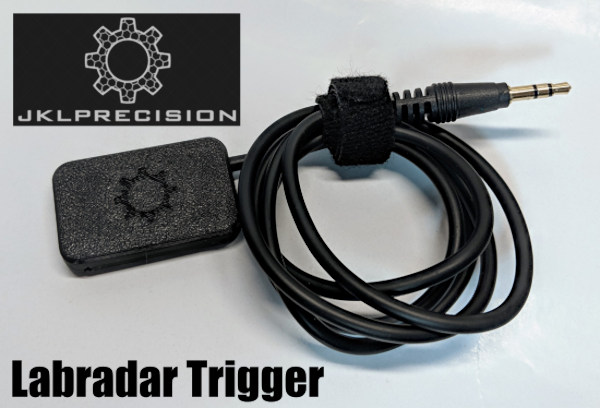
SUMMARY: This article reviews a device that “triggers” the LabRadar chronograph to register bullet speed. Rather than activate by sound or Doppler reading, this $35 JKL Inertial Trigger works from the rifle’s instantaneous recoil pulse when a shot is fired. After some frustration with his LabRadar when shooting at a range with reflective surfaces, our tester is now reporting that 100% of his actual shots are being captured correctly by his LabRadar chrono equipped with the JKL Inertial Trigger. He won’t use his LabRadar without it now. Other users have become instant fans of this inertial LabRadar trigger as well. It is very affordable and it works great. VIEW LARGE PHOTO.
JKL Inertial Trigger for LabRadar Chronograph
Product Review by F Class John
The LabRadar chronograph has been one of the most revolutionary tools in the shooting world because of how it collects velocity data, how it reports (and stores) that data, and, ultimately, the ease with which it can be positioned and operated. However, it’s not a perfect system. A majority of the complaints come from users whose LabRadar’s sometimes fail to record all the shots fired in a string. For the average plinker, this may not be an issue. But for serious shooters trying to do ladder tests or load development requiring all shots to be reported, it can be frustrating when a shot is missed.
Traditionally, LabRadar has recommended trying different settings that compensate for the gap between the unit and muzzle as well as well as having different options for how the unit recognizes a shot fired. While these options work to some degree, they aren’t a guaranteed fix especially when shooting at ranges with concrete baffles or with roofs, walls, and dividers that can alter sound waves. While nobody can precisely explain why shots are lost under certain circumstances, the fact remains it DOES happen. In addition, the default system can sometimes pick up stray shots from nearby rifles.
Not willing to give up on this sophisticated chronograph, many shooters have looked for a foolproof way to prevent such failures from happening. In fact, for this shooter, the frustration was so high that I actually sold my first LabRadar and went back to another chronograph before ultimately buying another LabRadar almost a year later. But I made that repeat purchase only after vowing to finding a way to make the LabRadar work — EVERY time, for EVERY shot.
See How JKL Inertial Trigger Works in this Video
JKL Inertial Trigger — Outstanding Product That Works Great
Enter the JKL Trigger for the LabRadar. This is an easy-to-use, inertial-driven trigger that activates simply from the recoil of your gun. The unit consists of a small rectangular pad attached to a long audio cable. All you do is plug in the audio cable, attach the pad to your gun with the provided hook and loop (Velcro) material. Then (important), you must change the LabRadar trigger settings from “Doppler” to “Trigger”. The unit works great and is easy to set up. In my experience, the unit will activate no matter where you place it on a stock. However the recoil of every gun is slightly different, so you will need to make sure you find a location that doesn’t interfere with your shooting setup.
An unexpected benefit of using the JKL trigger is that it gives you a larger area in which to place your Labradar unit, making it more convenient to setup on benches or range stations. I found this a welcome relief since the LabRadar originally seemed somewhat fussy about where I placed it. Now I can place the LabRadar in more convenient locations — as long as it’s still near my gun and pointed at the target correctly, I get consistent bullet speed data.
Are There Issues with “False Positives”?
If there is any downside to using the JKL Inertial Trigger, it’s that a very hard bump or aggressive working of the action can trigger a false reading. However these are easy to identify in your data, because the speed value is way lower than true fired shot values. Simply remove that low entry or otherwise ignore it in your calculations. To be fair, this “bump activation” really doesn’t happen very often once you get used to using the inertial trigger.
SUMMARY — Outstanding Accessory for LabRadar Users
Bottom line — if you own a LabRadar, then definitely get a JKL Inertial Trigger. Priced at just $35.00 this device is not expensive, yet it’s one of the most effective accessories you can buy for the LabRadar. I’ve recommended these inertial triggers to dozens of shooters. Every one of those guys who did buy a JKL trigger says they can’t imagine using a LabRadar without one. If you love what the LabRadar can do, but have been frustrated with shots not getting recorded 100% of the time, then definitely get yourself a JKL Inertial Trigger. It turns a good system into an amazing system. JKL Industries states that its inertial trigger “will work on anything from a .22 LR to a suppressed system or with standard rifle and brake.”
We like AR-style .22LR rigs for Rimfire Tactical Matches and 3-Gun cross-training. With an AR-style rimfire rifle you can train with low-cost ammunition while enjoying the same ergonomics, controls, and sighting systems found on your centerfire ARs.
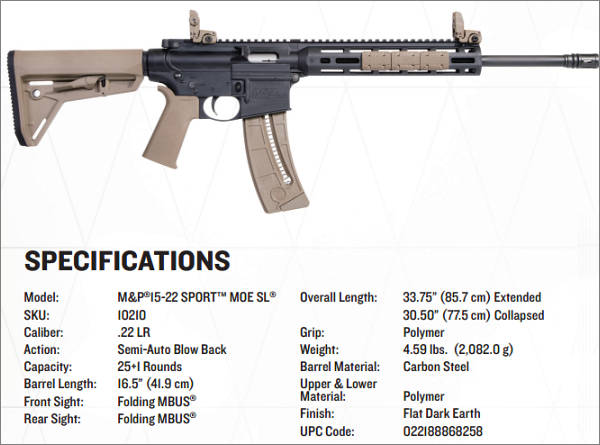
Smith & Wesson offers an upgraded version of its M&P 15-22, a fun rifle that we’ve praised in the past. The enhanced M&P 15-22 Sport MOE SL model (Magpul Original Equipment Slim Line) features a more comfortable handguard, an improved grip, and an adjustable Magpul buttstock. The dedicated .22 LR M&P rifle retains the look and features of the company’s popular M&P rifle line, with the enhanced ergonomics of Magpul furniture. The M&P 15-22 Sport MOE SL model is offered with either Flat Dark Earth (Tan) stock and grips, or with Matte Black components. MSRP is $505.00, with street price around $450.00.
Click Image for full Spec Sheet.
Here is an interesting Long-Term Test of the M&P 15-22 Sport MOE SL:
IMPORTANT: If you are considering buying an M&P 15-22, then definitely watch this video. It explains which types of ammo (CCI, Browning) work well, and which caused issues (Federal bulk). In addition the video explains how best to clean and maintain the rifle.
The M&P 15-22 Sport MOE SL features a high-strength polymer upper and lower receiver. In addition to the standard features of the M&P 15-22 Sport rifle, which include front and rear MBUS folding sights and the M&P Slim M-LOK handguard, the new MOE SL version comes with a Magpul mil-spec carbine stock, SL Grip, and Magpul Type2 M-LOK rail covers. The M&P 15-22 SPORT MOE SL is available in matte black or flat dark earth finishes and comes with a 25-round .22 LR magazine.
S&W 15-22 MOE SL Notable New Features:
— Adjustable stock with improved sloped comb profile.
— Shielded ambidextrous release lever prevents snagging and accidental adjustment.
— Push button QD socket and sling loops.
— Grip is slimmer with more vertical grip angle and Beavertail backstrap.
— Heavily textured grip contact surface.




 The National Rifle Association’s President’s Match was instituted in 1878, as the American Military Rifle Championship Match. In 1884, the name was changed to the President’s Match for the Military Rifle Championship of the United States. It was fired at Creedmoor, New York until 1891. In 1895, it was reintroduced at Sea Girt, New Jersey. Today, the match is held at Camp Perry, Ohio.


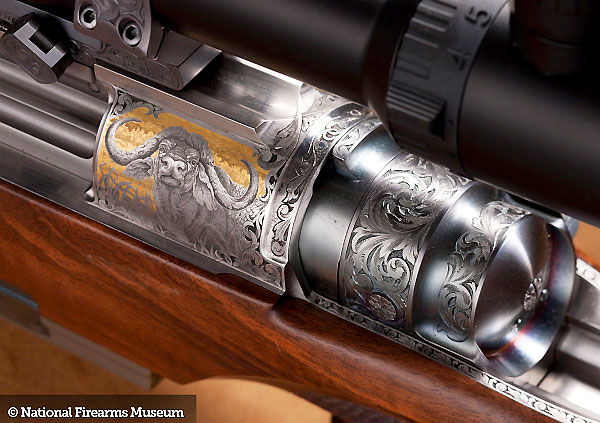
 This amazing twin-barreled bolt-gun has a unique closing mechanism that locks two separate bolt bodies into the chambers of the right and left barrels. Yes there are two firing pins, two ejectors, two extractors, and two triggers. We’re not sure how one jumbo camming system closes two bolts — Perhaps one of our gunsmith readers can explain how this system works.


 Hydro-Forming Procedure Step-by-Step:
 Special Shell-Holder
 Never had a chance to hunt prairie dogs in the American west? Then check out this video. Dan Eigen, host of the


 This video, produced for the folks at