You know that Zeiss riflescopes boast superb glass, excellent controls, and a rock-solid warranty. What you may not realize is how rugged Zeiss scopes are. Zeiss optics are designed for the toughest conditions that hunters may experience. Zeiss understands that hunting optics can be exposed to extreme temperatures, moisture, shock, and vibration.
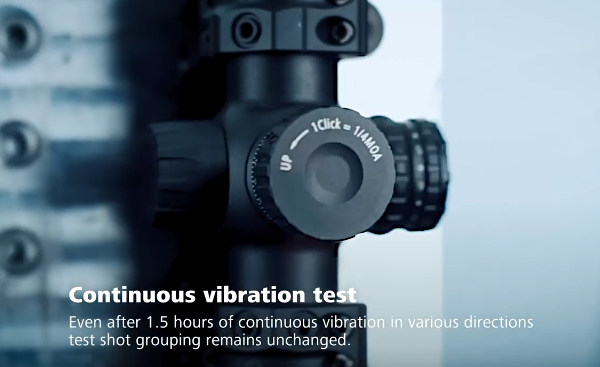
To ensure Zeiss scopes perform in the toughest conditions, Zeiss tests production-line optics with rigorous testing procedures unrivaled in the optics industry. Zeiss runs Impact Shock Tests with 800 impact cycles at high G-forces. In addition, Zeiss does a continuous vibration test for 1.5 hours. Scopes are also tested in a salt spray environment to confirm corrosion resistance. But there is more — test optics are immersed in water for two HOURS at depth and the scopes are also lab-tested at -40° F in a climate chamber and also subjected to “temperature shocks” from -13° to +122° F. Now that’s some serious testing.
Zeiss does all this elaborate scope testing to ensure its optics perform in all situations, in all environments. View all these tests in this Zeiss video. We think you’ll be VERY impressed:
Impact Shock Test — 800 Cycles
Continuous Vibration Test — 1.5 hours
Water Immersion Test — Validated Waterproof for 2 hours at 13 feet
Temperature Testing — Extreme Temp Shock Test and Sub-Zero Freeze Chamber
Corrosion Resistance Test — 24 Hours in Salt Spray Environment
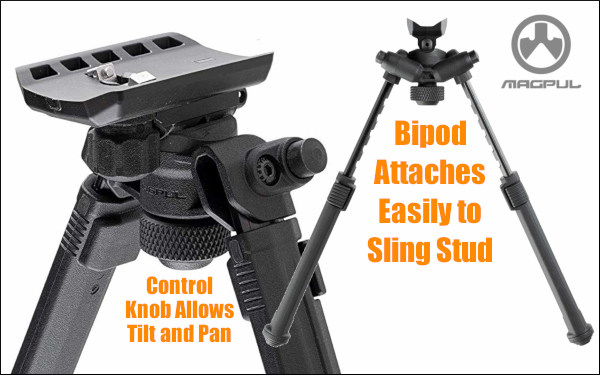
Are you looking for a stable bipod that attaches quickly and easily to the sling stud on your hunting or varmint rifle? Magpul has a new bipod that fits standard hunting-style, radiused fore-ends well. This new Magpul Sling Stud QD Bipod clamps to a sling stud in seconds. Watch the video to see how it works.
Priced around $110.00 on Amazon, this new Magpul is more expensive than a Harris-type bipod, but it has some advantages. There are no exposed springs to grab your hand. The vertical leg adjustment is quick and easy. There is a large knob in the center that allows you to traverse (pan) left to right, while keeping the feet in position. In addition, by loosening the knob you can tilt the rifle up to 25° from vertical either side (i.e. rotate the rifle around the bore axis). For this kind of rotational adjustment, a Harris swivel with a Pod-Loc is faster and easier, but the Magpul isn’t bad.
The legs consist of anodized 6061 T-6 aluminum shafts inside injection-molded, reinforced polymer columns. The legs stow neatly forward and lock into place with one hand. You can adjust leg height from 6.6″ to 10.0″ using push-button locking detents. Should users choose to change feet, the Magpul bipod’s legs accept most Atlas-pattern bipod replaceable feet.
Magpul Sling Stud QD Bipod Features:
• Rapid, self-locating mounting system attaches to Sling Studs on narrow or wide fore-ends.
• Up to 25 degrees of tilt either way around the bore axis of weapon (50 degrees total).
• Uncle Mike’s-style sling stud on rear of mounting body.
• Efficient individual leg height adjustability in 0.5″ increments for a total of seven positions.
• Adjustable friction knob for setting tilt and ease of movement.
• Removable rubberized feet compatible with Atlas pattern replaceable feet.
With days growing shorter and winter on its way — here is a great audio “infotainment” resource to help fill those long winter nights. Leupold now offers podcasts, 40-75 minutes in length, on a variety of topics of interest to hunters and precision shooters. A podcast is like a radio show that is available 24/7, at your convenience. When you want to “tune in”, via your home computer or mobile devices, just visit the Leupold Podcast Page.
One of the newest gun-oriented podcasts comes from optics-maker Leupold & Stevens (“Leupold). Oregon-based Leupold recently launched its “Core Insider” podcast series. These podcasts will deliver optics info, industry intel, tech tips, hunting advice, and tactical training guidance. Leupold’s Core Insider podcasts stream via iTunes and Spotify, and can also be accessed directly from Leupold.com. From the Leupold Podcast Home Page, you can either stream the podcasts live or download for later listening.
Premiering at SHOT Show 2018, the Leupold Core Insider Podcasts cover a wide variety of shooting and hunting topics. One early episode features Leupold team members Kyle Lamb and Buck Doyle discussing long-range shooting, while recent Episode 55 explains how Binoculars and Rangefinders function. There are now 56 Leupold Podcasts available online for FREE.
Episode 55, How Binoculars and Rangefinders Work. Click to launch Leupold Ep. 55 Podcast Page:
Among the regular Core Insider Podcast hosts is Leupold’s president and CEO, Bruce Pettet. “Our consumers are some of the most dedicated hunters and shooters in this industry – just like so many Leupold team members, both here in Oregon and across the nation,” Pettet said. “We want to reach out to our audience directly and deliver the kind of content they’ve been asking for…”
There are fifty-six (56) current Leupold Core Insider Podcasts. If you can’t access all 56 from the Leupold website, try the Apple Podcasts Page. Here are ten of our favorite episodes. Click links below to access:
You may want to tune in to Shooting USA tonight. There are three interesting topics covered in the one-hour cable TV broadcast. Hornady’s A-Tip Bullets are featured in a product spotlight. Next the ultimate speed-shooting contest, the USPSA Steel Challenge, is covered. And for the tactical/PRS crowd, Shooting USA interviews Tom Fuller of Armageddon Gear. The hour-long Shooting USA show runs on the Outdoor Channel Wednesday nights at 9:00 PM Eastern and Pacific time, 8:00 PM Central time.
1. Hornady A-Tip Bullets — Worth the Very High Price?
This week Shooting USA reviews Hornady’s new A-Tip bullets. These A-Tips generated a lot of buzz because of their high price and unusual packaging. These expensive ($75-$85/box) aluminum-tipped projectiles have very consistent bullet BCs according to Hornady. They are sold in sequential order for consistency, and shipped in clear plastic egg-crate style packaging to protect the tips. The jury is still out on these bullets, as we haven’t seen them used much in competition outside the PRS realm. But if you are curious, check out this report.
2. Steel Challenge — Fun and Fast Steel Plate Competitions
For fans of steel shooting, Shooting USA will cover the famous Steel Challenge, a speed shooting competition with eight standardized steel plate stages. It’s all about speed — the top guns can nail all five targets in under three seconds. Run by the Steel Challenge Shooting Association (SCSA) a division of the USPSA, the Steel Challenge is fast and exciting. Regional matches are held at affiliated clubs through the USA, with a large annual World Speed Shooting Championships (WSSC) that attracts competitors from around the world. In 2018 and 2019 the WSSC was held in Talladega, Alabama. LEARN MORE HERE
3. Armaggedon Gear — Tactical Accessories
Finally, this week’s Shooting USA episode visits Armageddon Gear in Georgia. This company, founded by former U.S. Army Ranger Tom Fuller, sells support bags, gun cases, slings, suppressor covers, scope covers, and a wide variety of other accessories popular with the PRS/NRL crowd. With a 22-year Military career behind him, Tom Fuller is creating and selling what he knows, shooting gear. Fuller’s company is an American success story, as Armageddon Gear now provides products to the U.S. Military, Law Enforcement, as well as PRS/NRL competitors.
If you are looking for a compact carry pistol, consider the Smith & Wesson 9mm M&P Shield. This is a comfortable, well-built gun with a better trigger (in our opinion) than a Glock. S&W products display excellent machining and good fit and finish. Moreover S&W offers a rock-solid warranty. To add extra incentive, Smith and Wesson is now offering a $50 Cash-Back Rebate for purchases of the 9mm M&P Shield through 12/8/2019. This offer also applies to the .380 ACP Shield EZ.
Smith & Wesson 9mm Shield Pistol Evaluations
Is the 9mm M&P Shield 2.0 a good pistol? Here are three helpful video reviews. We think this little pistol offers a very good combination of reliability, concealability, and affordability.
S&W 9mm M&P Shield 1000-Round Review
Jerry Miculek and Julie Golob Demo the Smith & Wesson Shield
Politicians need to justify their existence. That means they are constantly writing new laws, even when none are needed. For example, in California, corrupt Democratic Gov. Newsom signed 15 new gun laws last month, none of which will actually do much to cut crime (but these statutes will create problems for law-abiding gun owners). With each passing year, it gets more difficult to comply with all the new gun laws. With legal requirements constantly in flux, it can be difficult for gun owners to keep track of their responsibilities under state and federal law. Thankfully, USLawshield.com has prepared summaries of recent federal and state legislation.
In addition, U.S. Law Shield has created a series of videos that spotlight important legal issues (and situational challenges) gun owners can face. Here are five Law Shield videos covering important legal matters for firearms owners.
Five Important Videos That Can Keep You Out of Jail
Every day innocent legal gun owners are questioned by police in public. Understand the three types of contact you might have with police, what your rights are during the contacts, and if you have to tell the officers you are carrying a firearm.
Do you plan to travel through multiple states with firearms in your vehicle? Federal AND state laws are involved. You should check the regulations of ALL the states (and big cities) you will be visiting along the way. There are definitely some areas to avoid (such as New Jersey and New York City).
Gun owners can find themselves in trouble with the police for a variety of reasons. You need to know what to do after a self-defense use of firearms. You also need to know how to comply with regulations on carry, storage, and transport of firearms.
Laws governing gift transfers of firearms vary from state to state. Before giving a gun, even to a close family member, you should check the statutes in your jurisdiction. If you have any doubts, it may be better to give a pre-paid gunshop gift card, rather than the firearm itself.
Your firearm was just stolen. What are your next moves? Most people aren’t taking the right steps in this situation. Law Shield Attorney Richard Hayes helps you avoid three common mistakes gun owners when guns have been stolen.
In this NSSF Video, Ryan Cleckner, a former Sniper Instructor for the 1st Ranger Battalion, explains how to gather and organize D.O.P.E. (Data On Previous Engagements) and how to organize this information to make it readily available in the field. As the term is used by Cleckner, D.O.P.E. includes observed bullet drop information at various distances, as well as the effects of wind, temperature changes, humidity and other environmental variables.
If you know your muzzle velocity, and bullet BC, a modern Ballistics App should be able to calculate bullet drop with great precision at distances from 100-1000 yards — often within a couple 1/4-MOA clicks. However, because a bullet’s BC is actually dynamic (changing with speed), and because ballistics solvers can’t perfectly account for all variables, it’s useful to collect actual, verified bullet drop data.
It’s smart to start with ballistics data from a solver app, but, as Cleckner explains: “Odds are, you’re going to have to fine-tune that data to your gun and your system. Every scope and every rifle and every bullet [type] act differently. Your scope may not track the same from rifle to rifle, so it’s important you get the data that’s unique to you.” Cleckner also explains that the ballistic data supplied with some factory ammo may only give you a crude approximation of how that ammo will actually shoot through your gun.
Keeping Your Drop Data with the Rifle
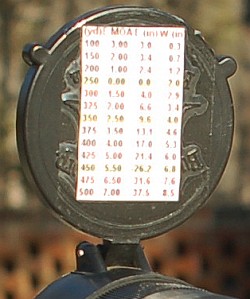
Cleckner also offers some good advice on how to record D.O.P.E. on simple index cards, and how to keep your ballistics data with your rifle. This can be done with a laminated drop chart or data transferred to a scope cover (photo right). CLICK HERE, to learn more about creating handy field data cards.
At the 4:15 mark on the video, Cleckner shows a calibrated tape he has fitted around the turret of his riflescope. The tape shows distance numbers (e.g. “4” for 400 yards, “5” for 500 yards etc.) that correspond with the number of clicks (rotation) required to be zeroed at that particular distance. With that system, you simply “dial your distance” and your point of impact should equal your point of aim. It takes some skill (and the right software) to create these tapes, but the concept is great.
Today is October 31st, Halloween (originally “All Hallows Eve”). That means it’s pumpkin time. Just how much fun can you have with pumpkins? Watch these two videos and find out. In the first video, the RatedRR team sends a few orange gourds to pumpkin heaven using Det Cord, C4, and binary explosives. The sequence starting at the 2:00 minute mark in the first video is truly amazing. WARNING: DO NOT TRY THIS AT HOME!
Watch Pumpkin Blasting with Explosives
In the next video, a pumpkin carved as a Death Star serves as the target for a .50 caliber rifle (looks like a Barrett M82 .50 BMG). As you may guess, the pumpkin Death Star suffers the same fate as the Hollywood version in Star Wars. NOTE: At the 0:42 mark in the video, a graphic displays “30,000 FPS”. That’s the high-speed camera’s frame-per-second rate, NOT the projectile velocity in feet-per-second.
Watch .50 BMG Rifle vs. Death Star Pumpkin
Warning: These demonstrations were carried out on closed ranges by experienced professionals certified to use explosives. Possession of C4 and Det Cord may be a violation of various Federal, State, and local laws. Detonating cord and C4 are classified as high explosives and are regulated by the BATFE. Don’t even think about trying to repeat these stunts on your own.
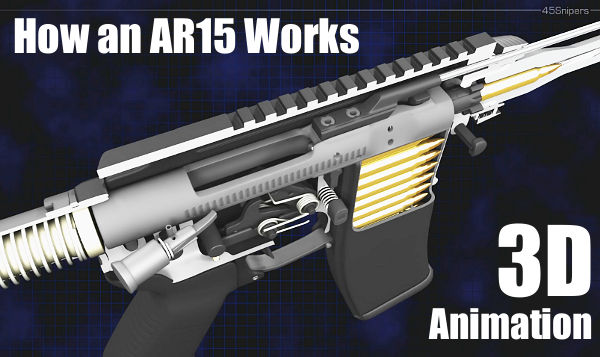
Ever wondered how the parts inside an AR15 work together? Just exactly how does the reciprocating bolt carrier feed rounds from the magazine? How do the elements in the trigger group work and reset after each shot? How does the gas system bleed gas from the barrel and operate the bolt carrier? These and other questions are answered in this eye-opening video from 45Snipers. Using “cutaway” 3D computer animation, this 5-minute video shows all features of an AR15 inside and out. This fascinating firearms animation allows the viewer to look inside the upper and lower receivers, into the bolt carrier, chamber, barrel, and magazine.
This video starts off slow and has annoying background music, but it is well worth watching if you own or shoot any AR-platform rifle. It illustrates all the key operations during the charging, loading, firing, and ejection processes. The cutaway animation shows how rounds are stripped from the magazine and then chambered. It then shows how every part of the trigger group works, and how the firing pin strikes the primer. You can even watch the bullet move down the barrel before the empty shell casing is removed from the chamber and tossed out the ejection port. Here are sample frames from the video:
Video find by Grant Ubl. We welcome reader submissions.
How fast can you shoot a bolt-action rifle? We doubt you can out-pace the ace “Stangskyting” shooters from Scandinavia. Some of these guys can run more than two rounds per second, including mag changes! That’s impressive. Bulletin reader C. Lemmermann from Denmark told us: “In Scandinavia we have this competition called ‘Stangskyting’. It’s similar to the ‘Mad Minute’ but we only have 25 seconds to hit the target [at] 200-300m distance with a 6.5×55 [target rifle].” In the Stangskyting video below a shooter named Børklop puts 16 rounds on target in just 25 seconds. (He starts with a round in the chamber and cycles through three, 5-round magazines).
Børklop’s performance, with just a sling and iron sights, is impressive. He’s shooting a Sauer 200 STR target rifle with 5-round magazine. Note that Børklop manipulates the Sauer’s bolt with his thumb and index finger, while pulling the trigger with his middle finger. As good as Børklop is, some Stangskyting competitors are even better. Roy Arne Syversrud from Oslo, Norway tells us: “The best shooters in Norway can do 21 shots in 25 seconds, changing the mag three times.”
Here’s another Stangskyting video. Check out the speed with which John Olav Ågotnes works that action — simply amazing!
This Guy Could Break the “Mad Minute” Record
Børklop’s rate of fire, 16 rounds in 25 seconds, is the equivalent of 38.4 rounds in 60 seconds. That’s a notable number because the record for the “Mad Minute”, a British Army marksmanship drill, is 38 rounds in one minute. That record was set in 1914 by Sergeant Instructor Alfred Snoxall, and still stands. So as you watch Børklop, keep in mind that Snoxall shot that fast for a full minute with a Lee-Enfield nearly 100 years ago!
Børklop has an average cycling time of 1.56 seconds per shot, starting with a round in the chamber. To beat the record of 38 rounds, he would need to make seven mag changes in sixty seconds. All those mag swaps could reduce his average time per shot, making it difficult to achieve 38 hits in a minute. But, if Børklop could use 10-round mags with his Sauer STR, this guy has the skills to break the record.
To emphasize the capabilities of the WWI-era British shooter who set the record, Snoxall shot as fast as Børklop does, but Snoxall reloaded with stripper clips. Snoxall’s SMLE (Lee-Enfield) rifle also had relatively crude open sights and the stock was far less ergonomic than Børklop’s Sauer STR stock.
Here’s another Stangskyting video showing John Ågotnes shooting rapidfire with his Sauer 200 STR (Scandinavian Target Rifle) chambered in 6.5×55. By our count, Ågotnes manages 17 shots within the 25-second time period. That rate of fire (17 in 25 seconds) equates to 40.8 rounds in one minute!






 Keeping Your Drop Data with the Rifle