Photo by Chevi Guy, for F-Class Shooting for Beginners Facebook Group. He declared: “We made it! Wind is howling 30 mph. Going to be fun.”
The nation’s most talented F-TR and F-Open shooters will be in Raton, New Mexico this week for the 2019 USA F-Class National Championships. The event, held at the Whittington Center, commences September 15th with the Mid-Range Nationals. The Long Range Nationals then run September 19th through 22nd.
The weather could be VERY challenging. There are been very strong winds at Raton recently, and on the range you can get winds from two different directions at the same time. At the F-Class Worlds in 2013, this reporter even saw dust devils spinning in the middle of the course during a team event.
CLICK HERE to watch a Facebook Video filmed yesterday at Raton. Windy enough for you?!
F-TR competitors in Raton at 2013 F-Class World Championships. It’s a beautiful, but challenging location:
The NRA Whittington Center is a very scenic venue with tall mountains behind the 1000-yard targets. You can fly into Denver in the North or Albuquerque in the South, then drive for about 3 hours. There are cabins “on campus” at the Whittington Center. Alternatively, shooters can stay in motels in Raton, about 20 minutes from the range. The location of the range is: 34025 US-64, Raton, NM 87740
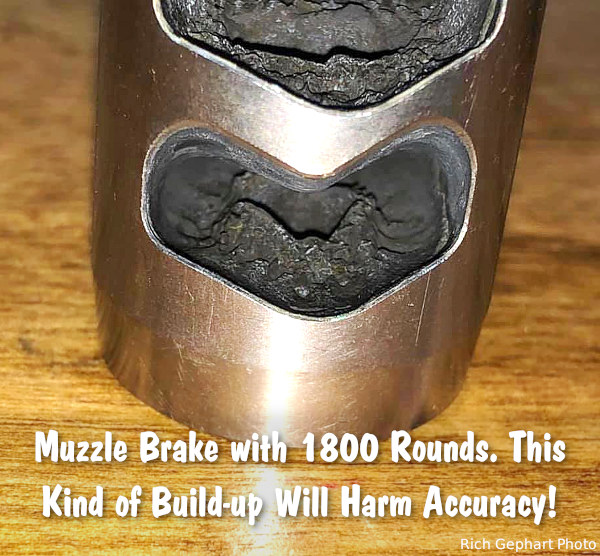
Many hunters and precision rifle competitors use muzzle brakes because these ported devices reduce felt recoil significantly. That make s real difference getting back on target for quick follow-up shots. While many rifle owners appreciate the benefits of muzzle brakes, they may also neglect their brakes, allowing hard carbon and powder residue to build up. Not good. You should regularly clean your muzzle brake to remove fouling and carbon build-up.
As Mark Edgreen posted: “Carbon build up on the crown and in the brake is a recipe for poor accuracy.” And another gunsmith reported that customers complained about guns that “shot out way too early” but they only needed to have the brakes cleaned.
Gunsmith and PRS/NRL competitor Jim See recently reminded his Facebook Fans about the importance of cleaning muzzle brakes: “How many times do I have to say it? You need to maintain your rifles. Clean your muzzle brakes people!”. Jim, who runs Elite Accuracy LLC, notes that hard carbon build-up in brakes can definitely harm accuracy. Look at this example:
Muzzle Brake Cleaning Methods
There are various methods for cleaning a brake, we list a variety of techniques, but we would start with NON-corrosive ultrasound. You’ll want to remove the muzzle device before doing these tasks.
1. Use Ultrasonic Cleaning Machine with cleaning solution. This may be the most efficient method: “I place my brake in the ultrasonic cleaner. Shiney as new.” (Jim Moseley).
2. Spray with commercial Carb Cleaner and brush. Then apply anti-corrosion coating.
3. Soak in half hydrogen peroxide and half vinegar. Suggestion: “Let sit over night and carbon melts off. Brush remaining carbon off, rinse and put the brake back on.” Apply anti-corrosive before mounting.
4. Soak in 50/50 solution of water and white vinegar and brush. (Be sure to apply anti-corrosion coating, such as Eezox, after soaking).
5. Tumble in liquid solution with stainless pins. Comment: “Comes out slightly faded, but perfectly clean on stainless, non-painted brakes though.” Warning — extended tumbling could affect threads of screw-on brakes. Also, tumbling can possibly harm painted or Cerakote finishes.
Gunsmithing Tip: By fitting the muzzle brake so that the barrel crown is slightly forward, it is easier to wipe carbon fouling off the end of the barrel. See photo:
For decades, ShootingUSA has been a leading video resource for the shooting sports and hunting. This popular cable TV show covers shooting matches, and provides expert information on precision shooting, gun maintenance, optics, and defensive firearms use. Here are five interesting videos all worth watching. Learn about wind-reading, gun maintenance, and optics.
1. Reading the Wind — SGT Sherri Jo Gallagher of USAMU
Sergeant Sherri Jo Gallagher of the U.S. Army Marksmanship Unit (USAMU) shows us how to read the wind in given conditions, and how to apply your wind assessment when aiming down-range. During her time with the USAMU, Sherri won the National High Power Championship, and was the first woman in history to earn the U.S. Army “Soldier of the Year” honors. Sherri comes from a legendary family of shooters — she was raised by Ace Marksman Mid Tompkins and mother Nancy Tompkins, the first female to win the NRA National High Power Championship.
2. Field-Stripping and Cleaning AR-Platform Rifles
Let’s face it — Black Rifles run dirty. On AR-platform rifles, the gas system blows carbon and powder residues back into the action and bolt carrier group. Accordingly, you need to clean ARs early and often, and you should fully disassemble the bolt carrier to access parts and recesses which accumulate greasy lube and hard carbon. This helpful video shows how to field-strip and clean AR-platform rifles. If you own an AR, this is definitely worth viewing. With over 1.9 million views, this is the #1 most-watched video on Shooting USA’s YouTube Channel.
2. MOA Defined — Jim Scoutten Explains Minute of Angle
Minute of Angle (MOA) — this is the most common measurement of group size, and hence rifle accuracy. You hear about shooters hoping to shoot 1 MOA or “half-MOA”, but many folks could not give you a precise definition. In fact MOA is an angular measurement that equates to one-sixtieth of one degree of Arc. In this video, host John Scoutten defines MOA. He then demonstrates how MOA translates to accuracy on target. He demonstrates one-half-MOA accuracy with a Les Baer Custom rifle. This company offers a three-shot, half-MOA guarantee for its rifles.
4. How to Adjust for Parallax
Most precision rifle scopes have parallax adjustment, typically a knob on the left side of the scope. but what exactly is “Parallax” and why do you need to adjust optics to ensure the parallax setting is optimal? In this Shooting USA video, John Paul of JP Rifles defines parallax and explains why you need to set parallax correctly for the distance to your target. The video then shows how to adjust parallax correctly, a process which should start with the scope’s ocular focus.
5. How to Mount a Riflescope
When mounting a scope you want to use quality rings, and ensure that the scope is leveled properly. In addition, you need to adjust the fore/aft position of the scope so that eye relief is correct. Ideal scope position may be different when shooting from the bench vs. shooting prone. In this Shooting USA video John Paul of JP Rifles reviews scope mounting basics.
Generation One Vortex Fury HD LRF300 10×42 laser rangefinder binoculars are on sale at a HUGE discount. These once sold for $1199.00. Now, with the introduction of the Gen Two Vortex Fury HD 5000 LRF binocs, the Gen One units are just $799.00 at EuroOptic.com. Save a full $400 with a unit that can range to 1600 yards and has excellent optics. If you need even more ranging capability (not likely for a typical hunt), Vortex’s Gen Two Fury HD 5000 model is available for $1199.00 on Amazon. The choice is up to you. We think most hunters will be more than happy with the $799.00 Gen One unit. The $400 you save can buy a quality scope for your hunting rifle.
The Vortex Fury has some very cool features. It offers angle compensation as well as line-of-site modes. Scan mode gives readings as you pan or track a moving animal. You can set the distance output to yards or meters. All the controls are on the right side so you can operate the Fury HD easily with one hand.
Here are two video reviews of Gen One Vortex Fury Laser RangeFinder (LRF) Binoculars:
Review Summary: This is more an infomercial than a field test, but the video does a very good job showing the features of the Gen One 10×42 Vortex Fury HD LRF300. In addition, the reviewer explains how hunters can best use the Vortex Fury LRF binoculars in the field.
Review Summary: This unboxing video covers the operation and controls of the Gen One Vortex Fury HD LRF300 rangefinding binoculars.
Why Use Rangefinding Binoculars?
With rangefinding binoculars, you can carry one less piece of gear, and a binocular optic is much more effective in the field than the monocular on a typical dedicated laser rangefinder (LRF). The stereo view gives better definition and depth perception, and the larger, binocular lenses give better low-light performance than the smaller-diameter monocular optic found in a conventional LRF.
What anti-corrosion products really fight rust effectively? You’ll hear many opinions, but what do actual field tests reveal? One rifle shooter, who posts on YouTube as BlueonGoldZ, wanted to separate myth (and marketing claims) from reality, so he completed his own long-term rust test using metal samples. First he used ordinary tap water spray, and then he did a second, longer-duration test with a salt-spray solution. Nine different products were tested: Break Free CLP, Corrosion-X, Frog Lube, M-Pro 7, Outers, Pro-Shot Zero Friction, Rem Oil, Slip 2000, and Tetra Gun Triple Action CLP.
BlueonGoldZ initially examined each product for its “beading” properties with a normal tap water spray. But the main test involved many multiple weeks of exposure after a “dense” salt-water spray. (No rust formed after two weeks tap water exposure, so the test was accelerated with salt-water exposure).
The clear winners in the test, as shown by the screen shot above, were Corrosion-X (Best), and Frog-Lube (Second Best). The photo shows the test samples two weeks after being sprayed with salt water. The results are pretty dramatic — you can see with your own eyes what happened. We think this is a very useful bit of real-world research.
Results from Similar Long-Term Salt Exposure Test
Unfortunately, BlueonGoldZ’s test did NOT include Eezox, which we have found to be extremely effective (on a par with Corrosion-X). In another long-term test of corrosion preventatives, the two best rust fighters were Eezox and Corrosion-X in that order. Since that test was completed, Corrosion-X, already an excellent product, has been enhanced. CLICK HERE for Long-Term Salt Exposure Test Report.
This week’s Shooting USA episode has two great features. Part One covers the USPSA Multi-Gun Nationals, a 3-gun match with fast action. A lengthy second sequence covers new guns and gear at the 2019 NRA Convention in Indianapolis, Indiana. This Shooting USA Episode airs Wednesday August 28, 2019 on the Outdoor Channel, at 9:00 PM Eastern and Pacific, 8:00 pm Central.
USPSA Multi-Gun Nationals
If you are a fan of 3-Gun competition, tune in to Shooting USA this week. The latest episode features the 2019 USPSA Multi-Gun Nationals held in Florida. You can see many of the nation’s top 3-Gun shooters attacking some very challenging stages with pistols, rifles, and shotguns.
Multi-gun competition has evolved considerably since it started 30 years ago. The firearms are more sophisticated, the optics are better, and the stage times are much faster. Still, the challenge remains the same: How fast can you shoot multiple targets, with the score determined by speed and accuracy? For the best in the sport, the answer is very fast indeed…
New Products for 2019 — Guns, Optics, Electronics and More
Shooting USA was in Indianapolis for the 2019 NRA Annual Meetings and Exhibits. At the big event, Shooting USA’s teams found some interesting new products, such as Hornady’s pricey new A-Tip bullets ($80 to $90 per 100), and new handguns from Colt, Smith & Wesson, and Volquartsen. Hornady also displayed a new Kestrel 5700 Meter with advanced 4DOF Ballistic Solver.
What’s it feel like to hit a 2158-yard target (from cold bore), and set a world record in the process? Well watch the video below to find out. Last week we reported that shooter Randy Wise set a new ELR Central world record, going three-for-three (from cold bore) at 2158 yards. The feat took place at the recent NRA ELR Championship at Camp Atterbury, Indiana. And he did that with a factory Savage action and barrel!
We first reported on Randy’s ELR record last week in the Bulletin. Now we have more photos, and most importantly, a video. You can now watch Randy Wise make his three hits in a row, starting with Cold Bore shot, at 2158 yards. The video was captured by Clay Rhoden of TargetVision/Longshot Target Cameras.
Watch Randy Wise Make ELR World-Record Three Straight Hits at 2158 Yards:
Watch the full sequence above (sorry there is no sound). Note that there were previously some hit marks on the 36″ x 36″ steel target. Ignore those. Steve’s first hit is at the bottom right — barely above the edge of the plate. At 0:42 you see the bright light flash indicating a hit. The second shot impacts in the top right — see the light flash at 1:09. The third and final hit impacts about 6″ up from the bottom, at 1:24. When the flashing light confirms Hit #3, Randy shows his emotion, pumping his fists with excitement.
Remarkably, Randy set the new ELR record using a stock Savage action and Savage factory barrel chambered for the .338 Lapua Magnum cartridge. The Savage barreled action was mounted in an Accurate Rifles Systems chassis with Rempel bipod. Randy’s rifle had a factory stock 26″ 1:9″-twist barrel chambered in .338 Lapua Magnum. His load featured Lapua .338 LM brass, Berger 300gr Hybrid bullets, Federal 215M primers, and a stout charge of Hodgdon Retumbo powder. Ballistics solution by Applied Ballistics LLC. For optics, Randy used a Vortex 15-60x52mm Golden Eagle.
ELR World Record Standards
One video viewer asked why this was a world record, when longer shots have been made in K02M competition. Here’s the answer from Applied Ballistics: “To be an ELR World Record it has to be done cold bore, and three for three. No sighters, no practice, no walking the shots on, no accuracy by volume. Also neither the shooter or rifle can have been fired in the past 24 hours, to ensure it’s truly cold bore. It’s a test of skill and knowledge of your system.” Skill indeed. 2158 Yards is 1.226 MILES. At that distance, Randy shot a group measuring roughly 1.3 MOA vertical and half-minute horizontal.
For his efforts, Randy received glory, and a nice $1000-dollar check from McMillan Fiberglass stocks. Here Randy poses with his check, flanked by Bryan Litz (left) and Kelly McMillan (right). The match was officiated by Clay Rhoden. Doc Beech of Applied Ballistics was the certifying official.
Team USA members Ashley Rheuark, Lanny Barnes, Lena Miculek, and Becky Yackley (L to R).
You go girls! Four American lady shooters crushed the competition at the recent 2019 IPSC Rifle World Shooting Championship held in Sweden. This was a major international event, with 669 shooters from 37 countries competing for six days at the Villingsberg Shooting Range in Karlskoga, Sweden.
Shooting Sports USA reports: “The IPSC Rifle World Shoot is … the Super Bowl or World Series for serious action rifle shooters around the world. The International Practical Shooting Confederation (IPSC), the sanctioning body for the match was established to promote and advance the sport of practical shooting worldwide.” This match involved 30 varied, challenging stages in the Villingsberg range (Villingsbergs skjutfält) a facility of the Swedish Armed Forces.
Four American ladies finished 1-2-3-4 in individual standings, showing complete dominance by USA women competitors. Ashley Rheuark topped the field to take the Gold Medal. Lena Miculek finished second to take Silver, and Lanny Barnes was third with Bronze. And American Dakota Overland finished fourth, just 5 points behind Barnes. In winning the women’s division, Rheuark shot superbly, finishing with a score of 1883.7501, over 30 points ahead of Miculek.
The American ladies also excelled in Team competition. Team USA’s Becky Yackley joined Rhueark, Miculek, and Barnes to capture the Gold Medal in the Women’s Semi-Auto Open Division. In addition, Lena Miculek won the Women’s Division Shoot-Off. Notably, Lena’s Shoot-Off performance was broadcast on Swedish National Television. Lena wasn’t the only winning Miculek — her father Jerry Miculek took top honors in the Super Senior Class.
The Semi-Auto Open division had the largest match participation with 531 registered competitors. Finland’s Jarkko Laukia won the Open division with Finnish team-mate Raine Peltokoski finishing second. Third place was taken by Vadim Mikhailov from Russia. CLICK HERE for full men’s and women’s match results.
Watch Match Highlights on Gunroom.TV
You can watch nine videos from the 2019 IPSC World Rifle Championships on the Gunroom.TV website. We suggest you watch the Day 5 Video and Day 6 Video. These interesting video from the last two days of the competition show many of the stages, which are quite different than typical American multi-gun shooting bays. The setting is green and lush.
Our friend Gavin of UltimateReloader.com has a new tool — the second generation Lyman Borecam. This upgraded version features higher-resolution 300K output so you can better see details inside your barrel. This digital borescope can also be used to inspect the interior of dies and other tools. Illumination, via LED, is adjustable. Record still images with the push of a button. The screen resolution for the latest Lyman Borecam is now 640×480, roughly 300,000 pixels (300K).
Gavin created a very thorough 15-minute video putting the Lyman Borecam through its paces. He uses it to scope a number of firearm barrels as well as some reloading dies. If you are considering buying a Borecam or other borescoping device, you should definitely watch this video. We have included time references to make it easier to “fast forward” to the subjects you want to see:
Lyman Borecam Video Timeline
1. 1:15 — Lyman Borecam Unboxing (All Components)
2. 4:00 — Shilen Match Barrel Blank Inspection (Brand New Barrel)
3. 6:16 — Thompson Center Compass .223 Rem Barrel Inspection (Used Barrel)
4. 9:08 — Smith & Wesson 686 .357 Mag Barrel Inspection (Used Barrel)
5. 10:30 — Glock 20 Polygonal Rifling Barrel Inspectino (Used Barrel)
6. 11:45 — M1911 Barrel Inspection (Defective Barrel with Bulge in Chamber)
7. 13:12 — Sizing Die Internal Inspections (Lee .223 Rem, Redding 300 BLK)
The Lyman Borecam comes complete with everything you need. Shown in photo are:
1. Borecam Wand (includes handle, rod, mirror, and digital lens/camera) with length indication scale. An inch scale runs the full length of the rod. That tells you where the lens is positioned inside the bore. Note the wand scale marks when recording screen captures. 2. Borecam Digital Display. The 600×480 display can record stills with included 128MB SD Card. A USB SD Card adapter is included. 3. Borecam Mirror Protector and cleaning kit. 4. AC Power Adapter (not shown, international plug adapters included).
UltimateReloader offers Three Key Tips for the Lyman Borecam:
— First, before you start, make sure the mirror is clear and free of dirt, lint, or solvents.
— Use the Up and Down Arrows to adjust the illumination to suit your barrel.
— Experiment with how close you hold the mirror to the bore wall. This affects both brightness and focus.
YouTube Viewer Comments on UltimateReloader Lyman Borecam Video:
“Great review, Gavin. Your video capture of the display looks better than what they show in Lyman’s own product video.”
“Price is getting low enough to think I need one on the short ‘To Buy’ list. Have some milsurp rifles with horrid bores that should be very interesting to view. Don’t waste $$ on those $20 things on Amazon, I did and thoroughly wasted my money.”
RCBS has introduced a new series of MatchMaster Competition Dies. These are available in Full-Length Sizing, Neck Sizing, and Seating configurations. These new MatchMaster dies are notable for four features:
1. The Competition Seating Die has a “view-port” for the bullet.
2. The Competition Seating Die features a free-floating, self-centering bullet-seating stem.
3. Expanders are titanium-nitride coated for reduced friction. Both the Neck-Sizing and FL-Sizing dies come with TiN expanders for smoother case extraction and reduced brass build-up on the expander.
4. RCBS is offering its own precision-machined Neck Bushings.
No More Mashed Fingers When Seating Bullets
RCBS notes: “Reloaders will love that they can end smashed fingers and misaligned bullets with the specially-designed bullet window [on the Seating Die]. And users can fine-tune any load … with the micrometer-adjustable, free-floating, self-centering bullet seating stem.”
RCBS Product Manager Will Hemeyer explained that the new Competition Seater is a game-changer. “What sets the MatchMaster Seating Die apart from the competition is a bullet-seating window with bullet-retaining system. Simply place the bullet in the window and raise the case into the die to seat the bullet. Couple this with a micrometer-adjustable, free-floating, self-centering bullet-seating stem and the MatchMaster Seating Die is easily the most accurate bullet seating die on the market.”
Why Use Expander with Bushing Dies?
Some viewers of Gavin’s video asked if an expander is superfluous when using neck-bushing dies. The answer is “it depends”. The bushings reduce neck diameter from the OUTSIDE. The expander should make the INSIDE of the neck perfectly round. Some hand-loaders prefer to take the necks down a couple thousandths below final loading diameter, then finish the job with an expander. That ensures the INSIDE of the case neck is perfectly concentric. This can be particularly useful for brass that has somewhat inconsistent neck-wall thickness. Bottom line, you can run these dies without expanders if you want, but that option is available. The expander is also removable so the assembly can be used for de-capping only.
MactchMaster Neck-Sizing Only Die
The MatchMaster Neck Sizing Die Set also uses RCBS neck bushings to control neck tension while not changing the body dimensions of fired cases. Frankly we strongly recommend that you full-length size your rifle rounds, but we acknowledge that some hand-loaders prefer to neck size for some applications. The MatchMaster Neck Sizing Dies do include a titanium-nitride coated expander, just like the FL-sizing MatchMaster dies.