We’ve done some bullet casting in the past, both for handgun bullets, and the large, heavy (400gr+) projectiles used with Black Powder Cartridge Rifles. We can say, unequivocally, that newbies should seek out the assistance of a skilled, experienced mentor, who is familiar with the important safety procedures that must be employed. Working with molten lead can be dangerous. And it also takes some skill to get good results (without visible casting flaws), particularly with very large bullets.
That said, there are valuable resources that can help you get started with the casting process. Wolfe Publishing offers two DVDs that cover the bullet casting process from start to finish. Bullet Casting 101 takes you through the basics: showing you how to choose the correct alloy for your application, prep molds, maintain the optimal temperatures, and lube and size bullets. The important steps are laid out clearly. In addition, Bullet Casting 101 helps you select the right equipment and preferred molds for your particular application. (To create uniform rifle bullets that shoot accurately, you really do need high-quality molds.)
Wolfe Publishing offers a companion DVD, Casting Premium Bullets for Handguns, that covers more advanced techniques for high-volume pistol bullet production. This DVD covers both single-cavity molds and multiple-cavity “gang” molds. (Gang molds can be frustrating at first; it is harder to maintain perfect temp control and mold separation is more complex). The DVD also reveals the sources of most common casting flaws, and explains how to detect cracks, voids and other problems.
You’ll save considerable time and effort if you really understand how to avoid common mistakes before you start pouring lead. And you’ll get the best results if you learn how to “blend” the optimal alloy for the job. Maintaining the right mold temperature is also critical for good results. These topics and more are covered in these two DVDs, priced at $16.99 each from Sinclair International.
Ruger has just introduced a new compact version of its Ruger American Pistol. We predict the new American Compact will become popular with CCW-holders. With a 3.55″ barrel, and 6.65″ length, Ruger’s new 9mm carry gun is similar in size to a S&W M&P9C, and slightly smaller than a Glock 19. At 28.7 ounces, the new Ruger Compact is heavier than the M&P9C (21.7 oz.), and the Glock 19 (23.6 oz.), but the Ruger is the slimmest of the three, with a slide width of just 1.05 inches.
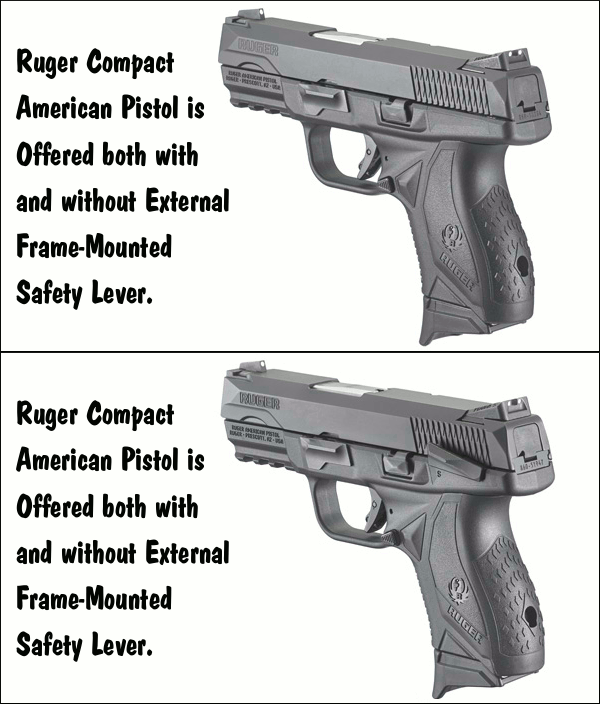
We’re pleased to see the American Compact is offered either with or without an external frame-mounted safety, to suit the buyer’s preference. Also, the gun offers easy take-down with no trigger pull required (by contrast, you have to pull the trigger to take-down a Glock).
Ruger’s new Compact American Pistol is offered either with 10+1 capacity*, or 17+1 capacity. The 17+1 version employs magazines from the full-size Ruger American pistol, with a sleeve or “boot” to fit the shorter grip. With either type of magazine, the gun has proven 100% reliable, according to writer Rich Grassi, who tested the new pistol for The Shooting Wire.
The grip ergonomics on the Compact American Pistol could be described as “Walther-esque”. Rich Grassi says that’s a good thing — this little pistol is comfortable in the hand: “You also don’t pinch a finger when inserting a magazine – either magazine – into the American Compact. Like the service-size gun, three grip modules (back strap with palm swells) are included. The gun has the Novak Low Profile carry sights with the ‘3-dot’ pattern thereon.” Grassi said his test pistol shot low with a standard sight picture, but otherwise the accuracy was good.
NRA testers say the new Compact Ruger American Pistol is extremely reliable and very accurate.
Ruger says this pistol “combines a recoil-reducing barrel cam… with a low-mass slide, low center of gravity and a low-bore axis to provide better balance, less felt recoil, and less muzzle flip[.]” The Ruger Compact American Pistol also features a pre-tensioned striker system, which allows for a short-take-up trigger with positive reset. Like its bigger brother, the Compact American Pistol features a modular wrap-around grip system that fits a wide range of hand sizes.
*Some early reviews have stated the “standard” capacity as 12+1. However Ruger’s website and the official Spec Sheet lists 10+1.
The third annual Pyramyd Air Cup attracted nearly 100 amateur and professional shooters from around the nation, making it the best-attended AAFTA Grand Prix Field Target event in the USA this year. Hosted September 9-11 at the Tusco Rifle Club in New Philadelphia, Ohio, the Pyramyd Cup featured multiple airgun shooting disciplines including Field Target, the rapid-fire GunSlynger benchrest event, and the PayDay Challenge. Watch this video to see all the events:
Reigning AAFTA National Champion Ken Hughes stated: “What a weekend! The Field Target courses were challenging, and the wild, rapid-fire style of the Gunslynger event was difficult in its own right. It was great getting to meet new airgun buddies and check out the new gear from the many vendors in attendance. I really enjoyed the PA Cup!”
Field Target Discipline Is Challenging
“Field Target is one of the most difficult shooting disciplines out there,” says Pyramyd Air Cup Match Director, Tyler Patner. “Combine the multiple skills required to rise to the top of your game, with the myriad of factors you take into account at each lane, and you’ve got a challenging sport.”
“Targets are small, metal silhouettes of animals that consist of a kill zone and a colored paddle,” explains Patner. “Placed at unknown distances from between 10 yards to as far as 55 yards, the targets have kill-zones ranging in size from 3/8 inch to 1 1/2 inches. When the pellet passes through the kill zone and hits the paddle, the target falls and you’re awarded a point. It’s a game of precision and practice. You range-find with your scope, dope for distance, take the wind into account, and then you have to execute. There are different restrictions based upon your selected class, but the challenges remain the same. Wind-doping, range-finding, and remaining mentally tough over the entire course of fire are the biggest hurdles competitors face.”
Huge Prize Table for Competitors
Competition prizes were donated by many airgun and optics manufacturers including: AirForce Airguns, Air Arms, Beeman, Crosman, Birchwood Casey, Diana, Feinwerkbau, H&N, Hawke Sport Optics, JSB, Leapers, Plano, Predator, Umarex, UTG, and Walther. “You’d be hard-pressed to find an airgun competition with a better selection of prizes for its winners,” says says Pyramyd Air CEO, Joshua Ungier. “Our winner’s packages help assure shooters that if they’re limited to traveling to only one competitive shooting event, they recognize the Pyramyd Air Cup as the industry’s premier event.”
Most bolt-action rifle shooters work the bolt with their trigger-pulling hand. This is because most rifles sold to right-handed shooters come with right-side bolts, while “lefty” rifles come with left-side bolts. This “standard” configuration requires the shooter to take his dominant, trigger-pulling hand off the stock to cycle the bolt, then re-position his hand on the stock, and “re-claim” the trigger. Often the shooter must lift or move his head to work the bolt, and that also requires him to re-establish his cheek weld after each and every shot. Not good.
This really doesn’t make much sense for precision shooting with fore-end support*. There is a better way. If you leave your trigger hand in position and work the bolt (and feed rounds) with the opposite hand, then you don’t need to shift grip and head position with each shot. All this requires is a weakside-placed bolt, i.e. a left bolt for a right-handed shooter or a right bolt for a left-handed shooter. The video below shows a “Lefty” working a right bolt. Note how efficient this is:
As our friend Boyd Allen explains: “If you think about it, if you are going to work with a factory action where your options are left bolt and left port or right bolt and right port, and you are building a rifle that will only be shot from a rest, using the left/left for a RH shooter or using a right/right for a LH shooter works better than the conventional configuration”.
Shoot Like a Champ and Work the Bolt with Your Weakside Hand
Derek Rodgers, the only person to have won BOTH F-Open and F-TR National Championships, runs this kind of “opposite” bolt set-up, shooting right-handed with a left bolt. Though Derek is a right-hander, he shoots with a Left Bolt/Left Port (LBLP) action. He shoots with his right hand on grip, while manipulating the bolt (and feeding rounds) with his non-trigger-pulling hand. He pulls the trigger with his right index finger, while working the left-side bolt with his left (weakside) hand. This allows him to stay in position, and maintain his cheekweld.
2013 National Championship-Winning Derek Rodgers Left Bolt/Left Port Rifle.
*For true standing, off-hand shooting (whether in competition or on a hunt), a conventional strongside bolt placement makes sense, since the non-dominant arm must support the front of the rifle all the time. When shooting from bipod or rest, it’s a different story.
You have to love Texas. While in other states (such as California) gun rights are under attack, in Texas, gun ownership is cherished and even celebrated…
Proof is the Texas Firearm Festival (TXFF), a celebration of shooting where you can “try and buy” the latest guns and gear. This isn’t your run-of-the-mill gun show. At the Texas Firearms Festival, the biggest “hands on” firearm exhibition in North America, you can “test drive” dozens of new firearms from top manufacturers including: FN, Sig Sauer, STI, Walther Arms, Remington, Taurus, Blaser, Henry Repeating Arms, Bergara, Benelli, Wilson Combat and more.
The TXFF takes place October 14-16 at the Best of the West Shooting Range in Liberty Hill, Texas, just outside Austin. The Third Annual Texas Firearms Festival is a two-day event where firearms enthusiasts can try and buy guns and gear from leading manufacturers. Saturday and Sunday ammo is all free! And with some of Austin’s best food trucks and exhibits, the festival is great for the whole family.
Here are video highlights from last year’s Texas Firearms Festival (loud volume):
Retail Village Showcasing the Best in Ammo and Accessories.
Full Auto Friday on Friday, October 14th for VIP Ticket Holders.
Ammunition Provided to Ticket Holders.
Ticket Options and Prices
The Festival isn’t free — but the price is more than reasonable considering the hours of fun you can have. A one-day pass, which includes the cost of ammo, is $79.00. A weekend pass for two full days of shooting is $119.00 (ammo included). There is also a $275.00 VIP Package which includes Full Auto Friday. And non-shooter tickets are available for $25.00. Purchase tickets at TexasGunFest.com/ticket.
Festival Location and Directions
The Festival will be held at the Best of the West Shooting Range in Liberty Hill, Texas. The address is 19500 W. SH 29, Liberty Hill, TX 78642. For driving directions, use this interactive Google map:
Today, September 24th, is National Hunting and Fishing Day. To help mark that event, we’re reprising a story from Europe that showcases the beauty of nature that can be experienced on a hunting trip.
If you need a break from your hum-drum day at the office, how about taking a virtual vacation to Norway, where you can explore the scenic mountains in the Fjord region?
Forum member Kenneth Skorpen (aka “Sal”) has created a cool video of a deer-hunting trip he took in Norway. He didn’t bag a buck on this trip, but the walk in the Fjordland mountains took Kenneth through some spectacular scenery. (At the 11:25 time mark you’ll see an amazing sunset over the Fjord.) Kenneth did encounter a doe that had fallen down the mountain, and apparently broken its neck (14:35 time mark). The terrain is very steep, and Kenneth observed that: “I feel fortunate to be able to do this, but I also feel very tired in my legs. Did you know that the hares around here have shorter left legs due to the steep hills?”
More Hunting/Shooting Videos from Norway
You can watch more interesting hunting and shooting videos from Norway on Kenneth Skorpen’s Streken Vertebrae YouTube Channel. Here are some links:
And here is another Skorpen video showcasing beautiful Norwegian landscapes. This was filmed during a February rifle testing session with targets at 1100 and 1400 meters. You’ll see some stunning snow-capped scenery here, starting at the 4:30 time mark.
Here’s a very cool 3D Animation showing pistol rounds being fired. Computer-generated graphics provide a look inside the cartridge at the moment of ignition as the primer fires and the flame front moves through the ignited powder. It’s really kind of mesmerizing. If you’ve every wondered just what happens inside your cartridges the moment that firing pin strikes, then watch this video…
Watch Video to See Handgun Ammo Being Chambered and Fired:
This animated video from German ammo-maker GECO (part of the Swiss RUAG group of companies) reveals the inside of a pistol cartridge, showing jacket, lead core, case, powder and primer. Employing advanced 3D rendering and computer graphics, the video shows an X-ray view of ammo being loaded in a handgun, feeding from a magazine.
Then it really gets interesting. At 1:32 – 1:50 you’ll see the firing pin strike the primer cup, the primer’s hot jet streaming through the flash-hole, and the powder igniting. Finally you can see the bullet as it moves down the barrel and spins its way to a target. This is a very nicely-produced video. If you’ve ever wondered what happens inside a cartridge when you pull the trigger, this video shows all. They say “a picture’s worth a thousand words”… well a 3D video is even better.
On our main Accurateshooter.com website, you’ll find a comprehensive review of the STM system for cleaning cartridge brass with stainless media. To clean brass with stainless media, start with five pounds of small stainless pins sold by StainlessTumblingMedia.com. Place these along with a gallon of water, a little liquid cleaner, and two pounds of cartridge brass in a rotary tumbler, and run the machine for one to four hours.
Forum Member Tests STM System
Our reviewer, Forum member Jason Koplin, purchased the STM media and a new Thumler’s Tumbler. He then tested the STM cleaning procedure on his own brass, including some extremely dirty and tarnished “range pick-up” brass. Jason was thoroughly impressed with how well the STM process worked — as you can see from the “before and after” photos below. Brass which looked like it was ready for the scrap heap was restored to “like-new” appearance. The process works equally well on both rifle brass and pistol brass. Jason observed that one surprise benefit of the STM cleaning procedure is a big reduction in noise. Jason said the water-filled rotary tumbler was much quieter than his vibratory tumblers.
You’ll want to read Jason’s full review which shows more before and after images. The full article features a “how-to” video created by Forum member Cory Dickerson, the young man who pioneered the stainless tumbling process and founded STM. The video shows how to load brass, media, and cleaner solutions into the tumbler, and how to separate media from brass once the tumbling is done.
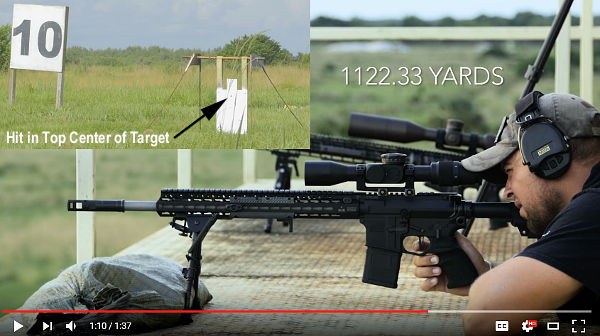
Many of our readers have never had a chance to shoot much past 600 yards. How far away does a 1000-yard+ target really seem to the naked eye? Well this short video answers that question. Gorilla Ammo, the video’s producers, used a camera-carrying aerial drone to fly downrange from the firing line all the way out to 1122 yards (and back again). Watch the drone footage at 0:00-0:07 and especially 0:48-1:03. The “bird’s-eye view” really gives you a sense of the distance. The “fly-back” at 0:48-1:03 time-mark is what makes this video worth watching.
The video features prone shooting at steel targets placed at 750 and 1122 yards. We do apologize for the lame, “oh so serious” voice-over which attempts to make this rather ordinary range session seem like some kind of life-changing experience. (Frankly, you may just want to turn the sound off — it’s that annoying.) It’s really not that big a deal to hit steel at 750 yards with a quality AR-15, chambered in .223 Rem, shooting Sierra 77 grain MatchKings.
Hitting Steel at 1122 Yards with 2540 FPS Ammo Can Be Challenging
The 1122-yard hits are a bit more impressive. Gorilla Ammo lists a relatively sedate 2540 fps Muzzle Velocity for its .223 Rem 77gr SMK ammunition. According to JBM Ballistics, at 1125 yards, that 2540 fps load has 68.3 MOA of drop from a 100-yard zero (firing at sea level and 80° F ambient). Morever the bullet goes trans-sonic around 750 yards (losing stability) and is traveling just 933 fps at impact. And the wind’s the killer — at 1125 yards, with this bullet/load, a mere 2 mph, full-value wind change can move the Point of Impact over three feet!
“[Elite] shooters have this specific thing that happens in their brain when they are shooting well. Maybe you’d call it a ‘quiet time’. One interpretation is that it is a lack of self-instruction or analysis. Once you are an expert you really shouldn’t be [thinking] ‘don’t do this, don’t do that’.”
In this video from USA Shooting, a scientist uses brain wave (EEG) and muscle activity monitors to study the biomechanics and cognitive functions involved in competitive shooting. The study explores how elite shooters control their muscles and mind before executing a perfect shot.
In the video, USOC Sports Psychologist Lindsay Thornton works with pistol shooter Teresa Chambers to evaluate (and optimize) Teresa muscle and brain wave activity during shooting. One purpose of the study is to see how a shooter’s muscles function before, during and after a firing sequence. The goal is to use the muscles in the most efficient manner. This reduces fatigue and improves shot-to-shot consistency. Thorton says: “We are trying to define [muscle activity] efficiency with numbers so we can replicate that.”
Thorton is also exploring how a top shooter’s brain functions when he or she is “dialed in” and shooting most accurately. Thornton explains: “We are looking at EEG activity, which is brain wave activity. Research studies show that shooters have this specific thing that happens in their brain when they are shooting well. Maybe you’d call it a ‘quiet time’. One interpretation is that it is a lack of self-instruction or analysis. Once you are an expert you really shouldn’t be [thinking] ‘don’t do this, don’t do that’ — everything should be pretty automatic.” Interestingly, the test showed a specific pattern of Alpha band brain waves right before a trained shooter breaks the shot.


 Wolfe Publishing offers a companion DVD, Casting Premium Bullets for Handguns, that covers more advanced techniques for high-volume pistol bullet production. This DVD covers both single-cavity molds and multiple-cavity “gang” molds. (Gang molds can be frustrating at first; it is harder to maintain perfect temp control and mold separation is more complex). The DVD also reveals the sources of most common casting flaws, and explains how to detect cracks, voids and other problems.
 Ruger’s new Compact American Pistol is offered either with 10+1 capacity*, or 17+1 capacity. The 17+1 version employs magazines from the full-size Ruger American pistol, with a sleeve or “boot” to fit the shorter grip. With either type of magazine, the gun has proven 100% reliable, according to writer Rich Grassi, who tested the new pistol for


 If you need a break from your hum-drum day at the office, how about taking a virtual vacation to Norway, where you can explore the scenic mountains in the Fjord region?
 This animated video from German ammo-maker


 On our main