Varminting for Fun — With Rimfires and Centerfires
One of the most fun things you can do with a rifle is to shoot varmints such as ground squirrels, prairie dogs, rockchucks, and groundhogs. There’s great satisfaction making a perfect hit on a critter that sends the beastie spinning in the air. Varminting also affords a great excuse to acquire more rifles, because it really does make sense to own and use multiple varmint rifles in various calibers.
Having multiple rifles on a varmint safari lets you preserve barrel life, and shoot lesser-recoiling calibers at the shorter distances. For example, with California ground squirrels, we like a .17 HMR inside 125 yards, then switch to a 20 Practical (20-223 Rem). For prairie dogs, you may want that 20 Practical, plus a nice .22 BR for 250-400 yards, and a .243 Ackley (or 6XC or 6mm CM) for long shots.
Seven Varmint Rifles — Rimfire and Centerfire
With 980,000 subscribers, the Backfire YouTube Channel is highly popular. The capable hosts provide honest, candid reviews. This video covers seven different varmint rigs. First off is the Air Arms TX 200 (00:25). Then the excellent .22 LR CZ 457 is featured (01:33), followed by a .223 Rem AR15-platform rifle (02:30). Next up is the .22 LR Christensen Arms Ranger 22 (03:40), which proved to be “crazy accurate”. Then the video showcases a Bergara Premier in 22-250 (04:20), an “excellent coyote gun that you could use on varmints as well”. Last up is the Ruger American Predator (05:20) in .17 HMR.
6XC Rifle Featured in Gunwerks Rockchuck Adventures
This Gunwerks video showcases varmint hunting in the Western USA. In this video Aaron Davidson and the Gunwerks crew try out some new rifles on some rockchucks. Most of the the rifles were suppressed but the host said the rockchucks took cover after the first shot, so this required good coordination among shooters and spotters. A 6XC varminter is featured at 2:44 and there’s some nice drone footage starting at 2:00.
6mmBR for Longer Range Varmint Adventures
The video creator reports “I spent a great deal of time deciding what 6mm cartridge I would pick for my next varmint build. I was sure of certain things. First, it had to fit an action that I owned. Most importantly, it had to be highly accurate, with light recoil. Quality, highly frangible bullets had to be available in the 50 to 70 grain weight range (for smaller to larger varmint hunting). For flat shooting ballistics, I wanted velocity above 3300 fps. I decided that the 6mmBR, with a slow twist barrel, was what I was looking for.” Components for this rifles are: Borden Alpine Action, Krieger Barrel, Grayboe Ridgeback Stock, Bix’N Andy Trigger, Thunderbeast Ultra Suppressor.
.22-250 Nails Ground Squirrels and Rock Hyraxes in South Africa
Here’s an interesting video from South Africa. The video maker starts with shots on ground squirrels. His .22-250 blasts them into little pieces. They he switches to more distant targets, a furry ground-hog size animal called the Rock Hyrax, Cape Hyrax, or Dassie. Mature Rock Hyraxes weigh 4-5 kilograms and have short ears and tail. These Rock Hyraxes are found at higher elevations in habitats with rock crevices, allowing them to escape from predators (but not skilled varmint hunters).
20 Practical — Great Choice for AR-Platform Rifle
If you want to use an AR-platform rifle in the varmint fields, consider getting a 20-caliber barrel chambered for the efficient, low-recoil 20 Practical cartridge. The 20 Practical is simply a .223 Remington necked down to 20 caliber. The parent .223 Rem cartridge of course works great in an AR, but the 20 Practical offers some notable advantages for high-volume varmint shooters. The 20 Practical cartridge is simply the .223 Rem necked down to 20 caliber — you can use standard .223 brass and load with standard.223 Rem dies. Just swap in a smaller expander and use smaller neck bushings.
The 20 Practical delivers very high velocity with very low recoil while still providing outstanding accuracy. The 20 Practical is great option for folks who favor “fast and light” — smaller, lower-mass bullets traveling at very high velocities. This little cartridge can launch 40-grainers at over 3900 fps.
.17 WSM — The Most Powerful .17 Cal Rimfire
We think that every varmint hunter should own a nice .17 Cal rimfire rig. Out to 200 yards or so the .17 WSM or .17 HMR is very effective on small varmints. It’s nice to be able to shoot affordable ammo out of the box and not have to scrounge for hart-to-find powder and primers. This video features a superb .17 Cal varmint rig, the Primal Rights TS Custom chambered for the impressive .17 WSM cartridge.
Prairie Dog Hunting with .17 HMR Savage A17 Rifle
On varmint excursions, we like to have a .17 rimfire for the closer shots, inside 150 yards. This video shows a successful Prairie Dog hunt with a .17 HMR. Watch and you’ll see hits out to 160 yards (00:50), proving the effective range of the .17 HMR cartridge. The host is shooting a Savage A17 semi-auto 17 HMR rifle in a Boyds laminated stock.
Varminters now enjoy three .17-caliber rimfire options. The .17 Mach 2, .17 HMR, and .17 WSM are all good choices, with the 17 Mach 2 (17 HM2) being the cheapest and the .17 WSM the most powerful. With a 3000 fps MV, the .17 WSM has some really impressive ballistics, — with a much flatter trajectory than both the .17 HMR and .22 WMR:
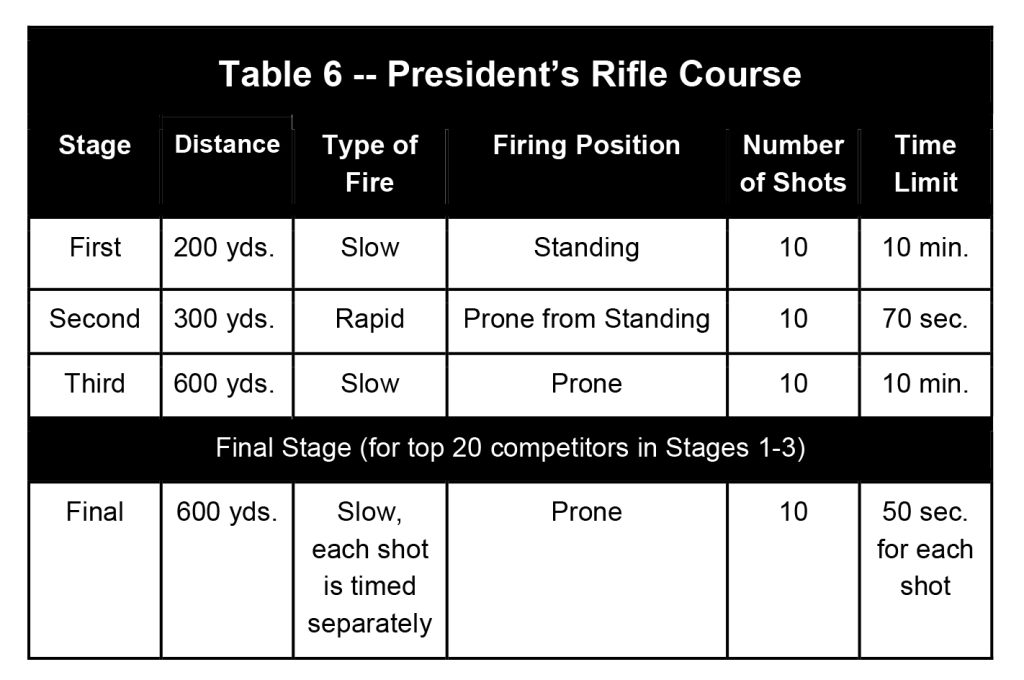
Today Shooting USA TV features the annual President’s Rifle Match at Camp Perry, Ohio. Also known as the “President’s 100″, this major Service Rifle match attracts nearly one thousand competitors to the historic ranges of Camp Perry each summer. This is a challenging, multi-stage modern service rifle competition that is a tough test of marksmanship skills. In the President’s 100 match, competitors shoot at 200, 300, and 600 yards from standing and prone. NOTE: This week’s TV episode also features the M1 Garand rifle in a History’s Guns segment.
Shooting USA SHOW TIMES: This Shooting USA Episode airs Wednesday, August 6, 2025 at 9:00 PM Eastern and Pacific; 8:00 PM Central. If you miss the regular broadcast, you can stream the show online at any time on Vimeo for $0.99 per episode.
This video is from a previous Shooting USA episode about the President’s 100 Match.
Looking downrange at the 600-yard targets. Camp Perry photos courtesy Dennis Santiago.
The historic National President’s 100 Match is a huge event. In recent years, there have been over 1000 ranked competitors from throughout the nation, making this one of the biggest rifle events of the year. The top 100 competitors overall in the President’s Rifle Match are designated as the President’s 100. They receive President’s 100 medallions and certificates.
The President’s 100 Rifle Match is richly steeped in history. This unique match was first held in 1878. Here’s the view from the line at 600 yards:
President’s 100 Course of Fire
There is a three-yardage, four-stage Course of Fire for the President’s Rifle Match Course of Fire. Firing is done on the SR target at 200 and 300 yards and the MR target at 600 yards. Scores in stages 1-3 determine the President’s 100 and the final rankings of competitors in 21st place and below. Scores in stages 1-4 determine the match winner and the final rankings in places 1-20. If there is a tie for first place (equal total and X-count), the tied shooters will continue to fire one-shot-at-a-time until the tie is broken. No sighters are permitted in National Trophy Rifle Matches.
Origins of the President’s Match The National Rifle Association’s President’s Match was instituted in 1878, as the American Military Rifle Championship Match. In 1884, the name was changed to the President’s Match for the Military Rifle Championship of the United States. It was fired at Creedmoor, New York until 1891. In 1895, it was reintroduced at Sea Girt, New Jersey. Today, the match is held at Camp Perry, Ohio.
The President’s Match was patterned after the Queen’s Match for British Volunteers. That British competition was started in 1860 by Queen Victoria and the NRA of Great Britain to increase the ability of Britain’s marksmen following the Crimean War.
The tradition of making a letter from the President of the United States the first prize began in 1904 when President Theodore Roosevelt personally wrote a letter of congratulations to the winner, Private Howard Gensch of the New Jersey National Guard.
After a hiatus in the 1930s and 1940s, The President’s Match was reinstated in 1957 at the National Matches as “The President’s Hundred.” The 100 top-scoring competitors in the President’s Match were singled out for special recognition.
At the 2018 National Matches, SFC Brandon Green (then with the USAMU) shot a 400-20X score to win the President’s 100 match. That set a new national record for the prestigious President’s 100 Match. No other competitor had ever achieved a perfect 400 score — not dropping a point in 40 shots — in the President’s 100 match since the event began (in its current form) in 1894.
E-Targets at 2025 National Matches — Rimfire and Centerfire
After years of testing, the Civilian Marksmanship Program (CMP) will make full use of eTargets at the 2025 National Rifle Matches at Camp Perry, which run July 20 through August 9, 2025. The advanced Kongsberg eTargets will be used at all Highpower rifle matches, National Trophy Rifle competitions, and Rifle Games events. In addition the eTargets will be used for the Rimfire Sporter Match on July 20 and the National Mid/Long Range Matches in August. The use of eTargets eliminates the need for pit duty, drastically cutting down the duration of each match. CLICK HERE to learn more about Camp Perry eTargets.
These matches are conducted by the CMP and Ohio National Guard. Since their inception, the National Matches have become a huge, national shooting sports event with over 4,500 annual participants.
RCBS Launches Locked & Loaded Sweepstakes This month RCBS is running big new contest — the Locked & Loaded Sweepstakes. The winner will receive over $10K worth of prizes from leading manufacturers. Major prizes include a Springfield Armory Model 2020 Heatseeker chassis rifle, Remington Gun Safe, and Banish 30-V2 Suppressor.
Running August 1–31, 2025, the sweepstakes brings together an impressive lineup of brands. One lucky winner will take home a fully loaded prize package valued at over $10,000, featuring premium equipment from RCBS, Hodgdon, Springfield Armory, Banish Suppressors, Burris Optics, Alpha Munitions, Remington Ammunition, Sierra Bullets, Weaver Mounts, and Remington Safes.
The Sweepstakes is open for entries August 1 through August 31, 2025. No purchase is necessary. Must be 21+ years and a resident of the 48 contiguous U.S. states. (Some restrictions apply.)
One grand prize winner will get a prize package worth over $10,000:
RCBS – Rock Chucker Supreme Master Reloading Kit, MatchMaster Die Set
Springfield Armory – Model 2020 Heatseeker Bolt-Action Rifle
Remington – Express Series Gun Safe with Free Shipping
BANISH Suppressors – BANISH 30-V2 Suppressor + Tax Stamp fees
Burris Optics – XTR PS 3.3-18 Scope and XTR Signature Rings
Weaver Mounts – Deluxe Tool Kit & Scope Mounting Kit
Hodgdon Powder – 8 pounds of Winner’s Choice of Powder
Alpha Munitions – Case of Alpha Cartridge Brass
Remington Ammunition – Case of Rifle Primers
Sierra Bullets – 500 Bullets
“We’re proud to team up with some of the best [industry] brands to deliver a sweepstakes that truly outfits a shooter from top to bottom,” said Joel Hodgdon, RCBS Marketing Director. “This prize pack has it all.”
NO PURCHASE OR PAYMENT IS NECESSARY TO ENTER OR WIN. PURCHASE DOES NOT IMPROVE CHANCES OF WINNING. OPEN TO LEGAL RESIDENTS OF THE 48 CONTIGUOUS UNITED STATES, 21+. VOID in AK, CA, DC, DE, FL, HI, IL, MA, NJ, NY, RI & WHERE RESTRICTED OR PROHIBITED.
2025 NRA National Smallbore Rifle Championship
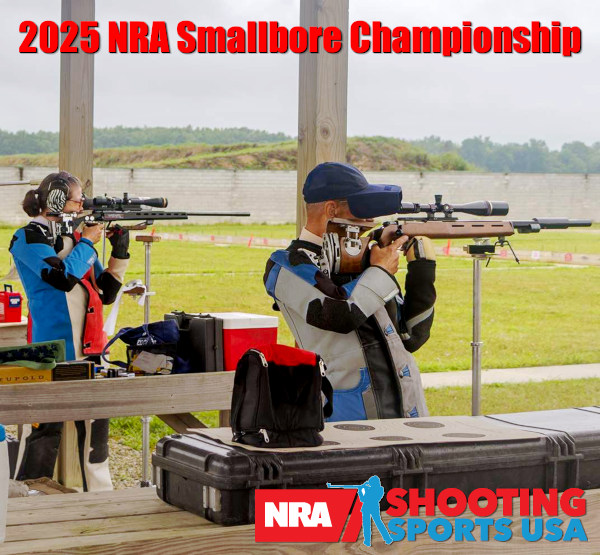
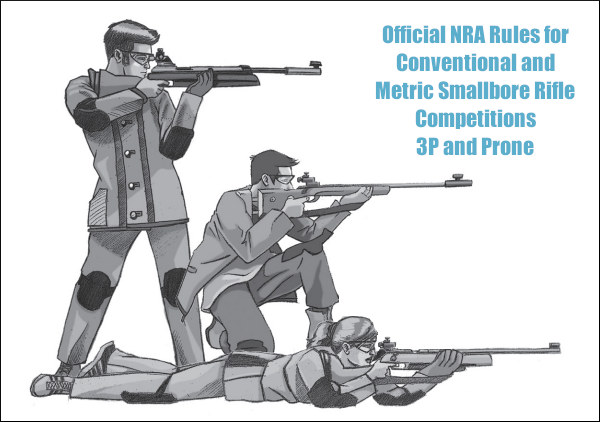
The 2025 NRA National Smallbore Rifle Championship was held at the Cardinal Shooting Center in Marengo, Ohio. This included a three-position event as well as a prone event. The 3P match involved Prone, Kneeling, and Standing positions. Michael O’Connor won the 3P Championship with a score of 2352-126X. Finishing second was Cameron Zwart (2330-116X) and Denise Loring finished third (2325-100X).
Notably, along with winning the 2025 Three-Position title, O’Conner secured the 2025 NRA Lones Wigger Iron Man Trophy, awarded for the highest combined score across both Smallbore Rifle National championships — Three-Position and Prone.
The NRA Smallbore Championship at the Cardinal Center ran July 20-29, with the Three-Position Championship concluding on July 29. This was the first year the NRA has hosted the Smallbore Nationals — both Conventional Prone and Three-Position — at the Cardinal Shooting Center. Participants say the event proved quite successful. CLICK HERE for Shooting Sports USA Match Report.
Rio 2016 World Cup Photo Courtesy ISSF and Team USA
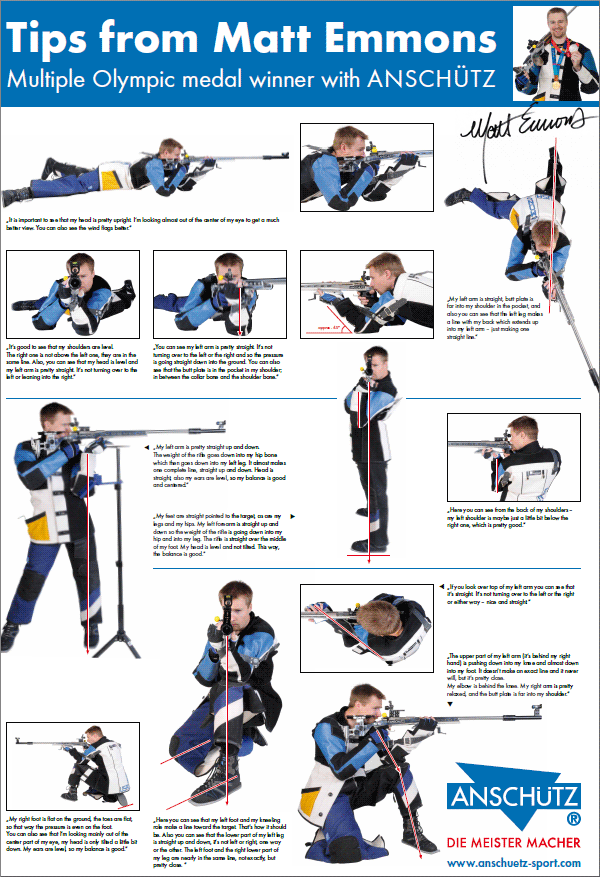
Would you like to try smallbore position shooting? Here are some tips from one of the best 3P shooters on the planet, Olympian Matt Emmons.
Matt Emmons competed in the Three-Position Event at the Rio Olympics, his fourth Olympic appearance. Matt has competed on the U.S. National Team since 1997, medaling in three Olympic games: Gold in 2004 in Men’s 50m Prone; Silver in 2008 in Men’s 50m Prone; and Bronze in 2012 in Men’s 50m 3X40. Although his specialty is Men’s 3-Position rifle, Emmons’ World Championship and Olympic Gold are in Men’s 50m Prone. He usually shoots an Anschütz or Bleiker .22LR rifle, with Eley Tenex ammo.
In this video, Matt explains 50m 3-Position Shooting For Smallbore and Air Rifles.
Here are shooting tips from Matt, courtesy Anschütz. Click image below to launch a full-screen PDF file.
CLICK Photo to Load Large PDF File
Here Matt Shows the Kneeling Position. The other two positions are Standing and Prone.
Three Sets of Hardware for Three Positions
You may be surprised to find that Matt often totes three complete sets of rifle parts to important matches — three buttplates, three cheekpieces, and three Centra sights with adjustable irises. Matt told Shooting Sports USA that he travels with “three sets for three positions. Our final is so fast that I need three sets of everything to allow a fast change-over between positions.” Matt carries his gear in an an Anschütz sport bag: “It’s similar to the big Ogio duffels with wheels, but lighter. I’ve worked with AHG/Anschütz for many years and I like their bag because all of my junk fits in it.”
A good case trimmer is an essential tool for precision hand-loading. To ensure consistent loads, you want your cases to be the exact same length. Today’s Saturday Showcase features five trimming tools, both powered and manually operated, that can trim your sized brass with great precision. In addition, some of these tools will also chamfer case necks inside and out. The powered case trimmers will save you considerable time (and effort) when working will large batches of brass.
Lead photo shows the Henderson Gen 2 trimmer from Panhandle Precision video review.
Henderson Gen 3 Power Trimmer — Ultimate Reloader Review
Gavin Gear of UltimateReloader.com has tested the impressive Henderson Gen 3 (V3) Trimmer. You’ll find a full write-up on Gavin’s website, and you can watch Gavin’s 18.7-minute video review above.
Gavin states: “The Henderson Gen 3 case trimmer is built on an adjustable tri-trim 3-way cutter with different pilots to accommodate different case necks. Three-way cutters trim to length and chamfer the inside and outside all at once. This trimmer has a 1700 RPM spindle and a custom DC motor made in the USA. The Henderson trimmer works much like a milling machine. You do not need much torque because of the way the taper works. The Henderson Gen 3 trimmer delivered outstanding cartridge length consistency after trimming. This trimmer is fast and easy to use and most importantly, returns consistent results.”
CLICK HERE for Henderson Gen 2 Trimmer video review, which shows how to how to set trim length and change cutter heads, using 6.5×47 Lapua, .260 Remington, and .300 Winchester Magnum cases.
Giraud Power Case Trimmer — Full Review by Erik Cortina
In this video, Erik Cortina of CortinaPrecision.com offers some very clever and useful tips that will help you get the most from your Giraud powered case trimmer. The Giraud trimmer is very precise. When set up correctly, it can trim brass with amazing consistency.
In the video, Erik trims 5 pieces of brass in 15 seconds (6:32 mark). He then measures all five with precision calipers (7:00-8:08). All lengths are exact within .0005 (half a thousandth). Erik notes that the Giraud trimmer indexes off the case shoulder. As long as you have fire-formed brass with consistent base-to-shoulder dimensions, you should get very consistent trim lengths.
Lyman Powered Case Trimmer Review
The Lyman Case Trim Xpress is an efficient, precise unit that allows easy adjustment of trim length with a click-adjustable collar. The trimmer comes with a set of cartridge-specific bushings that index off the case shoulder. One nice feature is a variable speed control. For the price, $146.20 on Amazon, this trimmer delivers excellent performance. To see more details, check out F-Class John’s video review of the Lyman Case Trim Xpress which shows set-up and operation.
Frankford Arsenal Universal Case Trimmer (for Power Drills)
This video features a handy tool that attaches to a portable drill. Used with various diameter collets, this can trim most popular sizes of shouldered brass. The universal collet system indexes on case shoulders for precise and consistent trimming (this does NOT work with straight-walled cartridges). The built-in depth micrometer allows for quick and precise micro-adjustments. There is a handy brass shaving ejection port. The system works well, particularly if you can stabilize your power drill in one position. This Frankford Arsenal trimmer, under $65.00 on Amazon, is an affordable alternative to the top-end powered case trimmers. It comes with a handy plastic case that holds the trimmer and collets.
L.E. Wilson Manual Case Trimmer
L.E. Wilson, makers of hand dies, case trimmers and other precision reloading tools, makes a popular and precise stainless steel case trimmer with micrometer adjustment. The above video explains the operation of the Wilson trimmer and shows how to trim cases and use the micrometer case length control positioned opposite the hand crank. We definitely like the micrometer control. This feature allows you to set the cartridge overall trim length with great precision. If you are trimming a variety of different cartridge types, the micrometer cut length control comes in very handy.
If you own a L.E. Wilson case trimmer, you should watch the official Accessories Video from L.E. Wilson. This video shows accessories for the L.E. Wilson trimmer. These include: Power Adapter for trimming (replaces hand crank), Titanium Case Trimmer Cutter (longer life), Inside Case Neck Reamer, Primer Pocket Reamer (removes military crimps), Uniform De-Burring Tool, Neck Chamfer Tool (30° and 45°), and handheld inside/outside deburring tool (and power adapter).
BONUS Video: How Important is Consistent Case Length?
This Primal Rights video explains why it is important to maintain precise case lengths if you want best accuracy and most consistent ES/SD. You’ll want to size your cases BEFORE trimming if your trimmer indexes off the case shoulders.
This Gun Digest book has become a “go-to” resource for NRL22 and PRS Rimfire shooters. Key topics included in this 2021 Edition full-color Gun Digest book include: rimfire semi-autos and how they work; bolt-action accuracy; match shooting skills; DIY precision gunsmithing; hunting with rimfires; and the future of the rimfire market.
With the growth of rimfire tactical competition, the .22-Caliber rimfire rifle is more popular than ever. Every major gun manufacturer has brought at least one new .22 LR rimfire rifle to the market in the last two years. Gun Digest’s Rimfire Revolution has extensive coverage of new models from major manufacturers.
The .22 Long Rifle (.22 LR) is the planet’s most popular ammunition type and firearm chambering. The .22 LR is used in the Olympics by 3P marksmen, but it also serves benchrest competitors, NRL22 shooters, backyard plinkers, small-game hunters, and tactical trainers. With the expansion of NRL22 matches (and the PRS equivalent), the humble .22 LR is undergoing a major resurgence in the USA. And with centerfire reloading components being so costly and difficult to find, many folks are shooting less centerfire, but way more rimfire.
Plus Coverage of .17-Caliber Rimfire Rifles — 17 HM2, 17 HMR, 17 WSM
This 272-page book also covers .17-caliber rimfire cartridges: 17 HM2 (Mach 2), 17 HMR, and 17 WSM. These are all excellent varmint rounds, with the 17 WSM effective out to 250 yards. The 17 HM2 will run in a normal .22 LR action and feed from standard .22 LR magazines. So, for most rifles, all you need to do a .22 LR to 17 HM2 conversion is a barrel switch. That gives your rimfire rig twice the versatility. Shoot .22s and .17s with the same gun.
NRL22 — Challenging Practical Competition with .22 LR Rifles
The USA has seen a big growth in rimfire tactical matches over the last five years. Right now there are probably ten times as many rimfire tactical matches as sanctioned PRS and NRL centerfire matches. The reason is simple — rimfire ammo is much less costly, and clubs can run challenging rimfire tactical matches at nearly any outdoor gun range that allows shooting out to 200+ yards.
NRL22 Competition — Tactical Rimfire Matches
The NRL22 match format is a great shooting discipline. NRL22 offers a high fun factor at relatively low cost. You don’t have to reload match ammo. A couple of 50-round boxes of .22 LR ammo will get you through the match. While some people bring lots of gear to matches, that’s by choice and not by necessity. You can keep it simple and still be competitive (and win).
Tips for NRL22 Competitors by Jonathan Ocab
I am a match director at my gun club and run our local NRL22 matches. People often ask me for tips for competing in NRL22. First, I recommend getting the course of fire for the month in advance and practicing those stages at the range. Here are other specific tips that should help NRL22 competitors improve their gun-handling and match results.
1. Dry Fire Practice — If you are not able to do live fire practice at the range, I encourage shooters to practice their shooting positions at home via dry fire. Setup props or barricades with pasters or other faux targets on a wall in the garage or inside the house and run through each stage.
2. Scope Magnification Level — The most common issue I see with newer shooters in NRL22 is the tendency to maximize their scope magnification. The timer will start, and the shooter gets into position on a target, but the scope is set to 15x or higher and the shooter can’t find the target. The shooter lowers the magnification, locates the target, and then increases the magnification again, takes the shot, transitions to another target, and repeats the process of decreasing magnification, locating target, etc. Novice NRL22 shooters should try using the mid-range magnification. Try shooting 7x-12x and learn to balance field of view and target image.
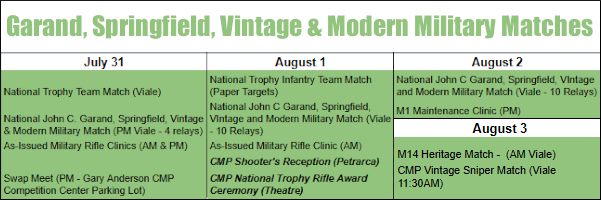
For the next four days — July 31 through August 3, 2025 — the .30-06 M1 Garands and classic military rifles will fill the firing lines at Camp Perry. The National John C. Garand, Springfield, Vintage and Modern Military Match (GSMM) concludes Saturday, August 2, 2025, followed by an M14 Heritage Match and Vintage Sniper Match on Sunday, August 3rd. SEE CMP National Matches 2025 Calendar.
Some participants will shoot just one rifle type, but there is also a combined GSMM 4-Gun Aggregate. This GSSM Agg encompasses a series of position shooting matches on NRA SR targets at the CMP Nationals. Match scores will be posted on the CMP National Matches Results Page.
This video shows the Garand Match at Camp Perry. The rifles are still the same a decade later…
The annual GSMM event is one of the most popular events at Camp Perry, drawing participants from around the nation. One of America’s top GSSM shooters is Brian Williams, who was profiled in our Daily Bulletin. The 4-gun Aggregate includes M1 Garand, 1903 Springfield/1917 Enfield (or similar bolt rifle), M1 Carbine, and AR-type rifle for “Modern Military”.
GSMM matches attract new shooters as well as older competitors. You don’t need to make a huge investment in rifles or optics. We have friends who have done well with a “box stock” 1903 A3 Springfield they acquired from the CMP decades ago. On the firing line are a mix of seasoned competitors and novice shooters. They all come together to share common interests in marksmanship and historic firearms.
During CMP GSMM matches, CMP staff members are always on hand to ensure safety on the firing line and answer questions. This match is fun and efficient. The electronic targets, with monitors at each station, show shot location/score instantly. And there is no pit duty. Competitors never have to venture downrange to change or retrieve targets.
E-Targets at 2025 CMP National Matches
After years of testing, the Civilian Marksmanship Program (CMP) will make full use of eTargets at the 2025 National Rifle Matches at Camp Perry, which run July 20 through August 9, 2025. The advanced Kongsberg eTargets will be used at all Highpower rifle matches, National Trophy Rifle competitions, and Rifle Games events. In addition the eTargets will be used for the Rimfire Sporter Match on July 20 and the National Mid/Long Range Matches in August. The use of eTargets eliminates the need for pit duty, drastically cutting down the duration of each match. CLICK HERE to learn more about Camp Perry eTargets.
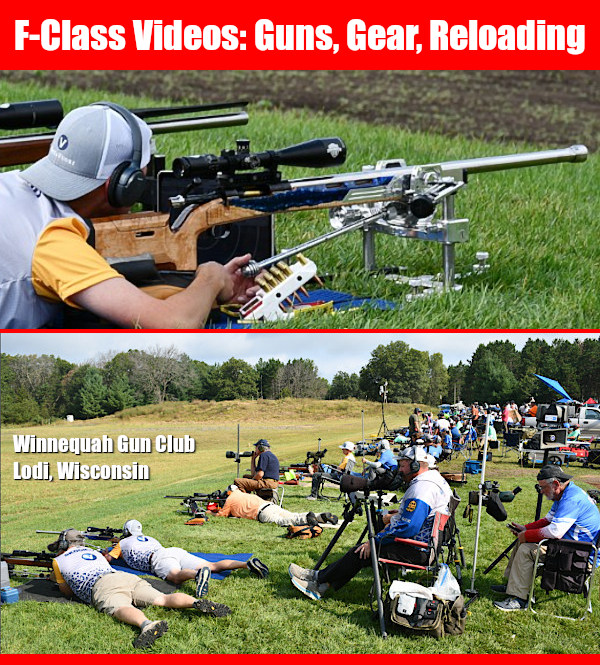
Today’s Saturday movie showcase features eight videos about F-Class marksmanship, gear selection, and reloading methods. The 2025 NRA F-Class National Championships take place next week at the Winnequah Gun Club range in Lodi, Wisconsin. The F-Class Nationals start on August 2nd and run through August 9th. There are two divisions: F-Open and F-TR. The F-Class Championships have two segments, Mid-Range and Long Range. The Mid-Range competition runs August 2-5, while the Long Range competition is scheduled for August 6-9. Competitors can register for the 2025 F-Class Nationals through the NRA Shooters Portal. Learn more about the range at Winnequahgunclub.org.
WICKED WINDS — At Ben Avery with 18-30 mph Winds
Long-range F-Class shooters will tell you that the winds can be the biggest challenge in a match. And things can get pretty wild at times as the Ben Avery range in Phoenix, site of the 2022 NRA F-Class National Championships. In this video, shooters fight through extremely strong 18-30 mph winds at 600 yards. In these kind of extreme conditions, a major unexpected gust can send your bullet off-target.
Wind-Reading for Long-Range Competition
In this excellent video Keith Glasscock, who has finished second overall at multiple F-Class Nationals, explains how to read the wind and even predict wind changes in cycling conditions. Keith notes that you should look at environmental features and mirage, not just wind flags. Keith is one of America’s best wind gurus — he was a team wind coach and he has finished second three times in F-Open division at the F-Class National Championships.
F-0pen rifle at the Berger SW Nationals at the Ben Avery Shooting Facility in Phoenix, AZ.
Load Development Procedures for F-Class — Seating Depth
In this video, 2023 NRA Mid-Range National Champion John Masek (aka “F-Class John”) explains how he does load development in an efficient and reliable manner. He specifically focuses on testing for optimal seating depth. With 318,000 views, this is the most-watched video on F-Class John’s popular YouTube channel. Viewers have praised this video: “This was a great video, really appreciate the explanation about how you bracketed the jump and why you chose the closest.”
Front Rest Options for F-Open (and Benchrest) Competition
If you are shopping for a front rest, definitely watch this comprehensive 42-minute video from start to finish. This is probably the most informative video about premium shooting rests available on YouTube. Top F-Class shooter and video-maker F-Class John covers a wide selection of front rests, with some observations about coaxial bipods as well. John covers the impressive new SEB NEO-X, the easy-to-transport SEB Mini-X, the excellent Rodzilla Rest, the innovative 21st Century Hybrid Rest, the sleek Italian Lenzi Rest. At the end of the video John reviews the very affordable Caldwell Fire Control Rest ($269.99 on Amazon), explaining how it can be a decent choice for shooters on a limited budget.
Reloading for F-Class — Interview with Erik Cortina
In this Precision Rifle Network video, Erik Cortina of Team Lapua-Brux-Borden covers the reloading process for his F-Class rifle. All phases of reloading are noted — brass prep, annealing, primer seating, precision powder measuring (to the kernel), and bullet seating. Erik also talk about load testing and use of barrel tuners. Erik produces the EC Barrel Tuner which is used by many top competitors.
Trigger Trio — Evaluation of Three Trigger Types for F-Class Rifles
In this video, F-Class John evaluates three triggers that are popular with F-Class competitors: Bix’N Andy, Flavio, and TriggerTech Diamond. John talks about the pros and cons of each trigger type and offers advice for mounting and pull-weight adjustment. The Italian Flavio triggers are sold by Bruno Shooters Supply, Bix’N Andy triggers can be purchased from Bullet Central, and the TriggerTechs are offers by MidwayUSA and Area 419.
F-Class Shooting at Bisley Range in the United Kingdom
F-Class competition is popular around the world, and the UK is a major center of F-Class shooting in Europe. The Bisley range is justly famous, with a long heritage of shooting competitions. This video features the European F-Class Championship held at Bisley in 2015.
Building a Modern F-Open Stock for Competition
In this video, our friend F-Class John explains the process for building two custom laminated stocks for his F-Open rifles. John selected handsome, highly-figured African hardwoods, which were then laminated into layers with purple-tinted heart-wood and dark Wenge wood stringers in the middle. The stock-maker then sliced the wood into layers (1:02) and then glued the layers together (1:40). After final cutting, the stocks are shown at 2:00, and then the video shows how the stocks received their final finish. Both stocks are fitted with the R.A.D. recoil-reduction system. See the bedding at 19:00 and the fully finished rifles at 19:12 with barreled actions fitted.
Here is another beautiful F-Open stock, on the firing line at Ben Avery, Arizona with a SEB Mini front rest. Note the metal side-bars on the front of the forearm. These metal fittings extend the stock’s “wheelbase” while also lowering the rifle’s center of gravity.
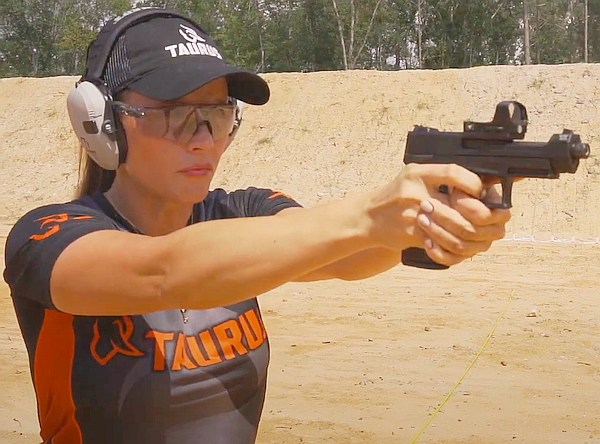
In addition to the basic, budget-priced TX 22 pistol, Taurus offers an impressive Comp model set up for optics. The Taurus TX 22 Competition model is built on the same full-size polymer receiver as the basic Taurus TX 22 but has a newly engineered slide and barrel assembly designed to work with red dot optics.
The Taurus TX 22 Competition features a “skeletonized” slide with a cutout between the ejection port to just behind the front sight. The mounting system allows the use of the following (but not limited to) sight models: Trijicon RMR, C-More STS 2, Vortex Venom, Doctor Noblex, Burris Fast Fire, Sightmark Mini, Holosun HS507C, Leupold Delta Point Pro.
Talented Jessie Harrison Demonstrates TX22 Competition
In this video, Jessie Harrison, the world’s best female action pistol competitor, shoots the TX 22 on steel, starting at 0:14 time-mark. She shows how the pistol’s low recoil allows amazingly quick follow-up shots.
There is an additional model, the Taurus TX 22 SCR (Steel Competition Ready) which offers a forward compensator. This TX 22 SCR was designed for steel plate competition and action pistol games. We like the balance and ergonomics of this pistol, and the integrated forward compensator does reduce muzzle flip, allowing faster follow-up shots and better split times.
The 2025 NRA F-Class Nationals take place at the Winnequah Gun Club in Lodi, Wisconsin, August 2-9, 2025. So we know many of our readers will be flying with their rifles in the days ahead. Here is a helpful article from Team Savage Shooter Stan Pate. This covers how to ship your rifle safely, and then re-establish zero properly when the gun is reassembled after transport. This is one of a series of Shooting Tips articles in the Savage Blog.
Traveling with Firearms — Important Advice
Traveling with firearms can be stressful. You must comply with multiple regulations and then trust your expensive guns to airline baggage handlers. And after arrival you’ll need to put your rifles back together and confirm the zeros. This article offers helpful travel advice from Team Savage shooter Stan Pate. Pate has traveled the globe competing with match rifles. Here he shares his tips for making trips easier on you and your firearms.
Easier Air Travel With Firearms
TSA isn’t nearly as careful with your rifles as you are. Proper storage before sending your firearm up a conveyer belt and into the belly of a plane is critical. Stan Pate spends lots of time each year traveling the skies and has devised a system for keeping his rifle safe when going to and from.
“Never travel with your firearm completely assembled,” Pate cautions. “A fully assembled firearm is much heavier [as a total unit] than one that has been broken-down and stored [in separate sections]. More weight creates more in-the-case movement, which can result in damage. I learned this the hard way years ago. My rifle was actually broken in half when traveling to an international competition. Record your torque settings, use those settings during reassembly and your return to zero should be no problem.”
“Be sure to check on current TSA rules and regulations before travel to be aware of any changes that may effect how you pack your rifles,” says Pate.
Rifle Reassembly and Resetting Zero
The quicker you can reestablish your zero, the quicker you can relax and stop worrying about if your rounds are going to hit their mark during competition. Pate, over the years, has developed a system for rifle reassembly and getting back to zero as quickly as possible. While his torque settings may not be the same as yours, the process can still be used.
“The barreled-action goes back on the stock, and then I tighten all three receiver screws finger tight,” says Pate. “Next, I tighten the front two receiver screws down to 35-inch pounds. The rear receiver screws on this particular rifle likes 15-inch pounds. [Note: Proper torque settings will vary with your action and stock type. Most actions have TWO screws, not three.] Scope attachment comes next, and I follow manufacturer settings when tightening it down. All that’s left to do now is go zero your rifle.”
This video explains an efficient method to Re-Zero your rifles


 The National Rifle Association’s President’s Match was instituted in 1878, as the American Military Rifle Championship Match. In 1884, the name was changed to the President’s Match for the Military Rifle Championship of the United States. It was fired at Creedmoor, New York until 1891. In 1895, it was reintroduced at Sea Girt, New Jersey. Today, the match is held at Camp Perry, Ohio.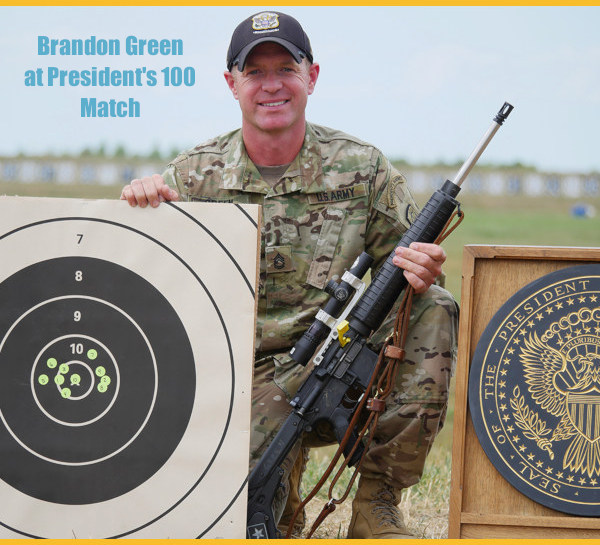






 Would you like to try smallbore position shooting? Here are some tips from one of the best 3P shooters on the planet, Olympian Matt Emmons.