The .224 Valkyrie is the “trendy” cartridge now for AR shooters looking for better long-range performance than the standard .223 Rem (5.56×45) can provide. With the right bullets and load, the .224 Valkyrie offers significantly less drop and drift at long range. The .224 Valkyrie is basically a 6.8 SPC case necked down to .22-caliber. You can use your existing AR15 lower, but you will need a dedicated .224 Valkyrie upper, or at the minimum a new barrel, modified bolt with proper bolt face, and 6.8-compliant mags.
Valkyrie fans say this efficient cartridge offers performance rivaling a 22-250 in a smaller case. The Social Regressive YouTube channel explains: “There are two key reasons why the 224 Valkyrie is unique and desirable. First, it is specifically designed to fit the limitations of the AR-15 platform. It does so even when loaded with gigantic bullets, like the 90-grain SMK that Federal announced. The .22-250 Rem is too long and too fat to work in the AR-15 platform; it needs an AR-10 bolt and magazine.”
Valkyrie Video Fest — Five Informative Videos
Here are five videos featuring the .224 Valkyrie cartridge and rifle options. We think the two applications that make most sense for this new cartridge are: 1) PRS Gas Gun matches (Open Class) — you get 6.5 Creedmoor ballistic performance with much less recoil for faster shot transitions; and 2) Long-Range (400+ yards) varminting — you get performance similar to a 22-250 in a cartridge that works with your existing AR15 lower. That will really help with those long shots on P-dogs.
In this video Gavin Gear test the .224 Valkyrie cartridge in both AR and bolt-action rifles. Using a drone to capture images of shots on target, Gavin produces some impressively small groups at 600 yards. This shows that the .224 Valkyrie has serious accuracy potential when the load is right.
In this 37-minute video on the “IraqVeteran8888″ channel, Chad tests a .224 Valkyrie rifle with various ammo, including 90gr handloads. The test addresses the pros and cons of this new cartridge, explaining the need to have realistic expectations, and a barrel with twist rate suitable for your bullet choices. This is a long video, but worth watching if you are contemplating building or buying a .224 Valkyrie.
This follow-up IraqVet888 video focuses on reloading for the .224 Valkyrie. Chad addresses a multitude of issues including: powder selection, bullet options, brass longevity and primer pocket uniforming. If you own a .224 Valkyrie and hand-load for the rifle, you should watch this video.
Here Gavin Gear tests Starline’s new .224 Valkyrie brass, seeing how well it stands up to repeated firings. Gavin checked for primer pocket stretching and found that 50% of the cases went 8 or more firings before the primer pockets grew too much. However a few cases did need to be retired after four firings. Gavin notes: “Brass longevity is one of the key considerations for loading 224 Valkyrie, so I thought I would put my Starline 224 Valkyrie cases to the test! Be sure to read the full Brass Test article for more insights.
The .224 Valkyrie has been marketed as a low-recoil round that can stay supersonic to 1300 yards and beyond (with 90gr Sierra MatchKings). Here a Sniper’s Hide duo shots an AR-platform .224 Valkyrie at distances out to 1550+ yards. To be honest, the accuracy wasn’t that impressive. However this test confirms that the .224 Valkyrie does launch the long, heavy projectiles at high enough velocities to prove superior to the standard .223 Rem. Frank Galli (aka “Lowlight”) teams up with Brian Whalen of Colorado Precision Rifle at the Blue Steel Ranch in New Mexico.
Here Todd Jarrett nails three steel targets and a pop-up orange clay bird. Watch full video below.
If you are a fan of 3-Gun competition, tune in to Shooting USA this week. The latest episode, which airs Wednesday October 4, features the 2018 USPSA Multi-Gun Nationals in Boulder City, Nevada. You can see many of the nation’s top 3-Gun shooters attacking some very challenging stages with pistols, rifles, and shotguns. CLICK HERE for TV Schedule.
Multi-gun competition has evolved considerably since it started 30 years ago. The firearms are more sophisticated, the optics are better, and the stage times are much faster. Still, the challenge remains the same: How fast can you shoot multiple targets, with the score determined by speed and accuracy? For the best in the sport, the answer is very fast indeed, but Match Director Pete Rinsing has a few tricks up his sleeve to challenge competitors on never-before-seen courses of fire at the USPSA Multi-Gun Nationals held in April 2017.
Todd Jarrett highlights from 2017 USPSA Multi-Gun Nationals. Check out 300-yard prone rifle at 00:30, and blazing rifle-pistol-shotgun transitions at 00:50:
Most people compete in the Tactical Division, including 8-time Champion, Daniel Horner. Horner rose to the rank of Sergeant First Class with the USAMU. Now a civilian, Horner currently shoots with Team SIG. Competitors in the Tactical division are not allowed a bipod, so many competitors utilize structures on the stage to stabilize their long gun. Regardless of division, the USPSA Multi-Gun Nationals is a true test of manipulating three different weapons, under pressure, on run-and-gun courses of fire. And the pressure is definitely on when a National Championship is on the line.
The relatively new Ruger Precision Rimfire has generated considerable interest because it is an affordable, chassis-style platform well-suited for tactical/practical cross training. It also offers some cool features including a +30 MOA scope rail and adjustable bolt throw length (from 1.5″ to ~3.0″). The adjustable bolt lets you switch to a longer, centerfire-style bolt “run” for consistent cross-training. That’s clever.
Introduced at the beginning of 2018, the Ruger Precision Rimfire has now been in the hands of multiple reviewers who have tested the little rifle for accuracy, reliability, and functionality. This smallbore chassis rifle has been tested with a variety of ammo and in both bench and “tactical” style sessions. Here are three videos that put the Ruger Precision Rifle though its paces.
VIDEO ONE — Impressive Accuracy Suppressed from Bipod at 130m
In this video, a UK-based shooter tests the Ruger Precision Rimfire with a suppressor. He came away mighty impressed with the rig’s accuracy, stating: “It is a flippin’ laser. Oh my god I’m impressed with that — five minutes in and it’s grouping literally like that [makes small “OK” sign with thumb and index] on the steel at 130m”. (Time-mark 2:40+)
VIDEO TWO — 22 Plinkster Explains Gun Features
In this video, popular YouTube gun tester 22 Plinkster explains the Ruger Precision Rimfire’s features in detail. Then he puts an early production example through its paces. He gets good accuracy from a bench, but also tries some off-hand shooting, demonstrating the rifle’s suitability for tactical cross-training.
With Federal Gold Medal Ultra-Match, 22 Plinkster produced a 5-shot group well under half-inch (with first three overlapped and the last two in same hole) at 50 yards. Note 22 Plinkster’s bench set-up. He uses a second rabbit-eared sandbag in the FRONT. This “field expedient” solution is clever. The front bag’s ears mate well with the rifle’s tubular fore-arm, adding considerable stability. And the front sand-bag helpd absorb vibration, always a good thing. For a varminter who doesn’t want to carry a bulky front rest, this is worth trying. The bag in front functions like a compact version of the large, heavy Bulls Bag.
VIDEO Three — Five Ammo Types and Front Rest
Here is detailed review from Down-Under that was positive. From bench, with Caldwell front rest, five different ammo types were tested: SK Rifle Match, SK Standard Plus, Eley Match, Eley Edge, and CCI High Velocity. The tester reports: “I was able to get 0.9″ 10-shot groups at 50 yards and 1.5″ 10-shot groups at 100 yards using Eley Edge. Overall the rifle is good but I don’t honestly think I achieved any greater accuracy over my standard Ruger American Rimfire Rifle.” We think that’s a fair assessment. This is an accurate rifle, but other affordable bolt actions can probably rival the accuracy, so the buying decision should be based on the rifle’s other features — such as the chassis.
For Ruger Precision Rifle owners, this .22 LR offers ergonomics just like their centerfire rig. This PRS-style .22 LR rig has some very interesting features, including adjustable bolt throw that lets shooters change from a rimfire 1.5″ bolt throw to a short-action centerfire 3″ bolt throw, reducing the chance of short-stroking your bolt in competition. The Ruger Marksman trigger adjusts from 2.25 to 5.0 pounds.
RUGER PRECISION RIMFIRE Important Features:
Quick-Fit Stock with adjustable cheekpiece and adjustable LOP
18″ barrel, pre-threaded for brakes and Silent-SR® suppressor
Barrel can be removed and replaced easily with AR-style tools
Picatinny scope rail with +30 MOA built-in elevation
Front 15″ free-float M-Lok handguard
Adjustable Trigger 2.25 to 5 pounds
Accepts all Ruger 10/22 magazines
Progressive reloading presses offer shooters speed and efficiency in producing custom-tailored rifle and pistol ammunition. However, there is a wide choice of Progressive Presses and a bewildering array of options to consider. In this video, the 6.5 Guys and UltimateReloader.com’s Gavin Gear provide an overview of the leading Progressive Presses on the market along with key considerations for precision rifle shooters. If you are considering getting a Progessive for rifle ammo reloading, you should watch this informative, 25-minute video.
10 Tips for Reloading Precision Rifle Ammo on a Progressive Press:
1. Make sure the brass is very clean. Don’t mix old range pick-up brass with newer brass.
2. Apply a thin, spray lube to all cases before the sizing/loading cycle.
3. Consider priming your brass separately (with a hand or bench tool) before the operation. Then inspect the primers before loading powder and bullets.
4. Always wear eye protection when loading with the Progressive, particularly if you are priming cases.
5. With tape, mark the powder measure/dropper with the powder type and charge weight.
6. Cycle a few cases, sizing and adding powder but NOT seating bullets. Weigh the powder charges to ensure the powder measure is dispensing the correct charge. Sometimes this will change a couple tenths as it “settles down” after the first few charges.
7. Check the brass for shoulder bump and bullet seating depth carefully for the first few rounds, then check again periodically.
8. Try to maintain a steady pace and operate the handle the same way every time.
9. Visually inspect the powder charge in each case (before bullet seating), and use a lock-out die if your Progressive Press has enough stations.
10. Never, ever mix pistol and rifle powders! If you have previously loaded pistol ammo with your Progressive, make sure ALL the powder (every flake and kernel) is removed from all components of the powder-dropping system before you add rifle powder.
Loading Pistol Ammo on a Dillon
The .45 ACP is probably our favorite centerfire pistol cartridge. In this video, Gavin Gear shows how to load this popular round on a Dillon 550B Progressive Press:
Visit these sites for more Reloading and Precision Shooting Videos:
The Ruger Precision Rifle goes big — major Magnum-size big. Back in October we revealed that Ruger was releasing new .338 Lapua Magnum and .300 WinMag versions of the Ruger Precision Rifle (RPR). These Magnum RPRs feature longer, stronger actions, and some key upgrades, such as a +30 MOA rail and beefy muzzle brakes on the end of the 26″ 5R Barrels. These are pretty impressive rigs for the money — $2099 MSRP, with the “street price” well under $1700.00.
So how do these Big Rigs shoot? GunsAmerica.com recently answered that question, testing a .338 Lapua Magnum RPR with a variety of factory ammo types. GunsAmerica’s tester Clay Martin, a skilled former military sniper (retired from 3rd Special Forces group), shot the rifle from prone off bipod. With Hornady 285gr Match Ammo, Martin drilled two 3-round groups that both measured right around a half-inch. With some other ammo, results were ugly, but the 285-grainers showed that the gun could shoot. (Five-shot 100-yard groups with Federal 300gr ammo were around 1.3 MOA — see photo below).
Overall Martin came away impressed: “My respect for the RPR in .338 Lapua Magnum is high. If it will shoot ½ MOA at 100, there is no reason to think it won’t at any range a match bullet will fly [provided you call the wind right]. Despite the uber-manly caliber, the gun was fun to shoot. The muzzle brake and weight do a great job of taming recoil[.] For a .338 Lapua-caliber rifle, I can’t think of a single better option below $5,000. If you have been waiting to step into the big boy rounds, this is a golden opportunity.”
Watch Field Test of .338 Lapua Magnum Ruger Precision Rifle:
RPR Magnums Boast 5R Barrels with Big Brakes
The new RPR magnums feature hammer-forged, chrome-moly heavy-contour 5R barrels fitted with tunable muzzle brakes. Those fat, large-port brakes will certainly reduce recoil and muzzle jump but we wouldn’t like to be shooting beside the .338 LM RPR — expect lots of side-blast. The new RPR magnums feature 18″ free-float anodized handguards with M-LOK accessory attachment slots on all four sides. Integral QD sling attachment points eliminate the need for additional adaptors and a flat-bottom 1.50″ dovetail is compatible with RRS S.O.A.R. and similar QD systems.
The .338 Lapua Magnum RPR features a 1:9.375″ twist rate while the .300 Winchester Magnum model features a 1:9″ twist rate, both of which stabilize long-for-caliber projectiles. These rifles ship with two, 5-round AI-style magazines. As with all RPRs, the bolt is a 3-lug design with 70-degree bolt lift.
Angled +30 MOA Rail and Adjustable Stock Standard
ELR shooters will be pleased that the new, magnum-caliber RPRs ship with a +30 MOA Picatinny rail. That will help give shooters enough elevation to shoot out to 1500 yards and beyond. As with other Ruger Precision Rifle models, the magnums feature a folding stock with adjustable comb height and length of pull. The Ruger Marksman trigger is user-adjustable between 2.25 and 5 pounds.
If you will be flying with firearms this holiday season, you should read this article. You need to familiarize yourself with current Federal Regulations on gun transport before you get anywhere near an airport. Thankfully, the Transportation Security Administration (TSA) has a web page that states the important requirements for airline passengers traveling with firearms and/or ammunition.
TSA Tips on Traveling with Firearms:
You’ll want to visit the TSA Firearms and Ammunition webpage, and read it start to finish. In addition, before your trip, you should check the regulations of the airline(s) with which you will fly. Some airlines have special requirements, such as weight restrictions.
Here Are the TSA’s Key Guidelines for Travel with Firearms:
1. All firearms* must be declared to the airline during the ticket counter check-in process.
The term firearm includes:
– Any weapon (including a starter gun) which will, or is designed to, or may readily be converted to expel a projectile by the action of an explosive.
– The frame or receiver of any such weapon.
– Any firearm muffler or firearm silencer.
– Any destructive device.
2. The firearm must be unloaded. As defined by 49 CFR 1540.5 – “A loaded firearm means a firearm that has a live round of ammunition, or any component thereof, in the chamber or cylinder or in a magazine inserted in the firearm.”
3. The firearm must be in a hard-sided container that is locked. A locked container is defined as one that completely secures the firearm from being accessed. Locked cases that can be pulled open with little effort cannot be brought aboard the aircraft.
4. If firearms are not properly declared or packaged, TSA will provide the checked bag to law enforcement for resolution with the airline. If the issue is resolved, law enforcement will release the bag to TSA so screening may be completed.
5. TSA must resolve all alarms in checked baggage. If a locked container containing a firearm alarms, TSA will contact the airline, who will make a reasonable attempt to contact the owner and advise the passenger to go to the screening location. If contact is not made, the container will not be placed on the aircraft.
6. If a locked container alarms during screening and is not marked as containing a declared firearm, TSA will cut the lock in order to resolve the alarm.
7. Travelers should remain in the area designated by the aircraft operator or TSA representative to take the key back after the container is cleared for transportation.
8. Travelers must securely pack any ammunition in fiber (such as cardboard), wood or metal boxes or other packaging specifically designed to carry small amounts of ammunition.
9. Firearm magazines and ammunition clips, whether loaded or empty, must be securely boxed or included within a hard-sided case containing an unloaded firearm.
10. Small arms ammunition, including ammunition not exceeding .75 caliber for a rifle or pistol and shotgun shells of any gauge, may be carried in the same hard-sided case as the firearm, as long as it follows the packing guidelines described above.
11. TSA prohibits black powder or percussion caps used with black-powder.
12. Rifle scopes are not prohibited in carry-on bags and do not need to be in the hard-sided, locked checked bag.
More Airline Travel Tips from Tom McHale
Tom McHale has written an excellent article for the Beretta Blog, Ten Things You Need to Know about Flying with Guns. We suggest you visit the Beretta Blog to read this informative story. Here are two of Tom McHale’s Travel Tips:
Weigh your gun case and ammunition
Most airlines will allow up to 11 pounds of ammunition. And, like any luggage, you will be charged more for any baggage weighing more than 50 pounds. This sounds like a lot, but when traveling to the Crimson Trace Midnight 3 Gun competition last year, my case with shotgun, rifle, pistol and ammunition tipped the scale past the 50 pound mark.
Pack ammo in the same locking case
This is another area that’s misunderstood and full of internet myth. Your ammo just needs to be stored in some type of safe container and not loose. Technically, you can keep ammunition in magazines, but I wouldn’t recommend it. It meets the letter of the law storage requirement, but too many airline and TSA agents will give you grief. Use a plastic ammo box or original cardboard packaging and you’ll be fine carrying that in the same lockable case as your gun.
*Please see, United States Code, Title 18, Part 1, Chapter 44 for information about firearm definitions.
What does it take to win in the tactical game? Ask Oregon’s Jon Pynch. He won the 2018 National Rifle League (NRL) 2018 Championship event along with three out of six of the bolt-action PRS matches in which he competed this year. And with 300 points overall this season, Jon has been a #1-rated shooter within the Precision Rifle Series (PRS). In most sports you’d call that an MVP performance.
PRS Competitor Jon Pynch had a superlative run in 2018, scoring victories in many big matches, capped off by winning top honors at the 2018 NRL Championship. And as you read this, this very day (December 2nd) Jon is shooting at the PRS Season Finale at the Triple C Range in Cresson, Texas. Here is Jon Pynch’s 2018 competition record:
2018 National Rifle League Champion
2018 National Rifle League Finale Winner
2018 Rock Lake NRL Match – Jon Pynch – 1st Place
2018 JC Steel High Mountain PRS Match – Jon Pynch – 1st Place
2018 Meaford PRS Match – Jon Pynch – 1st Place
2018 NCPPRC NRL Match – Jon Pynch – 1st Place
2018 Gunwerks PRS Match – Jon Pynch — 1st Place
NRL Champ Jon Pynch was interviewed for the NRL’s Precision Rifle Channel. Click the Red Arrow above to hear a wide-ranging 45-minute audio interview with Jon, with highlights listed below, so you can skip to key sections.
JON PYNCH PODCAST HIGHLIGHTS:
0:00 to 8:45 — 2018 NRL Championship
9:00 – The mental aspect of shooting
16:30 – Jon’s mindset going into a match
20:30 – What gear Jon ran this season
28:20 – Jon’s hunting background
30:55 – The next up-and-comers in the sport
41:20 – Plans and goals for 2019
43:55 – Three (3) under-rated items Jon can’t shoot without
Pynch won 3 out of 6 PRS bolt-action matches he shot in 2018. Pynch runs a landscaping business in Oregon. When time permits, he travels around the country to tactical matches. He grew up around guns, starting with his trusty BB gun, and the passion grew. About 14 years ago, Pynch started to dabble in long-range shooting from the hunting side. In the past few years, he has focused more on competition, observing how the sport has changed: “Over the past couple of years, I’ve noticed it feels like the level of competition and the level of quality products are growing at an incredible rate.”
CLICK HERE for full size image showing gun details.
The MPA BA Competition Chassis has many notable features: RAT System and multi-function Arca Swiss Rail provide a variety of bipod locations. There is a special rotating barricade stop, plus a spigot mount on the front of the fore-end which can extend the “wheelbase” between front and rear support. A clever Weight Tuning System allows competitors to adjust gun balance and reduce felt recoil.
State of the Art PRS/NRL Tactical Rifle:
Above is Jon’s Match Rifle shown from summer 2018 with older barrel chambered for 6mm Dasher. These shots were taken during a fire-forming session. John says: “On right (below) is unfired Lapua 6mmBR round. Shoot it and it turns in the case on the left. 6mm Dasher. 25 formed… 975 to go! Alamo Precision Rifles did a great job on this chamber/barrel. It’s won a few matches and placed well in a few others, but after 1800 rounds I think I’ll use the rest of its life as a practice/fireforming barrel.”
Making Brass — 6mmBR loaded round is fire-formed into 6mm Dasher 40° improved case:
Jon Pynch’s Favored Hardware — Curtis Vector Action, Kahles Scope, MPA Comp Chassis
Like many PRS/NRL competitors, Jon uses the MPA Competition Chassis, the most-utilized chassis in the 2016 and 2017 PRS series. The match rifle above sports a Curtis Custom Vector Action with Proof Research barrel. For optics Jon has recently used a Kahles scope in the rock-solid, MPA BA Mount, the #1 Mount used in the PRS in 2017.
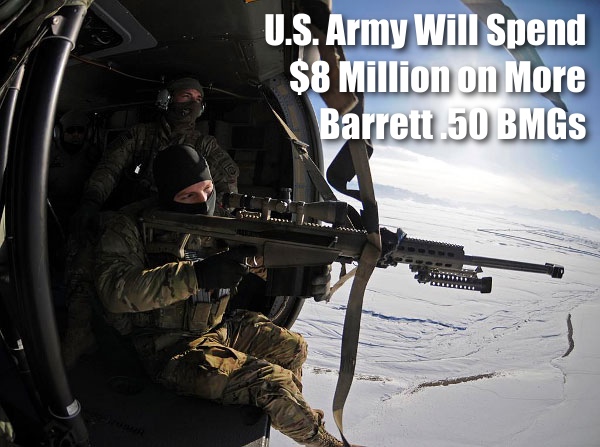
M107 on duty in Afghanistan with Company F, 2nd Aviation Assault Battalion, 82nd Combat Aviation Brigade’s Pathfinders. U.S. Army photo by Spc. Cody Barber, 11th PAD.
Christmas came early for Barrett Firearms Mfg. Inc. — the company was awarded an $8,000,000 U.S. Army contract for .50 BMG rifles, plus a $3.3 million maintenance support contract for M107s in service. Under the $8 million contract, Barrett will deliver new M107A1, M107, and M82A1M, Caliber .50 Cal Long Range Sniper Rifle systems with scopes, suppressors and spare parts kits. The work is expected to be completed by November 26, 2023, the United States Department of Defense reported this week.
The M107A1 was made “leaner and meaner” back in 2014, with a six-pound weight savings. That’s important to soldiers charged with carrying the big rig in the field. The M107A1 model comes with Lightweight aluminum upper receiver with integral 23″ (58.4 cm) 27 MOA M1913 optics rail, 20″ (50.8 cm) or 29″ (73.7 cm) barrel with fully chrome-lined chamber and bore, 10-round steel magazine with cartridge witness indicators, and anti-corrosive coating.
M107A1 with Quick Detach Large (QDL) Suppressor
$3.3 Million Maintenance Contract for M107s in Service
Barret Firearms Manufacturing, Inc. has also won a $3.3 million maintenance contract for the U.S. Army-issued M107, Caliber .50 Long Range Sniper Rifle system. The 5-year ID/IQ contract was awarded November 27, 2018 and will be available through November 26, 2023. The M107 Rifle System has been fielded by the U.S. Armed Forces for over 15 years.
The Official Rifle of Tennessee
Believe it or not, the Barrett Model 82/M107 is Tennessee’s official state rifle. Barrett’s plant and headquarters are situated in Murfreesboro, Tennessee. The Barrett rifle is a true Tennessee success story — a rifle born from sketches drawn at a dining room table by 26-year-old Ronnie Barrett, who was born, raised, and educated in Tennessee. Using sketches of his design, Barrett worked in a one-bay garage with a tool-and-die maker to build the first prototype.
Watch Jerry Miculek Shoot .50 BMG Offhand. Action Starts at 1:20:
The 6.5 Creedmoor cartridge has become extremely popular in the last few years. It is a favored cartridge among PRS and tactical competitors, and has been used successfully by deer hunters and High Power shooters. Notable major manufacturers such as Ruger and Savage are selling popular rifles chambered for this mid-sized cartridge. The availability of affordable factory rifles chambered in 6.5 Creedmoor further fuels its popularity.
To celebrate the 6.5 Creedmoor as 2018’s mid-size popularity contest winner, we’ve sourced five recent videos from YouTube. These videos cover loading for the 6.5 Creedmoor and also test accuracy in both custom and factory rifles. Enjoy this 6.5 Creedmoor Video Fest:
1. Gas Gun Shoot-Out: 6.5 Creedmoor vs. .308 Win
In this TFB TV video, testers put a 6.5 Creedmoor up against a .308 Winchester with AR-10 type rifles. The head-to-head test compares the ballistics, trajectory, recoil, and inherent accuracy of the two popular cartridge types. We can’t call this a definitive test because most 6.5 Creedmoor shooters run bolt-action rifles. The key take-aways are that the 6.5 Creedmoor has significantly less recoil, and a flatter trajectory (at least with typical factory ammo). Still, the video is a good starting point for anyone considering a gas gun in 6.5 Creedmoor.
2. Ruger Precision Rifle with Norma 6.5 Creedmoor Ammo
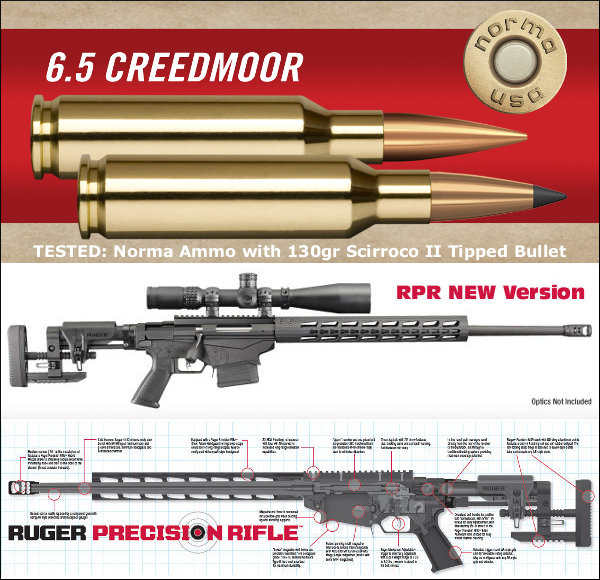
In this video Gavin Gear tests Norma-brand factory ammo in a Ruger Precision Rifle chambered in 6.5 Creedmoor. Gavin reports: “Norma is known for its high-quality brass and ammunition. Recently, I saw that Norma had announced a new addition to their Professional Hunter lineup of ammunition: in 6.5 Creedmoor! I thought I should try some out with the Ruger Precision Rifle. As you saw in the video, this ammunition behaves more like match ammunition.”
3. 6.5 Guys Test Lapua 6.5 Creedmoor Brass in Tactical Rifles
If you have a 6.5 Creedmoor rifle, or are considering getting a gun chambered for this cartridge, we strongly recommend you watch the full 6.5 Guys Video. Ed and Steve spent a lot of time conducting this test, and the video includes helpful summaries of their findings.
4. Reloading for the 6.5 Creedmoor — Gear and Components
If you own a 6.5 Creedmoor rifle, and plan to start hand-loading for the popular cartridge, this video may help you select effective load components. The video examines a wide variety of brass, powder, and bullets options for the cartridge. In addition the reviewer looks at various reloading dies and tools suitable for 6.5 Creedmoor hand-loading.
5. The Springfield Armory M1A — Now Offered in 6.5 Creedmoor
Many folks may not realize that Springfield Armory now makes an M1A chambered in 6.5 Creedmoor. With considerably less recoil, this 6.5 CM version is easier to shoot than the classic 7.62×51 M1A: “Having a 6.5 Creedmoor caliber in the M1A lineup gives long-range shooters more choices with the precision and accuracy they require,” says Springfield Armory CEO Dennis Reese.
Here’s a treat just in time for the holidays — you can see a video view of 1000-yard Benchrest competition tonight on Shooting USA television. The Wednesday, November 21, 2018 episode of Shooting USA features the 2017 IBS 1000-Yard National Championship held at the Whitehorse Shooting Center in Peeltree, West Virginia. This Shooting USA episode takes you to the Whitehorse 1K Range in September 2017. You can see the action on the firing line and the Shooting USA team also interviews many competitors. Watch this episode on the Outdoor Channel at these times: 9:00 PM Eastern and Pacific; 8:00 PM Central.
If you want to learn about the 1000-yard Benchrest game, definitely tune in to Shooting USA on September 26, 2018 (tomorrow) to watch last year’s IBS action. There were nearly 120 shooters competing (118 in Light Gun, 107 in Heavy Gun).
To learn more about on this event, read our detailed 2017 IBS 1K Nationals Match Report. At the 2017 Nationals, conditions were challenging to say the least, with rain storms, spiraling winds, and fog. In fact, rain and fog on Saturday (with cancelled relays) caused the Nationals to be extended by one day through Monday. What’s more, of the 107 shooters listed in the Two-Gun Overall results who actually shot both guns, there were dozens of DQs.
Top Guns at the 2017 IBS 1000-Yard Nationals were Edward Kenzakoski (Two-Gun Overall Champion), Mike Gaizauskas (Light Gun Overall, plus LG Score Agg), and Mike Brennan (Heavy Gun Overall, plus HG Score Agg). Group Agg winners were Richard Schatz for LG, and Charlie Lentz for Heavy. Two ladies also deserve mention. Sally Bauer shot the smallest group of the match, a 1.923″ 5-shot group in LG — that’s 0.184 MOA! Ruth Edwards drilled a 2.104″, also mighty impressive. Here’s Sally below with her very patriotic Heavy Gun…






 To learn more about on this event, read our detailed


